Meet Georgina Burford-Connole, Rejoin EU party candidate for Battersea

Georgina Burford-Connole is the Rejoin EU Party candidate in the Battersea constituency for the 2024 General Election. We and our partners at Clapham Junction insider are inviting all the candidates to short interviews – so you can learn more about who they are, what they believe in, and their plans to improve Battersea and help its residents. Details of all the candidates, and the other interviews, are here.

Could you introduce yourself to our readers? My name is Georgina Burford-Connole, and I am the Rejoin EU Party candidate for Battersea.

Tell us something about you our readers may not know… In my spare time, I run a small business selling Japanese Kawaii merchandise, and I was once killed by a cyberman as an extra on Doctor Who.

What makes the Battersea constituency special for you? Battersea is special and a wonderful place to live and work because of: the Commons, the river, the Park, the power station, Mondo Brewing Tap Room, the Bedford in Balham, Battersea Village Square. The list goes on and on!!

    The events that are put on each year in Battersea Park, Clapham Common, particularly the fireworks. And my daughter would not want the regular visits of Zippos Circus and the various funfairs that set up on the Commons to be overlooked.

    The transport links are fantastic too: both road and rail, with quick access to Gatwick via Clapham Junction and the A3 taking you (mostly!) rapidly to the south coast. The redevelopment going on (Winstanley Estate, the power station, just up from Clapham Junction, Arding and Hobbs) is testament to Battersea’s attractiveness. And it’s always sunnier in SW London!!

    With the busiest station at the heart of Battersea, public transport is used by the vast majority of people in the area. What would you like to see improved for that in Battersea? I don’t know where Crossrail 2 has got to but a link up with the Elizabeth Line would massively enhance Clapham Junction’s utility, providing quick access to Heathrow (in addition to the already good links to Gatwick), as well as rapid cross-London transport. Probably as tricky, if not more so, getting a tube stop into Clapham Junction would be amazing.

    Getting to the station by road is already easy due to the large number of buses that pass by, but traffic and dropping off/picking up with luggage can be tricky at busy times.

    So maybe more use could be made of Grant Road for drop off/pick up parking and the bus stands there moved to the car park behind the PCS building. Not sure if that’s feasible but providing more of a bus hub right next to the station and more space for cars / taxis could improve the efficiency around the station.

    Finally, it would be great to have more, dedicated e-bike parking places closer to the station.

      Housing is also a local concern. Recently we have seen some proposal for massive blocks of flats exceeding local plan rules – which justify their scale on the grounds that they also provide a share of affordable housing. Where is the right balance between providing the social housing we need, and making sure that our urban environment remains one people want to live in? This is tied up in wider issues of planning reform. Battersea is a victim of its own success, being an attractive place to live and work! If we had a more rigorous rules based planning system rather than one which is a little too vague and malleable, we might better be able to capture what local people regard as the key attributes to defend and keep.

      The fact that the constituency doesn’t exactly overlap with the local Boroughs also slightly complicates consulting on these sorts of issues. But more consultation at earlier stages would almost certainly help. By this, I don’t mean a single town hall style meeting where the developer and the Local Planning Authority set out the plans and people are simply allowed to comment.

      Rather I mean a proper conversation that extends over a number of such open meetings with local people, by the end, feeling a genuine ownership of their local area and a partnership with the developer and Local Planning Authority. (Note: I suspect this is about the height of the Glassmills redevelopment on the river – some 30 stories high!!) [editor’s note: suspicion correct; albeit that’s the latest in quite a long list!]

        The cost of living is a real worry for many of our readers. Since Labour took control in 2022, the Council has implemented the London Living Wage for its staff and contractors. What additional measures do you believe are necessary, including in the private sector, and what do you think is the best approach for the government to provide support? This is a huge question!! To answer in two (brief!) parts.

        First, at a local level I would like to see more participation of local people directly. Especially when times are hard. Participatory budgeting has time and again proved its worth in terms of transparency and understanding. Let’s do more of this. Second, reform of local government financing is long long long overdue. And, conscious of my comment above about the mismatch between constituencies and Boroughs, this area might be the one better suited for action by the local MP. A first action could be to reestablish the Audit Commission, closed in 2015, to provide some consistency and advice to local governments on their finances.

        Second, and not to be done without other aspects of tax reform, maybe it’s time to rebase council tax…?? I think the Mirrlees Review had something on this and that was 13 years ago!

          In the 2016 EU referendum there was a 70 % remain vote here, one of the highest in the country. There is still a lot of strong feeling about Brexit – but how relevant is it as an issue in this election? Brexit is the driving engine behind the continued cost of living crisis we face today, and it’s going to get worse as the cutting of trade links with the EU will make getting basic food stuffs much harder as accelerating environmental changes make food harder to produce.

          Brexit also continues to blight our ability to travel & work beyond the UK, has destroyed the retirement plans of hundreds of thousands of Brits, and stolen the educational opportunities from our young people.

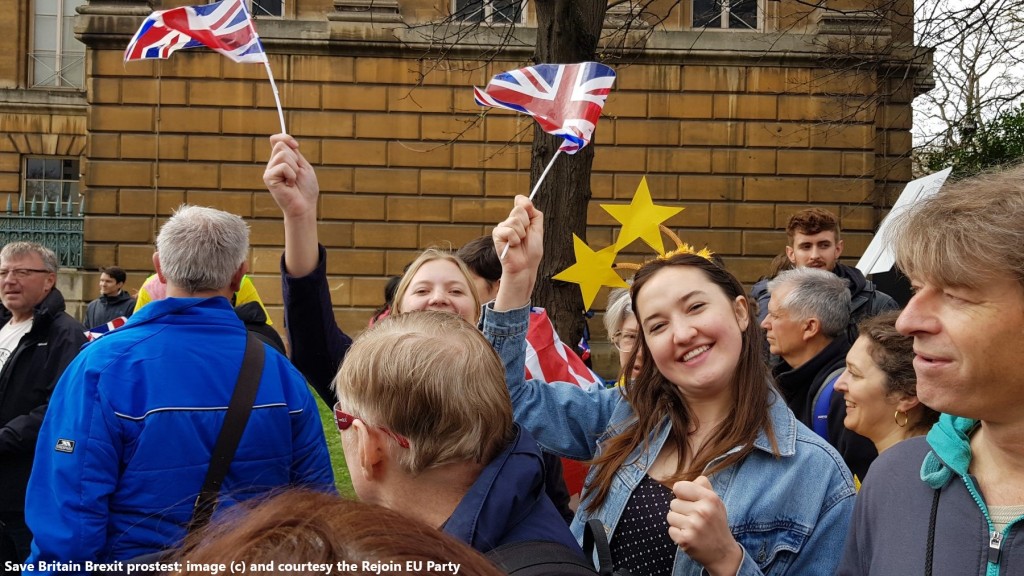
          Battersea could be the first place in the country to send a strong, critical voice to Westminster calling for the reversal of Brexit

            The environment has become a bit of a political football, getting tangled in arguments about onshore wind farms and even wokeness. What are the most important measures the future government should commit to in order to address the climate emergency? Continuing from my last answer, the UK CANNOT fight alone against climate change – we need to join together with the rest of the European Union to provide real global leadership here.

            I don’t think there is still a true awareness of exactly how perilous our planet’s future is : as many scientific voices tell us, if we aren’t frightened, we don’t properly understand what’s happening!

            If elected, I will provide a strong voice to ensure every policy debated in Westminster considers the UK’s responsibility to the planet

              The situation in Gaza is a concern for many voters, and specifically in London where many have a strong view. What do you think should be the government’s position? The images we’ve seen on our televisions are truly horrific & no decent person should be able to ignore the brutal murders that have taken place.

              The Government’s position should be to support an immediate cease-fire and ensure the International Criminal Court is supported in the thorough investigation of this catastrophe.

              Closer to home, many individuals have used the situation as an excuse for antisemitism and islamophobia – this should be utterly condemned, and such individuals NOT be supported in having their hateful voices heard

                And finally – why should our readers vote for you? Do the people of Battersea really just want one more dull Labour MP who will just follow the herd in parliament?

                Why not be vote different!

                A vote for me is a vote to show Battersea doesn’t just do what Keir Starmer says it should, and doesn’t just accept the status quo as a fait-accompli.

                  The Rejoin EU website is here. This is one of a series of interviews, where we aim to speak to all of the candidates for the Battersea constituency in the July 2024 general election, the others are here. Election day is Thursday 4th July, remember that this time you need to take Photo ID (with 22 acceptable forms of ID).

                  Posted in Politics | 1 Comment

                  What does the future hold for Battersea’s industrial spaces?

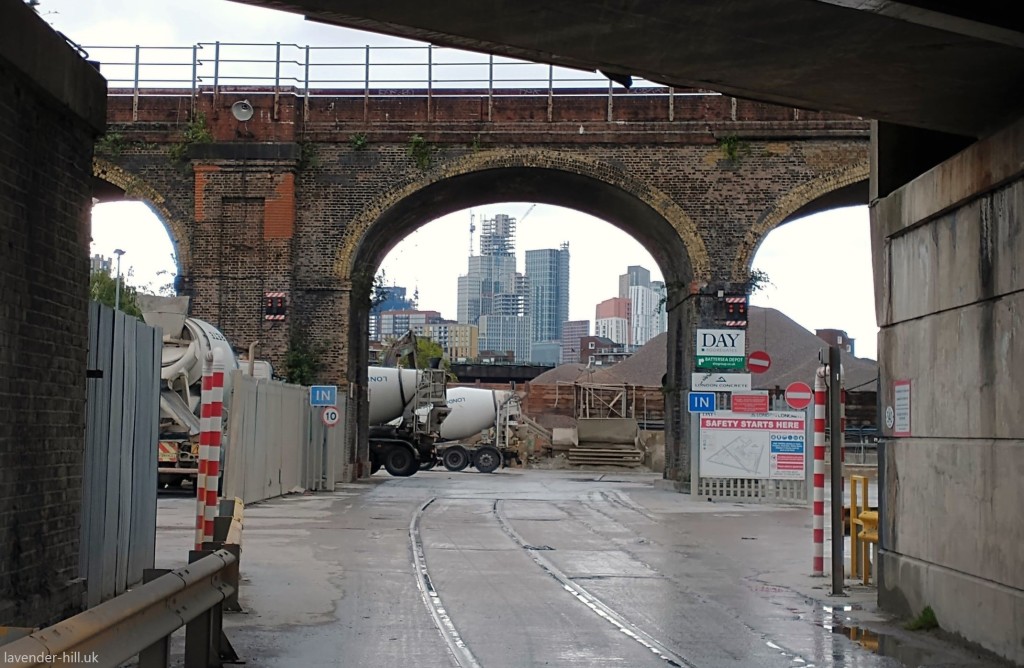
                  It’s hiding in plain sight – a giant area of Battersea that many of its immediate neighbours have never been to. In and among the railway arches between Queenstown Road and Nine Elms, this tangle of industrial sites is home to a bewildering array of businesses – including a concrete batching plant, a large bus depot, a railway maintenance site, scrap metal recycling, bakeries for the likes of Crosstown Doughnuts and Madeira Portuguese patisserie, food warehouses, a tile warehouse, and a large area of self storage – as well as several multi-tenant office spaces that house a vast number of small businesses. It’s a far cry from the dense residential streets to the south, let alone the jumble of new developments around the power station to the north.

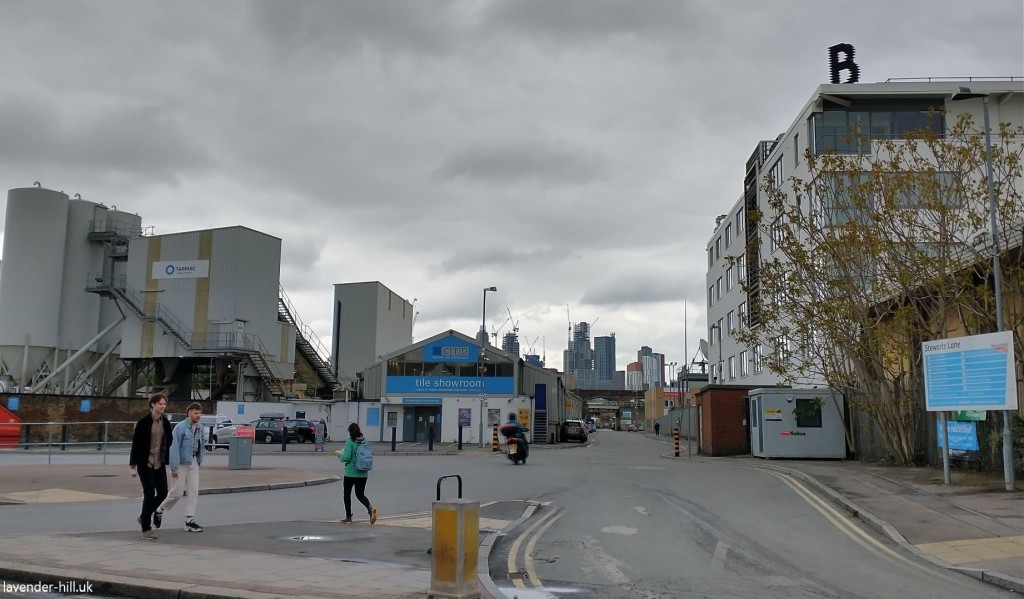
                  The industrial area used to stretch much further north and east, to encompass almost all of Nine Elms, where there were print works, delivery depots, a vast mail sorting office, the flower market, a dairy, and more – all visible behind the railway viaduct in the photo below. That has all been swept away by thousands of flats and offices.

                  A rare confluence of circumstances made this happen, including an enthusiastic group of Malaysian investors & pension funds that finally rescued the Battersea Power Station development (and landed a real coup in letting half a million square feet of space to Apple); a surprise move by the US Embassy to Nine Elms after all the options they initially preferred (like Kensington and Greenwich) proved too small / not for sale/ not secure enough; and what we understand was a direct personal steer from Boris Johnson to TfL to push the Battersea tube extension from somewhere in the ‘maybe-one-day’ middle ranks to the top priority for TfL’s investment plans.

                  But behind the scenes, a fair bit of Council ‘Masterplanning’ also helped. At least a dozen developers owned bits of land in Nine Elms, and left to their own devices they they would happily have gone their own ways and built blocks of flats that made individual sense, without forming a coherent whole. Wandsworth, together with the GLA, Lambeth, and others, set out to try and tie the projects together and create a new bit of London that would fit together, with the sort of facilities and services you would expect – using a mix of developer self-interest in creating more attractive flats to sell, and the tried-and-tested “planning’s going to be slow and sticky unless you comply” – all backed by a 156-page document published in 2012 called the “Vauxhall Nine Elms Battersea Opportunity Area Planning Framework” which set out some fairly specific guidelines on what development would and would not be acceptable.

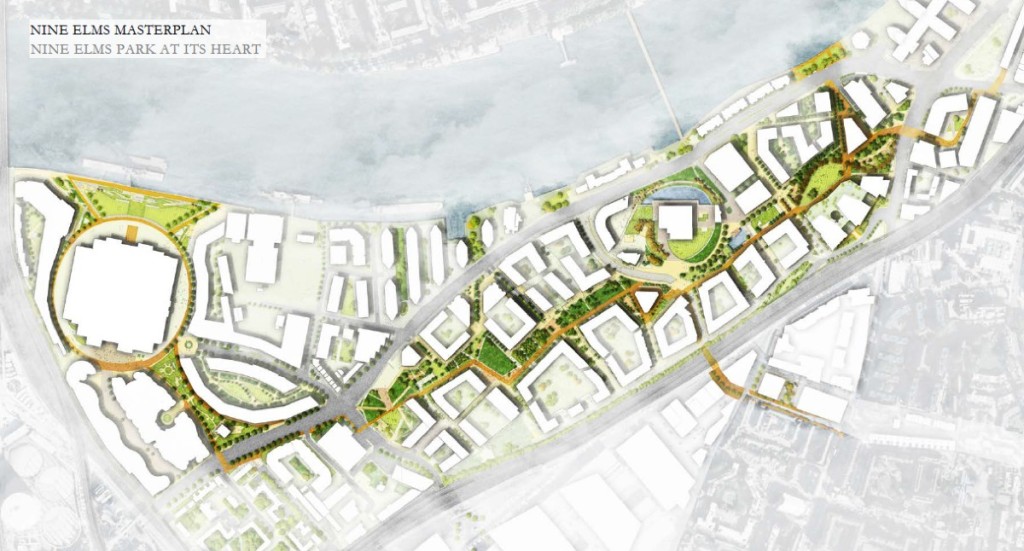
                  Some of the results of this are visible: particular parts of the development have had to chip in towards playgrounds, make provision to facilities like shops and cycle parking, as well as getting them to pay for upgrades to transport options. The masterplan also sliced off bits of each development site in an organised way, to create a single more-or-less joined up green space that runs the length of the development, shown above. Some of the planning is less visible – like the little-noticed new area-wide heating and power network, and a new school that’s in the works. The seeds are starting to come together even in the rather ‘Dubai-on-Thames’-esque area round Vauxhall, where what started as mix of 50-storey skyscrapers plonked down in a warren of shabby streets is at – slowly – starting to take on a more coherent attractive whole now that the ‘linear park’ is growing.

                  These factors turned Nine Elms from a lonely warehouse district to a somewhat glitzy new ‘neighbourhood’ with a ten-minute connection to central London. And whether you love or hate the way things have turned out (and we know a fair few of our readers sit on either side of that fence) – there’s no denying that Nine Elms has been pretty successful in delivering what it set out to achieve. It grew impressively fast – from demolition sites to a thicket of buildings in under a decade, in stark contrast to the glacial pace of development in the similarly-sized area around the O2 / Millennium Dome, where a single developer has spent 25 years very slowly redeveloping an area of land that had already had a new tube connection laid on by the government.

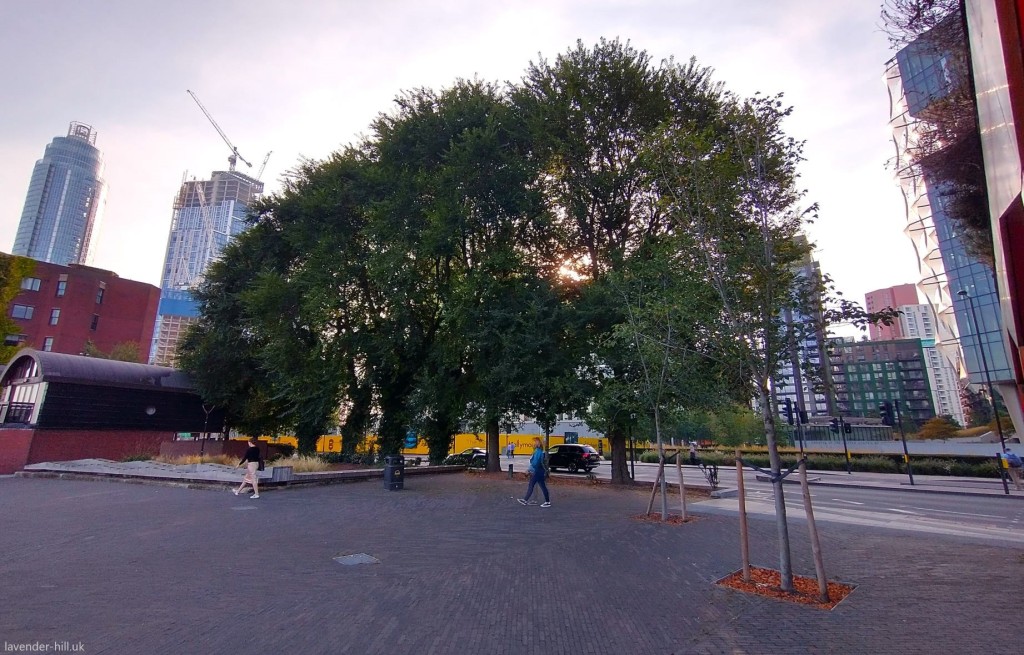
                  But this brings us to an interesting question. Because in this explosion of development, Nine Elms itself was treated as a blank canvas: the previous industrial & business activity was swept away with barely a backward glance. Tenants were given notice to quit, and the buildings reduced to rubble and tangled metal on the back of a series of skip lorries. Even the most awkward site of all, the waste transfer station that creates questionable smells in the summer, is set to be rebuilt with flats above it. Soon the only original features left in Nine Elms will be the power station, the Heathwall pumping station, and seven of the elm trees pictured below (the developers planted two more) –

                  Back in 2012, Wandsworth Council reckoned there were around 1,200 businesses in the Queenstown ward, generating about 14,000 jobs in sectors including transport and logistics, food and drink, wholesale distribution and knowledge based industries – and the whole of the Battersea and Nine Elms area had been officially labelled as ‘strategic industrial land’, to try and protect its employment uses from rapacious property developers. This label was removed for most of Nine Elms, to free up the space for redevelopment – with an assumption that the rest of the industrial area south of the railway viaducts could become more densely packed to accommodate some of the businesses and jobs, helped by ‘improvements to access and public realm’. This densification is already well underway on the Covent Garden Market site, where a somewhat overdue replacement of the rather tired 1970s buildings is being used as an opportunity to fit the whole market on about half of the previous space. The 2012 planning framework document included a slightly ominous note that “Given the uplift in land values in the Opportunity Area on the basis of land use policy changes, the planning framework envisages that many of the existing businesses in Nine Elms will relocate.” – which was likely a code for these businesses being likely to find the area was to expensive for them!

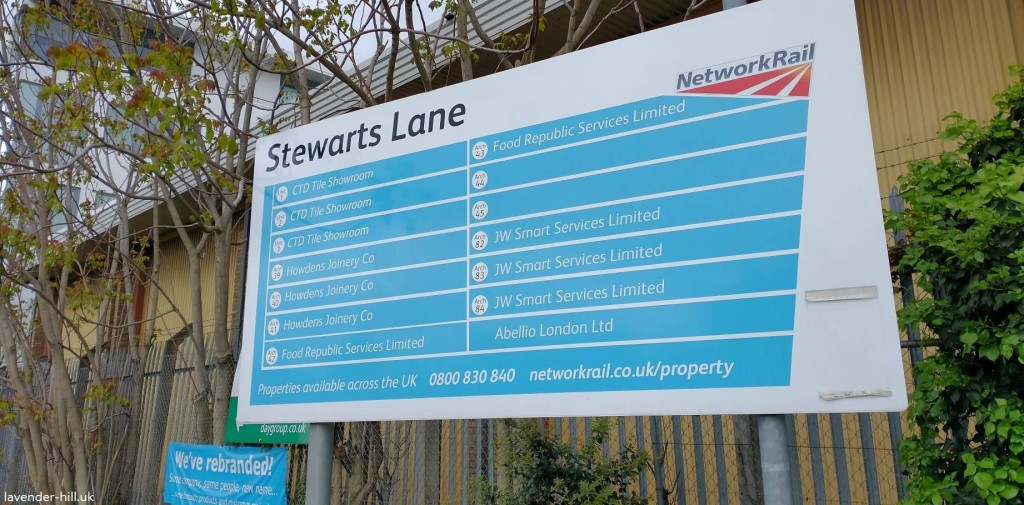
                  Will the same thing now happen to the rest of Battersea’s industrial area? The new transport and access has brought Battersea’s industrial area rather closer to the city centre, and it has (as predicted) pushed up land values significantly. A lot of buildings like the old furniture store and later Decca radio & television factory at Ingate Place above already have the look of prime ‘loft apartment’ conversion material, and being five minutes’ walk from a Zone 1 tube station makes that prospect even more likely! Other buildings like the warehouses below on Stewarts’ Lane are more industrial but are still high-value land. It’d be easy to assume that with time, Battersea’s industrial district will go the same way as Nine Elms, as new residential developments gnaw away at the edges and gradually push these businesses out of the centre of London altogether.

                  But this would be a shame – because while this certainly isn’t the sort of ‘Battersea’ that estate agents get excited about, it is a significant employer. It houses a lot of the unglamorous-but-important businesses that work away behind the scenes to keep the city working, as well as a growing set of creative small businesses. And these sources of local employment matter! The Council even runs job fairs to help this local employment structure work – our photo below shows a typical advert for one of them on Lavender Hill.
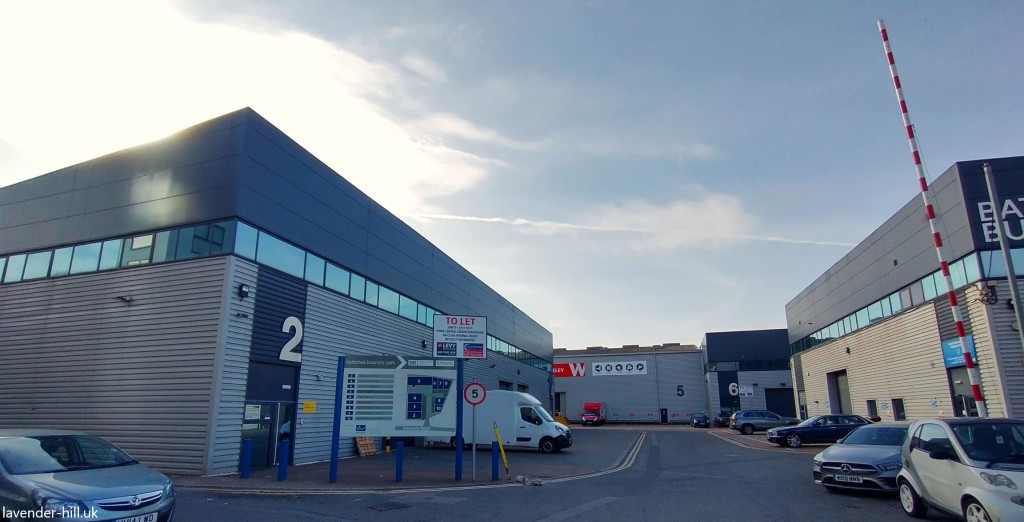
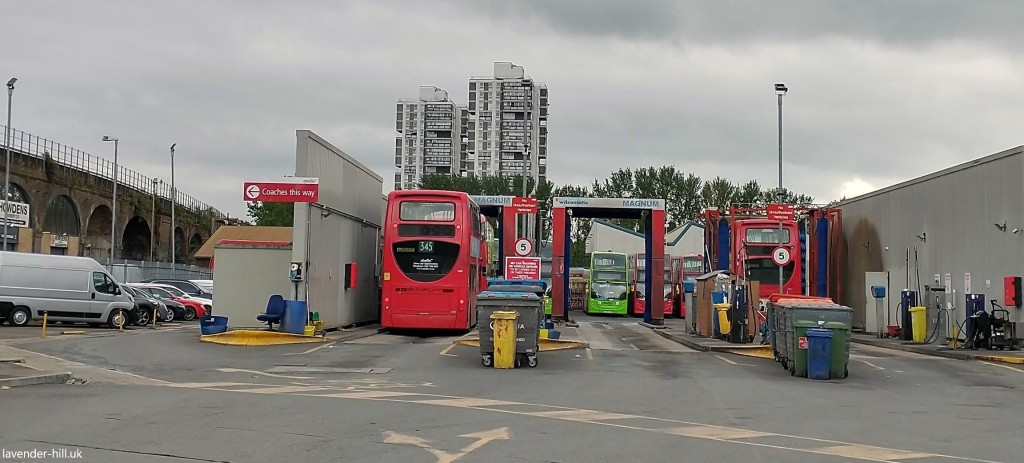
                  For a long time, the future of Battersea’s remaining business district wasn’t been at the top of anyone’s priorities. It just ticked over quietly. The landlords of the small-business workspaces did report a healthy level of demand for their buildings, which led to some investment: the Battersea Studios, originally a TV studio with generous amounts of car parking, realised there was more money to be made as a venue for small businesses, and developed a new five storey building (the one on the right in our photo below) that is let to a huge array of mostly creative and technology-focussed businesses. There was never a shortage of demand for the other facilities either – the concrete plant spent on the left in the same photo spent several years in a row as the busiest in Europe, as it served projects right across Nine Elms and inner London.
                  But gradually, thought turned to what this area should evolve in to. And the Council, after a bit of consultation and masterplanning, created something a bit unusual, called the Battersea Design and technology Quarter. This is a vision for how the slightly neglected pockets of industrial land labelled as 11, 12 and 13 in the map below could become a cluster for creative design and technology businesses – creating about 230,000 square metres of employment floorspace and over 10,000 local jobs. It’s all about building a more resilient local economy, by building on the strengths of our existing traders and residents, including providing space for them to be able to grow without leaving Battersea, as well as bringing new companies in to fill strategic gaps in the existing mix of businesses, and providing opportunities to accommodate some new industries in Battersea.

                  In practice this means supporting projects that will create space for small and medium sized businesses, as well as incubators and accelerators to help companies with good ideas grow fast. There’s an explicit aim to deliver some ‘affordable’ workspace – which tends to mean that new developments sign up, at the planning permission stage, to keeping at least a proportion at a reasonable price.

                  The plans for the new quarter aren’t saying exactly what needs to be done where or when – as that will also depend on what the many landlords and developers can pull together – but they will act as a strong guide to what path future development takes. It carries some weight in the planning and development process, where the local plan (a really important planning document that really does define what is likely to be approved) has been adjusted to reflect these new plans.

                  A lot of this comes down to supporting projects that help use the existing land, which includes a lot of surface car parking and single storey industrial space, more intensively – to allow light industrial uses to work alongside commercial office and studio uses – the Local Plan says that for new developments “Industrial uses (including logistical) must be provided within ground floor units [in most cases], with the opportunity for industrial and office uses on upper floors“. The approach of keeping these ‘ground floor’ uses in any new developments should ensure that existing businesses can still find a home on the new site.

                  The image below is a concept sketch of how the whole site could look in the future – with somewhat taller buildings that accommodate light industrial &logistical tenants on the ground floor and lower levels, and smaller business space above. The area around Havelock Terrace, nearest to the tube, is already the most densely used bit of the site and is likely to continue as the highest-rise bit of the project, with the land further south being suitable for a wider mix of lower density industries.

                  One of the bigger headaches, with a plan that aims to create a bit of a cluster with a good number of companies close to teach other and becoming more than the sum of their parts, is that the quarter is split up in three separate bits of land between the railways that are each cul-de-sacs, and not connected to each other. This is a similar challenge to the one that Barratt faced when they built Battersea Exchange housing development in the space between Battersea park station and Queenstown Road station, but in this case there aren’t a lot of easy-to-open-up railway arches.

                  The plans therefore want to improve access in and around the site for both vehicles and pedestrians – noting that “Contributions to upgrade pedestrian routes to/from Battersea Park Station and Queenstown Road Station and improve accessibility to the new Northern Line station at Battersea Power Station will be required” as part of new developments. They aim to ensure that Battersea Park Station is able to cater for a future extension of the London Overground (something we’ve written about before), and that better connectivity with Queenstown Road Station is provided though the Battersea Exchange development (a long running aim that we’ve reported on many times). This all feels long overdue, as the street layout is currently somewhat inefficient and was clearly designed on the cheap, with large-vehicle turning circles in mind but not much else.

                  There are hints that the long-closed pedestrian bridge shown below that runs from Heathbrook Park to the middle of the site (crossing a whole bundle of railway sidings) could be reopened for public use at some stage down the line (which would considerably improve accessibility to Wandsworth Road station), and there’s also some scope for east/west links under the railway from Heathbrook Park to Stewarts Lane using currently-vacant arch spaces.

                  There’s scope for some helpful changes for the site’s neighbours as well – for example, some relatively low rise building along the Silverthorne Road could provide some shielding of the houses further south from the noise and especially dust from the concrete batching works deeper in the site. Some of the existing sites could easily see upgrades – for example, the large bus depot could become an indoor facility with other uses built above it, giving a somewhat more weather-resistant site.

                  This is a big and ambitious vision, and it will clearly take time to deliver! But the seeds are already there. There’s already a steady stream of new projects aiming to make more of the space, and the impressive connectivity to the rest of London. One trend that is set to continue is the extension of some of the existing workspaces, and a shift from a few large land-hungry tenants, to a larger number of small businesses. Battersea Studios have had great success with their second building and are planning a third, which could be added in a corner of the site that is currently mostly used by satellite dishes and cooling systems.

                  This is maybe a good example of the sorts of buildings we can expect – with a light industrial space at the ground level, big powerful lifts, and several floors of offices on the upper levels. It builds on the gradual improvement to the existing buildings, which have seen new external seating areas, a food offer, and improvements to the access road including signage, seating, lighting and road surfacing and widening works.

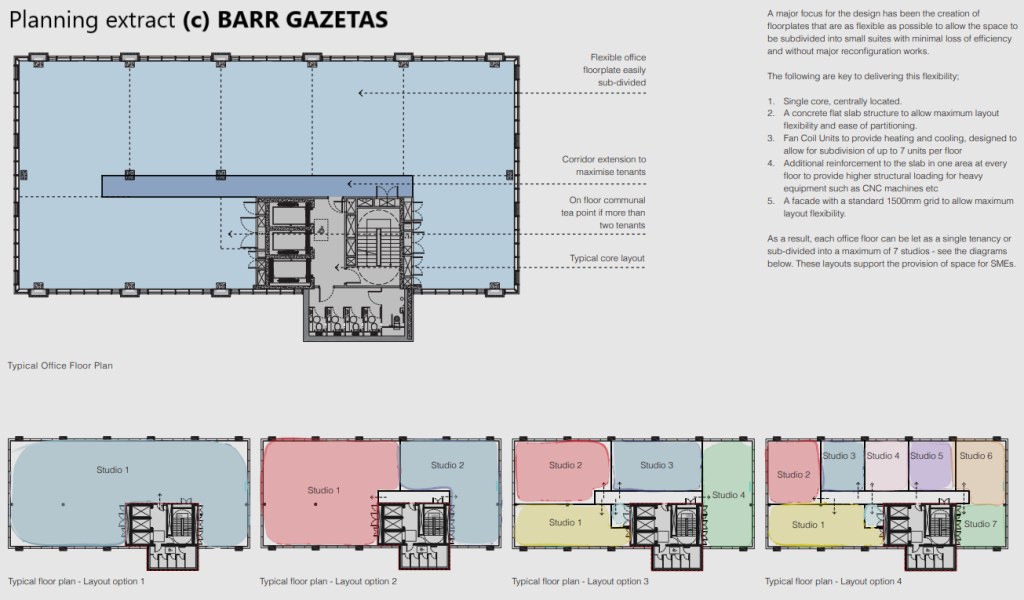
                  The new project promises ‘first class amenities, including generous communal roof terrace and London Plan levels of cycle parking and showers at ground and basement level.’. It would have a very flexible interior – with floors that can be let as a whole floor, or in all manner of subdivisions to accommodate businesses of varied sizes – as shown below for a typical floor.

                  We have reported on quite a few developments over the years, some of which have been built, and some of which are in earlier parts of the development process. One of our favourites is the big old classic hat factory building just south of Queenstown Road station, whose tenants have been moved out ahead of a refurbishment.

                  Ingate Works across the road has already been built, as a high quality office making good use of an awkward and more-or-less-abandoned set of land behind the Queenstown Road flats.

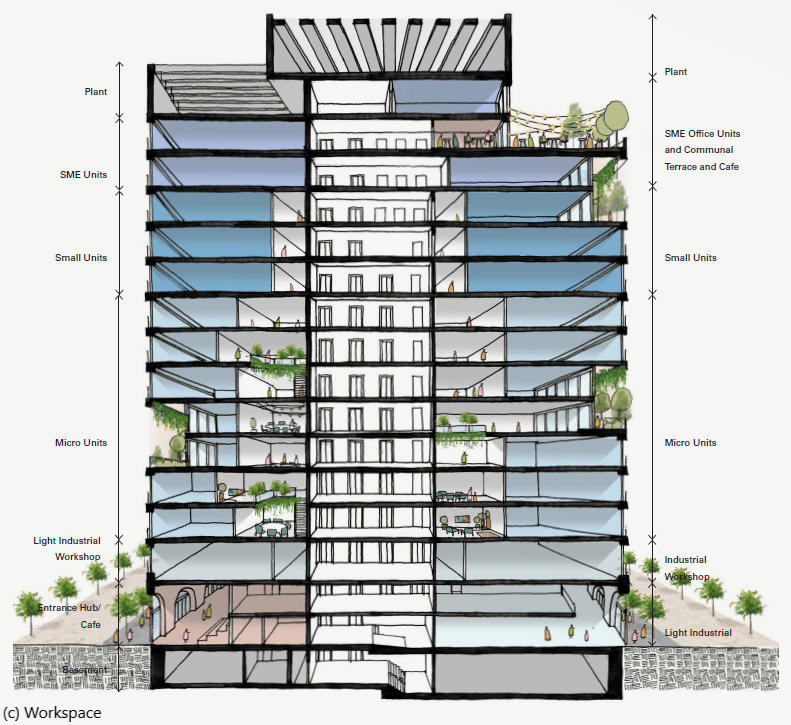
                  We’ve also reported on a rather clever building being planned for Havelock Terrace, which will see some low-rise industrial space replaced with a newer, smarter version of the same thing that goes taller – with industrial space on the lower levels and office space above it – but also roof terraces and wider facilities that will make these a nice place to work.

                  The cross section to the right, for the Havelock Terrace building, is maybe typical of the approach – which allows us to keep some of the more heavy-duty industrial and workshop spaces in Battersea, while also accommodating wider businesses above. It’s undoubtedly a tall building, but it’s worth bearing in mind that its neighbours are a load of railway lines, and some similarly tall new Nine Elms buildings!

                  Approaches like this will help our local small businesses and workspaces evolve and keep running, and in our view at least it’s better than just creating areas that have lots of flats but where everyone has to commute far away top find work.

                  This is an evolving area and we can expect to see quite a lot of change in the years ahead. We’re optimistic that this will be done in a way that keeps the disruption to both existing tenants, and neighbours of the site, to a minimum; the projects that have got going so far like Ingate Works seem to have managed this well.

                  If you’ve read this far, chances are you find this subject interesting – in which case we’d recommend you join a free talk this Wednesday (26th June 2024 – advert for the talk pictured) at 6.30pm at Battersea library on Lavender Hill, on ‘The Battersea Tangle‘. It’s by Dennis Austin of local architects daab design. Dennis will look at the lasting legacy of the rail companies’ development on this bit of Battersea, and what the rail depot and the industrial spaces around it can play in our future. The talk is free and all are welcome – but you’ll need to book in advance to ensure there’s space, so send an email to heritage@gll.org .

                  Dennis is based locally and is a proper expert on the area; he has previously run a walk & talk around the Battersea Design & Technology Quarter – visiting the three main sections to see the spaces ‘hiding in plain sight’, while exploring how they could all create new dynamic meeting places for local communities and future tenants. These are quite unusual tours – which include examining the three aggregate sites, peeking over the walls of the active rail depot, and discussing the role of the bus depot! Daab are also the people behind a project called Silver Linings, a series looking at the history of the Park Town Estate (which is the area either side of Queenstown Road). It’s well worth a look – and it was an inspiration behind one of our previous ‘local history’ posts that looked at the unexpectedly complex and interesting history of the Cedars Road Estate.

                  This is part of our occasional series that covers development on spaces for business in Battersea; our other business-related posts are here. If you find our local history coverage of interest, you may enjoy a long article on the complicated history of the Cedars Road estate, a similarly detailed look at the past of Culvert Place, a photo story about the Shaftesbury Estate drawing on its conservation designation, an article about the cluster of derelict buildings around the old Artesian Well bar on Clapham North street, a very detailed history of Rush Hill Road, and an article about the area around Falcon Lane that dives in to the area’s messy past and some scary 1970s road-building projects that very nearly got built!  Details on how to get in touch, or receive updates from us, are here.

                  Posted in Business, Environment, Planning | 3 Comments

                  Meet Francis Chubb, Liberal Democrats candidate for Battersea

                  Francis Chubb is the Liberal Democrats candidate in the Battersea constituency for the 2024 General ElectionWe and our partners at Clapham Junction insider are inviting all the candidates to short interviews – so you can learn more about who they are, what they believe in, and their plans to improve Battersea and help its residents. Details of all the candidates, and the other interviews, are here.

                  Could you introduce yourself to our readers? I am a solicitor and I live in Battersea with my family. In my past I have been a junior army officer, a journalist in Egypt, and participated in business ventures in south-east Europe. I have also been a trustee, and chair of the trustees, of a charity that operated a museum in London. I studied Philosophy and Politics in Liverpool and Law in London. I initially trained as a barrister before becoming a solicitor and I, together with a business partner, opened my own law firm in 2009. I have also qualified as an arbitrator and mediator.

                  Tell us something about you our readers may not know... I was in Berlin on 9th November 1989 when the Wall came down. It showed me that change for the better can be attained even when it appears extremely unlikely and that people’s drive to achieve it should never be underestimated.

                  You spent six years as an army officer – what are you most proud of in your time there? Of having brokered a settlement to a logging dispute between Croat and Serb parties on the Inter–Entity Boundary Line between Glamoč and Mrkonjić Grad, while serving in Bosnia Herzegovina. This was a real test of one’s listening skills and ability to deal with egos and cultural sensitivities in a tactful and diplomatic way.

                  What have you learned as a Solicitor / Barrister that you will bring to national politics? How to research and marshal facts, to set out an argument, to really listen to people, and to try to see and engage with alternative points of view. Also acquiring a respect for a system of laws which keeps the peace, enables disputes to be resolved peacefully, and creates a framework in which people can cooperate in amazingly different ways.

                  The Liberal democrats have a loyal following here, and the share of the vote increased towards 15% in recent elections. However, Battersea’s still often assumed to be a two-horse race between Labour and the Conservatives – how can this time be different? The result of this election appears to be a foregone conclusion.

                  But, because of the way the odds are stacked, people now have the space to think about how to make their voices heard. Those who wish to see a genuinely freer, fairer, more equal and more accountable form of politics in Britain can demand this without fearing that their efforts to draw attention to this need will let in to power someone wholly unsuitable.

                  Furthermore, a Labour Party in government will be faced with many serious challenges, so they will have to choose their priorities carefully. The disarray the Conservative Party finds itself in makes it unlikely that it will be a constructive opposition. Having a strong Lib Dem presence in Parliament would mean that issues that are important to people but are not top priorities for Labour will stay on the agenda.

                  With the busiest station at the heart of Battersea, and many of us relying on public transport – what local transport improvements & developments would you push for as an MP? Accessibility and reliability are two areas in which public transport regularly falls short. I would push for improvements to both. In particular I would like to see a continued effort to make using public transport to travel across London as seamless as possible, especially for those with disabilities or those burdened with small children and luggage.

                  I am also interested in the operation of the road bridges across the Thames in London. Hammersmith Bridge has been closed to traffic for 5 years, with a considerable impact on traffic through Putney. The responsibility for its upkeep lies with Hammersmith and Fulham Council, which does not have the money for its repair. This situation could easily happen to Battersea, which has bridges at or near its eastern and western boundaries, as well as three bridges between those. The closure of any of them would create choking points that Battersea could ill afford. I think it is worth considering London’s main bridges as strategic assets for the capital, and as such creating an authority whose task is to maintain, repair and replace the bridges to keep them open as much as possible and minimise the disruption that closures cause. This would assist the flow of public transport as well as commercial and private traffic.

                  Housing is also a key concern here. Many of our readers worry about the proposals we keep seeing for giant new blocks of flats, way exceeding the rules in the Local Plan. However, these projects justify their scale on the grounds that they also provide a proportion of affordable housing. Where do you think is the right balance between providing the social housing we need, and making sure that our urban environment remains one people want to live in? In my view, high-rise does not mean useful social housing and I also oppose them.

                  It is a balance, but I believe that a higher proportion of affordable housing can be created by recognising that it is reasonable to demand higher density housing within a short radius (say, 500 metres) of a significant transport node. In those areas we should be looking at building low-rise buildings, with green spaces enclosed or around them, with a mix of sizes to enable families to live in them as well as single people or couples. If built like Barcelona or Kensington, these could still be highly attractive places to live.

                  In the 2016 EU referendum there was a 70% remain vote here, one of the highest in the country – which aligned with the Liberal Democrats’ very clear position! There’s still a lot of strong local feeling about Brexit – but how relevant do you think is it as an issue in this election, and where do we go from here on Europe? Brexit itself has been traumatic, which is a major reason why it has not featured much by name in this election. But Brexit is both a symptom and a cause of where we are as a country today. In my view, we should recognize that sticking-plaster solutions, although urgently needed, will only get us so far. This applies to many of the challenges we face, not just our relationship with Europe, but also climate change, the economy, the health service, criminal justice, public services and infrastructure, housing and immigration. We need to look at our own democracy with a critical eye and make significant changes. Doing so will enable us to revisit previously settled, but inadequate, positions and achieve a level of political consensus to enable us to take mature decisions for the next few decades. Among these will, almost certainly in my personal view, be one to join Europe once more; and it will be much easier to do so when we have both a solid domestic consensus for doing so and when we can demonstrate to our European partners that we have shrugged off the 19th Century at last.

                  The situation in Gaza is a concern for many, especially in London. As a former journalist in the Middle East, you have also specific experience and expertise in the area. What do you think should be the next government’s position? My personal experience of the region was some time ago now, and much will have changed. However, we all have an interest in seeing peace in the Middle East – and nobody more so than the people concerned, the Israelis and the Palestinians themselves. I think the next government should aim to facilitate a reconciliation and a solution and it should not be afraid to take a different position to that of some of our allies if that is what is needed.

                  And finally – why should our readers vote for you? Every vote for me is a vote that says: “Actually, I think we can do better than this. I would like to see a democracy that promotes fairness and restores trust to the people. I would like to see a country that defends political and civil freedoms and is ambitious on climate change. I would like to see an economy that responds to the climate emergency and lessens rather than adds to the inequalities across the country.” Every vote for me will put a bit more pressure on the next government to make these changes.

                  And, as for me, I believe that my training and experience would make me a very effective advocate and representative for Battersea.

                  Francis’ twitter is here, the Wandsworth Liberal Democrats (who cover the Battersea, Putney, Tooting and Wandsworth constituencies) website is here, and the national party website is here. This is one of a series of interviews, where we aim to speak to all of the candidates for the Battersea constituency in the July 2024 general election, the others are here. Election day is Thursday 4th July, remember that this time you need to take Photo ID (with 22 acceptable forms of ID). 

                  Posted in Politics, Uncategorized | 1 Comment

                  Meet Dan Smith, Workers Party of Britain candidate for Battersea

                  Dan Smith is the Workers Party of Britain candidate in the Battersea constituency for the 2024 General Election. We and our partners at Clapham Junction insider are inviting all the candidates to short interviews – so you can learn more about who they are, what they believe in, and their plans to improve Battersea and help its residents. Details of all the candidates, and the other interviews, are here.

                  Could you introduce yourself to our readers? I’ve lived in and around the area most of my life, educated in Dulwich before studying dentistry at Kings College Hospital. I’ve a proven track record of success with 24 years experience of getting things done in Healthcare, business and leadership.

                  Tell us something about you our readers may not know. I exchanged several letters with Sir David Attenborough as a kid and obviously still a massive fan of his! I’ve always been very fond of nature and won the Natural History prize for my research project on marine life. I actually wrote to him again a couple of years ago and to my surprise, he wrote back another hand written letter.

                  What makes the Battersea constituency special for you? I live just off Clapham Common and think this such a great part of London! From the vibrant green spaces of Battersea Park, Wandsworth Common, and Clapham Common to the iconic redevelopment of the Power Station and Nine Elms. From the beauty of the Thames to the bustling areas of Northcote and Clapham Junction; it’s just got so much going for it.

                  With the busiest station at the heart of Battersea, public transport is used by the vast majority of people in the area. What would you like to see improved for that in Battersea? I will fight hard to push through the Northern Line extension to Clapham Junction which will ease congestion on our roads and put more bums on seats in this usually pretty empty part of the Northern Line.

                  Housing is also a local concern. Recently we have seen some proposal for massive schemes exceeding local plan rules – which justify their scale on the grounds that they also provide a share of affordable housing. Where is the right balance between providing the social housing we need, and making sure that our urban environment remains one people want to live in? I think where we are now is pretty perfect and has the right balance of housing and space. There are however, over 30,000 long-term empty homes across London. I would want to massively increase council tax on these empty homes to such a level that even the super rich would consider selling these properties or at least help to reduce the council tax for the rest of us if they don’t.

                  The cost of living is a real worry for many of our readers. Since Labour took control in 2022, the Council has implemented the London Living Wage for its staff and contractors. What additional measures do you believe are necessary, including in the private sector, and what do you think is the best approach for the government to provide support? We have strong plans to bring down the cost of living by nationalising our public utilities and reduce tax. Our money tree will come in the form of public owned alternative to Amazon, Netflix and Starbucks with all profits going back into the UK. Amazon made £25 billion form the UK alone last year and paid no tax. Add in Netflix, Starbucks and a few more and we’re talking at least £40 billion every year for the UK economy.

                  In the 2016 EU referendum there was a 70 % remain vote here, one of the highest in the country. There is still a lot of strong feeling about Brexit – but how relevant is it as an issue in this election? I voted remain and if there is the right opportunity to rejoin, I will push hard for this. I know politicians like to be overly prolix with their words but I prefer my responses to be more concise and to the point.

                  The environment has become a bit of a political football, getting tangled in arguments about onshore wind farms and even wokeness. What are the most important measures the future government should commit to in order to address the climate emergency? I am massively in favour of net zero and pretty fervid with both climate change and with science. There are a great many studies to back up that nuclear energy is actually one of the safest and most efficient ways of getting to net zero. Both Labour and Tories are famous for their U-turns after the election and I fear this will happen in this particular instance. We need more fighters in Parliament who are going to hold them to their word and I won’t be holding back!

                  The situation in Gaza is a concern for many voters, and specifically in London where many have a strong view. What do you think should be the government’s position? Within the next year, I suspect many people will be ashamed of voting Labour and Tory when these parties equally ramp up their support for the genocide after the election. Taking a moral stand against the actions of our two main parties is one of the biggest reasons I am running for MP. I will do all I can to bring about an immediate, unconditional ceasefire, recognition of the Palestinian state and proper justice for Palestine. I am heavily in favour of a stable 2 state solution and it is something I have researched at length.

                  And finally – why should our readers vote for you? I am fighting hard for all our health workers who are rapidly burning out and either want to leave the profession or leave the country; this also goes for our teachers as well! Our requests have fallen on deaf ears in Parliament and we need a loud voice in government to stop the exodus of our key workers as soon as possible. As a dentist, I have left the profession that I love so I can protect its future and to help SAVE OUR NHS!

                  Dan’s website is here, and his instagram is here. This is one of a series of interviews, where we aim to speak to all of the candidates for the Battersea constituency in the July 2024 general election, the others are here. Election day is Thursday 4th July, remember that this time you need to take Photo ID (with 22 acceptable forms of ID). 

                  Posted in Politics | Leave a comment

                  We’ve interviewed Battersea’s candidates for the July election – and found a few surprises…

                  We’ve got an unusually wide set of choices for the election – with nine candidates! We and our partners at Clapham Junction Insider have contacted all the candidates we can track down, and offered them an interview – to find out who they are, what they’d do as our MP, and why you might want to vote for them – and to ask some difficult & awkward questions too. This is our summary of the candidates, with links to the interviews; we’ll keep updating this page as we interview the remaining candidates. Election day is Thursday 4th July, remember that this time you need to take Photo ID (with 22 acceptable forms of ID, including everything from 60+ London Oyster photocards to national identity cards issued by an EEA state).

                  Joe and his family have lived in Battersea for six years, and they love it here! Since his daughter was born he has dedicated as much time as possible to combating climate breakdown, to secure a future for her and all young people. He agues that we need a World War II-sized mobilisation to change almost every aspect of life in Battersea and Wandsworth as well as the UK as a whole, as everything we hold dear is under threat, not on some distant timescale but in the lifetimes of most people alive today. That is why he is running in the general election for the Green Party – the only party that takes the climate crisis seriously.

                  Joe’s interview is here – where he also reveals an unexpected Eurovision link! You may also want to see Joe’s very active twitter & party website.

                  Tom’s a proper local, having lived in the area for ten years, first near Clapham Junction, then in Balham, and now in a flat just off Lavender Hill. He’ll be a familiar face to many of our readers, having represented the Lavender ward as a local Councillor at Wandsworth Council for two years.

                  His main political interests are housing (in particular making home ownership a more attainable ambition for people who are struggling to get on the housing ladder), crime (where several years on the front line as a local councillor means he’s well aware many of us feel less safe than we did a few years ago), High Streets (where he has been a vocal campaigner to reinstate the summer weekend pedestrianisation of Northcote Road), and foreign and defence policy (where the world has become a more dangerous place in the last few years and he believes it’s important to take these threats seriously). He’s very proud of the UK’s support for our Ukrainian allies and also the large number of Ukrainian refugees that have been taken in by residents in Battersea, and Wandsworth more broadly.

                  Tom’s interview is here, which contains a fair few surprises – including an insight to the less-glamorous-than-it-sounds life of being a wine waiter! Tom’s own website, (very active) twitter, and linkedin.

                  Barry is a Management Consultant and Chartered Environmentalist. What makes Battersea special for him is its relationship with the Thames Estuary, Battersea Park, Falcon Park, Heathbrook Park, Clapham Common, and all the other wonderful small open spaces that make it such a green constituency.

                  He’s standing because Labour was in power for 14 years and crashed the economy, then the Tories did the exact same, and the LibDems have worked with both Labour and Tory and nothing got any better. He feels that the only reasonable therefore rational choice is to choose something else, and that Reform has common sense and will balance society, environment and economics to find the good life for everyone no matter their nationality or culture.

                  Barry’s interview is here, with lots of thought about how we can tackle the housing crisis in Battersea and London – and his own website is here.

                  Francis Chubb is a solicitor, an arbitrator and an accredited mediator, who set up his own law practice 15 years ago. He is also a former Army officer, has worked as a journalist in the Middle East and as a businessman in Southeast Europe and has senior not-for-profit experience as the former chair of a charitable trust.

                  He was prompted to stand by dismay at the direction of politics in Britain and the growing inequalities in our society: the danger of ‘Two Batterseas’ – those with and those without. He believes that it is within our grasp to push for better politics, an up-to-date democracy with stronger civil and political liberties, that will be fairer and more accountable and make us freer and more equal. He feels we need to dare to believe that we can make a difference, and that change can happen.

                  Francis’ interview is here. His twitter is here, the Wandsworth Liberal Democrats (who cover the Battersea, Putney, Tooting and Wandsworth constituencies) website is here, and the national party website is here.

                  A born and bred South Londoner, Dan was educated in Dulwich before studying dentistry at Kings College Hospital. With 24 years experience of getting things done in Healthcare, business and leadership, he wants to address the cost of living crisis and the environmental disaster posed by our sold-off utilities. He lives just off Clapham Common and knows the Battersea area well – including the advantages and challenges of living here compared to other areas of London.

                  Dan’s interview is here, with ideas on how nationalising more of our public utilities could help the UK economy and how to get the 30,000 long-term empty homes across London back in use; he also reveals that he’s a semi-regular correspondent with David Attenborough! His website is here, and his instagram is here.

                  Marsha is a well known person to many of us, because she’s our current MP. She became an MP in 2017 after three years as a Lambeth councillor, beating Battersea’s previous Conservative MP Jane Ellison with a majority of 5,668. Before starting her career as an MP she was a disability rights campaigner and charity founder, ad while in parliament she has been a shadow Minister, first as shadow Minister for Disabled people, and was later promoted to a more senior role as Shadow Secretary of State for Women and Equalities.

                  Marsha’s interview is here, where she shares thoughts on her guiding principles of of making a difference and being a voice for a voiceless, as well as a wide range of her policy priorities including improving transport in Battersea, and how to help disabled people have equality in the workplace, with more on her website, twitter and Instagram.

                  Georgina is standing in election for the Rejoin EU party. She argues that Battersea could be the first place in the country to send a strong, critical voice to Westminster calling for the reversal of Brexit. She argues that Brexit is the driving engine behind the continued cost of living crisis we face today, and it’s going to get worse as the impact of cutting our trade links with the EU takes effect. Brexit also continues to blight our ability to travel & work beyond the UK, has destroyed the retirement plans of hundreds of thousands of Brits, and stolen the educational opportunities from our young people.

                  Georgina’s interview is here, where she shares thinking on a wide range of areas including on how we could do a better job of delivering new housing while also making places that people want to live in, and even how she was once killed by a cyberman as an extra on Doctor Who! She asks whether the people of Battersea really just want one more dull Labour MP who will just follow the herd in Parliament – and suggests we should vote different! The Rejoin EU party’s website is here.

                  The SDP describes itself as a patriotic, economically left-leaning, and culturally traditional political party, whose campaign promises include ending mass immigration, re-nationalising our railways and utilities, and making a decent home available for everyone, with more details on the Party’s website and Youtube. We know Ed himself lives in the heart of Battersea, although we haven’t managed to find out much else about him.

                  Jake Thomas is standing as an independent candidate. He’s a sole trader living on the Shaftesbury Estate (near Queenstown Road), with his wife and three children, who also stood as a candidate for the Brexit Party back in 2019. His policies include controlling migration, putting people before parties, resisting the rise in corporate capitalism / socialism, and not buying imported Chinese products.

                  Posted in Politics | 2 Comments

                  Meet Tom Pridham, Conservative candidate for Battersea

                  Tom Pridham is the Conservatives candidate in the Battersea constituency for the 2024 General Election. Some of our readers may recognise Tom, as he’s currently also a very active and enthusiastic ward Councillor for the Lavender ward (covering the south of the street, between Lavender Hill and Clapham Common). We and our partners at Clapham Junction insider are inviting the candidates to short interviews – so you can learn more about who they are, what they believe in, and their plans to improve Battersea and help its residents. Details of all the candidates, and the other interviews, are here.

                  Could you introduce yourself to our readers? I have lived in the area for ten years now, first near Clapham Junction, then in Balham. 18 months ago, my partner and I bought our first property, a flat just off Lavender Hill. I’ve served on Wandsworth Council for two years, representing the ward where I live, Lavender. My main political interests are:

                  • Housing, in particular making home ownership a more attainable ambition for people who are struggling to get on the housing ladder.
                  • Crime – I’ve spoken to lots of people locally who feel less safe than they did a few years ago and one of my priorities as a councillor is working with the police to ensure that residents’ concerns are addressed.
                  • High Streets – We have fantastic high streets in Battersea, in particular, of course Northcote Road. One of my main focuses as a councillor has been campaigning to reinstate the excellent, and popular, summer weekend pedestrianisation of Northcote Road which was sadly cancelled by the Labour administration in the Town Hall.
                  • Foreign and Defence Policy – This may seem far removed from everyday concerns but the world has become a more dangerous place in the last few years and I believe it is important to take these threats seriously. I’m very proud of the UK’s support for our Ukrainian allies and also the large number of Ukrainian refugees that have been taken in by residents in Battersea, and Wandsworth more broadly.

                  Tell us something about you our readers may not know… My parents are both lifelong Labour supporters! I was brought up in a household where I was encouraged to discuss politics and express my views. I am not sure they expected me to be a Conservative though…

                  What makes the Battersea constituency, where you have lived for quite some years, special for you? There is a great deal that is special about our area. But for me, it is the variety on offer – the town centres in Battersea, Nine Elms, Balham, and Clapham Junction, the excellent green spaces (Battersea Park being the best park in London of course), and the thriving local businesses. All this combined with the diverse range of people and international feel (my ward has a thriving French community) makes it a great place to live.

                  You worked as a wine expert. What can you bring from your previous activity to the role of an MP? Yes, I worked for quite a few years as a sommelier. I think people often have a misconception about the role and think that it is extremely glamorous. In reality, it consists of working long hours (I once worked twenty 13 hour days on the bounce) to very high standards for modest pay. There are several things that transfer well into politics – firstly an understanding of what it’s like to work in a job that is not highly paid despite requiring hard work. Secondly, an ability to relate to different people (other staff and customers) and get a sense of what they want. Thirdly, and perhaps most importantly, a resilience and ability to put in hard graft.

                  The life of a local councillor is a lot of hard, unrewarded work behind the scenes. What have you learned as a councillor here that you will bring to national politics? Yes, being a councillor can sometimes be hard work, particularly given that most councillors undertake their duties alongside a day job, as I do. In order to do the job effectively, one has to be very good at time management and prioritisation; skills that are essential to being a good Member of Parliament. The most important thing I’ve learnt as a councillor is that it is absolutely impossible to put people in boxes. We often hear about how a certain group of people think one thing and if you have a certain opinion on one issue you will have a specific opinion on another. In reality, every person you speak to is unique. It’s important to take everyone on their own terms.

                  What are you most proud of doing in your time as a Battersea councillor? As an opposition councillor, it can sometimes be difficult to achieve change, as the majority party run the Council and effectively makes all the key decisions. The things I’ve been proudest of as a councillor are actually the individual pieces of casework that I’ve managed to get resolved. People come to their local councillor with a whole range of problems such as lifts not working, noise nuisances and unfair fines. Many people are (often for understandable reasons) somewhat cynical and disillusioned with politics and politicians. Being able to actually effect change and deliver things for people can be very rewarding. After I resolved one such issue, someone told me that I had “restored their faith in public service”, which was a very nice thing for them to say.

                    With the busiest station at the heart of Battersea, and many of us relying on public transport – what local transport improvements & developments would you push for as an MP? Transport is a big issue and one that I have focused on quite a bit in my campaign. We are lucky to have Clapham Junction as such a big transport hub right at the heart of the constituency. My view is that we need to find ways to take the pressure off it and improve transport connectivity to the north. The first thing we should do is make it easier to cross the river on foot by building the Cremorne footbridge, giving residents in North Battersea better access to connections north of the river. The second thing we should do is reopen Battersea High Street Station, in between Clapham Junction and Imperial Wharf on the overground. Finally, and this is perhaps a longer term goal, I would like to see the Northern Line extended through north Battersea, further taking pressure off Clapham Junction.

                    We should always encourage people to use public transport wherever possible – however, we also have to be mindful that, for some people, cars will be necessary and we need to make sure that people feel confident making environmentally friendly choices, such as using electric vehicles. Ultimately, as numerous polls show, people care deeply about the environment and I think we should trust them to make sensible environmental decisions rather than telling them what to do when we may not understand their circumstances.

                    Housing is also a key concern here. Many of our readers worry about the proposals we keep seeing for giant new blocks of flats, way exceeding the rules in the Local Plan. However these projects justify their scale on the grounds that they also provide a proportion of affordable housing. Where do you think is the right balance between providing the social housing we need, and making sure that our urban environment remains one people want to live in? This is always a difficult issue for community politicians to navigate and the right balance will always depend on the specific circumstances in question. One of the things I care most about is making home ownership attainable and affordable and, for that to become a reality, we need to increase the supply of housing. Nevertheless, I can fully understand why people feel aggrieved when a development is proposed that feels out of kilter with their view of the area. Ultimately, politicians (whether MPs or councillors) are in a position to reflect the concerns of residents to developers and local authorities and work to find a way to build more housing (ideally through good design and more gentle density) in a way that residents feel comfortable with.

                    We were one of the most anti-Brexit constituencies in the country, and it may have cost our previous Conservative MP Jane Ellison her seat. Have we moved on from that now? And where do we go from here? Well, I’ll start by saying that I think it’s been a huge shame for the area to lose Jane as a Member of Parliament. She was a fantastic local MP who worked very hard across a number of different communities and was always immensely responsive to her constituents.

                    Brexit is obviously an issue that evokes strong feelings on both sides of the debate and there are some people for whom it remains the key issue. However, to be honest, this is not raised that often with me on the doorstep anymore and I think people have begun to move on. My hope is that, as a society, we focus more on the future of our relationship with allies in Europe (where we have done excellent work on Ukraine) and beyond rather than re-fight the Brexit debate. I believe this is already happening.

                    As Brexit happened, there were two key issues locally that I was anxious to see resolved – getting settled status for our EU residents, and agreeing bilateral frameworks with the EU and elsewhere to maintain the competitiveness of London’s services sector. I am proud of the work that the Conservative Government has done on both these fronts. I am also especially proud of the work that the previous Conservative-led Wandsworth Council did in funding Citizens Advice Wandsworth to create a bespoke service to assist EU residents with their settlement status rights.

                    Has the Conservative party fallen out of love with London in the last few years, with the talk all about ‘levelling up’ and focussing spending and priorities elsewhere? Why should Londoners still support the party? It is of course true that the Conservative Party has had a challenging few years in London, but I am hopeful that the tide will turn in the years ahead. We’ve already seen indications in some parts of the city that there is growing discontent with Labour rule and, here in Wandsworth, we gained a council seat off Labour in May. The main thing that drives me to be a Conservative is that it is the party of ambition, the party of business and the party that recognises that the best way to drive economic growth and improve society is by encouraging people to reach their full potential rather than stifling it through over-regulation and a statist attitude. I believe these values do still resonate in London.

                    The situation in Gaza is a concern for many, especially in London. What do you think should be the next government’s position? Like many in Battersea, I’ve found the situation in Gaza and Israel extremely concerning. I also know that a number of Battersea residents are directly affected by the ongoing conflict there.

                    This is a difficult and complicated situation to respond to. I believe the Government has taken the right stance on this. On the one hand, supporting Israel’s right to defend itself following a barbaric terrorist attack from Hamas. On the other, pushing to ensure that as much aid as possible can be delivered to the people of Gaza who have been so badly let down by Hamas dragging them into an unnecessary conflict. The ultimate goal must be a two-state solution, which has been the UK’s long-standing position.

                    And finally – why should our readers vote for you? At this election there is a choice between a Labour-led Government and a Conservative-led Government. I know that the last few years have been a difficult time for many but – in spite of all these difficulties – I would urge people in Battersea to compare the two approaches on offer. I think Rishi Sunak has dealt well with a difficult situation and has the right priorities as Prime Minister. I do not believe that a Starmer Government has the right solutions for our country, and I think Labour’s proposals would be particularly bad for our area. Policies such as the introduction of VAT on private schools, the introduction of higher Council Tax bands (which could see bills skyrocket) and the introduction of capital gains tax liability on primary residences will have a particularly negative impact on constituents in Battersea.

                    I am a proud Battersea resident and, if elected as your Member of Parliament, I will stand up to Sadiq Khan and the Labour Council in Wandsworth and fight your corner on the issues that affect your day to day lives.

                    This is one of a series of interviews, where we aim to speak to all of the candidates for the Battersea constituency in the July 2024 general election, the others are here. Election day is Thursday 4th July, remember that this time you need to take Photo ID (with 22 acceptable forms of ID). You may also want to see Tom’s own website, (very active) twitter, and linkedin.

                      Posted in Politics | Leave a comment

                      Meet Barry Edwards, the Reform UK candidate for Battersea

                      Barry Edwards is the Reform UK candidate in the Battersea constituency for the 2024 General Election. We and our partners at Clapham Junction insider are inviting the all the election candidates to short interviews – so you can learn more about who they are, what they believe in, and their plans to improve Battersea and help its residents. Details of all the candidates, and the other interviews, are here.

                      Could you introduce yourself to our readers? Hi, my name is Barry Edwards and I am a Management Consultant and Chartered Environmentalist.

                      Tell us something about you our readers may not know… I am a BS EN ISO International Standards Lead Auditor, which means that I am a suitably qualified and experienced person to verify compliance within evidenced management systems

                      On your bio, you say that you run a business in the borough. What makes the Battersea constituency special for you? I don’t run a business in Wandsworth Borough, but in its next-door neighbour the London Bough of Richmond upon Thames. What makes Battersea special for me is its relationship with the Thames Estuary, Battersea Park, Falcon Park, Heathbrook Park, Clapham Common and all the other wonderful small open spaces that make it such a Green constituency.

                      In the 2016 EU referendum, 70% of our constituency voted to remain, one of the highest in the country. There are still strong feelings about Brexit. On your website, you pledge to “work with [people], learn from them and represent their views, aspirations and requirements”. What do you have to offer to Battersea constituents in this context? Now that we have secured our own sovereignty and Parliament has the final decision which decides the evolution of society, the environment and our economy, I am a sustainability expert with the training and expertise to ensure that these are balanced towards meeting the needs of Battersea, without compromising the needs of future generations. It was really a shame that there was so much propaganda on both sides and people unfortunately came to believed that the EU could make better decisions about the UK’s national interest than we could.

                      The cost of living is a real worry for many of our readers. Since Labour took control in 2022, the Council has implemented the London Living Wage for its staff and contractors. Do you think it was the right move and what do you think is the best approach for the government to provide support? I think that the London Living Wage is substantially short of what is sustainable. London is a very expensive place to live, with house prices and rents increasing year on year. Reform will raise the personal tax allowance to £20,000 per annum, lifting huge numbers of young people, pensioners, and people on low incomes, in fact, taking 41% of Londoners out of being taxed altogether.

                      Reform will re-evaluate the living wage so that it is a realistic figure, in line with the real cost of living in the capital. Reform will reduce the competition for employment, therefore increasing the value of work, increasing wages for most people in Battersea.

                      With the busiest station at the heart of Battersea, public transport is used by the vast majority of people in the area. What would you like to see improved for that in Battersea? I would like to see TfL have improved standards and that these are measured against accountable criteria. This is an essential and, in some cases, critical means of transportation and over the years standards have been falling and prices have been increasing.

                      We need a railway, tube and bus services that are clean, safe, at the appropriate frequency and on time. This has been sadly lacking and the leadership and management of this service, has simply not been there. Reform would do a full assessment and put in place, if necessary, an Act of Parliament to ensure these standards are met going forward.

                      Housing is also a local concern. Recently we have seen some proposals for huge tower blocks exceeding ‘local plan’ rules – which justify their scale on the grounds that they also include a share of affordable housing. Where is the right balance between providing the social housing we need, and making sure that our urban environment remains one people want to live in? The correct balance of society, environment and economics is to meet the needs of today, without compromising the needs of future generations. That balance can only be set by ensure that we use “air-space development” to meet the serge of demand force by increasing population and then move to a sensible protection of the critical spaces such and farmland, open-spaces and National parks, to ensure food security and biodiversity.

                      Air-space development is a process which build on existing properties to provide additional accommodation. If homeowners were allowed to develop above their existing homes, an extra storey, there would not be a housing shortage, or the need to build any more new houses. The homeowners could decide if this was right for them, their properties would go up in value and they could get a rent for these developments. This would be affordable reducing rent and young people would have somewhere to live without harming the environment.

                      You cannot just keep building houses, you will start to build on Green Belt, farmland, and our Parks, so this essential land uses should have Legislative protection, to guarantee food security. This would put family first, as the children of the property owner could then prioritise their own children to have a place of their own, or rent out the additional flat. This would also reduce social care as the children would be nearby if case of emergency and any other properties could offer this as rented accommodation.

                      You have a special interest in environmental issues and have said, “people should be on the side of the planet that provides all the things we need.” What are the most important measures the future government should commit to in order to address the climate emergency? I wish everyone when they consider the future to make one simple calculation. It is all based on mathematics and the arithmetic is not that difficult. If you have a steady growing thing, of any type and a recognised rate over at finite period, say 1% per year, this would cause the item to double in size. This is called the doubling time. We are taking about ordinary steady growth. If you apply this to population, then a population growing at 1.4% per year would double in 60 years. This is what Battersea has to look forward to as it is growing at that rate.

                      If this is allowed to continue, then not only the population, but all services including the NHS, schools, housing sewage treatment water supply, energy and tolerance would all have to double to simply keep pace. If these support services did not increase then the level of service would halve. But you say the pie could grow in size, so everything doesn’t have to be shared. However, using current verified projection the economy is flat Zero % growth, yet the population is still growing at 1.4%. and even if the economy could grow at that rate, the only place where this huge need of extra space could come from would be to build on our parks.

                      Therefore, the single most dangerous thing to our prosperity is more people – More is Poor. This massive increase the population also affects the climate emergency because anthropomorphic climate change is caused by people and their consumption behaviours, and the more people the more carbon footprint, so More is also Climate Change. This might be poorly expressed as the immigration election, but as the only way that this population growth in the UK is growing is through immigration, therefore Over-Population is Immigration, so despite this awkwardness in terminology, it is absolutely accurate.

                      The situation in Gaza is a concern for many voters, and specifically in London where many have a strong view. As a former journalist with exposure in the Middle East, you have also a specific experience. What do you think should be the government’s position? I have not been a journalist in the Middle East, but fully understand the situation and consequences of the Hamas War. The Governments position should be that it is entirely correct that Israel should be able to defend itself. What would we do in the UK, if the country was attacked 1200 people were killed and over 200 hostages were taken? We would defend ourselves, but what if the perpetrators were a recognised terrorist organisation that stated that it would do it again and would not be satisfied until our nation was destroyed? This would pose an existential threat to our entire way of life, this is the only way to see this conflict in Israel and act accordingly.

                      Israel is an ally and we must ensure democracy, the rule of law, individuality, tolerance and the respect for other faiths is maintained. Therefore, antisemitic behaviour should not be tolerated, all terrorist organisations should not be allowed to win and peace and mutual respect for both communities and cultures should be helped to return as soon as possible. However, this can only be achieved through the hostages being returned and the support for terrorists to be discouraged.

                      And finally – why should our readers vote for you? Because Labour was in power for 14 years and crashed the economy, then the Tories did the exact same. LibDems have worked with both Labour and Tory and nothing got any better. As a professional Environmentalist I can state expertly that the Greens don’t understand sustainability and the SNP and Plaid Cymru are both raving Nationalist who shouldn’t be allowed to be in control of anything.

                      Given these fact the only reasonable therefore rational choice is to choose something else. None of the above. It just so happens that that change is Reform and this is not he short straw, it is the best straw as Reform has common sense and will balance society, environment and economics to find the good life for everyone no matter their nationality or culture. Britain needs Reform, Battersea needs Reform, as this will lead to a more sensible, realistic, sustainable Life for All.

                      You may also want to see Barry’s own website, which is here. This is one of a series of interviews, where we aim to speak to all of the candidates for the Battersea constituency in the July 2024 general election, the others are here. Election day is Thursday 4th July, remember that this time you need to take Photo ID (with 22 acceptable forms of ID).

                      Posted in Politics | Leave a comment

                      Meet Joe Taylor, the Green Party candidate for Battersea

                      Joe Taylor is the Green Party candidate in the Battersea constituency for the 2024 General Election. We and our partners at Clapham Junction insider are inviting the candidates to short interviews – so you can learn more about who they are, what they believe in, and their plans to improve Battersea and help its residents. Details of all the candidates, and the other interviews, are here.

                      Could you introduce yourself to our readers? My family and I have lived in Battersea for six years and we love it here. Since my daughter was born nine years ago, I’ve spent as much time as I can trying to stop climate breakdown to give her and all young people a viable future. That’s why I’m running in the general election for the Green Party – the only party that takes the climate crisis seriously.

                      Tell us something about you our readers may not know… My day job is in the music industry, managing songwriters who mostly write songs for big DJs.

                      We hear you co-managed the British entry for Eurovision a good few years ago. What lessons would you draw from that experience that you would use as an MP? I didn’t expect to be reminded of Eurovision during this election campaign but my first hustings was at South Thames College (in our neighbouring Putney constituency) and my encounter with the Workers Party candidate did remind me somewhat of my encounter with Lordi, the hard rock band in monster costumes who won Eurovision for Finland in 2006, as I explained in this Twitter thread.

                      What do you think of Wandsworth Council’s efforts so far to ‘go green’ – which has seen a decent push for electric vehicles, more comprehensive recycling, and cycling? Wandsworth Council declared a climate emergency in 2019 but nothing that either administration, Conservative or Labour, have done since suggests they understand what “emergency” means. Everything we hold dear is under threat, not on some distant timescale but in the lifetimes of most people alive today. We need a World War II-sized mobilisation to change almost every aspect of life in Battersea and Wandsworth as well as the UK as a whole. I campaigned for food waste collection and now we have food waste collection, but it’s a tiny step when the challenge facing us is so huge.

                      With the busiest station at the heart of Battersea, public transport is used by the vast majority of people in the area. What would you like to see improved for that in Battersea? The truth is we need to see every urban area including Battersea becoming pretty much car-free this decade. So we’re going to need more public transport and for it to be cheaper, and more pedestrianisation and provision for active travel also.

                      Housing is also a local concern. Recently we have seen some proposals for huge tower blocks exceeding ‘local plan’ rules – which justify their scale on the grounds that they also include a share of affordable housing. Where is the right balance between providing the social housing we need, and making sure that our urban environment remains one people want to live in? The Green Party is pledging to provide 150,000 new social homes each year, some of them new builds. All new builds will be built to Passivhaus standards or similar, meaning they will require minimal heating and cooling. The fact that it’s still legal in 2024 to build houses with poor insulation and gas boilers – which will soon have to be ripped out – shows how reckless our current government is, and how little regard they have for the future. How dare they call themselves conservatives? In general, I think our focus should be on making better use of the buildings we’ve got by retrofitting them (something the Green Party is very serious about) and making sure they are permanently occupied.

                      In the 2016 EU referendum there was a 70 % remain vote here, one of the highest in the country. There is still a lot of strong feeling about Brexit – but how relevant is it as an issue in this election? The Green Party is in favour of rejoining the EU, rejoining the customs union, and restoring free movement. Sounds good to me as long we can keep a laser focus on avoiding climate breakdown.

                      The situation in Gaza is a concern for many voters, and specifically in London where many have a strong view. What do you think should be the government’s position? The Green Party would end UK military co-operation with Israel, reinstate funding for a UN agency for Palestinian refugees, and support international investigations into war crimes allegations. We will continue to push for a ceasefire, the release of hostages and a long-term settlement to bring security to both sides. In general, the Green Party is a voice for peace and for disarmament. Shockingly, it is often the lone voice in English politics advocating for these things which every human being should be working towards.

                      The environment has become a bit of a political football, getting tangled in arguments about onshore wind farms and even wokeness. What would you do as an MP to keep people focussed on the facts, and avoid it becoming a point of division where everything gets bogged down in politics and nothing gets done? The first thing we need is for political leaders to stand up and be honest about the scale of threat facing us. Then we need a Churchillian response – the whole of global society must unite to survive, but if some countries won’t do their bit, then we must do more, not less.

                      You have built a lot of your campaign around climate change. In a time of financial pressure and global tension – why should voters focus on this above all else? Because otherwise we’re going to lose everything we hold dear.

                      The Green party is sometimes seen as a bit of a single-issue party, maybe someone you would vote for to make a point but not someone you would trust to run the country. Is this fair? I actually think the party should be even more focused on climate and nature than it is currently. The Green Party’s target for this election is to win four MPs, not to run the country just yet sadly.

                      And finally – why should our readers vote for you? Vote Green for a liveable future and a kinder, fairer world where we look after each other and live in harmony with nature. But even more importantly, come and get involved in the new Battersea People’s Assembly, which will take place at Battersea Arts Centre on Sunday July 7th at 2.30pm. It’s time for us, the people of Battersea, to come together, get to know each other, organise and prepare for the challenges ahead. If you elect me as your MP, I will work to bring about the decisions of the assembly.

                      This is one of a series of interviews, where we aim to speak to all of the candidates for the Battersea constituency in the July 2024 general election, the others are here. Election day is Thursday 4th July, remember that this time you need to take Photo ID (with 22 acceptable forms of ID).

                      You may also want to see Joe’s very active twitter & party website. His crowdfunder appeal is below –

                      Posted in Politics | Leave a comment

                      Like a cat: Clapham Common’s most historic house escapes demolition yet again!

                      A few months ago we wrote about a rather unique house, hidden away between the big Victorian houses along the north side of Clapham Common. 64 Clapham Common Northside is much smaller and simpler building than its neighbours. It also looks very forgotten, with boarded-up windows, a neglected garden, and a hole in the roof.

                      This small house was built in the 1780s, and belonged to John Cunningham (whose son, also called John, was the Curate for Clapham, and later became the Vicar of Harrow). This was a time when Lavender Hill was a country track winding its way through the fields, on a hill overlooking the Thames valley, and Clapham Common was mainly used for grazing animals. However change was on the way, as wealthy folk started to build big luxurious houses with extensive gardens, making the most of the omnibus services that started to reach all the way out here from London. Many of these early houses clustered around the edges of Clapham Common, and a few along Lavender Hill (including Rush Hill House we’ve written a more detailed article on).

                      John followed the example of his new neighbours, and built his own big country house, called Northside, which was was finished in 1811. Unfortunately he within a year of the work finishing, so didn’t really get to enjoy his new house! Maybe because he needed somewhere to live during the building works, the original 1780s cottage escaped being demolished, but instead got incorporated into the new house at its eastern end, as a kitchen and servants’ wing – as shown below.

                      The new house, shown above, went through a few owners, and later had a substantial extension, as well as a ‘Swiss chalet’ being built in the grounds. It was quite an interesting property, with a complicated layout including a Gothic hall and a dining room with a coved ceiling, and large gardens including stables. It kept being well cared for, with full redecoration in the mid-1800s – but in the 1870s the railway arrived at Clapham Junction, closely followed by enormous levels of dense residential development, as well as all manner of industrial projects – and nothing would ever be quite the same again.

                      As we saw with our detailed history of Rush Hill House a bit to the north, the last few big country houses were increasingly at odds with the sounds, smells and general urban feel of their new industrial and residential neighbours. People who could afford a big house like Northside would now choose somewhere much further away from the city, and the land these big old buildings sat on was increasingly worth more than the houses themselves. Northside put up a good fight, staying put all the way to the 1890s – but the end was inevitable, and it was put up for auction, and quickly demolished, to be replaced by the network of streets we know today.

                      Or mostly demolished. Because one small bit of Northside, the original two-storey cottage (the one that had been incorporated in to it as a servants’ quarters and dairy) was saved from demolition, for the second time! It became a small house, much as it had been before Northside was built, and got sandwiched between a pair of new Victorian terraced buildings around the Common. And well over a century later, it’s still standing – now known as 64 Clapham Common Northside. It’s the one peeking out behind the big weeping willow tree in our photo above. Numbers 65–79, the red brick terrace to the left, replaced the main house, but are still attached to the two storey cottage.

                      It’s a building that is familiar to many people who lived here in the 1980s and 1990s, as for many years No.63 right next door was the local doctors’ surgery – for much of that time run by Dr Dunwoody, who had also been MP for Falmouth and Camborne in the late 1960s, and Minister of Health, as well as an early crusader against smoking as the first director of the Ash group (‘Action on Smoking and Health’). He later moved the practice to the brand-new Stormont Road Health Centre on the ground floor of what’s now Antrim House.

                      In 1987 and 1988 the house had two more brushes with demolition, with a couple of planning applications proposing major reworking of the building, adding extensions galore and an extra floor, and turning it in to a five bedroom house. Both were refused on the grounds that extra floors would be an insensitive change out of character with the existing building, and that some of the changes would be insensitive to the adjacent conservation area. The owners at the time appealed against the second rejection, and lost.

                      At some point after that the house seems to have been abandoned – and left empty for over a decade. It’s in a sorry state now, and no longer habitable. But there’s bene a burst of recent activity as the house seemingly changed hands, and was put up for sale by Fresh Aspects Property, for offers north of a million pounds. It was billed as a potential refurbishment project – or alternatively as an opportunity to build a new home, and to help pave the way for buyers to the sellers applied for planning permission to demolish the building and create a larger replacement building, echoing the form of the existing house but with more windows, a balcony and an additional storey.

                      After escaping demolition in 1810, 1895, and 1988 – would this be the end for Clapham Common’s original cottage? Well, it turned out that this lowly cottage had a lot of friends in high places, and the planning application gathered a variety of objections from neighbours, as well as detailed correspondence from the Battersea Society, the Clapham Society, the Georgian Society, The London and Middlesex Archaeological Society, and The Council for British Archaeology.

                      The Clapham Society noted that after losing the late-1980s planning appeal the previous owners had left it to decay for a decades, despite the fact that an 18th century cottage in a prime position overlooking Clapham Common could achieve a good rental income – and the strange abandonment could have meant a loss in rent of over a million pounds, and leaving it empty in a housing crisis made it worse. The architect of the latest rebuilding proposal had evidently struggled to justify the replacement of the original house with a taller ‘pastiche’ replacement in their heritage statement, which had included the bizarre argument that knocking down the building and rebuilding something else “will contribute far more to its conservation than any attempt at renovation“; this was dismissed as ‘complete nonsense’. The Battersea Society had similar views – also commenting that it was deplorable also that no action had been taken on the proposal made in 1988 that the building should be locally listed, and suggested that this should be remedied in the next review of local listings.

                      The Georgian Society , who specialise in the protection of Georgian historic buildings, weighed in with serious concerns – noting that demolition would create significant harm to the building that had some historic significance, and that the loss of the building would also cause some harm to the conservation area. They noted there was work underway to list the building, and that failing that it should be locally listed, and were concerned about the lack of information provided int he proposals on the historic fabric of the building that was still present. The London and Middlesex Archaeological Society noted that the house is a unique survival of the former built environment within the Clapham Common Conservation Area from the late 18th century, and should be preserved.

                      The Council for British Archaeology also opposed the demolition. In a strongly argued submission they noted that the modest scale of the building, its legibly historic character, and the phases of its evolution over time, illustrate the history of the development of the area and contribute to the character and appearance of the Conservation Area (which essentially covers the buildings along the side of the Common – No. 64 is in it, as shown in red in the map below). They noted that the rural and pre-nineteenth-century origins of Clapham Common were later largely hidden by nineteenth century development, and that the fact so little of that phase of the area’s development had survived gave this surviving cottage (which had also been a dairy, when there were still cows around!) particularly high historic value.

                      They described the Heritage Statement supplied alongside the application to demolish the building as “entirely inadequate”, strongly disagreeing with any suggestion that the lack of uniformity of No. 64 with neighbouring buildings as something that needed to be improved – pointing out that the different scale and style of 64 Clapham Common Northside was precisely what made it so important, and that this was key to the building’s historical value. This would be totally lost if the building was demolished and replaced with a pastiche copy of the later buildings in the area. They were especially concerned with the argument put forward in the Heritage Statement that the building’s demolition and replacement ‘would contribute far more to its conservation than any attempt at renovation’, saying that this “demonstrated a total lack of understanding of the significance of the scale, surviving historic fabric, and modest character of the historic building.” Its demolition would cause substantial harm to the historic building, which was the opposite of conservation. This was a damning objection letter, arguing that the application was wildly inconsistent with the requirements for a historic property in a Conservation Area.

                      This was a robust set of objections; we’ve reported on local development proposals for some years and we’ve rarely seen quite such a full house of comments along the lines of “you must be joking!”. But maybe the final nail in the coffin for these plans came from the Wandsworth Conservation and Heritage Advisory Committee, which met and discussed the case in some detail, and apparently unanimously objected to the demolition proposal, saying it was was unacceptable and entirely out of keeping with its surroundings. They noted that after the 1980s appeal was thrown out, English Heritage (now Historic England) had asked if the asset was wished to be listed, which was declined. There had also been a recommendation in 1988 that the asset should be locally listed. They noted that the house had remained empty for approximately 35 years, and thought it was ‘both shocking and bizarre’ that the property had been left in this state. Having confirmed that this was indeed an original Georgian building, and one that had remained remarkably close to its original condition, the committee felt was felt extraordinary that the property had not been Grade II listed in the way other similar buildings and structures had: it was “a rare case type”, as almost all of the other Georgian buildings had been lost across London.

                      By the time the planning officers got to the case, the conclusion was looking hard to argue with. And sure enough – permission to demolish and rebuild was refused. In their impressively comprehensive report on the case, they noted that the existing property makes a positive contribution to the character and appearance of the Clapham Common Conservation Area, and that the application had failed to clearly or convincingly demonstrate that the demolition was necessary to achieve public benefits that outweigh the harm from its loss. They also noted that because of its scale, siting and design, the proposed replacement building would appear incongruous, unsympathetic and visually intrusive, which would negatively affect the character and appearance of the Clapham Common Conservation area. It would also result in harm to neighbouring amenities in terms of increased overlooking, increased sense of enclosure and overbearing, loss of outlook, loss of privacy, and loss of daylight/sunlight. And that wasn’t all – the application had also failed to demonstrate how the new development could be done in a way consistent with the Council’s zero-carbon target. They also disagreed with the proposals to replace the current front garden wall with a much higher one going up to 2.3 metres: “front gardens and their boundaries are as much part of the public realm as the street and the common and that boundaries should not be so high as to obscure the building behind“.

                      Interestingly, the planning officers commented that the house was of considerable age and interest, and its poor condition did not undermine its historic interest. Noting it had been left empty for decades, they pointed out a note in current planning rules that says where there is evidence of deliberate neglect of, or damage to, a heritage asset, the deteriorated state of the heritage asset should not be taken into account in any decision – i.e. saying the building had ‘fallen in to disrepair’ was not an argument for demolition.

                      So the house has, yet again, survived! Like a cat, it somehow manages to defy death and keep going – but it has definitely cashed in a fair few of its nine lives by now, and after years of dereliction it’s already on the road to ruin, and it’s obviously not just going to stay as it is. So where do we go from here? Well the good news is that after a few decades of mouldering away, the building is in the hands of an active developer who’s clearly looking to do something with it. That ‘something’ is now unlikely to involve knocking it down, but it will likely include changes to extend it at the back, refurbish it to current standards, and generally address the sorts of issues you get when a house sits empty for decades with a hole in the roof. It’s an excellent location for a house, and there’s plenty of scope to turn it in to a real asset to its future owner as well as to Clapham Common. Local firm Fresh Aspects have successfully got several other ‘complicated’ buildings in the area back in to use, as we reported when we last wrote about this house, and there’s decent margin in refurbishing it or selling it on for someone to do as a project.

                      If this sounds like the project house for you – you’ll want to contact Fresh Aspects! If this was interesting you may also want to see our wider articles on local history, or on planning and development in the Lavender Hill area.

                      Posted in Clapham Common, Housing, Local history, Planning | 2 Comments

                      Plans are in for five new flats on Gideon Road, behind The Crown on Lavender Hill

                      Back in 2019, we reported on plans to build a bundle of new Council-owned housing and flats – mostly on bits of car parking in the Gideon Road Estate just north of Lavender hill. These were quite ambitious plans, and a rare example of new-build Council housing – partly designed to accommodate people moved out of the Winstanley Estate as it was redeveloped, and partly designed to provide the sort of accommodation that’s quite rare in the Borough, like wheelchair-accessible flats or flats with the space to accommodate large families needing many bedrooms. The plans were split in to three phases, the first of which was for lots of houses and flats at the western end of Gideon Road, which have now been built – one of them’s pictured below and we’ve published lots more photos here.

                      The second part of the development involved building a small building behind The Crown pub – on space that is currently part of the Gideon Road Estate car park, with a set of concrete-and-asbestos garages that had been available to rent. The plans for this small building have evolved over the last five years – at first it was going to be a block of three flats and a separate freestanding house, but then the whole project picked up long delays, not helped by everything grinding to a halt for a while during the Pandemic. Wandswoth has new revived this bit of the project, changed the plans, and there’s a chance for you to comment on them.

                      The Council now proposes a single building with five flats. Two of them are on the ground floor – a one-bed flat, and a large four-bed flat, both with small private gardens, and provision for two street trees to be added to make the car parking area a bit less of a concrete wasteland. There are then three two-storey flats on the first and second floor (a one-bed, a two-bed and a three-bed), each with internal staircase and a private balcony. This is a substantially larger build than what was initially envisaged for the site, hence why there are now five properties rather than four (and larger properties too, with a total of 11 bedrooms rather than 7) – but it’s fair to say it is also a clever approach, solving quite a few issues that had become apparent with the previous design.

                      The original plans created a small, dark and hidden away garden for one of the ground floor flats, next to the staircase leading down from Tipthorpe Road, which was clearly never going to work for plants, and which was so tucked away that it had the feel of being a burglar’s hideaway in the making. The original plan also broke up the estate car parking provision, with two of the existing open-air spaces visible on the right on the photo below replaced by a bin shed and moved to a spot hidden away in the same corner – creating the sort of place a car break in would be a racing certainty. These have been done away with in the final design.

                      One of the most ingenious and – on reflection – maybe obvious changes, is that the new building uses the difference in height between Tipthorpe Road and Gideon Road to have two level step-free entrances, with the two lower-level flats accessed from the Gideon Road car park, and the three upper flats accessed via a short corridor from a front entrance at the end of Tipthorpe Road (shown in grey at the top left of the first floor floorplan below). By doing this, it provides a ‘ground floor’ access to every flat without needing either an expensive and fault-prone lift or a shared internal staircase.

                      The three upper flats are all duplex (two-floor) ones, with internal staircases, but generous living spaces at the entrance level. They’re nicely designed properties with lots of living space and light, and in an unusual but welcome move, the flats include small rooms for storage, about the size of a large airing cupboard. These used to come as standard in 1970s Council accommodation but are very rare in an age where every square foot gets costed out and chopped to the bare minimum by property developers. The flats will have heat pumps for heating, as well as solar panels on the roof.

                      The entrance on to Tipthorpe Road will create a clearer ‘end’ to the road, shown above – with the existing staircase down to the car park set to be rebuilt to a slightly wider width and with a longer middle landing – ensuring the staircase isn’t all hidden away behind the building, but also creating a handy space underneath for the sprinkler tanks and electrical supply for the building. The existing ramp running from Tipthorpe Road towards the rest of the estate and the playground is also set to be retained, albeit in a slightly more tucked away form running between two buildings rather than as the current wide open balcony arrangement (but is likely to be closed for quite some time during the building works – as we saw with the first phase of the new development on the estate where the flats facing the works had to put up with narrow temporary walkways with poor visibility round the corners, that felt rather unsafe at night, for several years).

                      By and large, this is a decently thought through development that has clearly had some time and effort spent on it, and which is creating five impressively good quality Council-owned flats in a bit of the Gideon Road estate that’s not particularly lovely at the moment. By turning a neglected corner in to new homes – and homes that look set to be fairly smartly presented and well integrated to the layout of the wider estate – these plans seem unlikely to be especially controversial.

                      That said – there’s no getting away from the fact that this is quite a large building to be adding on an already dense estate, and its immediate neighbours – especially the flat at the back of 100 Lavender Hill, and the next door terrace at No.17 Pountney Road, are likely to find their views are more enclosed; there’s also understandable concern from neighbours that this is creating a fairly narrow alleyway and a more hidden away staircase in an area that already has some problems with dubious characters lurking around in the evening! Parking will likely also be a concern, given that the development is for five flats, including a specially designed wheelchair-accessible flat, with no associated parking at all. This is realistically likely to mean the loss of at least one of the adjacent estate’s existing parking spaces to become a dedicated disabled space (which comes on top of the loss of the 11 garages being removed at this site and the 35 garages that were recently demolished to make way for the linked Gideon Road development), adding to the pressure for car parking in a spot where it’s already difficult.

                      To see the details, or comment on the plans, search for planning application 2024/1212 on the Wandsworth planning website. It’s unlikely to be especially controversial; at the time of writing three objections have been made – noting concerns that parking spaces are being lost, that the flats will turn an open walkway in to a narrow overshadowed alleyway, and that a new building with 16 residents will create overlooking concerns for neighbouring flats and balconies. The window for comments notionally closed on the 30th May, but in practice the Council will consider comments after this date as far as possible.

                      In the meantime, presumably recognising the disturbance Gideon Road’s residents have already seen as an extended building project has run in and around the estate for several years, funding was found and work has recently completed to improve the general landscaping of the wider estate – which has significantly improved the green spaces in the estate (our separate post here has more details on that project). There’s still a third phase of the development to follow after this one, which will fill in the ‘corners’ of Tyneham Close – we’ll report on that in a future article.

                      If you found this of interest, you may want to see our wider articles on local environment, planning and housing issues. To receive updates sign up here. And if you have any news on these developments do let us know!

                      Posted in Environment, Housing, Planning | 2 Comments