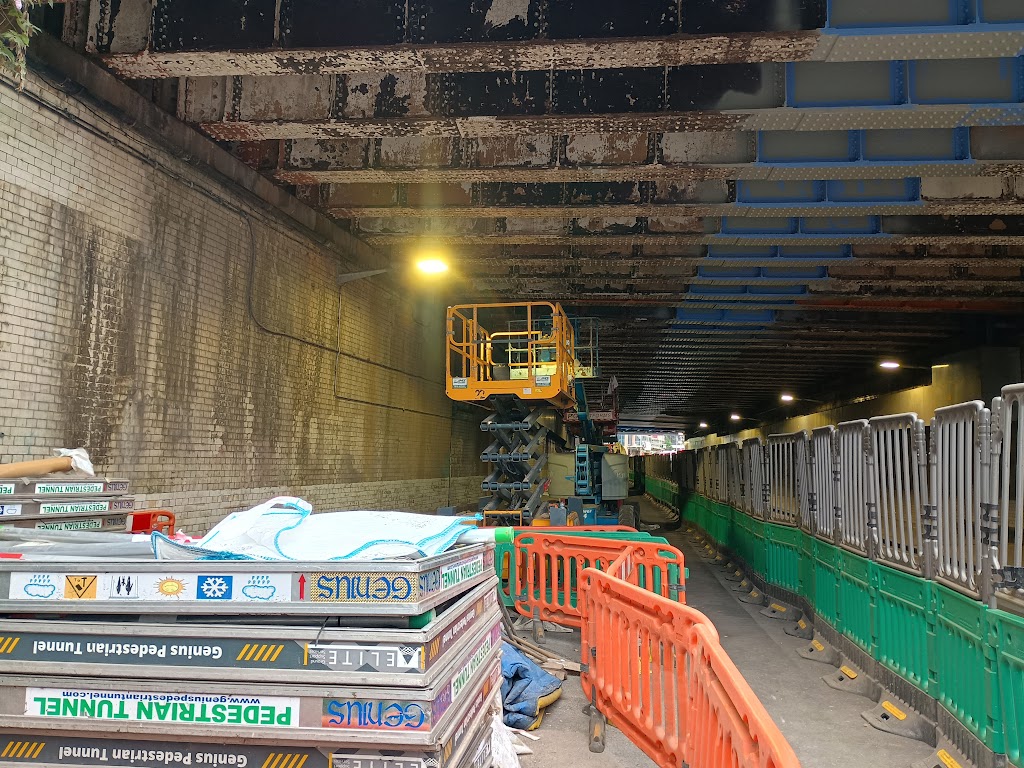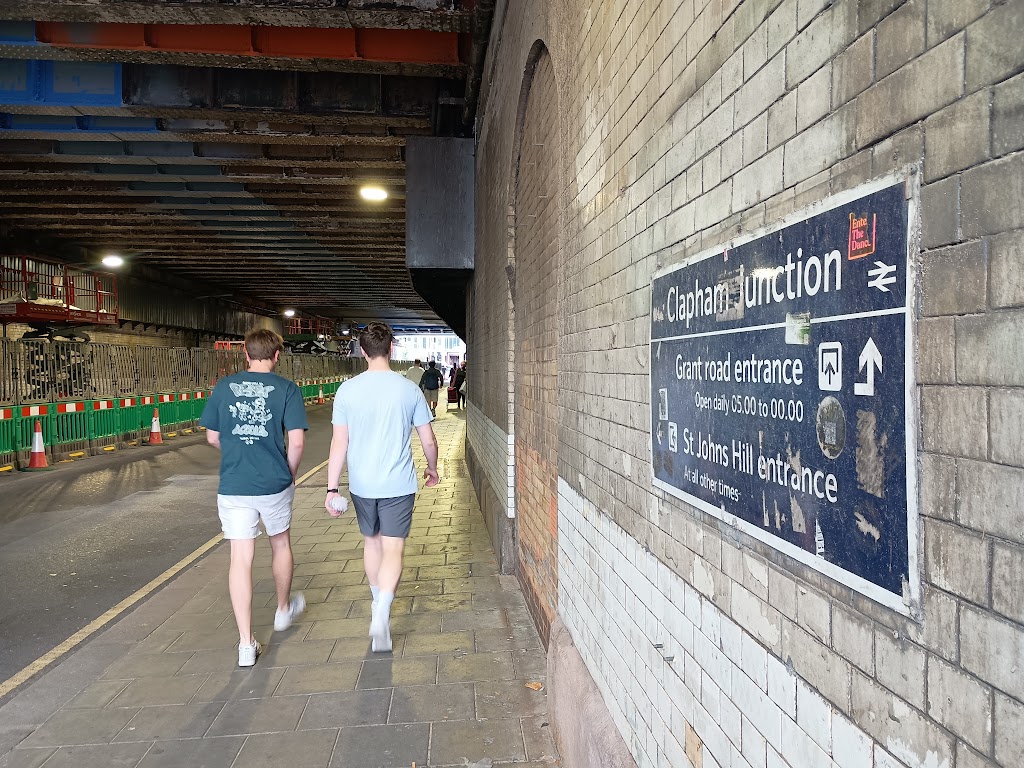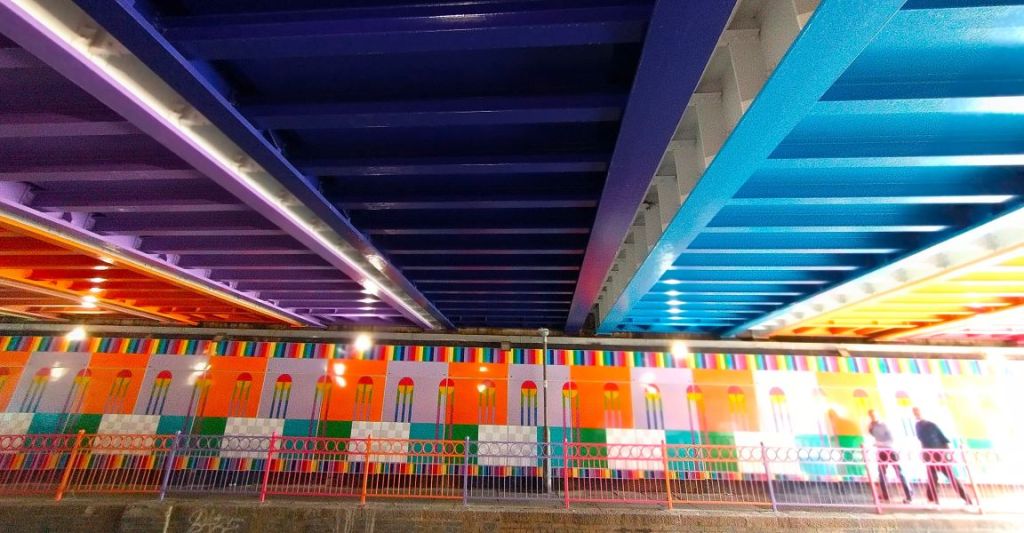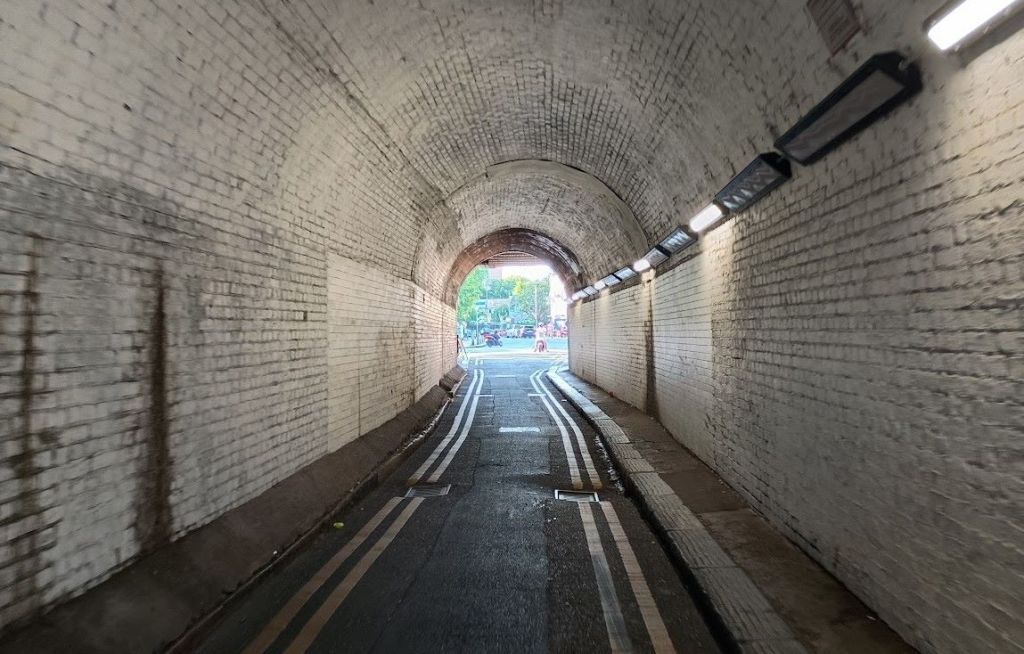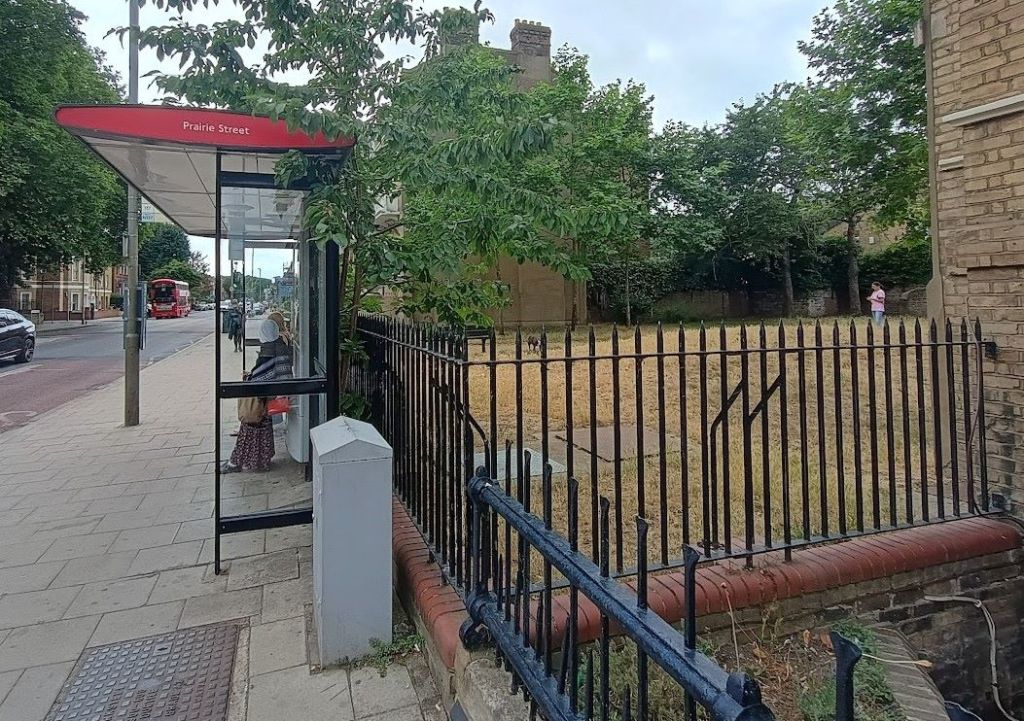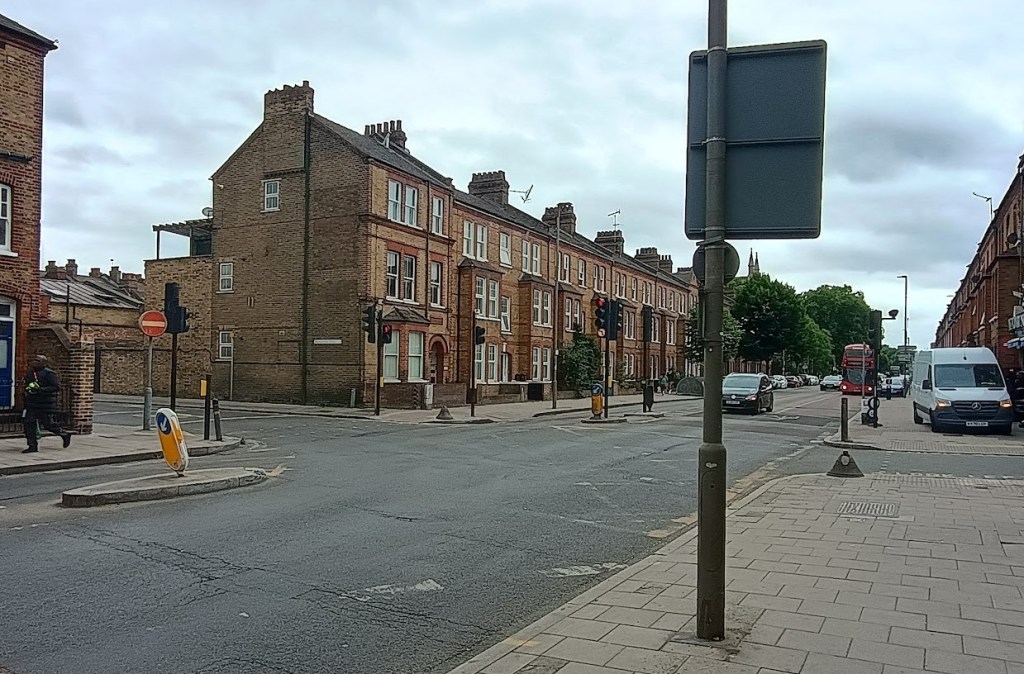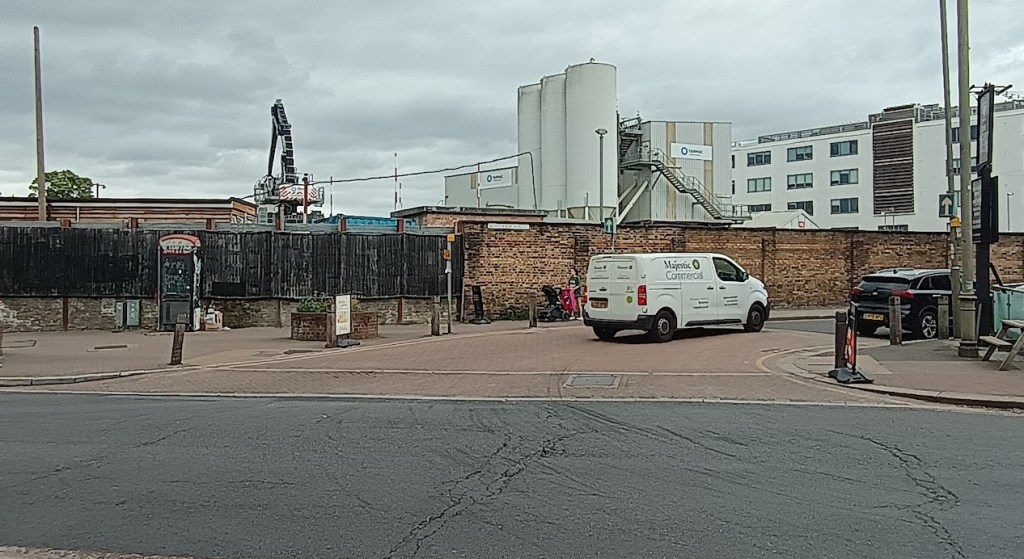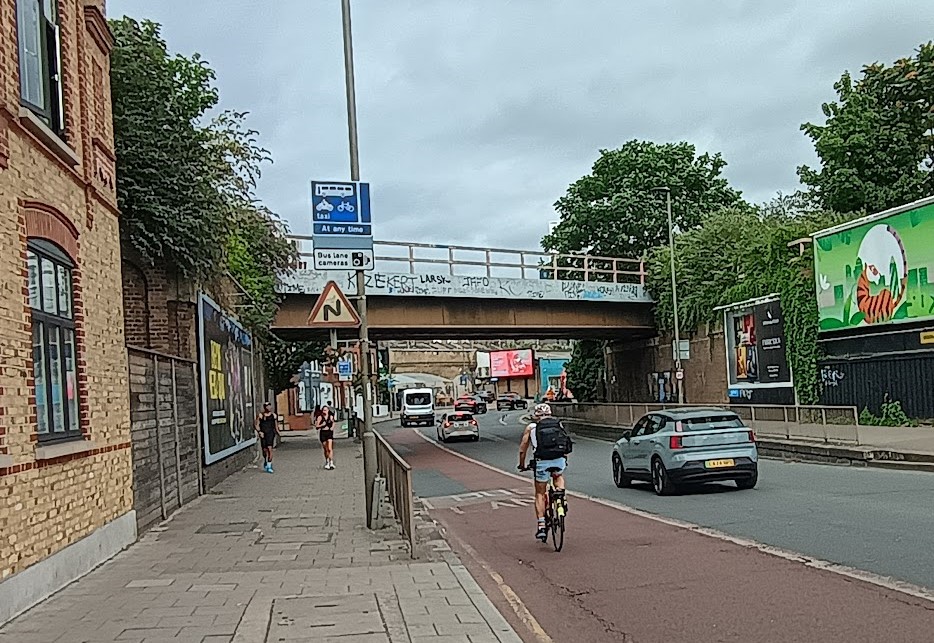
In pictures: Falcon Road bridge’s transformation

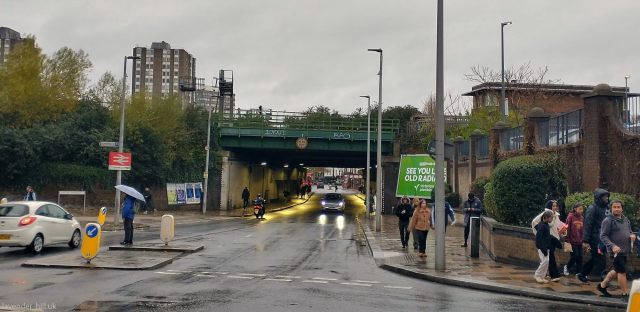
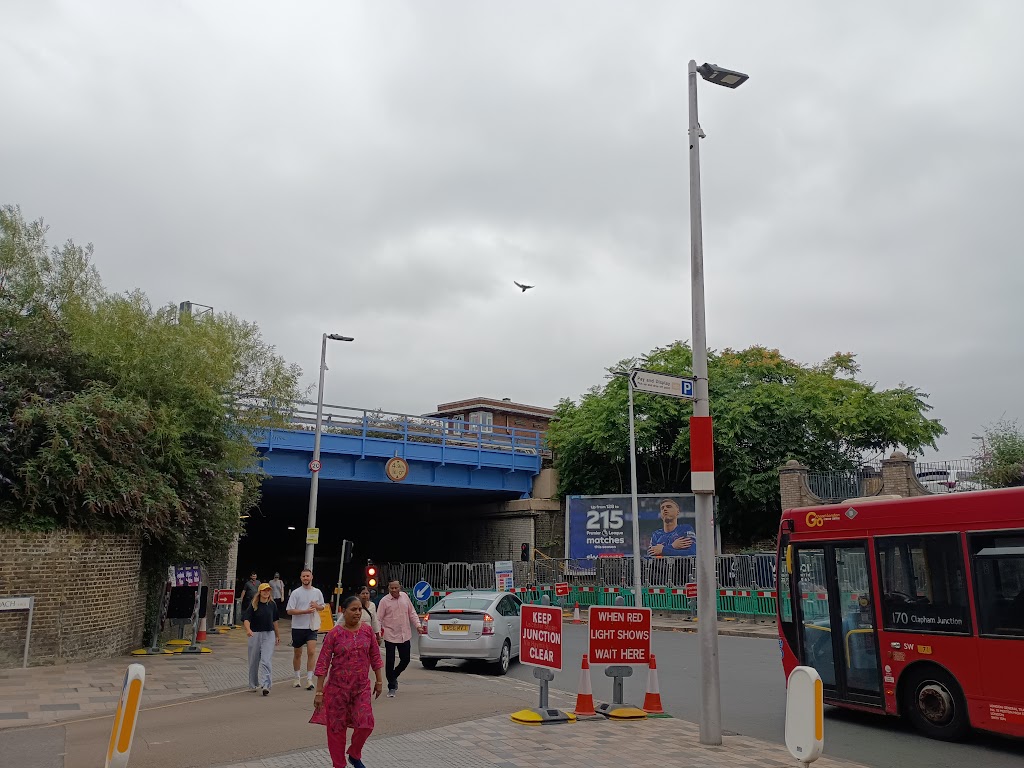
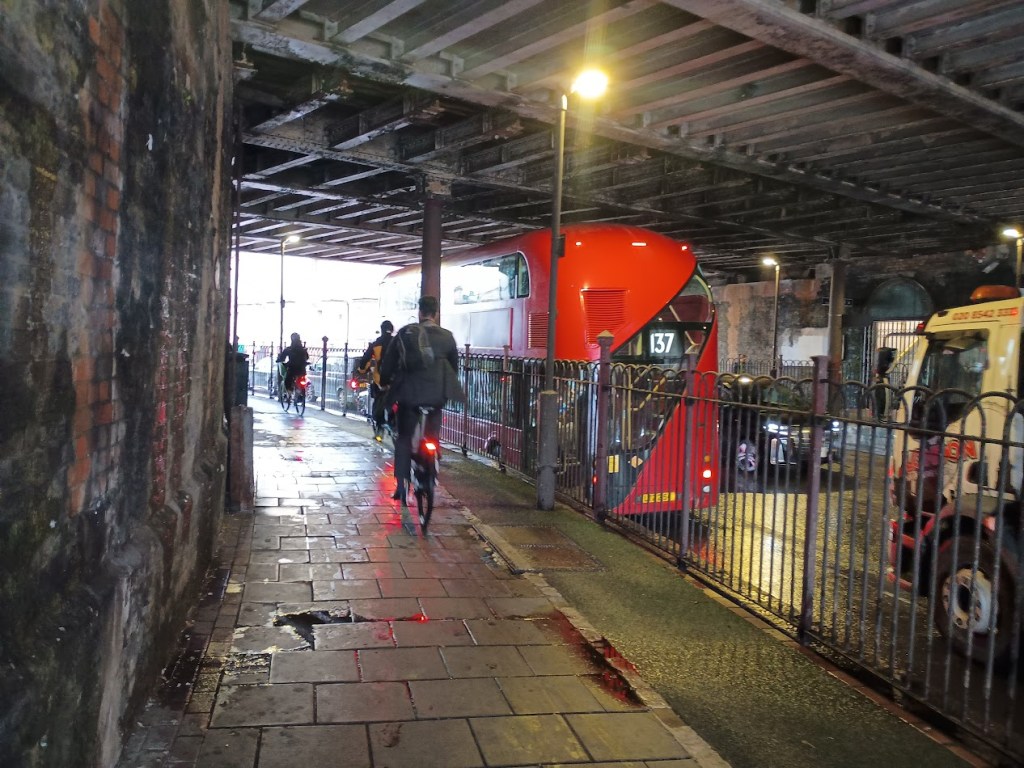
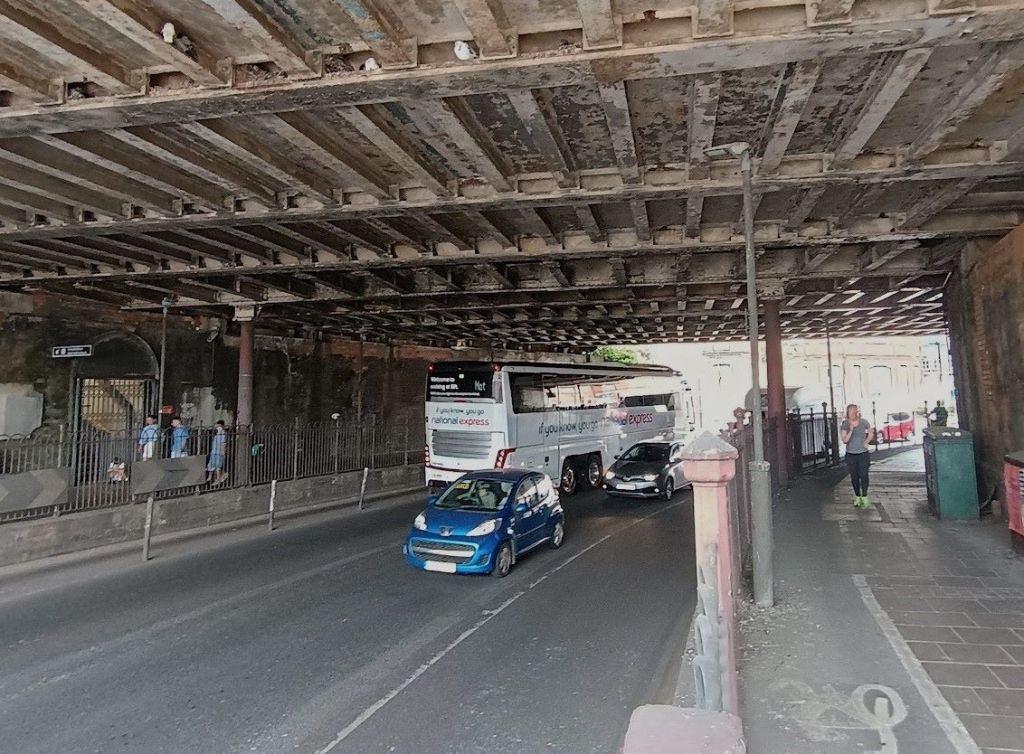
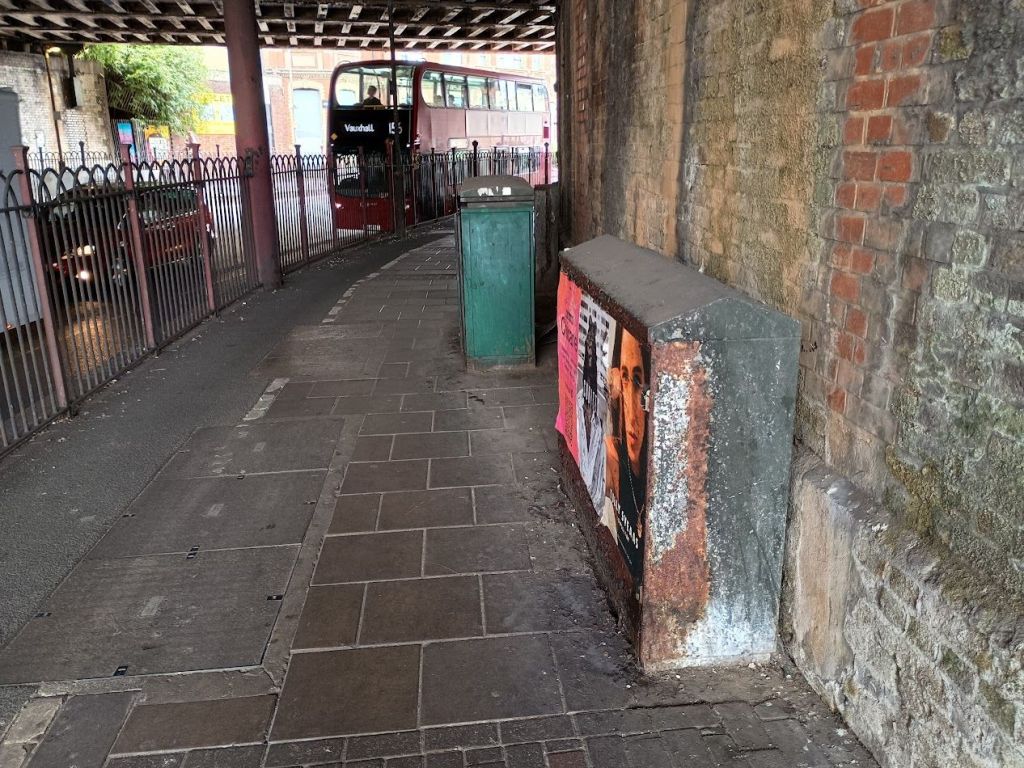
As we wrote way back in 2019, nobody likes the Falcon Road railway bridge. Dark, loud, mucky, and always wet, the need to run the gauntlet of drips and pigeon poo is an unpleasant part of the day for those of us who use it. It’s been splitting Clapham Junction in two from the very beginning, as the railway junction was pretty much the reason a town centre was built here. Over 100 metres long and running under nineteen railway lines in one go, it has reinforced a long running north / south divide in Battersea, condemning those on the north to a rather grim walk to get to the main town centre, and preventing the many businesses on the Falcon Road benefitting from being so close to the crowds of people at Clapham Junction.
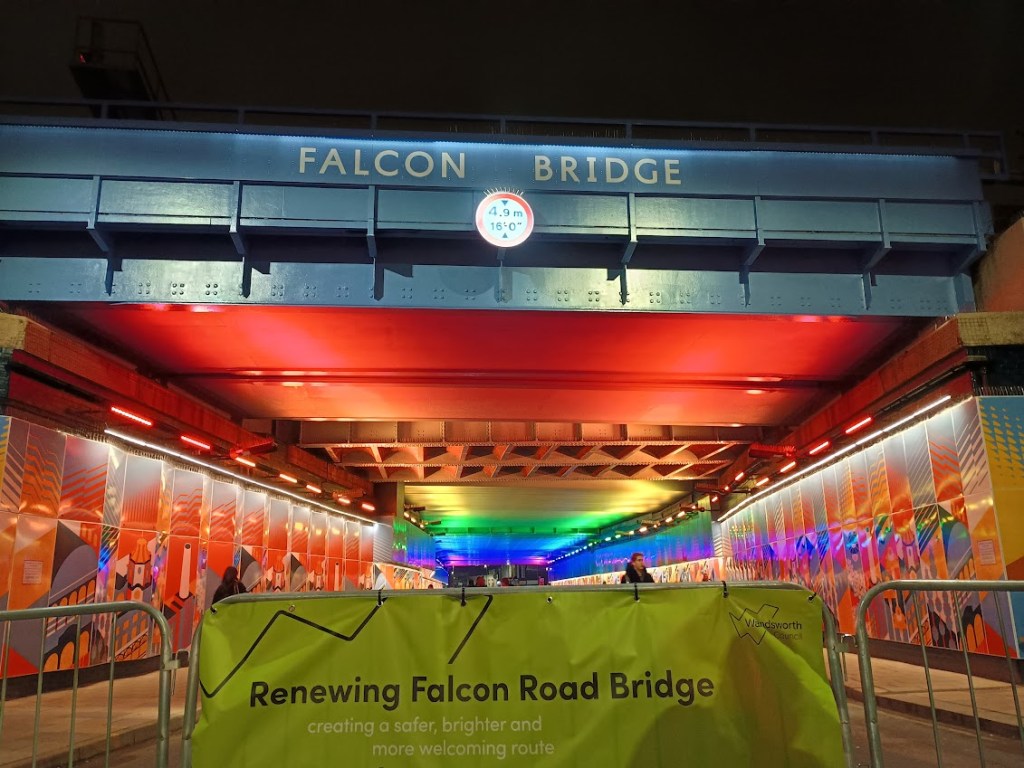
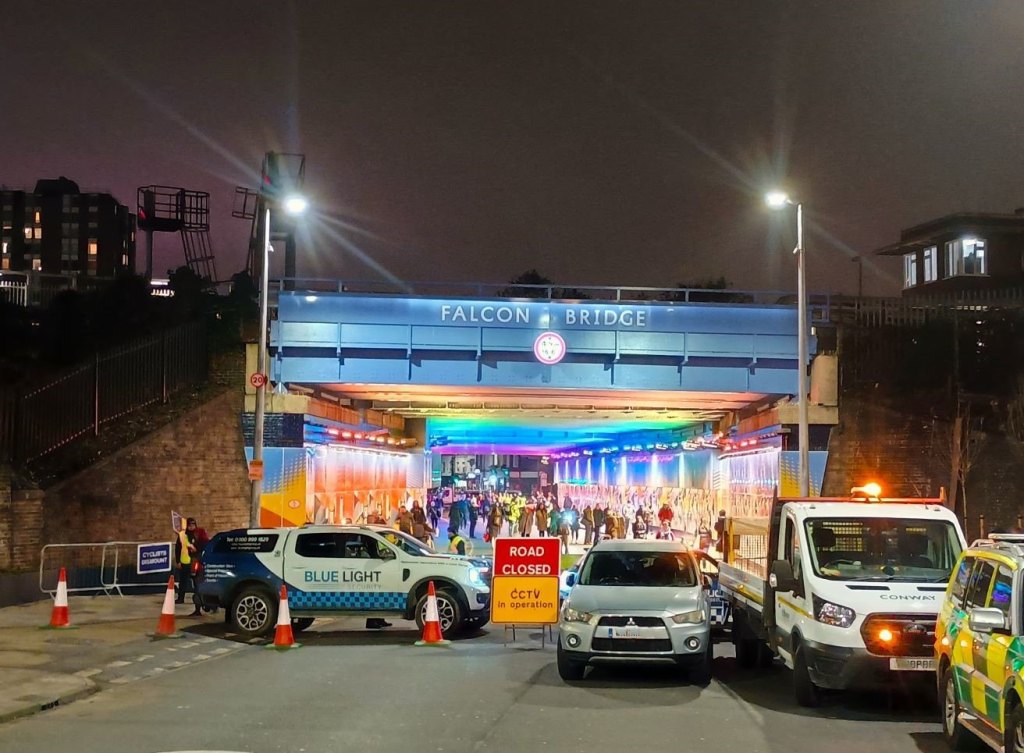
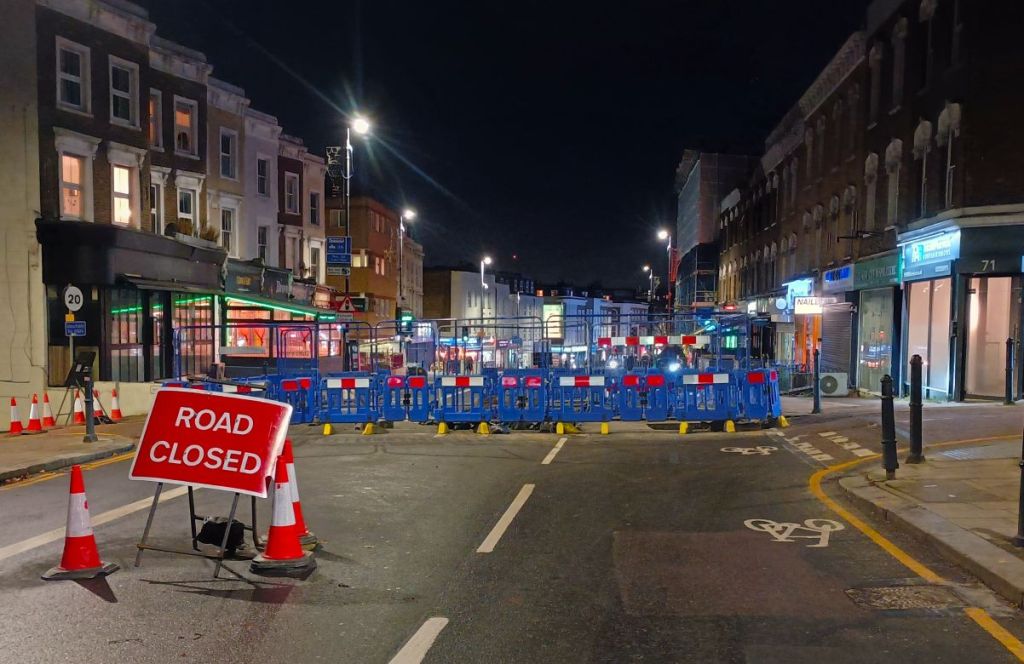
But that has changed. Wandsworth Council has been on a push to renew and clean up our town centres, and one thing that emerged time and time again in discussions with residents was Falcon bridge! They decided to go for it – making the most of the ‘neighbourhood improvement’ funding coming from a lot of the big housing developments along the riverside – and kicked off a major project to completely transform the look and feel of the bridge. There would be no half measures here, this was to be a proper effort that would make an impact. And after months of preparation, and three months of building work, the road briefly closed last night to celebrate the completion of the works.

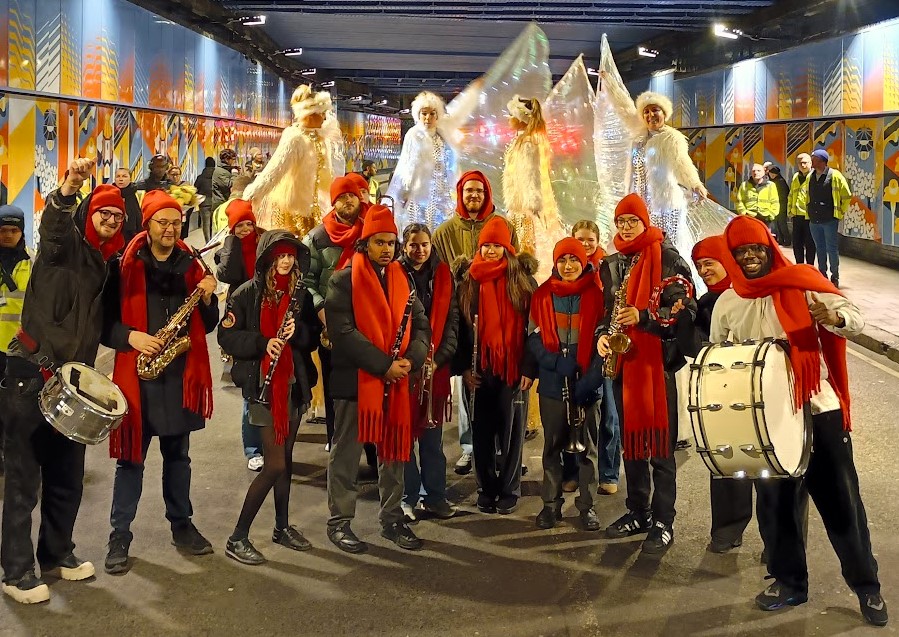
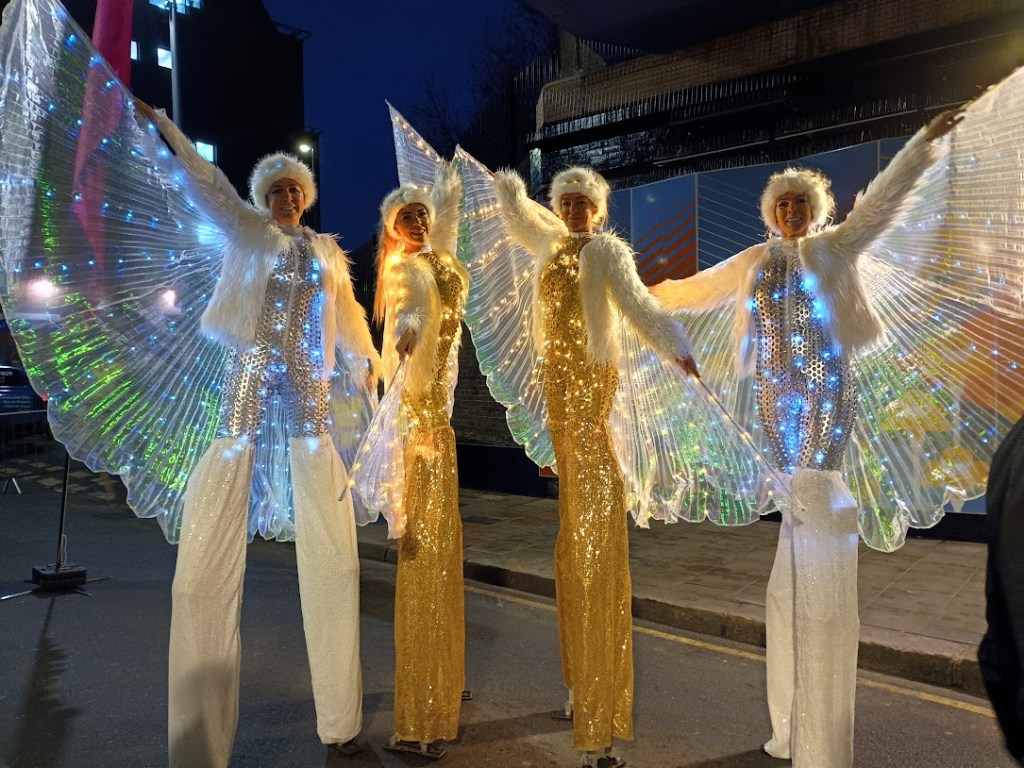
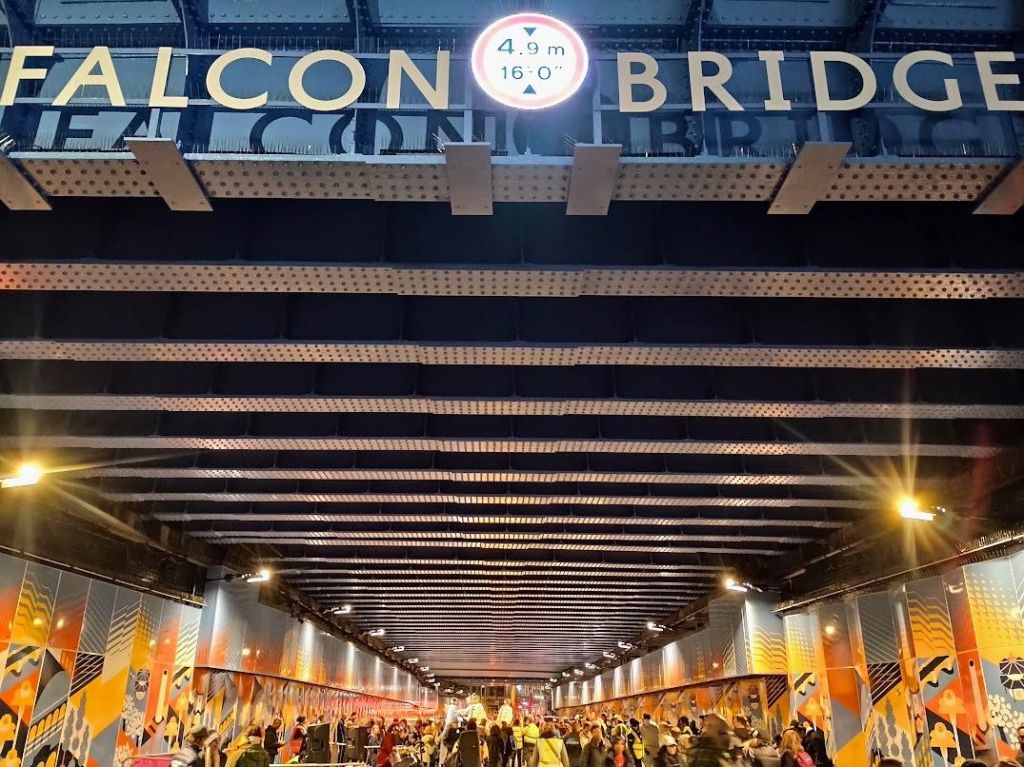
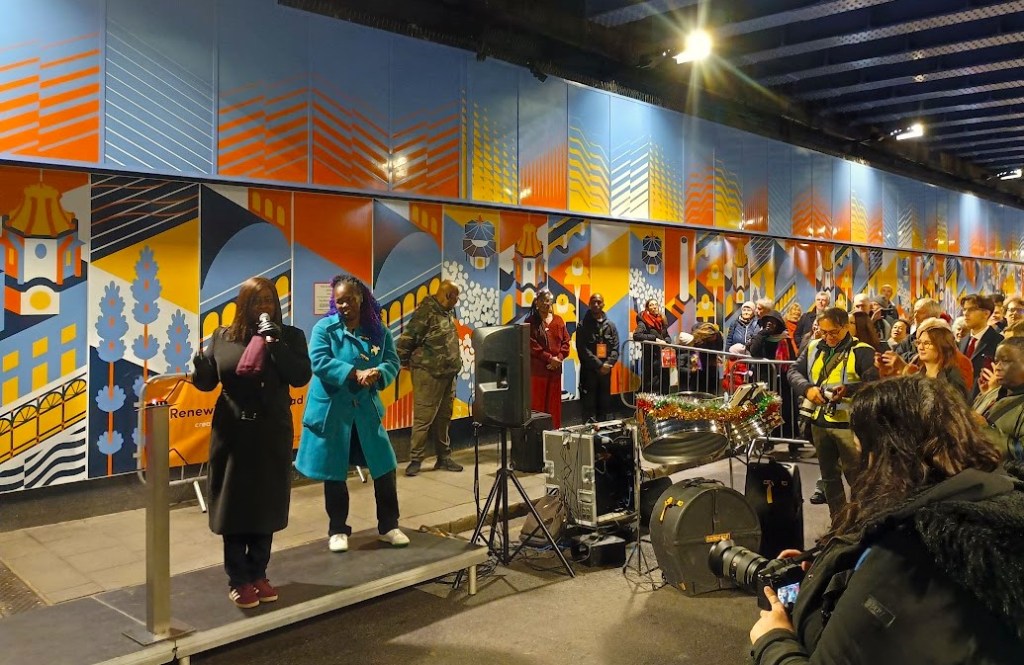
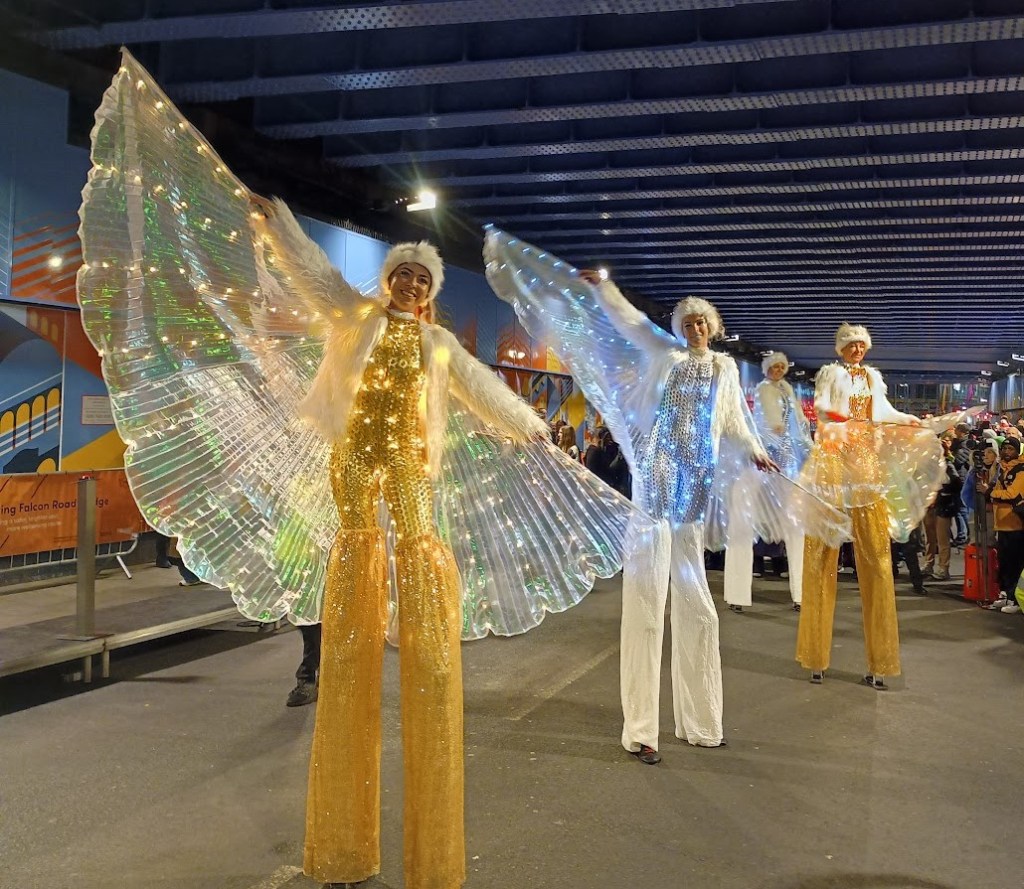
It’s the first time there’s ever been an event actually under the bridge! Even if it had been possible to close the road before, the venue would have been too dirty and unappealing to want to – but this time passers by were surprised to see a full range of entertainment, and the crowd grew quickly. The Falconbrook School Steel Pan Band set the scene, making the most of the acoustics, followed by the Brass Band from World Heart Beat, accompanied by stilt walkers.

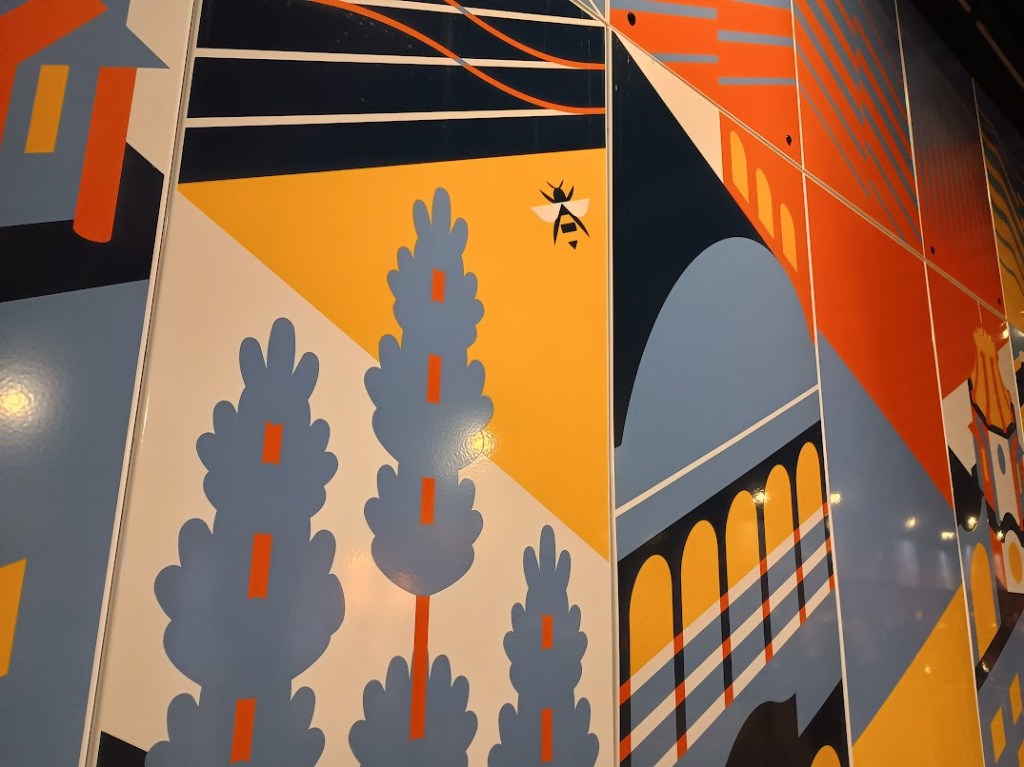
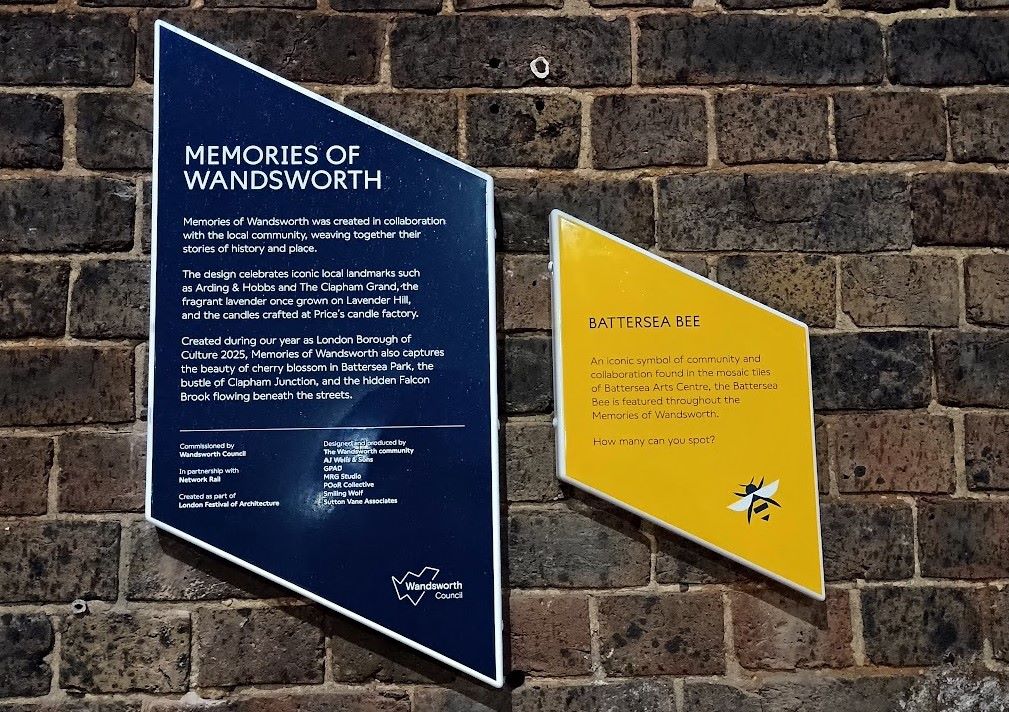
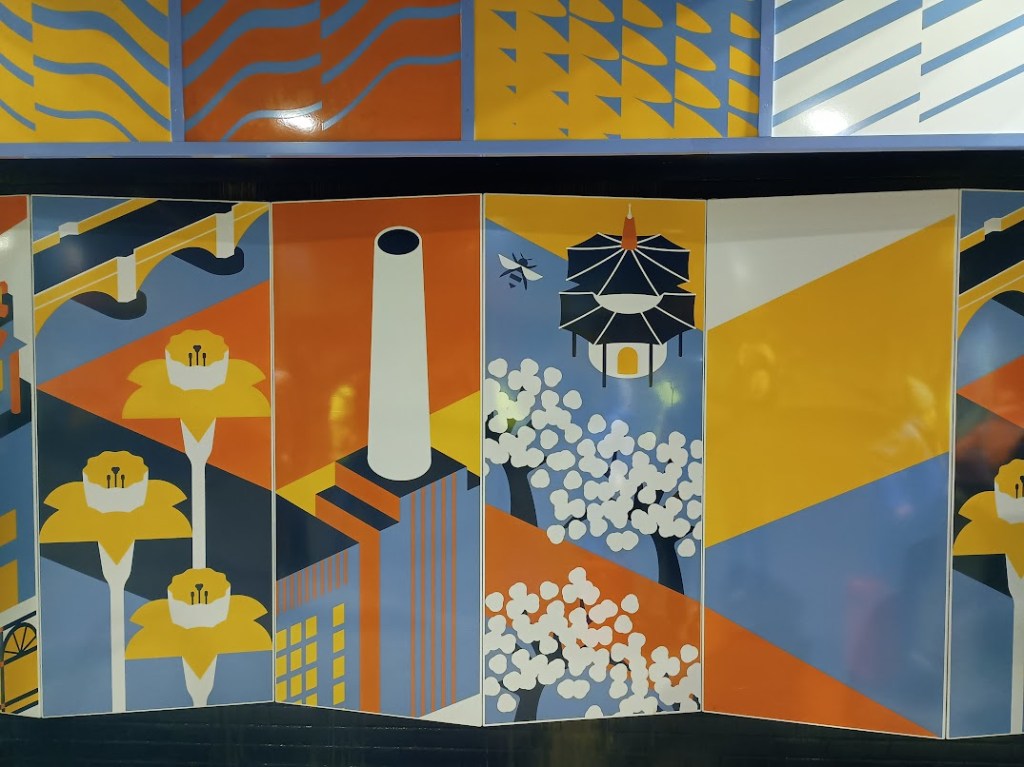
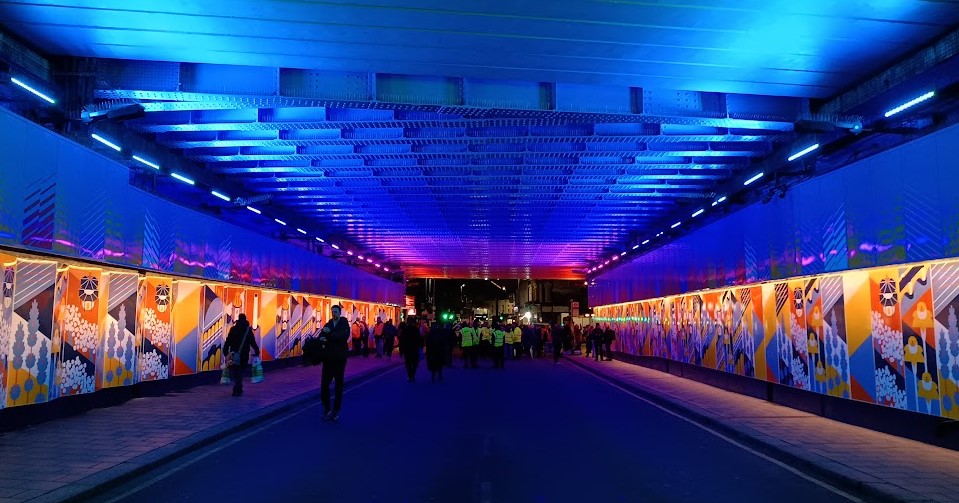
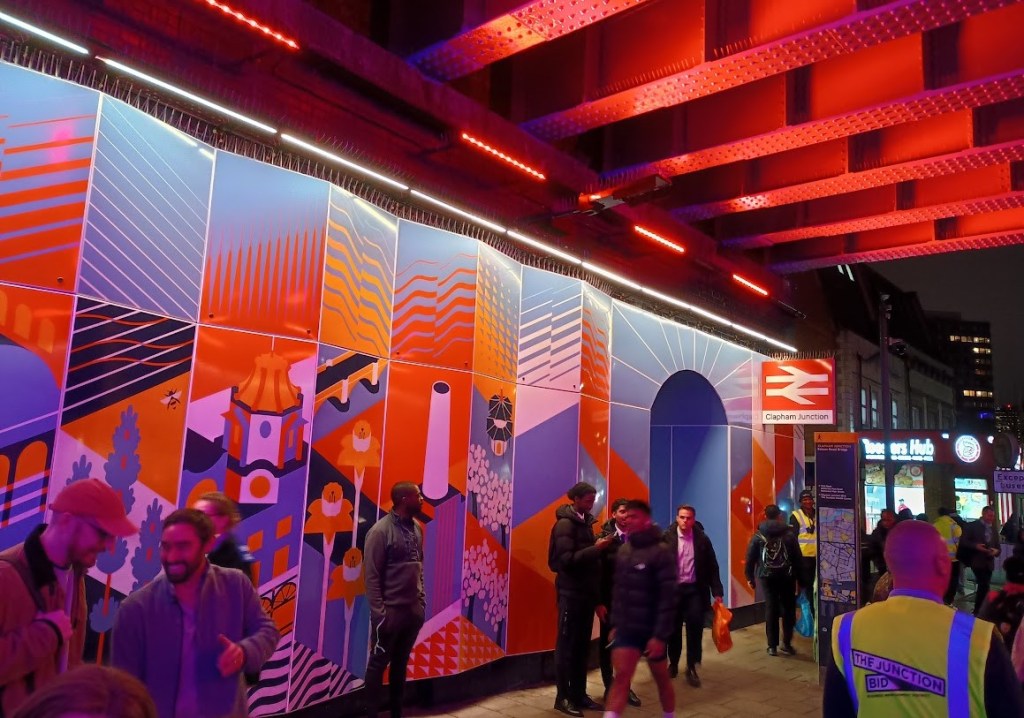
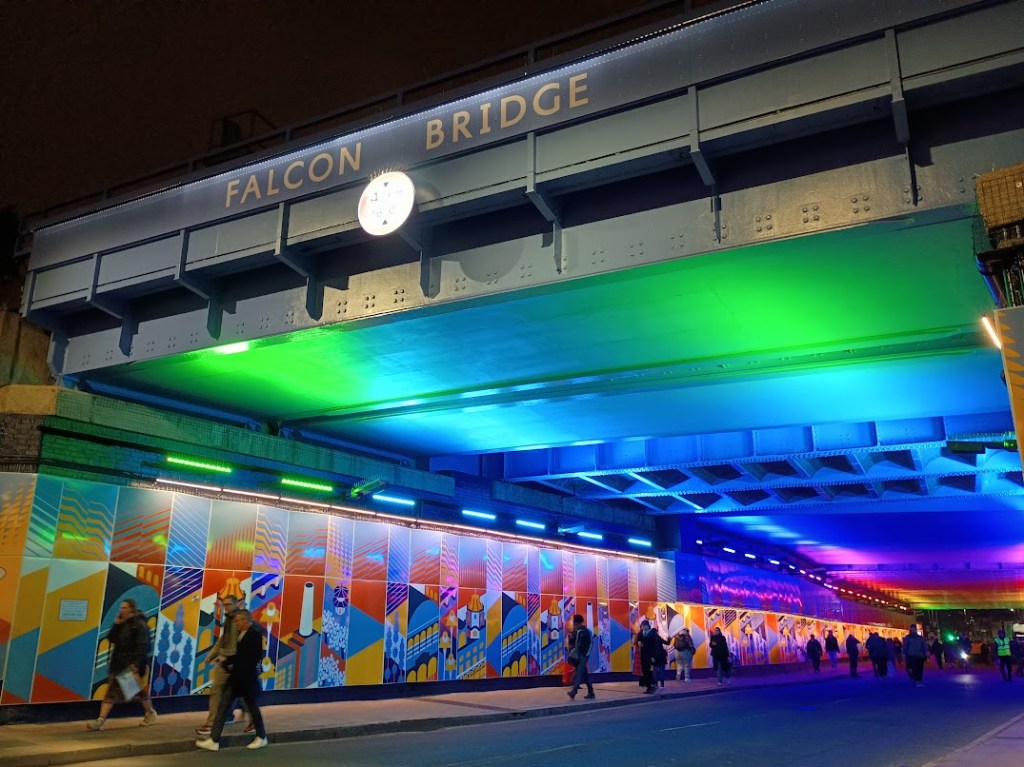
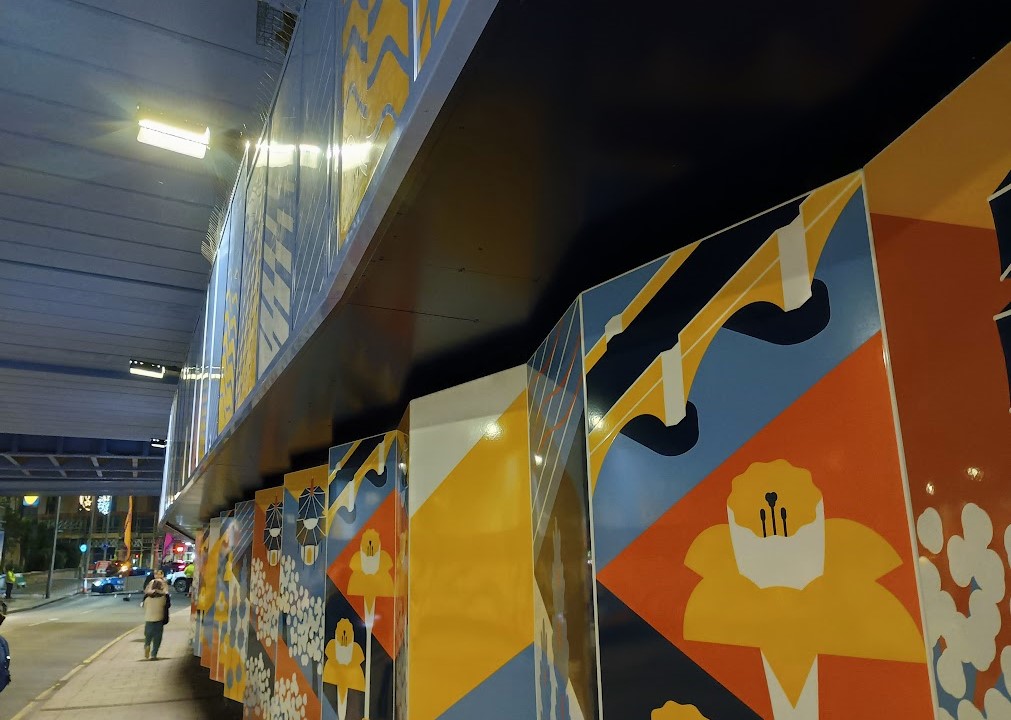
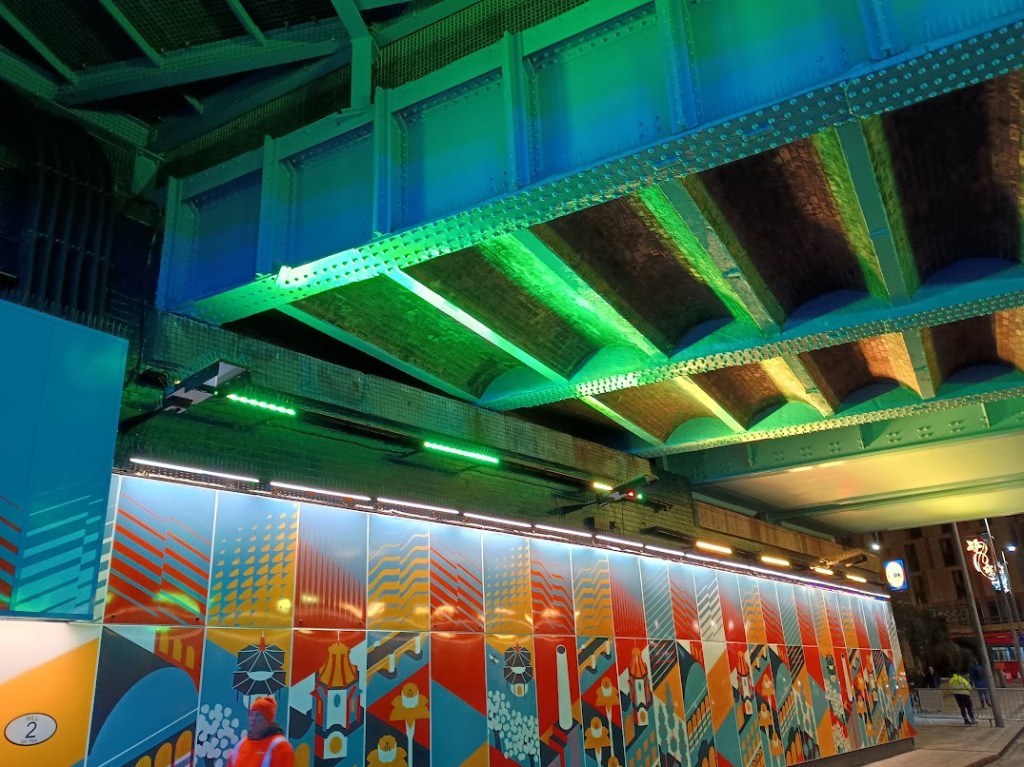
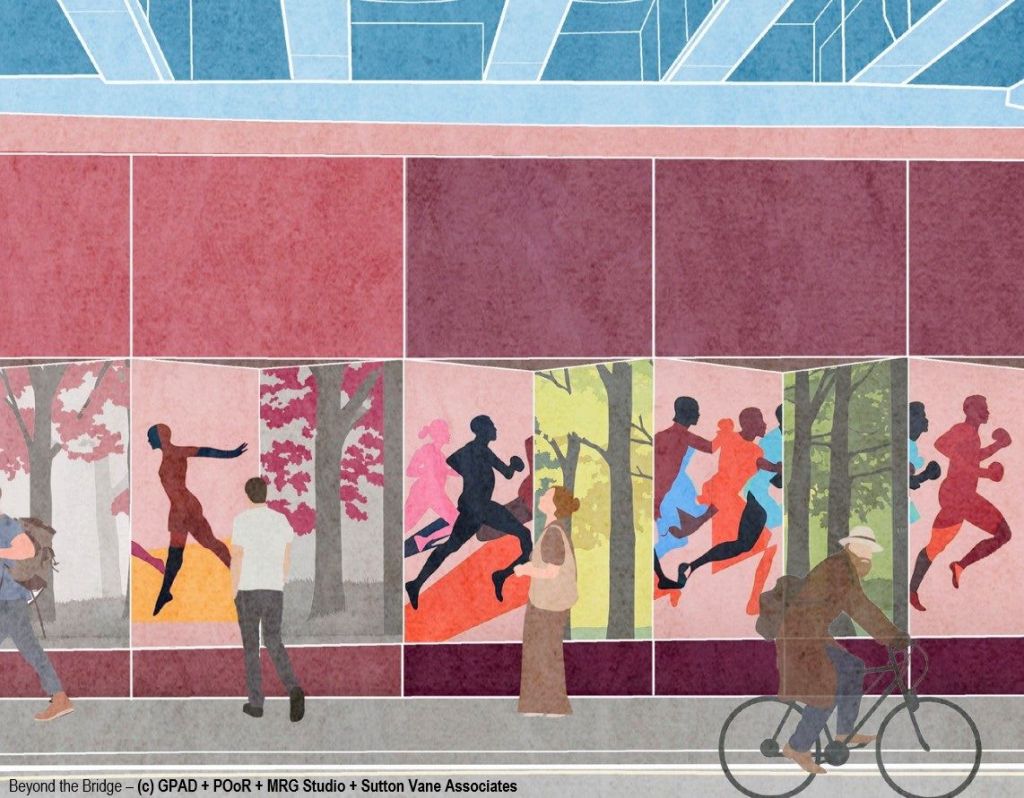
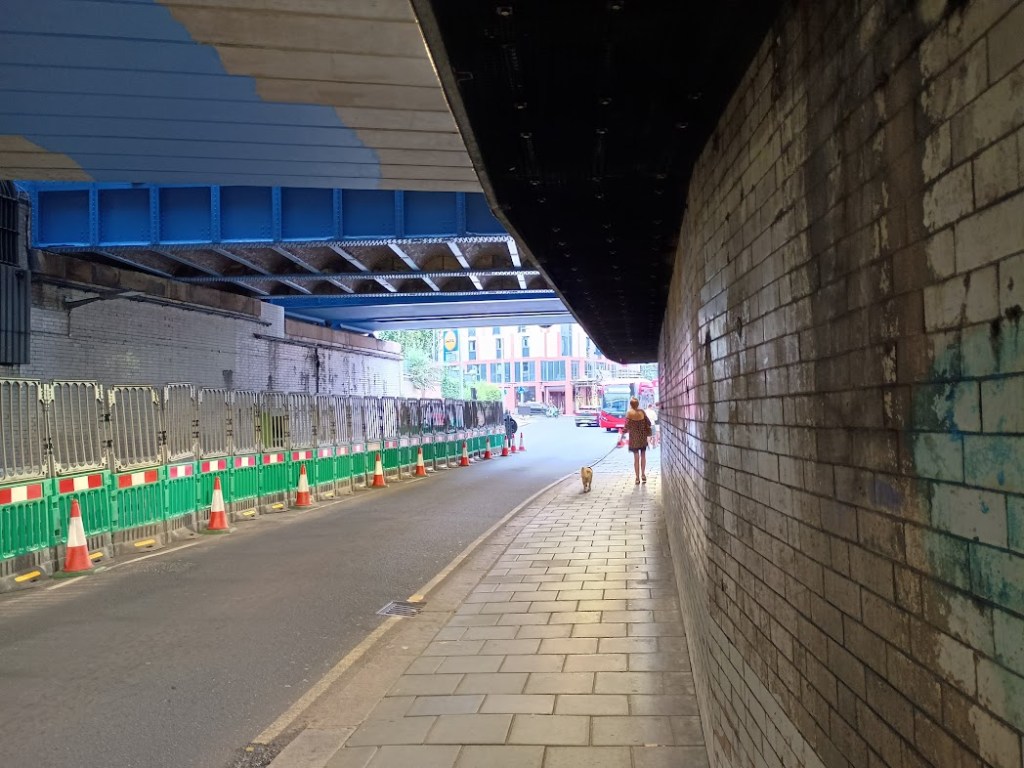
As everyone gathered for the opening, it was already clear that the bridge has a very different look and feel. It’s clean, it’s bright, and maybe most surprisingly of all, it’s dry. The entire wall surface has been covered with five hundred enamel panels, whose designs were developed in a serie sof community workshops. They include stylised images of Battersea Bridge, the Price’s Candles factory that once occupied a huge area north of the York Road (and which, even though the last part of the business moved out to Bedford in 2001, remains the largest British owned candle maker), the Peace Pagoda, Arding and Hobbs, Battersea Power Station, cherry trees in Battersea Park, and of course our favourite the lavender of Lavender Hill.

The panels also include daffodils – which (thanks to one of our readers) we know are a nod to the five hundred daffodils planted in Christchurch Gardens by pupils at nearby ChristChurch primary school. The gardens – slightly hidden behind a fruit and veg shop at the other end of Falcon Road – include a relatively little known memorial to those we lost, and flower each spring in memory of the civilian casualties in Battersea during World War II. The planting followed an oral history project interviewing people who were living in Battersea during the war (whose summary includes many eyewitness accounts and can be downloaded here).

The mural also includes lots of Battersea bees. The bee has long been a symbol of Battersea, so much so that many bees feature in the mosaic floors at Battersea Ars Centre, from when it was Battersea Town Hall. It reflects the industrious and community minded people of Battersea – and maybe also the prevalence of bees back when large parts of the low lying area along the riverside were market gardens that were known for their production of quite exotic fruit and vegetables for London’s markets, as well as the Lavender fields up towards Lavender Hill.

One reference that may be less immediately apparent is flowing water, shown on several of the panels – the ones that also show Arding & Hobbs. This isn’t a reference to the ominous drips that used to rained down on pedestrians – rather it’s a nod to the Falconbrook river, which is responsible for the clear dip between Lavender Hill and St John’s Hill. Once a quiet rural river winding its way through the fields from Balham to the Thames, it was buried soon after the station was opened, and it now flows – quietly and unseen – under our feet as we walk through Falcon Bridge, before heading off under the York Road Estate, and under the remaining buildings of the Price’s Candles factory.

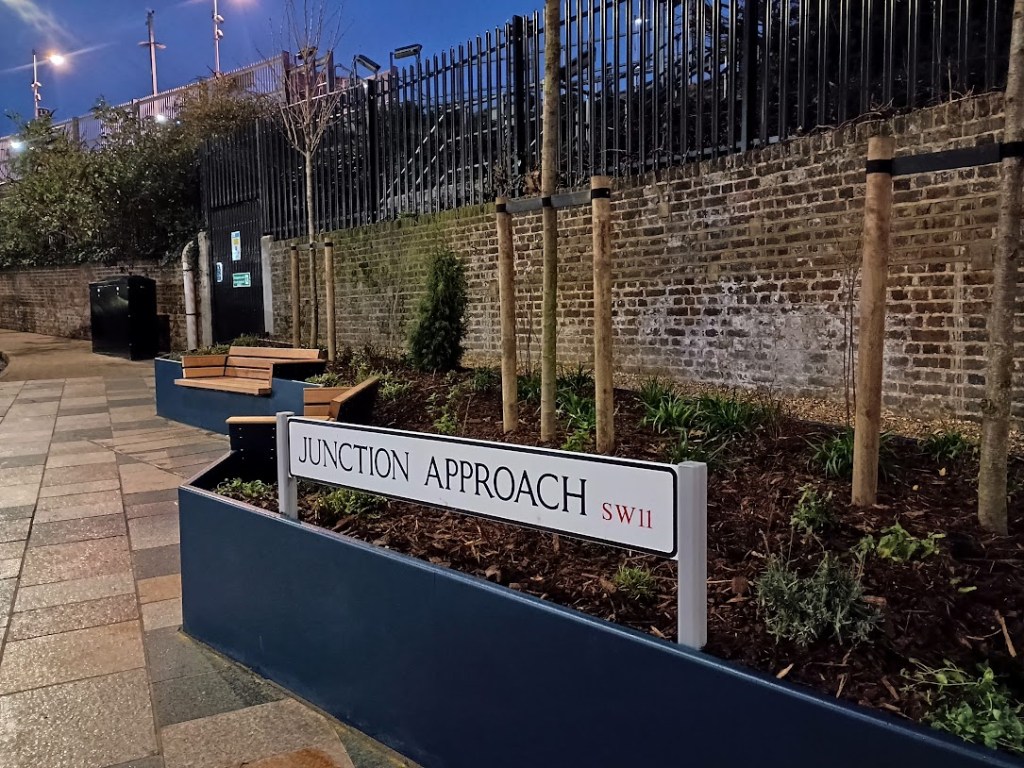
It’s not just about the bridge: there used to be scruffy patches of wasteland and unofficial advertising hoardings at each end of the bridge; those have been replaced with new planting and seating more or less following the design in the original competition.

But now it was time for the main event. Kemi Akinola (deputy leader of Wandsworth Council), Marsha de Cordova MP, and Simon Hogg (leader of the Council) spoke about the project. As a key event in Wandsworth’s year as Borough of Culture, this was a chance to celebrate the community and local landmarks, with a design that reflects the cultural identity of Wandsworth.

It was also a chance to finally deal with a bridge that had been deeply unpopular with residents, for being unpleasant and unsafe, and that had split Clapham Junction and Battersea for too long.

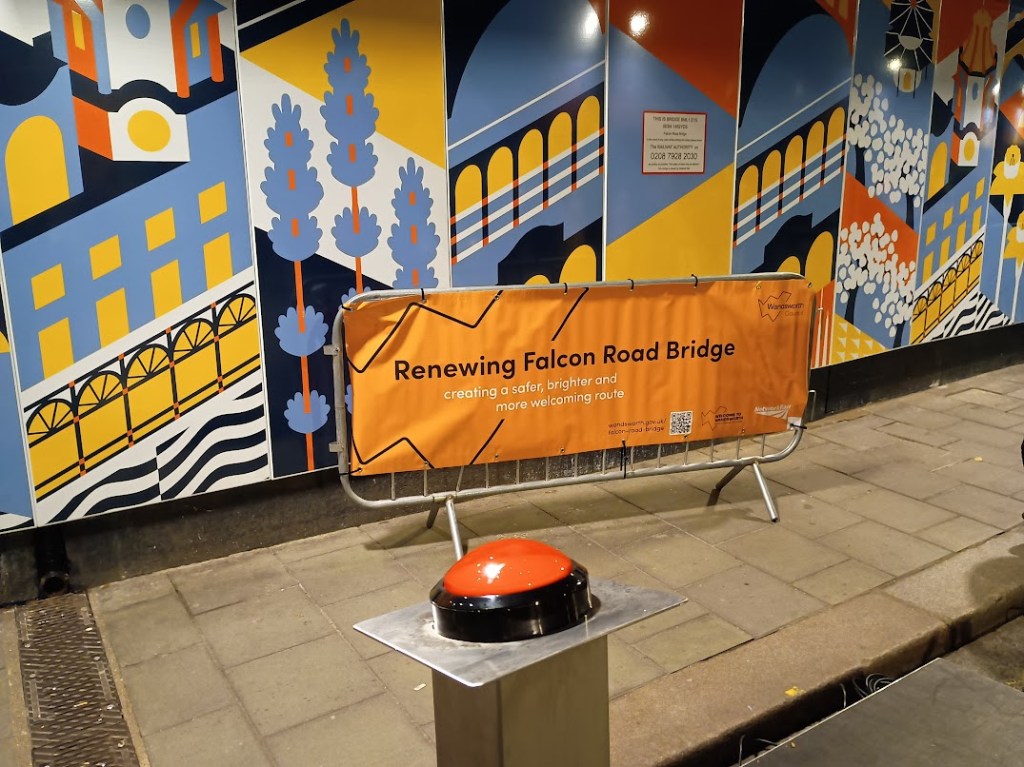
Thanks went to 1,000+ residents who had been involved in the consultation and design stages, the design team who had turned ideas in to a reality, the engineering team at Conway who had managed a complicated build, and to project manager Sam Emmett for leading what had been a complex project bringing together lots of different organisations and managing a fair few challenges. But now it was time to dim the main street lighting, and for the big red button…

And Falcon bridge’s lighting was switched on…

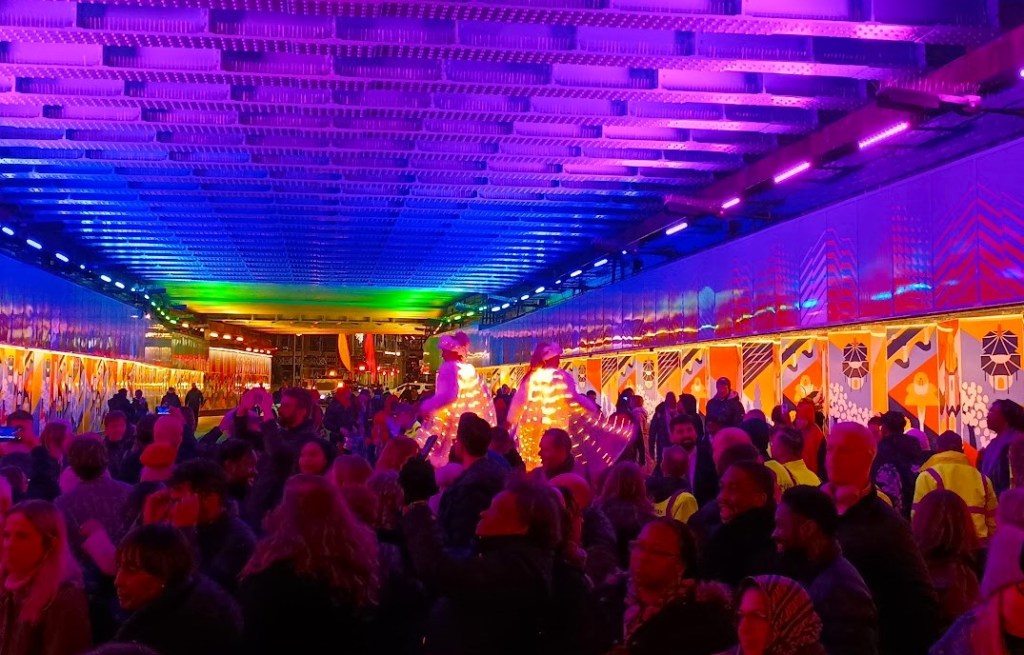
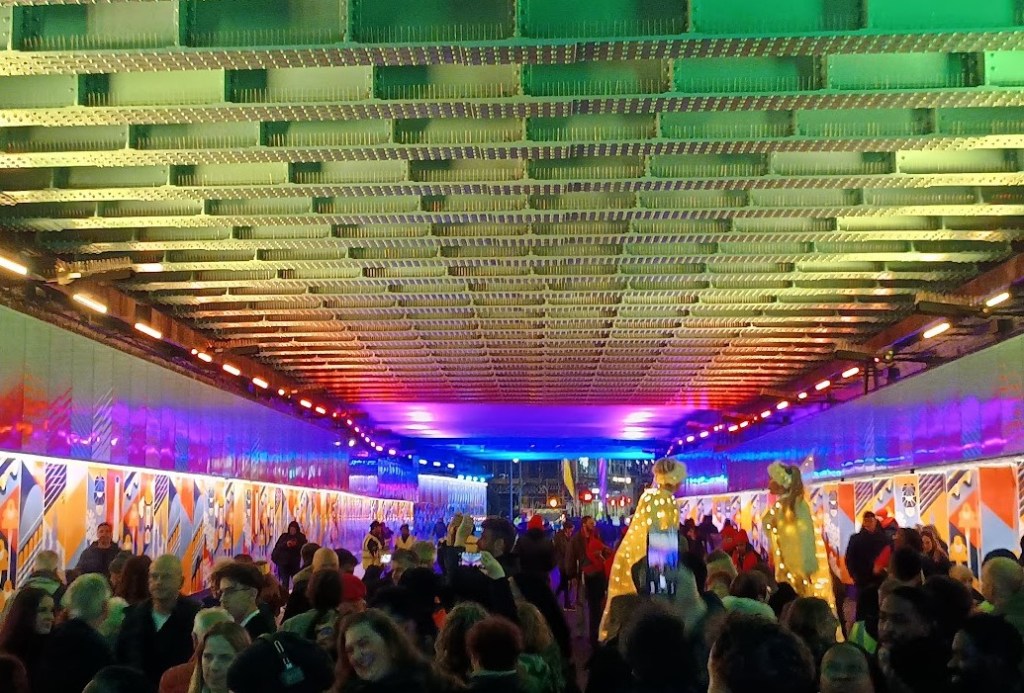
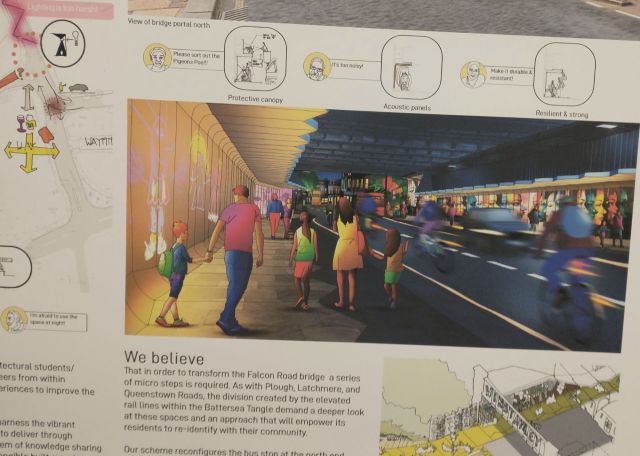
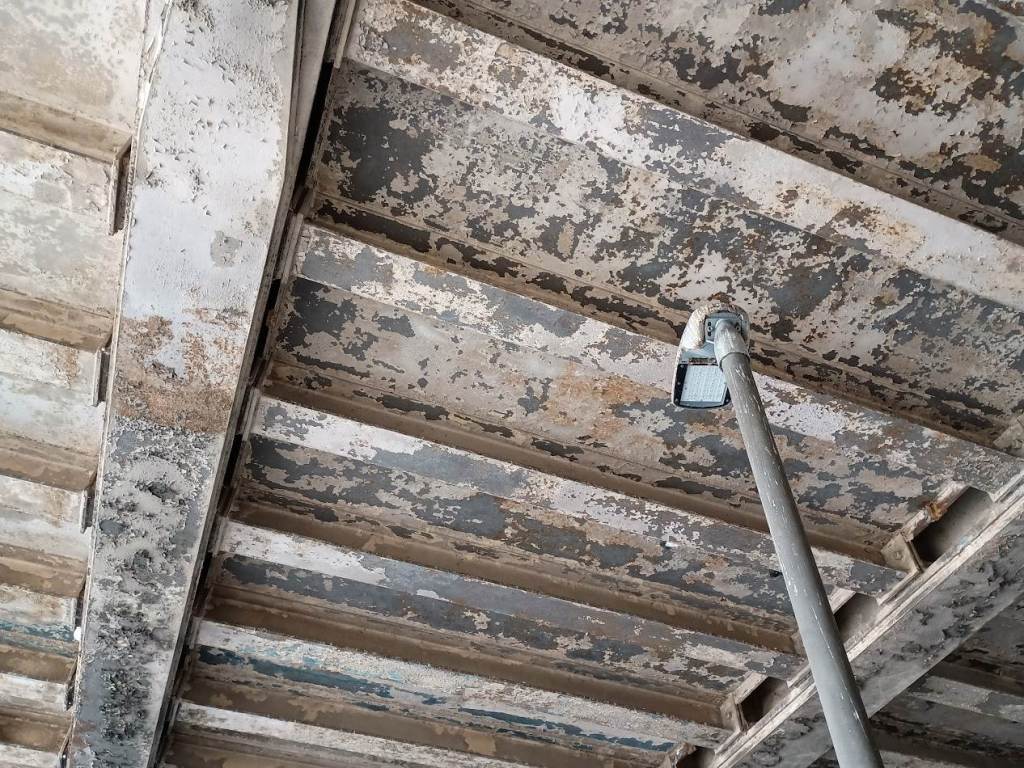
And the whole bridge lit up. There are upwards and downward facing lights, all of which are individually controlled. The main roadway lights have also been replaced with new ones that are more directional and pigeon proofed (and thanks to legendary London reporter Ian Mansfield, who was also at the launch, we now know that the lights are brighter in the day than at night – to avoid making the contrast between inside & outside the tunnel too sharp). The Victorians who originally built the first spans of Falcon bridge, as a workaday thoroughfare between the new suburban town centre being laid out to the south and the fields and distant village to the north, would never have expected it to look like this.

The design team at GPAD and POoR Collective was at the launch, to see the way people were reacting to the bridge – as it’s much more real now that it’s built. The bridge, and the lighting, were clearly making an immediate impression on passers by who hadn’t expected to see anything going on on a slightly rainy Monday evening.

So was the team from FM Conway who had done the construction and installation – and who many of us will have seen on site for several months – were also present. It has been quite a complicated project to deliver – with a live railway and road, pedestrians day and night, and the need to keep closures of the road and lanes to a minimum, while also dealing with an old and rather unpredictable underlying structure. It’s not every day that a project gets such a big launch, and they were pleased to see a job well done, and getting so much public attention!

The five hundred wall panels are made of vitreous enamel – maybe better known for its role in sauce pans that last forever, and which is an exceptionally durable surface finish that withstands all the elements, the team at A.J. Wells who made the panels had made the journey to see this in action. They’re well known as the maker of TfL’s signs on the tube, they were pleased to see the way this had made such a local impact – while the project wasn’t technically unusual for someone used to making robust products for complicated sites, there have only been a few cases of enamel being used at such scale under bridges, and Falcon Bridge was already leading to interest elsewhere.

We also spoke to Sam Emmett, who has managed the overall project – and who was able to answer many of the questions we’ve had from readers over the last few months! It was clear this has been a complex project but also a particularly rewarding one, especially as the changes to the bridge have become much more visible in recent weeks. Sam noted that right from the start the design has had to work closely with Network Rail – who own the bridge, and who also need access to the signal cables and structure on an ongoing basis. While that is never a straightforward thing to do, the team were clearly appreciative of Network Rail’s efforts to help the project progress.

What about the pigeons, who used to be the only ones to love the bridge, and who seemed to lurk on the girders in huge numbers? The cable ducts that run above both pavements had notoriously become home to thousands of nesting pigeons over the years; and the project team worked with a wildlife group to re-house them elsewhere, and keep a check on their health in doing so – so that the original perches could be given a deep clean, and then pigeon proofed with grills and deterrent spikes. There will still be occasional pigeons there for three or four months (as they are used to it as a location) – but thanks to thousands of spikes and surface treatments the bridge is now much less attractive, and they are moving elsewhere.

Graffiti is another concern, and featured heavily in the design thought. The secret weapon here is the enamel material used for all of the wall panels. It’s super tough – way more resilient than any paint cold ever be – and is about as graffiti-resistant as it gets. Sam confirmed that there has already been a tag (a green one about a foot wide) and it just wiped off without needing any chemicals or equipment at all.

Handling water and drips was always going to be a particular challenge – with leaks from the tracks above, and the walls also being an especially wet part of the bridge. You can’t realistically treat the original bridge walls to waterproof them: the arches and soil behind them is saturated, they have leaked pretty much from the day they were built, and short of rebuilding the bridge it’s pretty much inevitable that water will continue to seep out.

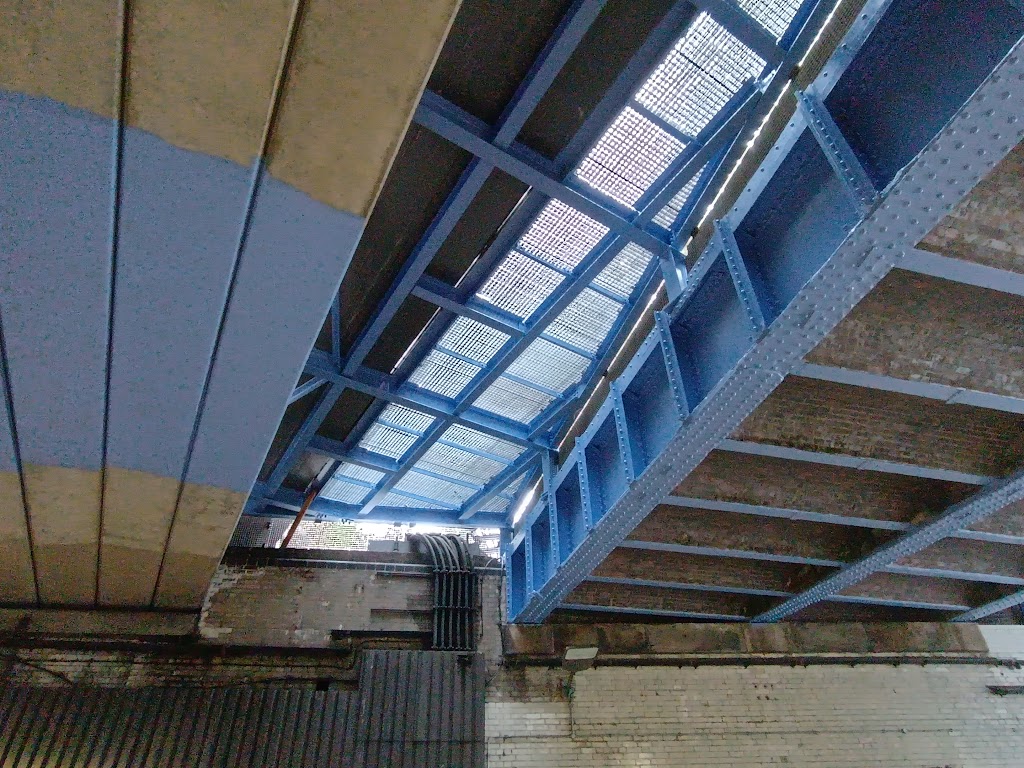
The solution has been to install the panels in a way that is offset from the wall, with a gap behind where the walls can keep leaking water as they always have – which then flows to ground level and in to drains. The cable ducts above the pavement were a little more complex – and the approach there has been to install a drip tray at the base of the ducts – that’s the dark blue bit in our photo above – which channels water over and behind the panels, instead of it dripping on to the pavement (and the effect is quite noticeable – suddenly the walkway is dry!).

Behind the scenes, there are a fair few different kinds of bridge here – a lot of Victorian girder bridges, some more modern concrete beams of the sort you’ll see on motorways round the country, some grid areas where there are short spaces between bridges, and a section of brick arch shown in our photo above. The latter was especially awkward from a ‘drips on to the pavement’ perspective, so the section of brick arch right above the walkway was treated with a waterproofing system, to keep the most important sections dry.

Asked what he was most proud of about the project, Sam said it was the way everyone involved had pulled together to deliver it. It had been very busy – half a road, eight mobile platforms, three subcontractors, over forty people on the case, electrical work, landscaping, waterproofing, all in a small and constrained area that had to be kept open and accessible pretty much throughout. The teams had made it all come together. And the night before, as they had done a quiet test of the lighting to prepare for the big switch on, it was really good to see people saying “oh wow!” as they walked through.

And we’d agree with that reaction. It’s fair to say that historically the area immediately north of the railway has been a bit neglected – and that the deteriorating state of Falcon Bridge had become an only-too-obvious sign of that neglect. The relaunched bridge is the sort of practical improvement that improves everyone’s experience of our town centre, and helps re-join the communities on the two sides. Wandsworth have done something good here, taking one of the worst features of Clapham Junction, and delivering a proper transformation.

Lavender-hill.uk is a community site covering retailplanning and development  and local business issues, and sometimes posts like this one on transport and the environment – all centered on the Lavender Hill area in Battersea. We sometimes also post more detailed articles on local history. We first wrote about Falcon bridge on sister site Clapham Junction Insider way back in 2019 – What can we do about Falcon Road’s horrible railway bridge? – and reported on the works in progress back in September. If you found this interesting feel free to sign up to receive new posts by email (for free, unsubscribe anytime).

Posted in Environment, Photo stories, Street by street, Transport | 2 Comments

In pictures: Himalayan Salt, a smart new Indian restaurant, opens on Lavender Hill

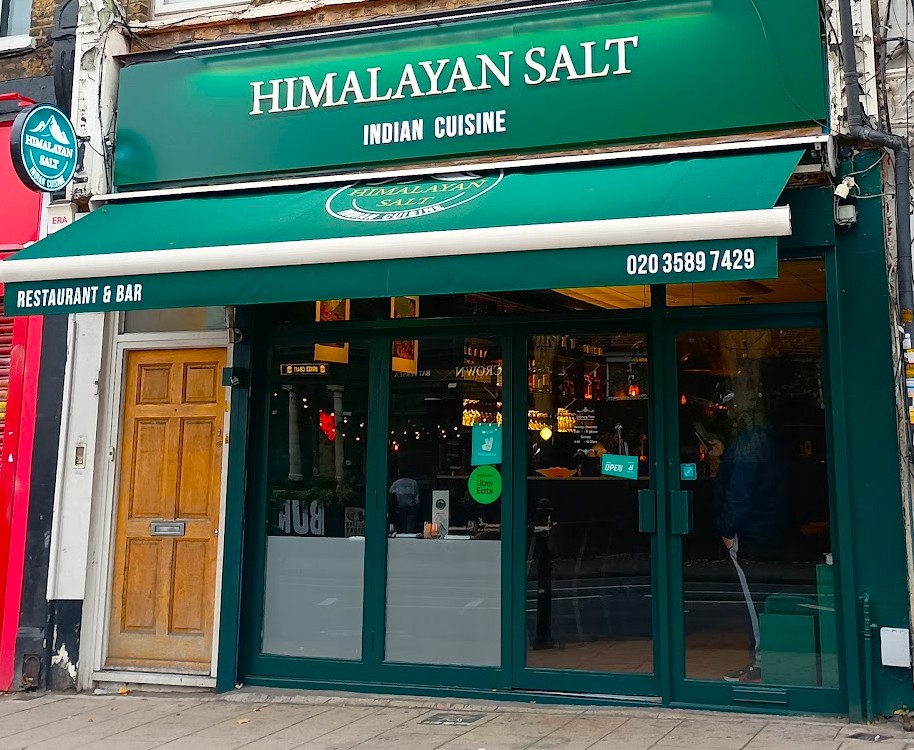
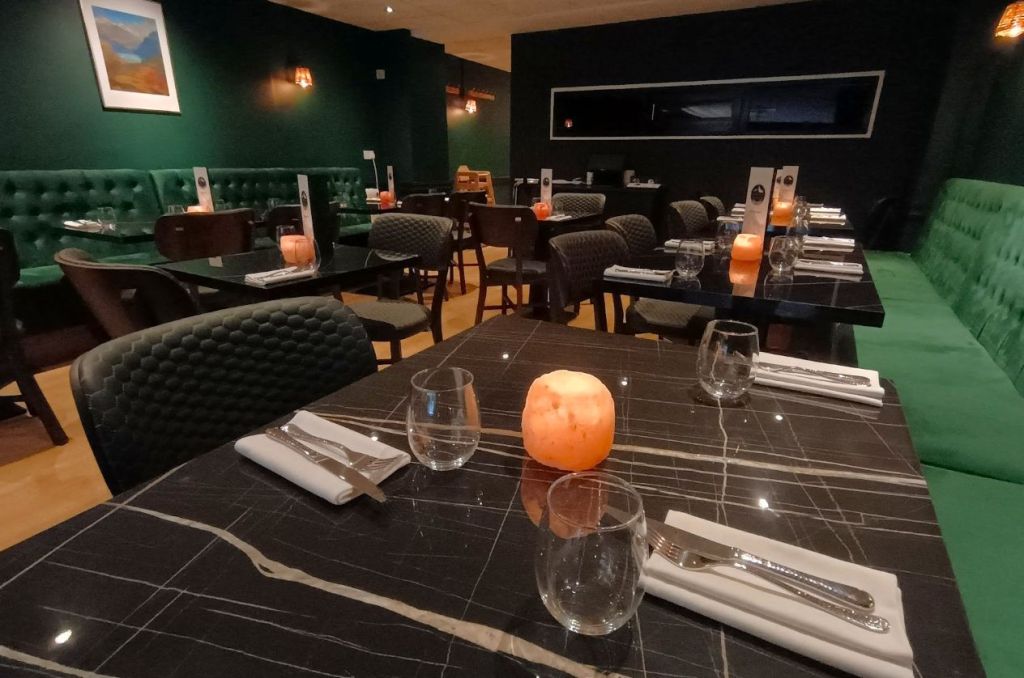
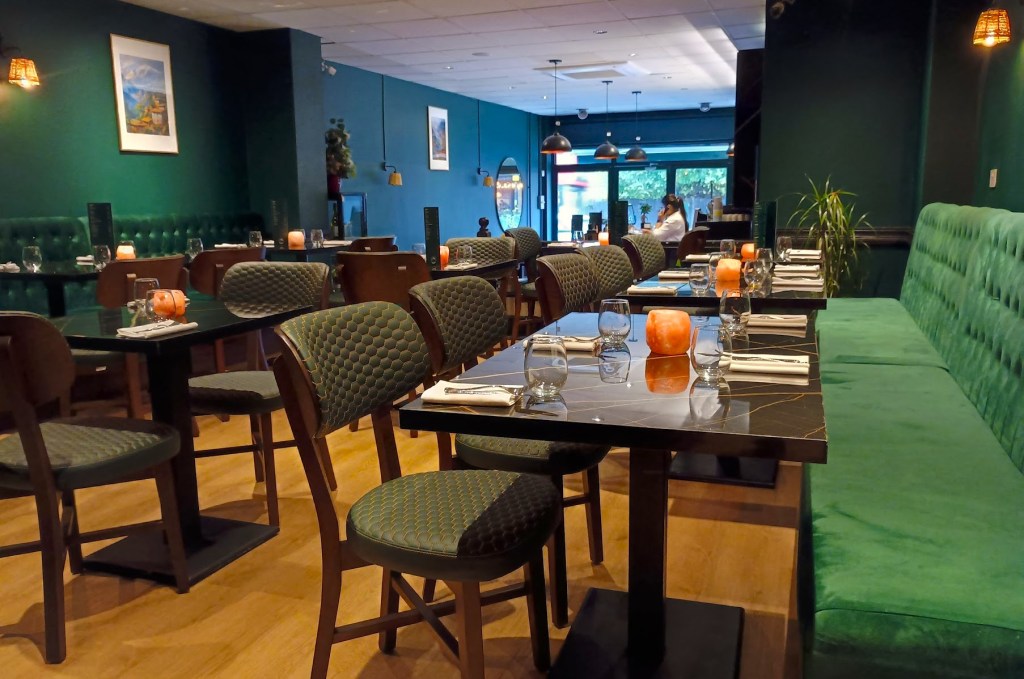
While the Indian restaurants we have tend to trade for many, many years – it’s surprisingly rare to see a completely new entrant. Lavender Hill’s recently opened Himalayan Salt is maybe the exception: having opened just a couple of months ago, it has already made an impact, and established itself as a popular and busy venue with strong reviews, attracting customers from well beyond the immediate neighbourhood. The menu’s a mix of the classics, and some more unusual options – with a mix of dishes from the Himalayas all the way to the coast, including a wide range from the grill, as well as a respectable set of vegetarian specialities. The restaurant may be new but the team behind it is not, with quite a lot of previous culinary experience brought to the new venture, including at the well-reputed Holy Cow in Putney.

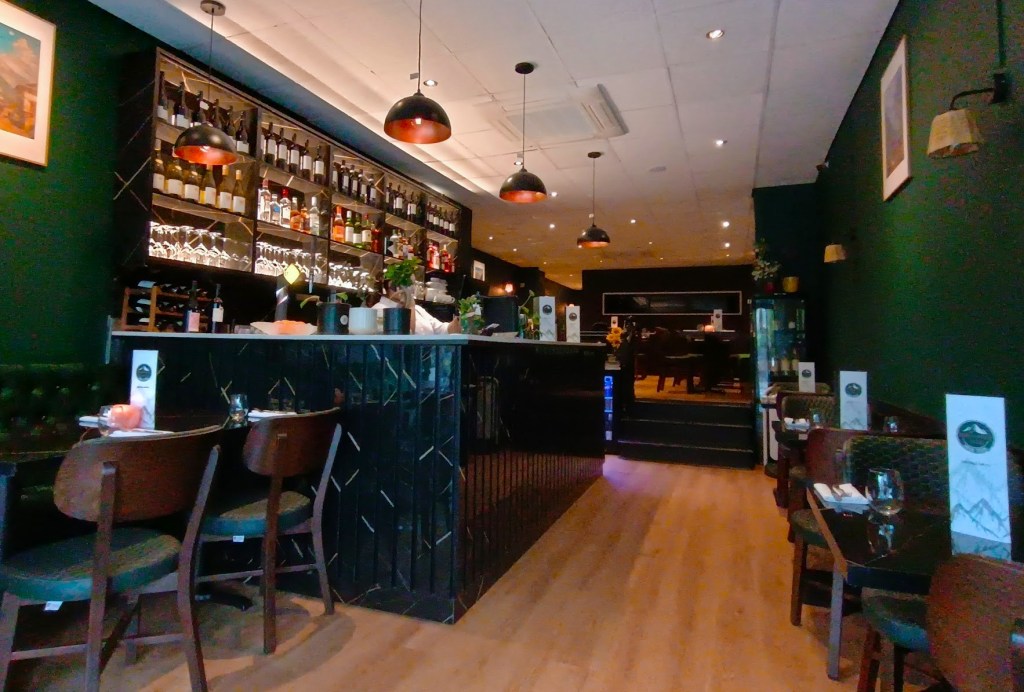
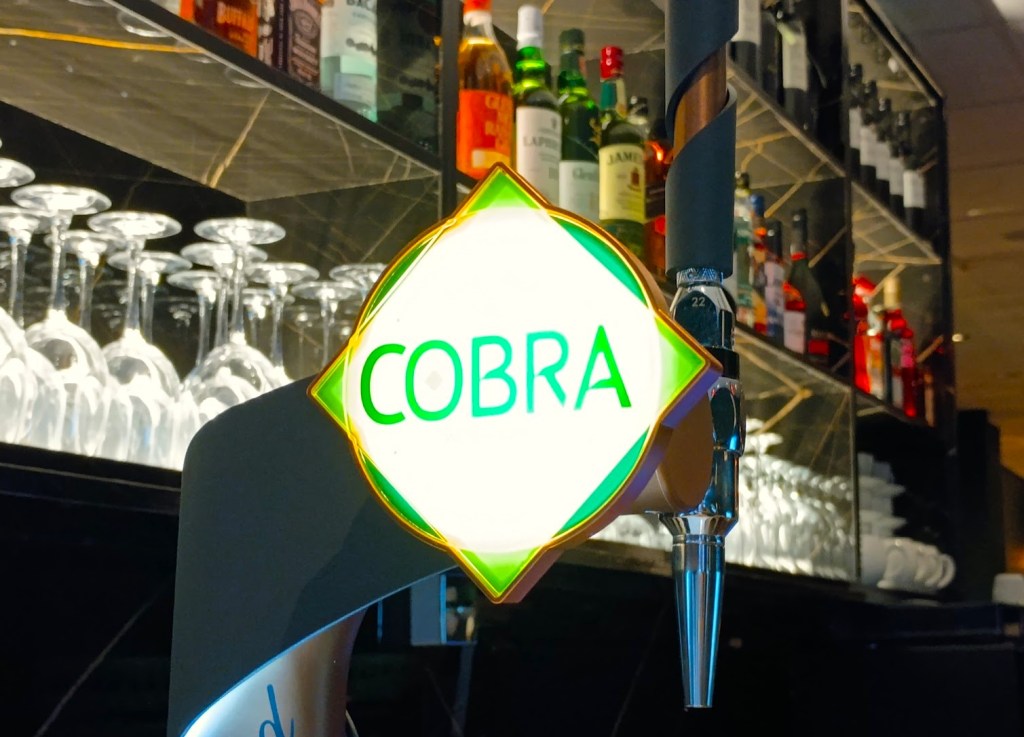
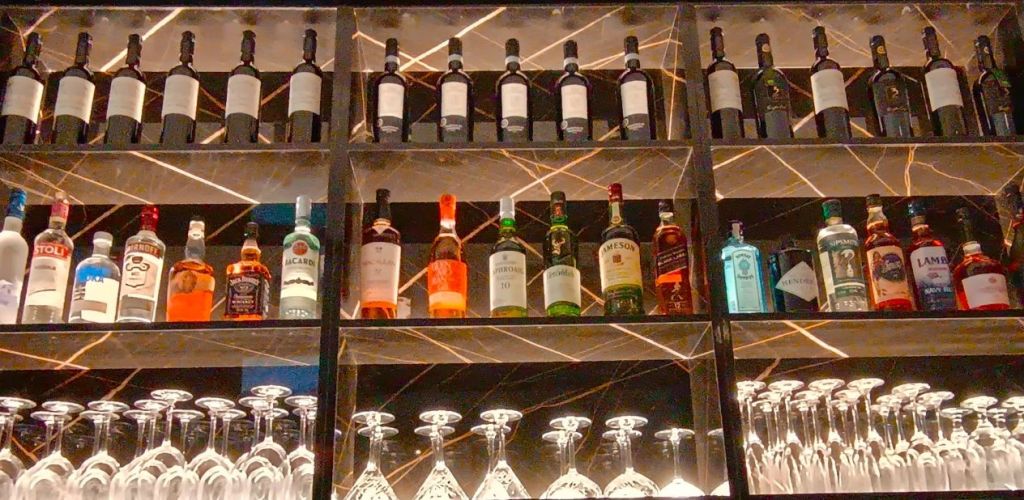
The premises were closed for quite some time prior to the grand opening, to allow for a complete makeover of both the front and the back of house – which proved quite an adventure with some of the key components arriving at the eleventh hour! It was clearly worth the wait and the investment though, as for those who remember it as it used to be it’s been quite a change of style. The dining room now has a cosy sophisticated feel, with rich dark green walls, new wooden flooring and banquette seating and seating for around 40; with the salt in the name echoed in the form of table lights. The front has smaller tables around the bar, which has everything you would expect on offer, and Cobra on tap, while the main space – up a few steps and deeper in the building – is flexible to accommodate a good range of table sizes.

For many, many years this was a traditional Portuguese restaurant, Costa do Estoril. Not the tourist style restaurant, but the real deal that you’d find rather out of the way in small towns, not much to look at but highly rated on the food. The team behind Costa do Estoril went on to open Grill on the Hill a few doors down, who are still very much in business, and the original premises then had a brief time (only a year or so) as Moto, a sushi restaurant. The current owners have really worked with the space, to turn it in to something different.

At the back the kitchen (which still has a window to the dining area, preserved from the days when tis was a sushi restaurant) so you can sometimes see preparation underway) has also been modernised and upgraded to the latest standard – which may also have helped Himalayan Salt acquire a 5-star food hygiene rating from the Food Standards Agency at the end of October.

Reviews have quickly come in with a fair few repeat customers – and they’re consistent in recognising the excellent service, and the delicious food – which is widely recognised as being very much a cut above your standard Indian restaurant, full of flavour and beautifully presented. Pricing wise this is outstanding value compared to some of the Northcote Road options, slightly more expensive than nearest neighbour palace Spice, slightly less than Blossom by Khan’s.

One question that can arise in trying a new Indian restaurant is where it sits on the spice-o-meter; we can confirm that this is broadly ‘medium’ – the ingredients in play here are clearly good quality and haven’t been overloaded in spice, to let the underlying flavours and ingredients do the talking. Special marks (which your author can confirm) for the sauces and chutneys accompanying the starters, and some flatbreads that go well above what one might expect. Kulfi and Gulab Jamun are also on offer as a dessert.

Takeaway is of course on offer (and to ensure everything makes it in mint condition sealed containers are used rather than the more traditional plastic boxes), as well as an in-house delivery service, as well as all the usual third party delivery services. But if you’ve not been we’d suggest you visit – to meet the enthusiastic and committed team behind this new venture, and get the full experience as Himalayan Salt establishes itself as a key part of Lavender Hill’s ever growing set of restaurants.

Himalayan Salt is at 117 Lavender Hill, Battersea, London SW11 5QL (between Stormont Road and the Battersea Business Centre), and at the time of writing is open daily from 5pm. Tel. 020 3589 7429. Takeaways available by ordering directly, and also via Deliveroo, Just Eat, and Uber Eats. Lavender-hill.uk posts from time to time on retail developments in the Lavender Hill area of Battersea, London – with occasional more detailed articles on local historyand other subjects of wider community interest. If you found this interesting you may want to see other recent posts on local retail and on food and drink.

Posted in Business, Food & drink | Leave a comment

A fall from grace: Is there a future for Clapham’s little-known Georgian orangery?

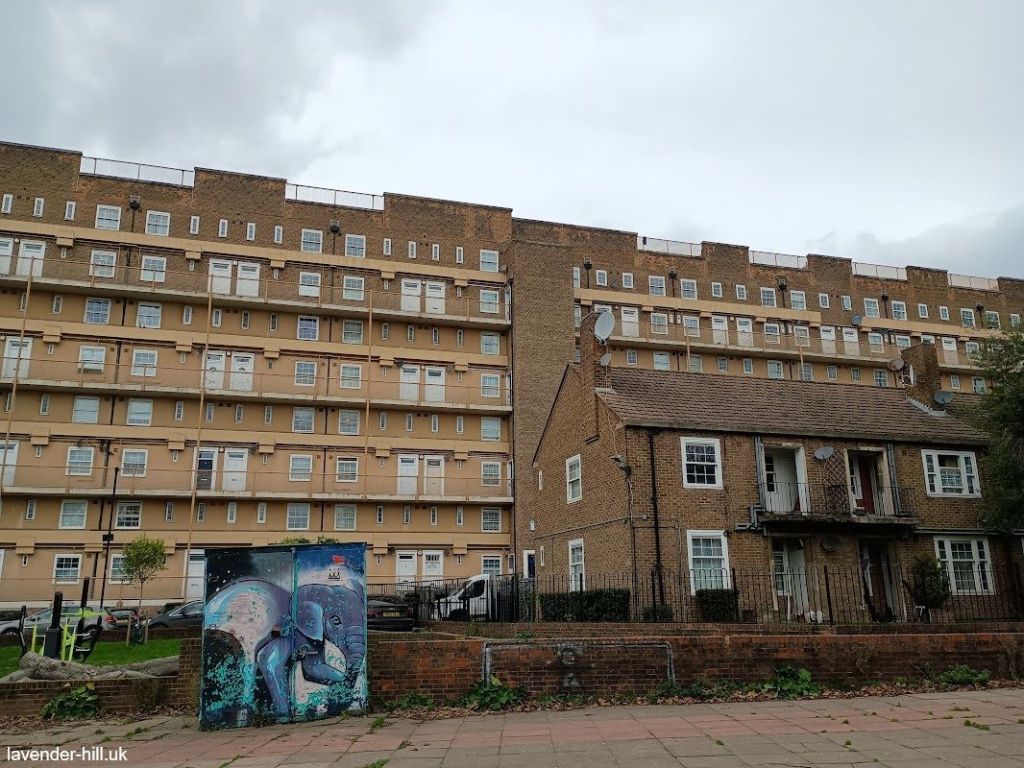
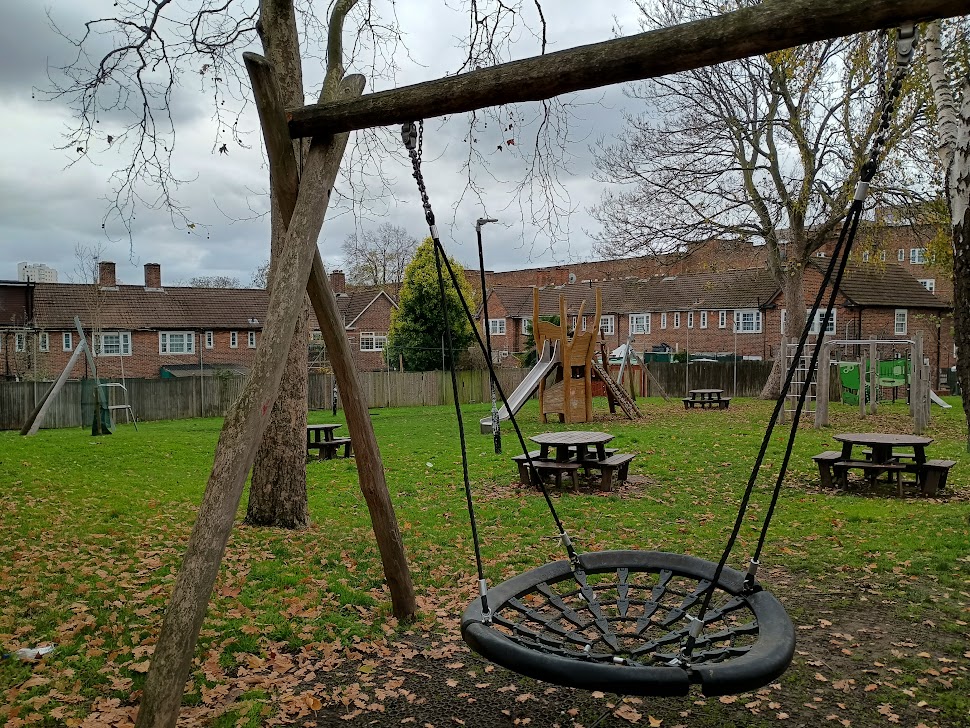
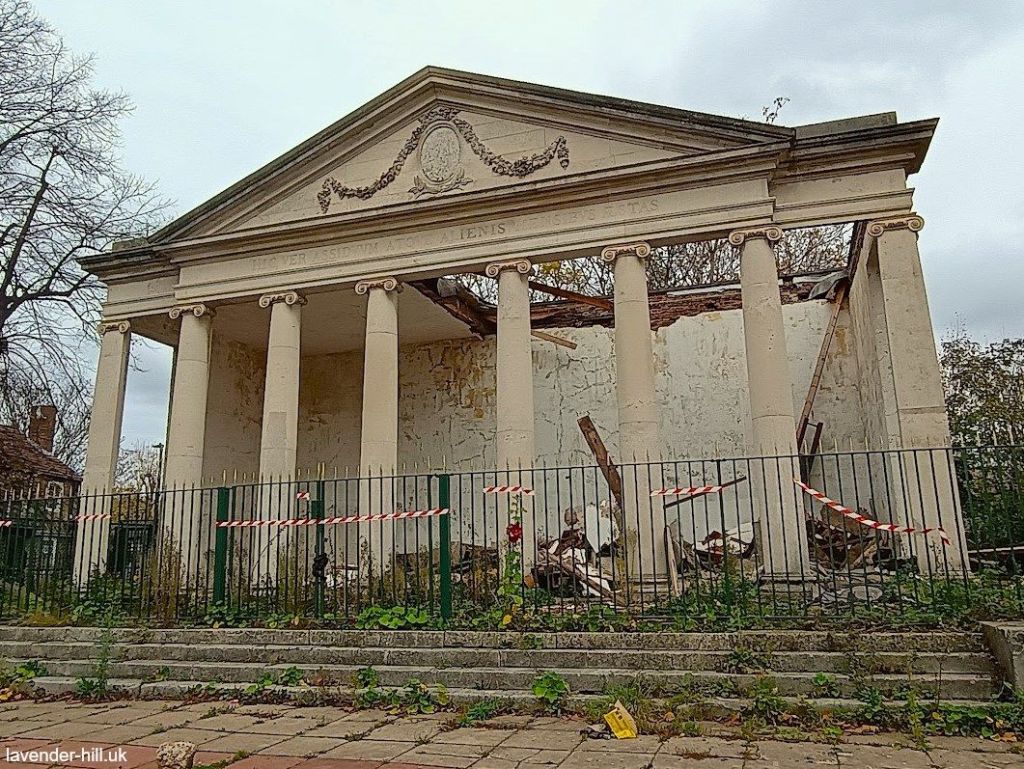
Work your way through the 1950s Notre Dame housing estate at the Clapham High Street corner of Clapham Common, and after going past a load of bins and a few rows of decaying garages, a rather decent children’s play area emerges – with a zip wire, swings galore, small climbing wall, table tennis and even a rarely-seen teqball table. More unusually, at the back of it, stands a Georgian-era colonnade that seems to have walked straight out of a Turner painting.

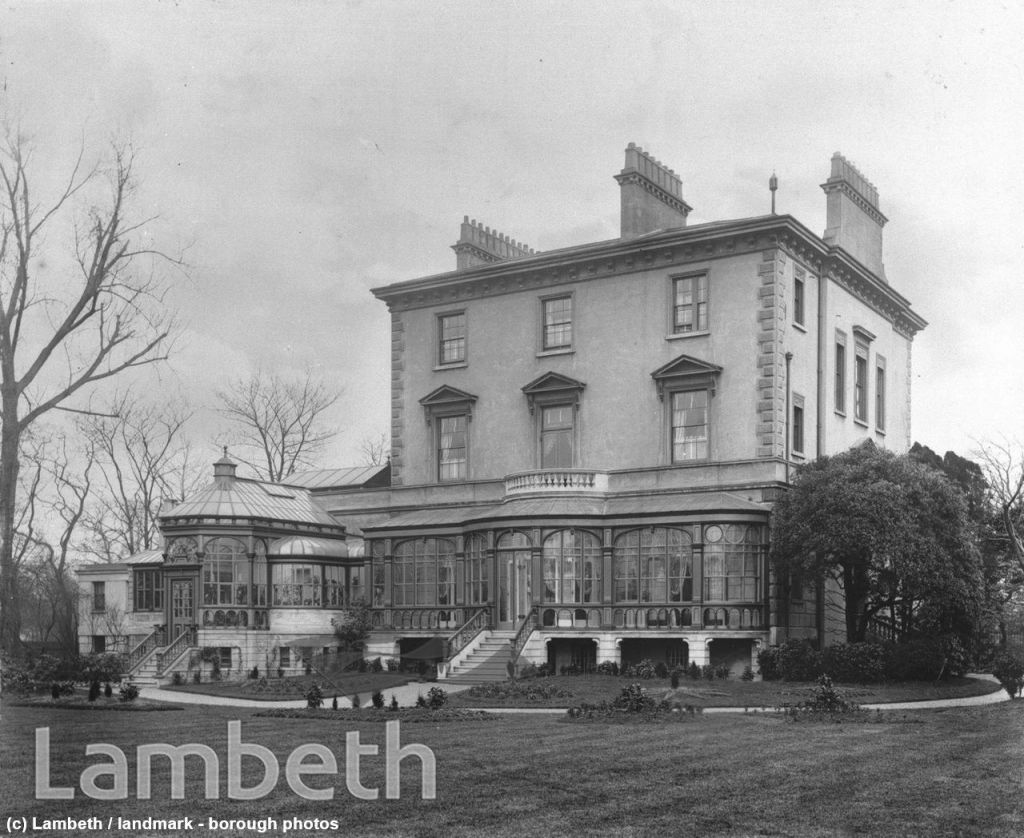
It’s the Clapham Orangery – and it dates back all the way to Clapham’s long-lost days as a cluster of large country houses scattered around the Common.  Thornton House was a particularly big house whose garden stretched all the way to what’s now Abbeville Road, included the whole of what is now the Notre Dame Estate (and because that includes a load of terraced houses as well as the more recognisable big blocks of flats, that’s a huge garden).  The house was built by John Thornton, a man of considerable means, and Director of the Bank of England, who was said to be the second richest man in Europe.

The house was inherited by his youngest son Robert – also a wealthy man mainly thanks to a huge £40,000 inheritance from his dad (well north of £5 million in today’s money). Robert would become an MP, and director of the East India Company. He was clearly popular wherever he went, described as ‘a most agreeable, lively and pleasant man’ – and he was also known for having a large collection of prints and minerals, and a real love of plants. The huge garden was clearly no accident – the gardens of Thornton House were described at the time as ‘the most expensive gardens in the vicinity’ – including stables, parkland, meadows, a grotto, and woodland. To make a central feature, in 1790 Robert built ‘an exquisite greenhouse’, strategically placed by the side of a long ornamental lake, with grassy banks and overhanging trees either side.

It’s not really a greenhouse as we would imagine them now, more a grand stone orangery that had glazed sides facing south/south west to catch as much sun as possible, with an interior suitable for a variety of exotic plants and trees – including, no doubt, orange trees. Spelt out over the door is HIC VER ASSIDUUM ATQUE ALIENIS MENSIBUS AESTAS, roughly translating as ‘Here is persistent spring, and in months where it should not be, summer’, topped by a floral garland made of locally-developed Coade stone.  It was also a social space: the Thorntons hosted Queen Charlotte at the orangery in 1808.

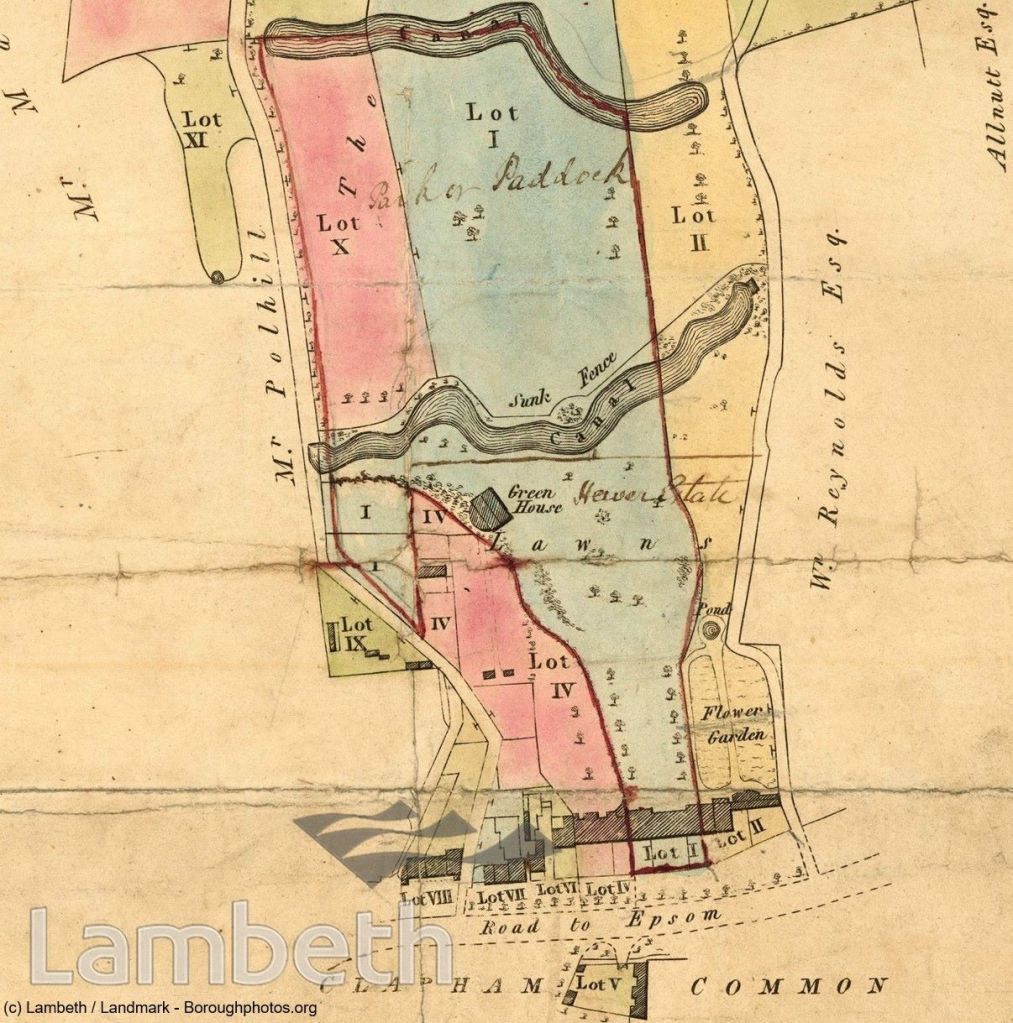
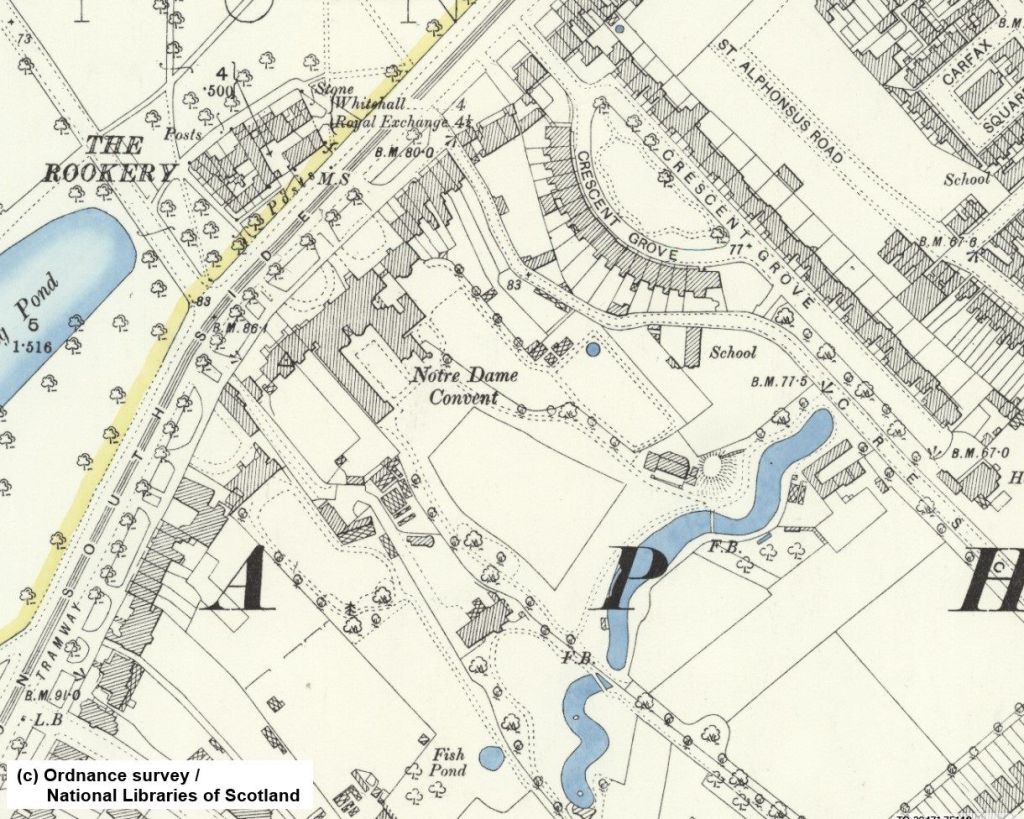
Robert’s impressive 13-acre garden was a real landmark and the talk of the town, but his business ventures didn’t go so well. He had some early success in investments, but later made some large stock market losses, while his business got tied up in the politics of the time and lost a lot of value. Having gone from being a very wealthy man to being £45,000 in debt; he put the house up for sale by 1810 – the map above shows the way it had been split in to individual lots with the orangery labelled ‘Green House’ in the middle of the blue section, placed in a way to have sweeping views along one of the two lakes in the gardens. Selling the house didn’t end Robert’s financial woes, he ended up bankrupt and fleeing to France in 1814 under a false name to escape his creditors, later moving on to the United States where – still a popular figure with his neighbours, if no longer a wealthy one – he died in 1826.

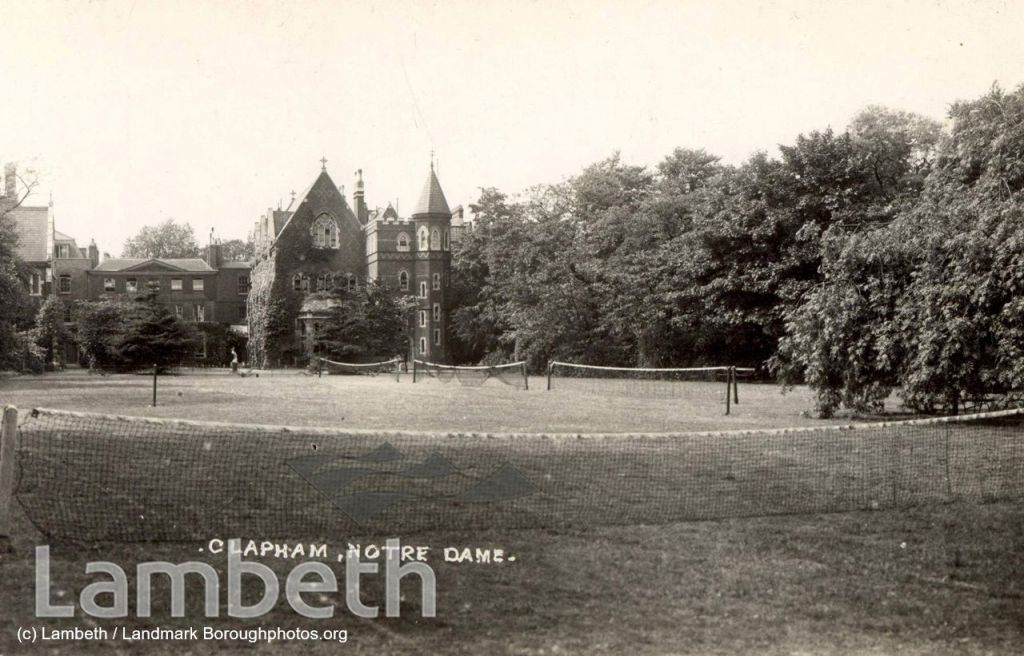
But his house and gardens mostly carried on: the pink and blue sections stayed in common ownership, with the end further way from Clapham Common split off – with the second lake filled in and becoming part of Abbeville Road. In 1851 most of the estate was sold to a convent of Belgian nuns, the Sisters of Notre Dame, who developed a network of religious schools around the country. They had a clever, and innovative for the time business model of establishing fee-paying day schools (and sometimes boarding schools) for young ladies, which would provide them with an income, and using the income to open separate poor schools or work in established parish elementary schools; they would also develop the Notre Dame school in Battersea. They established the Notre Dame convent and girls’ school on the site. They kept the house, orangery and lake – but added new buildings, playing fields and tennis courts, and the girls could row on the serpentine lake and ride ponies in the grounds.

Thanks to National Libraries of Scotland’s brilliantly structured collection of historic maps we can see the layout of the convent, with one lake still in place and the orangery still standing as the grey building just above the large ‘P’ of Clapham:

The school ran happily for decades, until in 1939 the sisters left – as the whole school was evacuated to the countryside after seeing some damage from German incendiary bombs. We’ve seen reports that the empty accommodation at Thornton House was then requisitioned by various government Ministries, with the Free French Forces, Charles de Gaulle’s resistance government in exile, moving in for several years. By 1945 the once spectacular house and gardens were declining: the glazing on the orangery had been destroyed, and the house had taken blast damage. 

After the war the school returned, but in a different location in Clapham; the nuns sold the property – to the local Council, who had a pressing need to build a lot of new housing in a hurry. This was a time when development was unusually ruthless, and the next years would be brutal for Thornton House: both the house and the later school additions were summarily destroyed, Robert’s prized trees and plants were bulldozed, the winding lake was filled in, and a network of streets were laid out over the gardens. A new housing estate, designed by the borough of Wandsworth (as this was, back then, part of Wandsworth) and named after the Notre Dame convent, was developed – creating 400 houses and flats.

The estate design is, to be frank, not great: the architects’ main aim was to build as many flats as they could, as quickly as possible, while keeping the spend to the bare minimum, and compared to some of the very carefully designed estates Lambeth would build in the following decades (some of which we have reported on) it’s a fairly bare bones affair.  But they did try to elevate it and make it a good place to live – working with what they had -which in this case, led them to save the orangery, and keep an area of land around it free of development, as a feature and as a central green space for the estate. The trashed windows had to go, but the rest was in serviceable condition. No longer within private grounds of the school, it became a more accessible local landmark.

Soon after the estate was developed, the orangery caught the eye of the authorities as a rare survivor of times long gone – and it was made a Grade II listed building in 1955. From then onwards it was a story of little change for decades – and as Lambeth went through its famous years of political activism and financial chaos in the 1980s, a late 1700s orangery was the sort of thing many in the Council really couldn’t care less about. It became very neglected and ended up covered in graffiti, with the drainage and some of the ornamentation falling off, and damp everywhere.

Following a sustained effort by the Clapham Society who have been trying to protect it for decades, a local group called the Clapham Orangery Group brought English heritage on board, proposing a preservation trust and offering funding assistance for repairs – “providing Lambeth demonstrate its commitment to its future and long-term preservation” (it’s clear that English Heritage didn’t have much faith in Lambeth either!). This did lead to the orangery getting repairs and being cleaned up – and Lambeth themselves got back on track, managing the estate as well as could be expected in the circumstances and keeping up with basic maintenance on the orangery.

But it still never had a purpose – so didn’t get much more than the minimum in terms of care and attention. The gradual decline of the structure saw it added to the Heritage at Risk list of buildings whose end may be near – where its condition there is described as ‘fair’, with reported ‘slow decay’ with no solution agreed. 

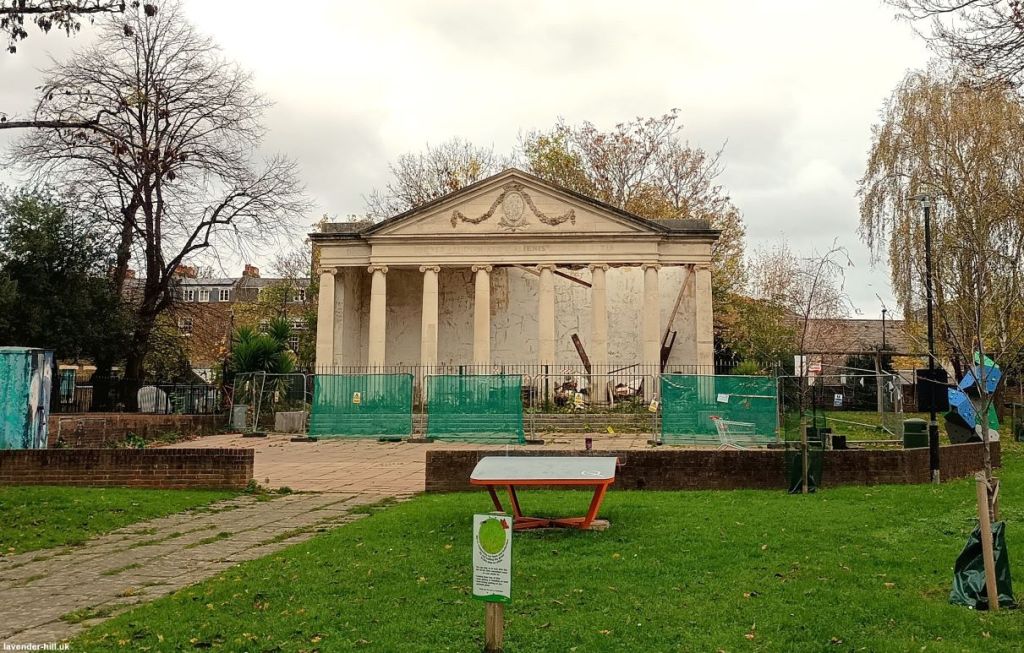
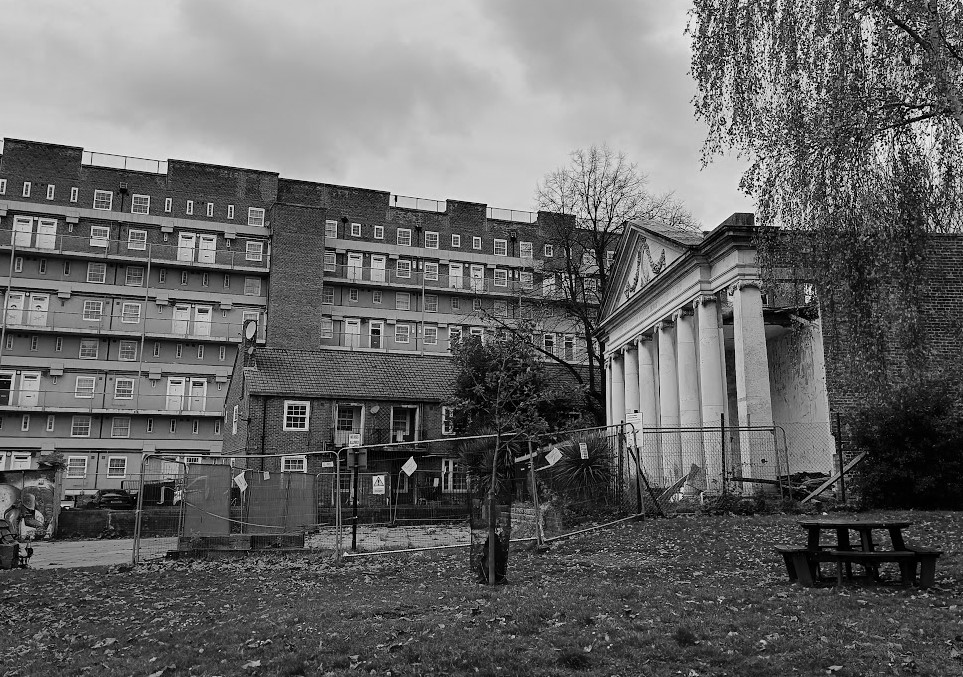
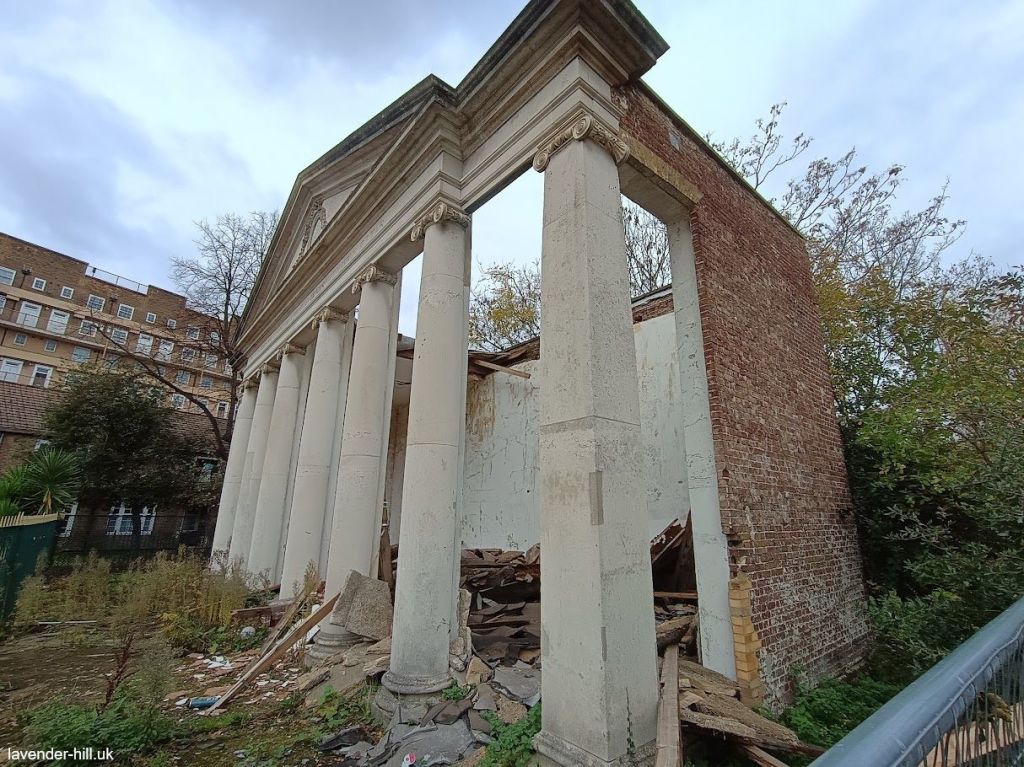
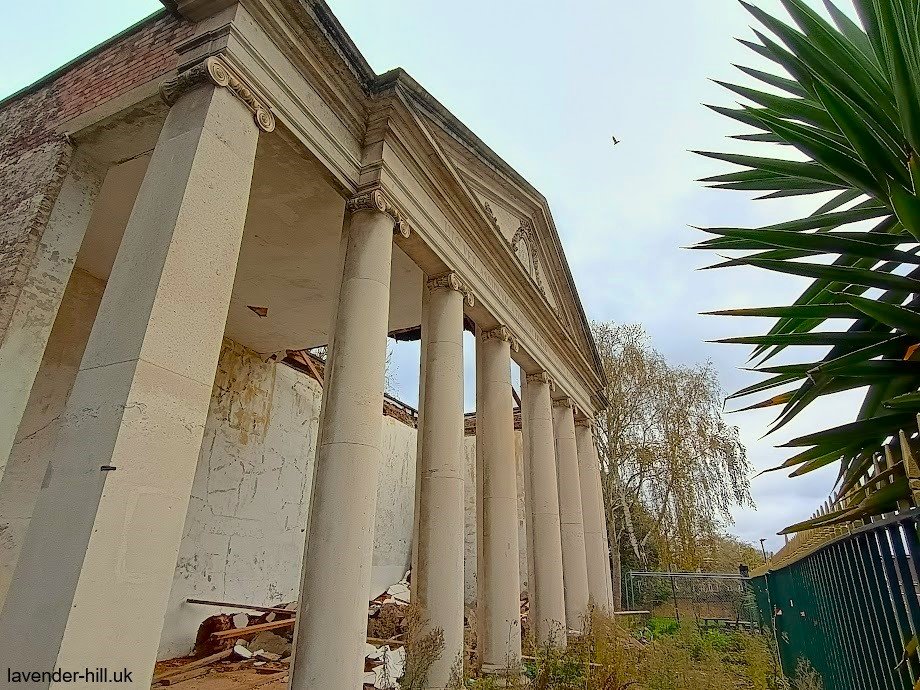
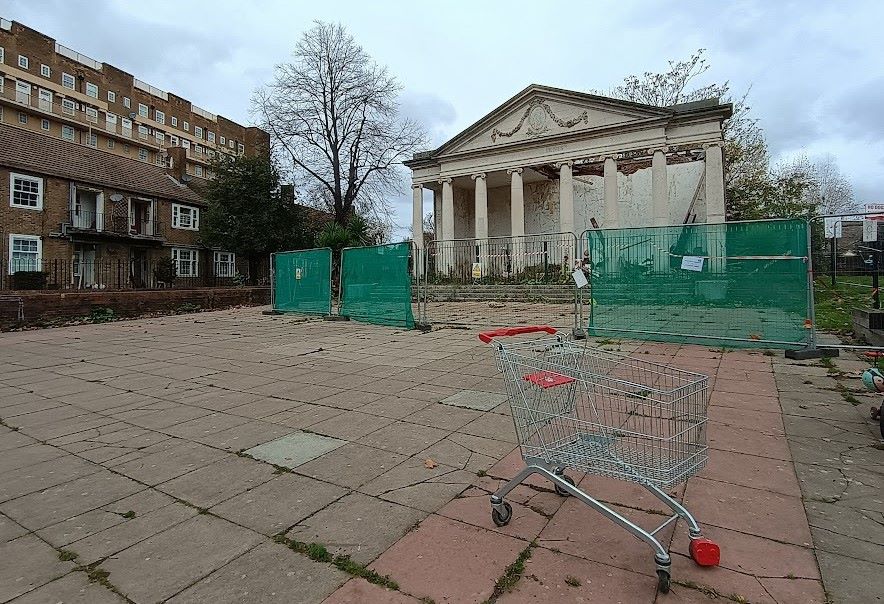
However things have changed since Historic England’s website was last updated, to rather more rapid decay – as in early August a large part of the roof completely collapsed!  As our photos show, it’s really not looking great – the whole structure has come down, and the top of the walls are now exposed to the winter.  Security fencing has been put up around the building to keep people at a safe distance in case any more of the structure collapses.

The building is owned by Lambeth’s housing department – and they have other priorities. We’ve occasionally reported on the headaches facing Lambeth’s big estates, with looming maintenance nightmares increasingly on the radar as ageing and high-rise properties reach the point where a lot of their infrastructure needs substantial investment to keep things going, let alone bring property up to current standards – our article on the vexed question of what to do with the Westbury Estate, whose phased redevelopment has become severely stuck, and whose towers are increasingly looking to need major works, is here

The Notre Dame Estate that completely surrounds the orangery may be another of these headaches – a hastily built complex that delivered a lot of flats on a particularly tight budget, much which – having been built in the late 1940s – is approaching its eightieth birthday! A centralised heating system with exposed pipes and ductwork covers missing, a questionable level of thermal efficiency, mediocre accessibility, and reports of recurring infestations of ants, are a very direct illustration of the financial demands Lambeth is facing with many of its high-density, high-rise buildings. 

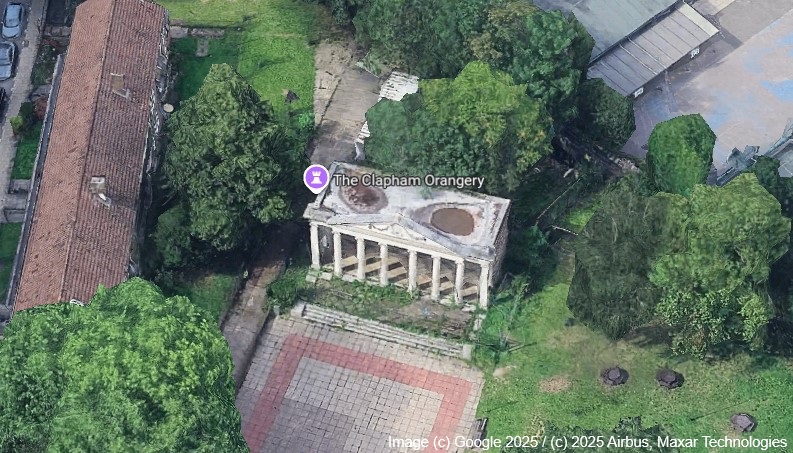
Lambeth’s also increasingly struggling to keep its head above water financially – just last week an auditor’s report set an ominous tone on the state of the Borough’s financial affairs, with concerns on almost every element. It may explain how we got to this situation in the first place (a cursory Google maps exploration shows that water has been pooling on top off the roof for some time – never a great sign!) – and none of the financial challenges augur especially well for their ability to get the building repaired any time soon. 

On the plus side – the damage is so far limited to the roof having collapsed, and it’s not an especially complicated fix if it can be done fairly soon, before the walls and structure take further damage from their exposure to the elements. The flat roof, while fashionable when the orangery last saw significant works in the 1950s, was always going to be a maintenance headache, and a gently sloping corrugated steel replacement, coupled with a replacement suspended ceiling, is both more in keeping with the way it would have originally been built, and a better long term bet for the structure. The Clapham Society – who are still some of the key people trying to keep our orangery alive – report that Lambeth are seeking external funding to pay for repairs estimated to cost £100,000, and that the London Buildings Preservation Trust is in discussion with Lambeth about using its experience, skills and resource to save the Orangery.

The slightly isolated location of the orangery limits its ability to generate income to pay for its ongoing upkeep – so this isn’t going to see the original glazing between the columns restored and the building up for lease as a cafe any time soon, echoing what (as we reported) happened to the similarly imperilled old building in Clapham Common’s woods, and which could have been a very real option had the orangery been slightly closer to the Common. It used to be open as a play area, and has occasionally been used as a film location – but maybe the key is to find an ongoing use (and we’re interested if any of our readers have ideas that would be compatible with its listed building status).

Robert Thornton’s one-of-a-kind greenhouse has already done well to reach its two hundred and thirty fifth birthday, and we owe the designers of the estate some credit for sparing it from the bulldozer, as well as the team in the 1990s who rescued it. It’s now a lonely, broken and mostly forgotten local landmark, hidden in an ageing housing estate, surrounded by cracked paving and emergency fencing, and in the not-very-caring hands of a cash-strapped local authority. It’s all a far cry from its days as the treasured of a passionate plant collector, when it was surrounded by lush greenery, packed with even more exotic plants, and the talk of the town. Can it fight on, as one of the last reminders of the way Clapham was before it was taken over by London, and as something that makes the Notre Dame Estate a bit special? Or is this the beginning of the end? Fingers crossed a way forward can be found – and we’d encourage you all to do what you can to get this poor building the care and attention it deserves – and as ever, we’ll keep you posted.

Lavender-hill.uk is a community site covering retailplanning and development  and local business issues, centered loosely on the Lavender Hill area in Battersea, with occasional more detailed articles on local historyand other subjects of wider community interest.  If you found this interesting you may want to see recent posts on Battersea Power Station’s mysteriously missing historic cranes, on the story of how one of Clapham Common’s oldest houses was saved, or on the pioneering women of Battersea’s early days. You can also sign up to receive new posts (for free) by email – and if you have tips and leads to share, get in touch. There’s also lots more detail on the orangery, including a rare old photo of it when it still had the windows more or less in place, at the Folly Flaneuse.

Posted in Clapham Common, Curiosities, Local history | Leave a comment

In pictures: The Shelf, a new approach to retail, opens on Lavender Hill

We write a lot about retail! It’s fair to say Clapham Junction’s shops have held up remarkably well over the last few years, despite a pandemic, huge increases to energy costs, a notable growth in theft, increased National Insurance costs, tightening (and costly) environmental standards for business premises, and the ongoing competition with cheap-to-run online operations. That continued local success comes down to a lot of imaginative people running many of our businesses – as well as to this being a relatively rich area, and having a fairly active population who go out and use their town centres rather than driving off to big retail parks.

But retail is very much evolving. We’re seeing more food shops, and the food shops we’re seeing are focussing more on food to go and fresh, now that a portion of their customers are getting the heavier, longer-life stuff delivered. We’ve also seen far more businesses focussed on fitness and beauty – with at least a dozen gyms, from huge luxury options like Third Space to the smaller and more specialised individual training and exercise gyms run by personal trainers at the eastern end of Lavender Hill, and notable growth in coffee shops and cafes.

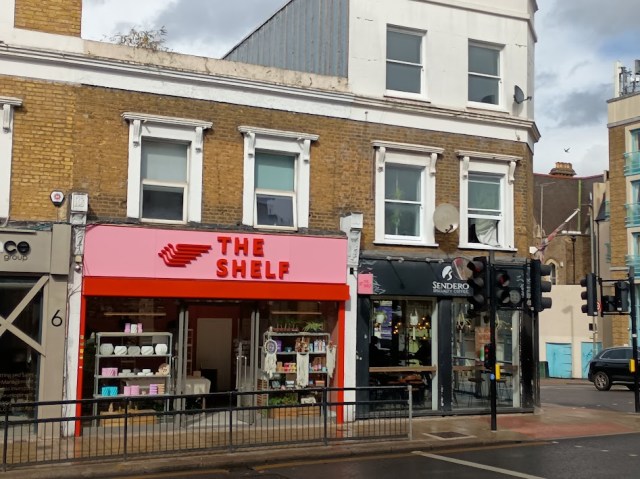
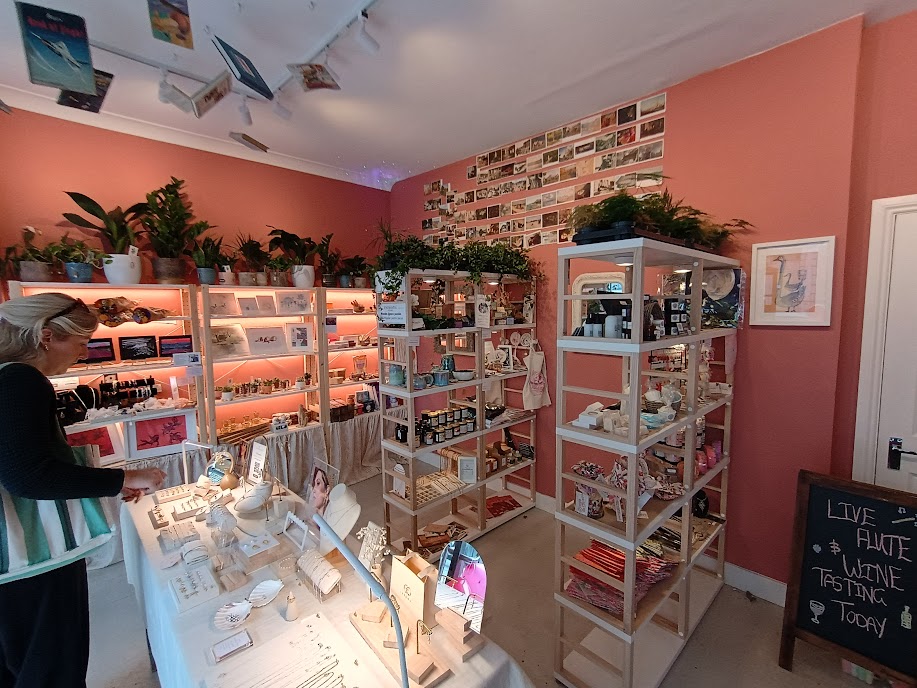
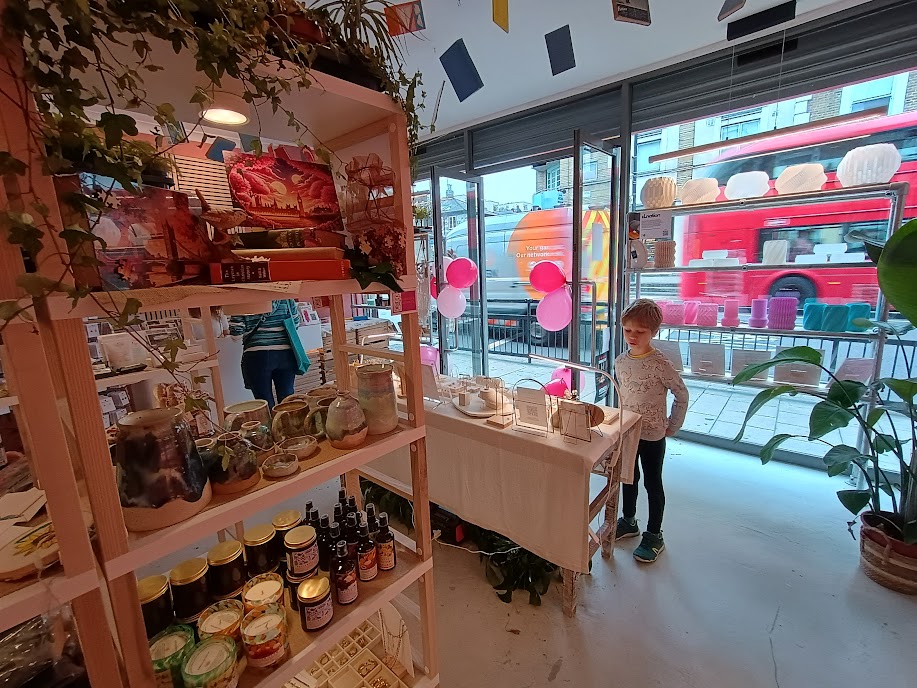
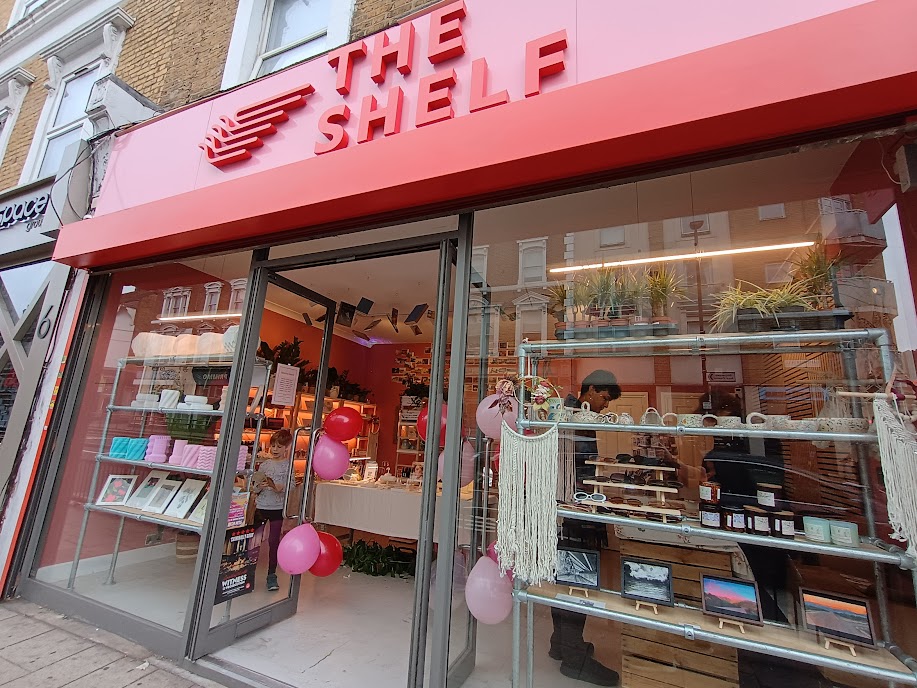
And something even more innovative has just opened, next to Sendero Coffee at the eastern end of Lavender Hill. The Shelf is the project of local resident Taras, who is putting his dream of having his own community shop in to practice. It’s been beautifully renovated over the last few weeks and is looking very much the part.

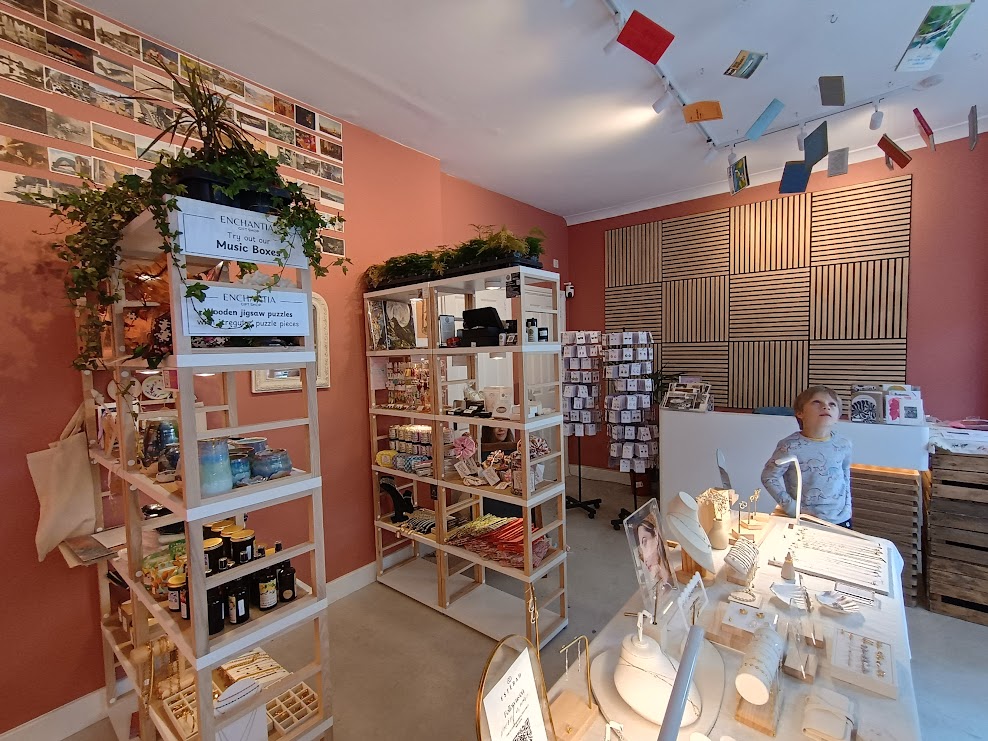
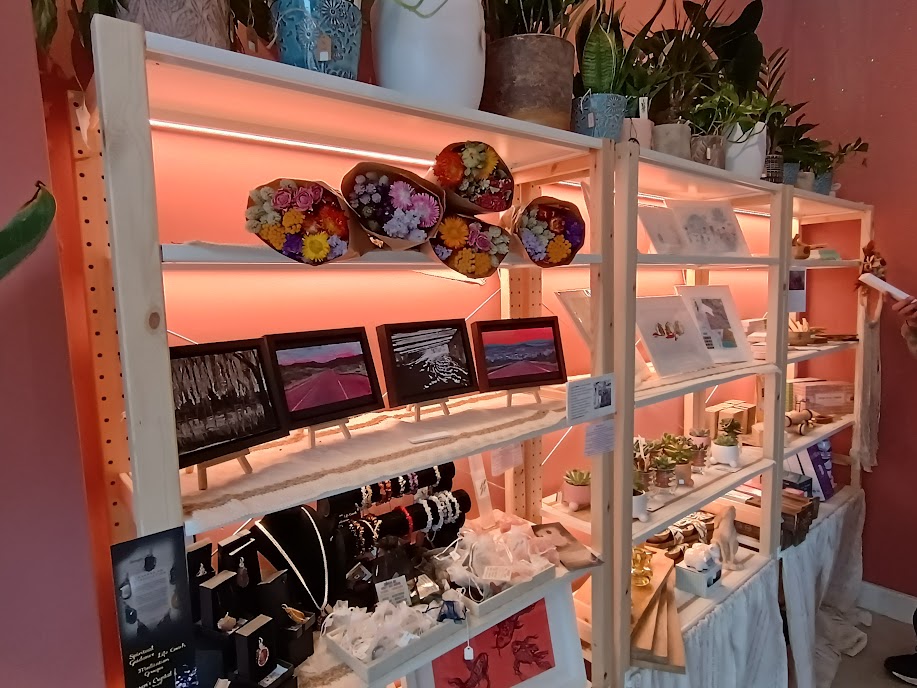
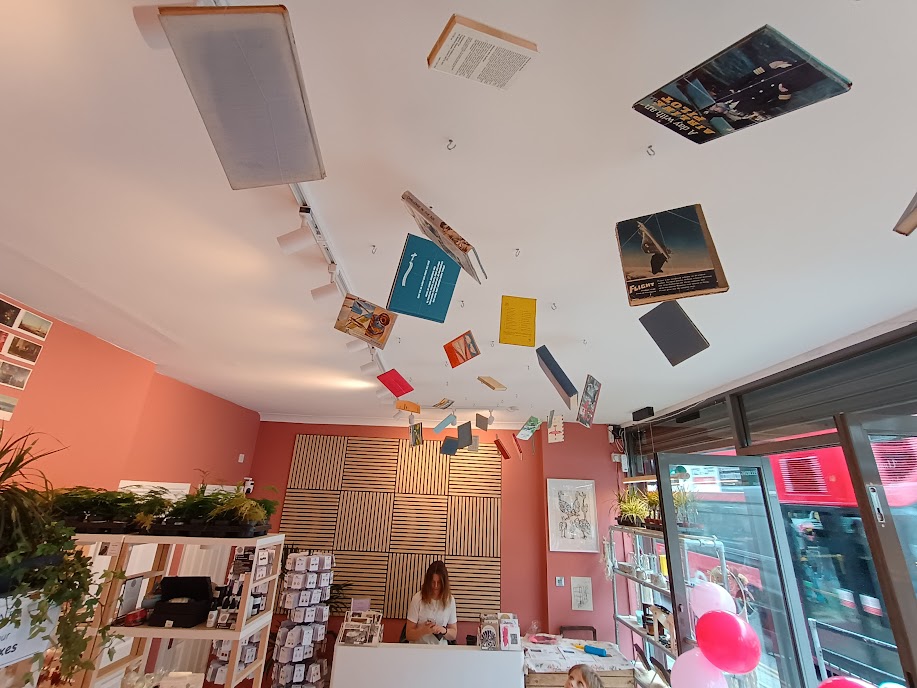
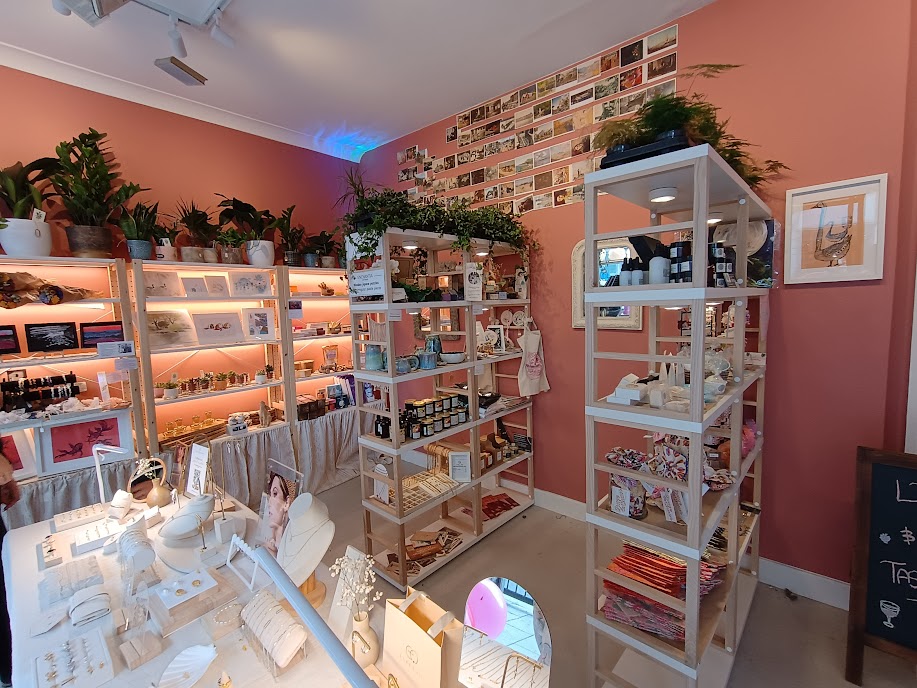
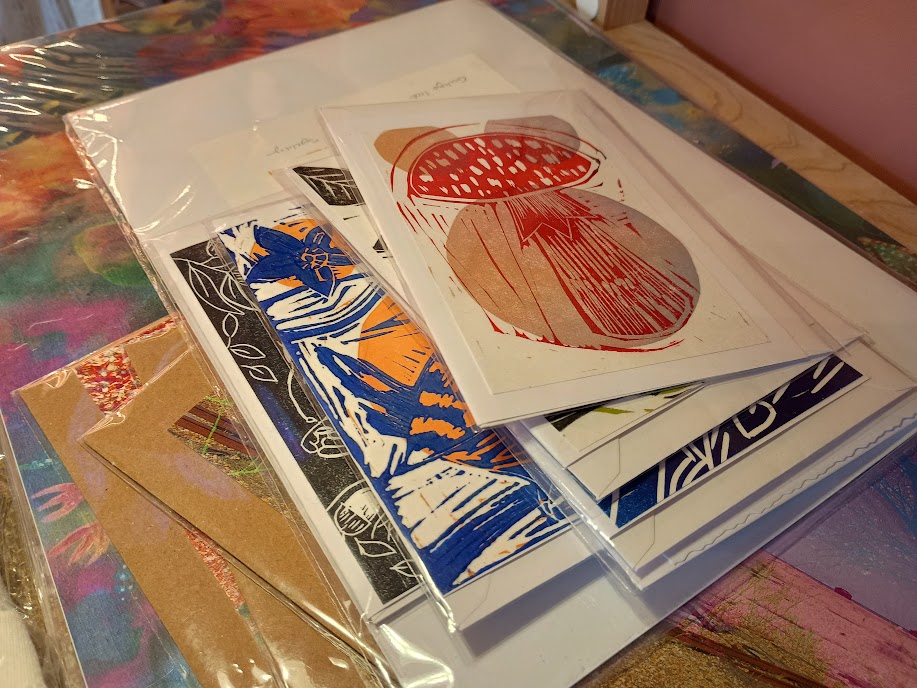
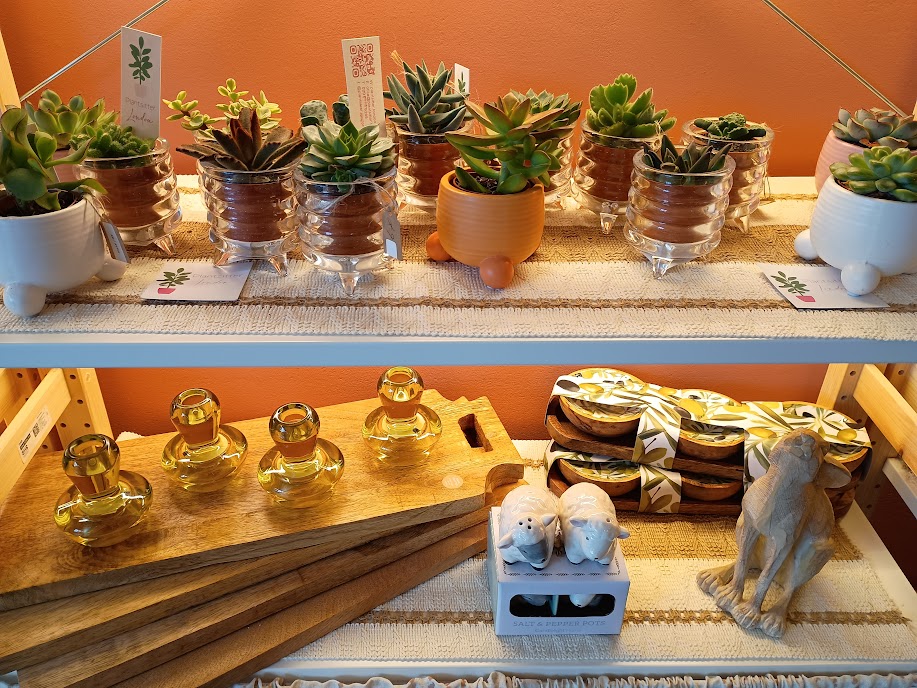
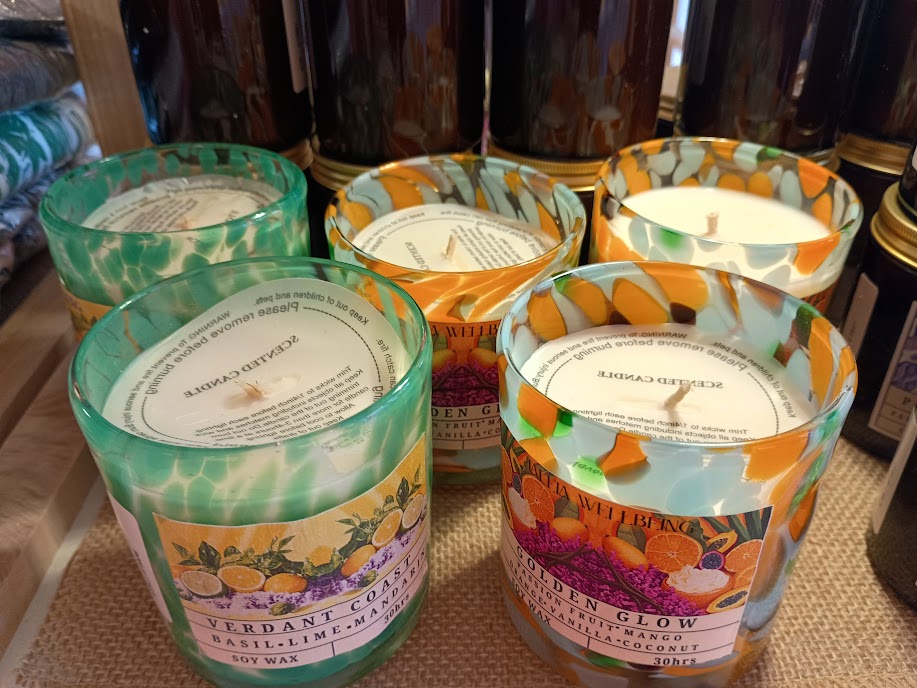
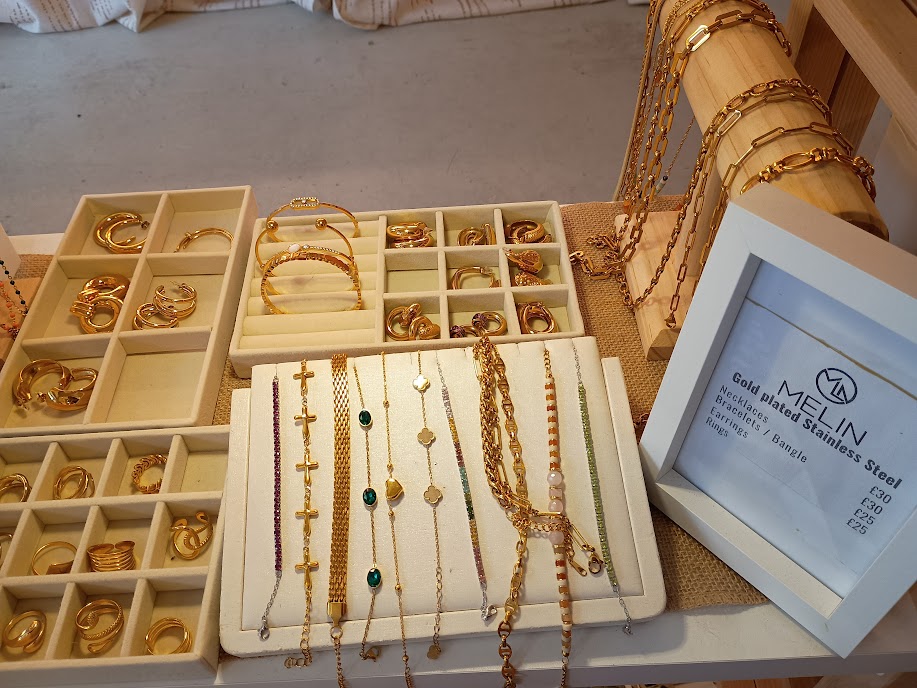
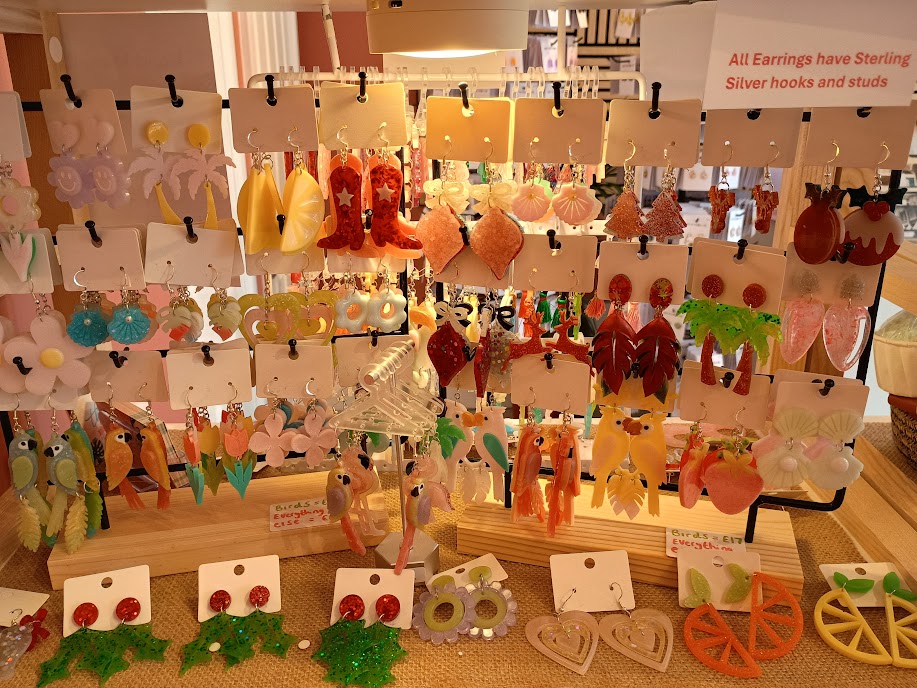
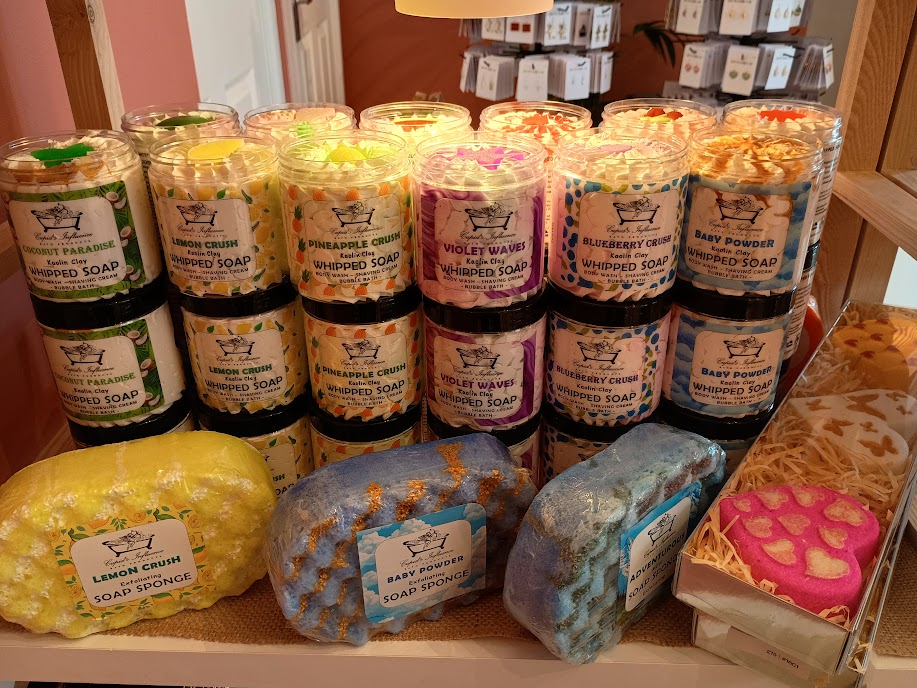
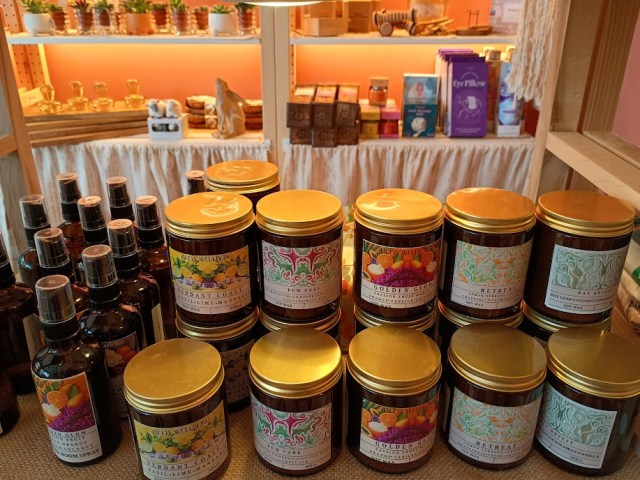
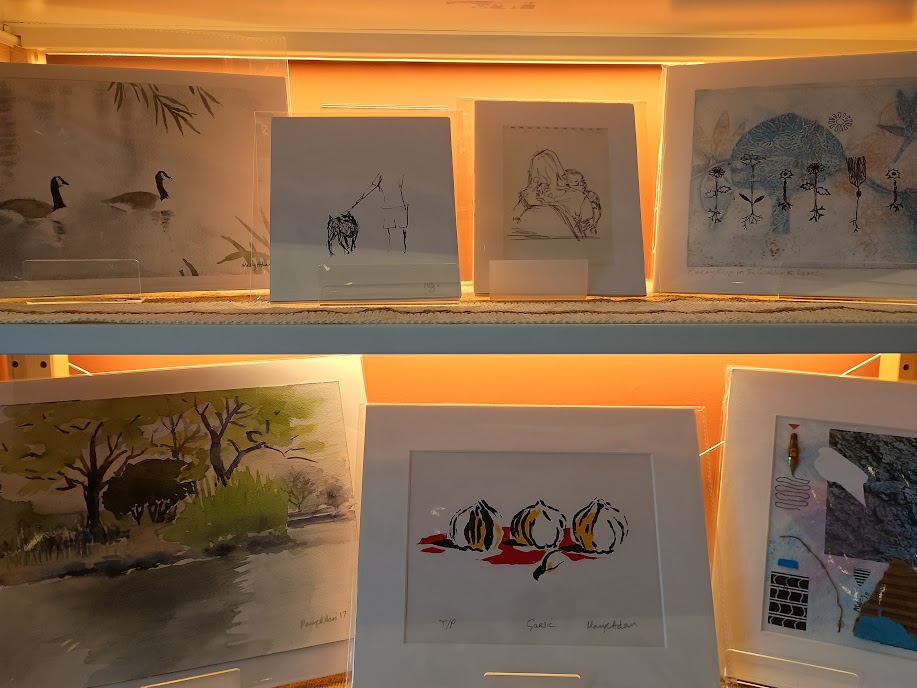
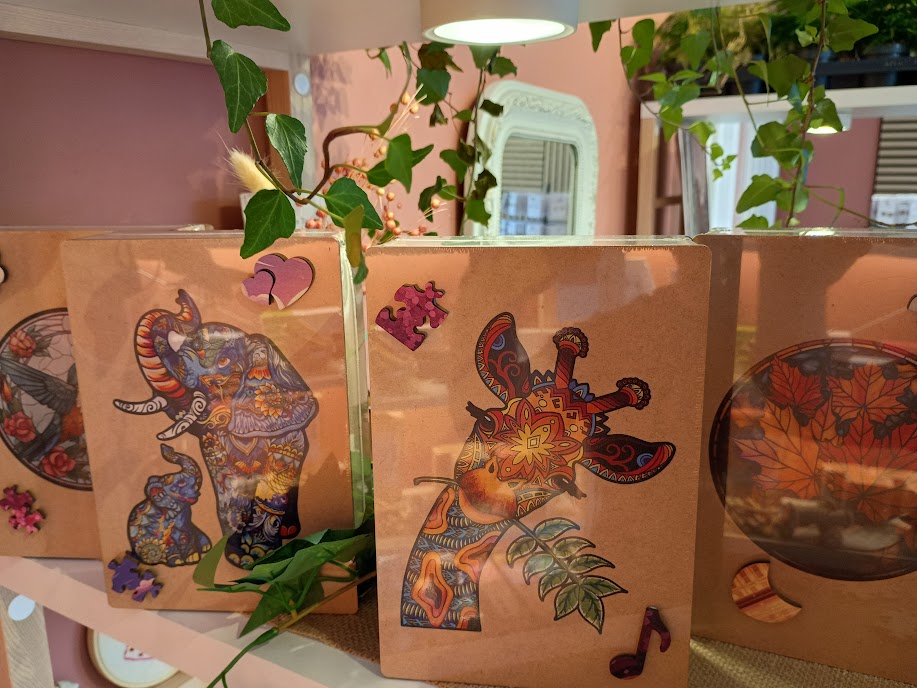
The Shelf showcases small independent businesses and individuals, with a range of art, ceramics, homeware, beauty and skincare, and jewellery and accessories, as well as plants, postcards and cards, and candles.

The unusual thing is that this is a shop that is open to anyone to sell in. You can rent a shelf to sell from- with the rates are completely transparent, typically £50 a week for a small shelf & a 10% commission on sales (with discounted rates for longer presence).

The Shelf take care of everything else – the premises, the staff, the rates, the payments, the advertising and the customers.

For sellers, you get a professionally presented retail space in a smartly designed good location, for a fraction of the cost of a full storefront.

The store’s been designed in a way that should make things look good – with a mix of layouts, and all fitted with soft lighting, to give a clean, neutral stage that lets the products stand out.

Their strapline is Rent a shelf, we’ll take care of the rest!. With no long-term leases, no hassle – and with thousands of passers by each week, it gets real visibility from real shoppers.

Traders can rent short-term, test a new product line to see how it sells, or grow into a bigger display as the business expands.

And for us residents – it’s something new and quite unique to Lavender Hill, and a way to discover new brands and support local, perfect for gifts and treats.

Of course you can buy things online – but as the novelty of some of the online retailers well and truly wears off amid a flood of Temu-type rubbish that’s really not worth it, the idea of The Shelf is maybe a way for actual physical retail to work in a modern era – and to serve smaller makers, artists and designers whose products stand up to close inspection.

Because this is somewhere you have a much better feel for the look, feel, and also quality of the products, and it;s a way of doing so in a relatively affordable and simple way.

Our photos give a feel for what was on offer when we visited – but with the mix of people renting space here, this will change, with new products in every week; we have seen this is becoming a bit of a regular stop off for people on their way to and from the likes of Sainsbury’s and Sendero.

The rest of this post gives a feel for what’s on offer. If you’re around – do visit The Shelf; and say hello to Taras and his team.

The Shelf is at 4 Lavender Hill, London SW11 5RW – close to the junction with Wandsworth Rad, Cedars Road and Queenstown Riad. They’re open daily, from 10-6 at the time of writing (web / instagram). Lavender-hill.uk posts from time to time on retail developments in the Lavender Hill area of Battersea, London – you may want to see our other recent posts on retail and on food and drink in the area, and if you live near The Shelf you may want to read our article on a significant cycle and pedestrian safety upgrade being planned for the nearby bit of Queenstown Road. Do also sign up to receive new posts by email (for free, unsubscribe anytime).

Posted in Business, Retail | 2 Comments

Lavender Hill Police Station is closing – what does it mean for local policing?

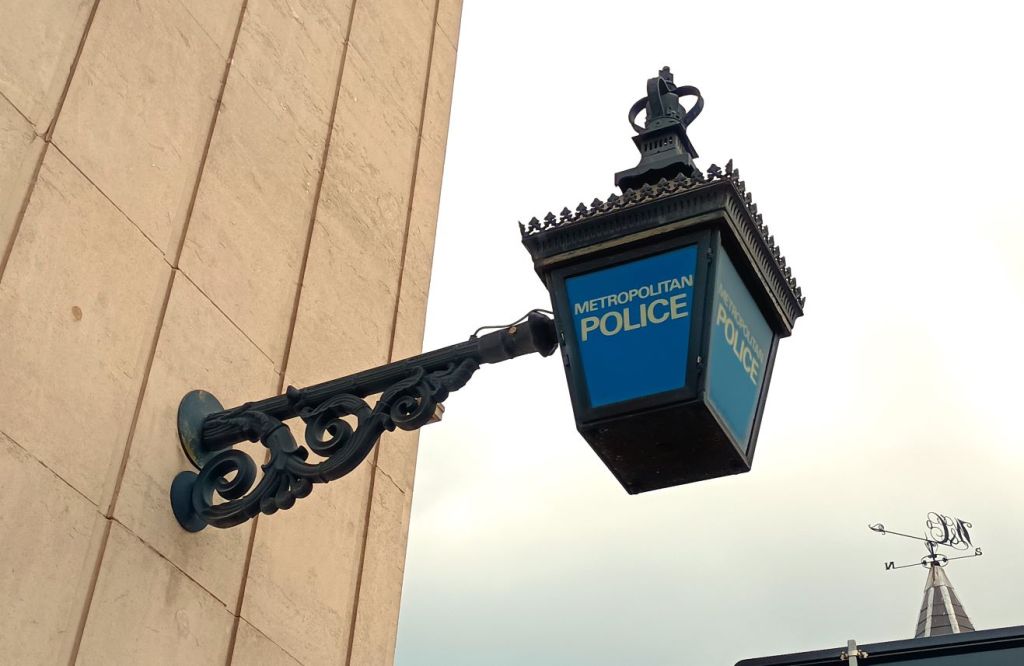
The news was leaked long before it became official: Lavender Hill Police Station, which currently has a 24-hour front desk you can visit anytime, is set to close to the public. It’s not the only one: Kensington and Wimbledon are also doomed, as part of a wider plan by the Met Police to roughly halve the number of ‘open’ police stations. Even some of those that will remain open will have reduced service, with just eight open all hours – leading to the rather impressive statistic that London will have an average of well over a million people per 24 hour police station!

We thought we’d already seen the worst of the police cuts – they started to be closed way back in 2014, when we had 140 police stations with public access. A previous cost cutting exercise back in 2017 saw several nearby police stations close, including Wandsworth. At the time Sadiq Khan made a Manifesto pledge to maintain at least one open-all-house police station in each of London’s 32 boroughs – and as we reported at the time Lavender Hill was the survivor in Wandsworth, but with an expectation that the Lavender Hill Police Station would move to somewhere else nearby within three years. That move never happened – but we’ve hit even tougher economic times, and the Home Office (who fund the police) got one of the worst deals in the 2025 government spending review – an outcome so bad that it was widely claimed that Yvette Cooper was on the brink of resigning. London has also suffered from a series of national governments whose attitude to London ranges from mild dislike to outright hostility – and the latest round of cuts to London’s police budget have been particularly savage: the Met needs to find £260 million in savings this financial year.

The best of a bad set of options?

Sadiq Khan put a brave face on these new cuts, saying the closures are ‘pragmatic’. Frankly he doesn’t have a lot of choice in the matter given the budget he’s been handed, which is becoming smaller and smaller in the hands of a government that seems to have a somewhat tense relationship with him – he described the cuts as ‘devastating cuts to policing’. But he has also argued that given that the Met faces a stark financial situation, putting the police counters on the chopping block is the least-worst approach, and will improve safety for Londoners – on the grounds that very few people used the counters and their running costs could be better spent on neighbourhood policing.

And he’s probably right on this front. Staffing up the front desks at all hours, for the relatively small number of people who still go there to make enquiries, report crimes, or meet officers in person is an expensive process: staff need to be employed on late night shifts, and there need to be enough people involved for the building to be safe for those staff to work in. The huge majority of crimes are now reported online or by phone (with just 5% of crimes now being reported in person at the remaining police stations, and 1% of crimes being reported in person at night).

A fair bit of wider police work with residents and businesses is done in other locations – with our local Lavender and Shaftesbury & Queenstown Ward teams holding regular meetings at Lavender Hill’s cafes and sometimes pop up street stalls, as well as the quarterly Ward Panels where you can hear what the police team has been doing, feed in any particular new concerns, and steer what the priority focus of the ward team should be for the next quarter (we’d recommend our readers with an interest join these, they are a good insight in to the work behind the scenes to keep us safe). In a world where a lot of residents are out at work all day, day today contact is increasingly now using the new MetEngage platform, which you can sign up to to receive updates sand alerts.

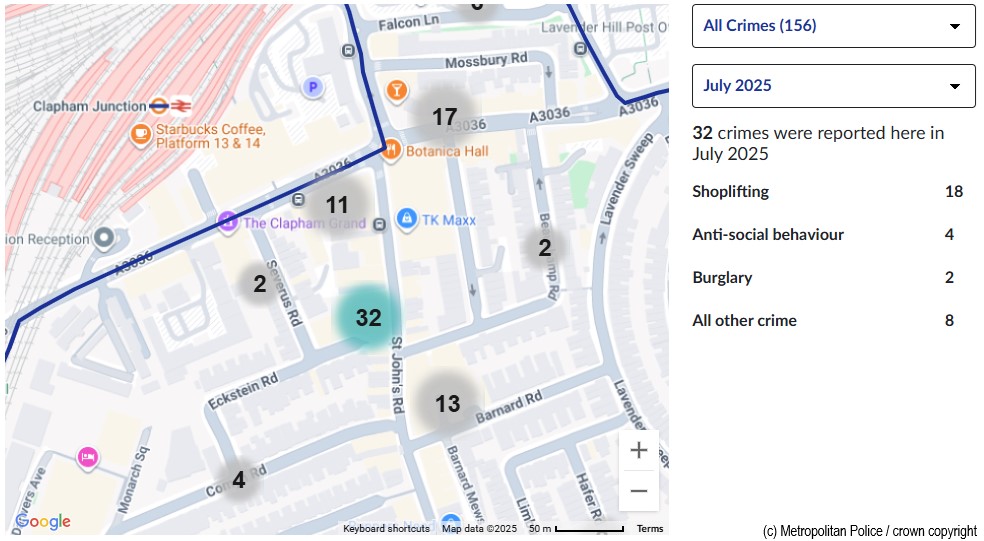
There’s also plenty of data now published like the monthly crime map – which shows what offences were recorded where in the area, and tracks local trends and patterns in crime.

Technology is changing a lot of how the Met police works. The police station front counters aren’t just for reporting crimes that have just happened, they are also often used as bases where the public could go to make witness statements. This used to be very much a pen and notepaper affair – but is now increasingly being done by videoconference as part of the National Police Digital Strategy – which is probably more convenient and efficient for everyone involved.

Some people will be hit harder by the closure

So yes, the world is maybe moving on from front desks at police stations. However the impact of losing the front desks won’t be felt evenly. Most customers won’t notice the difference if the counter closes, and we doubt any of our readers will. Some residents will clearly feel more confident reporting crime in person, and the police stations do act as a place of safety for people escaping difficult and dangerous situations – there are well documented cases of trafficked people and those trapped in modern slavery, and those fleeing domestic violence, escaping to – and finding refuge in – police stations. The police are designated as ‘first responders’ within the National Referral Mechanism framework, which provides a pathway to support and protection for victims; there are other options like Council offices and hospitals – but the 24-hour and local nature of police stations was particularly useful in some cases.

The savings from closing all these police stations are surprisingly small: 7 million pounds a year. The bigger story is on how all the rest of the savings will be made. You can only get so far with efficiency gains and new technology, before you have to really accept that there will be fewer police, and more crime. The Met Police have said that they are prioritising neighbourhood policing, response policing and public protection – which includes the frontline teams you will see in and around Lavender Hill – while rather vaguely noting that they are “reducing some services and staff numbers”. Some of the areas to be chopped are known – and include police horses, police in schools and parks – but there’s also an expectation that there will be about 2,000 fewer police in London.

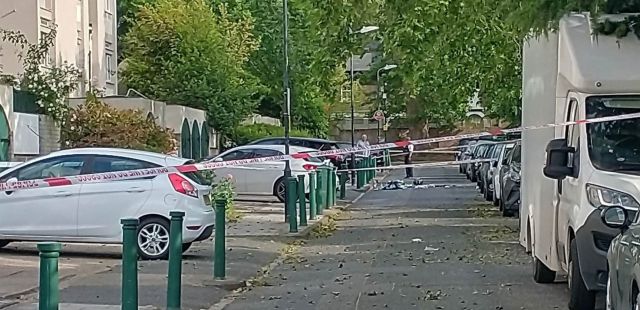
Time will tell how significant the wider impact is. We don’t tend to cover crime much on lavender-hill.uk but did publish a special report on local crime last year, at a time when there had been a really noticeable increase in many types of crime that was significantly affecting a lot of traders and residents, and seemed to be spiralling out of control. The controversy on the new rough sleepers hub, and in particular the risk that if it was managed poorly it could increase local crime, was partly offset by the presence of a police station just across the road; clearly that will now not be the case which is likely to reawaken some concerns.

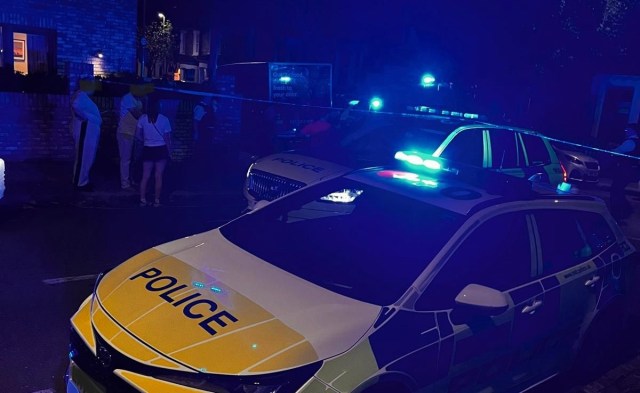
Local crime has fallen back from that peak, due to various factors – notably including some very solid neighbourhood policing by our local police team, tracking down criminal movements in detail and working with affected residents who took the time to report what was going on and ensure that the police had the intelligence and information they needed – as well as some of the most recurrent criminals being moved on from a hostel near the Cedars Road. There have been some high-profile local incidents – but on balance it’s fair to say our local police team deserve significant credit for calming things down. But you’re never really out of the woods in a big city, especially as the area around Clapham Junction is currently the Borough’s hotspot for antisocial behaviour – and there’s always a risk that the severe cuts to London’s policing will unleash a new explosion of trouble.

Will the whole local police operation close alongside the front desk?

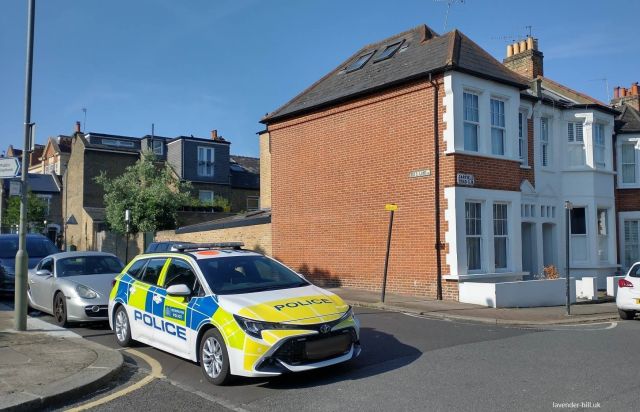
Another question is – if the front counter closes – will the police station itself also close, and will our local Ward teams end up based much further away, and maybe more detached from the Wards round Lavender Hill? As our Councillors note, we are already seeing far too many instances of our police being taken out of the area and sent to neighbouring Lambeth and Central London, and this will surely only increase with the closure of the station.

There’s a degree of uncertainty about this at the moment. Lavender Hill police station is relatively small, and it’s not really the kind of building the Met Police especially want to use any more. It used to house custody cells, but these (and a similar set in Tooting) were relocated to a newer and more modern 30-cell facility in Wandsworth town centre back in 2012. Wandsworth police station no longer has any public access – but is still very much in business and being used by the police. It’s considerably larger than the Lavender Hill site, and is home to the investigation teams that make up Wandsworth’s Criminal Investigation Department – and it also has a far larger and easier to use parking area for police cars and vans than the Lavender Hill site. The latest closure round of front counters is partly based on an assessment of ‘how well individual counters are aligned with custody suites and local investigative teams’ – so losing those custody suites back in 2012 has probably in a way fed in to the downfall of our local police station. Fingers crossed this doesn’t happen (but if you have any behind the scenes insight on the long term future of the building – get in touch).

Even if the whole police station closes, it doesn’t mean the government (who own the site) can just sell if off to some developer for a quick buck, as a site for redevelopment. The police building is part of a complex of three interlinked buildings built in th emid-1960s that were originally built as a joint project. The largest of the three is Lavender Hill Magistrates Court. It’s one of the main ones in London – with four courtrooms, and some specialities including traffic offenses and bulk-processing of fare evasion cases, including being the prototype for some innovative approaches to speeding up cases. It’s where the Archbishop of Canterbury was famously fined for speeding – and where Stormzy pleaded guilty to the rather bizarre act of driving a Lamborghini whose windows only let 4% of the light through. The court isn’t going anywhere soon – it’s a fairly up to date premises, and while there is a need for further upgrades in accessibility and facilities, it has had ongoing maintenance and upgrades.

The third bit of the complex is a small office building facing Latchmere Road which houses the London probation Service. The Probation Service’s building isn’t in the best condition, which is fairly typical situation for their properties – which maybe isn’t too surprising given that London’s Probation services have been stumbling from crisis to crisis for some years. Selling part of a wider government building off won’t work especially well for any developer – so we wouldn’t be entirely surprised if the court took over some of the police space.

The campaign to limit the damage

The Conservatives and Liberal Democrats have both kicked off campaigns to save Lavender Hill’s police station – with the Conservatives noting that they were successful last time round in saving it from the 2017 cuts and optimistic that they can do it again. Council leader Simon Hogg has noted that the closure would be the first time in living memory that there’s no full-time police station open to the public in the Borough, with clear concerns on how trust, visibility and community reassurance will be maintained without a local police station.

Meanwhile for those who do need to visit a police station in person, Lavender Hill’s nearest police station that will be staying in business as a place you can actually go and speak to a police officer looks likely to be in Brixton. There’s some sense to that location being the last one left, with Brixton in general (and Brixton’s Windrush Ward, which that police counter is inside, in particular) being an area with far higher crime levels – but it’s not somewhere that anyone in Wandsworth or Lavender Hill is likely to want to go to late at night to escape from a dangerous situation. While very much support the good work by our Ward policing teams, and it’s hard not to be concerned at what a sharply reduced budget will mean for them in the next few years.

Lavender-hill.uk posts from time to time on developments in the Lavender Hill area of Battersea. We seldom cover crime – but if you found this interesting you may want to see our detailed special report last year exploring some of the causes and potential fixes for local crime. And if our wider coverage of local issues including retail developmentslocal businesseshousing projects and local history in the Lavender Hill area of Battersea is of interest, do sign up to receive new posts by email – for free, unsubscribe anytime.

Posted in Crime & security, Politics | 2 Comments

In pictures: Work starts on improving Falcon Road’s horrible bridge

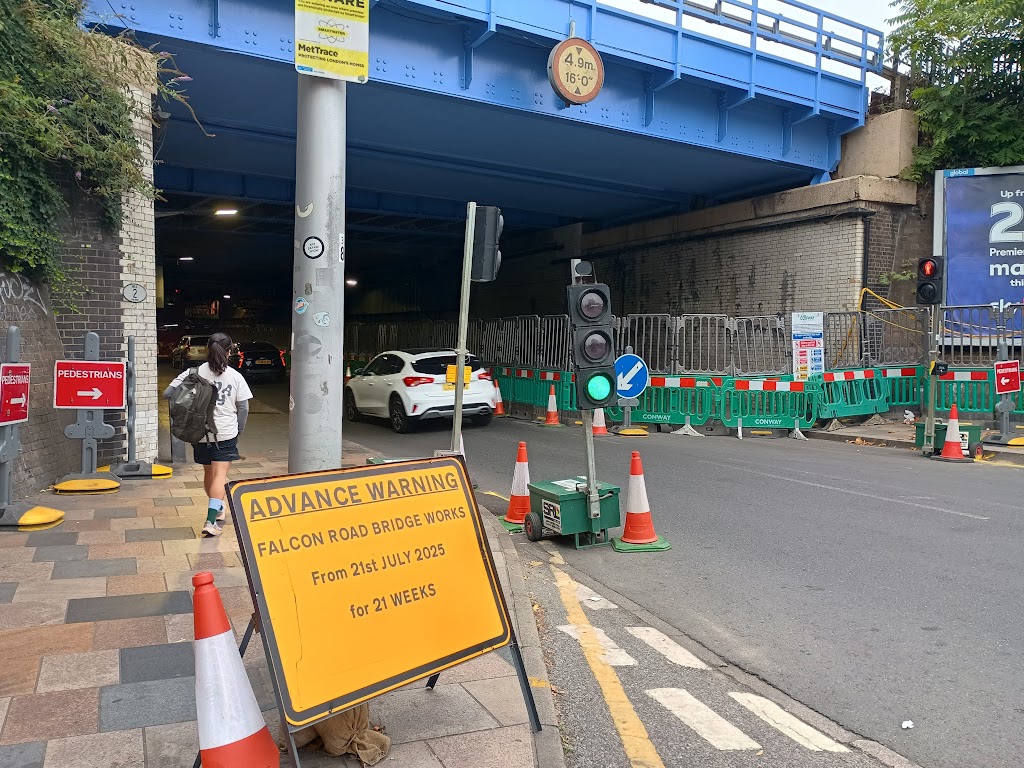
It’s been a long time in the making. As we wrote way back in 2019, nobody likes the Falcon Road railway bridge.  Dark, dirty, loud and with a mysterious tendency to be wet even when it’s not raining, the need to run the gauntlet of drips and pigeon poo discourages anyone who doesn’t live north of the tracks from venturing up the Falcon Road. But like it or not, it’s unavoidable lowlight for many of us. It reinforces a long running north/south divide in Battersea, and prevents the businesses on the Falcon Road benefitting from being so close to Clapham Junction’s town centre. It’s also really just an unpleasant part of the day for anyone who needs to use it.

Its run-down condition is not lost on Wandsworth Council. Back in the early 2000s the lighting was made brighter, the walls were deep cleaned, and some orange & pink feature lighting was added to a few of the girders above.  For a while, the bridge did look better – but it wasn’t maintained, and sadly it wasn’t enough to turn the tide for Falcon Road. To make matters worse, a major rail signalling upgrade then led to two huge cable ducts being installed above the pavement on each side of the road, creating even more space for pigeons and general dirt, and making the space feel even darker and more enclosed.

There has been a bit of a push in the last few years to deal with our shabby local underpasses. Thessaly Road in Nine Elms went first, with a design competition that attracted over 100 entries from ambitious emerging architects, followed by a major makeover (mainly funded by Nine Elms developers) that involved an explosion of colour. It’s quite striking, it definitely changed the feel of the bridge which had previously been relatively clean but distinctly dark and gloomy, and it seems to have lasted well.

Earlsfield also saw a more “heritage” makeover – going for a Victorian railway green with the original station name restored.  Both of these – which also involved some repairs to the bridges themselves – cost around £200k. The far end of the Wandsworth Road saw a much more DIY makeover, really just cleaning and painting it and adding some coloured lights. Some of the more minor underpasses also saw some love: as we’ve reported previously the problematic underpass at Culvert Place has also seen new lights and some fairly rudimentary painting, as part of a bigger scheme to introduce a long-distance pedestrian phase through the tunnel.

Falcon Road probably sees as many pedestrians as these other bridges added together, and has been on the Wandsworth ‘to do’ list for ages – so we were pleased to see things finally get moving. It started, as the more ambitious makeovers tend to, with a design competition, which saw seven proposals shortlisted. These were exhibited, and it was interesting to see both the wide range of approaches taken, and the variation in the extent to which the entries took account of the actual site. Some were led by very local teams who clearly knew the opportunities and headaches of the bridge in detail – like the need to deal with the big ugly cable ducts and the awkward scraps of land either side – while others were clearly a bit more conceptual. There was also a vote on which should be taken forward. The vote was only advisory: the final decision was made by a n expert panel – as in choosing the design team for the project they also needed to take account of various less obvious factors like cost, practicality and technical deliverability.

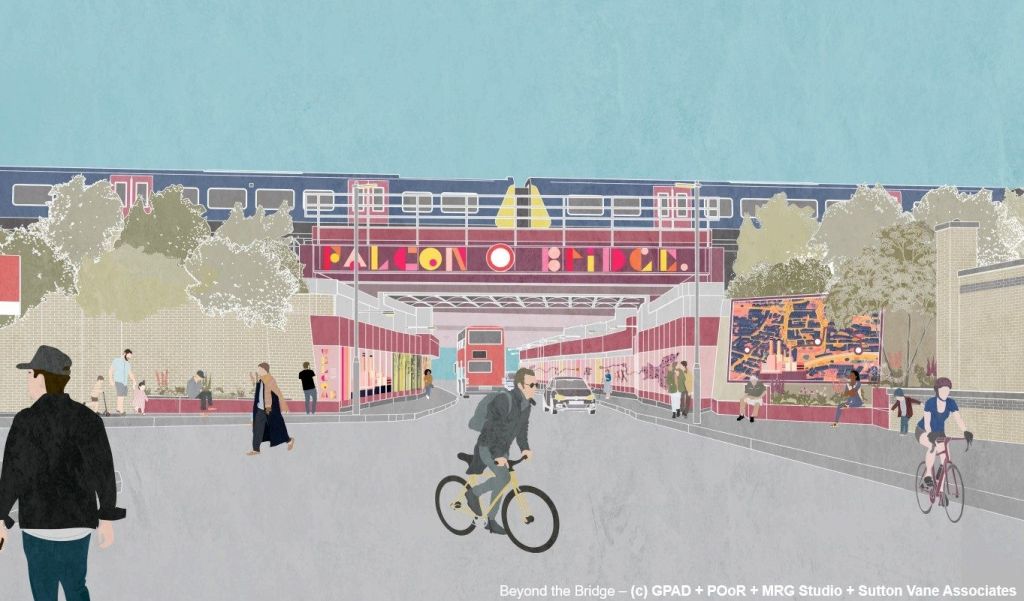
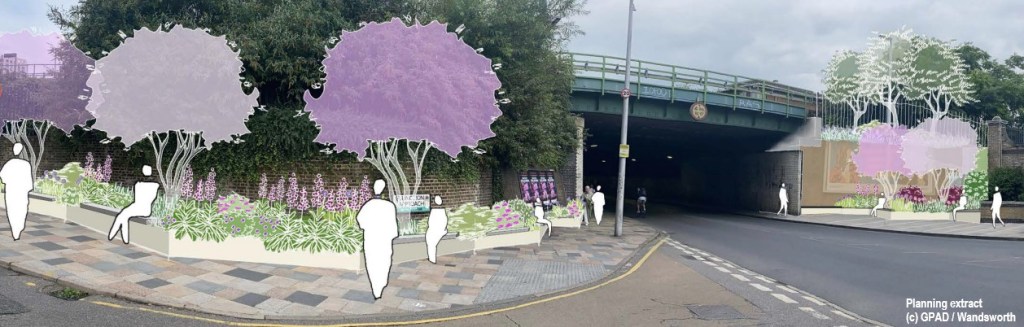
The Panel chose Beyond the Bridge, presented by design team of GPAD (a Hackney-based architecture & interior design practice), POoR CollectiveMRG StudioSutton Vane AssociatesCundall, and MDA Consulting – the headline image from their design is shown below.

Proposed features included a Memories of Wandsworth wall of local stories and artwork (mainly on panels attached in front of the existing glazed wall bricks), new seating areas at either end of the bridge with pollinator-friendly plants, smart lighting all the way through that can change colour for different occasions and events, and sound-absorbing panels to reduce noise under the bridge.

Now a ‘competition winning’ design tends not to translate directly to a workable real-world build, especially in a damp and messy working environment with loads of constraints – like the need for Network Rail to get maintenance access, the need to make something that will stay clean, and the need to remain within a realistic budget! So more work then took place to refine the design and prepare it for actual construction.

This included a series of co-design workshops that explored how the designs could reflect the unique identity, culture and history of Clapham Junction, including how locals perceive the area, and the significance of Falcon Road Bridge and its surrounding areas to the community, and what residents want their neighbourhood to be like in the future. The workshops, and a series of drop-in events at Lavender Hill library, Clapham Junction and in and around the bridge itself, also explored more practical issues – with an opportunity to explore the designs and highlight issues with the existing underpass.

The feedback was exactly what would probably have been expected: unsurprisingly was good feedback on the approach of having way more lighting and greenery, and on having a cleaner, safer, and generally nicer walkway, as well as for designs reflecting local heritage and diversity. Pigeons, on the other hand, unsurprisingly dominated the negative feedback – as did the eternal dampness of the area and scope for being splashed by vehicles, and some wise thoughts about the need for long term maintenance and cleaning, and for the planting areas to be looked after.

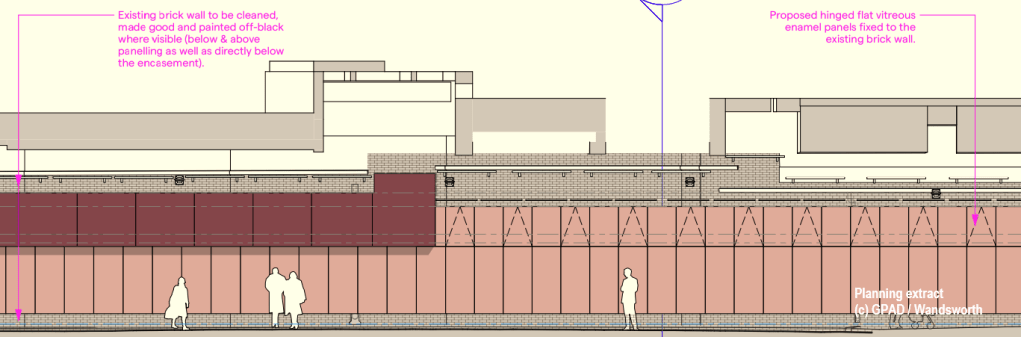
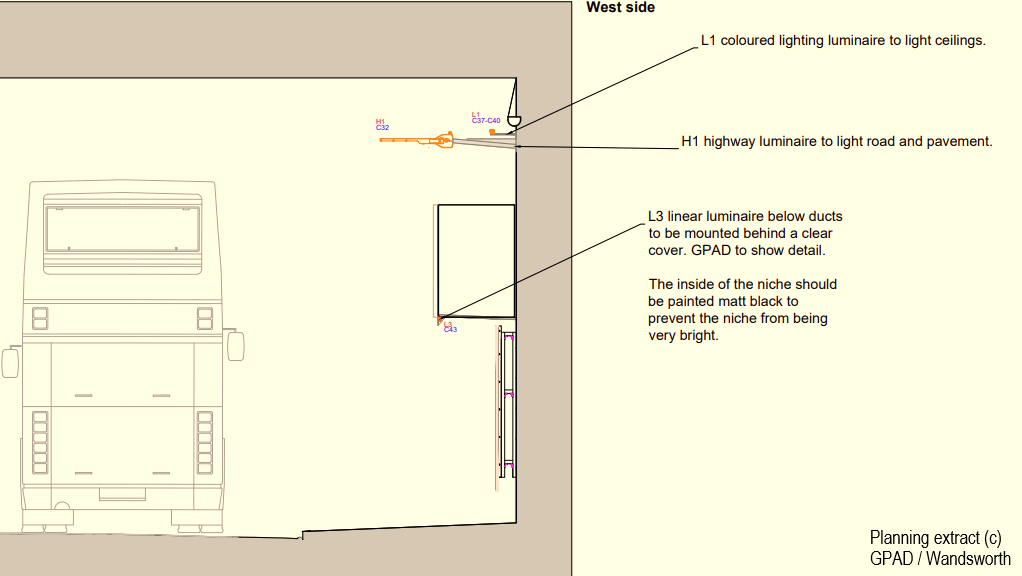
We now have the more detailed plans – which are reasonably clever. Many of the higher level panels which have lighting and railway signal cables running behind them will have hinges so that Network Rail can still get to the cables behind them without destroying the whole setup.

Given that there’s no way of fully waterproofing a 150-year-old railway structure that has a load of wet earth behind it, the panels have a space behind them to allow for drips and they don’t go right to the ground – so that they can allow any leaking water to still escape from the structure. The existing wall above and below the panels will be painted a dark colour to avoid any muck being too visible.

A lot of thought has gone in to the lighting – where the existing street lights remain in place, but new colour-changing lights are also added that face both upwards to light the ceiling, and down below the big cable ducts to light the pavement. These will need to be of a tough enough design to withstand the wet and somewhat mucky environment of a railway underpass – but are likely to make a big difference to the overall feel of Falcon Bridge.

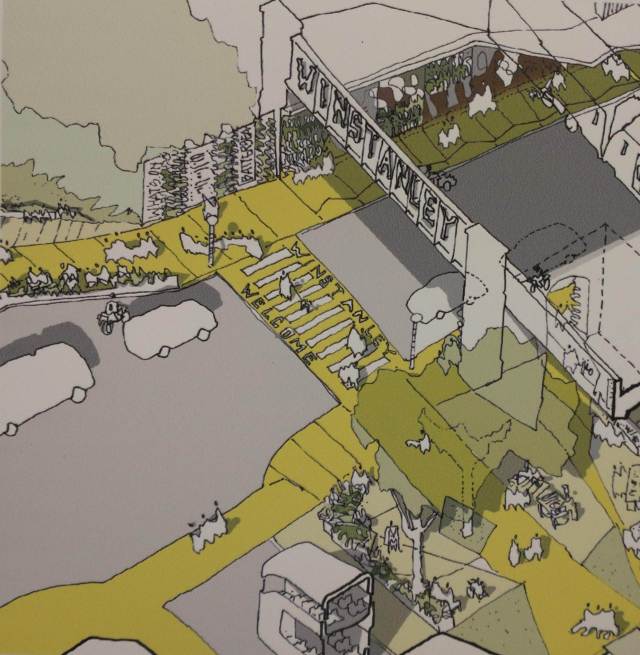
The ends of the bridge are currently home to rather scruffy patches of wasteland and unofficial advertising hoardings. These will be replaced with planting and seating more or less following the design in the original competition.

The pavement on the station entrance side south of the bridge will be partly covered by new seating and planting, while the curious alcove between Lidl and the bridge will also be planted. A similar approach is being taken at the other end of the bridge, but only on the Banana Park side where there’s enough space.

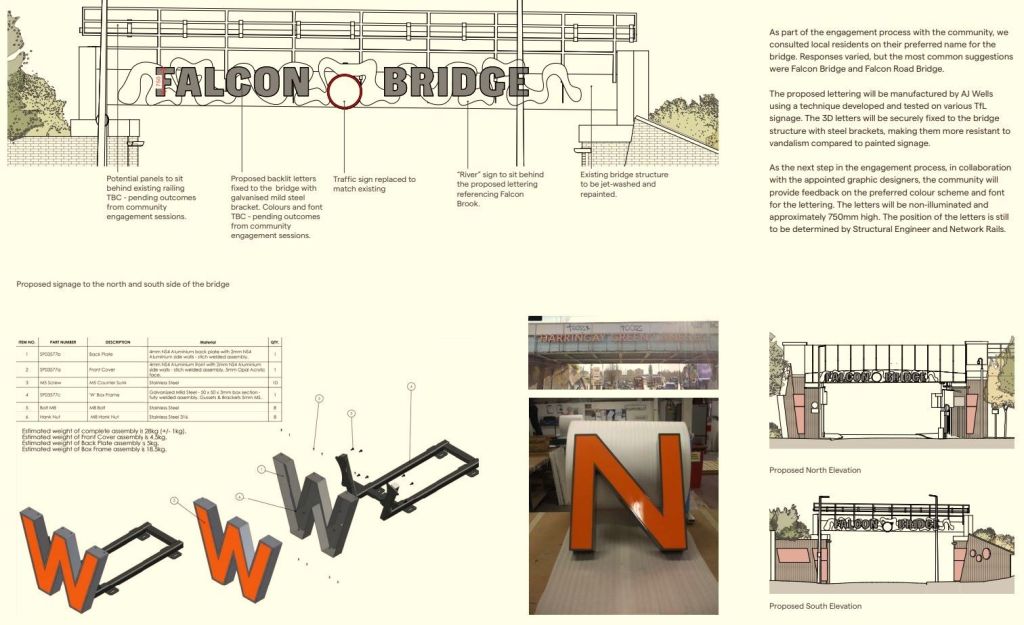
The bridge will also be properly named – with an illuminated Falcon Bridge sign likely to be added at each end.

These changes needed planning permission – so Wandsworth submitted a proposal for “Alterations including installation of panelling system to tunnel walls, illuminated signage on north and south elevations of bridge, highway and creative lighting and landscaping and seating on southern side of the tunnel“. It’ didn’t prove particularly controversial; the only comment at the time of writing is from the Battersea Society who support the plans – in particular the work to divert rain away from the pavements, to use panels to create a cleaner and dryer surface on the walls, and to tidy up the green spaces at each end of the tunnel – while expressing concerns on whether some aspects of the proposal will be easy to maintain to an adequate standard, and mild surprise that what is actually going to go on the panels remains a mystery at this stage.

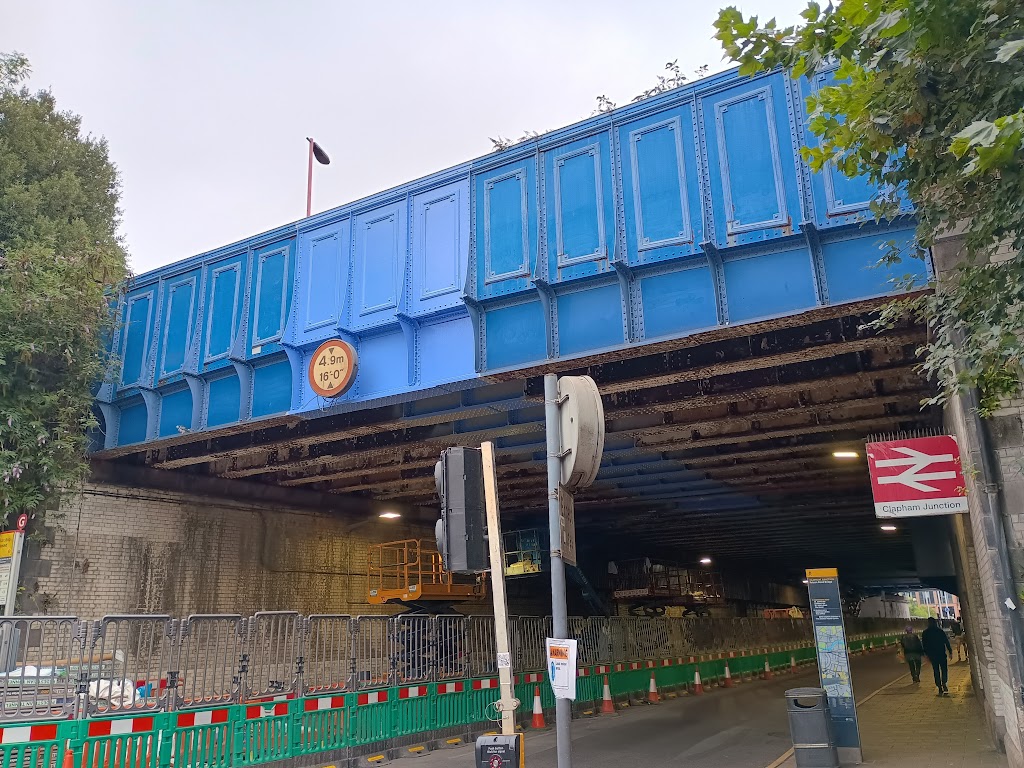
Work has, in the meantime, already got going – starting with a pressure wash and complete repaint of the main bridge structure.

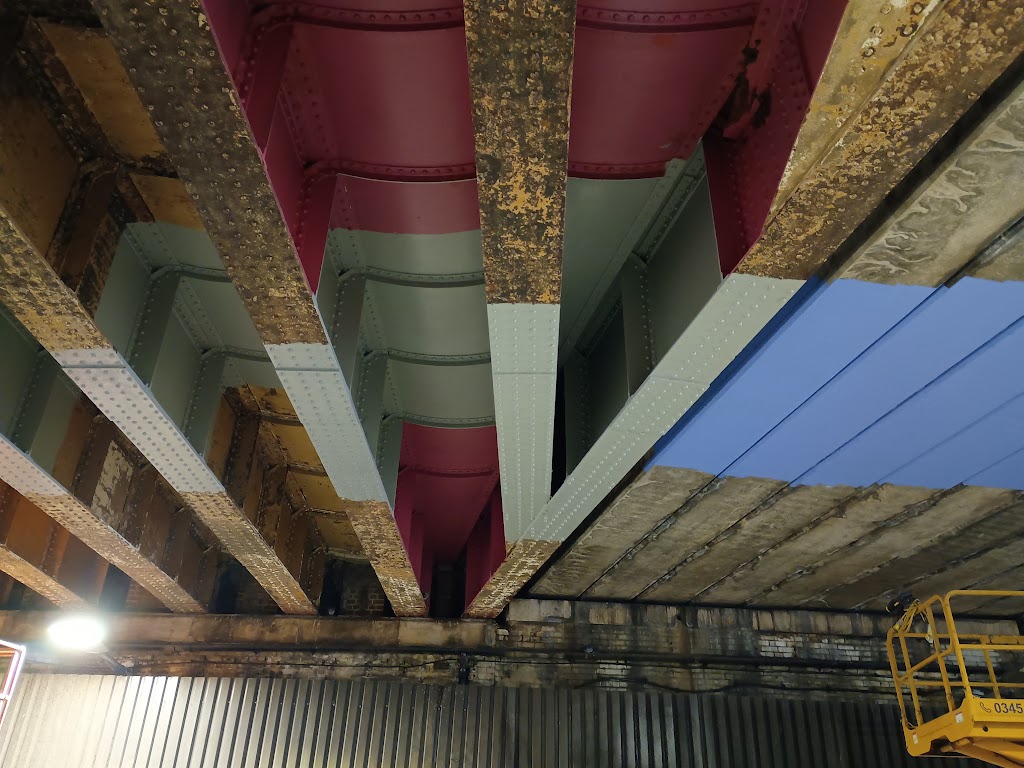
It’s all becoming very blue – the concrete bridge sections are being painted directly, while the iron and steel parts have an undercoat followed by the blue.

We understand that the metal parts were found to be in a surprisingly good condition once it got a pressure wash, with the original layers of paint not needing further sandblasting or removal – so this part of the project has advanced quickly.

The photo above shows the pink sections that were painted in the previous effort to improve the underpass in the mid-2000s (which was accompanied by localised coloured lighting, until it got removed to make way for Network Rail’s new signal cables) as well as the new grey undercoat on the steel sections, and the final blue paint on the concrete sections. Some sections were also previously painted orange as visible in the photo below.

Both ends of the bridge have already seen a repaint, which has somewhat improved their appearance (and made them a lot cleaner).

Like a lot of Network Rail’s bridges, these are a prime target for graffiti – we’re hoping that some sort of grill is also installed inside the railing, to make it harder for taggers to reach through or over the parapets and vandalise the newly painted surfaces. Because with schemes like this one, what is actually one sometimes matters less than how it is maintained in the future. The design needs to take quite careful account of how the design can resist future graffiti, pigeons, dirt, leaks and general muck without needing expensive follow up work, and the Council needs to have a cleaning process that keeps a reasonable eye on it. Network Rail – who own the bridge – apparently declined to do any repair work on the leaky tunnel roof, meaning there’s obviously a risk that all the planned improvements quickly become dirty and spoil the impact of the new lighting. The issue of pigeons on the ledges remains a bit TBC – hopefully something can be fitted that prevents them perching all day above the pavement.

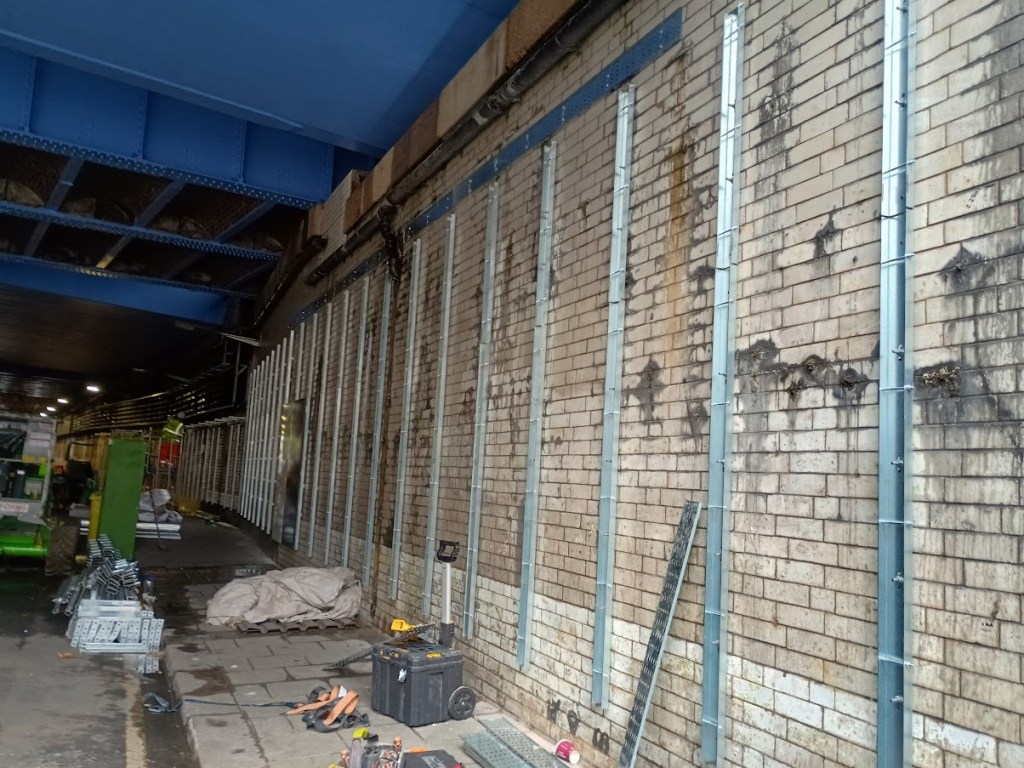
The walls either side of the underpass are currently being covered over with galvanised steel battens, which will hold the planned panels right along both sides of the bridge. These will be made of vitreous enamel – a super strong material produced by the same people who make signs for TfL, so we can be fairly confident it will be tough and long-lasting (the planning application includes details of how graffiti is cleaned off this type of panel).

This still has a while to run, and while no amount of lighting and decoration can fully magic away the somewhat unpleasant nature of this underpass, this project is very much good news and is finally progress on something that has been a lowlight of the Clapham Junction town centre for decades. Wandsworth have taken a fairly imaginative approach to developing designs and run a surprisingly large public engagement programme on the details, and seem to be throwing a reasonably large budget at it – fingers crossed the end result lives up to the fairly high expectations.

Lavender-hill.uk is a community site covering retailplanning and development  and local business issues, and sometimes posts like this one on transport and the environment – all centered on the Lavender Hill area in Battersea. We sometimes also post more detailed articles on local history. You may want to see a previous article on the bridge at Clapham Junction Insider, back in 2019 –What can we do about Falcon Road’s horrible railway bridge?. If you found this interesting feel free to sign up to receive new posts by email (for free, unsubscribe anytime). If you want to comment on the planning application on the details of the works, it still seems to be at least theoretically possible even though things have got going – search for case 2025/2192 at wandsworth.gov.uk/planning (it technically was open for comments in July, we’re not sure why there has yet to be any decision).

Posted in Crime & security, Environment, Photo stories, Planning, Politics | 3 Comments

In pictures: Lavender Hill’s brand new pottery studio

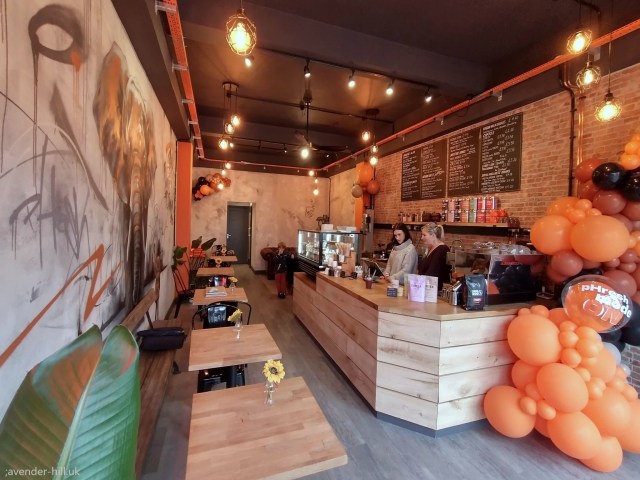
Nearly two years ago we reported on the opening of Phresh – a new family-run juice bar, coffee shop and deli at 103e Lavender Hill. The business has proved very popular and owners Donna and Steph really appreciated the welcome they saw from the Lavender Hill community – indeed it’s gone so well, that they have been quietly working on a big plan, to grow the business further.

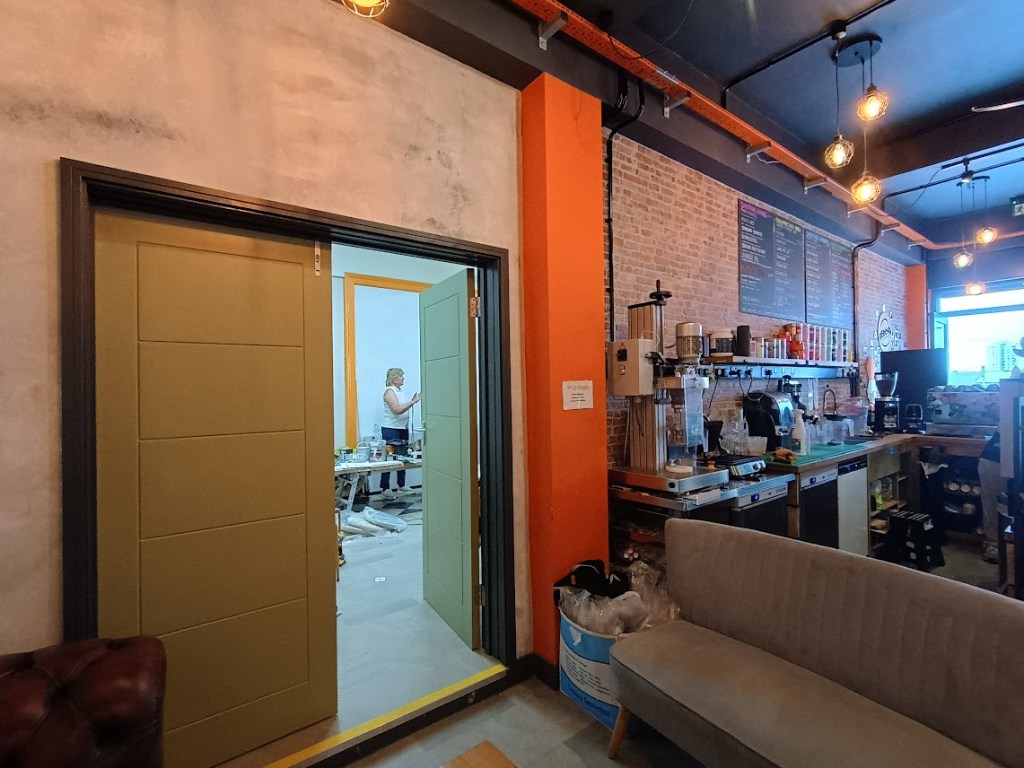
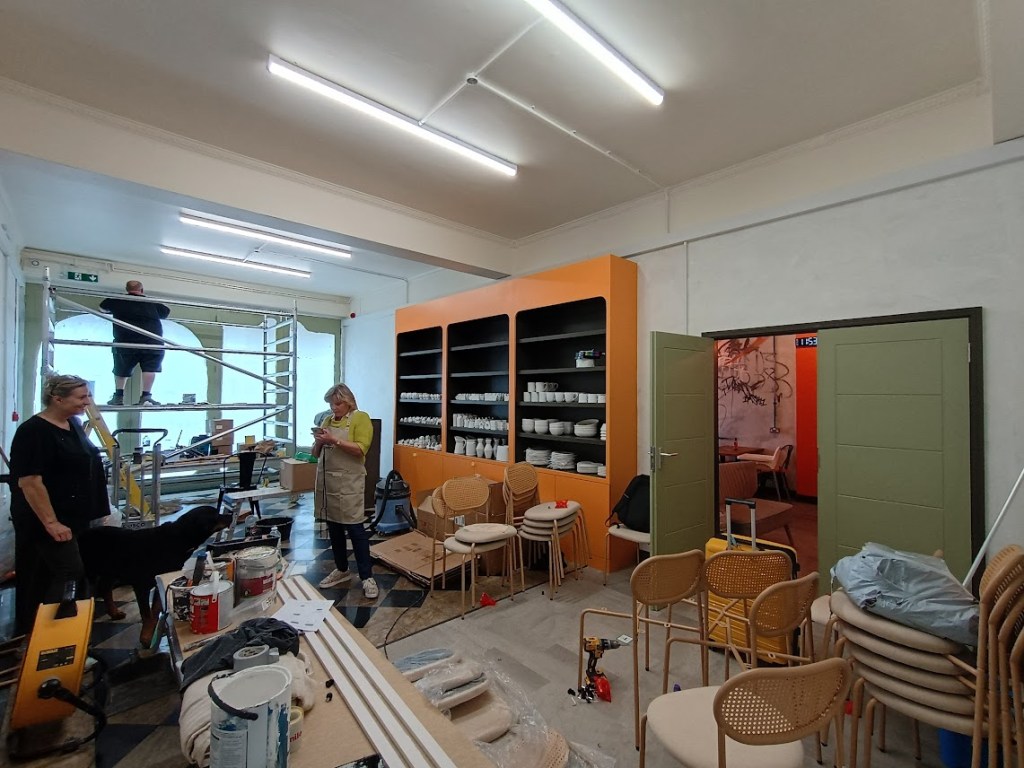
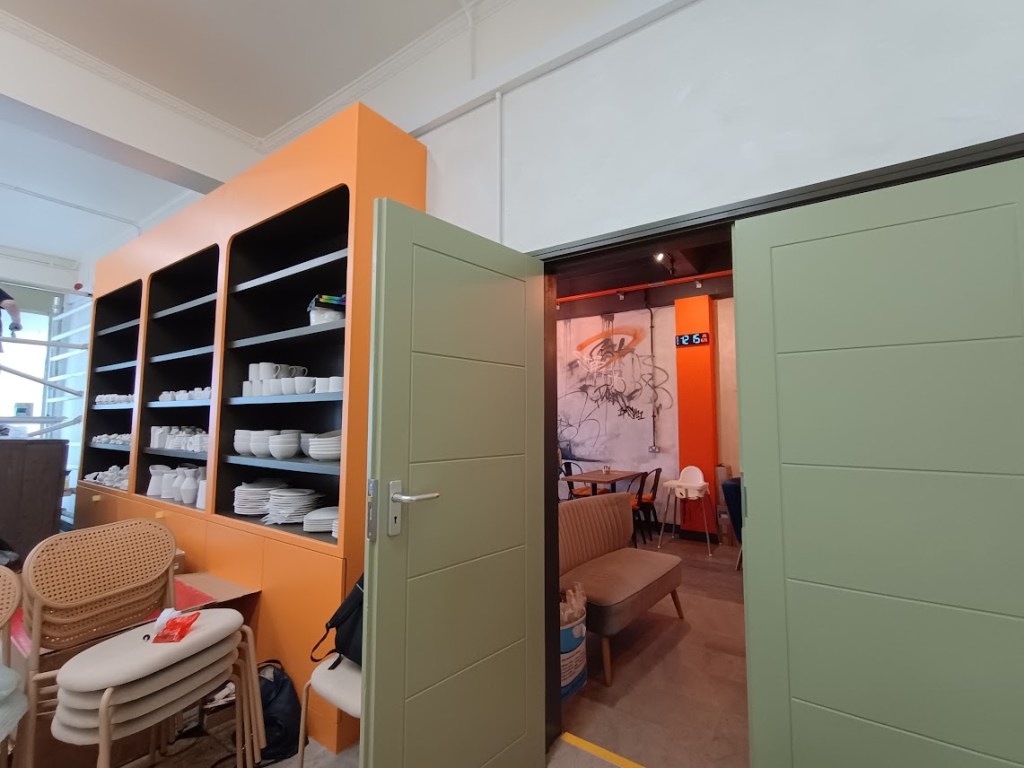
For the last couple of months they have been clearing out and refitting the unit next door (which used to be the Baguette Deli) – and regulars may have spotted a doorway suddenly appearing at the back of the current Cafe, in the area with the big comfy sofa!

We popped in earlier this week for a sneak preview of the works that have been going on – which is about to see Phresh launch its very own ceramics cafe, Phresh Pottery.

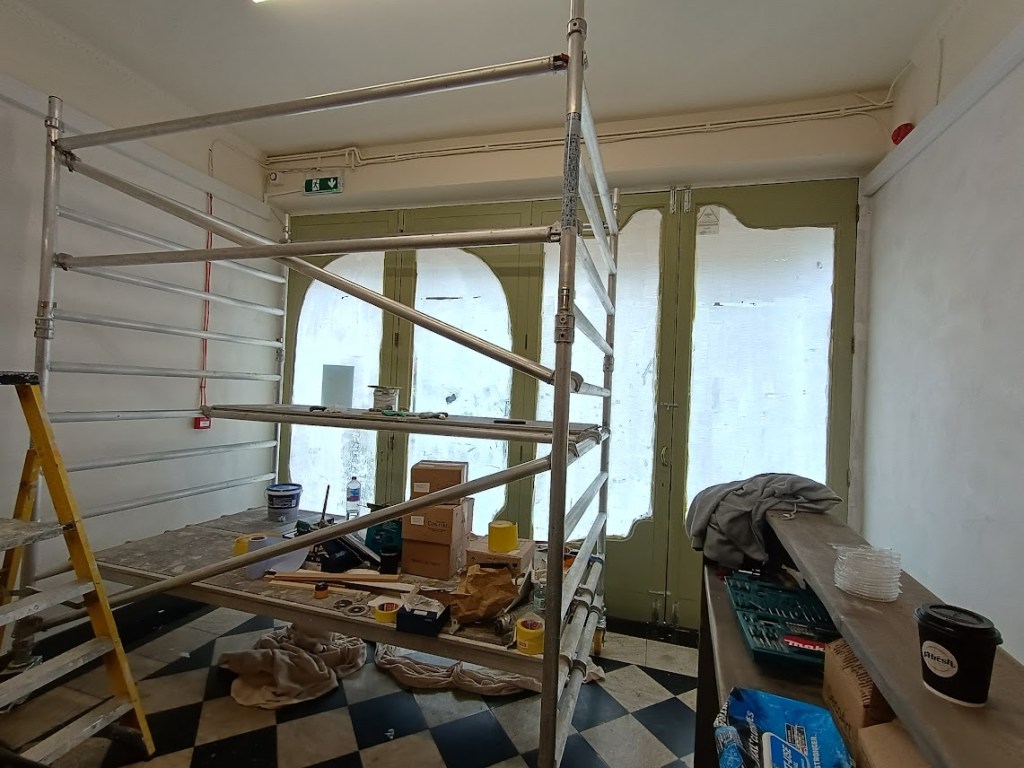
It was very much all hands on deck when we took these photos, with the rush to get everything looking perfect underway – but it’s already possible to see the premises taking shape.

Some of the orange colour theme is carrying through – but in contrast with to the cool clean style of Phresh next door, there’s a more hands-on feel here, to allow for things to get a bit messy – no one’s going to panic if some clay or paint ends up on the floor.

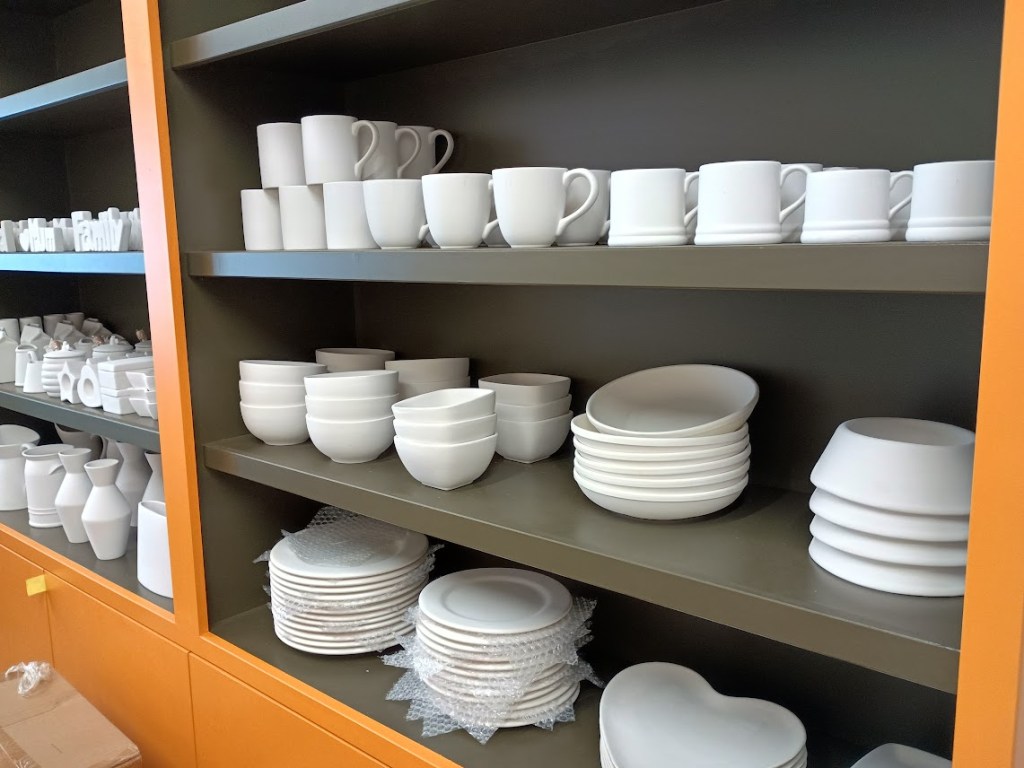
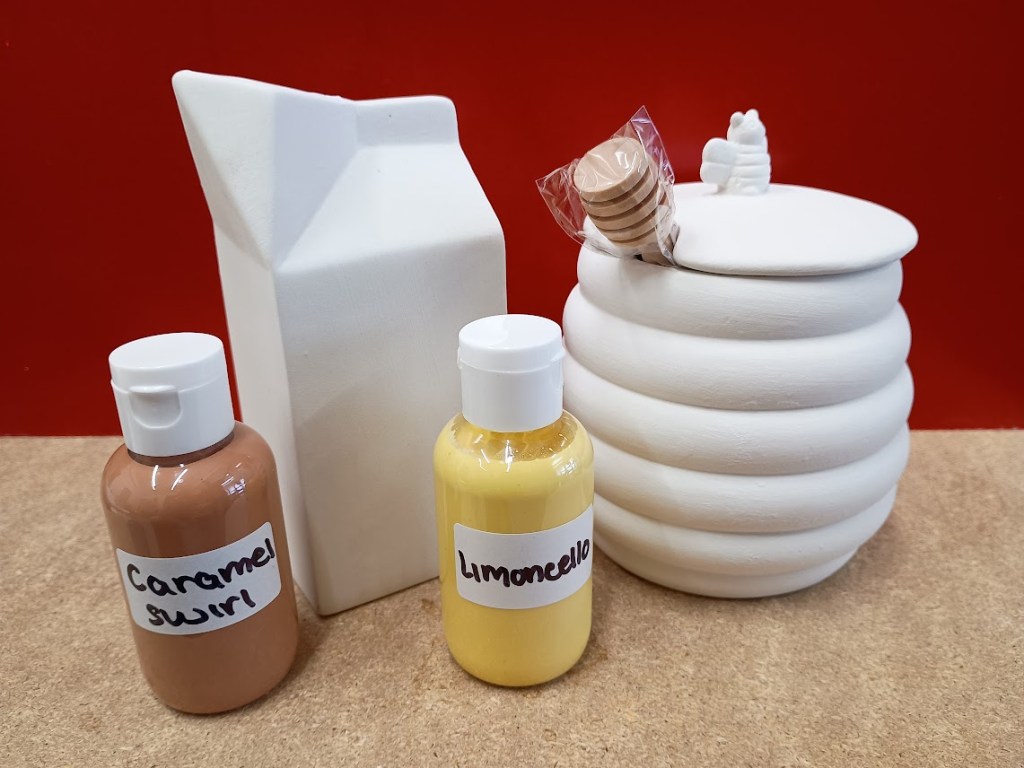
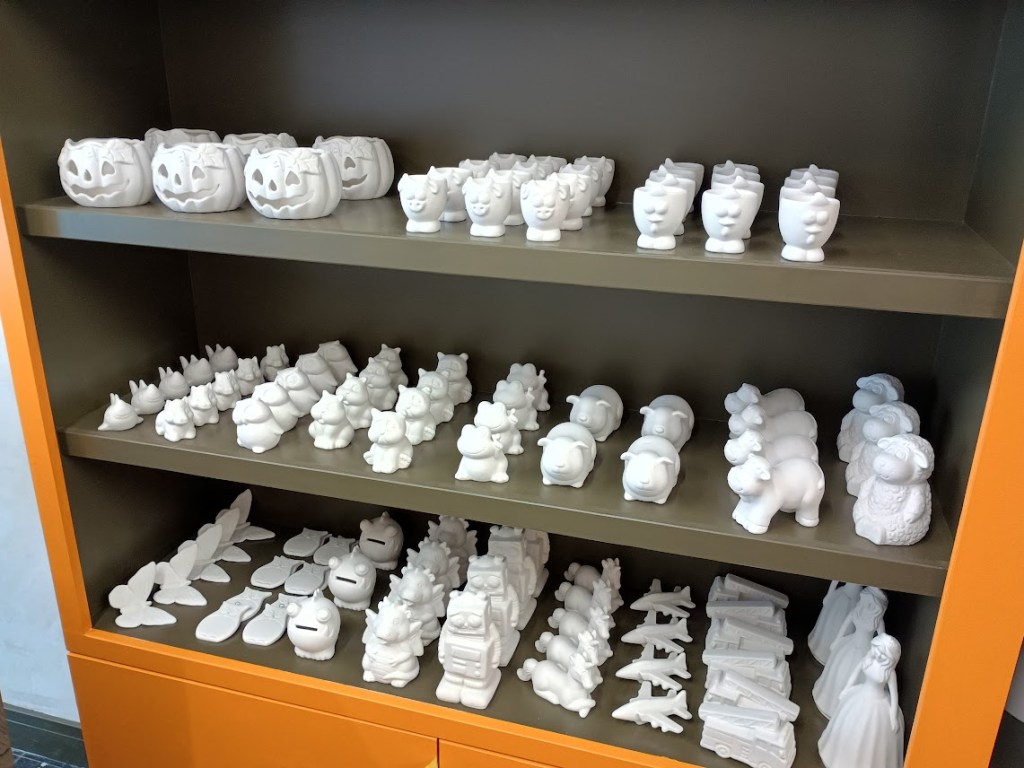
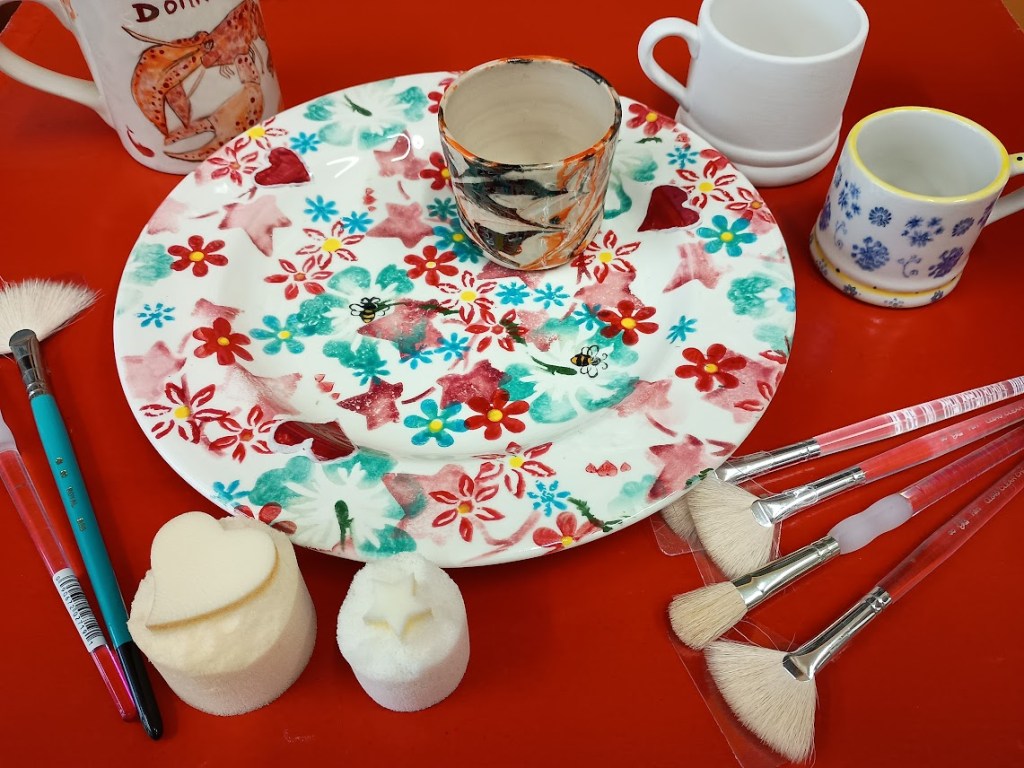
A wide range of bisque – unglazed ceramic – is already in place, from animals and fire engines to candle holders, plates and vases – all just waiting to be painted, glazed and fired. There are big and small – with the range starting from a reassuringly affordable £10 to decorate and keep.

The building work has been quite extensive, with the old kitchen and back of house of the Baguette deli swept away and completely re-engineered to a new and more open layout that allows the space to be properly used. The cafe next door hasn’t changed much as part of these works – but its kitchen at the back has been expanded to extend the food on offer, which already includes a mix of cooked all day breakfast options as well as modern classics, pastries, porridges and pancakes.

Firing ceramics in a way that brings out the colours and makes them watertight needs powerful specialist kiln equipment – so readers won’t be surprised to hear the electrics in the new premises have had a complete replacement. The kiln itself was still in a transport depot at the other end of the country at the time of our visit but it’s definitely on the way!

And there’s plenty of room here, with capacity for about 28 people with generous levels of space and comfort. Conscious that this is somewhere that will be perfect for birthday parties and gatherings, capacity can be nudged up to 36 or so in slightly more compact layouts. And this is where a key advantage of the space also comes in to play – that with a well established cafe directly connected to the venue, you can always escape from the kids’ party to next door for a while and have a quality coffee or light lunch!

The plan is for Phresh and Phresh Ceramics to run as linked but parallel venues – so the cafe and deli will carry on just as it does now – but if you’re visiting the ceramics next door you’ll be very welcome to have something to eat or drink from the cafe before or after, or get a nice drink to have while you paint. The only tip is that it’s best not to take plates of food through to the ceramics side (as any greasy fingerprints tend to cause chaos with the glazes).

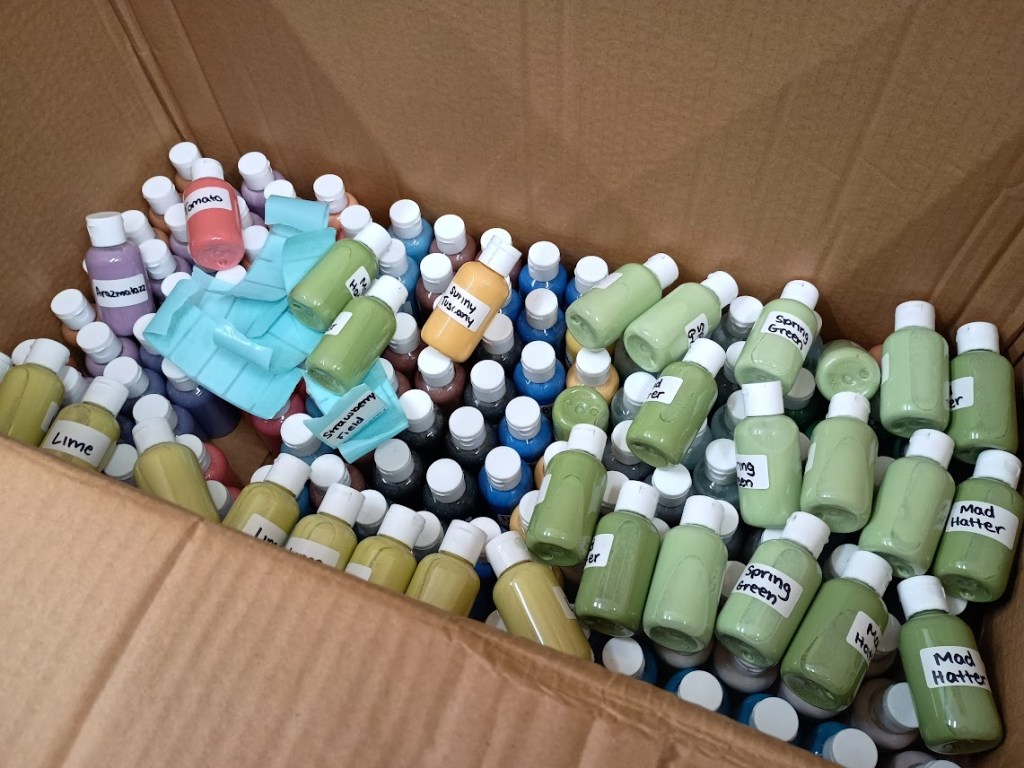
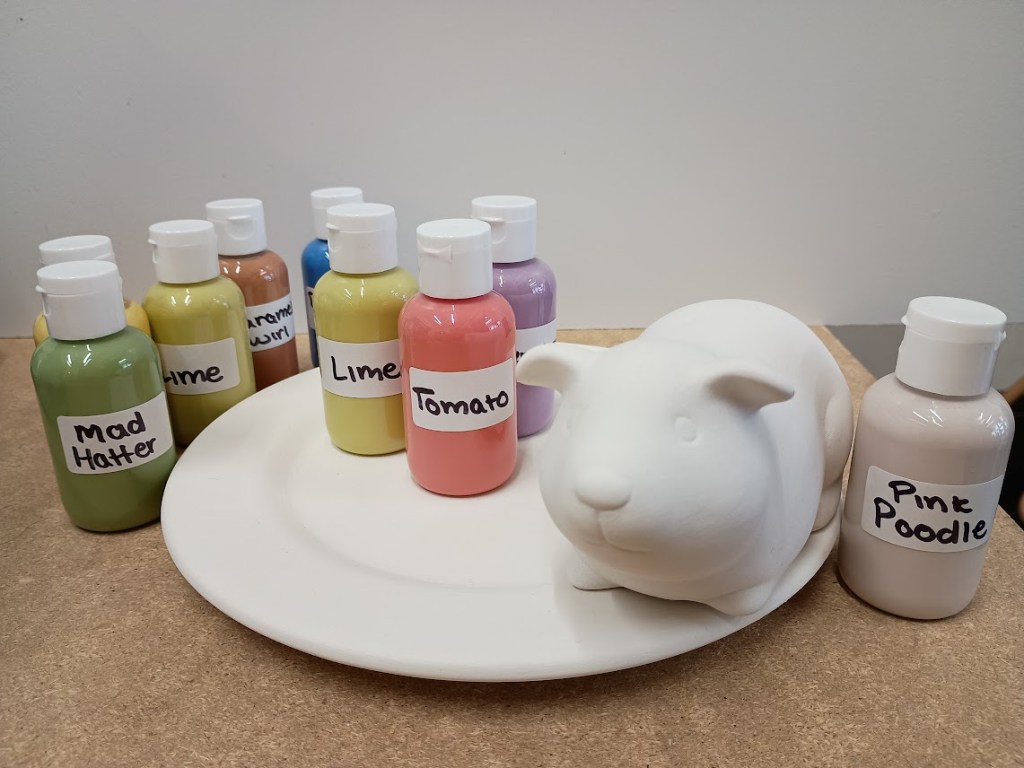
Speaking of glazes, the whole range is starting to appear – with everything from Pink Poodle and Caramel Swirl to Tomato and Lime. One of the big moments of painting pottery is always how the colours work out – as in our experience the firing and glazing tends to turn even the most unpromising artwork in to something interesting.

Te aim os for thsi to be a fun, hands-on creative space where everyone can unwind and express themselves through pottery painting. Bookings are welcome and can be made straight away – but this very much isn’t just a place for groups and pre-booked events, and walk-in customers are also very welcome. At least once a month, they will run a baby and toddler session where you can make hand and foot prints in clay, and fire them to create a personal treasure. The team will then carefully glaze and fire items in the kiln to make sure they are finished beautifully and ready to take home.

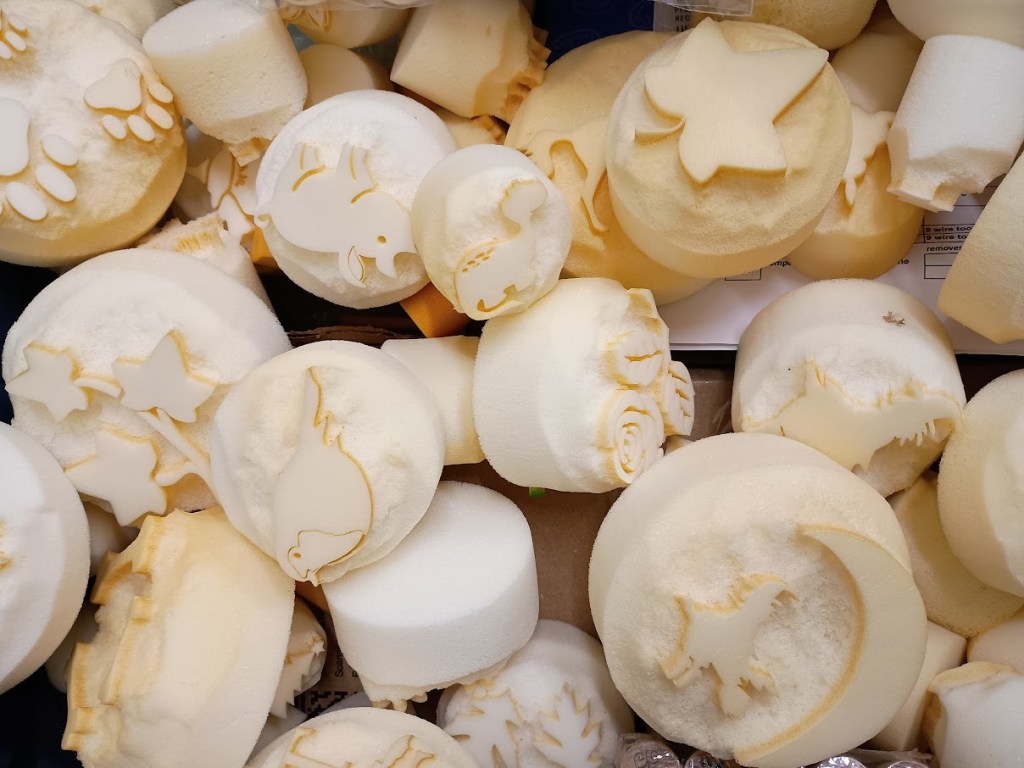
The target audience is very much grown ups as well as children – all ages and levels of experience are covered, with lots of quite sophisticated options for decorating places and making very personal creations. You’ll of course have proper help and guidance. The brushes available include tough child-friendly ones, but also more complex and sophisticated tools aimed more at an adult audience. There are also a wide variety of carved sponges to make prints and shapes – like the stars on the plate below.

Having had a good dig through the various options our favourite is definitely the guinea pig! He definitely wants a mix of pink poodle, caramel swirl, white, black, and maybe some fine fur texture.

The soft launch is tomorrow (Thursday the 21st) – with pottery painting, baby hand and feet clay prints, a free drink with every painted piece and giveaways. Some of the equipment is still arriving so things will continue to build up over the next couple of weeks.

It’s good to see this independent mother-and-daughter business doing so well, and this looks set to bring something very new to Lavender Hill – they’d love to show everyone round, so do visit just to see what has been done over the last couple of months if you have the opportunity – and maybe try your hand at a ceramic masterpiece!

pHresh Pottery, 103f Lavender hill, Battersea SW11 5QL (web / facebook) – attached to Phresh Cafe at 103e. Booking for Phresh Pottery is available here; walk-in customers also welcome. Latest details are on their Google profile. Lavender-hill.uk posts from time to time on developments in the Lavender Hill area of Battersea – if you found this of interest you may want to see our other recent posts on food and drink and retail in the area, or our wider articles on business, environment, planning and housing issues – as well as some of our favourite articles on local historyYou can also sign up to receive new posts (for free, unsubscribe anytime) by email.

Posted in Business, Food & drink, Photo stories | 1 Comment

Queenstown Road’s most special tree gains protected status

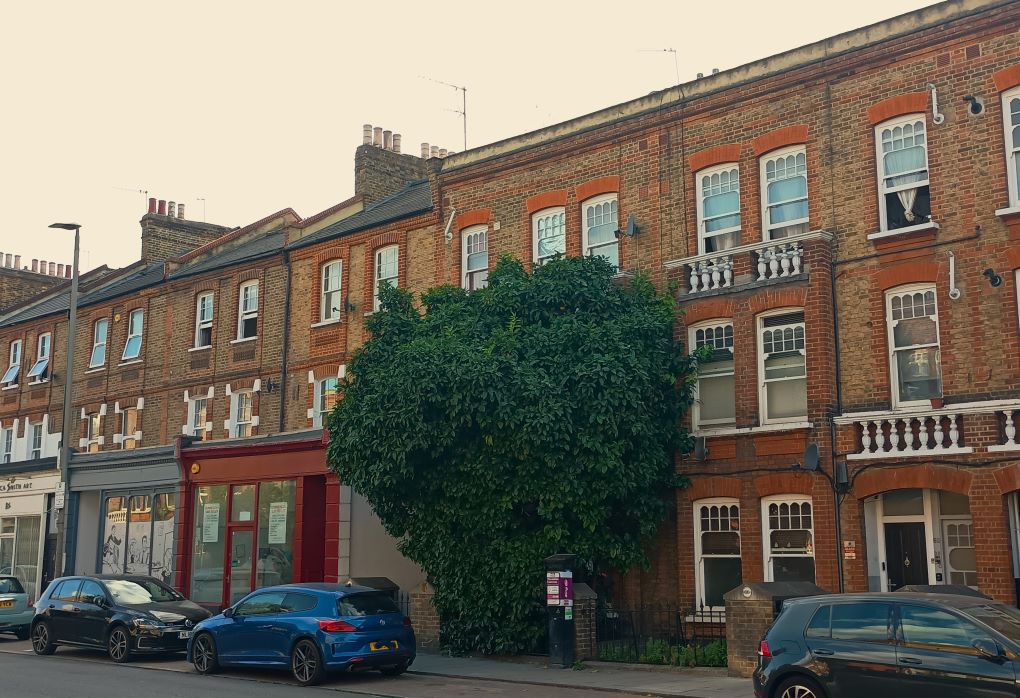
When we think of rare and protected landmark trees, we’re probably imagining some giant and ancient landmark – the giant redwoods of California, the giant plane trees in some of London’s major squares, or the sadly-felled Sycamore on Hadrian’s Wall. But Battersea’s now got one all of its own – and it’s just a few metres high, about forty years old, and one that only our most observant readers will have noticed.

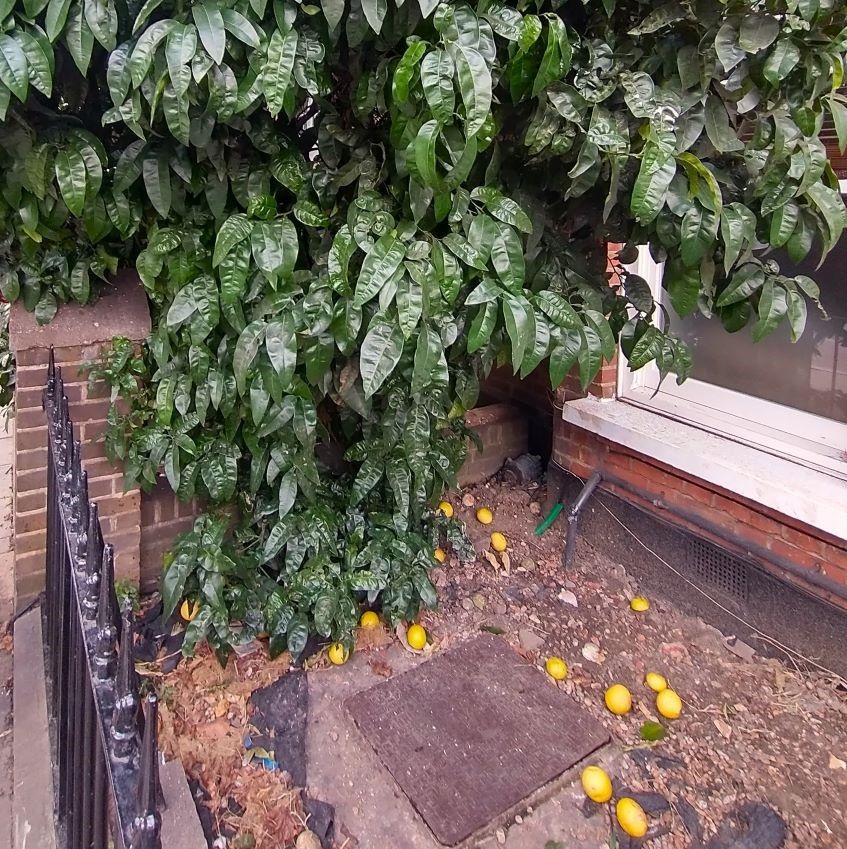
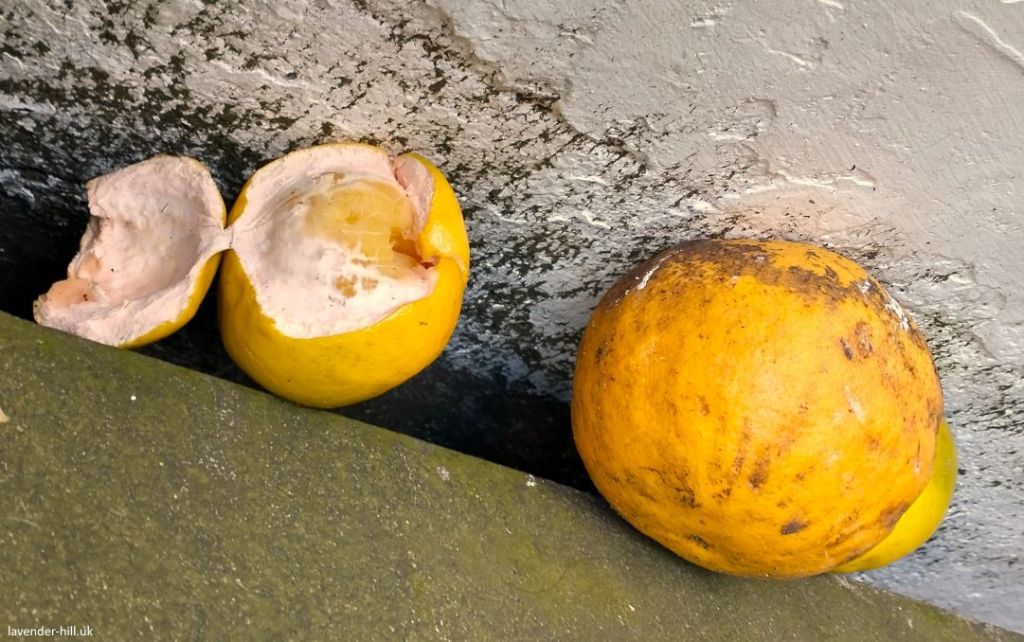
Towards the southern end of Queenstown Road – just after the last of the small stretch of shops – is a very leafy tree in a tiny front garden, which stretches out in to the road. It’s green all year aound and it seems to be thriving – but your author didn’t pay it all that much attention until a few years ago when we realised that the grapefruits we kept seeing on the pavement weren’t the result of repeated burst-shopping-bag disasters, but were actually growing on the tree. Because it’s one of the tiny handful of grapefruit trees that is growing outdors in the UK outside of Kew Gardens.

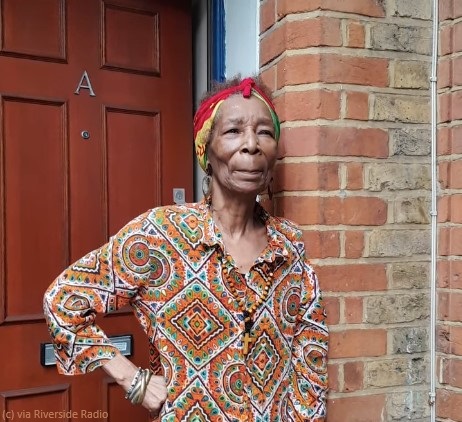
It was planted by Marline Calliste Anderson, who moved to the UK in the 1980s from Grenada. She hid the tree, which was then a little seedling, in her suitcase for the journey as a reminder of home. It nearly got confiscated at customs, but the staff apparently smelled its leaves and recognised it as something ‘citrus’ and low-risk so let it through. In Battersea Marline planted it in the tiny little front garden area and tended to it for years – leading to the happy tree we have now.

In a way she was also lucky, as the location – just at the foot of the slope in the road, in a very sheltered spot near the middle of town, well away from any biting winds or severe frosts – and also in a location that has extremely good soil just under the surface thanks to being on the edge of the old Thames floodplain (which we’ve written about in a post way back on the Heathwall river that flows almost underneath the spot) – was pretty good one for a grapefruit tree.

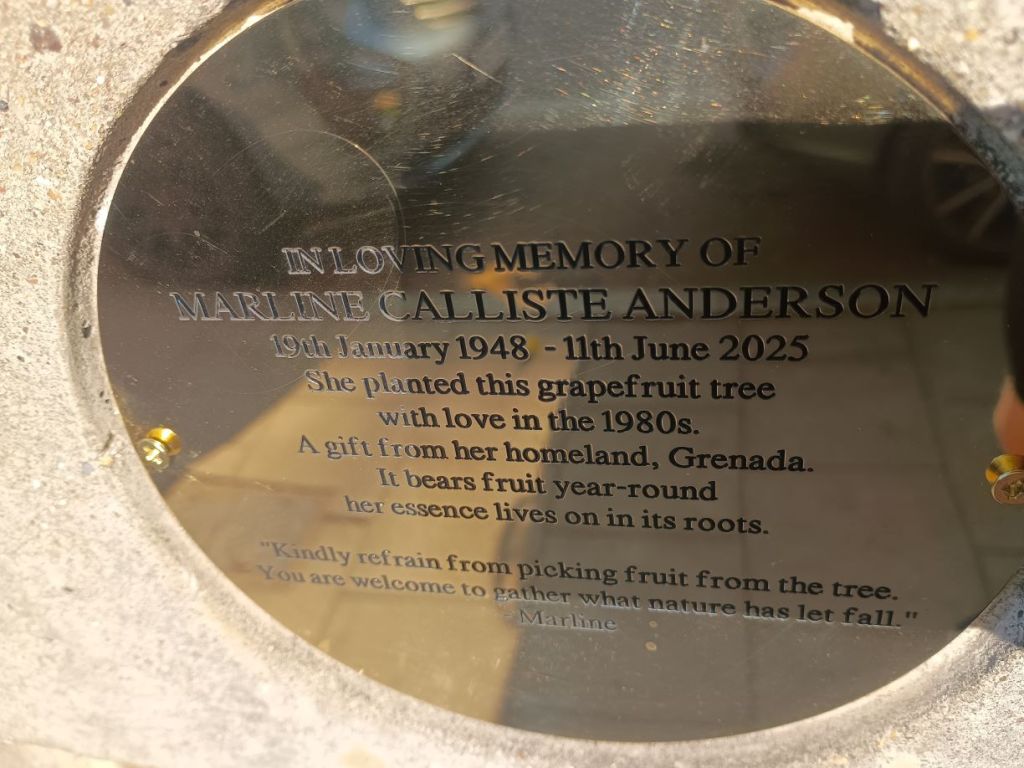
Marline died in June, and Marline’s family, friends and neighbours have since added a small plaque to the gate post by the tree – saying “In loving memory of Marline Calliste Anderson, 19th January 1948-11th June 2025. She planted this grapefruit tree with love in the 1980s. A gift from her homeland, Grenada. It bears fruit year-round, her essence lives on in its roots”.

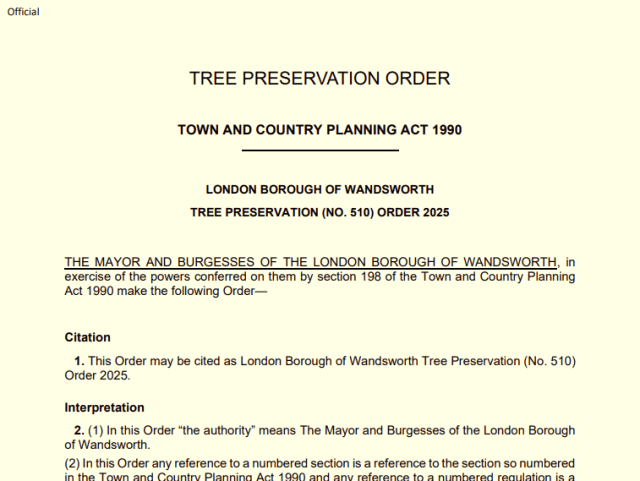
Marline had become friends over the years with Lior Berman, a chef who also lived in the street – and after Marline died Lior contacted the council to try to get a tree preservation order to help make sure Marline’s tree could stay in place for future residents and neighbours to enjoy. And the order, London Borough of Wandsworth Tree Preservation (No. 510) Order 2025, was agreed by the Council.

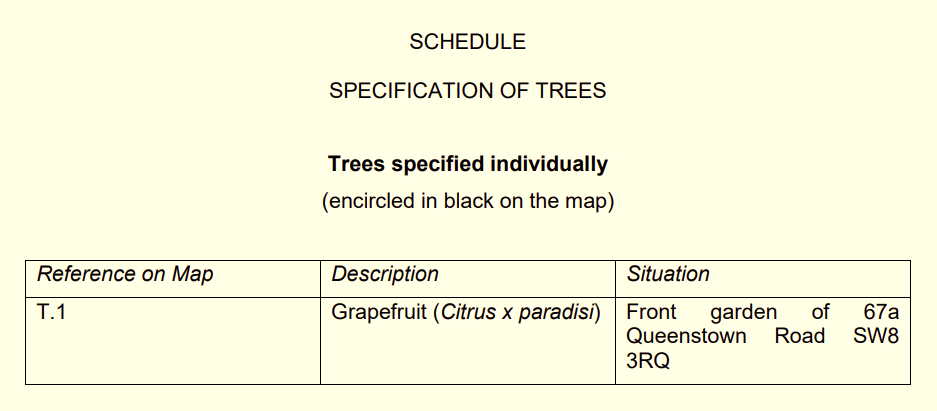
At the point of the order being made, Deputy Leader of Wandsworth Council Kemi Akinola saidWe were very pleased to grant the Tree Preservation Order and ensure that this beloved local landmark stands for generations to come. Marline was much-loved by her neighbours and we’re proud to have listened to the wishes of the community. In our year as London Borough of Culture, it’s great to recognise the contribution that people of African and Caribbean heritage have made to Wandsworth.‘ The Order, which we have posted an extract of below, specifies the tree as ‘Grapefruit (Citrus x paradisi)‘.

Our tree has found a bit of fame in the last few weeks – the BBC visited, with reporter Anna O’Neill trying the grapefruits (‘I was given one and ate it for breakfast on Wednesday and it was delicious‘), and local community radio station Riverside Radio also visiting the site and recording a short report and also an interview with Marline’s friend Lior who led the work to get the Tree Preservation order. If you’re in the Queenstown Road area – do try a grapefruit (though go for the ones that are ripe and have fallen off the tree, not the ones still attached) and spare a thought for Marline’s public-spirited contribution to Queenstown Road back in the 1980s.

We post on a somewhat eclectic mix of local topics in the Lavender Hill area of Battersea, London. To receive new posts by e-mail sign up here (for free, unsubscribe anytime). Some of our favourite local history articles are here; including on how this bit of Battersea was where the UK aviation industry started, on the pioneering women of Battersea’s early days (who included factory developers, social reformers, fearless pilots, celebrated artists, tenacious campaigners and ‘dangerous subversives’), and on the grand plans that could have seen a much smarter and more expensive bit of London built along the Queenstown Road. If you live near Queenstown road you’ll also want to see our recent article on a significant cycle and pedestrian safety upgrade being planned for this stretch of the street.

Posted in Environment, Local history, Street by street | 1 Comment

In pictures: An upgrade is on the way for the southern half of Queenstown Road

Wandsworth’s planning to make some improvements to the southern half of Queenstown Road – between its junction with Lavender Hill, and the big roundabout by Battersea Park. This scheme has been on the ‘we need to do something’ list for years – but following a Council agreement the plans are now likely to be consulted on, and depending on the money situation, they might actually move to construction at some point next year.

This isn’t some enormous construction project. It’s a bundle of fairly small changes that, taken together, should reduce the rather high number of accidents along the street, and make it a slightly better environment for people walking, cycling or driving along it – as well as some changes that will make it a better road to live or run a business on. We’ve taken a walk along the street, while piecing together what we know about the scheme – to see where the current problems are and what is being planned.

The first bit of plans will see changes at the Lavender Hill end – where an ‘improved public realm’ will be provided for the bit of Queenstown Road that is lined by shops. Hopefully as part of this we’ll see some changes made to drunks’ corner to fix the increasingly broken wall – and ideally also make it a bit less of a convenient hangout space for vagabonds and ne-er-do-wells who like to gather here and harass passers by and potential customers of the charity shop. Though this will need the housing and transport bits of the Council to work together (not always an easy thing!) as the green space is technically part of the estate.

One bit of helpful decluttering has already happened: the three old BT payphones that lined this bit of the road have already been removed, which was a good start as they hadn’t worked for years – and had become eyesores more used as unofficial toilets than to make calls.

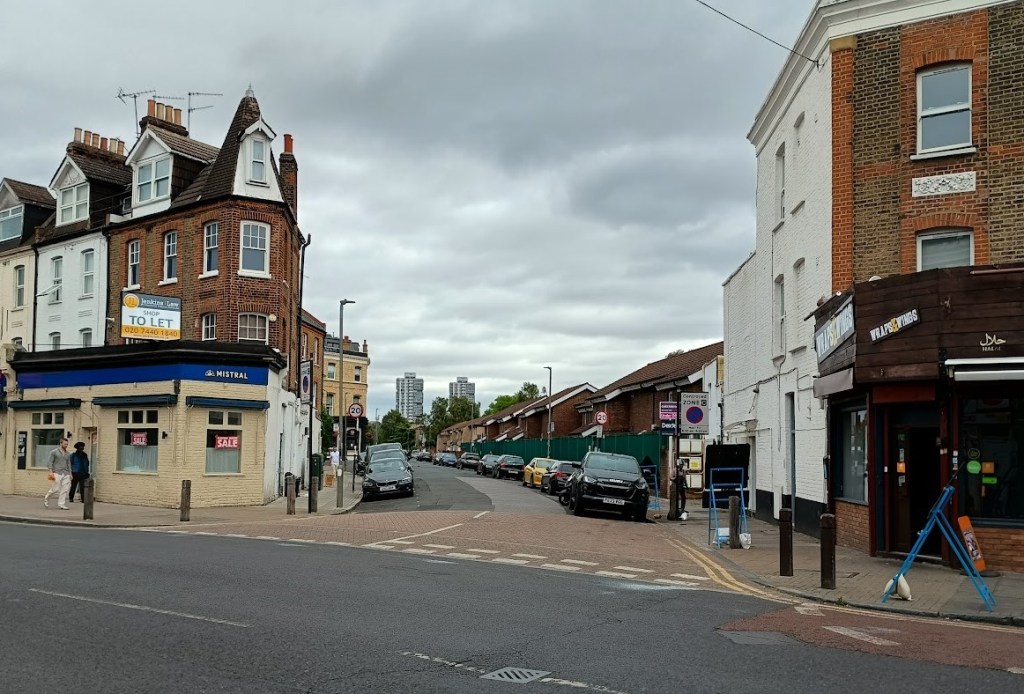
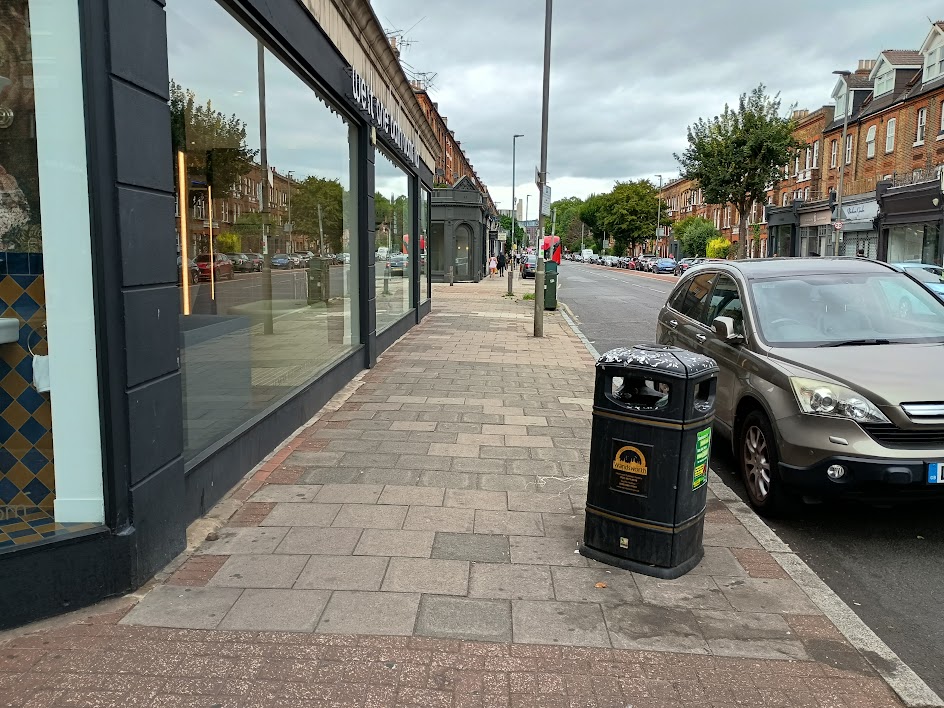
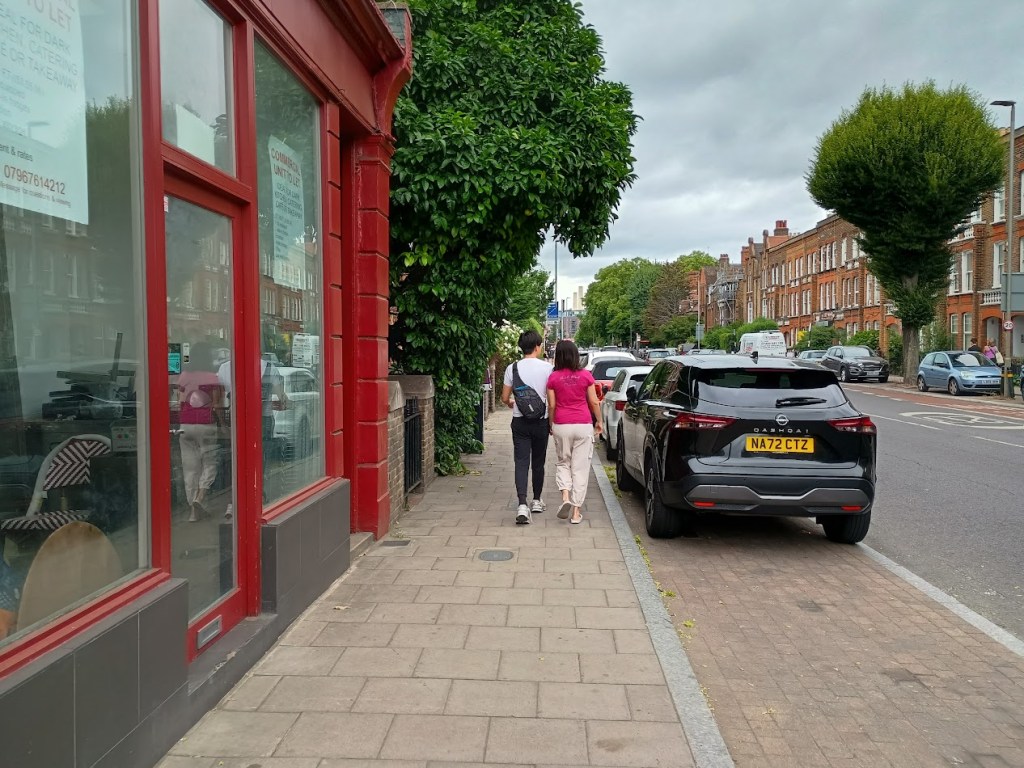
The next section, which has a series of shops and restaurants doing their best to attract custom – really not helped but the pavement in front being an absolute shambles that makes it look scruffy and uncared for. The plans here are focussed on an improved public realm – in essence, making this messy and always somewhat mucky bit of the road more attractive. They are expected to include ‘localised footway widening and introduction of inset parking’ – which hopefully means this rubbish bit of pavement can be completely replaced (including working with landowners so that new paving can run right up to the edge of the buildings, with demarcation studs used to avoid any tangles on which bits are privately owned) – while also creating a better defined inset parking spaces, adding a few street trees, and generally decluttering the space and creating something that works better for the traders here.

This is one of the worst-maintained bits of main road pavement in the Borough; you know it’s time for an upgrade when you can look across the Road and ever-shambolic Lambeth has something better looked after! There’ also an unhelpful tendency for this section to attract litter whenever there’s a strong wind. This part of the road is currently a real missed opportunity, and one of the key bits Wandsworth will hopefully really spend some time (and money) on – as getting the details right will turn a rather dilapidated street to somewhere much more attractive, and make a big difference to the whole local town centre.

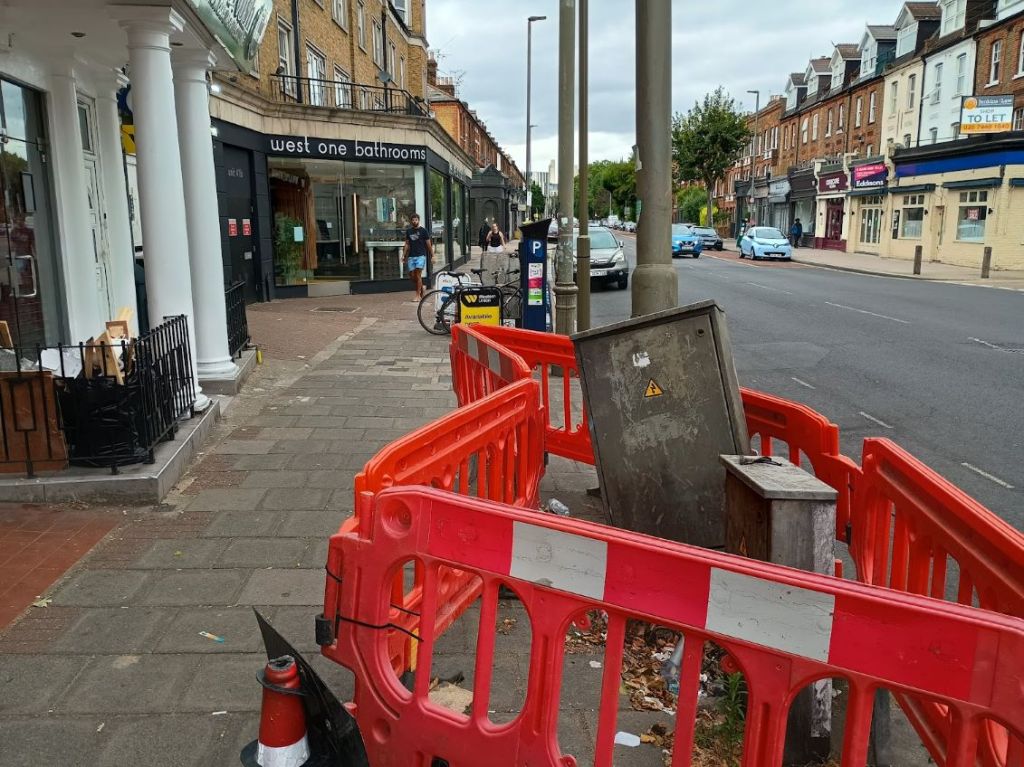
The section of pavement in our photo below is also in the running for some kind of award, for having possibly the longest running pavement repair in Wandsworth, where the CCTV camera and street cabinets have been leaning precariously for over two years! Again we share the frustration of the traders here as this really isn’t the sort of environment for small businesses to thrive in.

The plans will see a cycle route created along the calmer side streets on either side of the Queenstown Diamond – Ingelow Road (for northbound cyclists) and St Philip Street (for southbound cyclists). In practice, this won’t mean much change really beyond some signs showing the route, and some minor works at the junctions. The really wide junctions already have raised crossings, but could usefully be narrowed a bit, with the corners built out further in to the roadway to make them safer to cross and control vehicle speeds a bit.

The stretch of pavement in front of West One bathrooms was, for some years, actively subsiding in to the ground – that has at least been sort of patched up in recent months, but this could again be improved with slight pavement widening to maintain a consistent road width, repaving the pavement with better quality materials, and some general public realm work to make it all look a bit less neglected.

There’s then a long straight section of Queenstown road where things are actually not too bad as things are. This area saw substantial improvement works in 2010, that moved the parked cars on to raised sections on the pavements (with the unusual side of effect of significantly reducing the width of the pavements). This addressed long standing concerns about the challenge of parking in the area by hugely increasing the amount of parking spaces available (as they were no longer clashing with the bus lanes), replacing awkward part-time bus lane parking spots that meant cycles had to veer out to the main traffic lane, with permanent 24-hour parking spaces that were separate to the bus lane.

The 2010 upgrade was well designed and has pretty much stood the test of time: the narrower pavements haven’t really been a problem in a stretch of street without many shops or businesses, and from a general safety perspective this part of the road actually works quite well. It’s also in rather better condition than the rest – so nothing is really planned to change on this part of the road. The main current concern on this bit of the road (which does reflect what we have seen) is that vehicle speeds tend to be quite a lot higher on this stretch with residents seeing many going well above the 20mph speed limit.

One thing that is suggested in the proposals is some scope for improvements to Queenstown Green, the small park half way along the street. This would be welcome, as the space – which is the result of a wartime bombsite that was never rebuilt – isn’t working especially well at the moment, and is a waste of the only green space in a large and dense area of flats. Maybe its biggest problem is that there’s not a lot in it other than grass, and the entire space is mainly used as a dog toilet – the sort where no one cleans up after their dog. If the area could be split in to two, with a dog-friendly area and a separately fenced no-dogs area, this would be an ideal space for a small playground aimed at younger children (as a complement to Lambeth’s Montefiore Gardens playground a few streets away), and generally make the park useful for people other than dog walkers.

The junction with Broughton Street, shown below, will see very small tweaks, mainly to allow two-way cycling at the end of the street (which is currently a one-way street) for those wishing to go along the quieter backstreets.

The next section of Queenstown road is by far the worst bit from a safety perspective, with three successive junctions all identified as collision hot spots. The first is Silverthorne Road, with 9 collisions involving notable injury between 2018 and 2022. We’re not at all surprised at this one, the junction is too wide and the risk of cyclists, motorcycles and pedestrians getting cut up by large vehicles turning is really quite high. In our experience the large volume of concrete-batching-plant-related traffic and buses heading to the depot that use this junction drive pretty carefully, but the situation with others leaves a lot to be desired. There are fundamental flaws in the junction design here and the corners need to be built out to make it more of a ‘T’ junction than a slip road, with a clearer cycle lane.

The next problem junction is Ingate Place, which saw seven collisions involving notable injury between 2018 and 2022 (and that doesn’t involve the spectacular stolen-car smash earlier this year that almost destroyed the Corner Cafe building). That might not sound like a lot over four years – but when you bear in mind that two of them were quiet Coronavirus years, and that this is a trivial cul-de-sac leading to a small industrial estate, that’s a lot, and shows the road design is clearly at least partly at fault here. The third problem junction is – maybe less surprisingly – the busy junction with Battersea Park Road, which saw fifteen collisions (but which sees a lot more traffic). About a third of casualties are motorcyclists and a third are cyclists – the rest being pedestrians & drivers.

The Ravenet Street underpass – the one that ducks under the railways on the left just after the first bridge in the photo above – is proposed to be improved, given that it can offer an alternative and safer route for (say) young families to get to Battersea Park Road, avoiding the sharp bends and the traffic light junction. The plans are to introduce contrasting cycleway surface material and ‘entry treatments’ at Ravenet Street – which essentially means making the turn more obvious and safe for cycles.

However the Council’s report notes that it ‘has limited lighting’ and’ and that there is ‘a lack of wayfinding’. That’s maybe an understatement – this is really not a very attractive route, given that any cyclists heading through here get dropped in the Doddington estate’s car park areas without a clear route onwards. That, and the fact that the gloomy and little-used railway arch has a distinctly ominous feel to it, means we doubt this is really a workable alternative cycle route for anyone other than proper locals who know their way around the estate. However some effort will be made to improve the lighting and general look and feel of the underpass to make it more attractive, which will still be of benefit to residents on either side.

The bit of the road opposite the Loaf furniture shop will see a new light-controlled pedestrian crossing, roughly where the bus stops are – which makes a lot of sense as there is a long gap without any proper crossings here, and this really isn’t a safe place to cross the road at the moment (and almost everyone using the bus stops ends up having to cross the road one way or another). There are general plans for improvements to the look and feel of the street, and this bit of the road – a smelly, dusty thoroughfare that nevertheless has a load of flats facing directly on to it without much in the way of back gardens – could really do with some help. We were involved in the addition of four new street trees here some years ago, which have been welcome and made it just slightly nicer – but there’s a lot more that could be done to improve this bit of Wandsworth.

A really problematic feature of this part of Queenstown road is the sharp bends as the road passes under three separate railway bridges, including a particularly long and dark one running under the platforms at Queenstown Road Station. This is a dangerous bit of the road, that creates serious safety challenges. The sharp bend is also really hemmed in as the road surface has been dug down several feet to allow taller vehicles to fit through, and it’s all not helped by a high proportion of HGVs using this stretch of road (a fair few heading towards the industrial estates on Silverthorne Road, as well as some important coach routes). All this means many buses struggle to make use of the bus lane – having two traffic lanes as well as a bus lane just doesn’t fit on such a tight corner.

The bus lane on this bit of road does not work – the tight turning radius means you get stuck if you try and use it, if there’s any meaningful traffic in the area (which there usually is). Bus drivers have to deal with this mess day in day out, and they aren’t fools: analysis undertaken for the council last year found that a third of buses did not use the bus lane at all in the morning peak, 52% only manoeuvred into the bus lane after the bend, and only 3% used the full length of the bus lane. Interestingly they also found that the handful of buses that did stay in the bus lane had the longest average journey times!

The cycle situation here is also a mess – with a choice of working through a horrible tangle of vehicles busy changing lanes under the bridge, or a rather unusual bit of on-pavement cycle lane that tries to avoid the mess – but which isn’t actually wide enough for a typical bike, partly due to several lamp posts in the middle of it. A lot of cycles – even those usually quite happy to stay in the carriageway – clearly do not like this section of the road, given the high likelihood of being trapped in a pincer movement and crushed by a turning long vehicle. The Council’s measurement work confirms what we have seen, which is that the existing northbound cycle lane at pavement level is really quite well-used despite being nonstandard, with approximately 37% of cyclists in the morning peak using the lane at pavement level, and 63% using the bus lane. The Council also commented that many of those using the footway facility were children with parents.

Back in 2020 the Council had a go at making this known pinch point a bit safer and more cycle-friendly, using a Covid grant to roll out a temporary scheme where the bus lane was made 24-hours, a southbound cycle lane was added from Chelsea Bridge to Silverthorne road, and a series of ‘wands’ were added to stop vehicles parking in it. It was of course done on the cheap and wasn’t really a permanent fix – but it has worked fairly well, and the temporary cycle lane was later made permanent.

The plans are likely to further develop the approach that was taken back then, by completely removing the not-very-effective northbound bus lane between Silverthorne Road and Queenstown Road station – and using the space freed up on the road to create a ‘stepped’ cycle lane on each side of the road – i.e. one that is raised above the level of cars, to keep cyclists protected. It’s not clear whether the on-pavement one will also be kept in place.

This isn’t a good bit of the road for pedestrians either, as the bridges are all in a pretty poor condition. The proposals suggest the Council will try and step in to improve these given their owner Network Rail clearly doesn’t care about them – with new feature lighting and art features introduced under the railway bridges (including Ravenet Street – which we have reported on before, in a previous phase of trying to upgrade that rather gloomy archway).

The middle of the three bridges, the one directly underneath Queenstown Road station, is particularly filthy, with no pigeon proofing at all, meaning walking through it is a bit of an obstacle course of dodging bird poo on the ground as well as that falling from above. The brick walls have a patchwork of decades of slime and mould on them, and the pavement seems to be wet a lot of the time. The northbound one is also somewhat blighted by a series of manky and foul-smelling utility cabinets, rusted after years of posters and urine. Unlike the other two, this bridge also has poor sight lines along the pavements, including some unhelpful alcoves just off the pavement on the eastern side, that can make it feel unsafe in the late evening.

There aren’t any specific details on any plans to clean any of this up, but really things can only get better at this point – we’re hoping that the worst of it – the middle bridges – can be dealt with, at least in terms of a serious wash and durable pigeon proofing above the pedestrian and cycle routes – as it’s a very mediocre route as it stands.

Heading further north, things improve a bit – the final bridge could again do with painting, lighting and pigeon proofing, and the northbound cycle lane could do with extending.

The hazardous junction with Battersea Park Road is set for an upgrade – with work led by TfL, who have been developing a scheme for Battersea Park Road as part of their Nine Elms corridor scheme, that will include this junction.

This means the mess in the photo above is likely to be replaced with something better able to handle the increasingly large flows of traffic here. TfL’s plans at the consultation stage included cycle lanes each way along Battersea Park Road, but made little reference to the desire for better cycle lanes along Queenstown Road. However they were developed many years ago and we’ll hopefully see further tweaks before anything is actually done here.

This junction is likely to be a long-term plan – as that part of the TfL project is both at a much earlier design stage than the rest of the TfL work on Nine Elms Lane (which is already underway, in areas nearer Vauxhall), and seems to be unfunded at the moment.

The final bit is the short and very busy bit of road between the junction and the roundabout. This is a mess at the moment – the main change is likely to be raising the level of the cycle lanes, so that they are properly separate from both the traffic lanes and the pavement. Both pavements are a bit too narrow for the amount of use they get, especially where there are bus stops, but there’s not really an easy way to fix that.

The next steps will see some sort of public consultation – probably one of the Commonplace online surveys, but with other consultation options also used – to get views and feedback from residents, businesses and road users, to make sure the plans are fit for purpose and deliver the overall aims of the project. Given a small part Queenstown Road is in Lambeth, there’s also going to be some comparing notes with Councillors on the Lambeth side of the borough boundary. This is likely to be later in the year, we’ll aim to keep our readers posted as this develops.

The other key question will also arise of how this will all be paid for. The changes on this part of the road have clearly been designed to be a fairly ‘bargain basement’ approach, because bluntly speaking there’s not a lot of enthusiasm for big spending in this area. It’s a slightly frustrating situation for those living in that corner of the Borough: a large pot of ‘Section 106’ cash was raised from developers over the last few years, in connection with the huge amount of new development in the area – and it was, back in the day, planned to go towards ‘local enhancements’ in the Nine Elms end of the Borough (specifically, the Vauxhall and Nine Elms Opportunity Area – which includes most but not all of the awkward bits of Queenstown Road) to better accommodate the impact of thousands upon thousands of new residents.

On the face of it that would have allowed a bundle of rather overdue works to go ahead – improving a lot of the areas around the Savona and Patmore estates and Carey Gardens, finally making progress on the much-delayed plans to bring step free access and safety improvements to Battersea Park station, and improving the horrible bridges and unsafe roads that are getting ever more crowded. Unfortunately, however, Nine Elms and the areas around it aren’t popular with the Labour administration – partly because the power station project is still seen as a project of the previous Conservative team – but mainly after the residents of Nine Elms elected Conservative councillors despite a high profile Labour campaign to win that area – so one of the first moves of the Council was to rip up the ringfence around that cash, and instead transfer it to wider and more electorally friendly parts of the Borough. This means projects here now have to battle with other priorities in Roehampton, Putney and Tooting – and that the funding available to provide for the huge local population growth in Nine Elms is a lot sparser.

There is still a little bit of funding available – and northern section of Queenstown Road is already seeing some improvement works, which are due to be done by spring next year – though you could be forgiven for not having noticed! Our photo above pretty much shows the full extent of works so far, which have involved moving one of the kerbs by about a foot (though there have also been some underground utility works). The aim is to convert the current slightly odd situation where there’s an on-pavement cycle lane right next to an on-street lane if you’re travelling towards the river, and not very much at all if you’re going in the other direction, to instead have a cycle lane on each side. The works on the northern section are being funded from a combination of some of those now-Borough-wide funds made up of contributions received from developments in the Nine Elms Opportunity Area, and a grant from TfL. The Council notes that there’s no approved funding to continue works to include the southern section (and we know TfL isn’t exactly showering Boroughs with rats at the moment) – but they’ll aim to try and do something similar.

Overall this is a welcome development, and one that feels rather overdue. Queenstown Road has become a major commuter route, and some of it is not really working at the moment, whether you’re on a bus, riving, walking, or cycling. This should be a chance to deal with some of its most dangerous and unpleasant sections, to make it somewhere people are happy to live along – and to make sure that everyone using the road gets home safely at the end of the day. Hopefully this will also improve the street environment for the couple of dozen independent traders spread along the road close to its junction with Lavender Hill and give this somewhat neglected corner of Wandsworth a better sense of place. Keep an eye out for the consultation stages, and when the full details are published, we’d encourage those with an interest to respond and help this scheme move forward in the right direction.

Lavender-hill.uk is a community site covering retailplanning and development  and local business issues, and sometimes posts like this one on  transport, all centered on the Lavender Hill area in Battersea. We sometimes also post more detailed articles on local history

If you found this interesting you may want to see our previous articles on smaller safety improvements to this bit of the road, our ongoing series of reports on improvements to Battersea Park and Queenstown Road stations, and on some of the office developments that are in the works along the middle bit of Queenstown Road – or to sign up to receive new posts (for free) by email – and if you have tips and leads to share, get in touch.

Posted in Environment, Planning, Retail, Transport | 3 Comments

In pictures: Arding & Hobbs is ready for another century

It’s been five years in the making – but we’re finally here. Arding & Hobbs is Clapham Junction’s flagship building, a departments store from the days when department stores radiated style and elegance – which survived wars and riots, as well as online retail, venture capital and the pandemic, to become probably the emblem of the area. Come with us as we take a walk through the history of the store, look at how it’s been given back a lot of its former style, and explore the thinking behind the new no-expenses-spared renovation.

Arding & Hobbs kicked off in 1876, when Clapham Junction was in a time of huge change. It had been a land of fruit, asparagus and lavender, fields, criss crossed by country lanes and a scattering of big ‘out of town’ houses with sweeping views over the fields towards the Thames. But within a decade that would be completely overrun by a dense Victorian railway suburb, and a small riverside track along the side of the Falcon brook, lined with a handful of farm workers cottages, would become St Johns Road, the core shopping street of a new town centre. A big new town centre would need a big new store – and Aring & Hobbs bagged the key spot in town – the giant corner site at the key crossroads by the station, one of the key junctions in south west London – and at first built a smaller and slightly simpler building on the site.

This traded happily for nearly thirty years. Indeed it traded so well that they developed a separate drapery shop on the other side of the railway at the junction of Falcon Road and Battersea Park Rad, but this was sold on in 1894 to two former employees, Mr. Hunt & Mr. Cole – who continued to trade as Hunt & Cole’s Falcon Road Drapery Stores. That building was later replaced by a modern office building with a large pub, the Asparagus, on the ground floor.

But the store then fell victim to a catastrophic fire – just before Christmas in 1909 – which saw 30 people hospitalised, and eight deaths – and was so big it was even reported on in Australia in the Sydney Herald. The fire ended up with the whole lot being demolished – and it led to a new regime of fire safety regulations that aimed to control fire spread in large buildings.

The business didn’t hang about, quickly rebuilding on a bigger and better scale, getting the current building done within less than a year. The new building was in an Edwardian Baroque style, and designed by architect James Gibson – who also designed the building that is now the UK’s Supreme Court on Parliament Square. The new building included a great big cupola, to make sure no one could miss the building as they approached it. And this time it incorporated cutting edge fire-proofing technology (of which more later!).

It would go on to spend the next hundred years as a department store. For the first thirty or so years it ran as Arding & Hobbs, a business squarely rooted in Clapham Junction. It was sold to the John Anstiss Group in 1938, who were in turn sold to retail giant United Drapery Stores (who went on to become one of the largest retailers in the country, running dozens of different brands) in 1948.

In the late 1970s United Drapery Stores sold the business to Allders – who merged it in with their wider chain. It traded well for decades – being the source for many of the clothes and furnishings in Clapham Junction and a wide area of south west London.

In 1984 the building acquired some fame in the video “Life On Your Own” by The Human League – which was set in a future, apocalyptic London where lead singer Philip Oakey was the only person left alive – and lives in the cupola. A somewhat home made electricity supply arrangement means he can turn on the original store sign (a big red one designed to be visible along Lavender Hill), and power some of the interior.

In contrast to the Arndale centre just down the road in Wandsworth, which drifted downmarket for many years (to the point where it was said to be ‘difficult to buy anything for more than a pound’) until a major reset in the early 2000s, Allders kept itself firmly in the middle market of department stores. Allders did make some internal changes to the building itself over the years – notably fitting escalators, which would become the main way for people to move round the building.

There was a bit of downsizing of the store. In the early 2000s, a series of modern terrace houses and a block of flats were built on Ilminster Gardens, that had previously been the Arding & Hobbs carpet warehouse. A small part of the store was also split off over three floors that could become a separate retail unit. This was at first going to become a branch of Sainsbury’s central, with a large travelator splitting the shopping area over two floors, and a smaller basement area for the back of house. This didn’t work out and after a bit of a gap the space was taken over by ‘off price’ retailer T.K Maxx – as an early foray away from retail parks to much more ‘town centre’ locations. They almost immediately found they had a hugely successful store on their hands, and went on to open a load more stores in all the nearby town centres including Wandsworth, Putney, Brixton Balham, Tooting and even Kensington.

Things were going well for T.K. Maxx – but Allders was struggling with what was maybe an overambitious acquisition of other businesses and stores, and was running in to increasingly severe financial difficulty. Arding & Hobbs was one of eight sites they sold to Debenhams in 2005 as the chain desperately tried to stave off collapse. We understand Clapham Junction – once it saw a light refit and the introduction of Debenhams’ somewhat sharper product range reasonably successful own brands – quickly became one of Debenhams’ more profitable sites, in stark contrast with Allders’ flagship store in Croydon which stayed with the parent chain and limped on for a few more years until collapsing completely – and whose huge building has remained largely empty in the doomed and decaying Whitgift complex ever since.

Debenhams might have been profitable in Clapham Junction – but even at the point of their Allders takeover there were storm clouds on the horizon for Debenhams, who were running well over a hundred large stores around the country of rather varying profitability – all of which were expensive to staff, but many of which weren’t generating much turnover. More problematically (and in a sadly familiar tale for those who follow retail disasters) the company spent three years under private equity ownership in the early 2000s, which saw its owners make a sizeable profit (over a billion pounds) – but which left the company saddled with a billion pounds of debt.

The private equity group – which included CVC Capital Partners, Texas Pacific Group and Merrill Lynch Private Equity – paid £450m for Debenhams’ real estate but only £68m was equity (or ‘real’ money), the rest was debt. Just 14 months later in February 2005 they sold Debenhams’ 23 freehold properties to property giant British Land for £495 million, in a deal that would see Debenhams lease them for £27.9m a year, rather than owning them. This made the private equity backers a £45 million profit – an impressive 67% return on their £86m investment in just over a year. A month afterwards, the Arding & Hobbs building was also sold on to British Land and Debenhams went from being a freeholder, to being a tenant. But selling the freeholds the company had kept on many of its stores meant they were now instead locked into expensive and lengthy lease deals. This mountain of debt made it hard for the company to invest in online shopping or in updating its stores.

Debenhams did continue to expand, opening another huge department store just a mile and a bit down the road in Wandsworth’s Southside centre, which was the last big bit of the jigsaw in updating the 1960s Arndale centre to a more up to date urban shopping centre. This was an opportunist move on the part of Debenhams, and we believe they took over a space that has been previously expected to become a branch of Marks & Spencer.

By 2018, British Land was trying to sell off some of its Debenhams properties – and the Arding & Hobbs building caught the eye of a fairly little-known real estate company called W.RE, who went on to buy the whole building for £48 million – becoming the landlord for both Debenhams and T.K. Maxx (whose slice of the building covered about 30,000 square feet over three floors).

Unlike the Clapham Junction store, we understand the huge Wandsworth Debenhams never turned a profit in its five years in business. In 2019, the company announced they were abandoning the Wandsworth branch, alongside 21 other poor performing stores, as part of a turnaround effort. The giant Wandsworth space went on to have a happy ending of its own, albeit a very different one to Arding & Hobbs, when it reopened as the very successful Gravity Max – with electric go karts, giant arcade, bowling alley, minigolf, bars, pool, darts, and a fair bit more.

Clapham Junction was to carry on trading, as part of a smaller, leaner Debenhams – that had dumped the no-hope locations and also pushed down the rent on many of its stores. However in late 2019, we first reported that the end might be not too far off for Debenhams in Clapham Junction too. Not a lot had been said in public, but we received tip offs that they had been given some sort of notice, presumably having done a deal to carry on at lower rent but in exchange for being thrown out at short notice if a better opportunity came along.

But within weeks of the final closure of the doomed Wandsworth store in January 2020, the Coronavirus landed, the doors to all Debenhams’ stores closed across the country – and all bets really were off. Debenhams went in to administration later that year, and this time it really was the end, with the business being liquidated shortly afterwards.

W.RE, the up-to-that-point relatively little noticed landlord, got a phone call saying Debenhams was gone for good – and they were suddenly in charge of the building. They’re a clever set of people – and when they took over the building back in 2018 with about twenty years to run on Debenhams’ lease they had a fairly good idea that they weren’t likely to be a landlord to Debenhams for that long, and change would be ahead. But this turned a medium-term development project in to a very near-term one – with some immediate questions about managing the security and services for what had become a large empty building, and working out what to do with it.

And it’s fair to say that Clapham Junction, as a town centre, was lucky at this point. Some of this luck was down to the nature of the building and its location: we’re blessed with one of the better department stores – it has style and elegance, it’s bang in the middle of a busy and successful town centre, it’s directly opposite one of the busiest railway stations in the country, it was tired but in a generally adequate overall condition, it’s not so big and deep that it won’t work for any other uses, and it’s Grade II listed. Something would likely happen – unlike the dozens of huge sixties department stores still sitting empty around the country, that are becoming liabilities for their owners and increasingly hazardous eyesores for the towns they’re in.

We were also lucky in the form of the landlord. Because W.RE, who we didn’t know all that much about, proved to have a proper interest in the building – and in making sure that whatever happened to it, did justice to the style and history of the original department store. In the ‘stay at home’ summer of 2020 we had a call with W.RE’s boss Sascha Lewin, and spoke about the plans in some detail. He and his team had been carrying extensive research on future developments, working with architects and consultants on multiple options. We noted at the time that W.RE were commendably frank about their plans for the building, and happy to have detailed discussions with community groups.

W.RE at first explored turning the upper floors in to a hotel – not a daft idea, given the few mid-range hotels we do have in the area do very well (especially the Premier Inn along Lavender Hill, which at the time was being extended due to high demand). However, the very deep floors meant that the hotel would either have a load of rather undesirable bargain-basement rooms without windows, or a fundamentally inefficient hotel layout. Sascha also recognised that a lot of the character of the building, such as the elegant proportions, the high ceilings, and the still-visible roof decoration, would be lost if it was split up into many small rooms.

The chosen option was for an office to take most of the upper levels of the building, with retail only on the ground floor and the basement. T.K. Maxx, with a long lease, would carry on as they do now.

And our photos here show that what was planned has now been delivered. The first thing you notice is that out on the front of the building, the old canopies (which weren’t original, but had been added at some stage in the late sixties – and added with the original height of the windows) have gone – which allows much bigger windows to be fitted, that reflect the original design of the building, as well as allowing the building to be properly seen from the pavement below.

The ground floor space was quickly let – and we’ve reported separately on some of the retailers that have taken the space. The corner has become new pub / restaurant Botanica Hall, a large and extremely busy food and drink venue, complete with full size pizza oven and lots of internal space – we wrote about them when they opened.

The next bit was briefly down to become an Amazon Fresh supermarket, but following a change of plan we ended up with the much-superior Prezzemolo & Vitale – a proper emporium of all things Italian – including a wide selection of cheese, meat and charcuterie, drinks, fruit and veg, and bakery produce, which includes an Italian cafe with a generous supply of cakes, and a food-to-go offer including sandwiches, salads, cold cuts and cheeses. There are lots more photos of them in our article last year.

What’s new, though, is that the office space on the upper levels is now also complete and mostly occupied. Going in to the reception, Debenhams’ white tiles and handbag display has been replaced with dark granite tiling, and deep green walls.

The multicoloured curtains in the reception are a deliberate nod to Arding & Hobbs’ displays in its days as a drapery, when it was the place you’d go if you needed some new curtains.

The current escalator access has been kept as the way in to the offices (but with new escalators, or at least very heavily refurbished ones) – again a choice designed to reflect the building’s character as a former department store.

The escalators weren’t there when the building was first built, but they were there for most of its lifetime, so it feels fitting to have preserved them.

All the way up the building the glass escalators are surrounded by a wood-based pattern that draws from the arch shape of the first floor windows.

The first floor is a bit of a surprise – it’s got the same colour scheme as the ground floor reception, which means it’s very smart, and it has a small gallery of photos from the earlier days of the department store, as well as of a few classic features that were uncovered during the building works. But there’s no connection to any office space on this level.

This office-less floor is the result of an early, and large, tenant arriving who W.RE maybe weren’t really expecting at the initial design stage: as we reported in 2023, Third Space jumped right in and took on the whole of the ex-Debenhams basement, a slice of the ground floor on Lavender Hill, and the whole of the first floor, to open a large and luxurious new gym.

The first floor is a very large space and exactly what Third Space wanted, with big windows and large floor areas. The plans below show the general layout, with the escalators at the top right essentially carrying on up through to the upper levels-

We had a few thoughts and suggestions back at the very start of the project, including concerns about the sheer scale of the proposed reduction in retail floorspace – from five full floors, to just part of the ground and basement; we had suggested the first floor would also be a good space with easy access from the ‘half floor’ facing Lavender Hill – which could be an excellent restaurant if it had separate access from the Lavender Hill corner. In the end this was exactly what did happen – and while it’s ended up as a gym rather than a restaurant, it suggests we were right.

With their own entrance over on Lavender Hill, Third Space don’t need everyone to pile through the office reception, so this floor has ended up as a small access route to the upper levels instead. This first floor does feature the first of what are a whole series of classic steel fire doors, that were added after the big fire that destroyed the first Arding & Hobbs building:

They are all made by Crittall, who some of our readers may recognise as a company that started out as an ironmongers based in Braintree – but went on to become nationally famous in the 1920s and 1930s for making the steel framed windows that are beloved by architects and pretty much archetypal of a lot of 1930s housing.

So it’s on up the escalators to the second floor:

The look of the building here changes completely. The dark green perfectly finished walls and drapes give way to a much trougher surface – because this floor has retained the existing walls, as they were once all the layers of department store surfacing were stripped away. The walls show the many changes the building has seen over its years as a department store, with additions, holes cut through, bits bricked up and reopened, and a few bits of deep building work that the original builders probably never thought would be on show.

The amount of office space available on the second floor is much larger, as with no T.K. Maxx on this level it covers the whole of the building. This floor has noticeably lower ceilings and smaller windows than the ground and first floor, but it’s still a decent space.

W.RE have let half of this floor to The Gym Group, not as a gym, but as their new head office. They used to be based in the famous 50p building by East Croydon station, but in April they joined what seems to be a growing exodus of businesses from Croydon and moved everything to Clapham Junction (and there’s a good chance that their old building will soon be converted to flats). They have very much gone with the look of the building – keeping the same style in the entrance area, with more classic office spaces further in. We’ve not put photos of here, to respect their privacy – but they have a video of their new office made just before it opened on Linkedin.

The other side’s currently available – which meant we could have a good look around!

This floor includes several more of the original big steel sliding fire doors – kept as features. These were designed to be quickly closed if a fire broke out, so that it could be contained within specific bits of the building. It seems very basic now, but this was quite ahead of its time when it was built – and it does echo the modern approach to containing fire in larger buildings. Rest assured that none of this is in use any more and the building has been updated with the latest technology!

The original fire shutters are also still in place over some of the internal openings – and if you knew where to look a few of these used to be visible in the Debenhams days –

Those who remember this as a department store will likely be struck by how much larger it now looks, without all the shelving and display space, as well as with all the windows now open and in use – as in the Debenhams days only some were visible.

There’s a sense of openness that wasn’t there before.

A lot of clutter has also been removed at ceiling level, and the entire building has been stripped back to show the original walls and ceilings.

The ceilings on this floor are noticeably simpler than on the level below – where they have far more plaster decoration (as is visible in the T.K. Maxx homewares section) –

This is the second floor corner overlooking Clapham Junction – and the photo shows the same view on the floor below (which is now part of the Third Space gym).

The original plans were going to see the windows restored, but part way through it was established that a lot of them had been hidden behind shelving and neglected for so long that they were beyond any realistic restoration – co on this floor many of them are new windows built to look like the original ones.

As layers and layers of old panels and wall coverings were stripped back, a few surprises emerged. Hidden away at the very back corner of the second floor, built in to the wall structure, was a big steel door. A locked one.

After a lot of effort it was opened – to reveal the original store safe! A whole room, complete with strengthened floor, and glazed ceramic tiling.

Sadly there were no missing millions, just a lot of very out of date gift tokens. But it has now been cleaned up and is a rather unusual space for the future office tenants to use.

Up one more floor, the third floor used to be the top of the store – including homewares, kitchenware, lighting, furniture and the cafe. At this point another new feature starts to appear: the escalators now have a huge new skylight above them, letting light in to the middle of the building.

This was always the most eclectic floor – it briefly included concessions from other furniture businesses, for a year or so it hosted the Party Superstore after their building had a catastrophic fire in the London Riots, and in the later years a large slice of it became an in-store Sports Direct concession.

The whole of the third floor has been let to X+Why – a whopping 27,500 square feet (which is about the same as the whole area of T.K. Maxx). It’s been fitted out as a members’ club and workspace, offering “premium flexible workspace options from private offices to dedicated desks to day rooms, meeting rooms and glamorous event spaces” – with a high degree of luxury across the board. The appeal of the third floor to them was clear – unlike he relatively compact second floor, the third has dramatic high ceilings and considerable style.

The old Debenhams cafe with its large dome has had a major makeover, but still has much the same function as it did right from the start of Arding & Hobbs. The central skylight has been carefully cleaned and repaired, and is a real feature. As we reported on at the time, work on this floor uncovered another long-forgotten skylight, which has also been restored as part of the X+Why space –

Probably more than any other bit of the building, this floor shows the building in its ‘original’ style. Reinvented for sure but very much using the rich materials and colour schemes that would have been suitable for an upmarket department store in the early years of Clapham Junction.

It’s up at the fourth and fifth floors that things really change. These used to just be the roof.

The roof used to be covered in a right mish mash of small single storey structures, including various sets of lift machinery and air conditioning from the old Debenhams (one of the larger bits was visible from the street – we’ve circled it below).

W.RE could see straight away that this was a wasted space, and that they had the potential to add floors to the roof. The original building is robust and well built, so it didn’t need much in the way of extra work to add extra floors – there have been just four new pillars added through the existing building (mainly in the escalator area), one of which is shown below –

They spent quite some time on the design of this new top floor– trying out various shapes as well as various designs. Their thinking was that a ‘plain, generic’ rooftop extension won’t work on what’s a fairly complex and ornate building, and we’re inclined to agree.

In the end they went for something really quite bold: a two storey structure covering much of the roof surface, with curves echoing some of those on the building below. 

Inside is a mostly open plan space – a really huge space, with lots of light and no internal walls at all.

Most of this floor is made of structural timber – which makes it light, and also marks a bit of a contrast from the heavy structure of the rest of the building.

The two new floors at the top are perched on the existing structure, with hardly any change to the lower levels. That said a small handful of extra columns have appeared – like these ones in the main foyer –

The two levels are designed to be let to a single tenant, with provision for the future occupiers to add whatever works for them in terms of access between the two levels.

It’s a really impressive space, and there’s definitely nothing quite like it in the area.

It’s a radical departure from the style of the lower floors – but the arches from the first floor windows, that we saw in the wood framing round the escalator, make another subtle appearance on the internal balustrade.

There are far reaching views towards the towers of the City from up here, with most of Battersea also clearly visible.

Looking the other way, the blocks at Battersea Reach, and distant building sites in Fulham are visible.

The building is now mostly occupied – with the whole of the basement, ground, first and third floors fully let, as well as half of the second floor. The top floor extension is still available at the time of writing – and it would make a fine office!

But that’s not all – as this level also comes with a wraparound balcony – complete with lighting, speakers, seating and a lot of planting.

The cupola, the landmark feature of the building, has been repaired and cleaned up – we understand the plan is to have a small servery added to serve the terrace.

The terrace is a really rather nice space, and a world apart from the busy ground floor environment.

One side of the terrace (the part on the St John’s Road side, which runs along the side of the office space) is planned to become a private space for the top floor office, while the other part (which is more separate, with thick planting between terrace and office) is open to tenants from the rest of the building.

Looking down, Lavender Hill is surprisingly far below us. There’s a glimpse of the Party Superstore, which is (as we’ve reported) set to partly become a new branch of Rudy’s Pizza.

The brass cladding on the rooftop extension (which was very bright at first) has, as predicted, weathered rather well.

The shape of the extension – which got reduced in size in the design stages to make sure that there was still a clear view of the Cupola from along Lavender Hill – has given a nice deep terrace with plenty of hidden away seating areas among the planting.

It is visible from ground level – but in our opinion the aims of the architects Stiff & Trevillion – which were to add a feature rather than just a bland box on the roof, but to also make sure that it was a feature that didn’t detract from the original look of the building – has worked.

It’s been an impressive transformation overall – done to a high standard. Department stores aren’t straightforward buildings to repurpose, and while we were blessed with a better quality building than many, this wasn’t an easy project or a cheap one. Of course it’s a shame to have lost our local department store after over a century – but what’s been done here is imaginative and fairly unique. The big investment made has also caught up with decades of underinvestment in the fabric of the building, with a complete renewal of all the building’s facilities and infrastructure – and created something that will prepare it for its next hundred years.

The wide mix of tenants who have taken up space in the building, all of whom are doing healthy levels of trade, a waiting list for Third Space, and a mostly-let office section, is also a vote of confidence in Clapham Junction as a town centre. Hats off to W.RE for making this happen, and to Sascha Lewin and his team for staying true to their original intent of doing this properly.

Special thanks to general & facilities manager John of Lee Baron who led the visit. If you found this interesting, you may want to see our previous articles on the long running redevelopment of Arding & Hobbs. Lavender-hill.uk is a community site covering retailplanning and development  and local business issues, centered loosely on the Lavender Hill area in Battersea, with more occasional more detailed articles on local historyand other subjects of community interest.  If you found this interesting you may want to sign up to receive new posts by email (for free – unsubscribe anytime) – and if you have tips and leads to share, get in touch. If the remaining part of the second floor, or the dramatic rooftop extension, look like the office for you – you’ll want to contact CBRE – but don’t hang about as we doubt it’ll be long before it’s fully let.

Posted in Arding & Hobbs, Business, Local history, Photo stories, Retail | Leave a comment