Rebuilding Clapham Junction Lidl

Further update: (Autumn 2019) Lidl have put these plans on hold, for now.  They have instead refitted the store internally (with self scan tills and higher shelving units, as well as moving the fruit and veg to create a more traditional supermarket layout).  It’s probably not the end of the story, as this remains a very profitable but also very overcrowded store – but we’re unlikely to see any major rebuilding in the next few years.

Update (18 September 2018): Lidl have made some further changes to the plans, that seem to directly reflect m any of the concerns raised, notably by CJAG – including not chopping down the two street trees that partly camouflage the blank facade on Falcon Lane, extending the greenery, and removing the proposed exterior car parking.  While not perfect, its not a bad scheme, and we’ve appreciated the frank and honest engagement from Lidl and their willingness to make changes response to concerns.  The planning officer at Wandsworth has now recommended this for approval, and Lidl have sent an associated flyer to nearby residents:

Lidl are proposing to completely redevelop their Clapham Junction supermarket on Falcon Lane. With faint echoes of Sainsburys’ recent supermarket developments at Vauxhall and Fulham Wharf, they plan to create two levels of car parking, underneath an expanded supermarket that would occupy most of the current site.

This is on the very edge of Lavender Hill For Me’s area of interest, but a larger supermarket here may have some knock-on effect on Lavender Hill. The above & below are before-and-after views & artists’ impressions (click for full size); and to their credit Lidl have been open about their plans, with flyers distributed quite widely, a pre-planning website including floorplans, and an opportunity to feed views and thoughts in (as they’re unsurprisingly keen to see support).

So – what do you think?  Supermarket plans are always controversial, and as ever it seems there are pros and cons to these plans –

Advantages

  • Clearly an upgrade on what’s there at the moment – the existing supermarket is 20 years old, and aside from a few small extensions to add an additional aisle and more recently a small bakery, has barely been updated and still feels more suited to an out-of-town site than a busy town centre. An active frontage and entrances along Falcon Road will make the supermarket far better integrated with the town centre, and could also add a bit more activity and sense of safety to the railway underpass.
  • A larger store built to modern standards, for an established supermarket in the area . Supermarkets can always be a menace for streets with many small traders, but the nature of Lidl’s product range means it doesn’t really provide head-to-head completion with many of the traders on Lavender Hill – a bigger anchor supermarket may even draw trade to Clapham Junction as a whole, in preference to other areas.
  • An enlarged two storey underground car park – with 137 car parking spaces and 64 cycle spaces (compared to 61 parking spaces, and no cycle spaces, in the current surface car park). This still pales in comparison to the size of the vast Asda car park, and is unlikely to have a huge effect ion overall traffic levels – but it may allow slightly better accessibility to the town centre as a whole.
  • Given that it’s probably only a matter of time until the Asda site is redeveloped, one day an enlarged Lidl could retain a cut-price anchor supermarket in the area during those works.

Concerns

  • While Falcon Road gets a full street frontage, the proposed development doesn’t have a very active elevation to Falcon Lane, as that part of the building is essentially used as the ramp so vehicles can get to the basement car park – although we understand that the store will be accessible from the south east corner via the car park. This makes it look a bit like a service road, which limits potential to develop sites further up the Lane in the future.
  • The benefit of the additional car parking is likely to be mainly for Lidl itself. Unlike the neighbouring Asda car park, this car park is not designated as ‘town centre car parking’ – in other words, strictly speaking you need to be a Lidl customer to use it, though you could stay on for longer and visit other shops.
  • So far there’s little precious detail on the design and materials, though it’s undeniably modern and may struggle to fit in to the streetscape and surrounding buildings. The images above are about as detailed as it gets at the moment – quality materials can make or break a building, and if there’s a lot of cheap-looking cladding it could really bring down the area.

We are interested to see what group members and Lavender Hill residents think about the proposals – contact us here.

Update – Tuesday May 16th

With thanks for the comments received, it sounds as though the general consensus is that this is a positive development to be cautiously welcomed – but with concerns about a few points including the quality of finish, and in particular the appearance of the wall facing Falcon Lane (plus an unescapable mild irritation that the supermarket is being desribed as ‘Clapham’ rather than ‘Clapham Junction’ or ‘Battersea’!).

Cyril at Clapham Junction Action Group has spoken to Lidl, who were apparently happy to discuss the plans and receptive to concerns and thoughts.  Lidl have provided some further information on some of the materials and plans – see the resulting CJAG article here.

The main unresolved section of the design is pictured below – essentially a section that looks a bit too much like like a car park ramp (which, to be fair, it is – but awkwardly it’s by far the most prominent part of the site).  The Alucobond cladding panels  (a metal/plastic sandwich that will look metallic) and flush windows on the staff offices above the car park ramp also look like something you’d find on a “cheap car dealership on the ring road” rather than a building in a still-mostly-Victorian city centre, and probably won’t age well.  This compares poorly to other recent developments like the new Premier Inn at the other end of Lavender Hill (where proper metal cladding and clearly defined windows were used on the side elevations) and could look fairly incongruous.

proposed side

Current design of the section that’d causing concern – an irregular curve with bars providing ventilation to the car park at the lower level, and what we think is metal or Trespa cladding panels, and a strip of glass, on the upper level

What could be done?  One suggestion that could work well is a green wall on the lower section, which could be accommodated as the pavement is to be widened.  This could certainly help provided it’s maintained.  The upper section could be redesigned to give a bit more definition and structure to the individual windows, and maybe incorporate a brick outer layer or a cladding material more akin to that on neighbouring buildings.

The right image below shows the view from the junction, with the fitness First building showing how a curved facade can be handled elegantly.
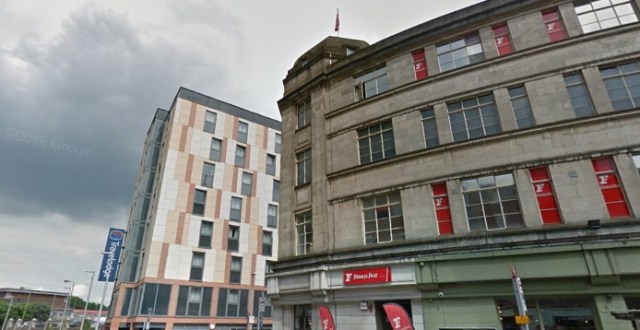
good

Next door but one – an extended Lidl would be to the left behind the Travelodge sign

Maybe the curved section could faintly echo its neighbour here.  We’re not envisaging a 1920s styling, but examples of successful half way approaches to handling this sort of tricky curved facade are everywhere, and could still work to make this seem a little less like a garage or retail park building and a bit more in keeping with the other buildings along Falcon Road –

corners examples

A few examples of handling windows on irregular curved corners

There are other approaches too on the ground floor, should a green wall not prove feasible – as it’s also quite possible to build ventilation into an existing window structure, if this is to look more like a standard building – here’s an example from a very classically designed building.  Overall – it feels as though there are maybe some design details to be resolved, but that the project as a whole is a positive one.

Posted in Business, Planning, Retail | 4 Comments

Sprucing up Lavender Hill’s pavements

A small project has kicked off outside the Church of the Ascension, to re-pave the pavement with better quality materials.  It’s not granite like the work near the station, but these are decent quality slabs nonetheless.

This was unexpected, but it’s a very welcome development – experience elsewhere in the Borough suggests a better-looking street environment attracts more trade, and paving has a subtle but significant influence on the look and feel of the street.  Plus the Church is a real feature of the area, that ought to be given the best possible environment.

It’s an interesting place to start, though, as the old pavement here really wasn’t too bad, other areas are far worse!   The surface either side of Battersea Arts Centre is an eyesore and increasingly full of holes, and the eastern end of Lavender Hill towards Queenstown Road has some shambolic sections that have dubious accessibility and do nothing for the local businesses.  We’re hoping these areas see similar improvement.

Update, 17th May

It now looks as though a significant part of the street, on both sides, will indeed be repaved – we understand the south side will follow.  Definitely good news.

New paving being installed

Unloading of more new paving, on the eastern section of Lavender Hill opposite Battersea Business Centre

In other news, Lambeth will be resurfacing the heavily-potholed main road surface at the junction of Queenstown Road & Lavender Hill (it’s just across the Borough boundary) in the near future.

Posted in Environment, Transport | Leave a comment

Large advertising hoardings masquerading as phone boxes

phone box previewA recent BBC News article (‘Westminster council opposed to ‘advertising junk’ phone boxes‘) noted that a company called Maximus Networks has submitted dozens of applications to install payphones along Oxford Street and other parts of Westminster.   Westminster is not impressed, as these are probably more accurately described as huge advertising hoardings installed on the pavement (1.3m x 2m), that happen to have a payphone attached to the back.  The suspicion is that the ‘payphone’ part is just a ruse to install adverts on public land while arguing they don;t need planning permission – we already have many smaller traditional payphones so it;s hard to see them hetting much, or indeed any, use!

Sadly the same company seems to be hard at work in Battersea – with no fewer than five of the things being proposed on Lavender Hill (as well as several on other roads in the Borough including St John’s Hill and Northcote Road).  Arguably these are just a lot of clutter, that will in all likelihood be a complete eyesore; similar ‘payphone advert hoardings’ previously installed in the Borough have become run down and (as expected) the phones, which are battery powered with a cheap solar panel, tend to stop working for good within a few weeks.  To make matters worse, some are proposed within a few feet of existing payphones, some could block access along pavements, one is in front of the Grade II* listed Church of the Ascension, and a worrying number are being proposed for locations that are fundamentally dangerous as – in trying to find very visible spots – the developers seem to have chosen sites that prevent cars waiting to pull out of street corners from seeing oncoming traffic.

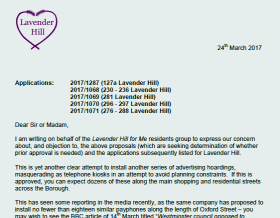
We’ve objected to these on behalf of Lavender Hill for Me (pdf objection letter), arguing that (1) these should have to seek proper planning permission rather than using a dubious planning loophole for payphones, and (2) the ones on Lavender Hill should be refused in any case for a whole range of reasons.

Wandsworth has successfully turned down some similar applications before (and even won cases where developers took this to appeal, in at least some cases), so with luck they will do the same again.

Posted in Environment, Planning | 1 Comment

Banning estate agent boards – has it worked?

img_7126-2

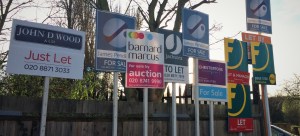
Estate agent boards near Wandsworth Common (an area not covered by these new rules), in January 2016

Back in March 2016, Wandsworth lobbied for, gained and implemented new legal powers to stop the proliferation of estate agent advertising boards in specific parts of the Borough – notably Clapham Junction town centre, and much of the length of Lavender Hill. The aim was to prevent tatty displays being left on otherwise elegant buildings, and make the street a more attractive place. This doesn’t completely prevent display boards, and there are still processes that allow them to be put up – but it does apply some hefty fines to prevent them being put up on the fly and left up for months and years. The areas covered are quite restricted – essentially focussing on areas where agents are tempted by what is effectively a free advertising opportunity, and where properties are split into flats meaning everyone probably assumes the boards are for someone else’d flat so they don’t get removed.

This was a UK first – previous schemes only covered designated heritage areas – and it got a fair bit of attention  in the specialist press. Credit goes to Wandsworth Council for handling the process and enforcing it, and special credit also goes to a local resident and member Lavender Hill for Me who pushed for this very determinedly.

agent boards.png

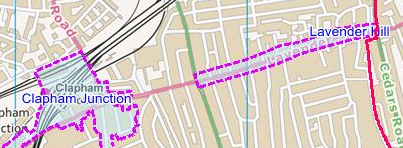
The area where estate agent boards face special restrictions, covering most of Lavender Hill (map extract source: Wandsworth Borough Council)

So – nearly a year after the new legislation came in to force – has this worked?

The obvious question to start with is – are there now fewer boards? Looking at Lavender Hill, it’s a resounding yes – there are far fewer boards, indeed a run along the road today found hardly any: one legitimate-looking one advertising recently vacated office space above Pizza Express, one on a flat just outside the designated area, and one ancient fourth-floor one that’s falling to pieces but so high up it’s hard to see how it got there or how it can be removed. The most problematic ones – ‘Let By’ boards that stay up for months as free advertising until they eventually blow off in storms – have vanished.

Does it improve the street? This also looks like a yes, especially at the eastern end. The Victorian terraces, some of which are pretty elegant, are decluttered and looking a lot better for it. The street no longer looks like a tacky closing-down sale, and it’s certainly a better environment for an aspirational new business.

Has it ruined the estate agents, or slowed down lettings, as some who opposed the move worried it might? It’s harder to give a conclusive answer, but there have been plenty of recent shop lettings, and flats above the shops were never realistically let on the basis of these boards anyway, so it doesn’t seem to have caused any real problems – after all, the value of these boards beyond general brand advertising for estate agent chains was always a bit doubtful.

All in all – this looks like a success. It’s even inspired a few other towns to go down the same road for parts of their town centres.

Posted in Environment | Leave a comment

Protecting Lavender Hill’s pubs

These laminated documents stuck to lamp posts are more important than the usual temporary changes to parking restrictions – they’re protection for our pubs.  Following the controversial death of the Castle on Battersea High Street, which was bought, closed and demolished by developers despite local uproar, Wandsworth has pushed the boat out to protect the Borough’s pubs.  They’ve really led the charge on this, and got a fair bit of national media attention for issuing a so-called Article 4 direction restricting developers’ ability to change the use of no fewer than 120 pubs and bars.

This means that ‘permitted development rights’, which allow developers to convert pubs to other uses like mini supermarkets without the need to seek any permission (other than for trivial and hard-to-refuse issues like signage and changes to air conditioning and fire door layouts), have been withdrawn for these 120 pubs. This gives the Council a far better degree of control. This was quite a big job – the pubs and bars across the Borough had to be assessed, essentially to define whether they had an important community function.

This isn’t the end of the story of course, as developers can still apply to change use and national policy doesn’t give Wandsworth carte blanche to say no – but this is where the other change comes in, the new supplementary planning guidance (essentially, an agreed approach to developing the area, which is formally consulted on so carries a fair bit of weight) it means that local democracy should count for more.

Protected pubs.png

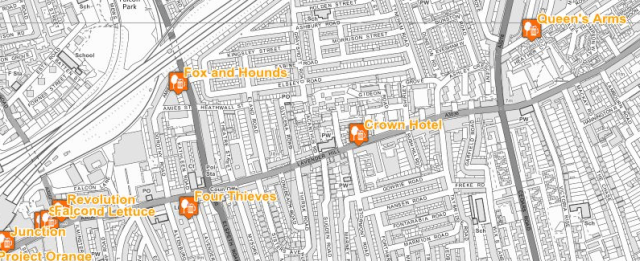
Pubs on and near Lavender Hill which, thanks to some good work by Wandsworth Borough Council, now have some degree of protection from development (source: Wandsworth Borough Council)

This map shows the protected local pubs on Lavender Hill.  There are no surprises, the pubs in question are the Crown (a good pub and a healthy business, although itself the subject of some recent planning issues), the Four Thieves, the Fox & Hounds (our only pub with a resident cat), Revolution, and of course the Falcon. These are all doing well, but then that was also the case at the Castle before it was demolished.

The Article 4 direction does include a handful of prominent recently-closed pubs, though Lavender Hill’s recently lost Ashtar at 5 Lavender Hill (formerly The Cedars) isn’t one of them, it faces an uncertain future after the most recent of a series of sometimes tenants seemingly moved to a new unit under the railway arches in Vauxhall.  Clearly The Lavender – once a pub of sorts but now a successful restaurant – hasn’t quite fitted in to the ‘pub’ category either.

All in all, this represents some good work by Wandsworth, who deserve credit for finding a way through in a tricky policy area.  Any pub still needs to succeed and attract customers if they are to prosper in the long term, but by ensuring changes to pubs that affect the whole community have to go through the planning process and be consulted on locally, this strengthens local democracy.  Above all, it makes it harder for third party landlords to  suddenly pull the rug from under the feet of viable local businesses in search of a quick buck.

Posted in Business, Planning, Retail | Leave a comment

New arrival: Sendero Coffee

img_20170111_191319034-2

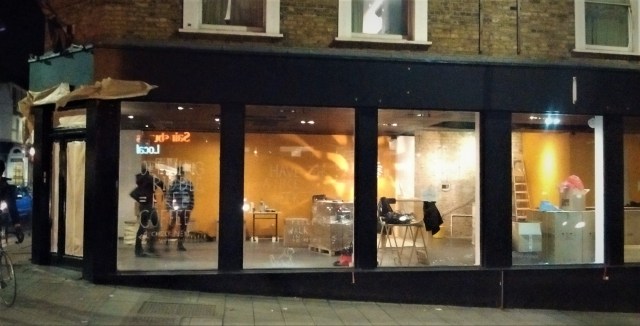
Work is well underway on a new coffee shop and showroom, Sendero Specialty Coffee, at 2 Lavender Hill (opposite Sainsbury’s – formerly the A Modern World furniture shop, also formerly DesignME).  We hear that – assuming all goes well – they will be opening at the beginning of February.

Certainly looks an interesting business – it’s worth a look at their coffee sourcing and importing work, which involved extensive travels to Uganda, Colombia and Ecuador, to source the coffee that will supply the new shop and the coffee sale business – lots of details on their blog.  It’s rare to see somewhere that knows quite so much about where their coffee comes from!

Back when Caffe Nero opened opposite, coffee shops on the main stretch of Lavender Hill seemed a brave move, but that pioneering branch seems to have been a success, and they have since been joined by Cake Boutique, Il Molino, Social Pantry and several more.  This new opening should be a good addition to the street – it looks like a good business and has plenty of potential to help trade by drawing people in from further afield, and experience so far suggests that the more good coffee shops open, the more people come here to visit them.

There’s a planning application in for the change of use (from the A1/Retail building use category to A3/Restaurants & Cafes).  Although it’s a loss of a shop in favour of an alternative use (which usually sets alarm bells ringing if it is likely to reduce the viability of neighbouring businesses) this seems a positive development, and Lavender Hill for Me has expressed support (pdf) for this proposal.

Posted in Retail | 6 Comments

Lavender Hill

Lavender Hill for Me is an informal community group working to support Lavender Hill, a neighbourhood in Battersea where we variously live, work, shop, eat, and travel.  We take an active interest in new developments that could help the area and want to improve Lavender Hill –  if you’d like to find out more about us and get involved, do get in touch.

Posted in Uncategorized | Leave a comment