It’s rare to see a street in Battersea without a construction site somewhere along it. Scaffolding, a slightly muddy pavement, maybe a front garden full of rubble and old timber awaiting collection. More ambitious projects might see the front garden surrounded by wooden construction hoardings. These hoardings are unexciting things, typically sticking around for a few months during the messiest part of a building project, and no-one pays much attention to them.
But Sisters Avenue, a street half way along Lavender Hill, has always been a bit different. From the outset it’s been home to rather smarter houses than its neighbours: detached three- and four-storey villas, originally designed for the wealthiest people in Battersea and making the most of the location right opposite the old Town Hall. So maybe we shouldn’t be too surprised that Sisters Avenue is now also home to a construction site hoarding doing its best to break all the records – as it’s now well on the way to its tenth birthday, and we’ve not seen any evidence of any actual construction having taken place!
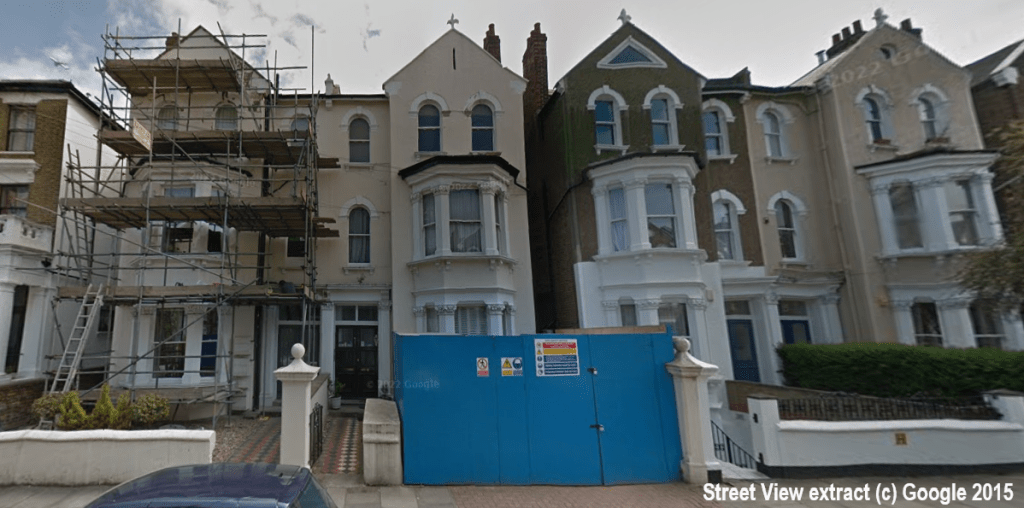
If you live nearby you’ll probably have seen it – because it’s been in place since the first half of 2015! In its first year it was an ‘ordinary’ hoarding – Street View’s first capture of it in May 2015 is below. Not the prettiest thing, especially given the prominence of the site on one of the more architecturally distinguished rows of houses in the area. But exactly what you’d expect, and perfectly understandable given that the house was set to see a large basement excavated, a development which obviously needed the public to be protected. It’s far from the only basement to have been dug out round here, and all the neighbours knew it’d only be there for a few months – maybe a year if the building project hit some snags. Right?
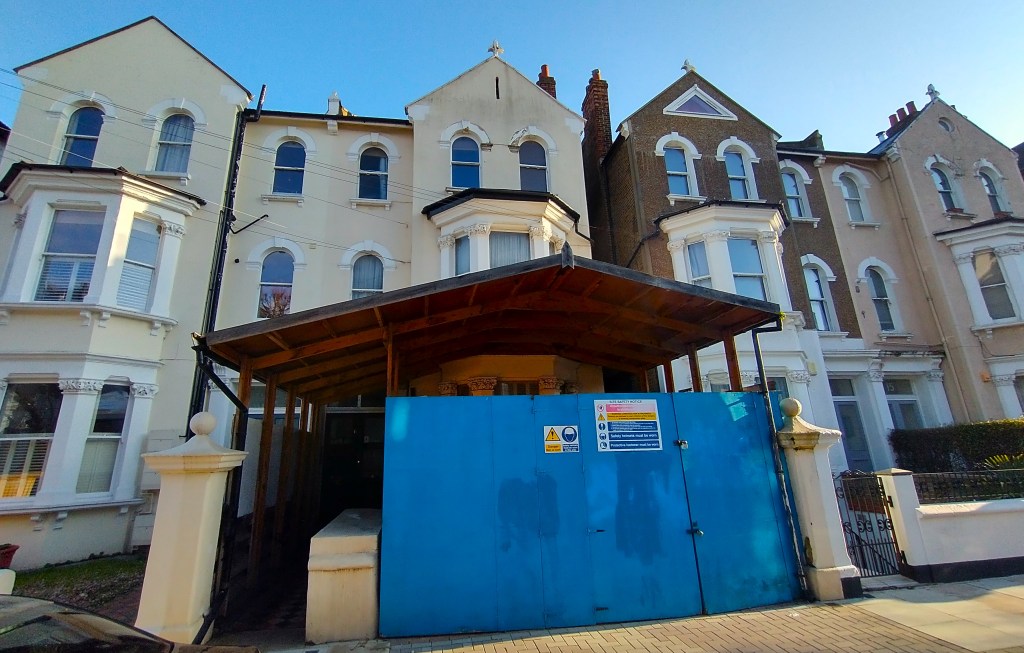
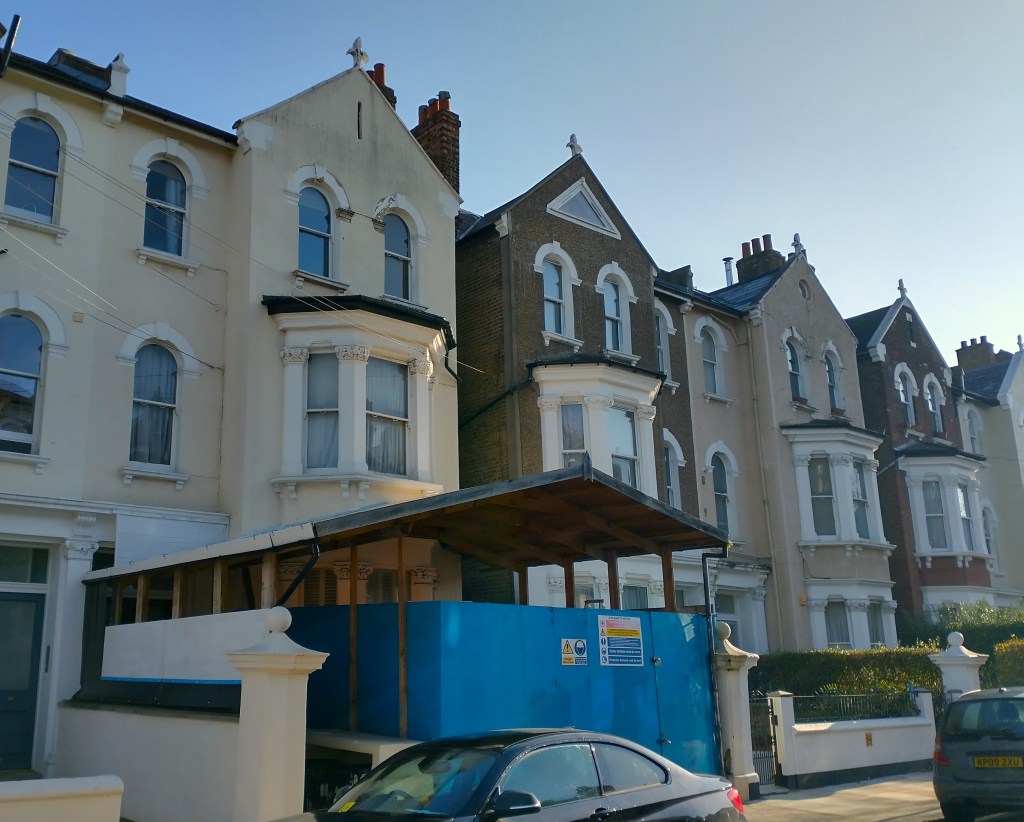
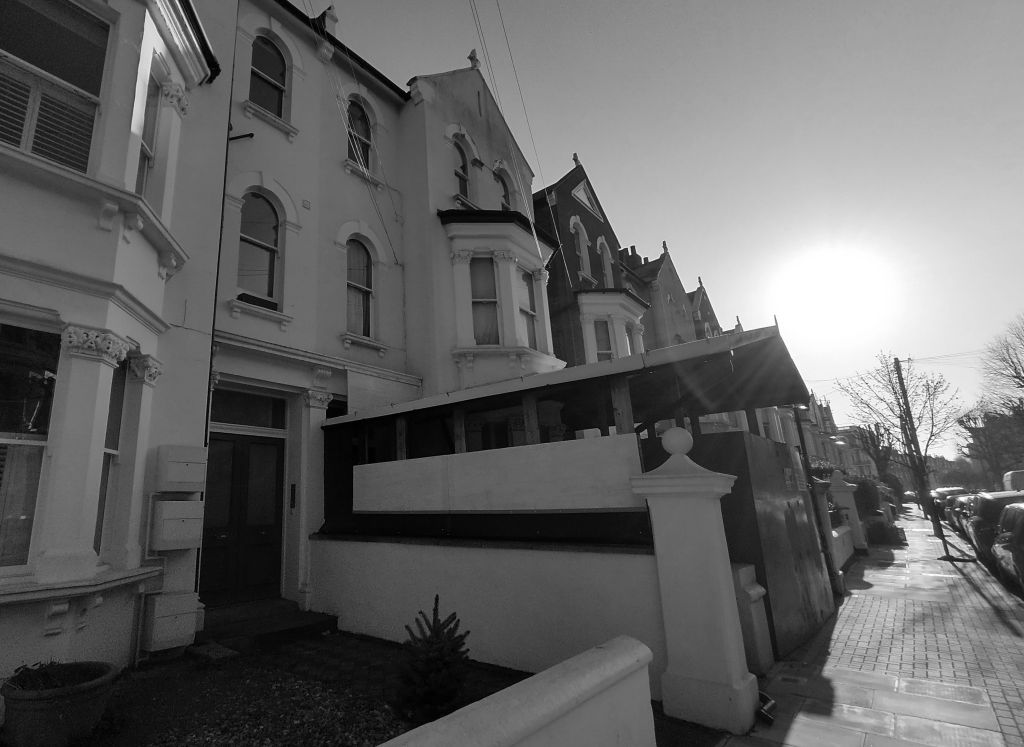
Or maybe not… Because a year later, things hadn’t exactly got moving on the building site. There was, however, plenty of progress on the building of the hoarding itself: it had sprouted a large roof! This stretched beyond the original hoarding to also include the pathway to the front of the building. This created a very substantial structure, now visible from most of Sisters Avenue as well as from Lavender Hill.
But none of the neighbours thought the big blue shed would still be standing eight years later! The planned project had been to excavate the whole of the basement, extending the current small basement that contains a single bedroom to create three bedrooms, a reception room and a further study, and large lightwells at the front and the side of the property. A decent project, but none of this really seemed to get going. Looking at the many captures Google’s street view has of the structure over the years, ladders peeking out from behind the hoarding occasionally move slightly. A bit of the roof falls off in May 2018, and after more than a year dangling off the side of the structure it’s eventually repaired. The once-vibrant blue paint gradually fades with years of summer sunshine.
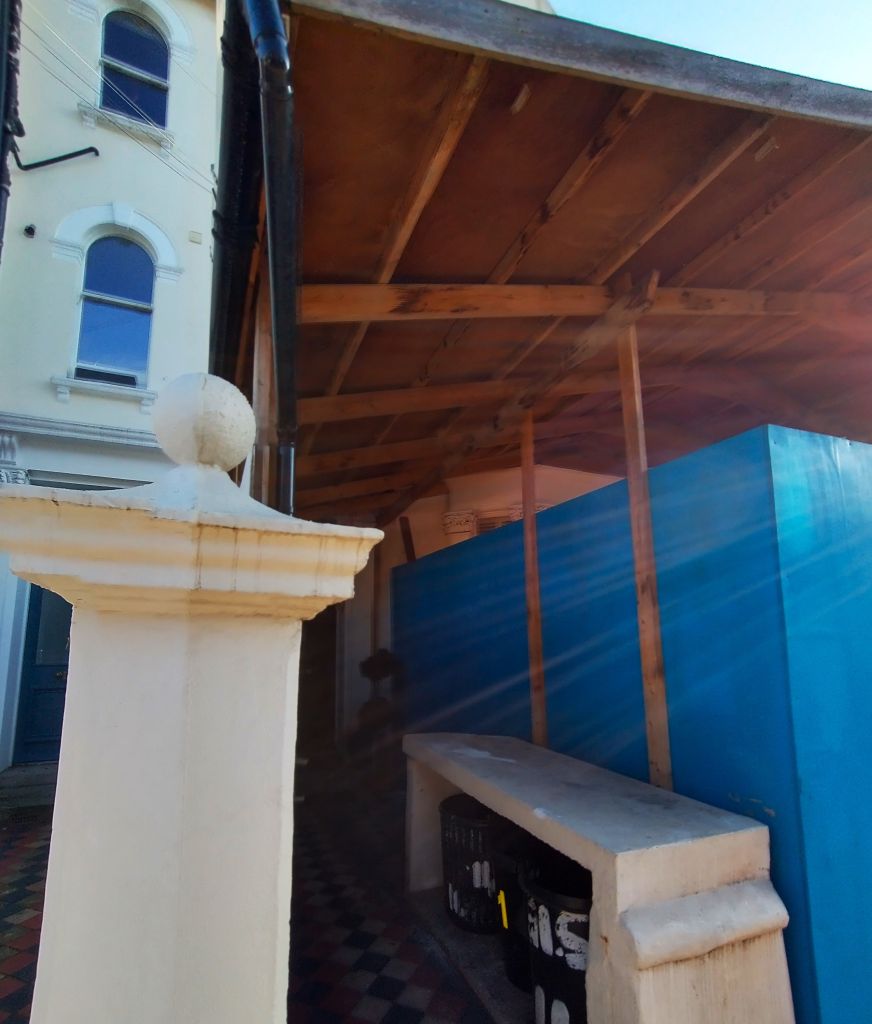
The exact contents of the shed are a bit of a mystery, but the structure seems to have become some sort of general storage space, essentially a large garden shed at the front of the property. Wandsworth’s planners eventually decided that enough was enough – maybe also conscious that the property owners might try to claim that the structure had been there long enough that they could argue it had, in doing so, acquired some rights to remain there in perpetuity. On the 29th October 2021, they issued an enforcement notice requiring the removal of the structure at Flat A, 11 Sisters Avenue, following what was described as “the unauthorised erection of a front garden timber enclosure comprising of timber hoarding to the front and sides and a timber framed shelter above at the property”. The enforcement notice required that the property owners remove both the structure at the front of the building and the one going round the side), that they restore the property to its previous lawful condition; and that they remove all debris from the site. They were given two months to comply. That should have meant that the structure would finally be gone by the end of 2021 – and we can imagine the other residents of the street breathing a sigh of relief – the end of the eyesore was finally in sight.
Or maybe it wasn’t – because over a year later, it’s still standing. It seems the owners weren’t about to let their structure be torn down without a fight – and they duly appealed against Wandsworth’s planning enforcement notice, escalating the case to the Government Planning Inspectorate. They essentially argued that the structure was a ‘permitted development’ on the grounds that it was a “building or moveable structure required temporarily in connection with and for the duration of operations being or to be carried out on that land or adjoining land”. They pointed to planning permission for the basement excavation that had been granted in July 2016 (when the hoarding was just a year old) and said that the structure was necessary for those works.
The planning inspector, Felicity Thompson, visited the site in September last year. She noted that at least some building works seemed to have taken place on site in 2017. However she noted that these works ceased “a number of years ago” following the death of the parents of the current owners (who it seems had owned the property, and were taking works forward before their death). She noted that an ongoing court case linked to the property had limited scope for further building works since then, and also notes a reference to probate processes on the property potentially concluding in 2022 – so it’s easy to see that things could have got in to a bit of a legal grey area.
However Felicity also notes that there was no evidence of substantive building works since 2017, other than the usual basic maintenance of the building. This led to her judgement that while the ‘permitted development’ exception does indeed allow structures to be built, it limits their presence to the duration of the building works. And as there’s no real evidence of any such ongoing building works at the site, the structure is not allowed. Her decision, in October 2022, says: “As a matter of fact, the [building] operations ceased and were not being carried out. The timber enclosure would not therefore constitute permitted development…”. This is a pretty clear cut conclusion – backing up the Council’s enforcement notice.
She does, however, clearly have some sympathy with the position of the owners, with suggestions in the decision document that they may have faced some sort of legal wrangles with the property. In her appeal decision she does also consider some other arguments that could be made in favour of the structure remaining: that requiring its complete removal is disproportionate, or that the two-month timescale Wandsworth allowed for its removal is too short. But to no avail, as on both grounds she comes down firmly in favour of the local authority: the structure is not allowed – and nothing short of full removal will remedy the planning breach. And a two-month timescale is completely sufficient to restore the front yard and dismantle a relatively simple wooden shed structure.
We’re already more than two months after the appeal’s enforcement deadline – and the structure’s still there. This is getting in to a dangerous space for the owners: ignoring an enforcement notice that has been upheld at appeal is not a good move. The Council has powers to take this in to their own hands now and remedy matters, and a charge can be made against the property including confiscation of income. Ignoring an enforcement notice that has been upheld at appeal is a criminal offence, and brings the prospect of trials at the Crown Court and unlimited fines.
There’s undoubtedly a sad story behind this neverending construction project, including the death that led to the original project being suddenly stopped, and whatever seems to have led to years of legal matters. There are two sides of every story, and anyone who has been involved in probate knows it’s not an enjoyable experience (and if you are the owners – please get in touch, as we’re keen to understand your side of this story better). But we’re left wondering why the hoarding wasn’t simply removed years ago – it’s hardly a major task, the wood could even be stored in the side passageway for reuse if works restart. What is so special about this ugly shed that means the owners have fought for so long, and presumably at some cost, for its continued existence? The fact of the matter is, no matter what is going on behind the scenes, there’s little excuse for leaving a supposedly temporary eyesore up for most of a decade. It’s time for this to be taken down, and maybe – if substantive building works ever start again that need a similarly giant shed – a new one could be put up. We feel for the many neighbours we know have had to put up with this thing for years, and who just want to see the back of this eyesore on an otherwise well-cared-for street.
Will the owners now do the right thing, or will this saga roll on? Ominously in late 2022 they applied for a new planning permission, for “Retention of temporary hoarding and canopy over to front and side until basement work is complete” – but then withdrew it on the 26th January. The ball’s in their court now, and we’re quite curious to see what happens next in this surprisingly long-drawn-out tale of an overgrown construction hoarding. Will the blue shed survive in to its second decade? Will Wandsworth move in to demolish it at the property owners’ expense? Might this all end in a criminal trial at the Crown Court? We’ll keep you posted.
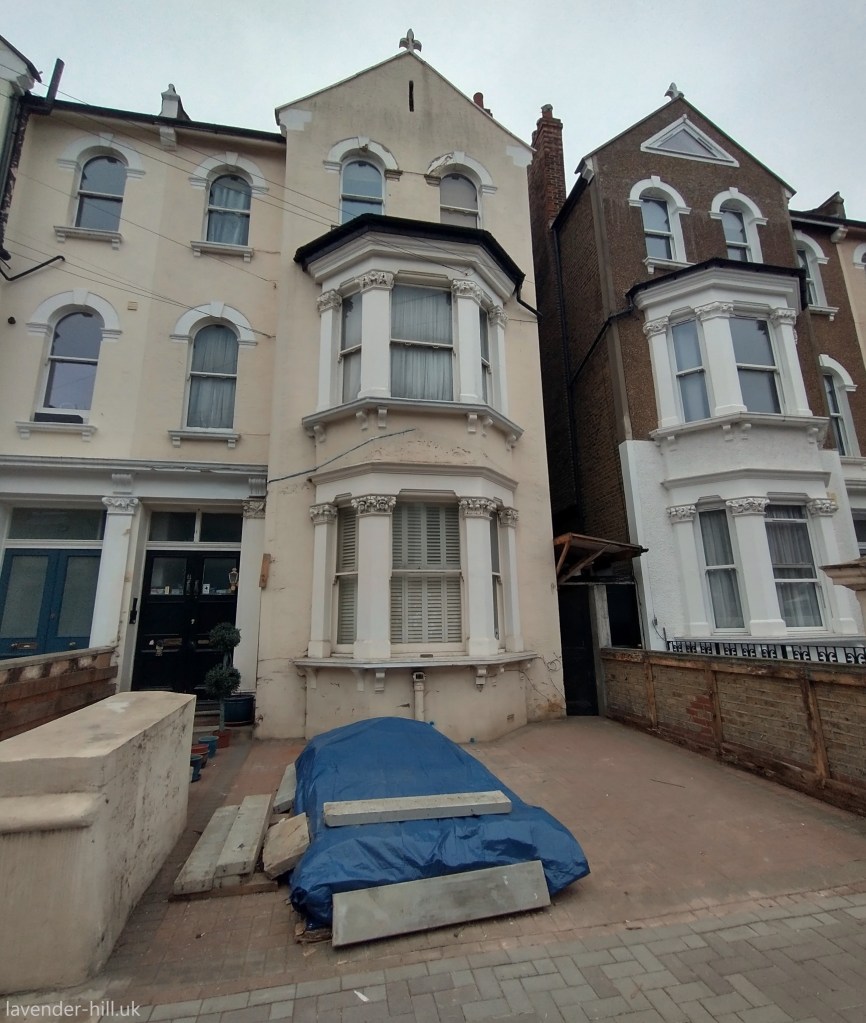
Update (10th February): No sooner had we written about the big blue shed – than it was gone! Just like that. Nothing left but a heap of materials wrapped in a tarpaulin (a blue one, of course, for old times’ sake). Looks like the owners weren’t too keen on a brush with the Courts! And it looks like the answer to the question of what was behind it for all those years is, well, nothing really – no big holes in the ground, no site equipment, no sign of building works at all. One might wonder what all the fuss was about and why the shed wasn’t taken down years ago. Rest in Peace, big blue shed. 2015-2023. We hardly knew ye.
As the Lavender Hill Christmas lights go up, it’s time for another of our occasional updates on retail comings and goings in the Lavender Hill area. It’s been a busy few months since our last update on the topic, with plenty of new arrivals, and a couple fo sad departures.
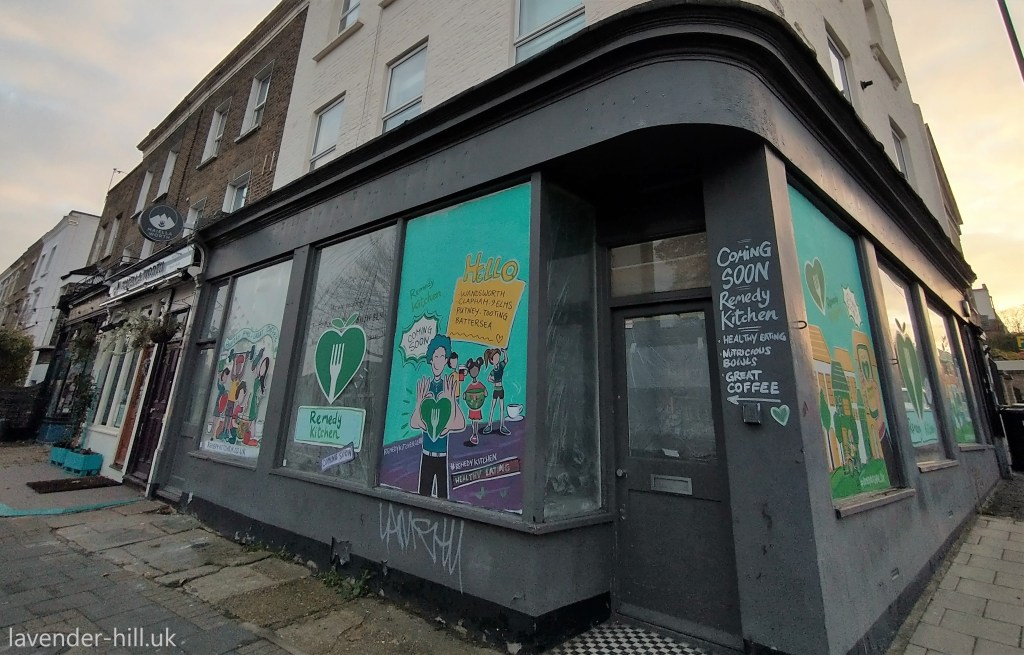
First up: At the very eastern end of the street up on the Wandsworth Road, the big and beautiful corner unit that was home to Sinclair Till’s collection of fabrics and furnishings (until they moved to Chelsea) is set to become a new branch of Remedy Kitchen, with works already underway. Remedy Kitchen specialises in food that’s fast but also fresh, colourful and healthy – with a keen eye to the environmental impact of the business. Owner Fadi Chafi founded the business in 2020, as a delivery-only kitchen based in the huge complex of kitchens opposite Battersea Heliport, before expanding to open an actual branch open to the public on Haverstock Hill near Belsize Park the following year. It’s been a success – being shortlisted by Deliveroo for a ‘best newcomer of the year’ award, and Fadi is now returning to Battersea in a bigger way with an actual branch.
There’s sadder news at the Queens Arms, which we reported on a good few times as it went from empty premises back to being an actual pub: the lease is now for sale. It’s slightly out of the way but as a rare ‘proper’ pub in this part of Battersea, hopefully this can find a new landlord.
Wild for Dogs has opened at 4 Lavender Hill, next door to Sendero. It’s a small business specialising in organic, vegan and cruelty-free grooming products for dogs, which all started when founder Laura Sarao was shocked by the ingredients and quality of the products available for her new puppy. As a specialist local business Wild for Dogs has a full website and offers delivery around the UK, but where visitors and shoppers are also very welcome at the branch.
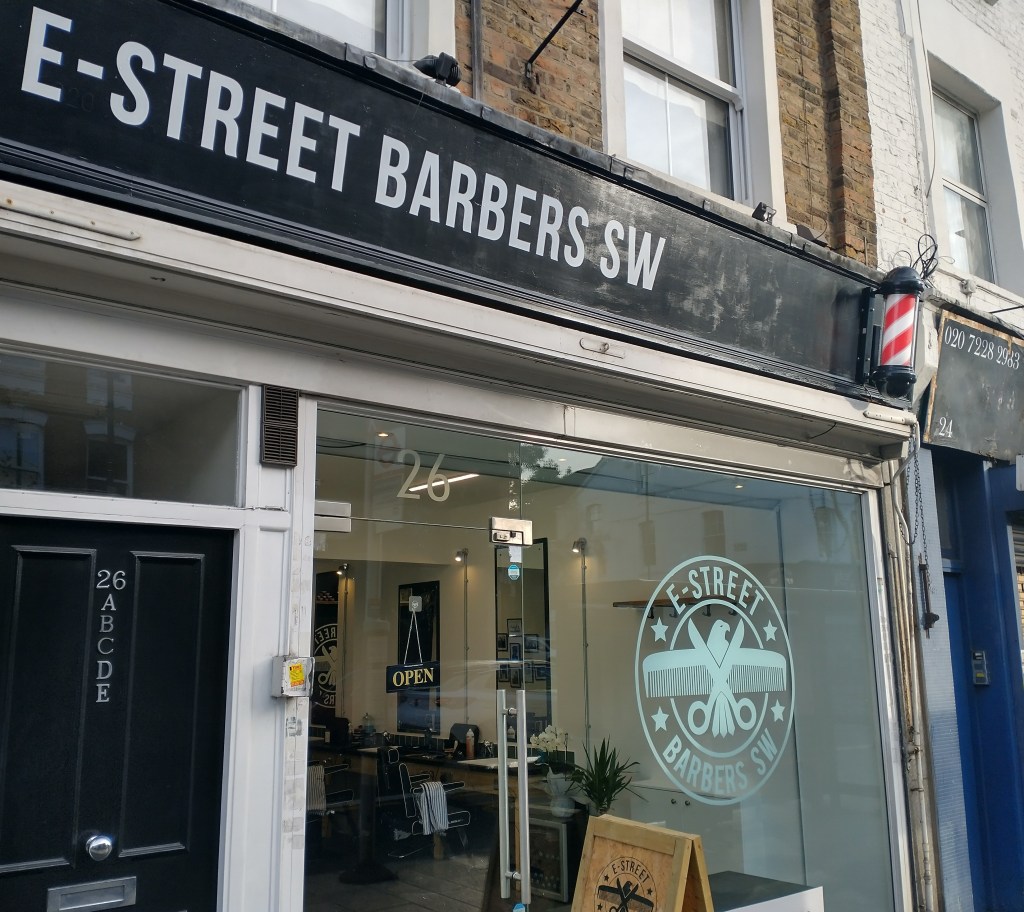
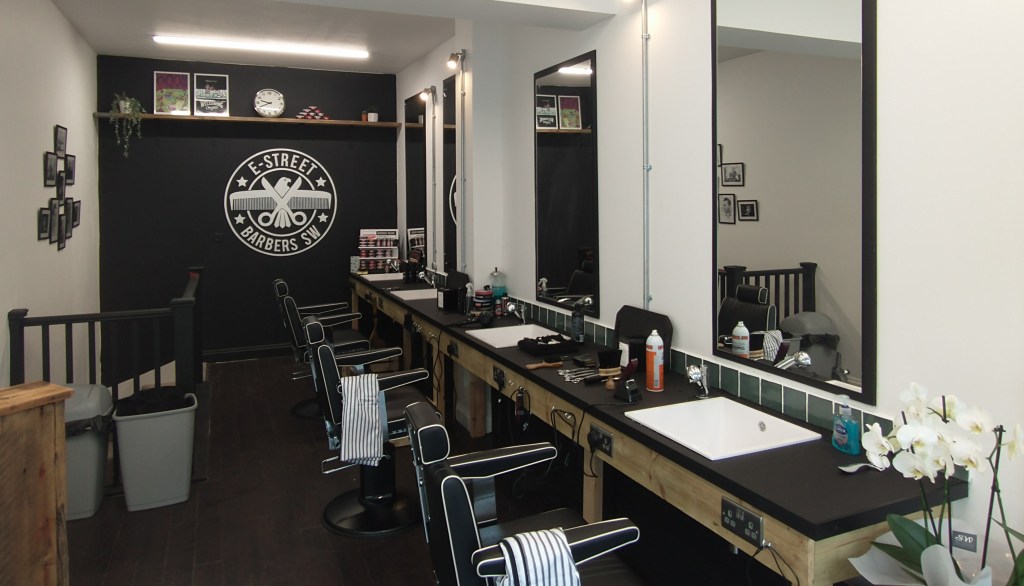
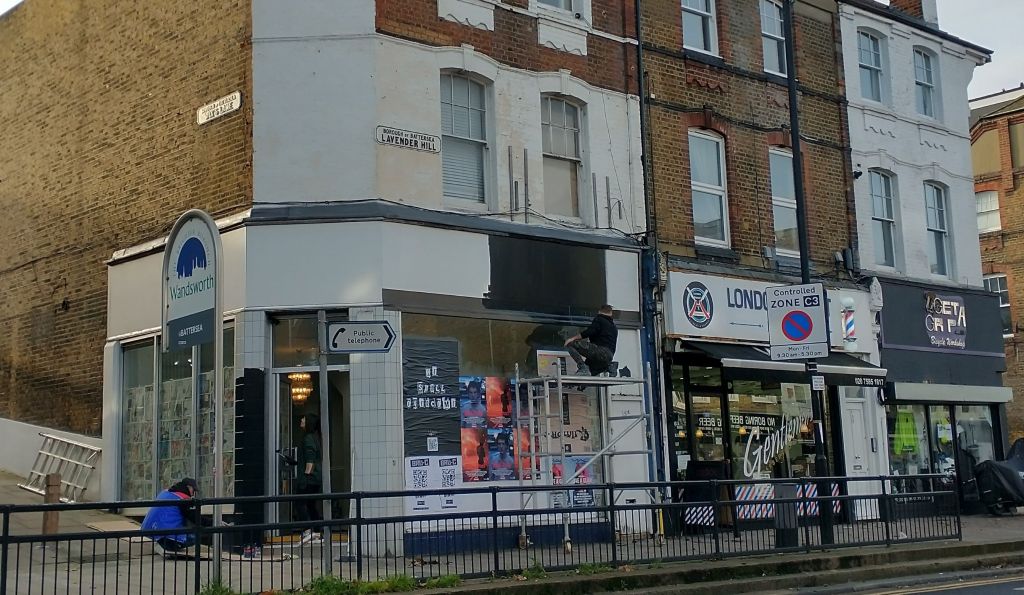
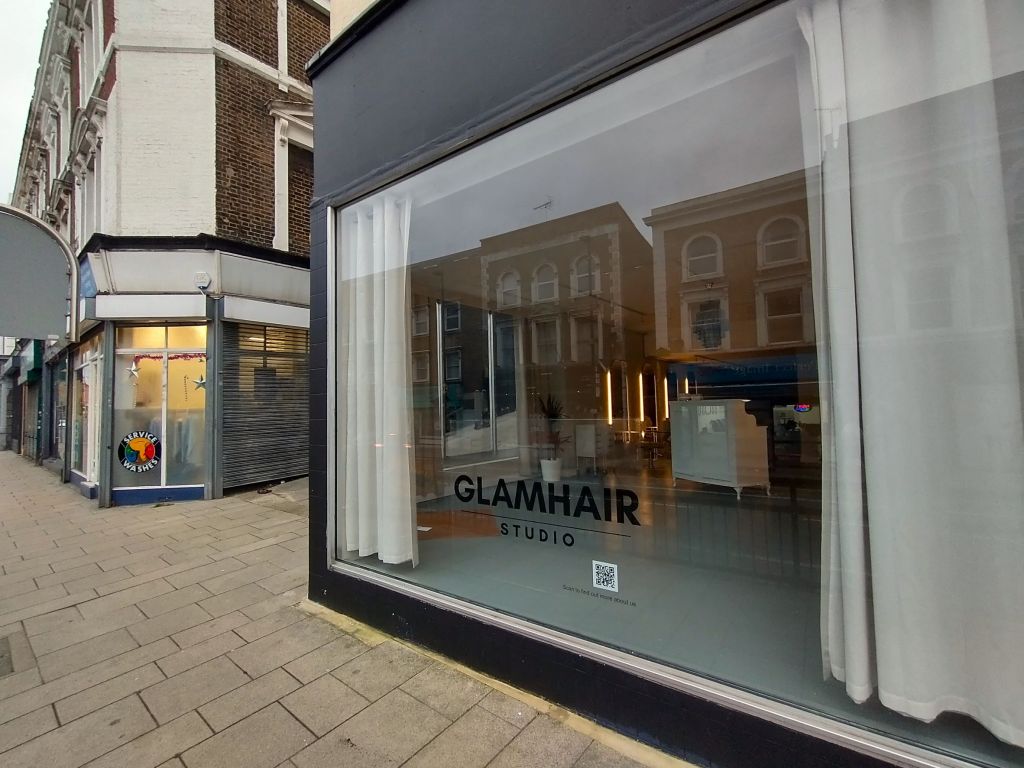
There’s a cluster of new hairdressers at the eastern end of the road. E Street Barbers SWhave opened at 26 Lavender Hill and seems to be quickly picking up a loyal following. It’s a new venture by owner Jack, who has set up south of the river after six years of working at E Street Barbers’ sister branch in Hackney (with experience of working in other haidressing businesses before that as well).
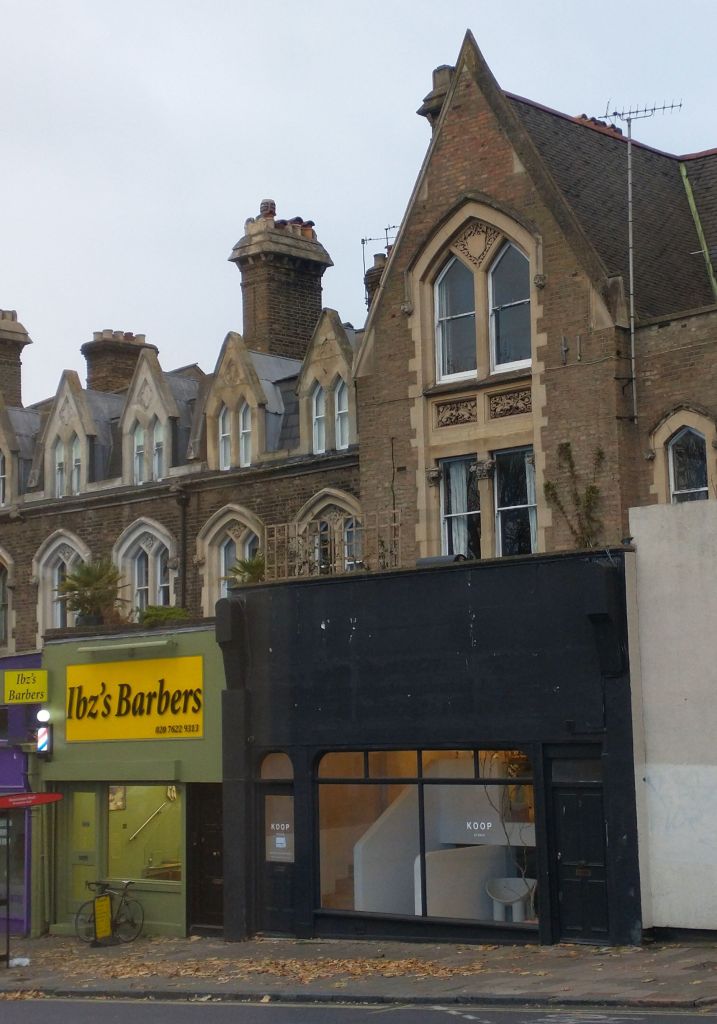
He’s continued the Clapton approach of simplicity and style, adding to the growing cluster of traditional mens’ barbers on Lavender Hill including very long-estabished local barbers Froud & Co, and London Barnet barbers opposite. The east end of Lavender Hill has clearly become the place for independent hairdressers – which typically migrate here to avoid the much higher rent in the units closer to Clapham Junction, and which have plenty of local demand as you can’t get your hair cut on the internet. Jack’s happy to take walk-in customers.
Koop Studio took over the old LHP Lavender plumbing shop (after they moved to a new premises just around the corner on Lavender Hill last year), with a slightly different business model focussed on being a studio workspace that rents chairs to a wide range of creative stylists in a smart and minimalist space.
It took quite a while for this unit to be re-let (we know a good few people looked at it along the way). It’s a surprisingly large shop, and like many of the shop units it also has a basement – albeit one that is unfortunately only accessible by a hatch, so which isn’t of much use; we were slightly surprised that it wasn’t developed like many of the other nearby shops to introduce a staircase and move the ‘back of house’ downstairs, and increase the available space.
Now that it’s back in business the old betting shop has scrubbed up quite well! It certainly looks a lot smarter than it did in the final years of being a William Hill.
Firezza at 40 Lavender Hill may have a bit of disruption ahead, as the landlord has asked for planning permission to convert half of the ground floor (where the pizza oven is) and most of the basement in to a flat, leaving a much smaller shop unit with that would no longer really work as a takeaway. It’s a long established takeaway so we hope that if these plans do materialise, they are able to relocate in the area.
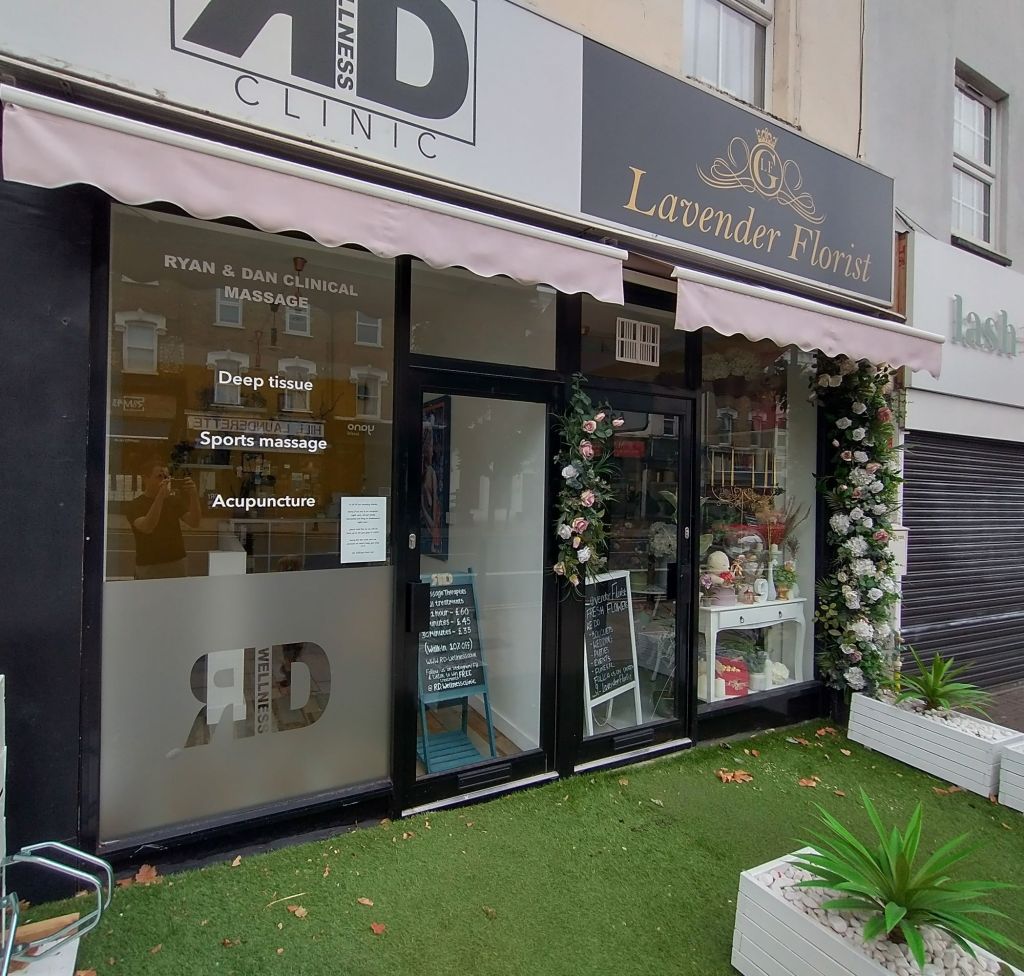
A few doors down from Firezza, two of the smallest shopfronts ever created on the street – where most of a unit was converted to a flat, leaving very small shop facing the street – have both found tenants. Ryan and Dan clinical massage have opened at 36 Lavender Hill. They’re very clear that this isn’t a traditional massage parlour aimed at a ‘quick rub down’ but is instead aimed at accessible and affordable treatments, particularly for those who suffer chronic/acute muscle pains and tensions, and to ease sports injuries. The co-owners are keen to change the narrative of what massage parlours and clinics currently provide, and open it up to a wider customer base in terms of ages and backgrounds who could benefit from treatments to ease their muscles. This is reflected in the more clinical and business-like design of the premises, which is quite different to the more typical styling of a massage business.
The other unit (also at 36 Lavender Hill) was even smaller as it didn’t have a basement – however is now home to Lavender Florist, the first flower shop on the street with a wide range of flowers and decorative items, who are also selling Bouquets as well as Christmas trees to order.
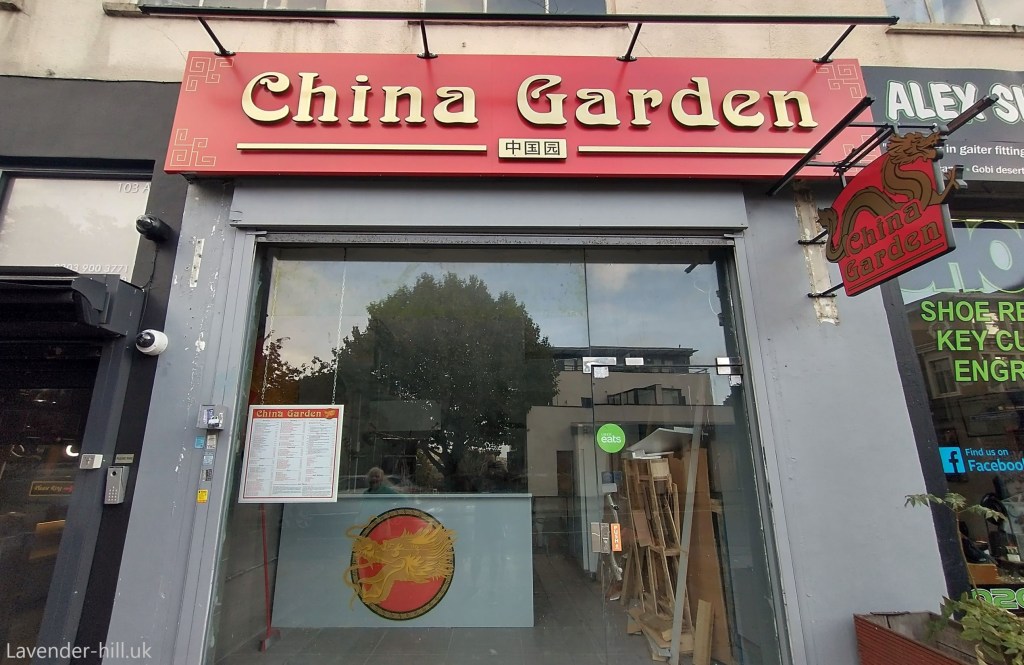
On the food & drink front, China Garden has slowly been taking shape at 103a Lavender hill, bringing a second Chinese takeaway to Lavender Hill following the retirement of Mr Liu who used to trade a few doors down the road a few years ago. The building works here have been quite extensive, including a full refit of the premises. This isn’t a completely new business, as we understand it’s linked to an existing takeaway – Bugatti Pizzeria – on Battersea park Road. It’s hard to say when they will open as work has been slow, but it looks as though it may not be long now.
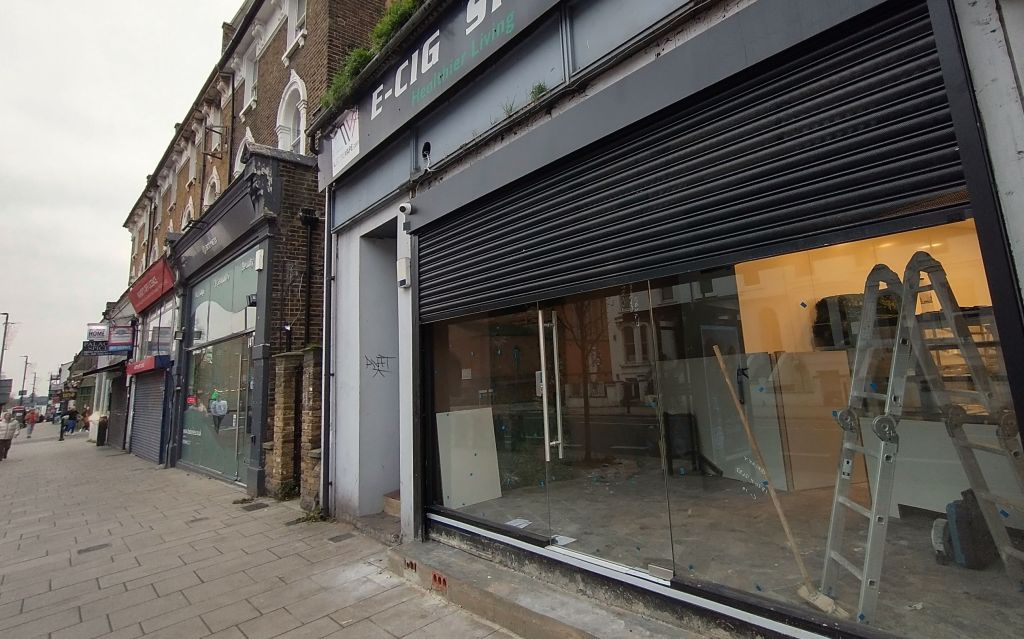
In a good news development, the increasingly scruffy shopfront at 128 Lavender Hill that was an E-cigarette store – pictured above – is having a proper makeover, and is set to become the latest branch of the Little Dessert Shop, serving artisanal waffles, crepes, coffee, cheesecakes, cookie dough & Italian gelato. They have lots of branches in the Birmingham area and a decent handful further north in Manchester, but only a scattering in London – the nearest is in Balham.
It’s not all good news on this stretch of the street though, as El Patio seems to have suddenly closed, with a landlord notice stuck to the doors – so sudden that large hams are still hanging in the window and there’s a full wall of wine and spirits still in place.
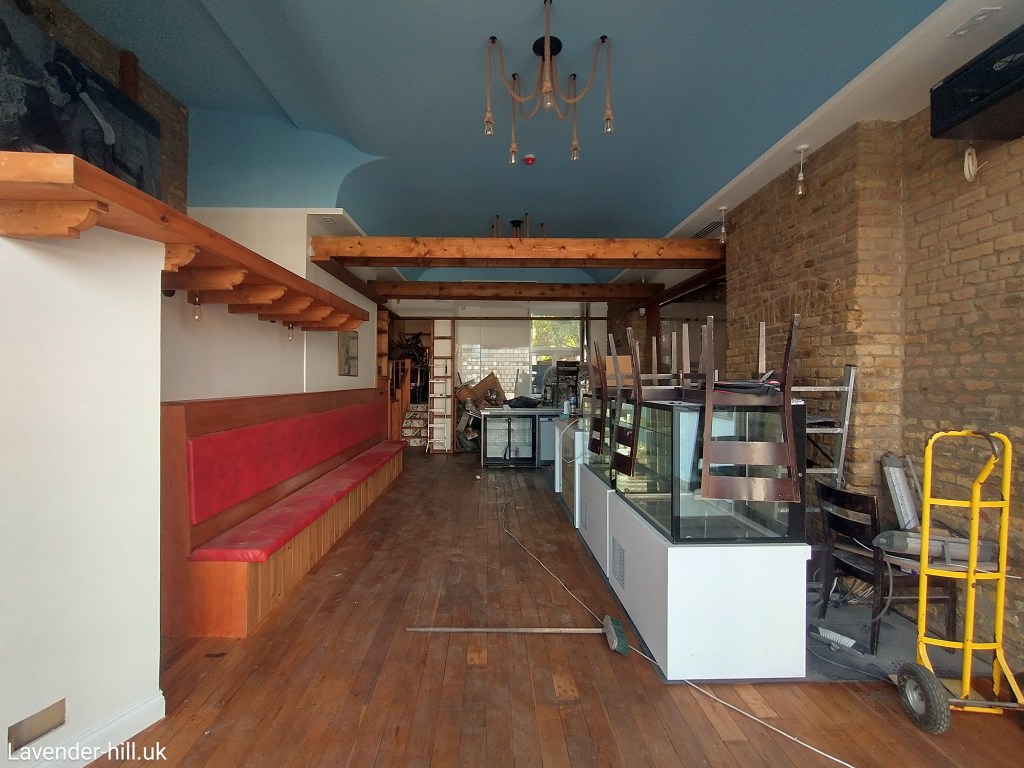
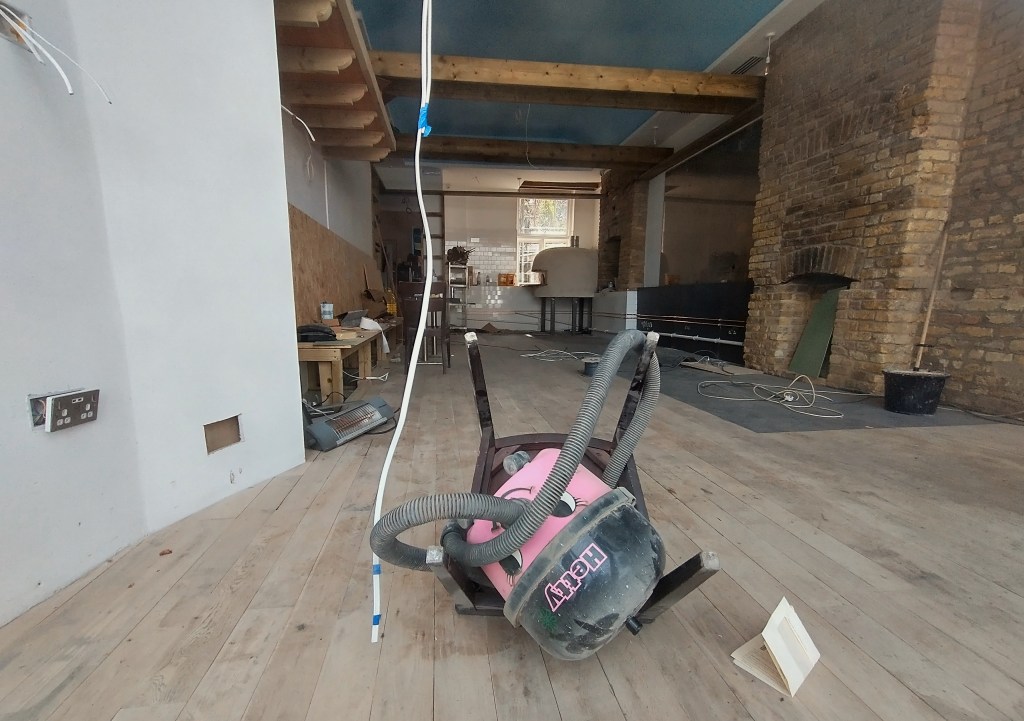
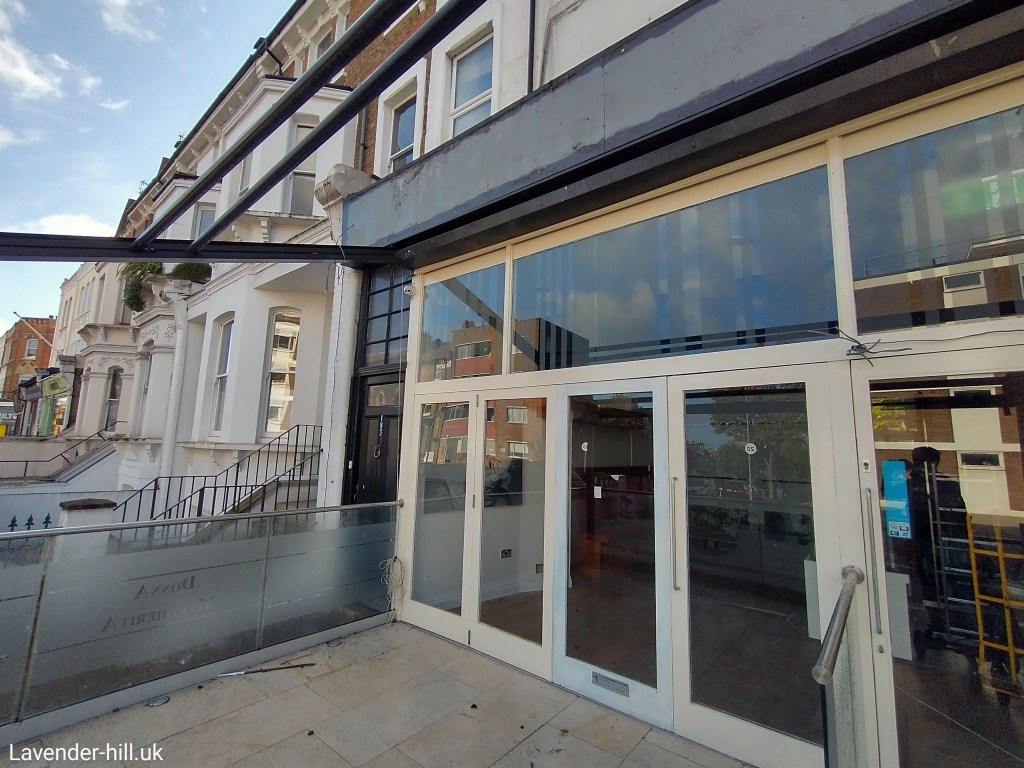
Meanwhile work carries on, slowly, at Donna Margherita, pictured above, which we have written about a few weeks ago – who are on the long road to recovery after an unfortunate kitchen fire. It’s still not completely clear who is taking over but most of the new material needed to reopen is now in place, including pictures on the walls and tables and chairs, so while it does look more like a building site than a restaurant at the moment we’re optimistic that this should be springing back in to life fairly soon.
Further along – Thermomix opened up close to the station, as we have reported previously, bringing a new life to what had been The Corner Stone Christian bookstore. Work’s also underway to create an as-yet-unknown new business in the shop that used to be the KV Cars minicab office at 129A Lavender Hill, which had been looking rather sad for some time after they closed the office, and something is emerging at 97 Lavender Hill, a shop right next to the way ion to Battersea Business centre that had rather briefly been a showroom for The Liberty, a maker of bespoke fitted furniture.
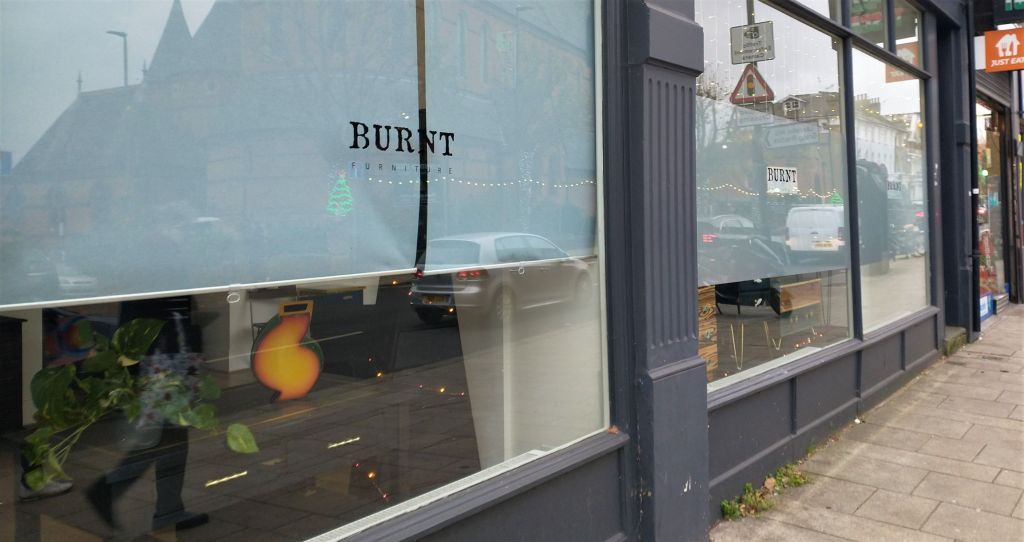
And finally, speaking of furniture, Kennington-based Burnt Furniture are opening what e believe is a pop-up store at 125 Lavender Hill. As the name suggests, they specialise in up-cycling furniture using wood burning techniques, using a Yakisugi burning technique. This looks quite interesting, with funky colours & various one-of-a-kind statement pieces. All in all – despite stories of struggling high streets around the country, Lavender Hill is holding up quite well. It’s encouraging to see so many new businesses take the plunge, and as we always say, if you live locally do make sure you visit all our new independent traders.
Retail roundups are an occasional series on traders in and near Lavender Hill, in Battersea, London. If this is of interest, do look at our other articles on local business, on retail,or on local food and drink.
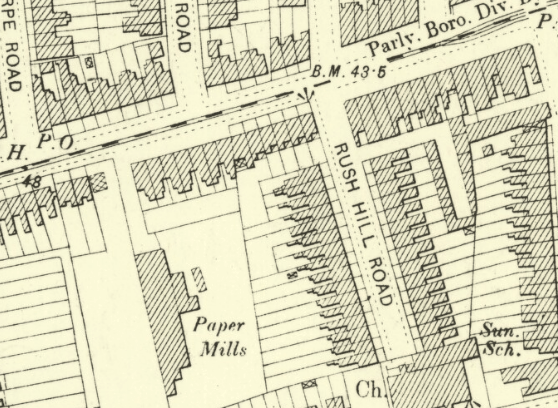
Rush Hill Road is a small street leading off Lavender Hill. We’ve dug in to its past, in the latest of our local history posts.
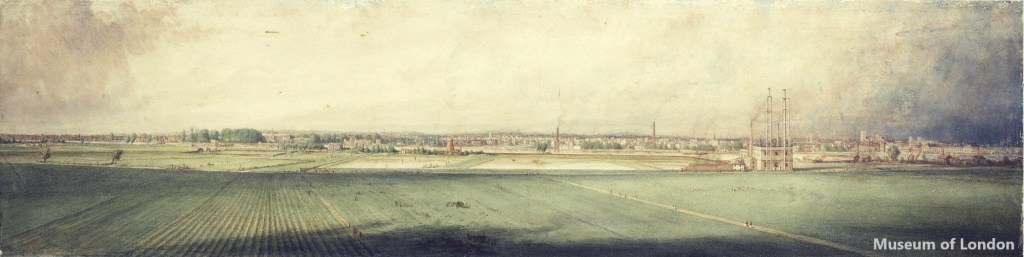
No-one knows who first named the area Rush Hill: at some point a field on the south side of Lavender Hill is recorded as being called Rush Hill, and the name’s stuck ever since. Before the railways arrived the area was a wide open space of fields, with a scattering of large houses with generous gardens. And it was an ideal spot for those houses: being the top of a hill meant there was good air and well-drained ground (with a few natural springs), as well as far-reaching views over Battersea Fields and the Thames to London. Robert Westall’s painting below shows the view in 1848, a few years before the railways arrived and everything changed; a few familiar buildings include Westminster Abbey and Chelsea Hospital; with the pipes of the Battersea Pumping Station in the foreground giving a small taste of future industrial development.
The people living in these scattered houses were wealthy – for some these were weekend retreats from the city, others were retired. The houses were typically quite close to the road with a short drive for carriages; with much larger gardens behind including lawns, ponds, kitchen gardens, and greenhouses to grow fresh fruit and vegetables. Most of these out-of-town properties had some stabling and paddocks, as well as space for cows and pigs, and maybe also separate coach houses.
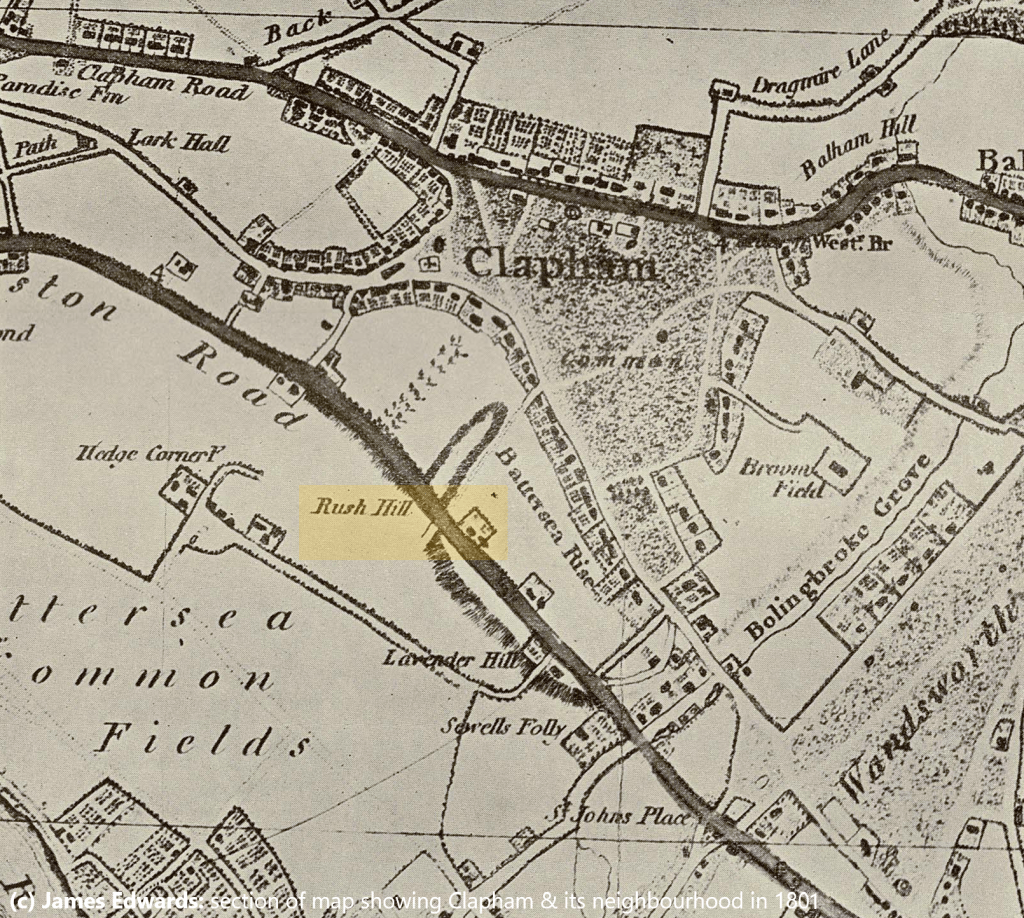
The map above shows the layout in 1801 (and takes a bit of getting used to as North is at the bottom left hand corner). In 1801 there was already a fairly extensive set of houses around all three sides of Clapham Common, the specked shaded area in the middle – with the Lavender Hill (then called Kingston Road) cutting across the map diagonally below it. There are only a scattering of houses shown on the Lavender Hill – but one is visible, right next to the label ‘Rush Hill’. This is the first mention we can find of Rush Hill, and the house in question is Rush Hill House.
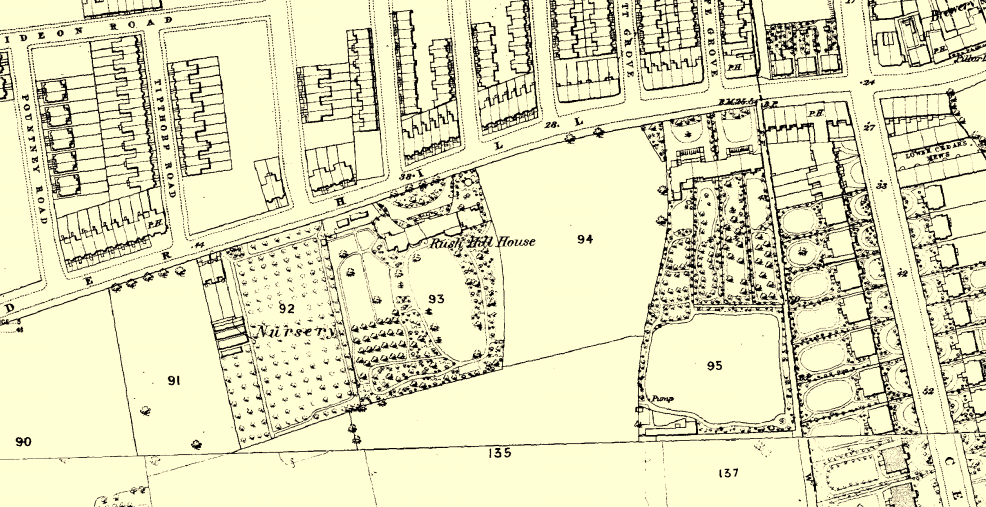
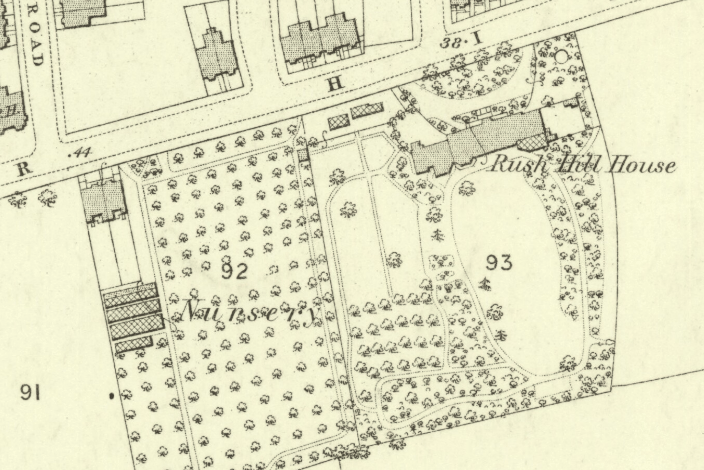
Rush Hill House was older than the other houses in the area, and its origins are obscure – we know that it was also a fair bit larger than the other houses, having been built at some stage in the 1700s. It’s mentioned in the will of Hop Factor Thomas Barry in 1770, but described as ‘my two messuages’ in the occupation of Edmund Rush on the south side of the road. A ‘messuage’ is an old word for a house – suggesting that Rush Hill House may initially have been a semi-detached pair of houses that were later combined into one larger residence. By the time it was a single property there were eight bedrooms, and a generously sized 30-by-18-foot drawing room.
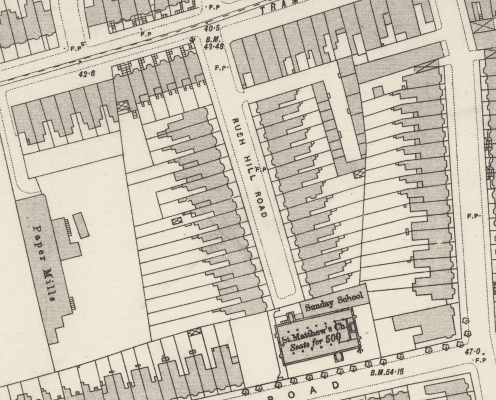
Extract (c) OS, via the National Library of Scotland’s impressive map archive
It’s the large house in the middle of the map above – complete with a double-ended driveway, a large south facing garden an orchard, and a couple of outbuildings near Lavender Hill.
This first mention of the house also gives a clue to the future name of the street: Edmund Rush was a mason living in Battersea, whose will dated 1782 is held at the National Archives. He was a noted builder in the 1750s and 1760s, responsible for several very upmarket streets in Mayfair including Dunraven Street in Mayfair, part of South Street, and some huge terraces at 5 and 6 Hyde Park Place. It seems that as an early tenant (and possibly a fairly well known one, given he was building some of the most expensive property in London), his name may have ended up attached to the house and the area.
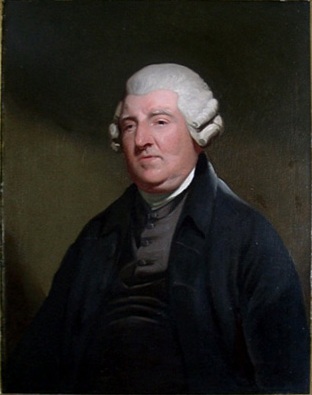
Peter Dollond, via Wikimedia Commons
Towards the end of the 1700s, Rush Hill House became the home of Peter Dollond – pictured to the right. Peter had grown up in Kensington, but left the family silk business to set up a shop in Kennington, where he designed and sold some of the best telescopes and optical instruments of the day – conveniently only a short trip from Rush Hill. This went very well indeed, and he built what became the national chain Dollond & Aitchison (which was to survive for several centuries, finally being rebranded to Boots opticians in 2015).
In 1842 Lavender Hill was described as ‘a most respectable and social neighbourhood’, and Rush Hill House went on to house a series of successful City businessmen including John Ashlin, a corn trader; followed by John Harvey, a banker and railway promoter, Intriguingly one of John A’s sons went on to marry John H’s daughter, suggesting that there must have been some sort of link between the successive occupiers. It was still a grant country house, with ten acres of land including a significant landholding to the north side of Lavender Hill.
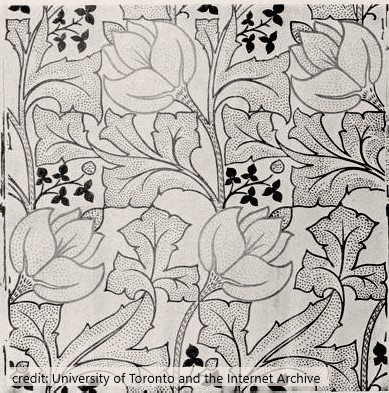
But change was on the way. The railways started their inexorable spread in the 1840s, and were accompanied by all sorts of dubious new neighbours! The first sign of change was Beaufoy’s Acetic Acid factory, which was built in about 1830 by Lambeth vinegar entrepreneur John Beaufoy close to the junction of Lavender Hill and Queenstown Road (and for some time thereafter remembered in the naming of The Beaufoy Arms pub, which appeared at some point before 1870 and survived in one form or other until a few years ago). Much stinkier stuff was to follow to the west, with a Size works being developed near where the Hare & Hounds pub now stands. Size was an early type of light glue, used in painting, and was made in a notoriously smelly process of treating and then boiling animal skins and hooves. The rural surroundings that had made Rush Hill House a popular getaway for over a century started to be replaced with dense new terraced housing aimed at the lower middle classes – at first a tricke of development and gradually a flood of building work as, one by one, the landowners sold their fields to developers. New houses surrounded the villa on three sides, and the previous tree nursery to the west was replaced by Essex & Company’s wallpaper factory – who made products such as the print illustrated to the right – which later went on to make envelopes and house a bus garage (and which is still standing, having been converted to Battersea Business Centre). Outside the house’s front gates Lavender Hill itself was evolving from a country lane to a busy commercial street.
A big smart country villa was looking increasingly out of place in this environment. Rush Hill House was well built and had outlasted most of the old country houses, but by now the writing was well and truly on the wall, and it’s easy to imagine that the later residents – surrounded by terraced houses, noise and strange industrial smells – will have known that the sun was setting on Battersea’s time as a place for big country villas. Sure enough, in 1872 Rush Hill House and its generously sized garden were put up for sale – described as “a favourable opportunity for carrying on successful building operations”.
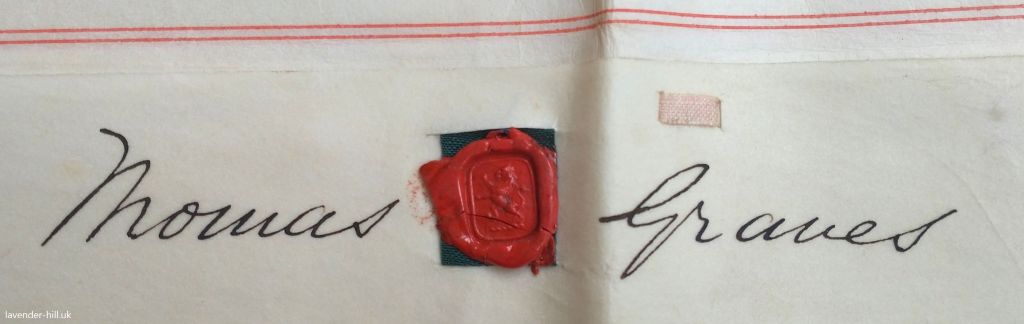
The land was bought and developed by Henry Shadwell Willett (a solicitor at Gray’s Inn, turned property developer) and Thomas Graves (a plumber in Marylebone, turned builder) – reflecting the way everyone who could was trying to get involved in the frenzy of building. On Friday the 4th October 1873 the Borough agreed plans to create a new road, which had been drawn up by their agent H. C. Bunkell, a builder / estate agent based on Holloway Road.
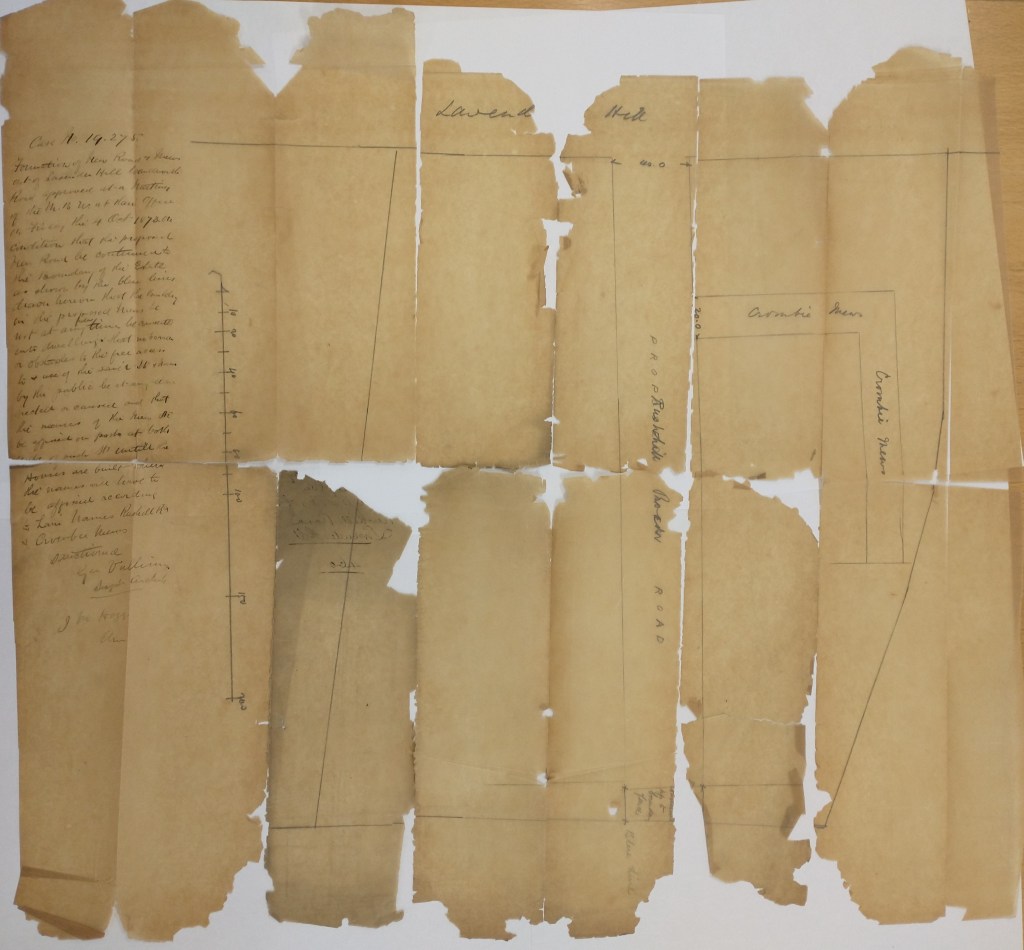
This is where our first archive document comes in: with the help of Wandsworth’s ever-helpful archives we found the original plan for the street, pictured below. The 19th century paper had crumbled a bit over the years, so ended up being a bot of a jigsaw! The clerk’s notes on the left give some insight in to how roads got created: he named the road ‘Rush Hill Road’, named the proposed mews street ‘Crombie Mews’, and approved it only on condition that the proposed road be extended another fifteen feet or so to the south “to the boundary of the estate” and so could in future be connected to to Gowrie Road, that “the proposed mews be not at any future time converted to dwellings“, that “no barrier or obstacles to the free access to + use of the same street + mews by the public are at any time erected or caused“, and that the developer put up a street name sign at each end of the street until the houses were built, at which point the signs were to be fixed to the houses.
Thomas Graves only built one house on Rush Hill Road – Number 1 – which seems to have been a bit of a show home for what could be built along the rest of the street (and if you look closely, the brickwork between No 1 and No 3 still has a visible dividing line). He then sublet the rest of the land along Rush Hill Road itself to James Mulvey who, sticking with the theme of everyone becoming a builder, had until then been a printer and lead trader based on Euston Road.
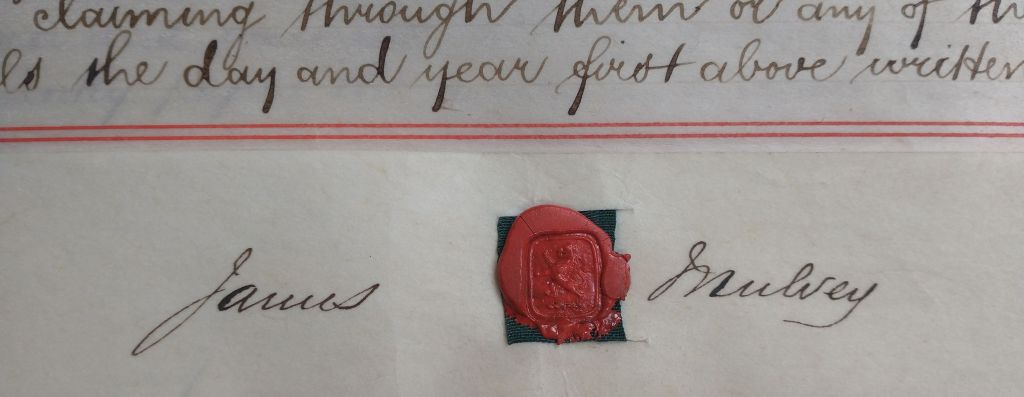
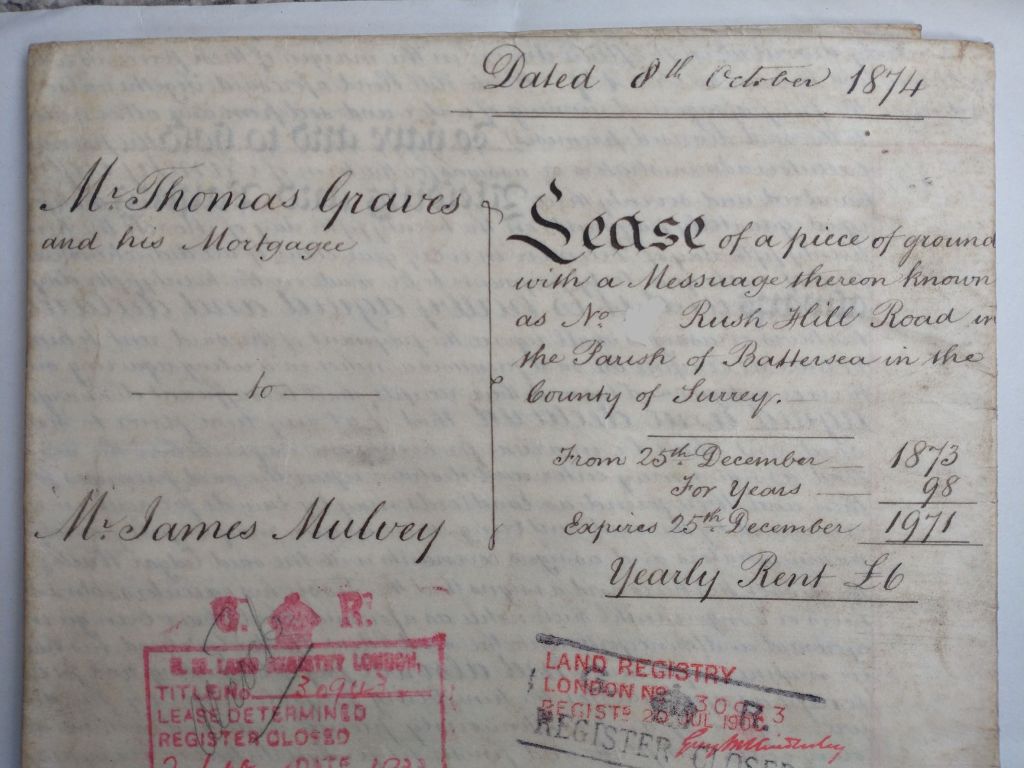
The leases – one of which is pictured below, and which include James’ signature and wax seal pictured above, would run for 98 years for an annual rent of £6 per house (although most of the houses ended up being bought as freeholds well before the end of the term).
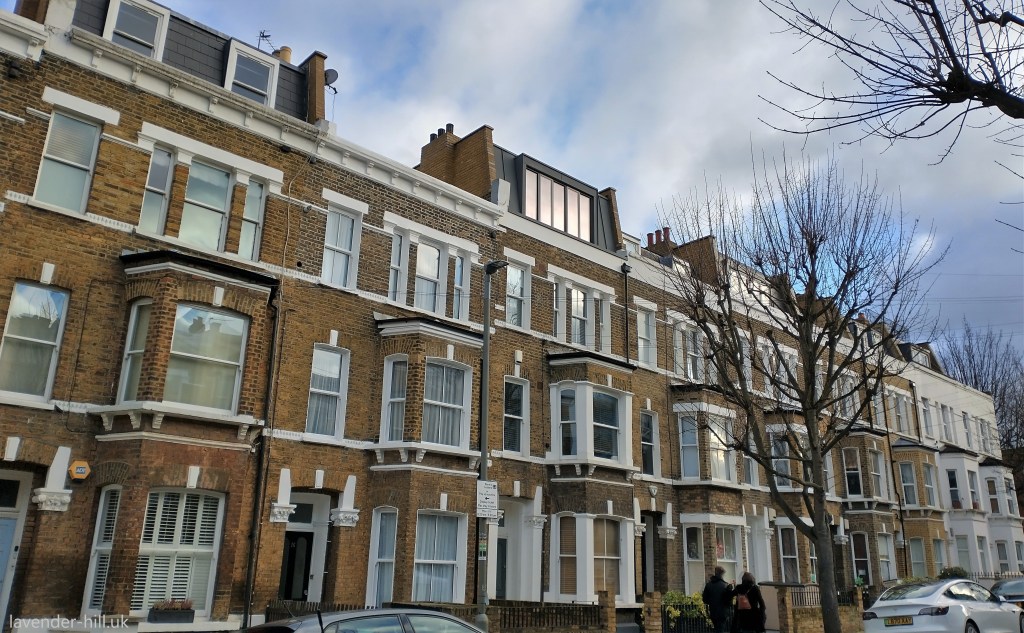
It was James who built the two big terraces (each of 15 houses) pictured below, in 1874 and 1875. Thomas set out quite a lot of conditions in leasing the land to James, mostly aimed at ensuring the the street was built to a high standard, essentially echoing the design of the one house Tomas had already built: James had to “complete and finish fit for habitation in every respect and with the best materials of their respective kinds and in a good substantial and workmanlike manner and of the value of three hundred and fifty pounds at the least” – about £32,000 in today’s money. James also had to “complete a footpath six feet wide with a proper stone kerb“, and to build smart walls and fences around the houses.
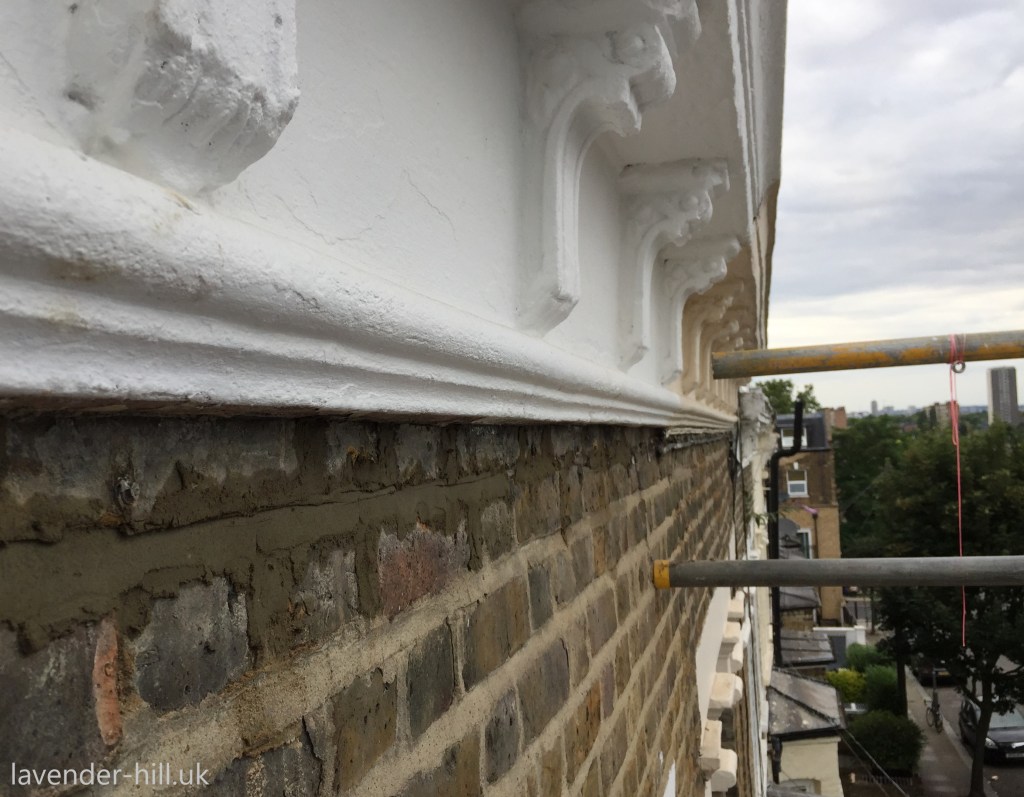
The North-London origins of both Thomas and James are also somewhat evident, as these houses originally all had front parapets with a cornice, pictured below. Parapet walls like these were usually chosen on main roads, or the typically more expensive streets north of the river, as they were more expensive and complicated to build; using them on a cul-de-sac in south London was rather unusual.
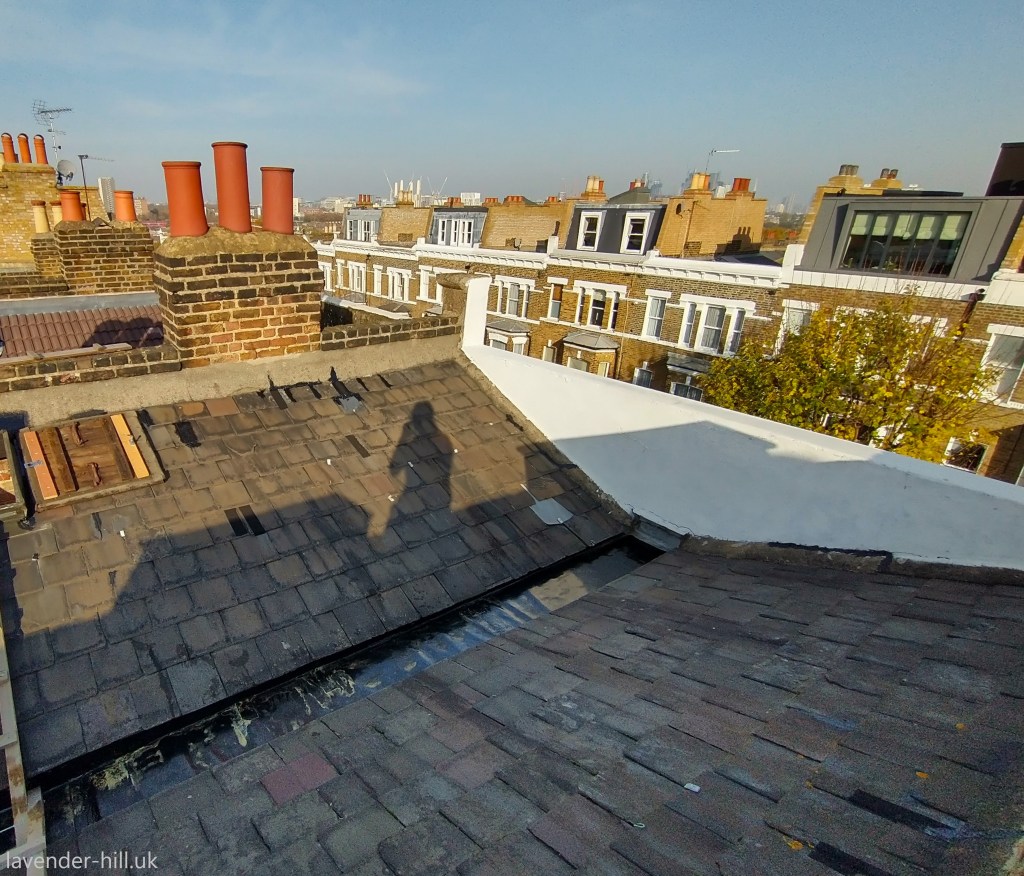
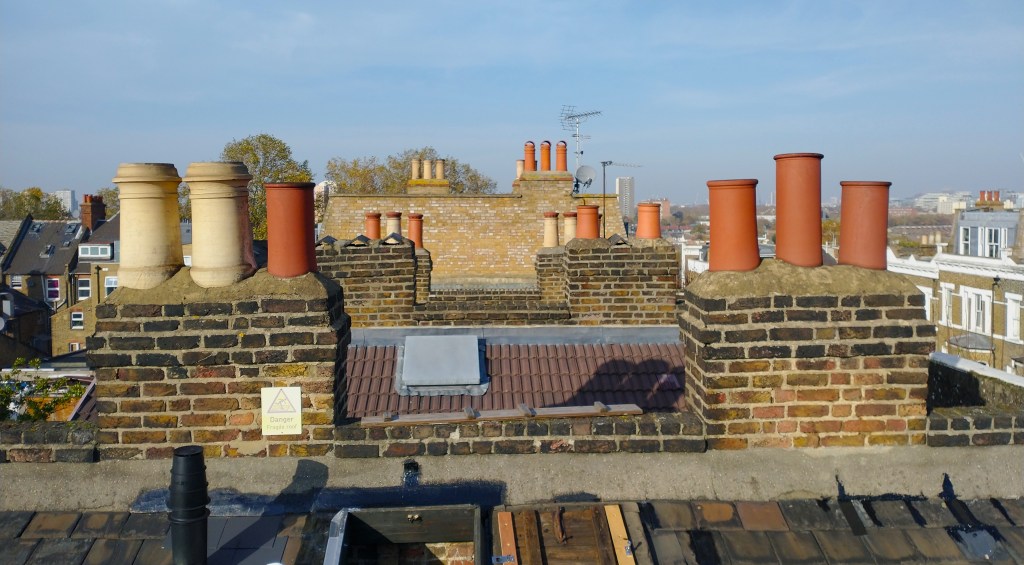
Behind these parapets were London butterfly roofs made of Welsh slate, with a V-shaped roof and a central gutter draining towards the back of the house – again something more common north of the river, in contrast to the visible roof and chimneys more typical of other houses away from the main roads in Battersea.
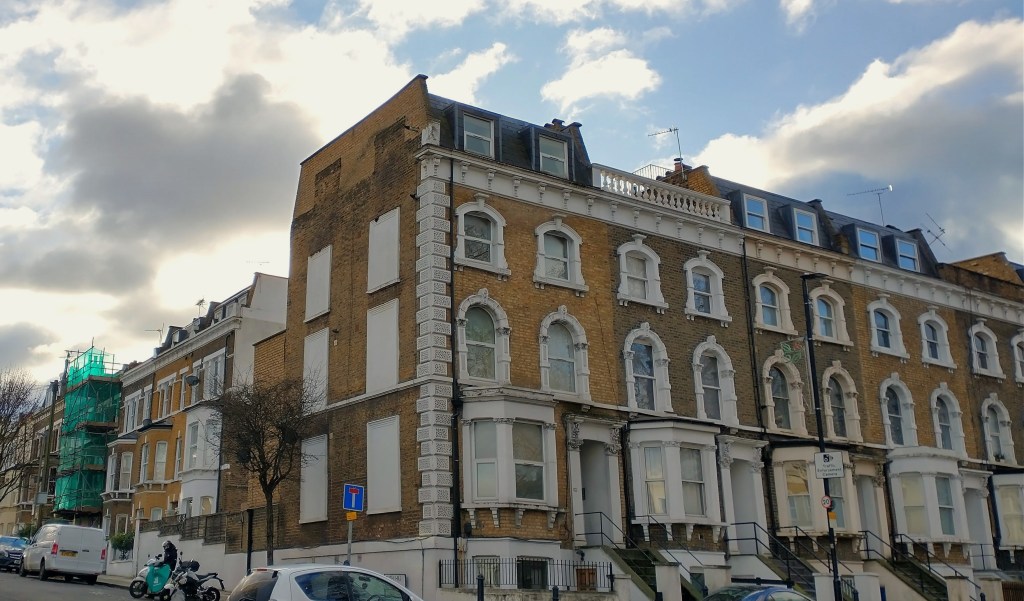
At the same time another local builder, Mark Chamberlain, had sublet the 300-foot street stretch of Lavender hill along the north side of the plot and was building Rush Hill Terrace. To the west of Rush Hill Road he built six particularly large and ornate four-storey houses between 73 & 83 Lavender Hill, each complete with double-height bay windows and a North London-esque steep flight of steps up to the front door to give the best views from the front rooms.
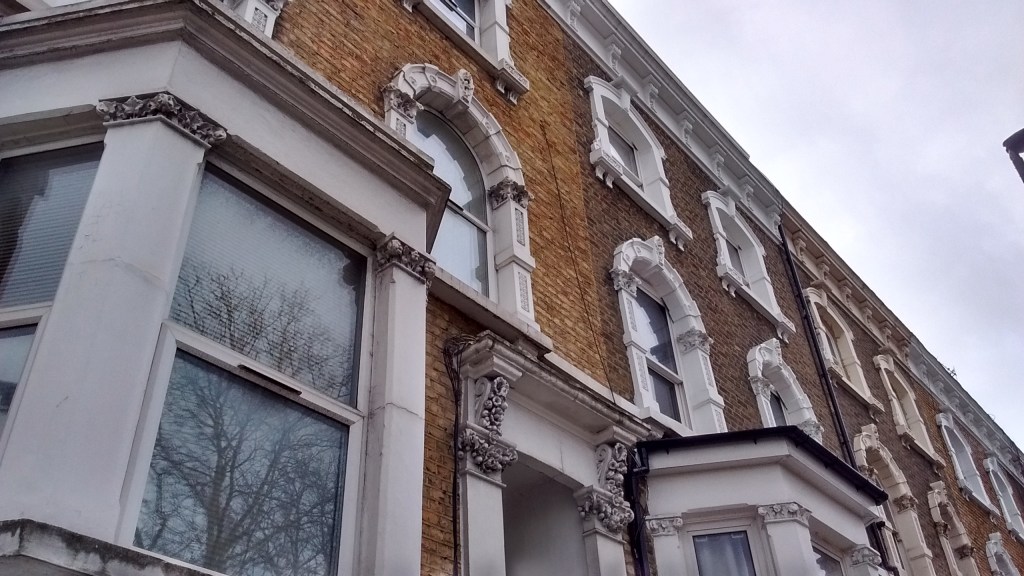
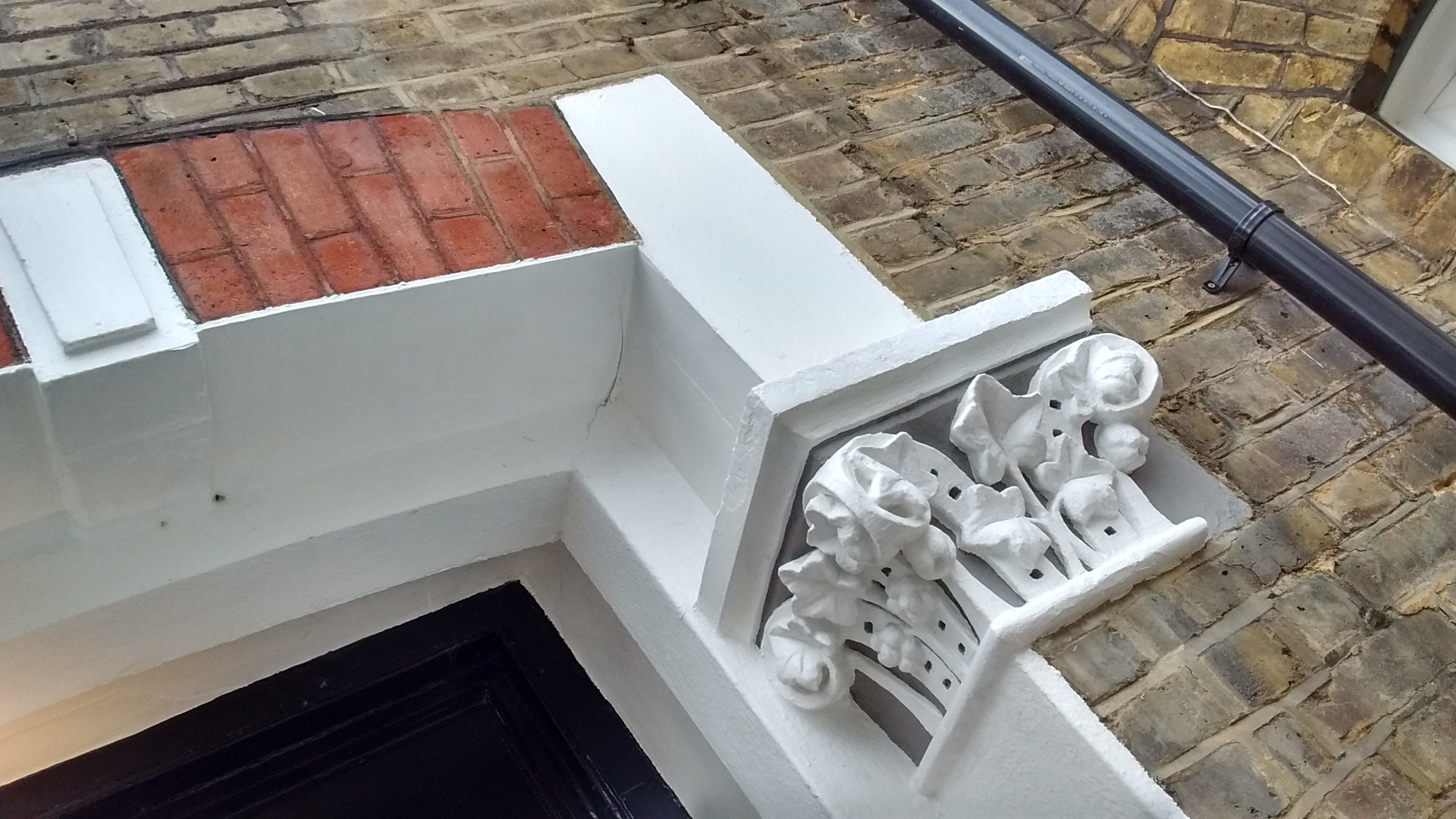
Mark understood that first impressions mattered when selling Victorian houses, and clearly liked to make his houses look more impressive by using good-quality decorative stonework around the doors and windows, as well as in the large cornice. The stonework – pictured below, albeit all now painted over as became the fashion – was actually an innovative form of terracotta, all supplied by famous sanitary engineer George Jennings of Lambeth, who had developed a profitable side business selling intricate moulded stone to decorate houses all over the Clapham area. This was a high-end product and it didn’t come cheap: the money ran out during the construction of the terrace, and the houses were briefly mortgaged to Jennings to pay for the stonework!
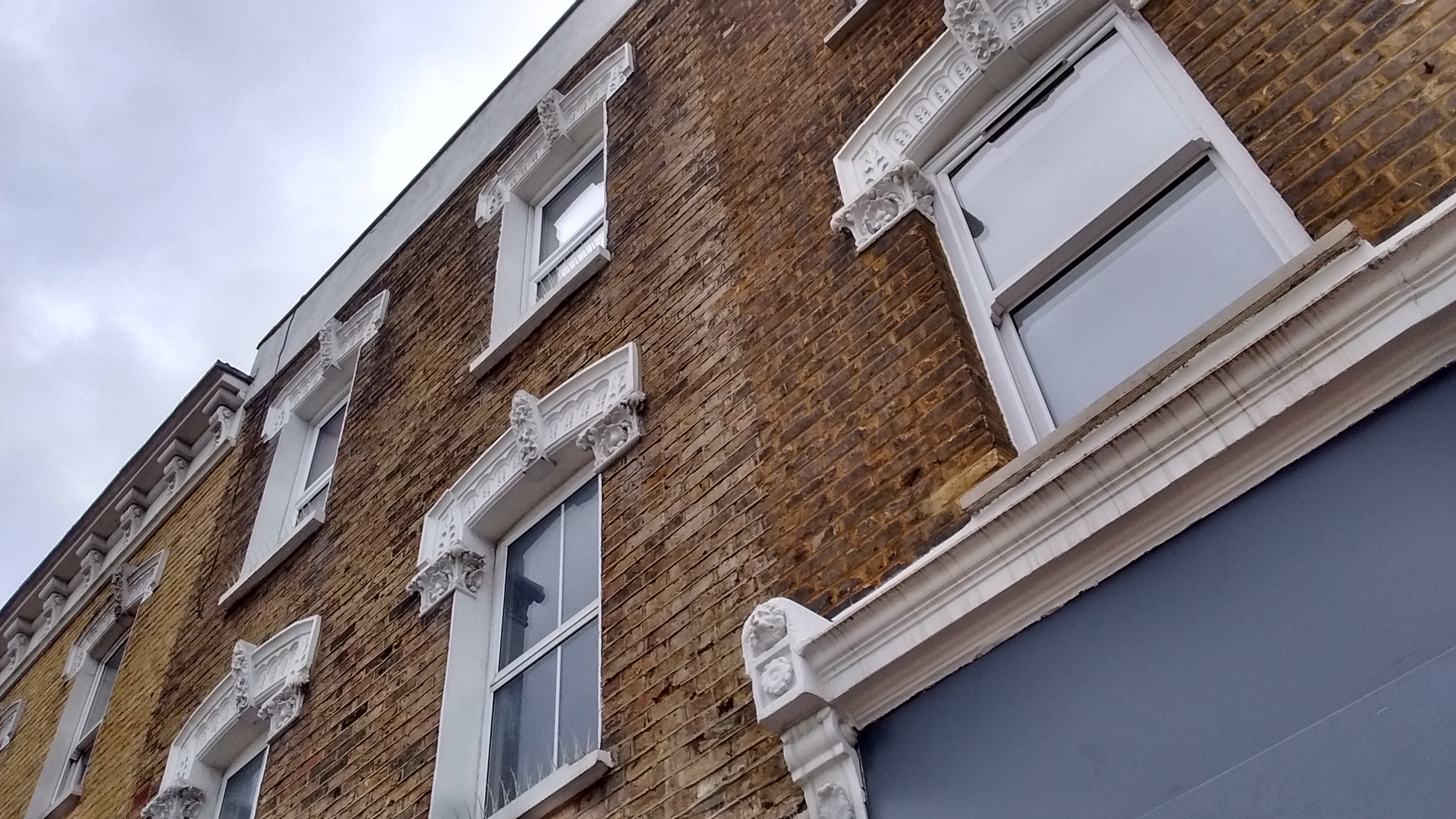
To the east Mark built a row of slightly simpler three-storey houses with shops on the ground floor, at 57 to 71 Lavender Hill; pictured below – without baty windows, but once again showing his liking for George Jennings’ distinctive moulded-stone surrounds above the windows. These houses, as well as those along Rush Hill Road, originally had ornate balustrades on top of the parapets, but almost all have since been removed or replaced – we don’t know why but presume that there must have been a bit of a structural issue with the original design at some stage.
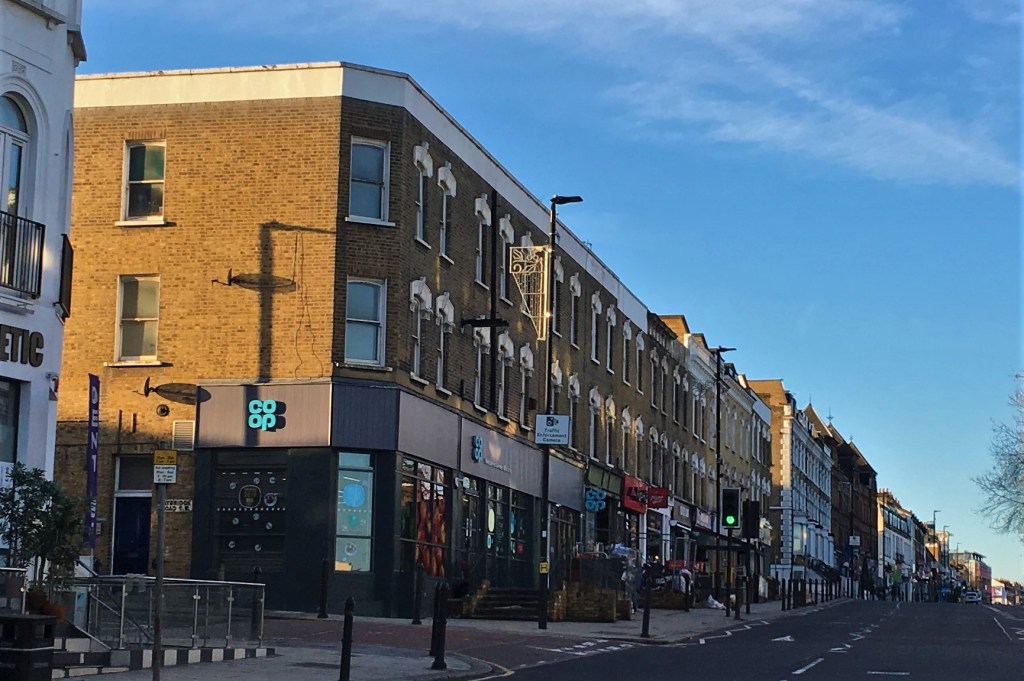
Mark later leased more land further to the east and extended his row of shops with houses above all the way to Taybridge Road (from No. 55 all the way down to 29 Lavender Hill, encompassing what is now the Co-op supermarket – pictured below). He used the same design; albeit a small gap is still visible in the brick between No. 55 and No. 57. Mark was a really prolific local bulder, and was clearly on a bit of a roll at this point as he went on to build even more of the same design to the north of Lavender Hill on the now-demolished southern section of Tyneham Road, as well as The Craven pub on the left of the photo below (originally in contrasting red brick), as well as big terraces of houses nearby at 2–18 Taybridge Road, and 33–41 Stormont Road, and even more houses further down Lavender Hill, as well as a gigantic five-storey terrace at 70-82 The Chase (which also has the same window surrounds as his Lavender Hill terrace).
One surprise is that despite the explosion of building work in 1874, the original Rush Hill House villa was not demolished. Despite its garden and driveway being replaced by eight shops and forty six terrace houses, and the western outbuildings and stables being demolished to make way for the new road, the main body of the house just got incorporated in to the new development and stayed in place for another fifteen years, jammed in behind the shops in Lavender Hill and now known as the somewhat less glamorous ’63 Lavender Hill’. Why this was done remains a bit of a mystery, and having a big old house jammed in to such a small space must have been a strange state of affairs. What we do know is that the last occupant of the old house died in 1887, at which point the remains of the villa and a small bit of garden were sold at auction and redeveloped – once again by our ever-active local builder Mark Chamberlain – to build the Mews. This unexpected life-extension for the old villa probably explains why Mark’s previous houses along Lavender Hill to the west of Rush Hill Road were built as grand houses with back gardens, while the ones he built to the east were built with more modest shops on the ground floor and buildings running to the back of the plot (pictured below): there simply wasn’t space for back gardens there, as there was still a giant old villa in the way!
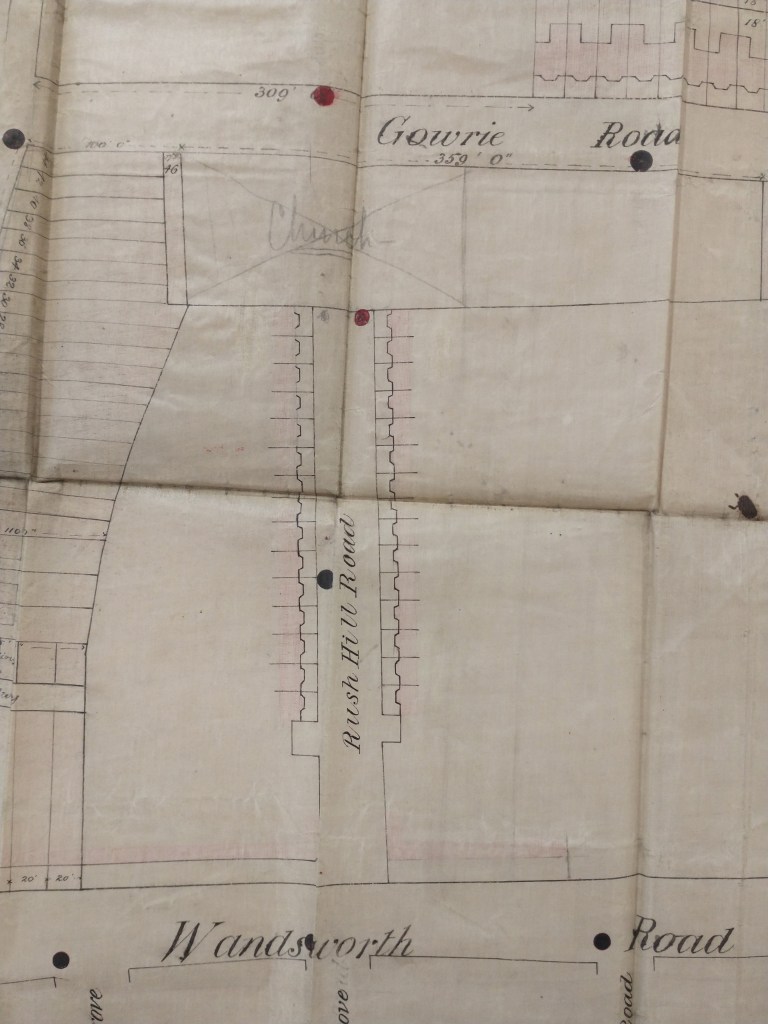
The original approval for the road included a condition that it be extended all the way to the edge of the plot, to allow a link to Gowrie Road, which had been developed as the Lavender Hill Park Estate by a different developer. A piece of land had been left unbuilt along the north side of Gowrie Road to provide for a connection. However amid slightly unclear circumstances, the land was instead donated by the developer to Reverend Erskine Clarke of Battersea to be a new church; the ‘Church’ plot is pencilled in in this map of that estate drawn part-way through its development, which we think is showing the plans for gas lighting by means of red and black dots:
St Matthews Church was designed by William White, who also designed St Mark’s on Battersea Rise, and built by W. H. Williams. It had an Early English style supposedly reflecting 13th century designs, including a vaulted roof and sacristy, and a small churchyard on either side that allowed access from Rush Hill Road to Gowrie Road. It could seat 550 and cost about £3,000 to build (about £400,000 in today’s money). It opened in April 1877 – two years after works had reached completion on Rush Hill Road.
It started life as a daughter church of St Mary’s Battersea, and was served by curates from that parish. In 1895 a new parish was created to reflect the growing local population, and at first it was assumed that St Matthew’s – which was squarely in the new Parish – was finally going to get its moment in the limelight and would of course be the church for the new parish. However the Ecclesiastical Commissioners insisted that the building was not substantial or impressive enough, which led to the bigger and more prominent church instead being built at St Barnabas, at the top of Battersea Rise instead. St Matthew’s was again relegated to being a daughter church of St Barnabas.
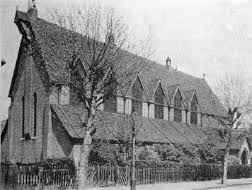
This permanent second-rank status meant that St Matthew’s was never a great success. The somewhat unloved church continued to be see some use until 1941 when it was permanently closed. Soon after closure it was damaged (but not destroyed) by bombing in the War. It lingered on for two more decades in increasingly decrepit condition, before finally being demolished in the early 1960s, leaving an open space that for some time was used as car parking and as an informal neighbourhood play area. Demolition paved the way for the site to be sold to Battersea Borough in 1967 for redevelopment as Council housing. Not many records remain of the Church, maybe reflecting its limited use in its later years, and the only photo we’ve found is the one to the above showing the Church from Gowrie Road – however it is shown on most maps, including a ‘Sunday School’ building between the Church and the start of the terrace of houses on Rush Hill Road. It’s not been completely forgotten at its old ‘parent’ Church though – as St Matthew’s old communion plate is still in use at St Barnabas.
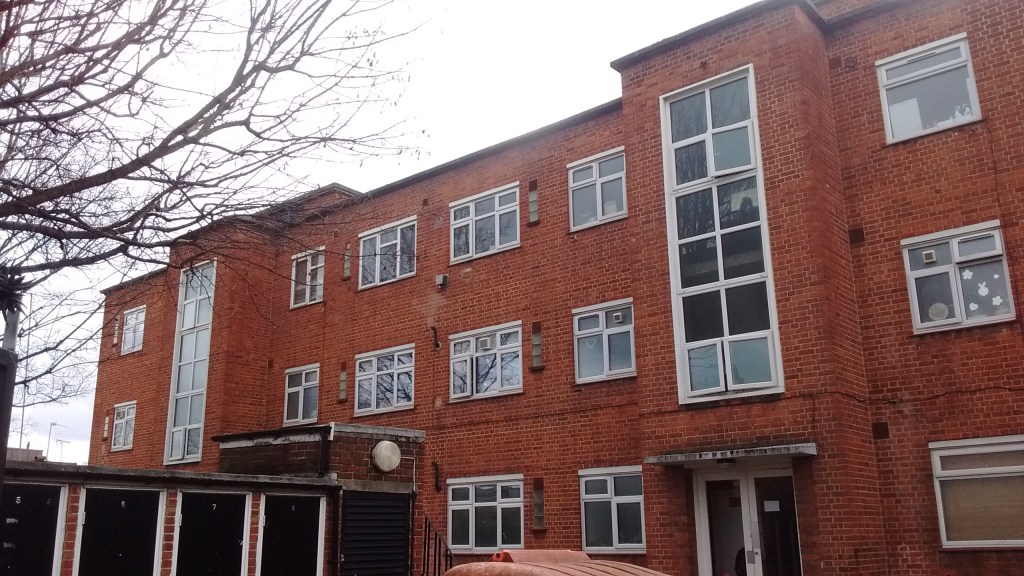
The block of 12 flats built on the site (eight of them with two bedrooms, and four having one) has no name – and despite having a somewhat hidden garden area, it seems to have made no reuse of any of the elements of the old church in its landscaping.
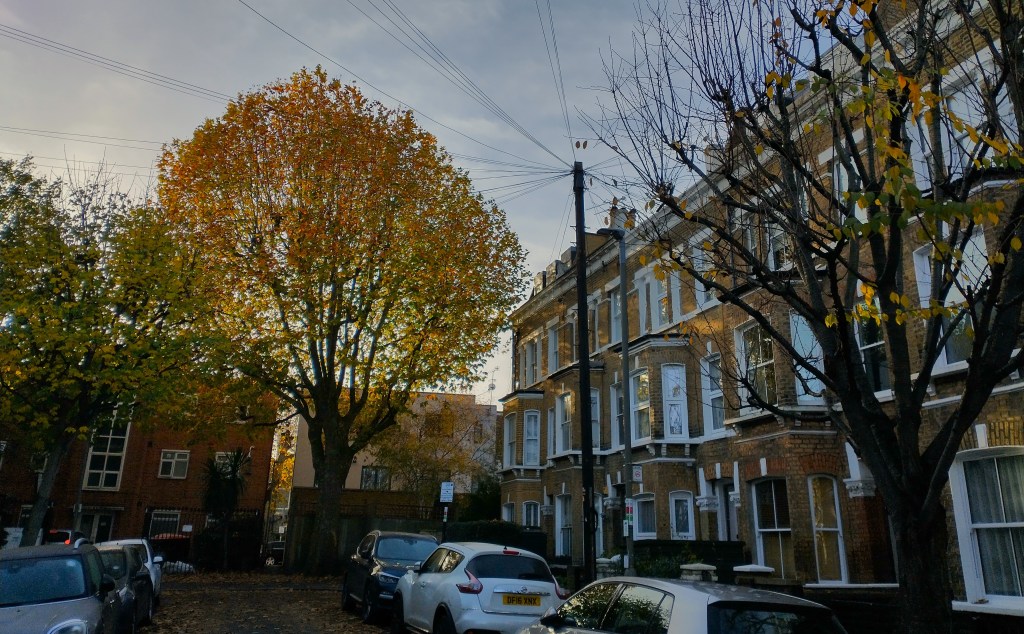
One feature of the church has survived though: two large London Plane trees on Gowrie Road, and the huge one at the south end of Rush Hill Road, are the same trees as in the photo of the Church above. The access path through the churchyard was also made permanent as a narrow alleyway, Rush Hill Passage, connecting Rush Hill Road to Gowrie Road.
Planning application extract (c) Solon Housing, via WHS
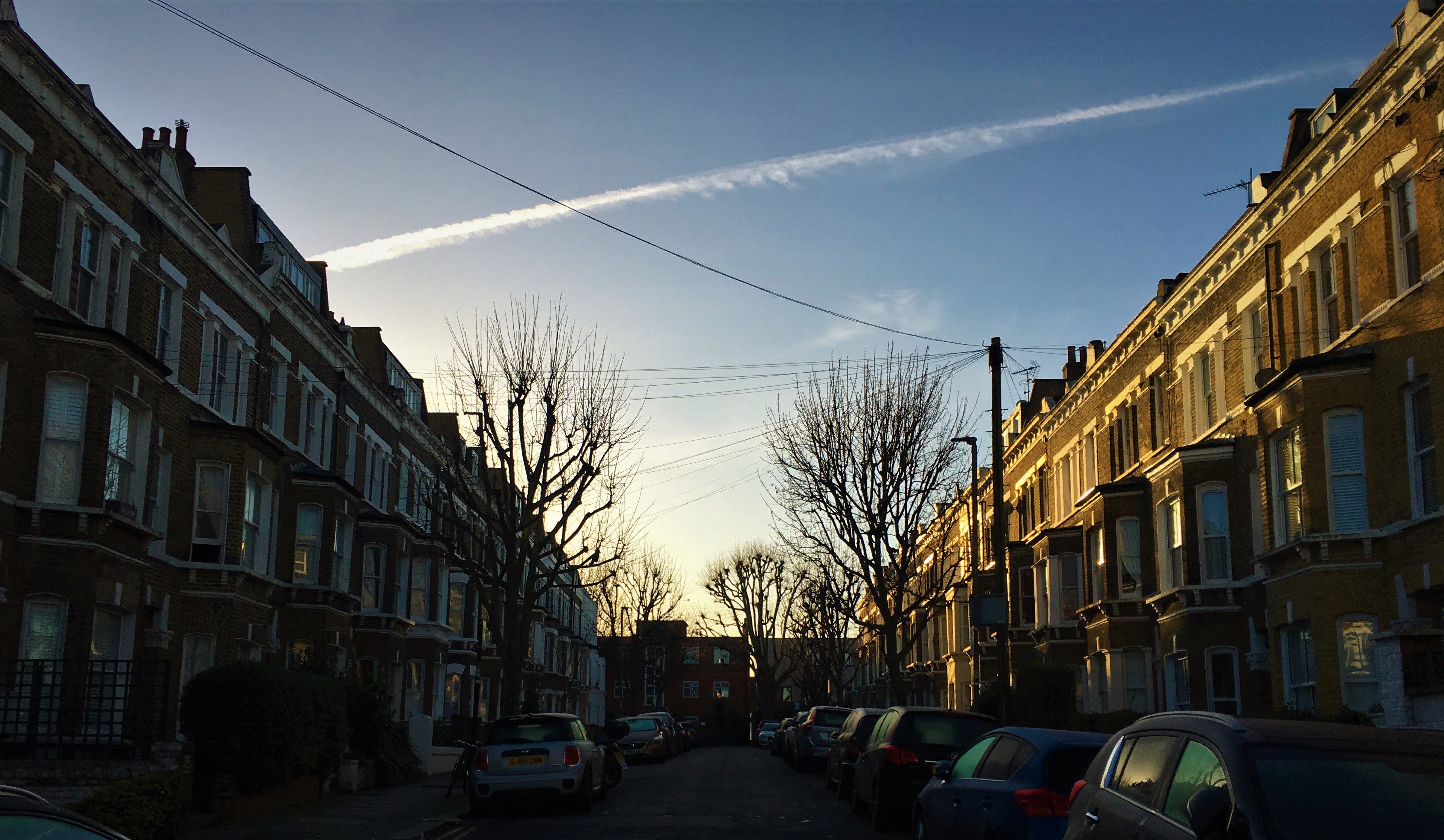
The houses on Rush Hill Road were unusually large houses for Battersea – they all had two reception rooms on the ground floor connected by a double door, and four large bedrooms on the upper floors. They had a bathroom, and two WCs right from the start (one on the first floor and one outside), and a kitchen and a separate scullery.
The ground floors were built to impress with solid brick walls throughout, thick oak doors, and cornicing and high ceilings – while cheaper materials were used on the upper levels where it was less important to impress visitors. The houses had gas lighting, and each house also had eight fireplaces for heating.
The shape of the original plot of land meant that one street could be fitted in with plenty of room to spare, but fitting two in would be difficult – which led to one of the distinguishing features of the street, in that the odd-numbered houses also have 90-foot back gardens, which are enormous compared to the 15-20 feet more typical of many other houses in the Lavender Hill Park Estate next door. The walls between the gardens were built of brick rather than wood, and some of them still survive. The houses also have an extra five feet or so of garden at the front, which would typically have been planted with somewhat exotic plants when the street was first developed.
The huge amount of space behind many of the houses is also where one of the more mysterious design choices emerges: having eight fireplaces in each house implied a considerable amount of coal being delivered on a regular basis; which in a middle-class house would usually mean either a ‘coal hole’ (a drain cover in the front garden or pavement that led to a coal storage basement), or a pathway running behind the houses with gates to the gardens (where it could be delivered to a back garden coal store). These houses had neither, despite having plenty of space to accommodated a rear entrance passageway; so all the dusty coal had to be carried through the front corridor.
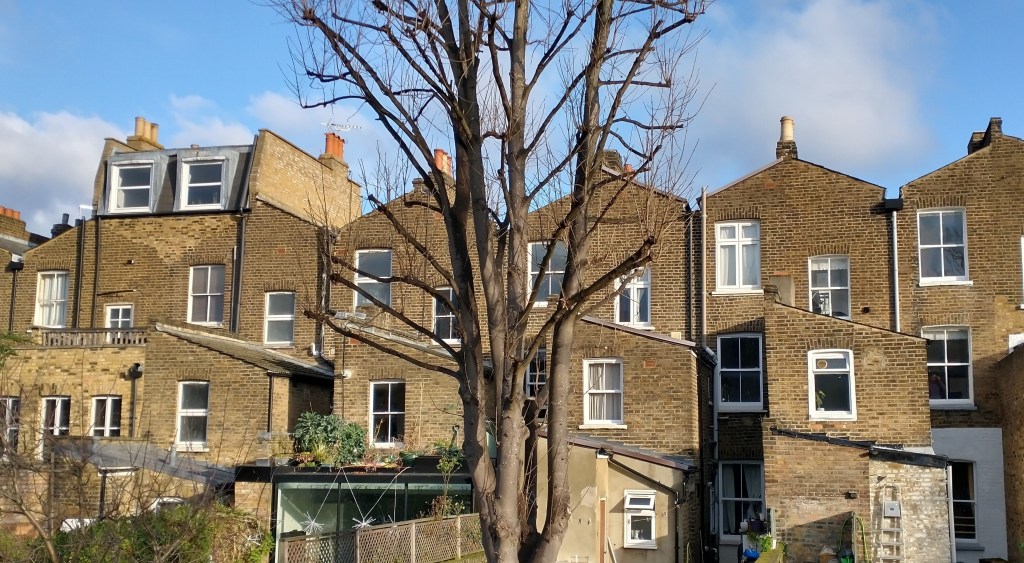
Another unusual feature is that the houses are not built in symmetrical pairs. Typically a terrace house puts every second house the other way round, so that the doors are in pairs next to each other and the back extensions can share a wall and chimney stack – meaning a big chimney is only needed every two houses because chimneys are shared between two houses. In Rush Hill Road every house (apart from No. 1, which was built by a different builder) is built the same way round. This is a bit more visible with the photo below, taken from the back of the houses, where every roof of the rear wings is angled the same way, showing that all the houses had the corridors and staircases on the right hand side of the house.
Building like this needs more bricks and effort; and seems to be another sign of the North London origins of all the developers – being done purely to create a more regular spacing of the bay windows and doors at the front of the terrace. The grander terraces north of the river were typically not built in pairs, as it was seen as slightly upmarket for each house to clearly had an independent entrance that was not immediately next to the entrance to the neighbouring house.
James Mulvey seems to have also had an account at George Jennings, and while his Rush Hill houses did not feature any window surrounds, the budget did stretch to include a different stone moulded capital for each house either side of the front doors. These pass mostly unnoticed now, but would have been part of the marketing of the houses in their day, and came at some cost to produce. A good few of these stone capitals seem to be based on various Acanthus plant designs – a long established Greek design that became very fashionable in the 1870s – but ivy, ferns, fruit, and in just one case (at 22 Rush Hill Road, and possibly a special request by a Victorian buyer) a king and queen also feature. The terraces also have a band of diamond-patterned stone running the whole length of the terrace just below the windows on each floor.
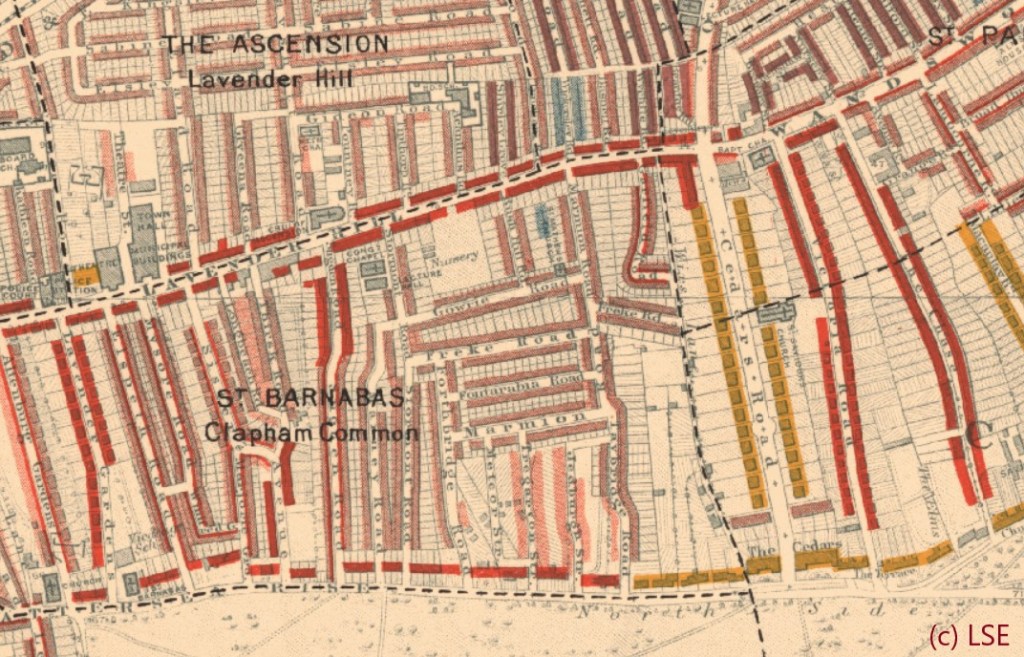
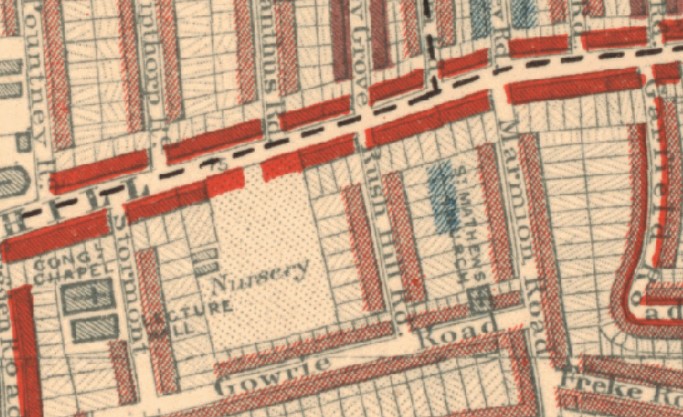
The big Rush Hill houses proved popular with the middle classes; selling quickly. They stayed pretty desirable, and we have some idea of how they were doing 25 years later in 1900 because Charles Booth – in his huge project to map out poverty and wealth right across London on a house-by-house basis – visited Rush Hill Road and categorised it as pink, which was code for “Fairly comfortable. Good ordinary earnings.”. Mark Chamberlain’s houses along Lavender Hill – which were larger – were shaded red, the second highest category, representing “Middle class. Well-to-do.“.
This reflects a pattern that was to change drastically as card came on the scene: the big grand houses on the main roads were the best houses for the richest people. Only when these became traficky thoroughfares, did things change – at which point these huge houses were typically split up in to smaller flats for the less wealthy, while the quieter houses on the back streets remained desirable. The previous failure to make Rush Hill Road a through road, thanks to the unloved St Matthew’s Church, also started to play to the advantage of Rush Hill Road which – thanks to being a cul-de-sac – remained a rare traffic free street in the area.
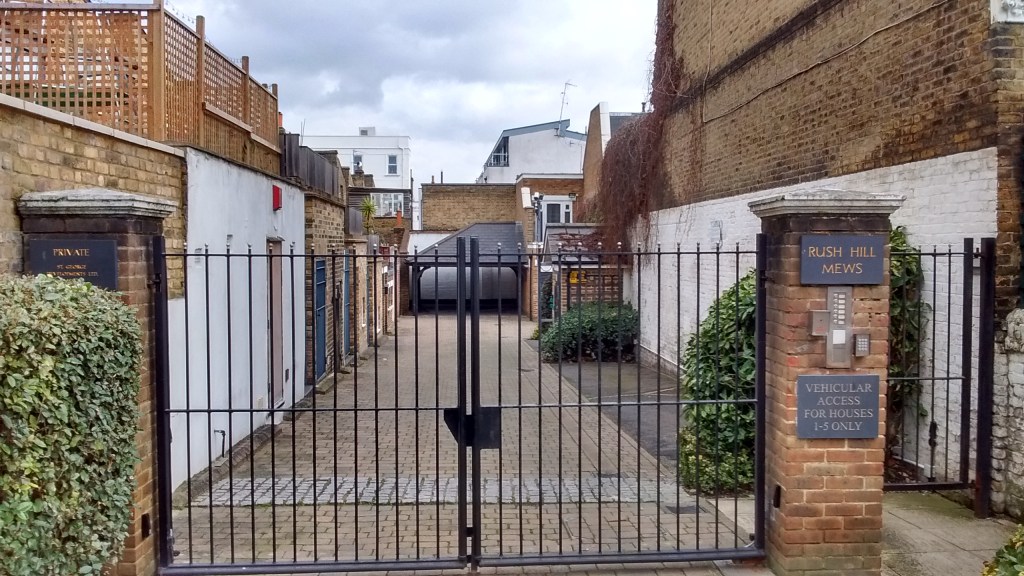
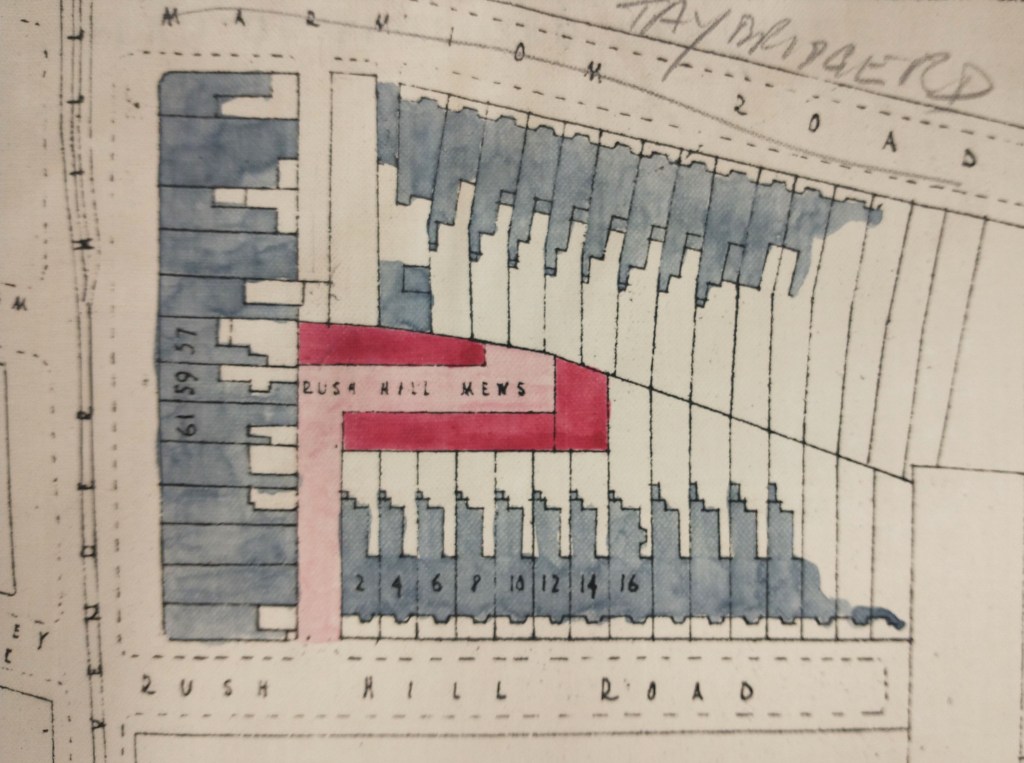
The map Booth was using wasn’t especially accurate: St Matthew’s is in the wrong place, Rush Hill Road was shown as connecting to Gowrie Road (it never did), and Craven Mews / Rush Hill Mews is completely missing. Booth spotted the latter anyway and shaded it light blue, as shown below, which was code for “Poor. 18s. to 21s. a week for a moderate family“. It also suggests that despite the original rule that the mews were never to be converted to dwellings, this had already happened by about 1900 as someone was clearly living there!
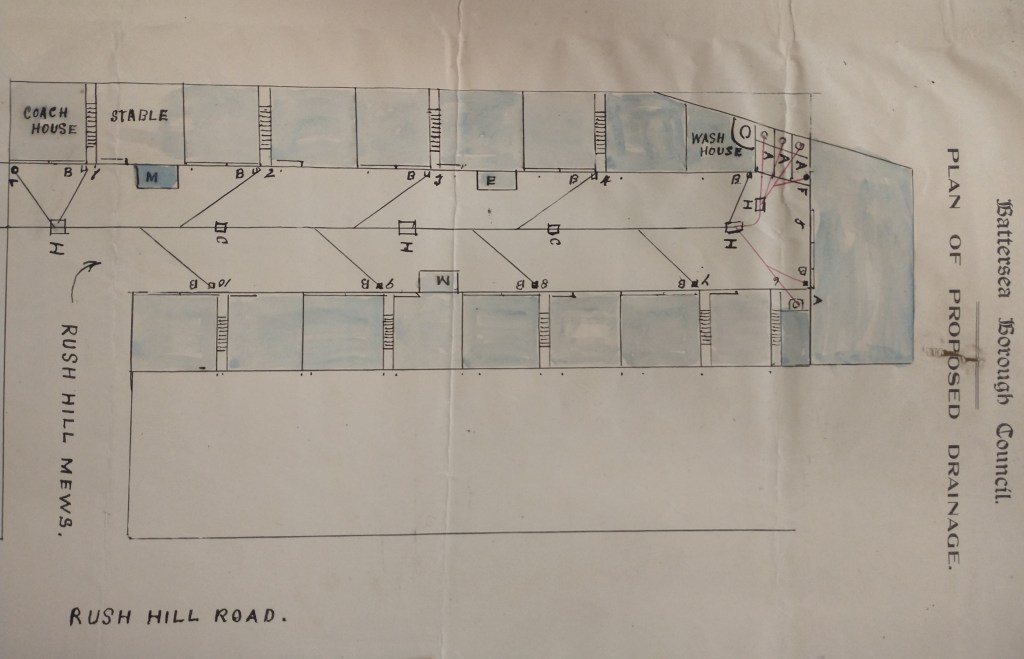
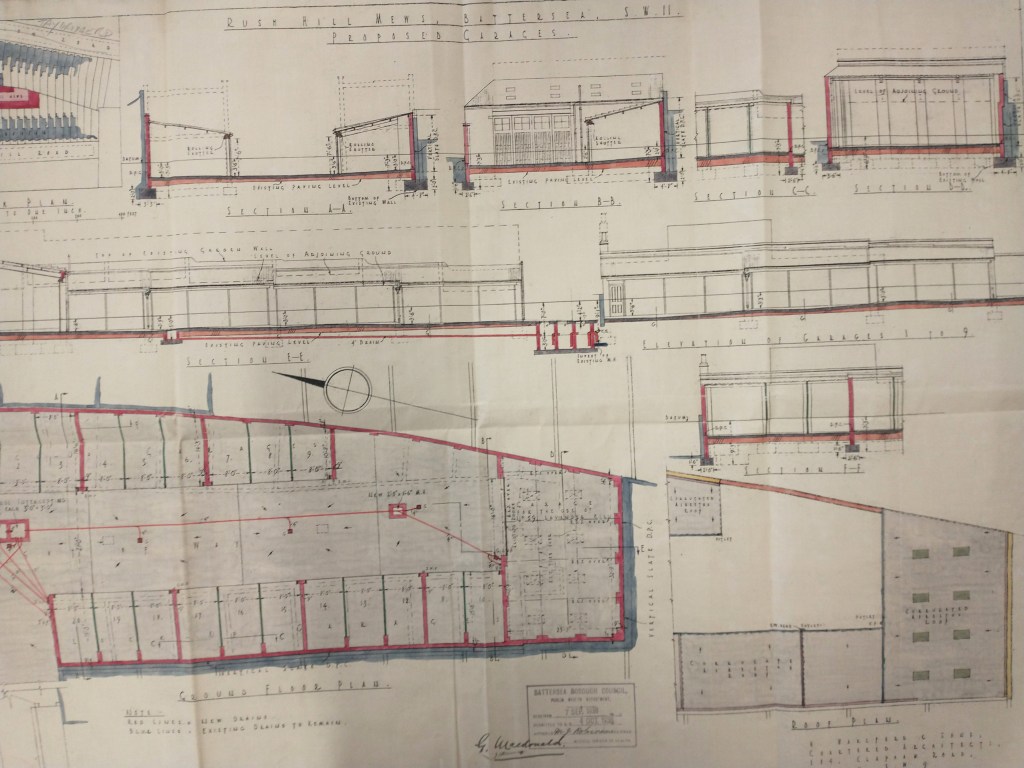
Not much changed over the next century. The mews, built as stables, somehow got renamed from Craven Mews to Rush Hill Mews. The original stable blocks were demolished in the 1930s and replaced twenty lock-up garages with corrugated asbestos roofs.
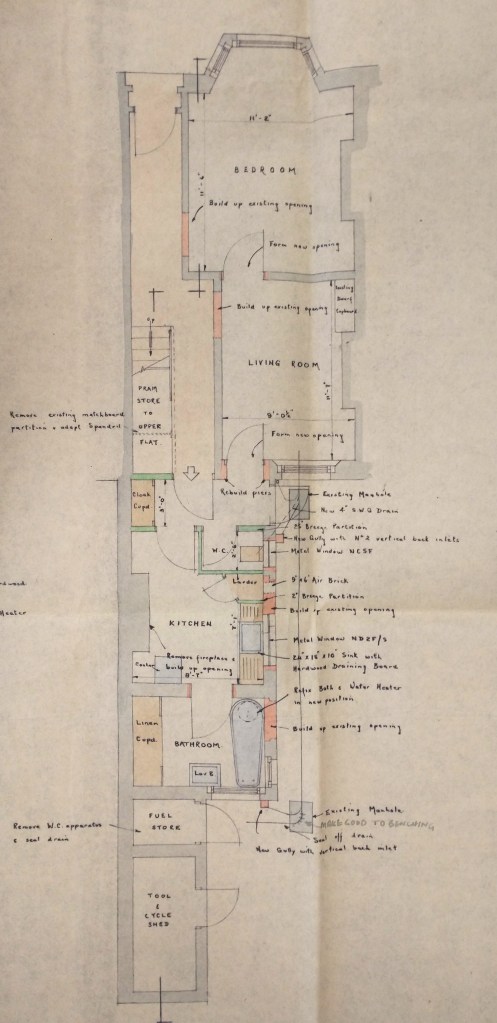
Planning application extract (c) rights holders, via Wandsworth Heritage Service archives – Rush Hill Road drainage plans
The image above shows the layout of the original stables and coach houses in Rush Hill Mews, and the one below is from the proposals to demolish them and replace them with garages. They show an interesting feature of early ‘planning applications’, in that the Council wasn’t too worried what you built or what it looked like, as long as the sewerage arrangements were up to an adequate standard! Most of the early plans in Wandsworth Archives are showing proposed drainage setups, which had to be submitted for approval – reflecting continued caution after huge cholera outbreaks that had taken place in London in the 1830s and 1840s,
As ever, the coach houses would by the 1930s have seemed old fashioned, and ready for replacement with something more modern and suitable for cars – but the new garages, which were fairly small and which had asbestos roofs, eventually also became obsolete as cars got larger, and were demolished in 1996 and replaced with five houses with their own external car parking.
Planning application extract (c) rights holders, via Wandsworth Heritage Service archives – Rush Hill Road drainage plans
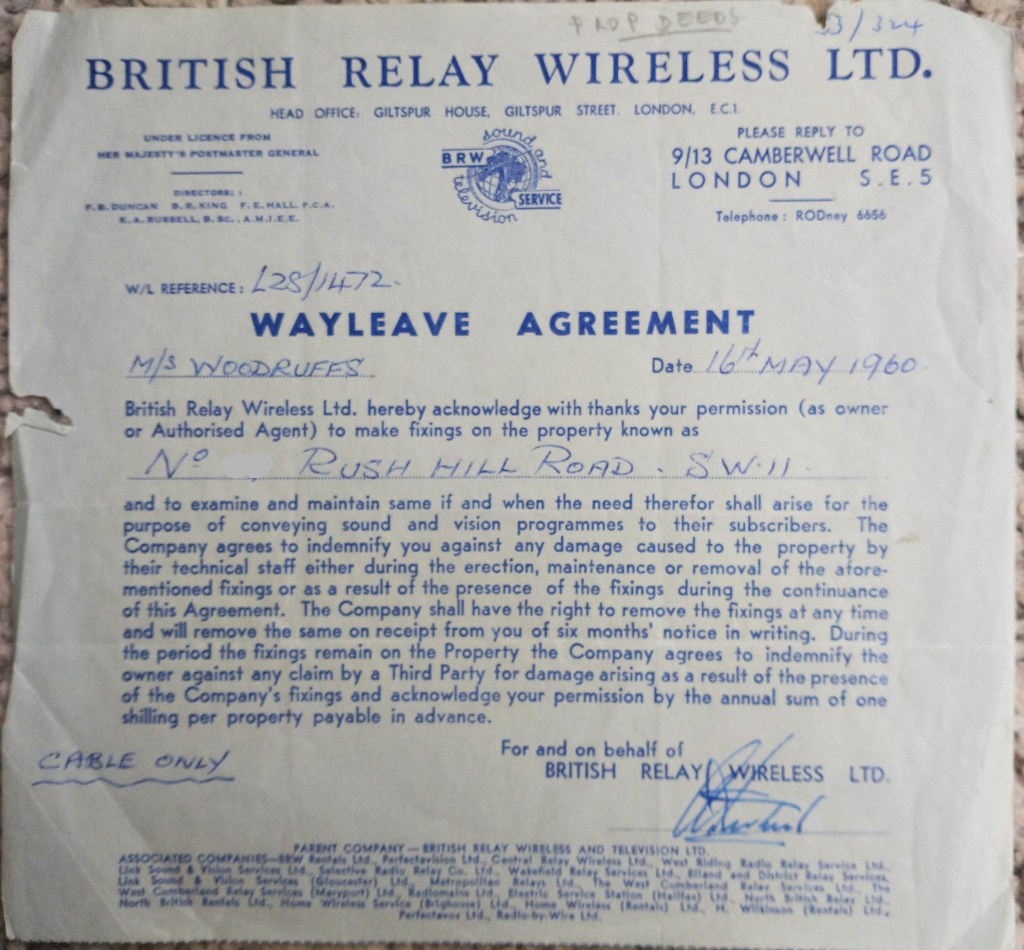
The houses gradually saw electric power installed, and the old fireplaces gradually gave way to gas fires and modern heating systems. The houses had seen electric power installed from the early 20th century, and an early cable TV system was installed by British Relay Wireless Ltd along the terraces in 1960 (a wayleave agreement for the cables, which ran just under the front parapets, is shown below).
The 1960s and 1970s saw a gradual decline in the fortunes of Battersea, as its remaining industry and employment along the riverside faded away. There weren’t many takers for the large, draughty old houses of Rush Hill Road! The houses along Lavender Hill were almost all split up in to smaller flats that were easier to sell, while the Solon Wandsworth Housing Association saw an opportunity to build a portfolio and bought eight of the Rush Hill houses, splitting each one in to two flats. By now modern records exist in the archives, including detailed building inspector reports – and we can see that the work involved was sometimes considerable, including comprehensive upgrades to the infrastructure of what had in by then become fairly dilapidated houses, and in several cases extensions so that both upstairs and downstairs flats could have access to parts of the large gardens. Solon went on to build up a portfolio of 1,100 houses in all, before being forced to merge with Wandle Housing Association in 2004, after a review by the Housing Corporation – following concerns about its finances and what was described as ‘unorthodox’ management – decided that Solon was “unmanageable” and had made poor decisions that put its whole business at risk. The forced transfer of all Solon’s houses to another housing association was very controversial, with accusations made that Solon’s assets (including those of many tenants with shares in the association) were being stripped, and that Wandle had “hit the jackpot” in getting hold of all these by now rather valuable houses – but it went ahead nonetheless, and although a few of the houses Solon had taken on have since gone back in to private ownership, Wandle still manages several houses on the street.
From the 1990s onwards Battersea’s popularity for families grew, and as the area’s popular state schools, proximity to Clapham Common and generally decent housing saw what had been seen as a rather gritty and industrial neighbourhood “rediscovered” by wealthy professionals. The seeds of gentrification started around Northcote Road, but as a trickle of development became more of a tidal wave it swept out down the Lavender Hill, with process exploding and developers seizing opportunities right left and centre among the unmodernised houses. Rush Hill Road was no stranger to this process, which saw several of the houses that had been spit to flats recombined to single houses.
Many of the houses saw extensions upwards and backwards – many going from three to four storeys as the butterfly roofs proved particularly easy to turn in to an additional floor. Rear extensions appeared right left and centre, and scaffolding became an increasingly present feature of the street as the houses saw ever more substantial renovations and modernisations to develop modern living accommodation.
Rush Hill Road’s tall terraced houses with their parapet rooflines are slightly different to the rest of the Battersea backstreets – but they’re by no means unique, as they have a sister terrace on Wandsworth Road close to its junction with North Street, which we think was also built by James Mulvey (pictured below). Apart from lacking a parapet, and having a more conventional roof running side-on to the road, these houses are exactly the same design as the Rush Hill Road houses – even down to the two arched windows in the original front doors, the band of diamond-patterned stone running along the terrace under the forst and second floor windows, and the moulded stone capitals either side of the doorways. Again they are not built in alternate left-handed and right-handed versions (hence a lot of chimney stacks, and rather more complicated back wings than would usually be built).
More intriguingly, there’s also a single house at 43 Stormont Road of the same design as the ones on Wandsworth Road, marooned amid a series of completely different designs by other builders involved in the building of the neighbouring Lavender Hill Park Estate (it’s the darker-coloured one in the middle of the terrace shown below); which was built in 1876, a couple of years after the start of work on Rush Hill Road, by Thomas Graves – the one who had built the very first ‘show home’ at 1 Rush Hill Road, before selling off the rest to James Mulvey. The white-painted house to its right, 45 Stormont Road, was also built by Thomas and looks like a ‘stretch’ version of the Rush Hill Road design, taking a space that could almost have accommodated two houses – with its entrance at the side. Quite what was going on on this piece of land is a bit of a mystery, as it was unusual and not very efficient to build a terrace of just two houses, especially with one stretched and one not! Meanwhile the four houses to its left – somewhat covered by scaffolding in our photo – also have all the signs of being a miniature development by Mark Chamberlain (the one who built so many houses along Lavender Hill), as they have the tell-tale expensive window surrounds.
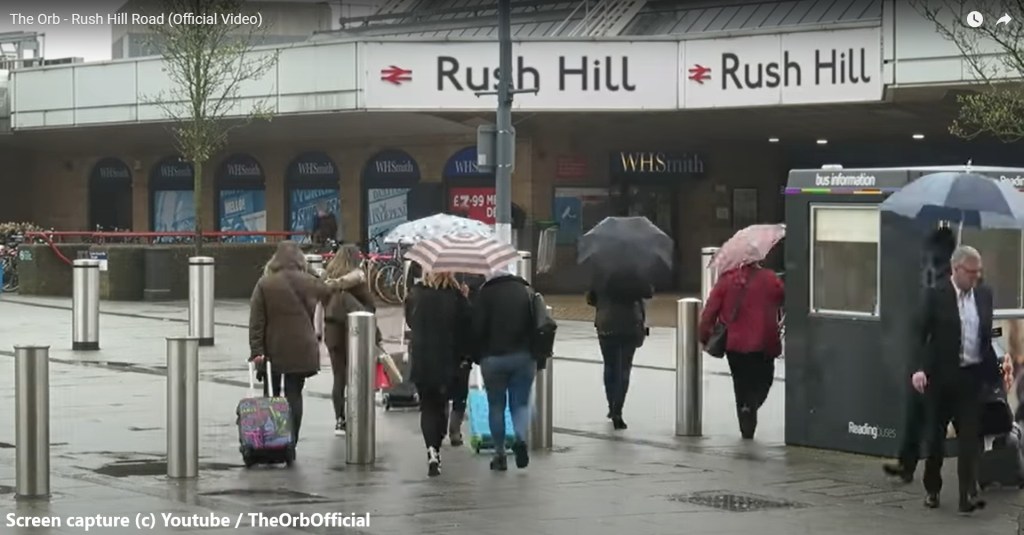
This brings this history to the close – with Rush Hill Road continuing as as a popular place to live, a far cry from its beginnings as a smart country house up on the hill with views of the Thames. However one final claim to fame for Rush Hill Road is that it has a track by The Orb named after it, Rush Hill Road, released in 2018. We know that The Orb’s co-creator and longest-running member Alex Paterson grew up locally and still lives nearby, and Battersea sees a good few references in their wider work. Keen-eyed viewers will notice the music video features Rush Hill station (which has more than a passing resemblance to the old entrance to Reading).
Special thanks to the staff of Wandsworth Heritage Service, and to those on the street who shared bits of useful knowledge and assorted old documents as we wrote this article.
It’s a bit hidden away on a side street, and now that the main access is through an unglamorous corridor from the main lending library few people even notice it. But if you venture down Altenburg Gardens to the old main entrance, hidden away behind Clapham Cycles, it’s quickly clear that Battersea’s reference library is quite an unusual building. It was built back in 1924, at a point when the streets and houses around were already fifty or so years old, and when the main library building facing Lavender Hill was already thirty years old and had already had one extension at the back to create what’s now the children’s section.
The main library facing Lavender Hill was an important building for Battersea: the town had been growing enormously as it industrialised, going from being not much more than a rural village in 1850 with 12,000 inhabitants, to a substantial industrial town with well over 100,000 people. Despite being by far the larger town Battersea was still managed by its much smaller neighbour Wandsworth, which had caused years of frustration. Finally the Council – or ‘Battersea Vesry; as it was then known – managed to detach itself from Wandsworth, and the new library which opened three years after the separation in 1890 was one of the brave new local authority’s first big construction projects, and was given a prominent site on Lavender Hill.
They ran a design competition for the main library, which received ten entries, and the winner was local architect Edward Mountford. It was his first commission from the Battersea a local authority, and a possibly helpful factor in him winning was that his design was the only one of the ten that could be built within the £6,000 budget! It proved an excellent move on his part, and the Council clearly liked his design – as he was soon also commissioned to design the much larger and bigger-budget Battersea Town Hall (now Battersea Arts Centre).
The Battersea library proved a success – and a few decades later in 1924 the library grew again, to incorporate a reference library, which was built with the aim of helping with the education of the Borough’s young adults. This was an interesting time to be building something: the 1920s typically mixed post-First World War optimism with years of economic depression, and there was generally a shortage of both money and materials. Optimism was clearly the approach here, and the spirit of the new library investment is reflected in the Latin motto carved in stone over the entrance, – Non Mihi, Non Tibi, Sed Nobis – which translates as ‘Not for Me, Not for You, But for Us.’ When people did manage to get things built in the early 1920s there were quite a variety of architectural styles, stretching from very traditional styles that were essentially continuations of Victorian designs, all the way to the first signs of the modern streamlined designs that would become very popular in the 1930s.
The reference library could have just taken the obvious approach and built in a similar style as Edward Mountford’s original library, or the Voctorian terraces around it – but instead it adopted a quite different style to the neighbouring Victorian terraces, and built a design that was, and remains, really quite unusual for the area. The architect was Henry Hyams, and he adopted an ‘Arts and Crafts‘ architectural style, a phase of architectural design that focussed on traditional materials, techniques and craftsmanship, as a movement against what was seen as the increasing mass-production of buildings and materials at the time. Arts and Crafts was a big movement in the late 1800s and early 1900s, but by 1924 it was becoming pretty clear that commercial forces the movement had tried to counter were unstoppable, and the Arts and Crafts movement was declining; no further public buildings in Battersea were ever built like this one.
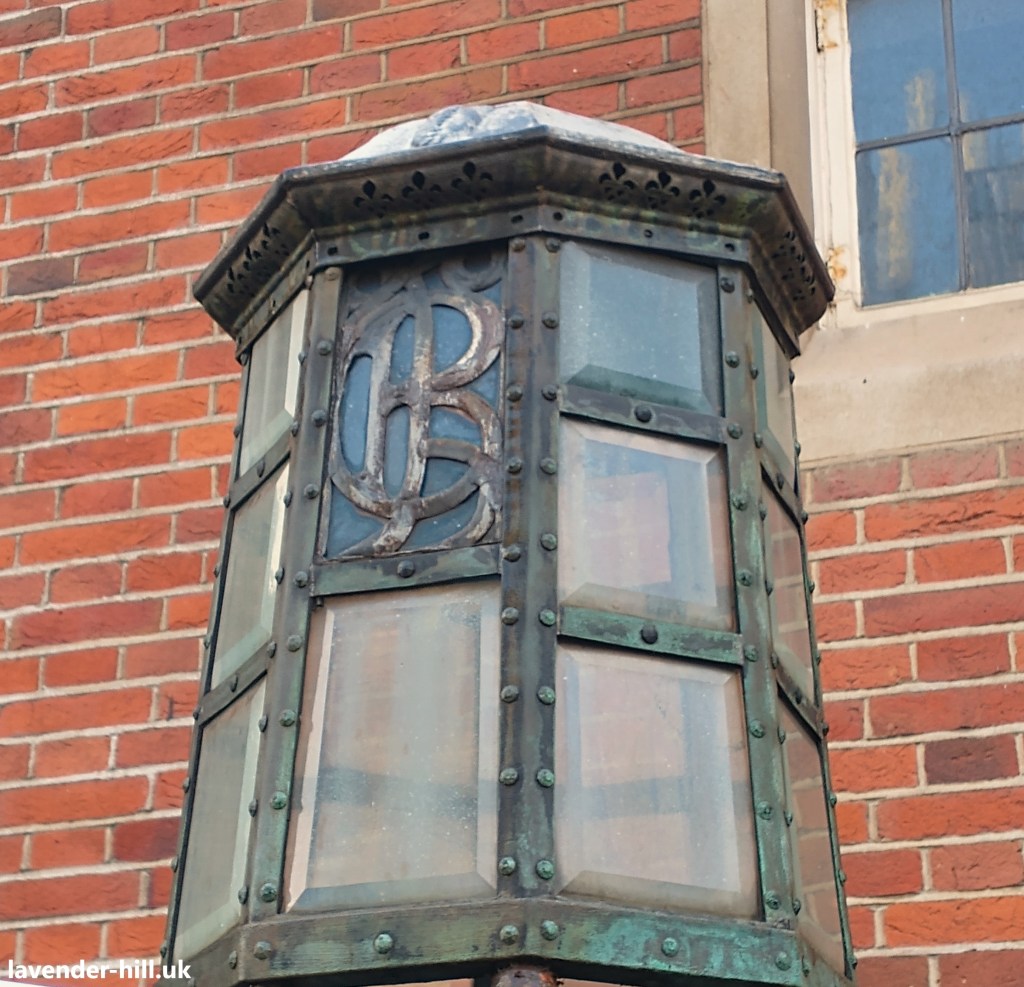
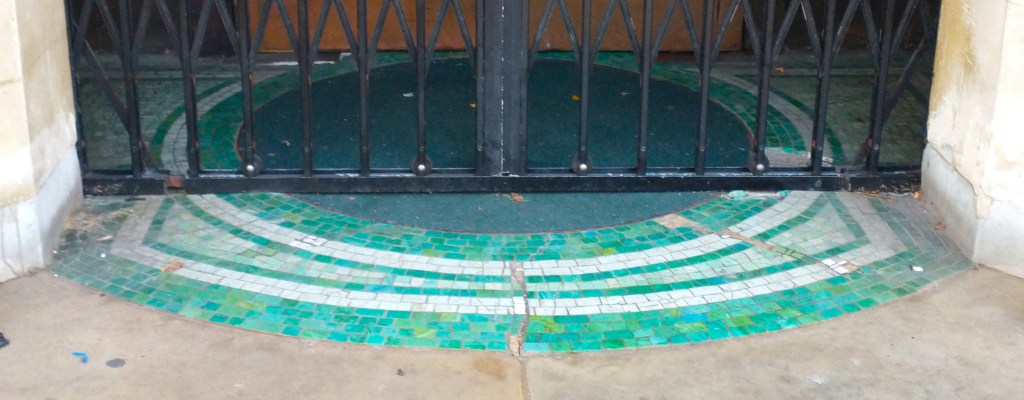
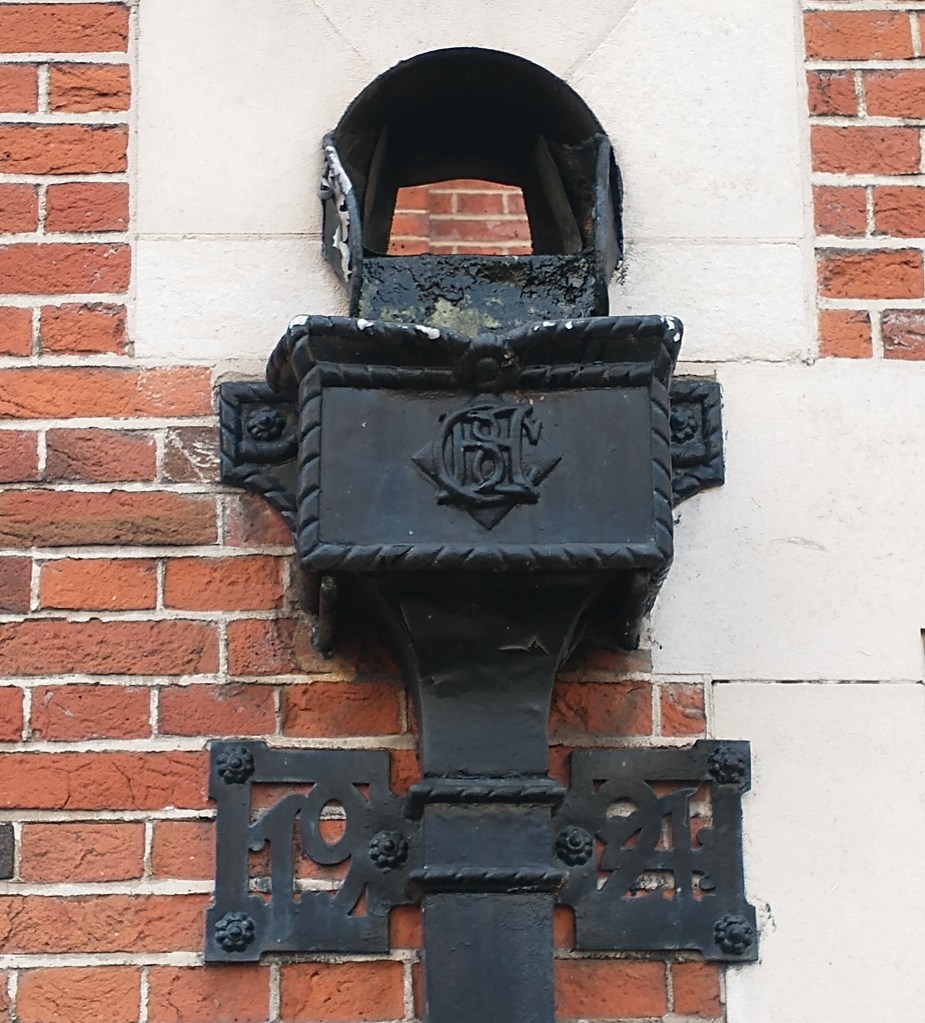
This becomes very apparent looking at the building, which only has a small street presence but which really goes long on hand made details including intricate carved stone arch above the door, copper and glass lamps, mosaic tiling on the doorstep, hand made metal guttering, and lots of use of oak and Portland stone.
Compared to the original library project where money had been tight and where Edward’s success had relied on getting a lot of mileage out of a limited budget, it’s pretty clear that by 1924 Battersea was a rather wealthier place and that it could afford to splash out on a building of the very highest quality. The whole library is now Grade II listed, and it is maybe a pointer to the quality of the build that it’s still doing exactly the same as it was when it opened in the 1920s. There may be more computers and photocopiers and wifi, and there have been a few lifts and ramps added over the years to improve access – but it is still well used, and its main focus is still serving its basic purpose as a calm and pleasant space for quiet study.
The new reference library was a building that set out to show the skill and style of traditional building crafts, and nearly a century later while the battle against mass-produced buildings may be well and truly lost, the reference library’s old-world charm and meticulous attention to detail still pays testament to those skills and remains an impressive (if underappreciated) part of Battersea’s architectural heritage.
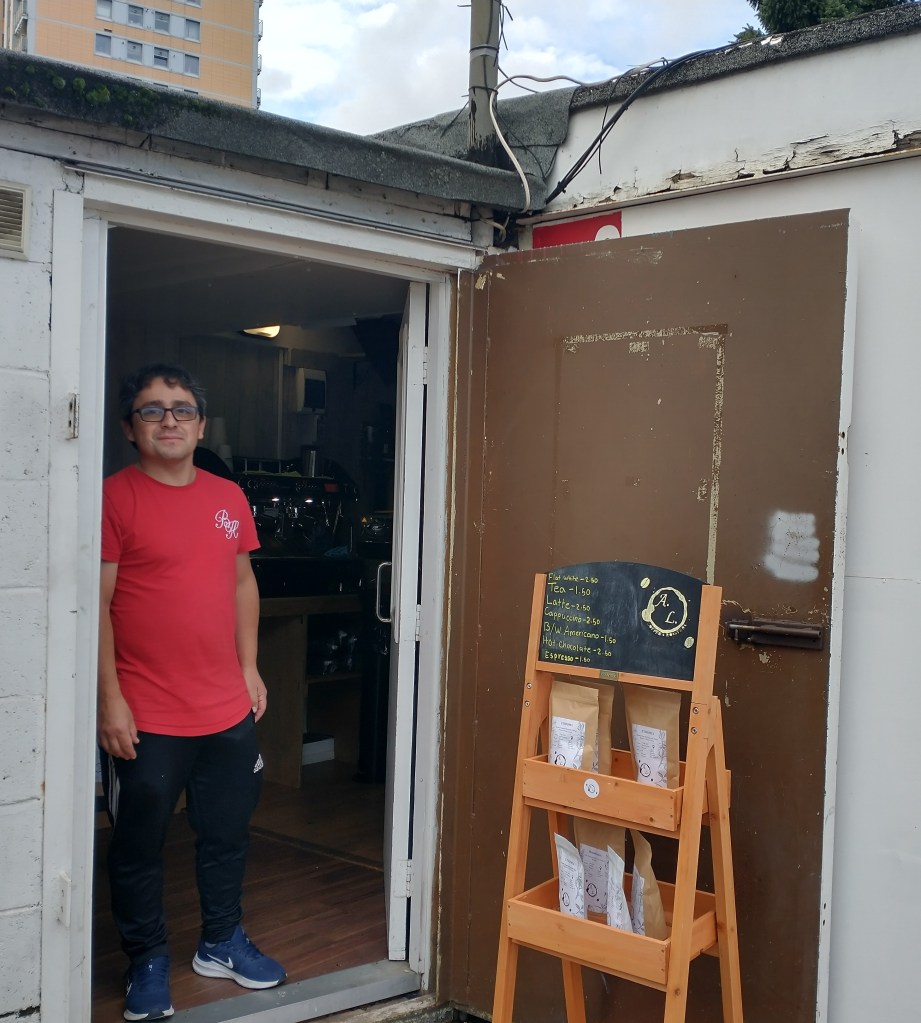
We’ve written about Culvert Road before. The rather dismal tunnel, and set of storage and industrial uses, just north of the Shaftesbury Estate. Few people know that hidden just north of the tunnel is a warren of small storage units, let to a variety of tiny businesses – which is currently facing an uncertain future with plans to redevelop it to a more modern set of business premises. Even fewer people have ventured inside. But an interesting new business has set up on one of the units right next to the entrance: if you go through the somewhat uninviting looking gates and immediately turn sharp left, you’ll find AL Coffee Roasters.
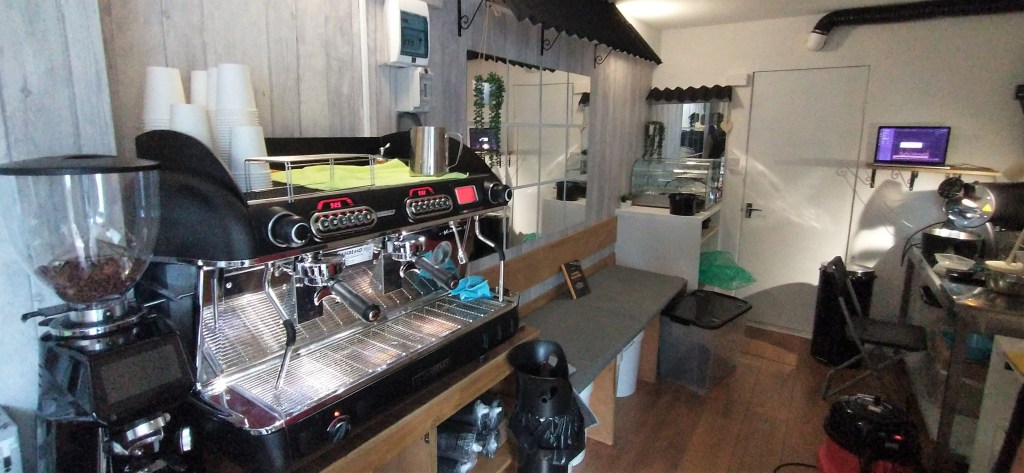
AL Coffee Roasters is a small family-owned coffee roastery with a Colombian angle, making small batches of interesting Coffee; and when we visited Andres (pictured below) was very happy to show us round the roasters and the technology being used to make a proper coffee. It;s quite rare to see a roastery in action from start to finish, but this is what Andres has assembled in a small storage unit.
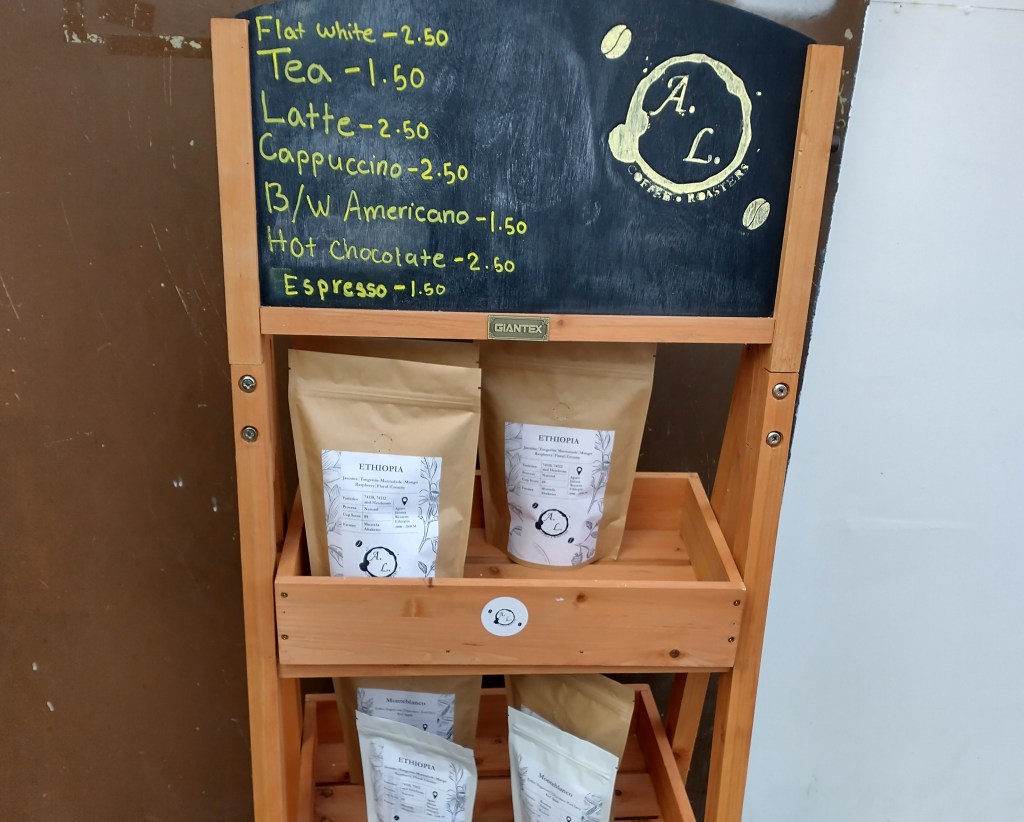
Most of the coffee produced is sold to businesses, but Andres has a proper coffee machine on site and sells various beans, as well as takeaway coffees. It’s an exercise of how to fit a lot of equipment in a small space, with everything just about fitting in to about ten square metres.
Andres’ business is not the first coffee roastery on Culvert Road: Caffe Nero’s UK-wide coffee roastery is just across the tracks in the Parkfield industrial estate, hidden away between all the railway tracks , and roasts coffee for thousands of branches right around the UK. The Nero roastery is the source of the occasional roast coffee smells that pass right across Battersea from time to time – we have often wondered if local coffee sales increase when everyone wakes up and smells coffee.
If you fancy a decent freshly-roasted coffee from an unusual location – AL Coffee Roasters is open most days. Head through the gates in the picture above, and turn left. There’s no website yet but the business is on Google Maps with up to date opening hours (at the time of writing: Tuesday to Friday mornings, Saturday afternoons, and most of the day on Sunday). AL Coffee Roasters, 105 Culvert Rd, London SW11 5AU.
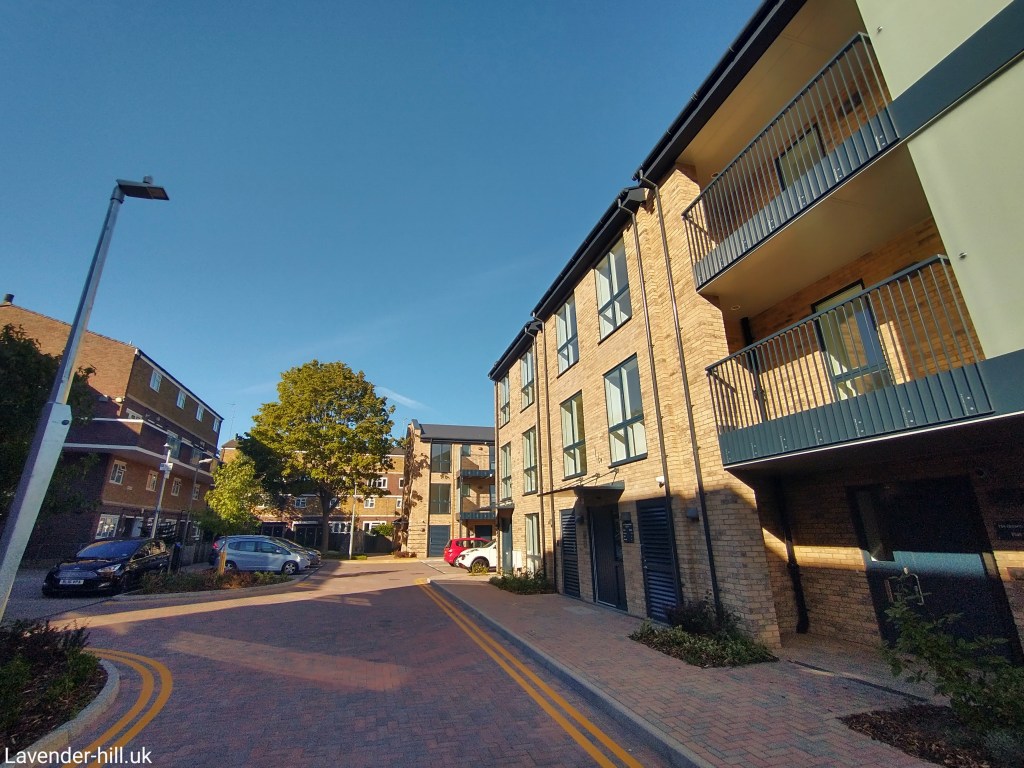
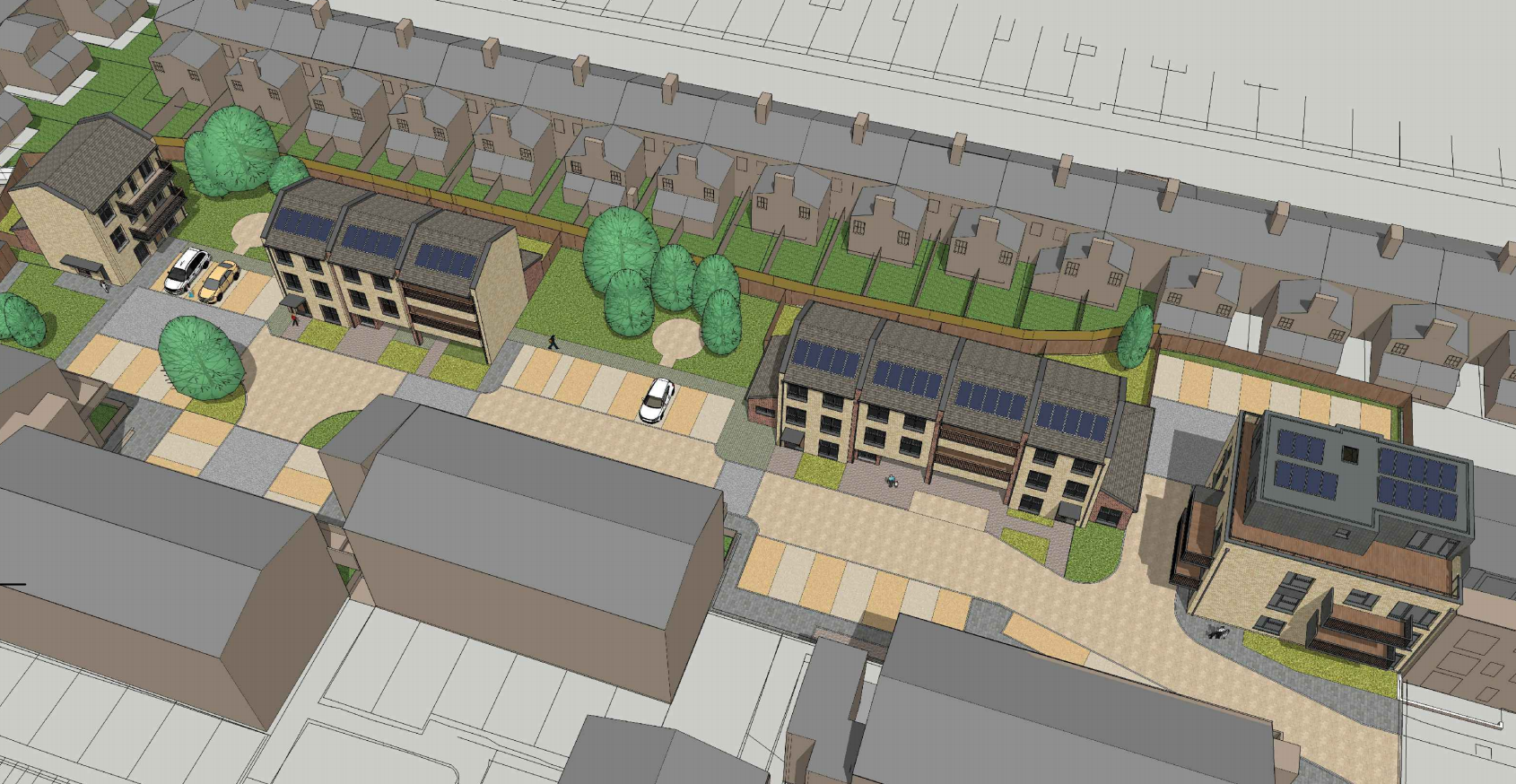
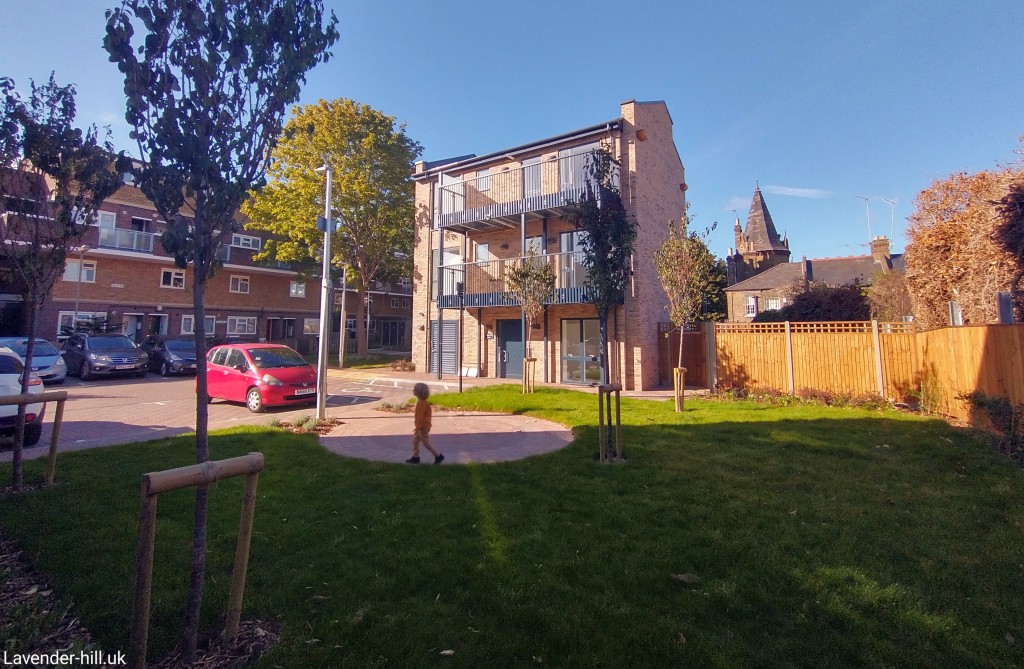
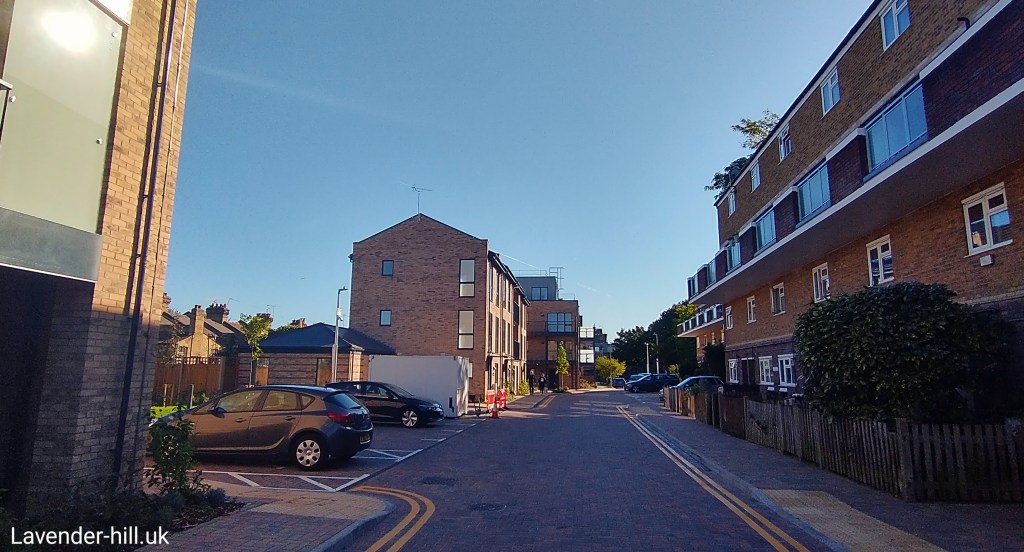
‘Luxury’ flats are flying up everywhere – but it’s not every day that you see a new estate made up entirely of rental properties owned by, and run by, a local Council. But that’s exactly what has just been completed at the bottom of the Gideon Road estate (to the north of Lavender Hill), with four new buildings containing a mix of 15 flats and three large terraced houses. And when we say large we mean it – these houses have up to six bedrooms! The artists’ impression below (from when we first write about this) shows the layout of the new buildings.
Work started in 2019 and it has taken rather longer than expected for the works to finish including a lengthy pause that was partly Covid-related where nothing happened for many months, much to the frustration of residents of the existing estate who had to put up with a closed car parking area and construction hoardings just a few feet in front of their front doors, with only a narrow pathway for access.
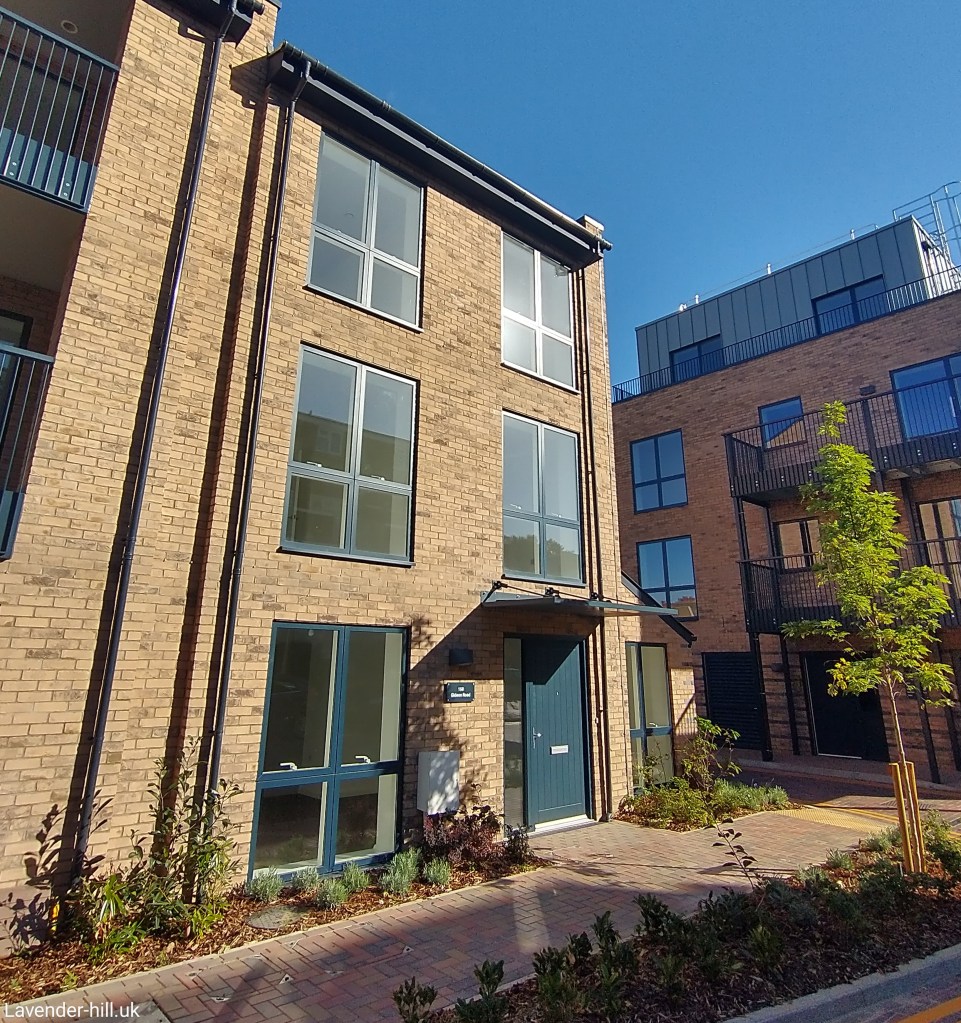
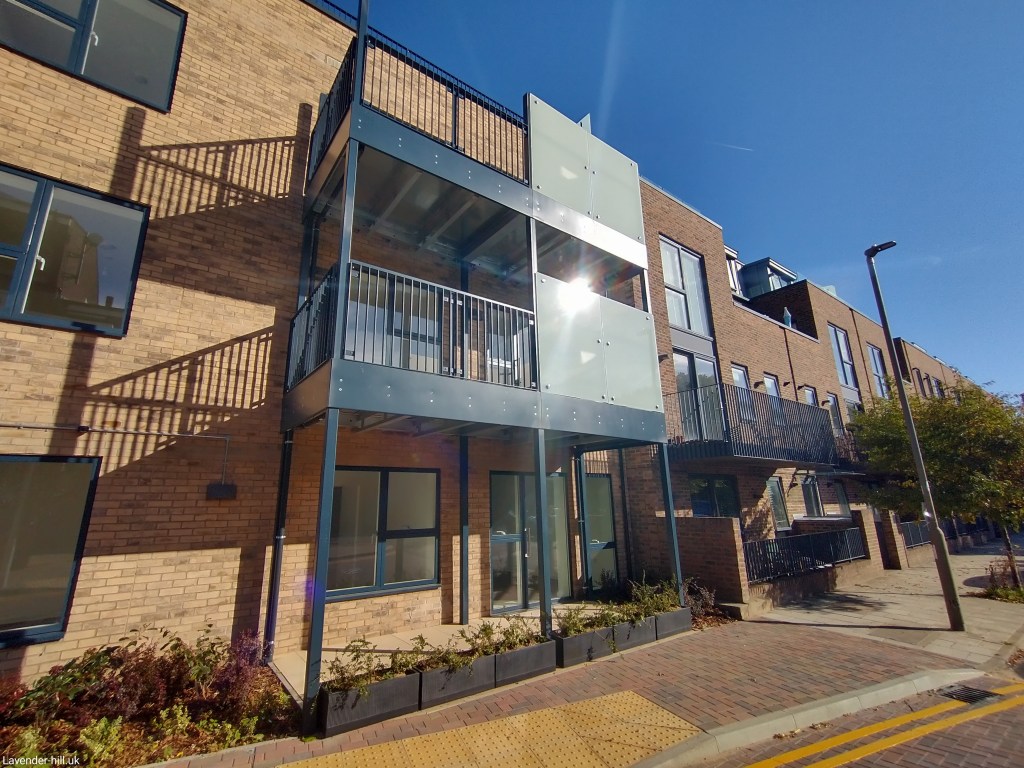
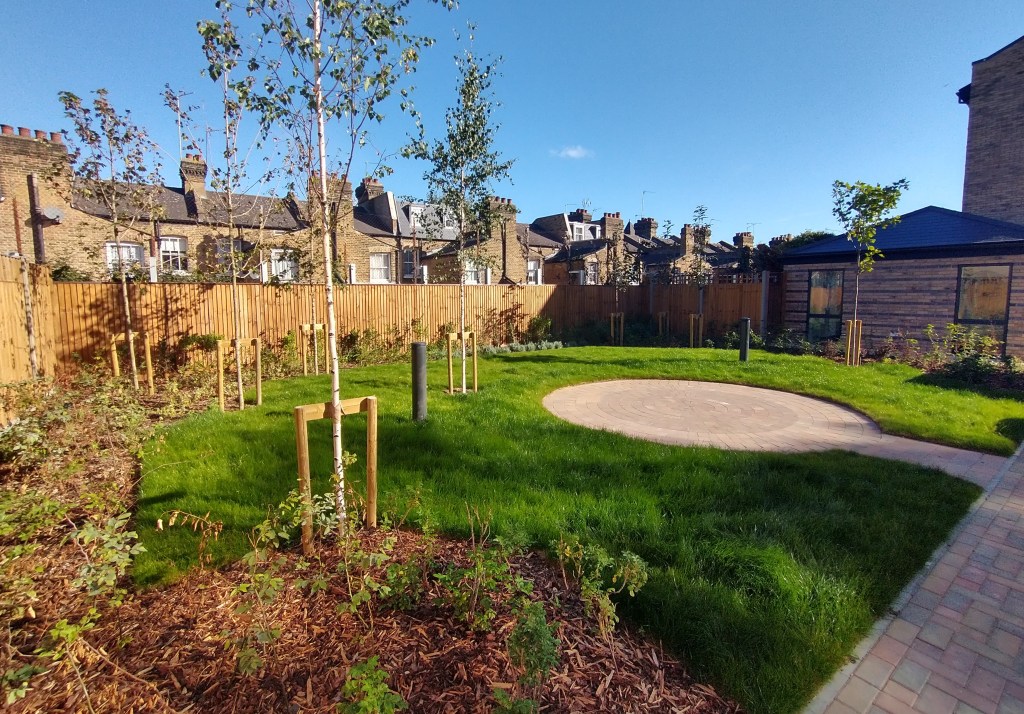
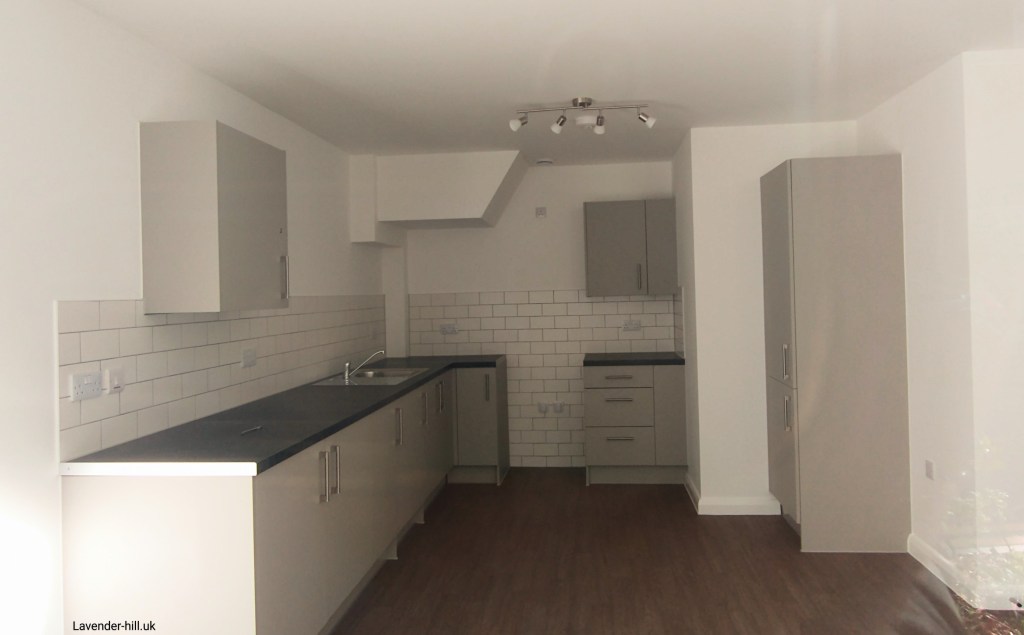
But now that the estate is finished and the estate has returned to normal, we have to say, these flats and houses are pretty good quality, and a significant improvement on the old garage area. There are balconies on all the flats, and a surprising number of both the flats and the houses have their own private gardens at the back. As our photo above shows, the development has also been fully gardened ahead of occupation, with planting in all the public areas.
The flats and houses have generously sized windows, which is always a good way of telling there has been a reasonably good overall design and build quality. One of the easiest ways of making something cheap to build is to include tiny little windows, as the windows cost more than the walls, and it makes it easy to meet insulation standards ‘on the cheap’ if you hardly include any glass in the structure. This is why so many suburban housing estates built in the last decade or so have so little natural light that you need to have the lights on in the day. Luckily that hasn’t been done here.
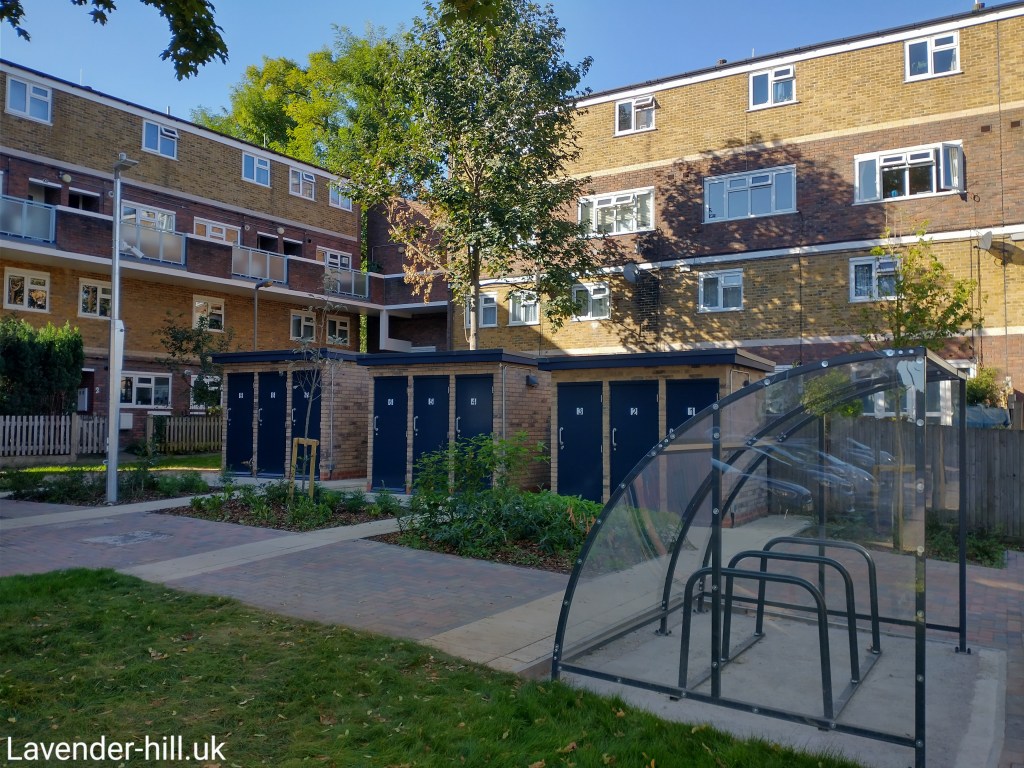
There are two small parks included in the development, pictured above and below. These create a little more green space, which has long been one of the challenges of the original Gideon Road estate: while it actually has a lot of outside space it is broken up in to lots of tiny bits, most of them overshadowed by tall buildings; the only proper open space is the paved playground area and even it is probably overdue for a refit at this point. These two new parks do have the advantage that they catch the sun a bit and bring something a bit new to the immediate area.
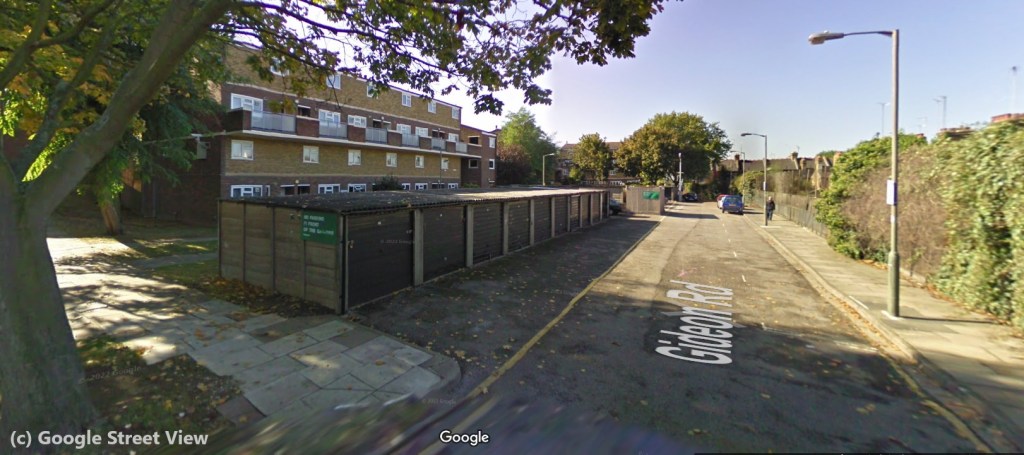
This new estate is built on a bit of land previously used for car parking and garages, and the development includes a replacement car park for the Gideon Road estate, hidden away behind one of the buildings. Car parking is quite a complex issue here: a fair few residents of th eexisting Gideon Road estate had bought their flats and in doing so had acquired rights to use the existing open-air estate car parking within this part of the estate. These rights could not be changed after the sales, which meant that the ‘on street’ spaces lost in the redevelopment have had to be reinstated in the new car park area. The situation was different for the lockup garages, which took up quite a lot of the land (pictured below) and which remained in the ownership of Wandsworth council, who rented them out to whoever wanted one. Demand was declining as the garages are too small to fit many cars, so they tended to be used for storage (but being old and damp, weren’t especially useful for this either). Because the lockup garages were kept by Wandsworth, and never freely available to leaseholders, they can be redeveloped without trampling on the rights of the leaseholders. This explains why so many of the new build projects involving adding buildings within existing estates are on existing areas of lockup garages – whether at Battersea Church Road (where about 50 garages are being replaced with a new tower block including 101 flats) or on Taybridge Road (where a set of four garages in a tiny little estate was sold off and redeveloped as a very cleverly designed single house).
Nine storage sheds that were lost in the redevelopment have been rebuilt at the side of the site, and there is also a covered bike shelter.
Before anyone gets too excited about being able to move in here, we should say that these flats are not going to have much effect on the waiting list for Council accommodation. Instead they’re mainly designed to accommodate residents who are being moved out of the Winstanley Estate ahead of its partial demolition and redevelopment; and to accommodate people with particular needs that Wandsworth struggles to handle in other estates – hence the really big houses for extended families. Our new neighbours will do quite well out of this move, as these new buildings are built to a much better quality than most on the bit of the Winstanley that’s being redeveloped.
The flats are all currently empty (with a security guard on site) but we expect they will be occupied within days or weeks. By and large, this new development looks like a success so far, and it makes for a tidier and more attractive edge to the existing estate; while it is a shame it took so long to complete it’s good to see that care has been taken in the landscaping and finishing. There’s nothing architecturally ground-breaking here and this has been built on a tight budget and a complicated bit of land – but these are decent quality homes that have been thoughtfully designed and which will be good to live in. It’s a credit to the developers that these do a fair job of looking like they have been here from the start, tying in to the existing Gideon Road estate and to the newer Westmoreland apartments next door, while not completely clashing with the Victorian properties to the north.
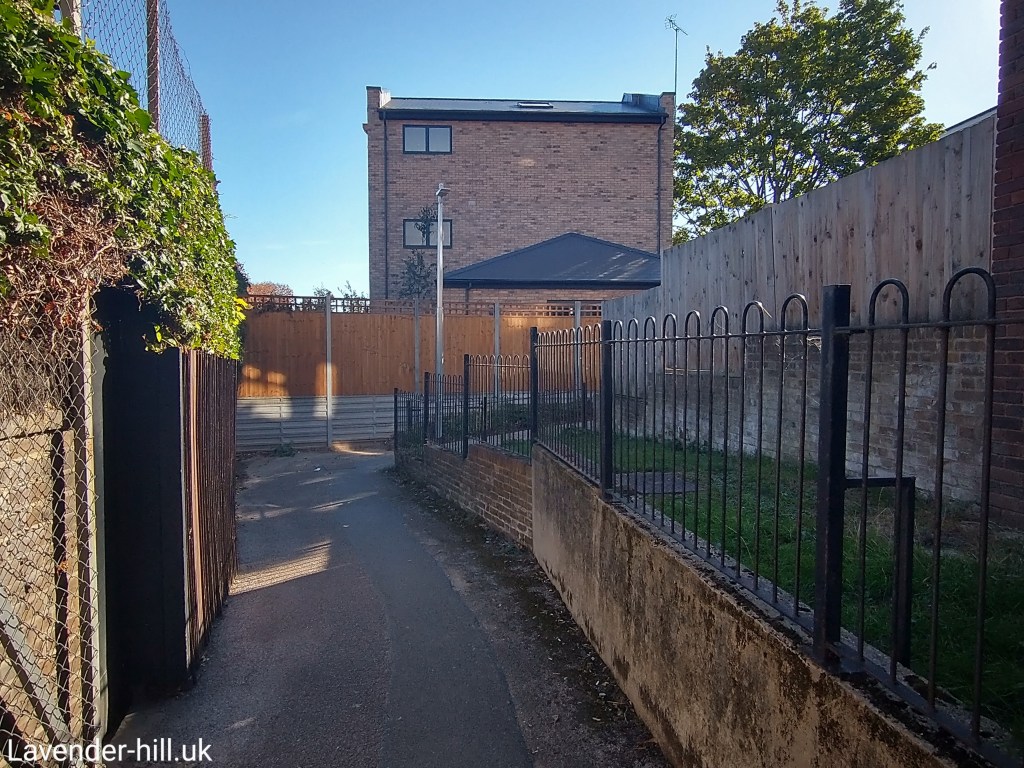
Our one regret is the way the existing path through to Grayshott Road has been changed. It used to go straight through to the end of the car park as a nice wide footpath with good visibility, and now it has been rerouted and become a complicated mess with blind corners and big fences either side, that is not really overlooked. Even the paving here is badly done, changing several times along the length of the path. This is bound to end up as one of those quiet pathways that always has rubbish dumped in it, that smells slightly of urine, and that you may want to avoid if you’re alone after dark (and we said this back at the planning consultation stage too). But this is probably the only aspect that is badly done, shows that overall this feels like a successful project.
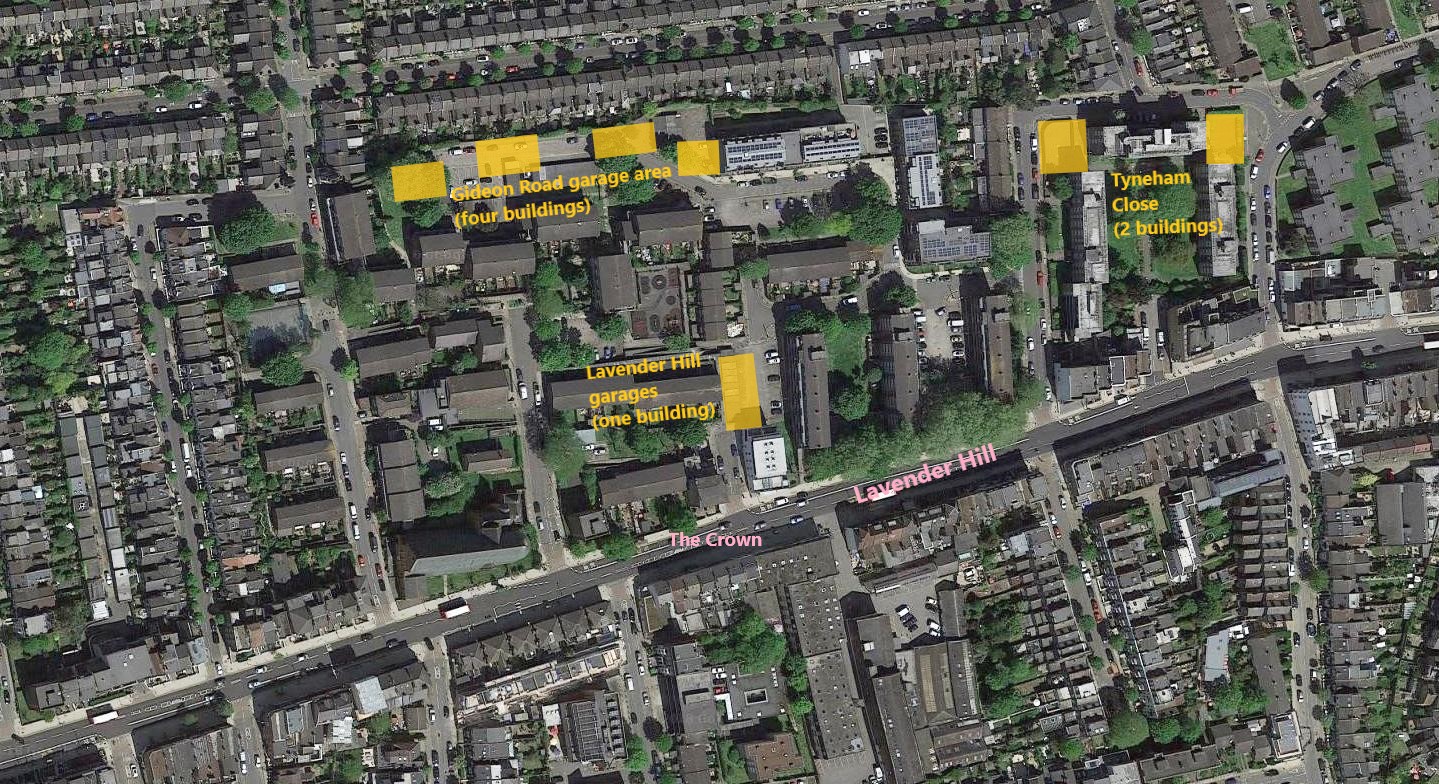
This stage of the building is all finished but there may be more to come: when these plans were originally approved, three further buildings were also involved, shown on the map below and labelled ‘Lavender Hill Garages’ (next to the Crown pub) and ‘Tyneham Close’. We understand there was some thought of also ‘filling in the gaps’ directly facing Lavender Hill as well, but this was discarded (just as well, as the large trees would have been cut down, and the three parallel blocks of flats would have lost a great deal of daylight if the area had been built on). As yet there is no sign of action, but we suspect these other buildings will be built in coming years.
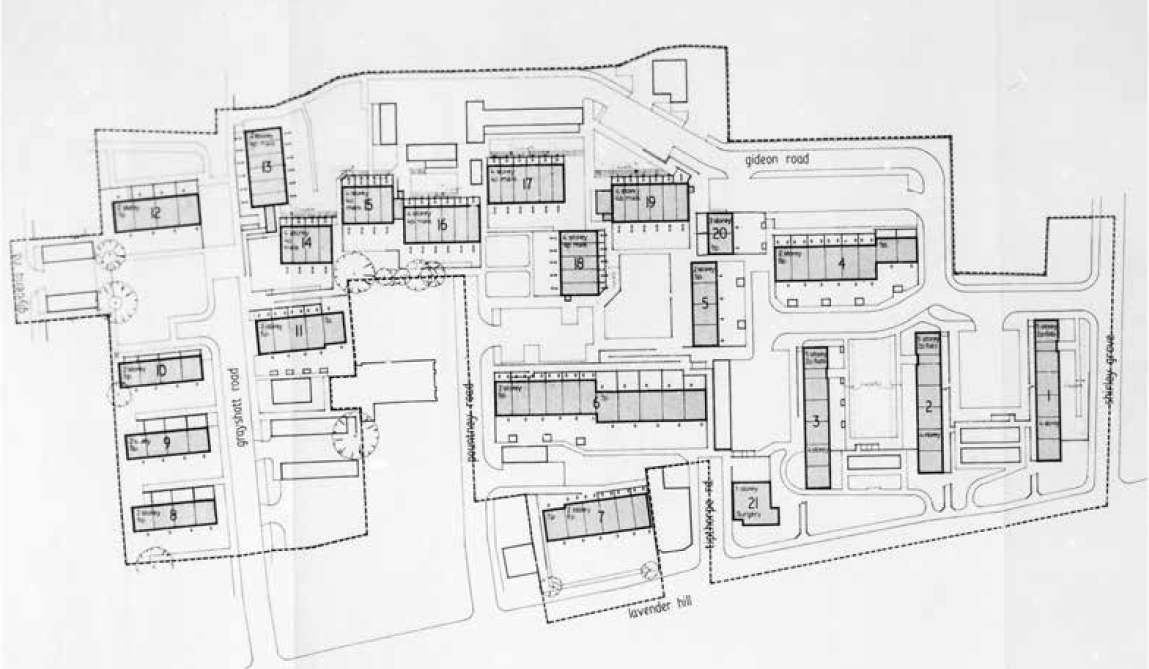
As one final curiosity: this map shows the original plan for the Gideon Road estate. It’s maybe surprising to learn that it was designed in the early 1970s as a single coordinated plan for around 200 houses and flats (as a partial redevelopment of the Victorian-era L’Anson and Townsend estates that were previously on the site), as walking around it it often feels as though it’s really several separate and unrelated estates that are loosely combined.
Original plan of the Gideon Road Estate, (c) Wandsworth Borough Council
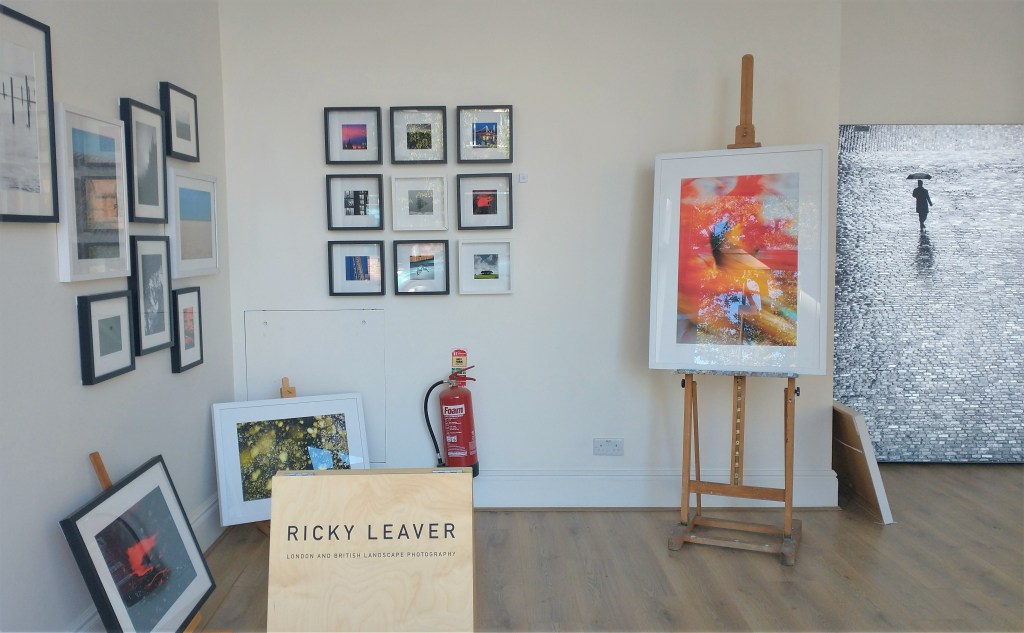
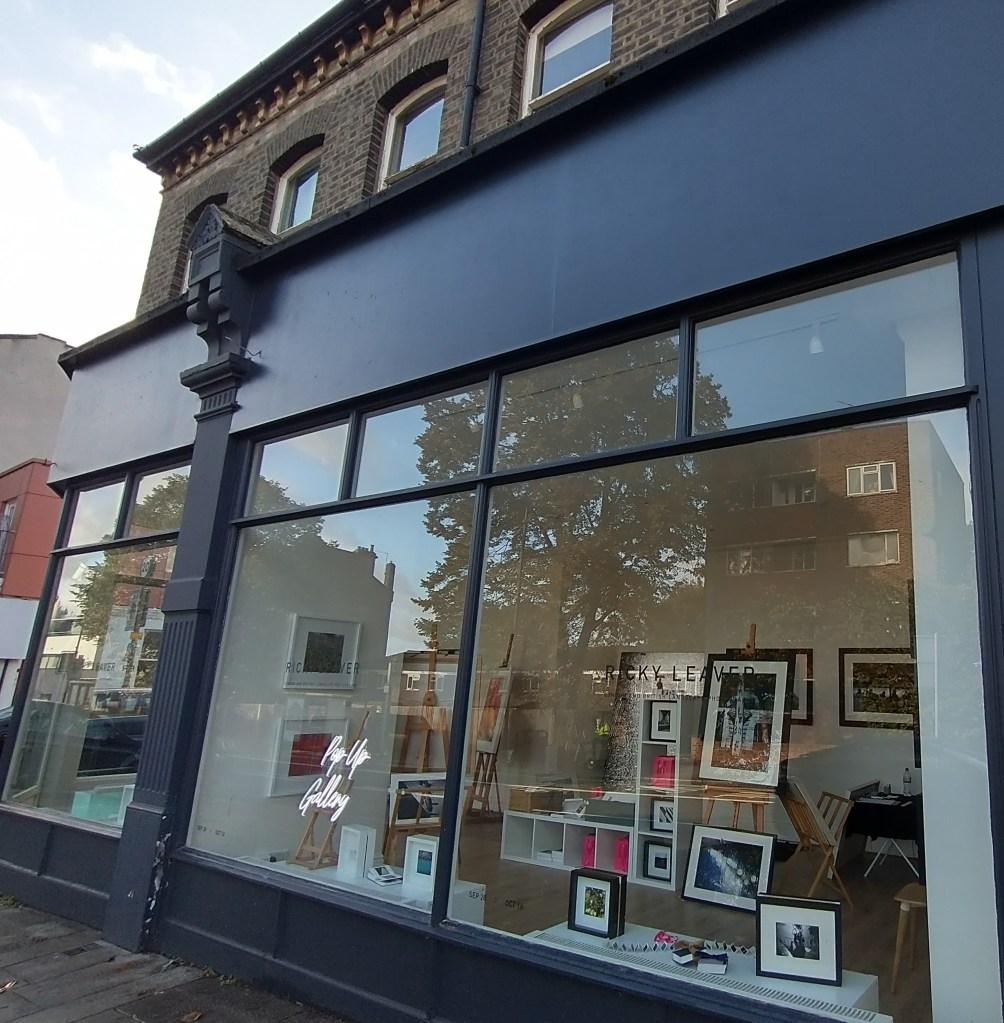
For the next two weeks there’s a pop up gallery on Lavender Hill showing a selection of Ricky Leaver’s work. Ricky – who’s almost local, living in Putney – is an artist whose work you have almost certainly already seen without realising it – not least as he was the picture editor of the Evening Standard website when it first went live in 1997, and in 2001 founded the Londonstills Picture Library – which supplies a images of London to newspapers, magazines and all sorts of other commercial and creative users, with a huge range of pictures (over 10,000!). He has since made a small selection of his work available as photo fine art – some of which is on display at the Lavender Hill gallery (with limited edition prints on sale), and some of which features on his own website.
It’s s not surprising that some of his photos capture areas familiar to many of us with an artistic eye. He explains that his cityscapes capture London as a colourful, throbbing, metropolis, ever changing, while still retaining its timeless quality. Ricky also has a gallery in his home where visitors are welcome; and this pop-up gallery will bring his work to a wider audience, and provide an opportunity to meet someone with a long career photographing our city. It’s at 125 Lavender Hill, SW11 6JN (the corner of Stormont Road – about half way along Lavender Hill), which will be open – free! – every day until Sunday 16 October from 11am to 6pm. Do visit!
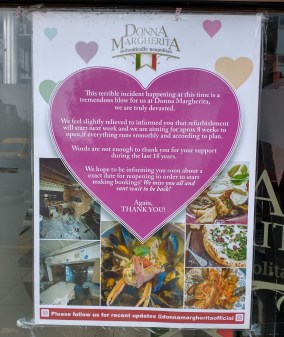
We’ve written a few times about Donna Margherita, at 183 Lavender Hill – one of our longest serving Neapolitan restaurants with two decades on Lavender Hill, and a firm favourite for years. They made it through the Coronavirus – opening a delicatessen along the way to serve the takeaway trade, with a wide range fo Italian produce. But as the Coronavirus faded and they reverted to being a restaurant disaster struck – with a major fire in the kitchen in April 2021 causing quite substantial damage and leading to immediate closure. Undaunted, and following the usual insurance uncertainty, the owners set about to create something brighter and fresher than what had gone before, with a new look – including bringing light in to the back of the restaurant area, a curved new feature ceiling in sky blue, and a crisper, simpler overall design – while of course keeping the all-important pizza oven at the back of the space.
Things were actually coming on pretty well, to the extent that by September 2021, five mkonths after the fore, we could start seeing what Donna Margherita 2.0 was going to look like; and the builders we spoke to were proud of the way things had progressed. Donna Margherita’s Instagram was clearly showing the enthusiasm too: “Ciao Amici! We’re still full-on working hard on our Donna Margherita 2.0, works are proceeding great but unfortunately, it might take a few more months before we can safely open our doors.We appreciate every single one of you reaching out and we hope to see you as soon as we open! This is the longest break we took in over 20 years and it will probably be the longest one we’ll take ever, we love our job and making you smile with our food!“.
But then everything stopped. We hoped it was just a case of struggling to find people to do the finishing touches in a very tight market in the building trades. But weeks turned in to months, and we were unable to detect any signs of activity, or contact anyone involved. Back in May this year, over a year after the fire, our post “Donna Margherita: Is this goodbye?” got a fair bit of attention, and if nothing else it showed that there is strong loyalty to a proper neighbourhood restaurant that has been with us for so long. There were clearly still people hoping that the restaurant could return – but the site remained as in the photo above for many more months. Extended closure is a dangerous place to be for any business, with business rates to pay but no income, no matter how understanding the insurers are, and amid the silence many started to wonder if it was all over for Donna Margherita.
But this may yet be a story with a happy ending. Because work has since resumed. As our photo at the top of the page shows, there are now new fridges and delicatessen displays in place for a kitchen area at the right hand side of the premises, the electrics are fully finished, the floor is polished, even the first seating is in place. It looks like Donna Margherita will be coming back to Lavender Hill after all. It’s been quite a journey for what the owners initially hoped would be an eight week renovation. We’ll make sure everyone is kept posted, and able to give them a warm ‘welcome back’.
Back in 2018 we first reported on Battersea Arts Centre’s ambitious plans to turn a private, ‘dead end’ road full of car parking in to a community garden. This was an ambitious and imaginative project and we loved it – and we wrote about it again as it took shape, and as the accidental sculpture created as a girder was bent and twisted in the major fire was installed facing Lavender Hill.
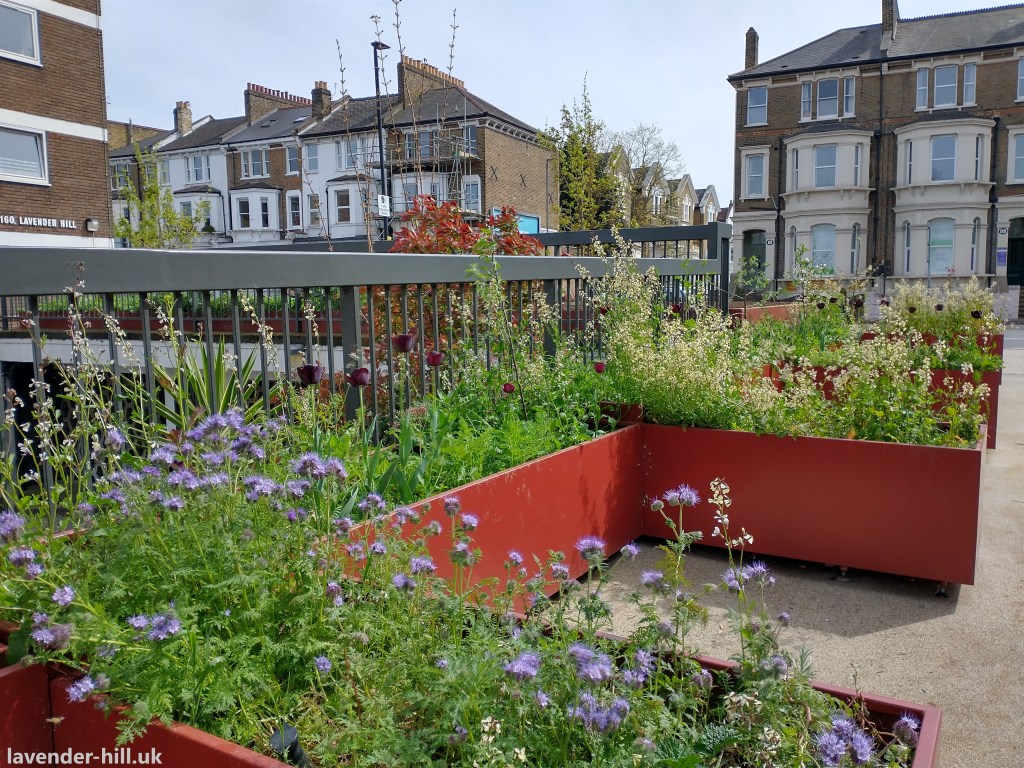
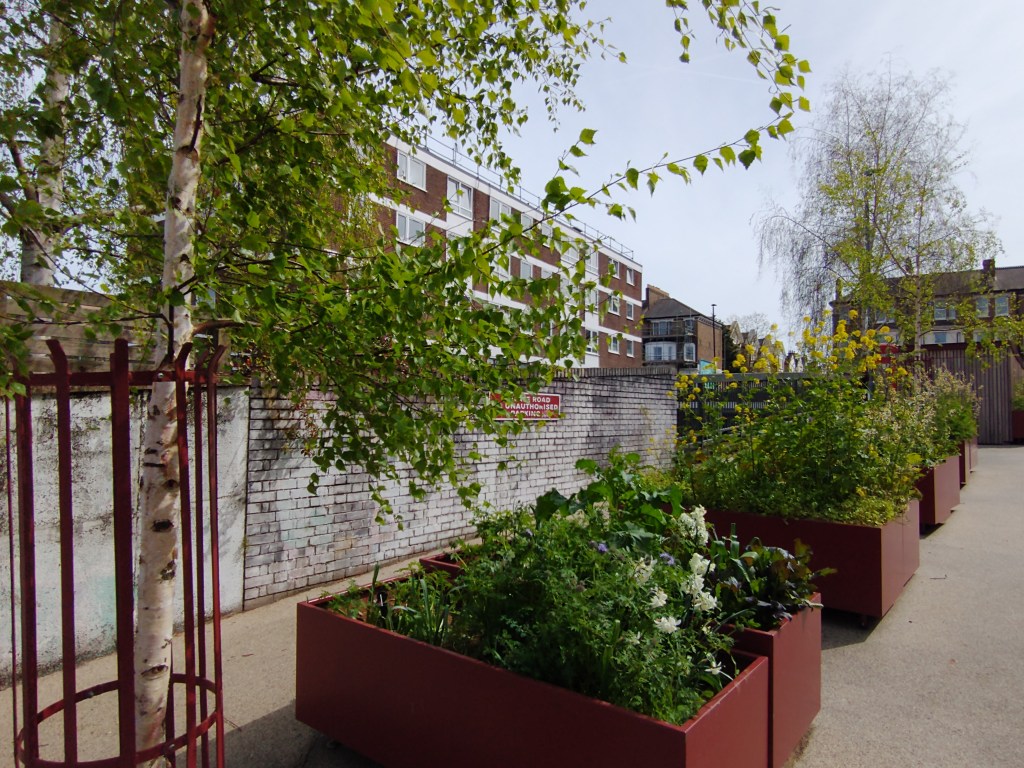
The garden went through a brief phase of being mostly weeds, but gained a wider mix of plants during the various Covid lockdowns, when it came in to its own as a traffic-free outdoor space in an otherwise densely built bit of town. It’s now fully up and running as a community garden (and occasional outdoor seating area for the Freedom Tap Room – formerly the Scratch Bar).
The aim of the project had been to turn the roadway into a growing space with wildlife-friendly herbaceous hard-wearing plants, including fruit trees and shrubs, to produce regular, low-maintenance harvests of edible things. The garden aims to be wildlife-friendly, and it includes plenty of ornamental plants as well as a surprisingly wide range of edible foods. Kayode Olafimihan & Susannah Hall from Permablitz London (who coordinate several community-led gardens around the city) created the original garden design that helped Battersea Arts Centre win funding towards the project from the Greater London Assembly, Heritage Lottery Fund and Wandsworth Council.
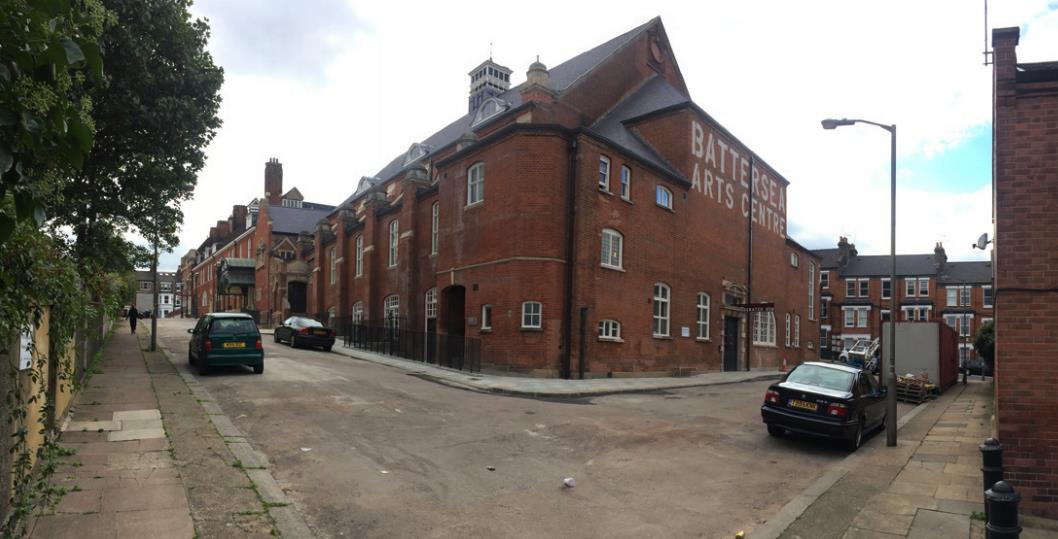
It’s been an impressive transformation, from what was originally a bit of a blot on the landscape – a badly paved section of road dominated by parked vans and rubbish storage – to an open and welcoming space that does justice to the old Battersea Town Hall next to it. Our photo below shows what the site used to look like before work started.
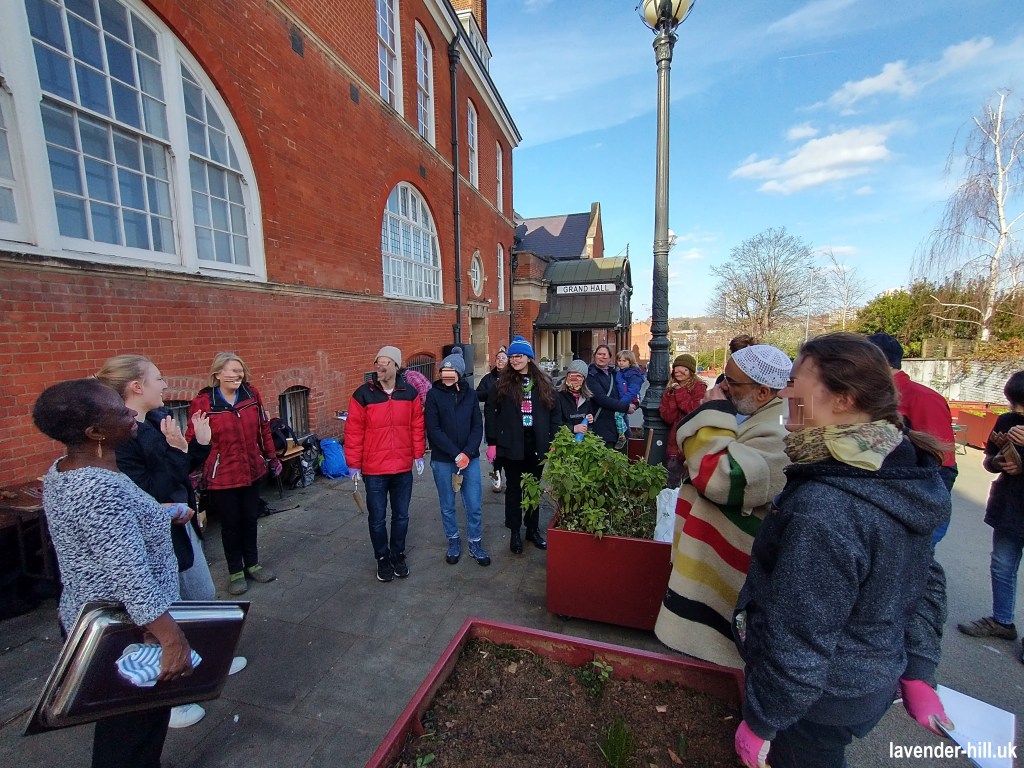
The garden now works on a community basis, with Battersea Arts Centre running it in partnership with the Permablitz team behind the original design – and they are keen for us to all be involved! This is done with a regular series of ‘Permablitz’ days, where they are keen for everyone to come and help with the gardening.
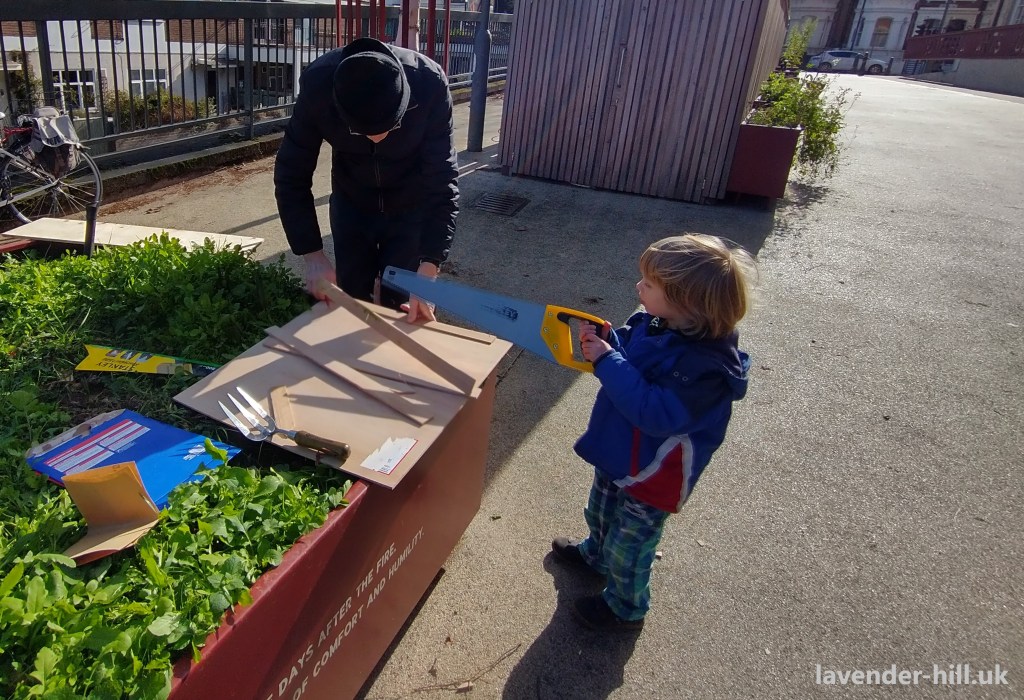
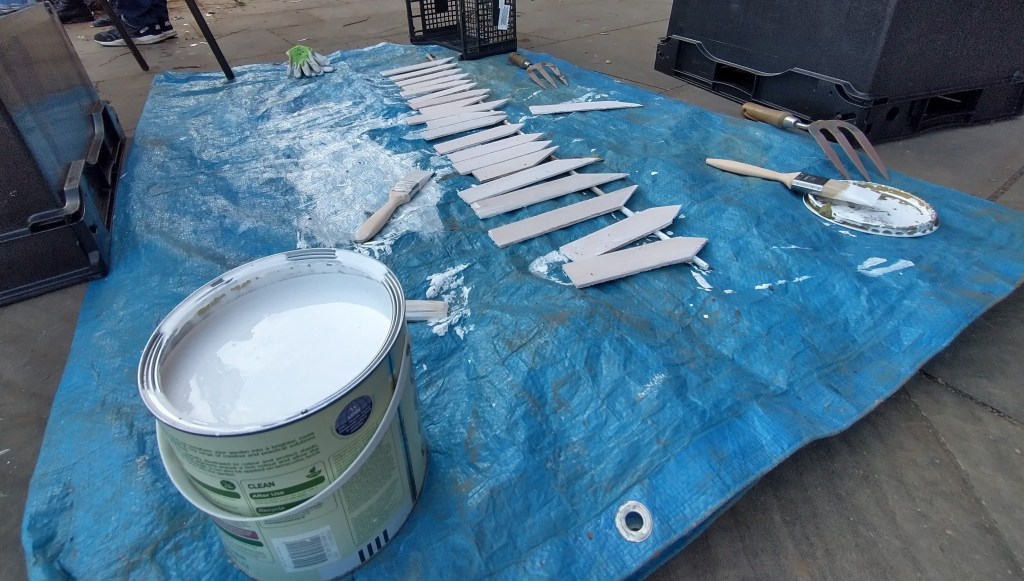
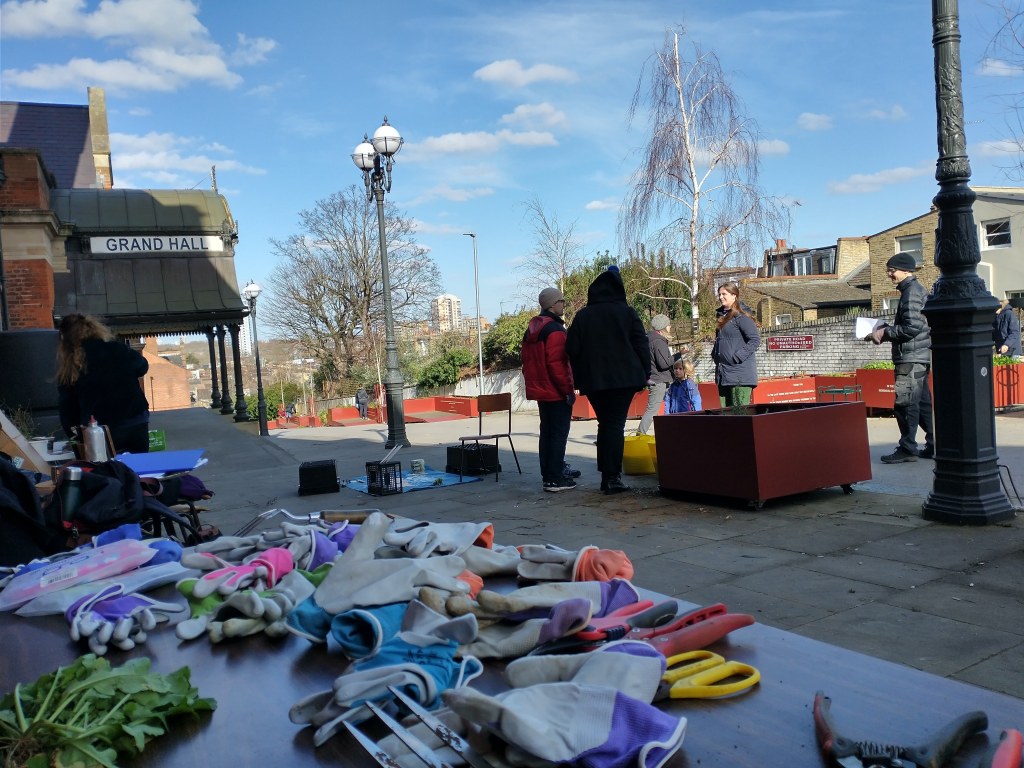
A really important part of these Permablitz days is that everyone is welcome on these days regardless of age, style or gardening knowledge – don’t worry if you’ve never done any gardening before, since coming along to one of these days is a great way to learn, as well as to meet people in the Lavender Hill area. There are always a variety of jobs to do, whatever your experience or physical ability; everything from making plant labels (above) to settling new plants in; when we visited the audience ranged from about four years old to ‘old and wise’!
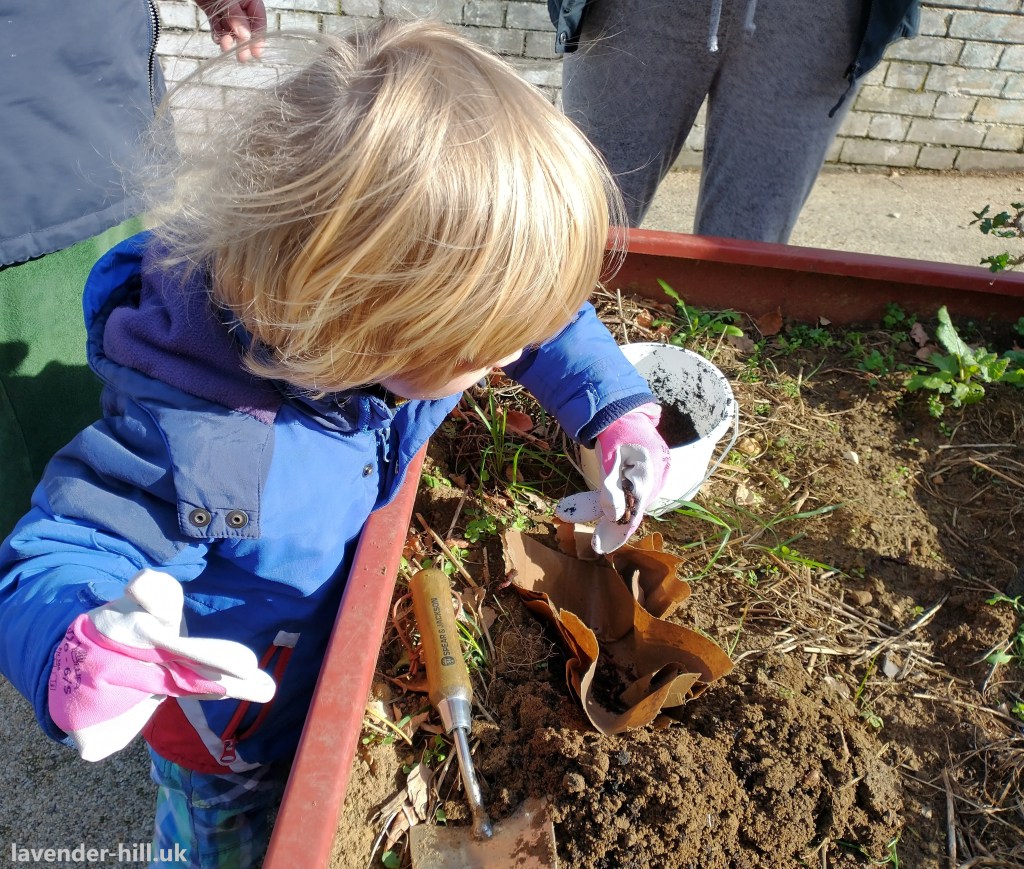
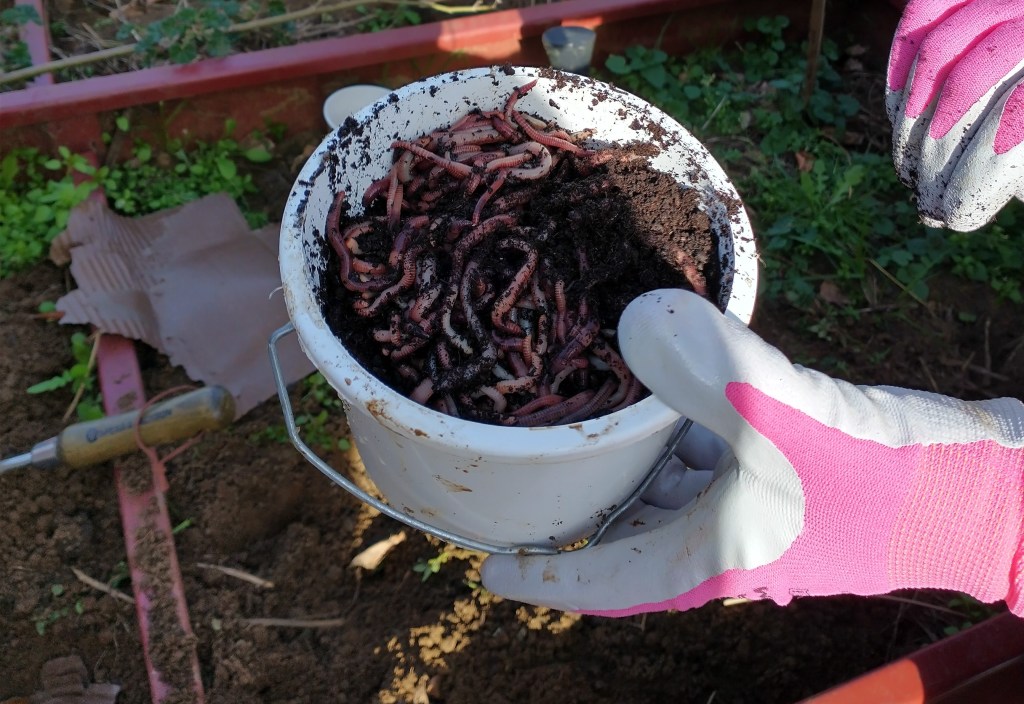
When we last visited work was underway to plant trees and plants, as well as to introduce worms (pictured above and below) to the various planters so that they could get to work on the soil. We had never previously realised you can get big parcels of live worms delivered to help with gardens – and picked up plenty of knowledge on what will settle worms in and keep them happy in their new homes,
These days, which are run roughly once a month, are also great opportunity to meet new people in the immediate area, and help develop the community garden. All the tools and gloves you might need are provided (including ‘worm proof’ gloves at the request of the four year olds present), as is food and drink to keep everyone going.
The next Permablitz day is on Sunday 9 October 2022, from 10am-4pm. Lunch will be provided and there will be activities suitable for all, including children – everyone is very welcome! Mini workshops will run in the morning (11am) and afternoon (no later than 3pm). Topics will include learning about the crucial role that earthworms play, and understanding the permaculture design of the garden. It’s all completely free! But the organisers do ask that you please book a place in advance so that they can know numbers for lunch, which is provided, and give you all the specific details. If this sounds interesting – book your place by emailing communitygarden@bac.org.uk. More details about the garden – as well as future Permablitz events – are on the Battersea Arts Centre website.
And even if you can’t make it – do have a look at the garden as it settles in and becomes an increasingly established and well used part of Lavender Hill.
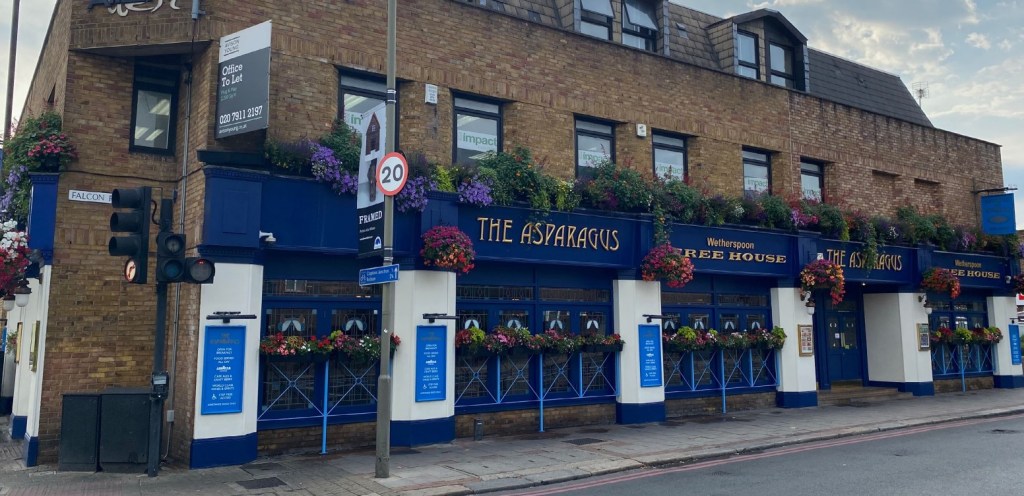
Some time ago we reported on the opening of The London & South Western, Wetherspoons’a newest pub, at the western end of Lavender Hill. It was notable that opening the new pub left Wetherspoon’s with two pubs within a short walk, at either end of the Falcon Road. We wondered about the future of their existing pub, The Aparagus: while both seem quite busy and profitable, the new pub was more central and more typical of the city centre pubs the company has increasingly been developing. Sure enough, about two years later, the Asparagus is for sale, as one of about 40 pubs on the market.
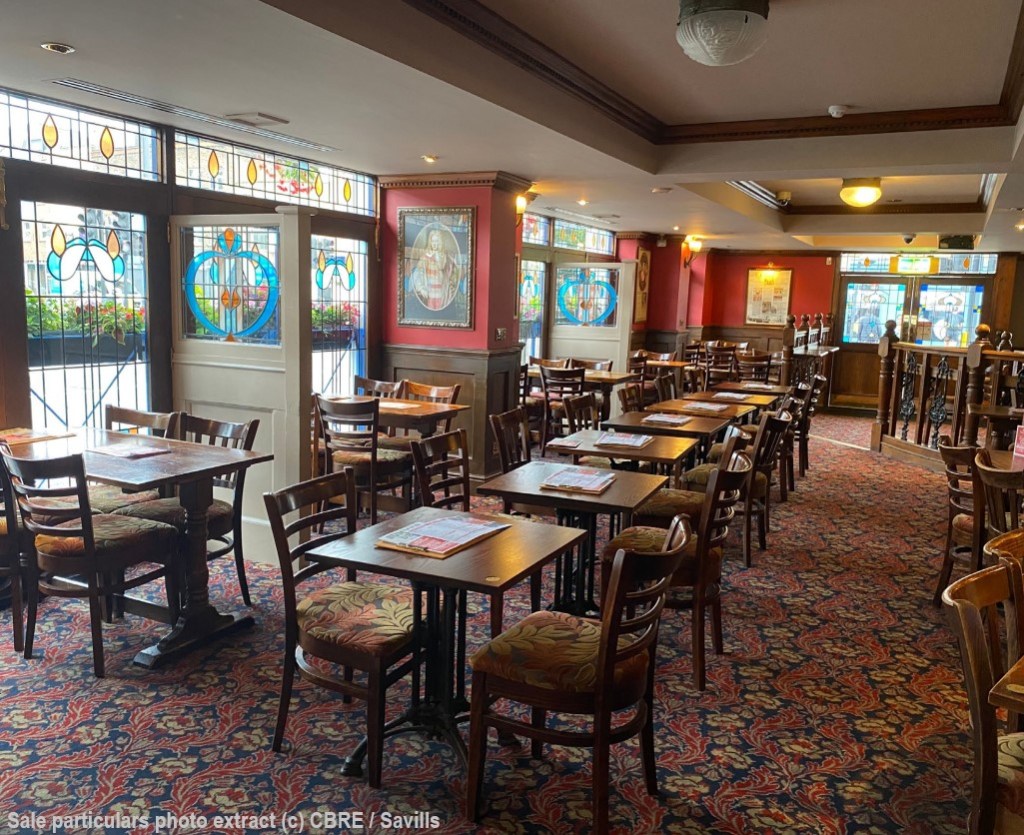
Exactly what is being sold is a little complicated. Wetherspoons are selling the pub as a going concern, including midnight / 1am licenses, as well as the freehold of the building, including full ownership of the whole of the ground floor, part of the first floor that houses the WCs, and the basement that houses the beer cellar, manager’s office, staff room and stores. It adds up to a sizeable area at over 6,000 square feet, and also comes with the outside terrace that catches the sun on the south side of the building.
But the rest of the first floor and the second floor have previously been sold off to someone else on a long lease, and are in use as offices. This restricts what can be done with the building, and means it’s unlikely to be of interest to anyone looking to quickly redevelop the whole site, which might otherwise be the most likely outcome given several rather taller developments of flats have recently gone up in the area. This complexity on the property does increase the likelihood that a new owner will carry on running it as a pub, rather than being focussed on building something much taller on the site. The list of companies looking to take on new large pubs isn’t an especially long one right now, but there are people out there opening pubs, as we saw with the Queens Arms.
The sale particulars don’t say much about the pub’s trading performance (and we can safely assume that it is not one of the most profitable sites for the current owners or Wetherspoon would not be seeking to offload it) – but it’s in a busy area with both a loyal clientele and a hugely growing population, so should be able to turn a decent profit in the right hands.
But there’s inevitably a risk new owners will want to do something else with the site. With a 3,600 square foot area on the ground floor it’s precisely the right size for a small supermarket, and there have long been plans to redevelop the building a few doors down that currently houses Tesco – maybe they might seize the opportunity to relocate. There’s also a seemingly insatiable appetite for new gyms, and while the prominent corner site may be a bit too expensive for a gym, it’s still a possibility. But we’d be sad to lose another pub. In the end, only time will tell. The agents suggest that prospective buyers make ‘discreet customer visits in the first instance’ – so keep an eye out for new customers having look about! It’s always an unsettling time for the staff when the business is for sale, but fingers crossed the pub will find an enthusiastic new owner.
Lavender Hill for Me is a community website working to support Lavender Hill, a neighbourhood in Battersea, London and a home to about 250 shops, restaurants and small businesses. We take an active interest in developments that could improve Lavender Hill for residents, traders and visitors.












 Lavender-Hill.uk : Supporting Lavender Hill