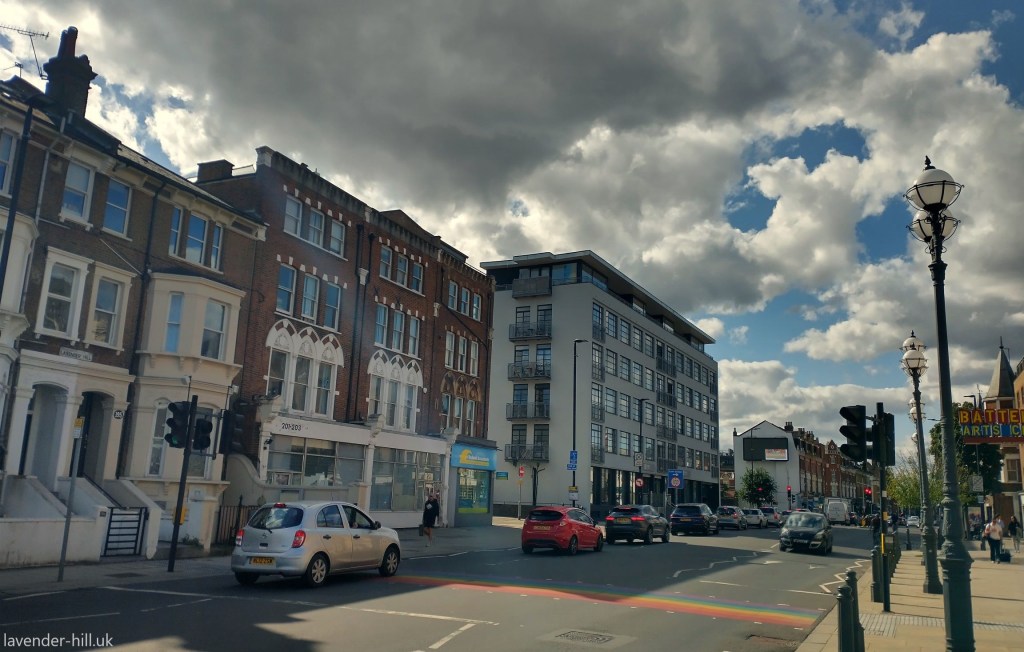
Lavender Hill Retail Roundup – October 2023

Lots of comings and goings since our last update on Lavender Hill traders at the end of 2022 – and this is a review of who has left and who has arrived, roughly running from the east to the west along the street. First up: M’s dining rooms is opening soon at 14 Lavender Hill, promising an African Carribbean takeaway, as well as the best Nigerian Suya spot in London! This is a site with a complicated history – the previous restaurant, Leilani, was initially quite successful but got tangled up in a series of licensing difficulties . They carried on trading on for a while after the license was revoked – but the premises was eventually repossessed by the landlord. Building work is now well underway, and this should be a fresh start for a large venue with lots of potential.

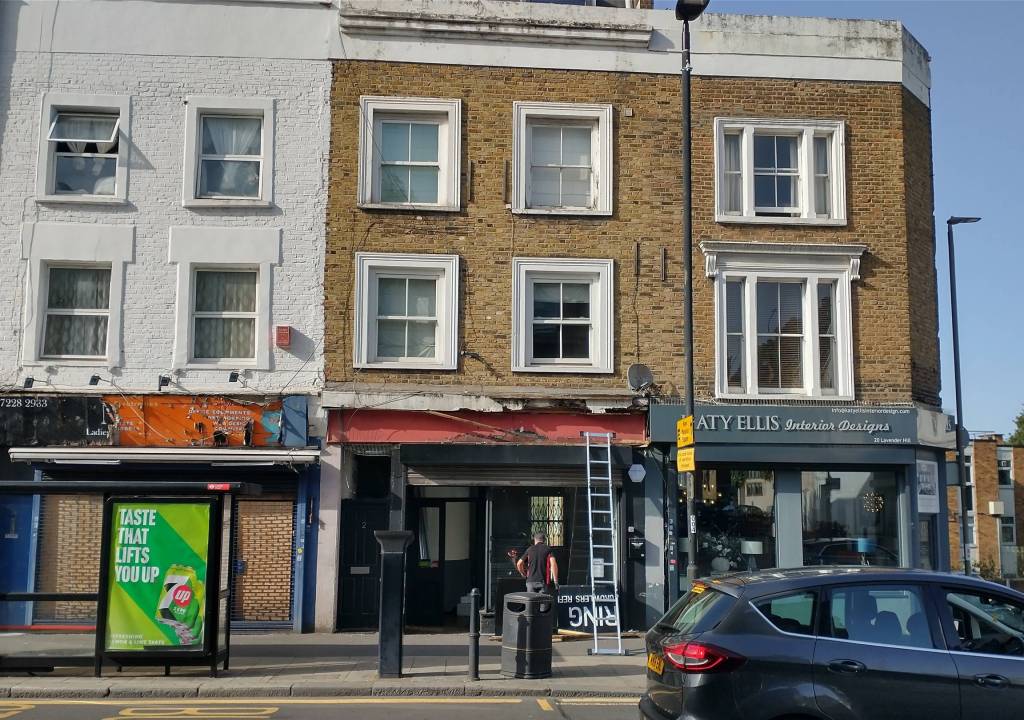
We’ve previously reported that No Boring Beer hit difficulties when faced with soaring utility costs, which tipped this small business over the edge. The site will soon reopen as a new base for SpyWines, who are a distributor of quality wines run by local resident Tim Harmsworth, and and who have been in Battersea since 2014. Stock is in at 22 Lavender Hill, and signage is on the way.

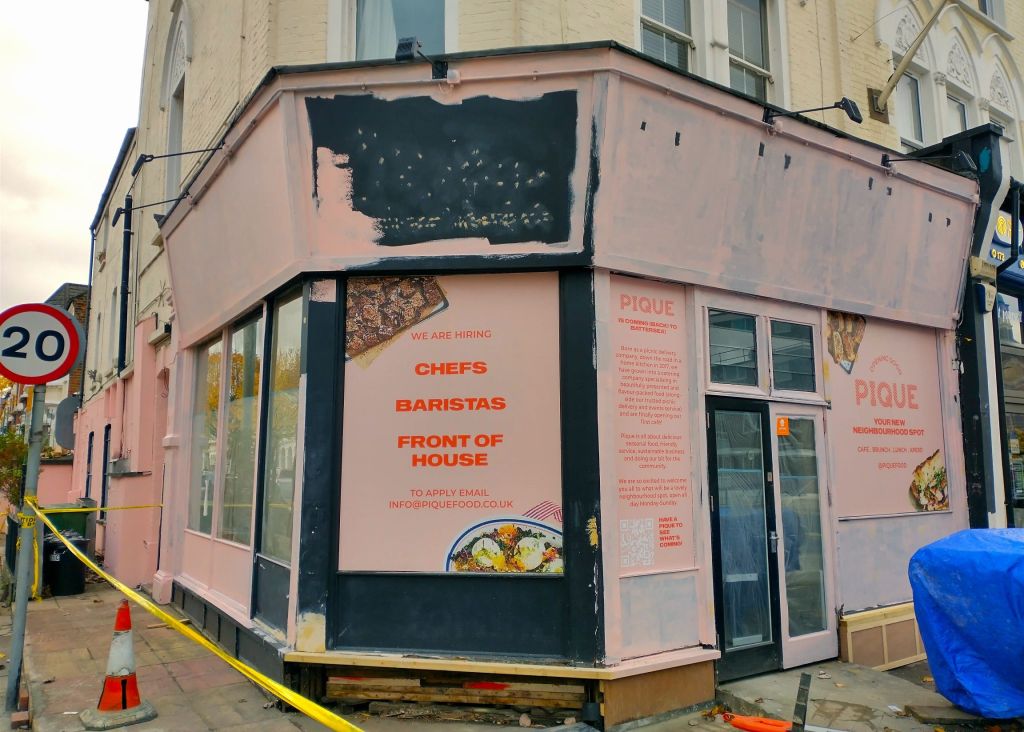
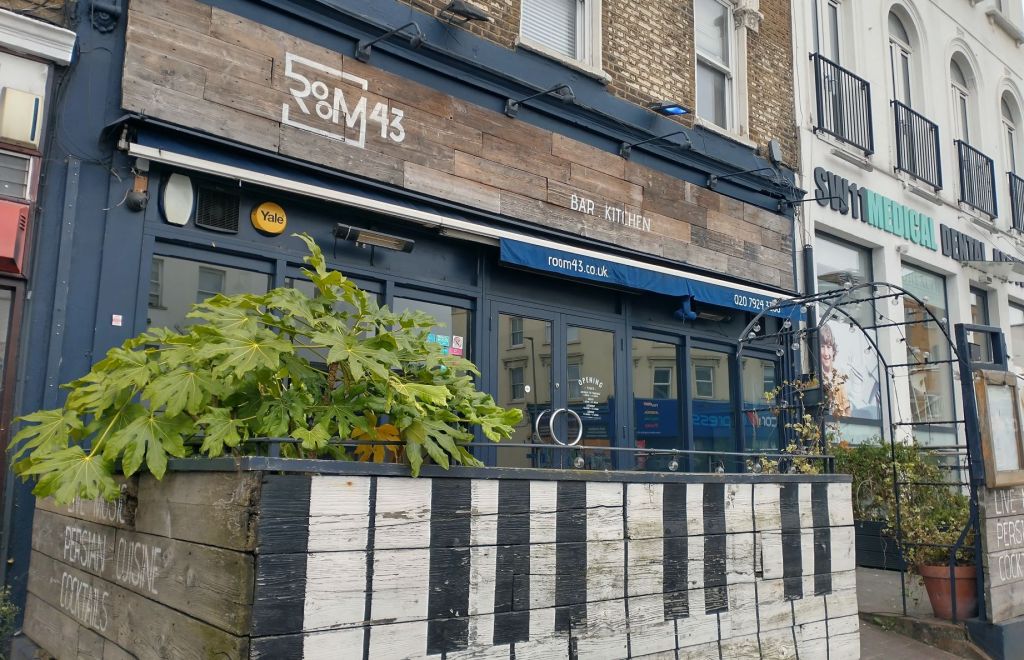
Room 43 at 43 Lavender Hill has closed – having become a popular live music venue, and quite a local favourite for many. As we understand it, it was good while it lasted but the business wasn’t making stacks of money and its owner’s heading on to new things. It’s been an orderly closure where the premises have been handed back clean and tidy for a new tenant – we hear it may become a cafe.

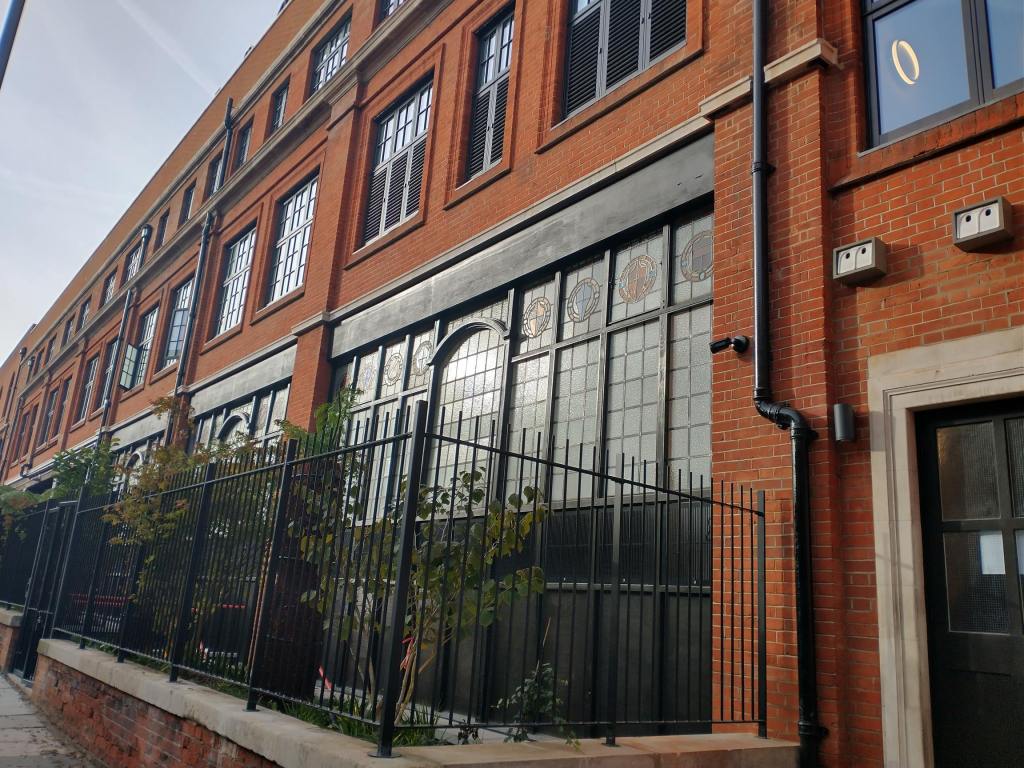
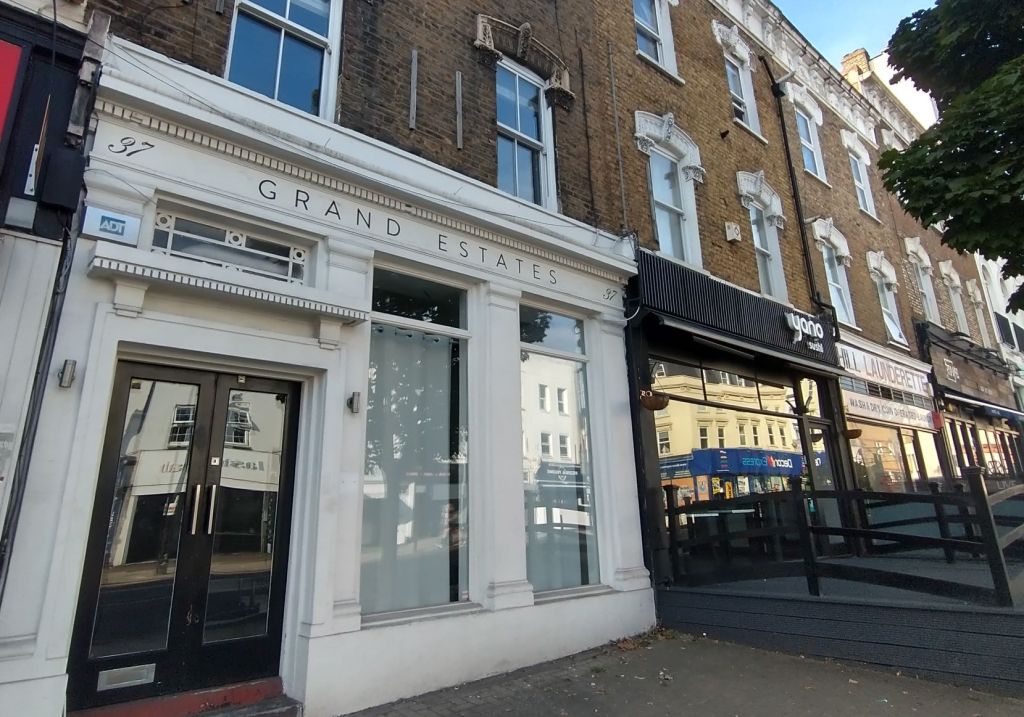
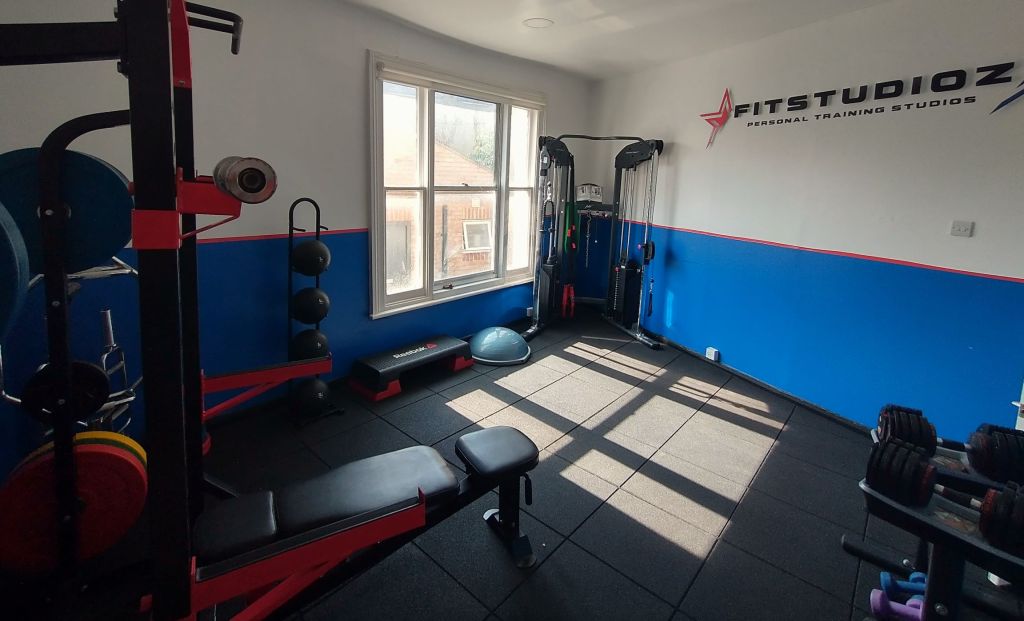
Grand Estates were a local property business, based in a former bank premises at 37 Lavender Hill (which still has a huge thick-walled safe room built in to the structure!) which has a long and varied history including as a recording studio called Lavender Sound Studios. They have been here for quite a while but have now moved on, and the premises has become a personal training gym.

The Hill Launderette next door is (as we have previously reported, with a short tribute article after years of service) awaiting some fairly minor building works to convert it to an animal grooming and daycare business. The front of the premises will house a reception and a selection of pet supplies for both cats and dogs – including packaged food and treats, and pet jumpers and coats, collars, leads and harnesses, grooming supplies like brushes, combs, shampoos & nail clippers, pet beds, toys, enrichment, and dietary supplements. The rear will be a doggy day care, including a stay and play section, small agility and enrichment stations, beds, water bowls, sofas and kennels for rest or isolation. There will also be a small soundproofed room for cat grooming. Yano Sushi at 39 Lavender Hill next door has closed at least for now, and its future is uncertain.

Snog, maker of frozen yoghurts, currently run a dark kitchen at 67 Lavender Hill, which serves the delivery trade only and is not open to the general public. It unfortunately had a fire break out because of an equipment fault – no injuries, but the premises remained closed for several months. Following building work to repair the damage they are now back in business.

Thermaluminium, who make aluminium windows and doors, are opening a small office and showroom in a shop that was once one of Lavender Hill’s longest running empty premises – and which had fallen in to ruin until it had a comprehensive refurbishment and extension, at 71 Lavender Hill (the junction of Lavender Hill and Rush Hill Road).

We’ve written separately about one of the most disastrous openings ever – where China Garden at 103a Lavender Hill took so long to fit out the premises that they were almost doomed from the start, and lasted just a few weeks. That premises has been cleared out for a new tenant, and we hope it goes better this time!

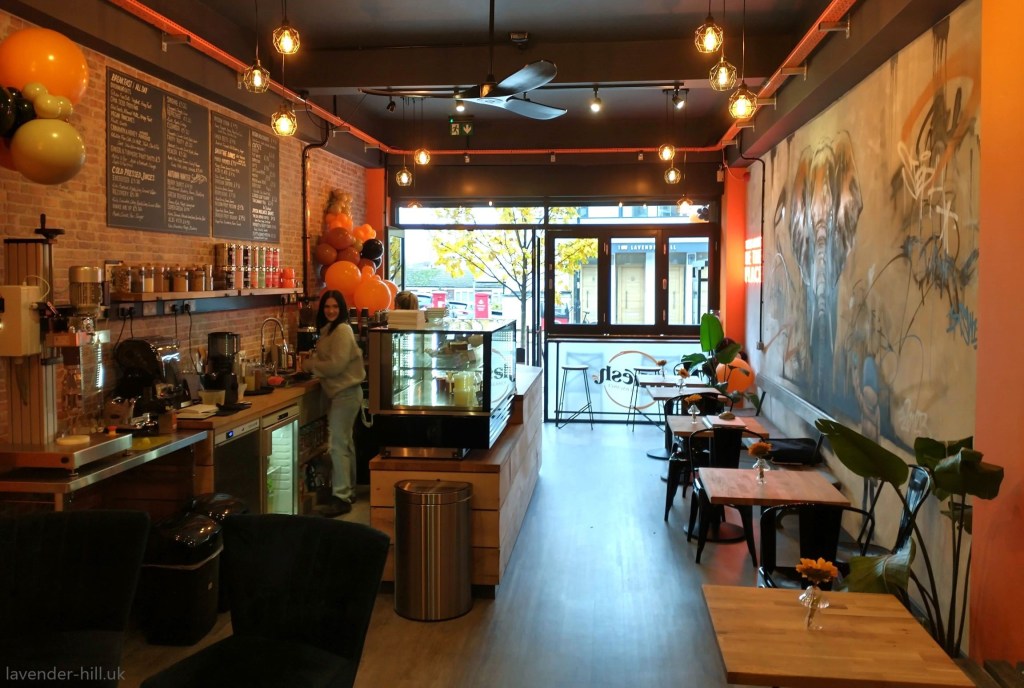
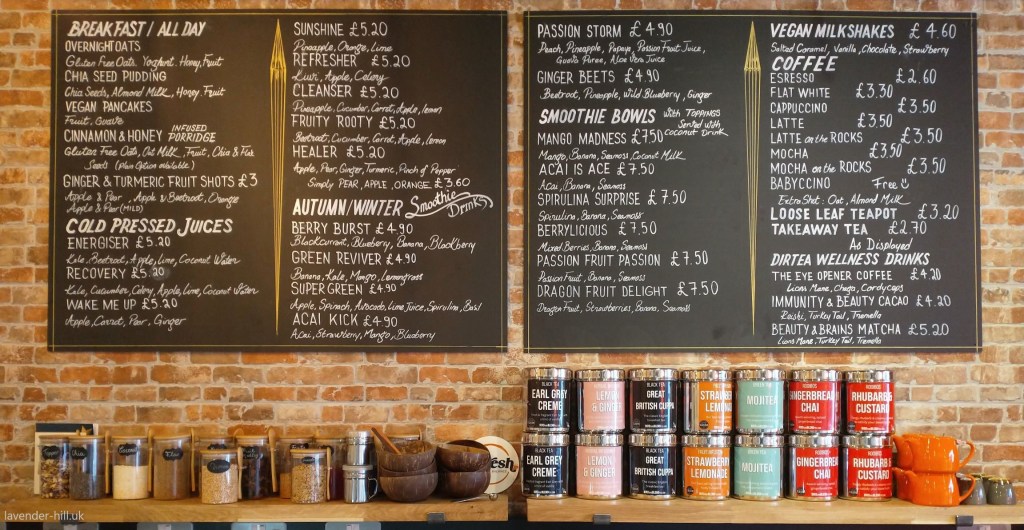
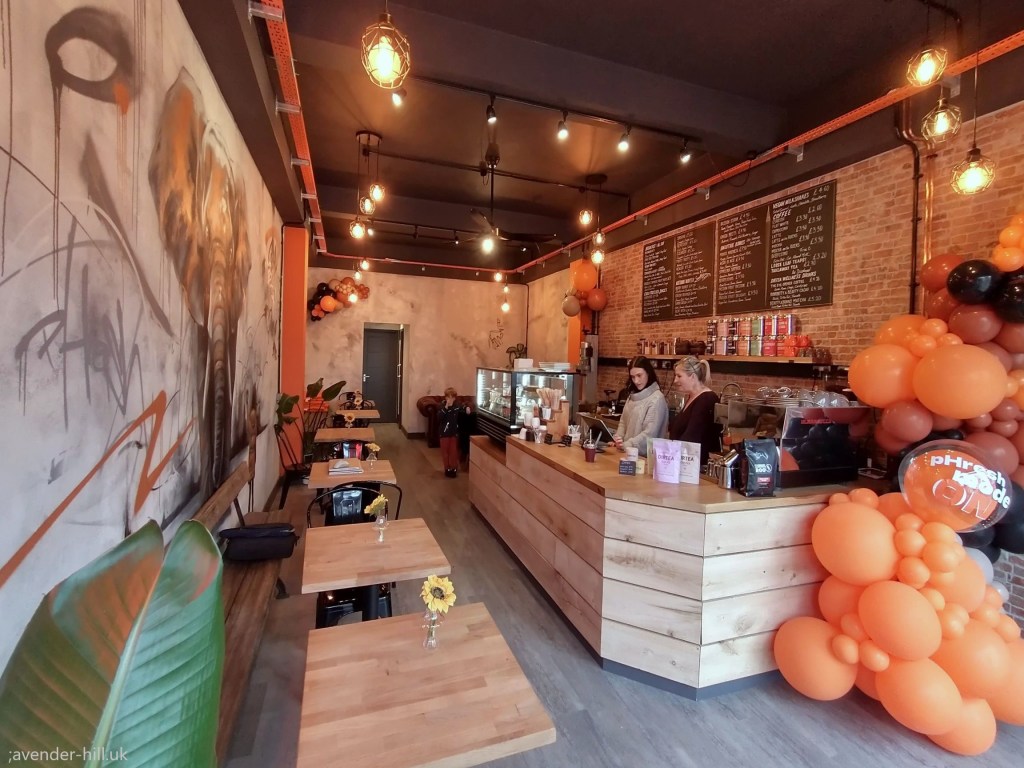
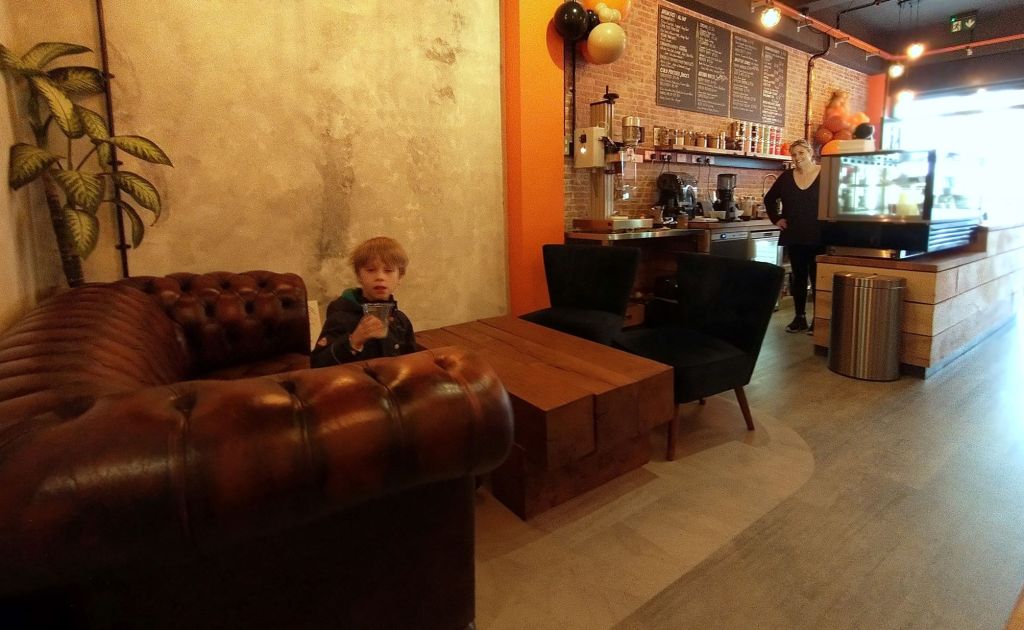
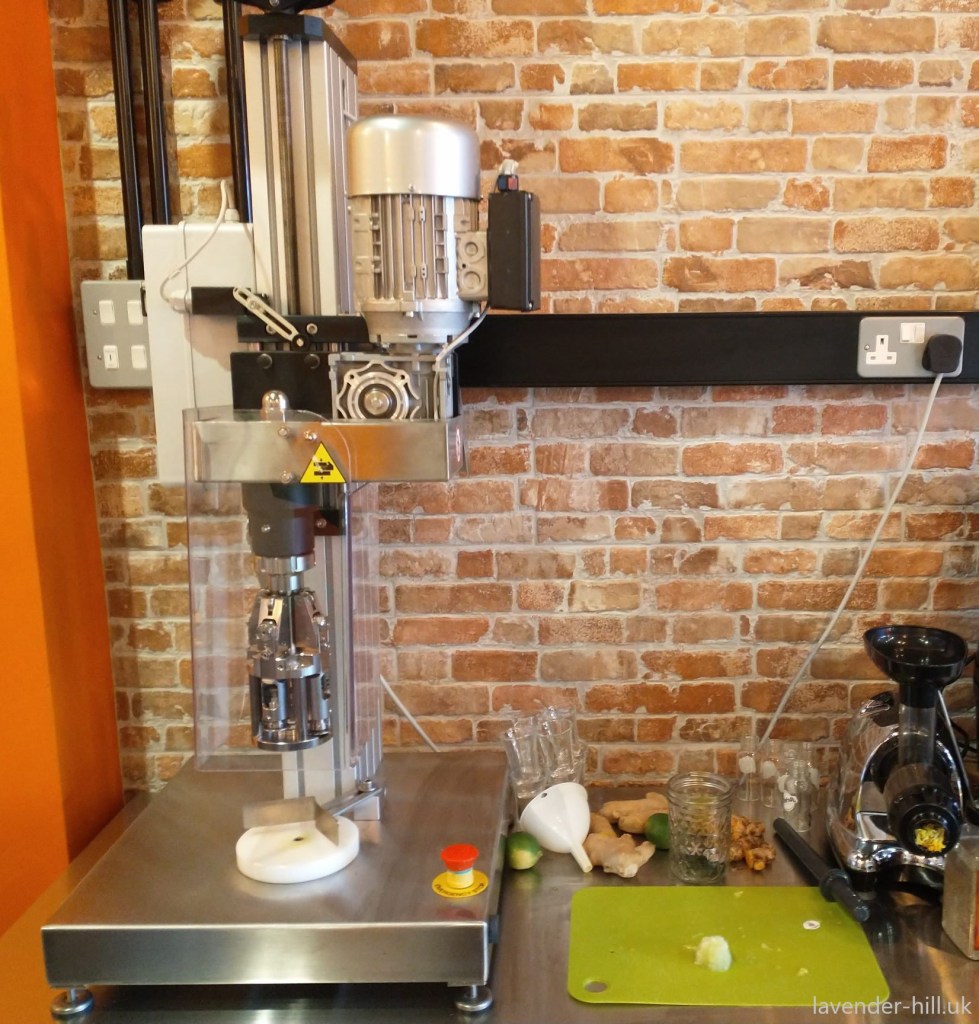
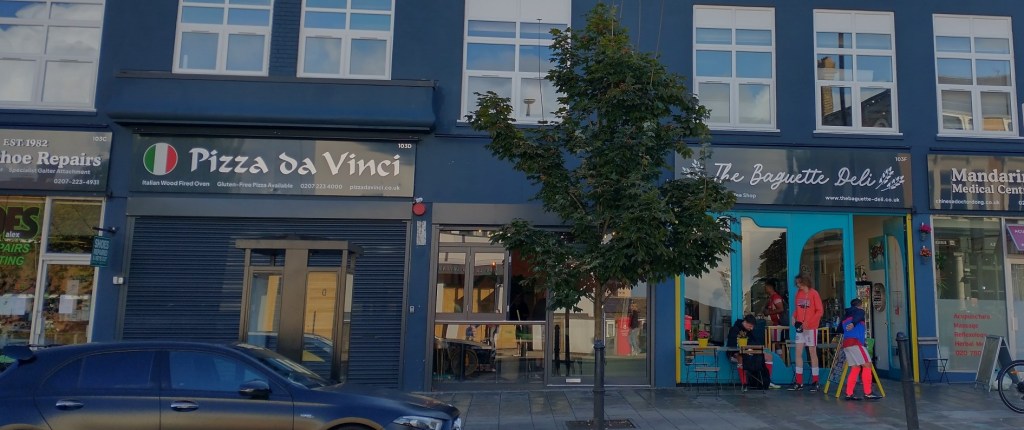
pHresh Juice will be opening at the end of November in 103e Lavender Hill – the premises between Pizza Da Vinci and the Baguette Deli that was previously Eve & Grace Wellness Centre. The place is looking smart already, and will offer cold pressed juices, ginger and turmeric fruit shots, smoothie drinks & bowls, specialty tea & coffee, healthy foods.

The whole row of shop units by the side of the Business Centre has had a spruce up, as part of a wider upgrade to the Business Centre that has seen new roofs, new windows and a lot of repainting and general tidying up – and as part of this, long established maker of proper wood-fired pizza Pizza da Vinci has also had a complete interior makeover – and has gone from being just a takeaway to also having indoor and outdoor seating. It’s quite an impressive change and the premises feels like it does them justice now.

Burnt Furniture – who opened at 125 Lavender Hill at the end of last year, and who specialise in up-cycling furniture, with an emphasis on highlighting the woods natural beauty using burning techniques and bold colours – are looking for local artists & designers who would like to sell their works at the shop.

Little dessert shop, who were about to open at 145 Lavender Hill in our update last year, are doing a healthy trade in delivering sweet treats – with a large range of iced coffees, milkshakes, waffles and crepes, cheesecakes, Italian gelato and cooke doughs.

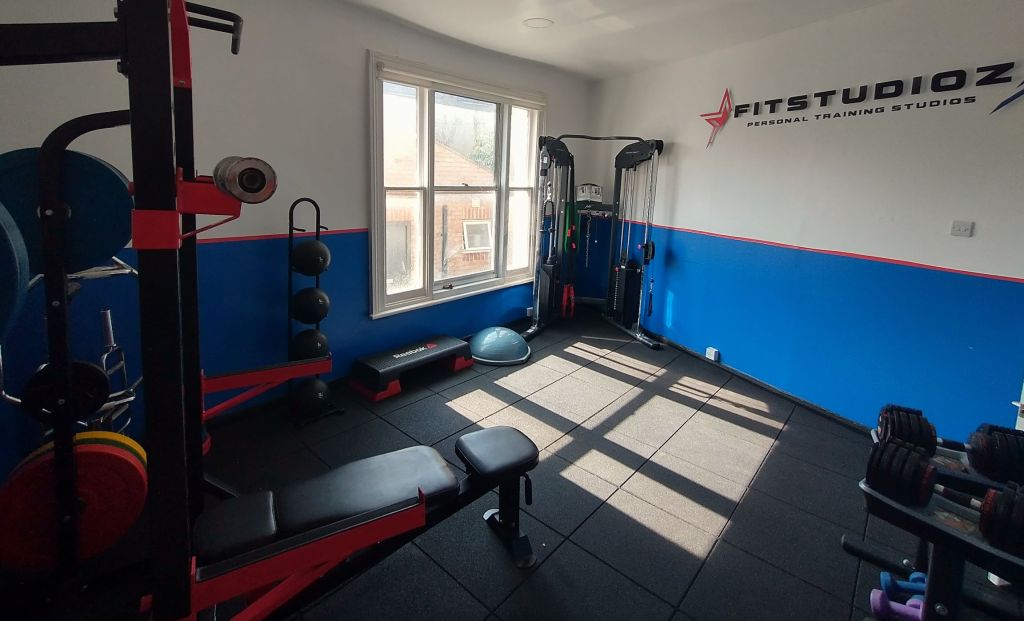
One of our favourite premises, the big high-ceilinged corner spot at 137 Lavender Hill, on the junction of Lavender Hill and Sugden Road, has opened as Fitstudioz, provider of bespoke personal training. As insured, certified fitness professionals, they offer tailored sessions by appointment, and are part of a small London-centered chain.

It’s a good space, with a weights area at the front, but several more hidden rooms behind that can cater, as well as for a wider set of treatments. It’s a well equipped venture in a good location, and we wish the super enthusiastic team success!

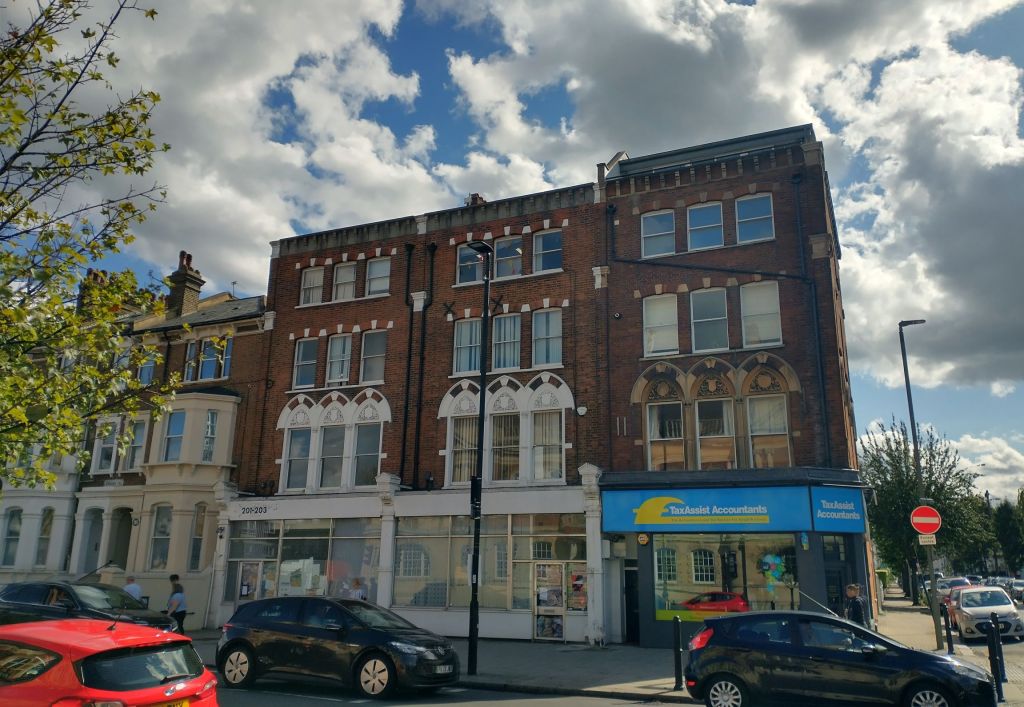
This was previously MyLondonHome estate agents, and their departure is part of a significant retreat and consolidation over the year, of what was a strangely large number of estate agents. Winkworth departed the vast space at 207 Lavender Hill, and were replaced by Noble Estates who lasted just a few months before moving to a rather very different site tucked away in a mews off Northcote Road, the space is currently empty. Courtenay, opposite Winkworths, were merged into ever-expanding Dexters – so the team transferred to Dexters’ existing premises immediately next door. And Gordon & Co next to the post office have been bought by Foxtons, so relocated to the Foxtons office. The survivors of this big shakeout are investing – with both Foxtons and lettings-only agent Winchester White investing in fairly extensive refurbishment works at their Lavender Hill premises.

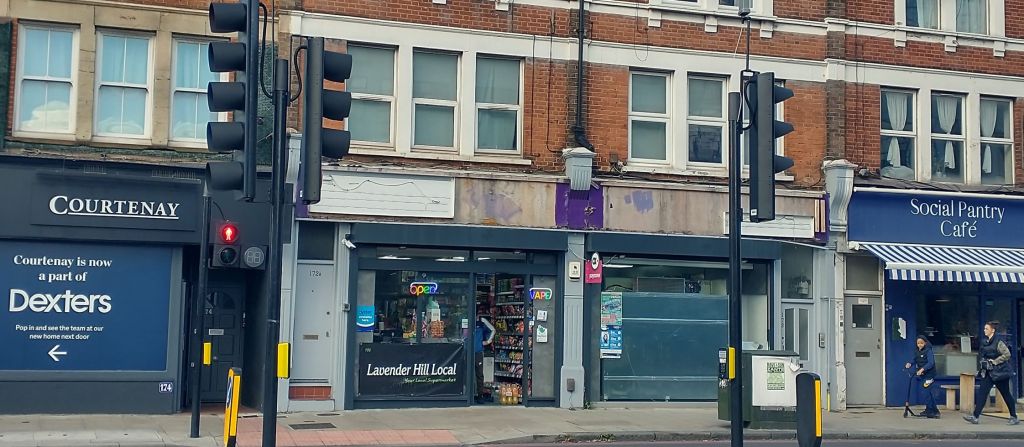
Lauristons estate agents at 172 Lavender Hill also completely disappeared, and have since become Lavender Hill Local, a brand new minimarket under the Costcutter franchise, oriented towards food and drink (with a decent chilled section) but also stocking household essentials as well as the usual vapes and off licence. They have long opening hours – but have yet to get permanent signage installed!

The former Royal British legion club at 173 Lavender Hill, which needed a pretty comprehensive rebuild after it was sold off by the Legion following a steep decline in numbers (and which we wrote about in 2021), has finally seen the ground floor leased to Colour Me Posh Nail & Beauty – whose grand opening was just a few weeks ago. It’s good to see this back in use after being empty for many years and our resident small child also appreciated the sweets on offer to celebrate the opening!

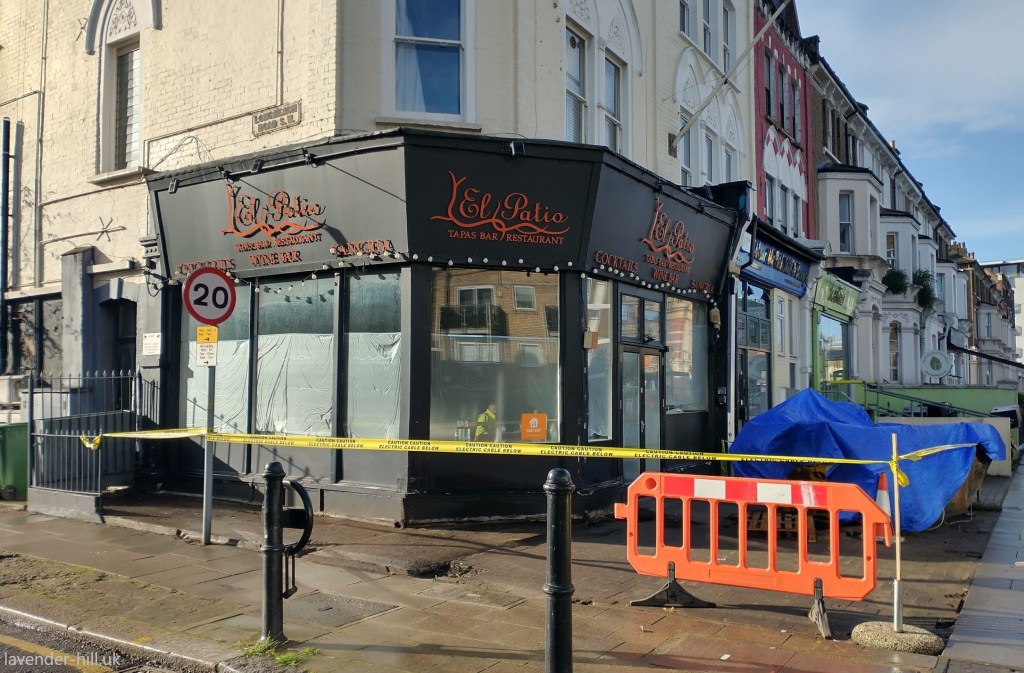
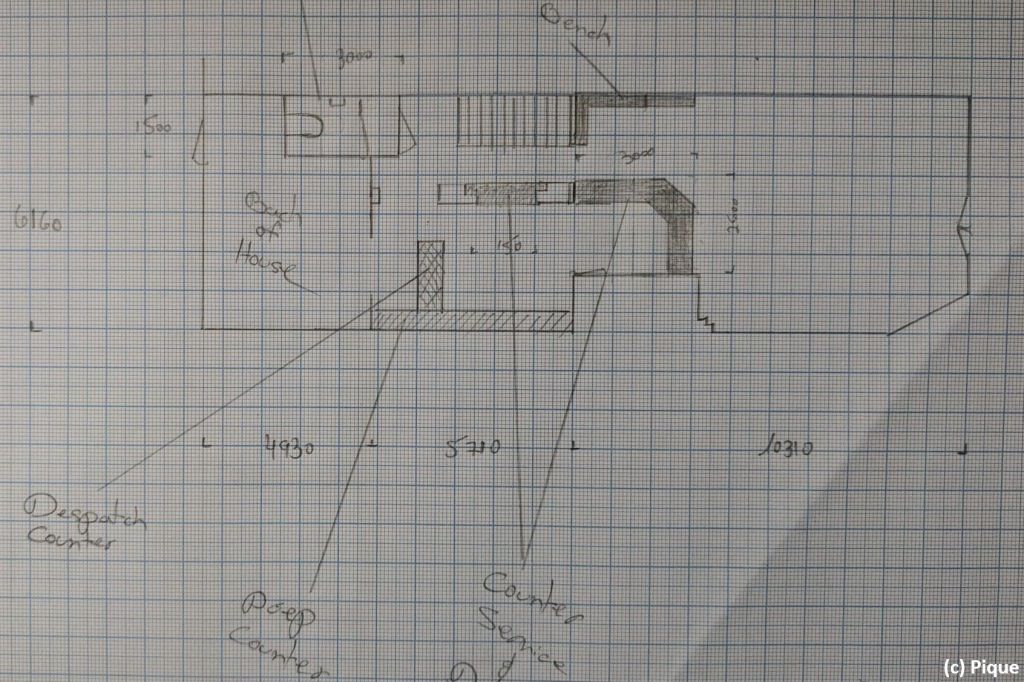
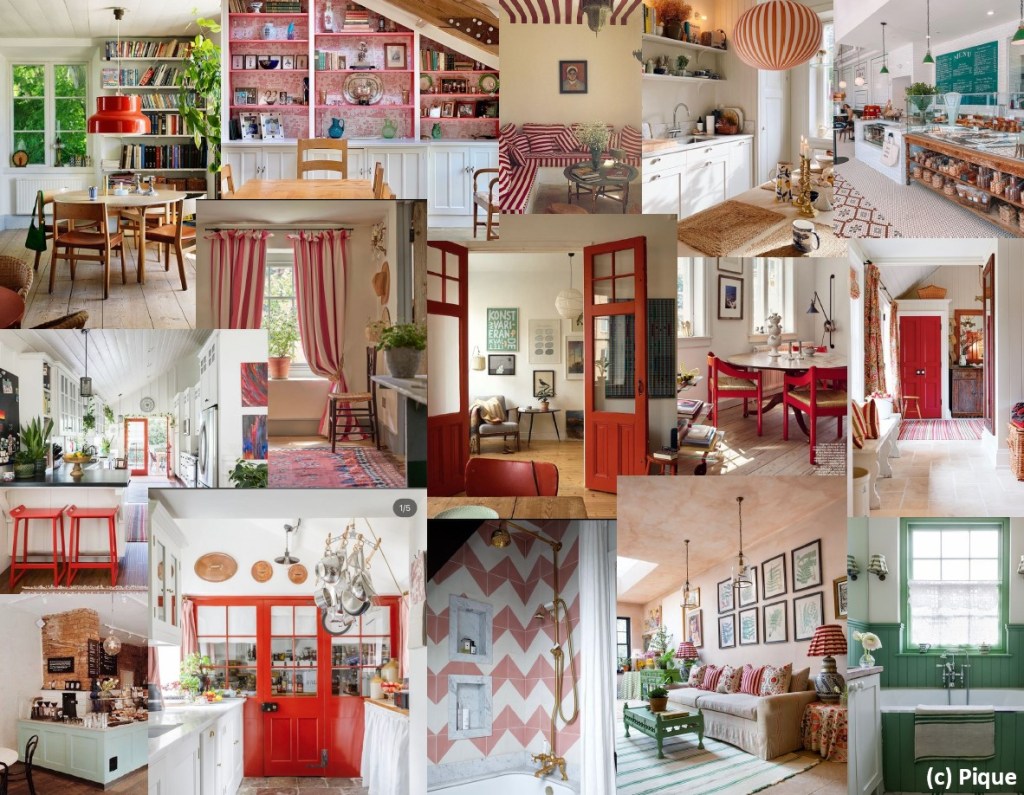
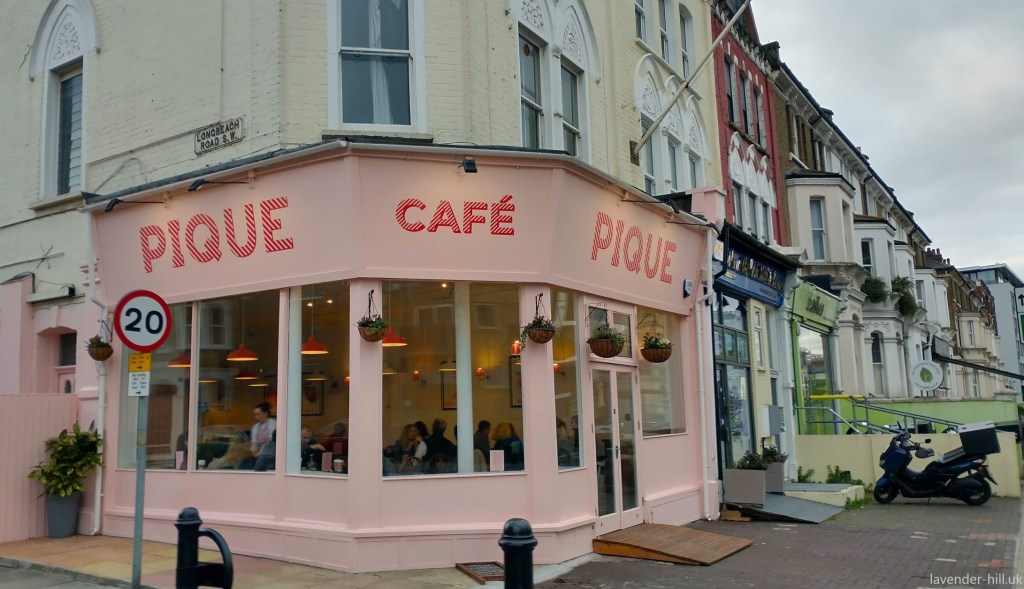
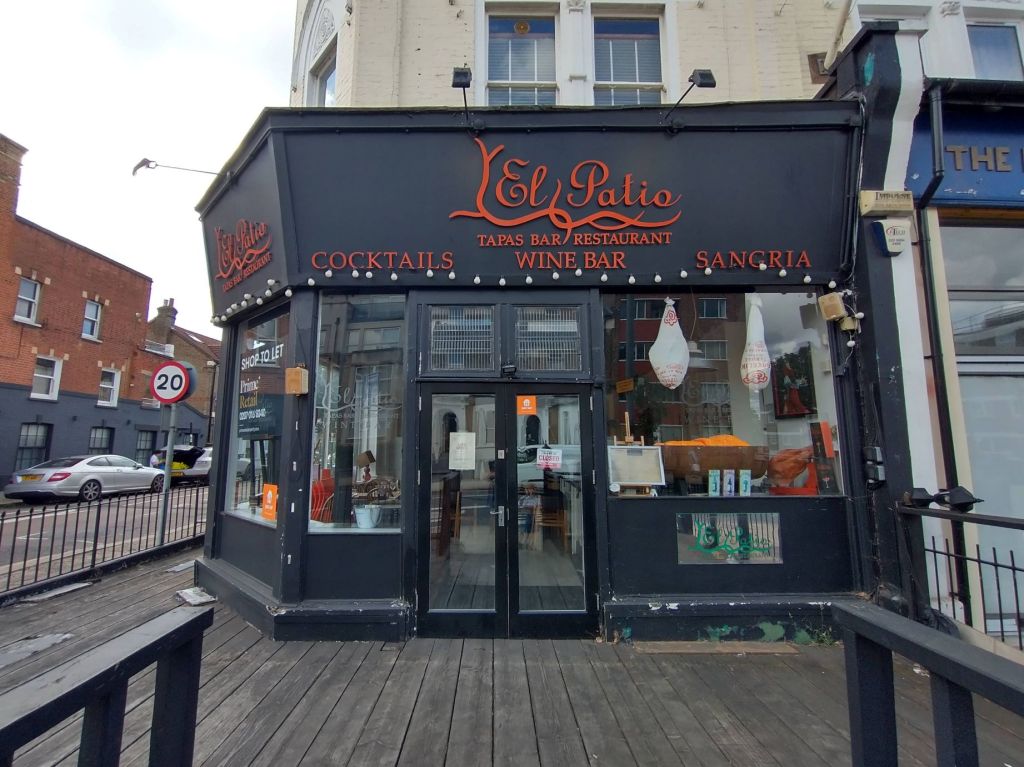
El Patio, right next door at 171 Lavender Hill, bravely carried on through the Coronavirus and beyond, but all things come to and end and sadly so it proved for this local venture. The premises was reclaimed by the landlord, and has sat empty (but fully stocked) for quite some months – although in the last few days lights are on and people have been seen inside the premises, with the ‘to let’ sign gone so we suspect something new is on the way.

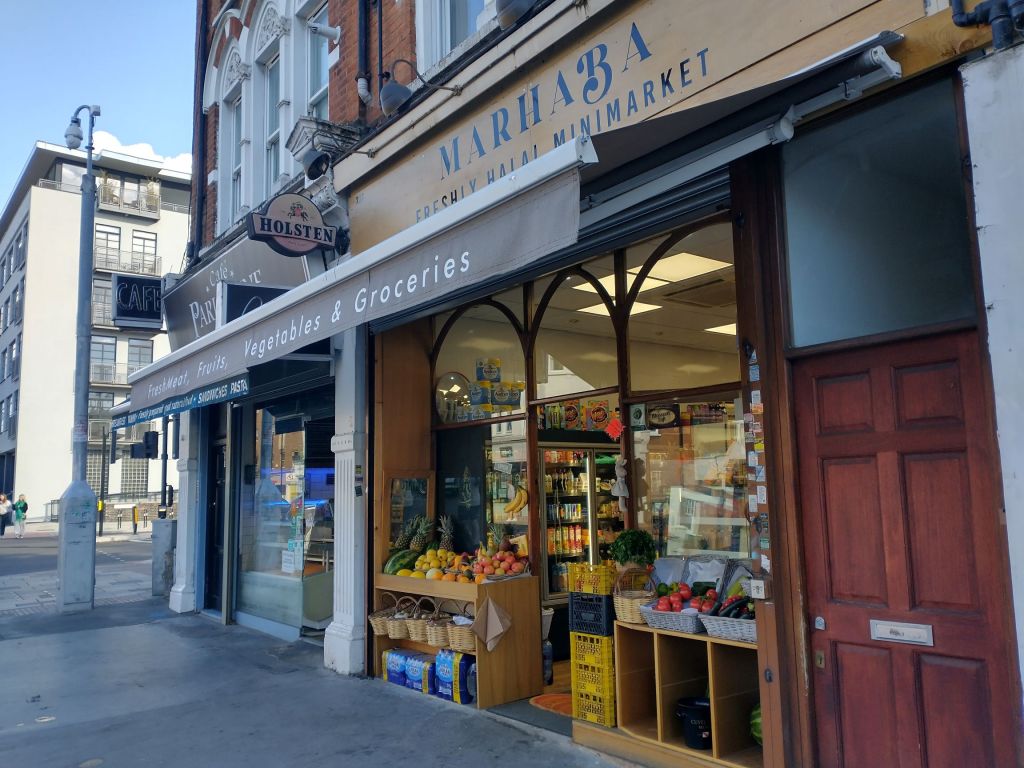
Heading west, we’ve previously written about the arrival of Mahraba Freshly Halal Minimarket – at 227 Lavender Hill, whose ever friendly and helpful staff stock fresh fruit and veg and a fairly eclectic mix of produce you won’t find elsewhere – and which has a small butchers at the back of the store.

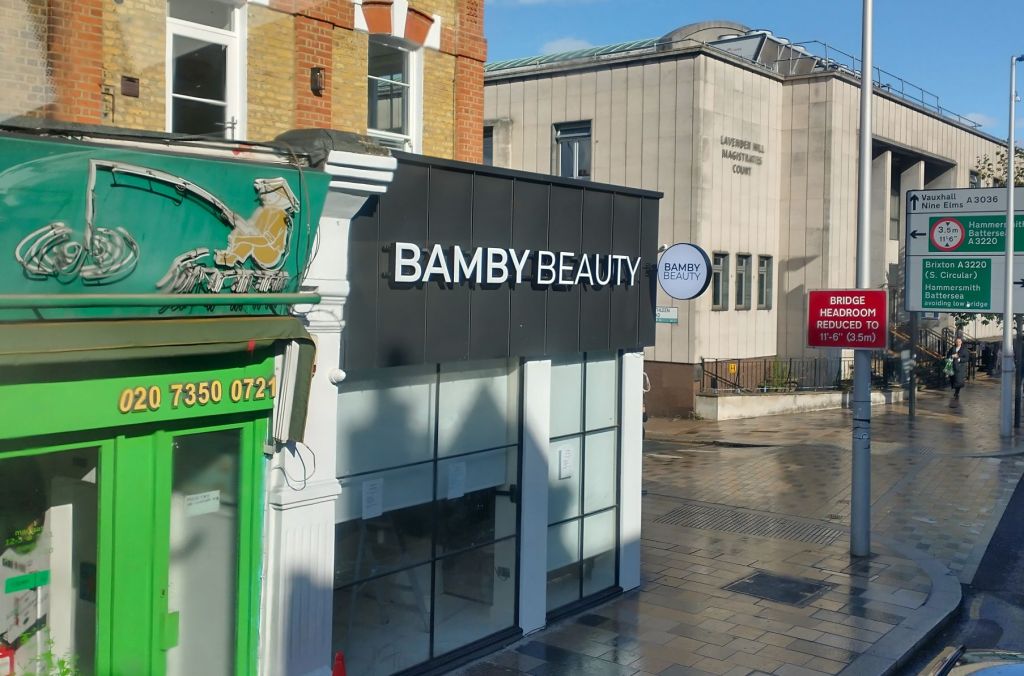
The building at 178 Lavender Hill, which has seen a notably high quality refurbishment by MAC Building Solutions (which included the old Victorian ghost sign on the side of the building being restored – our post on that here) has let its rather smartly kitted out ground floor to a new beauty operator, Bamby Beauty, who look a few weeks (at most) away from opening.

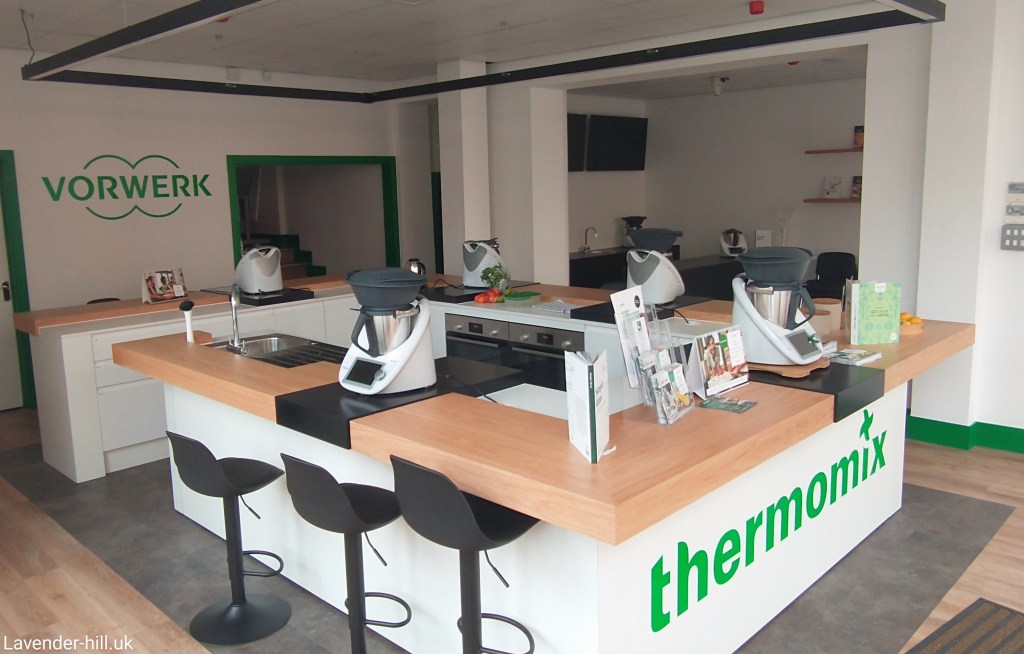
Thermomix, the retailer of high-end kitchen mixers which can also cook food, as well as tell you what to do to make specific meals, and who we wrote about late last year, have developed quite a healthy business, as it seems to the move from a rather deserted business park in Chelsea Harbour to a new location just a minute’s walk from Clapham Junction has paid off.

Finally – there’s always a note of chaos somewhere, and on Lavender Hill it often seems to be linked with the Thirsty Camel Food & Wine, which lost its licence in the summer. As MyLondon report, the Metropolitan Police initially ordered a review into the shop, and Wandsworth Council’s licensing committee held a hearing in June which was followed by a decision to revoke the licence, amid concern that the business was selling nitrous oxide to customers, and of a knife being found under the counter, ruling that “there was no appropriate alternative”. The Police reportedly said that ‘the shop had also continually breached conditions on its premises licence concerning CCTV, staffing and recording incidents‘. Thirsty Camel is a small family-run business, and no one wants to see these small ventures fail (least of all us) – but this sort of trade does no one any favours and we’re hopeful that they can now turn the corner.

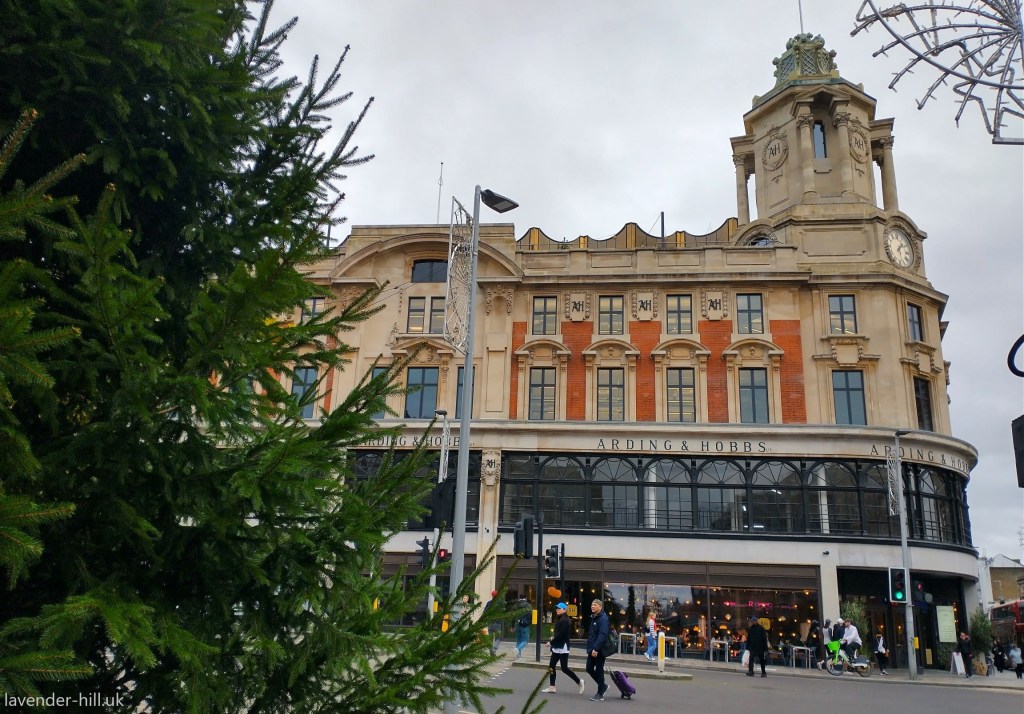
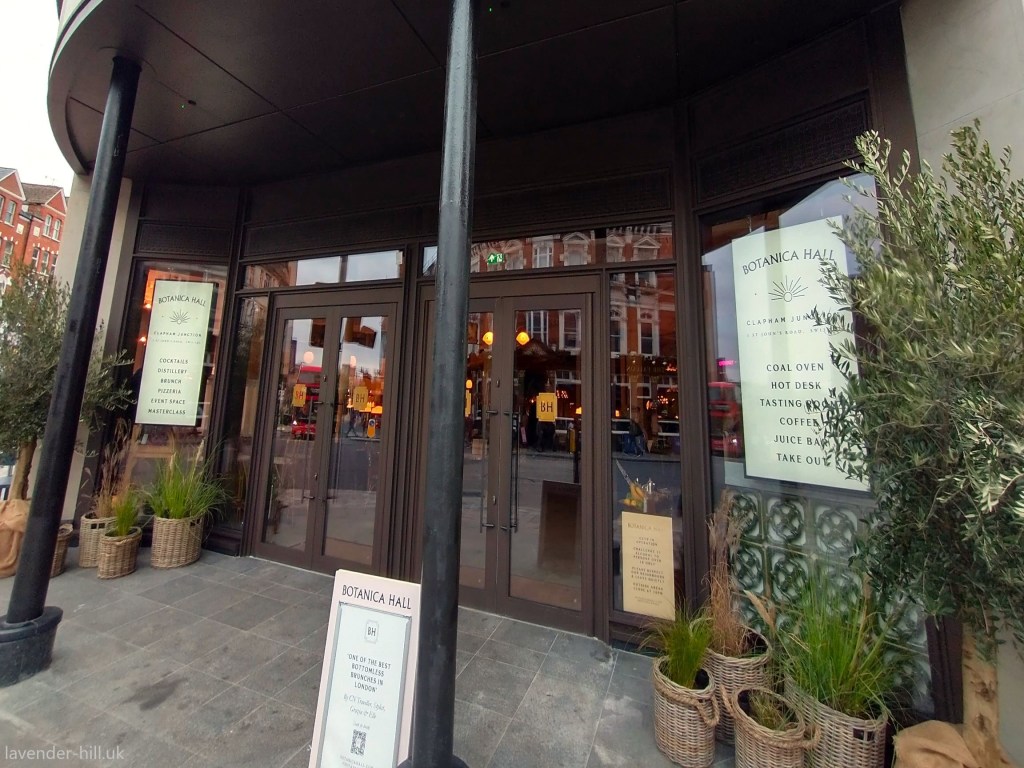
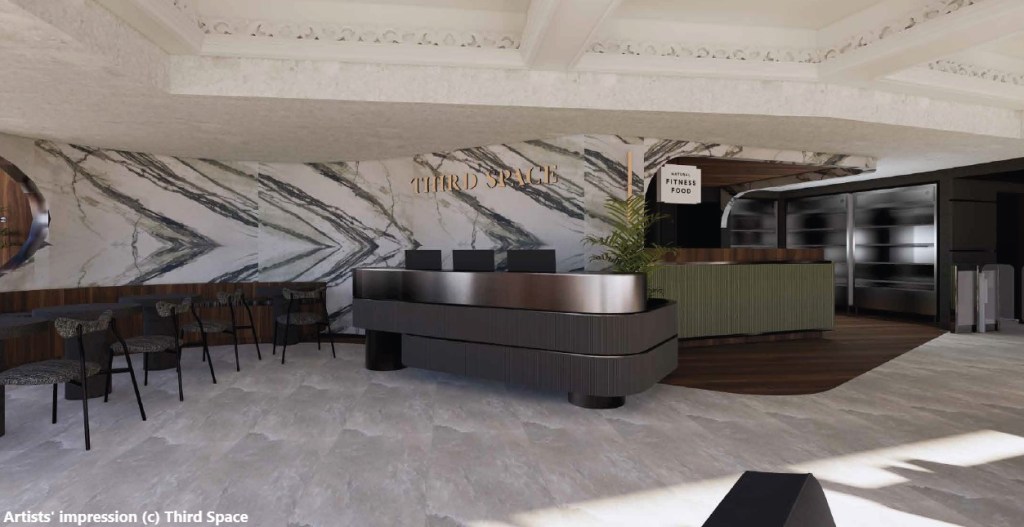
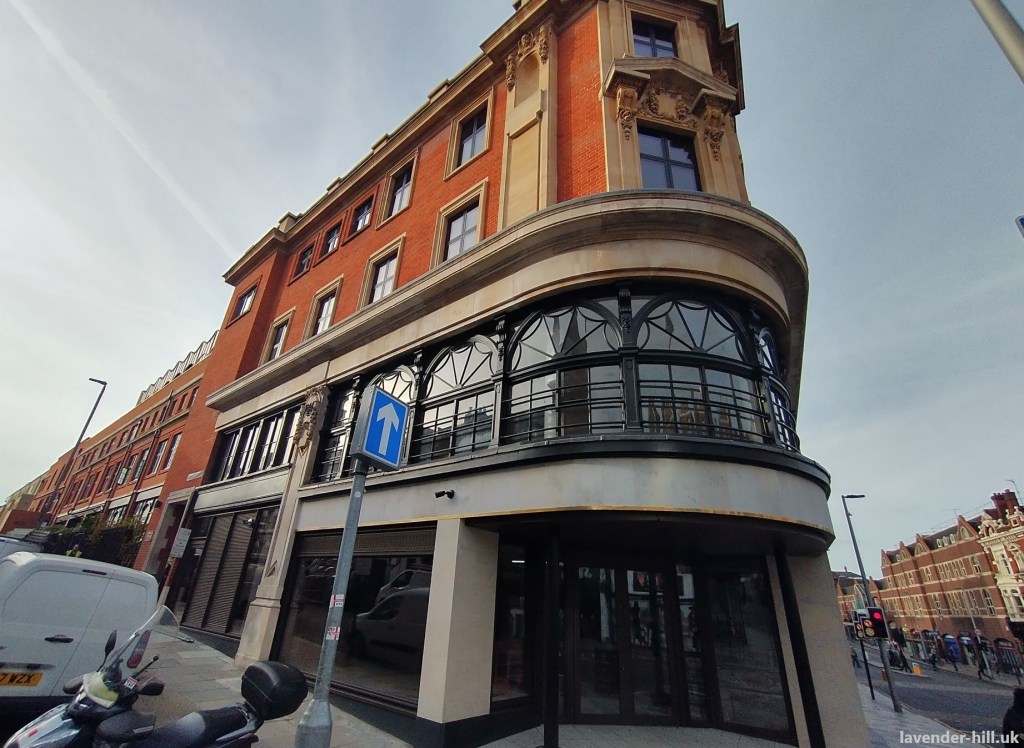
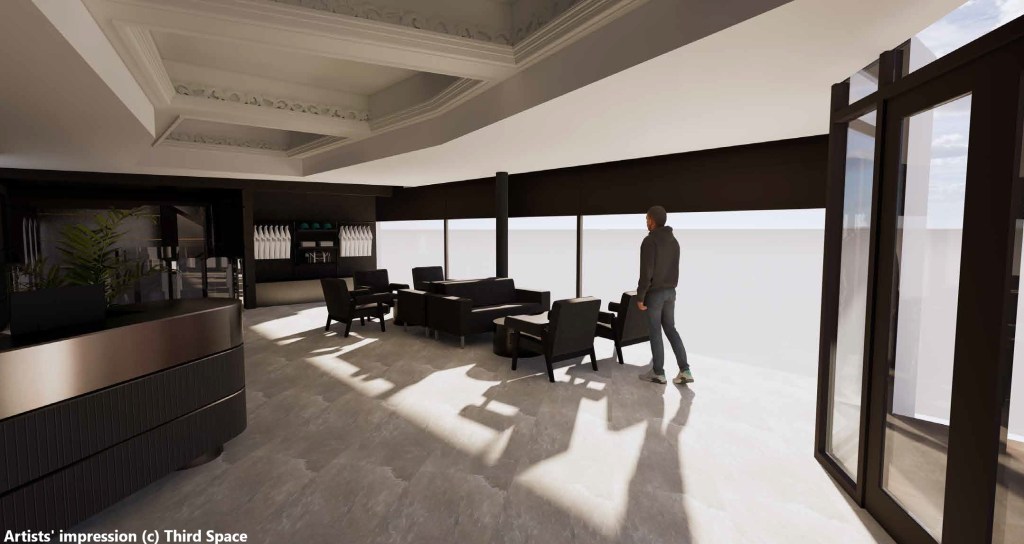
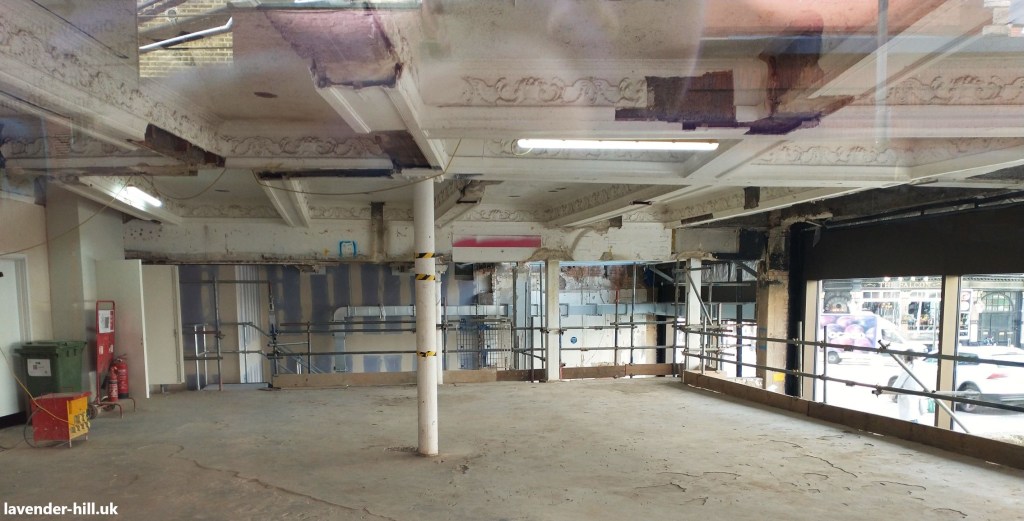
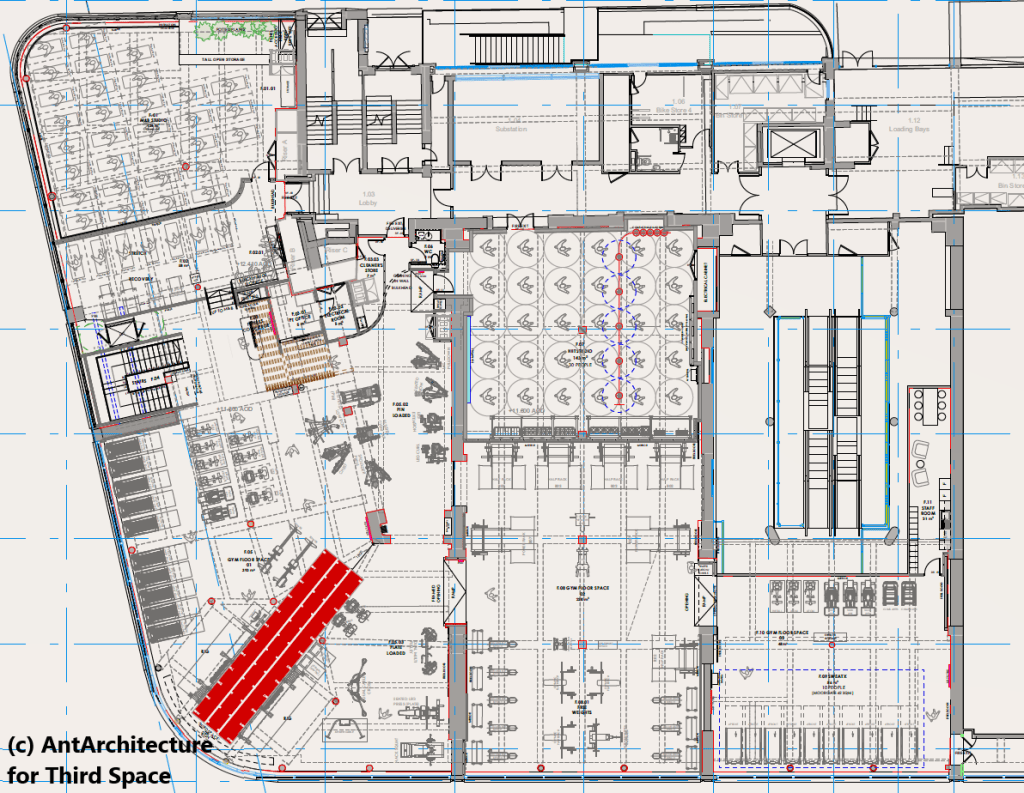
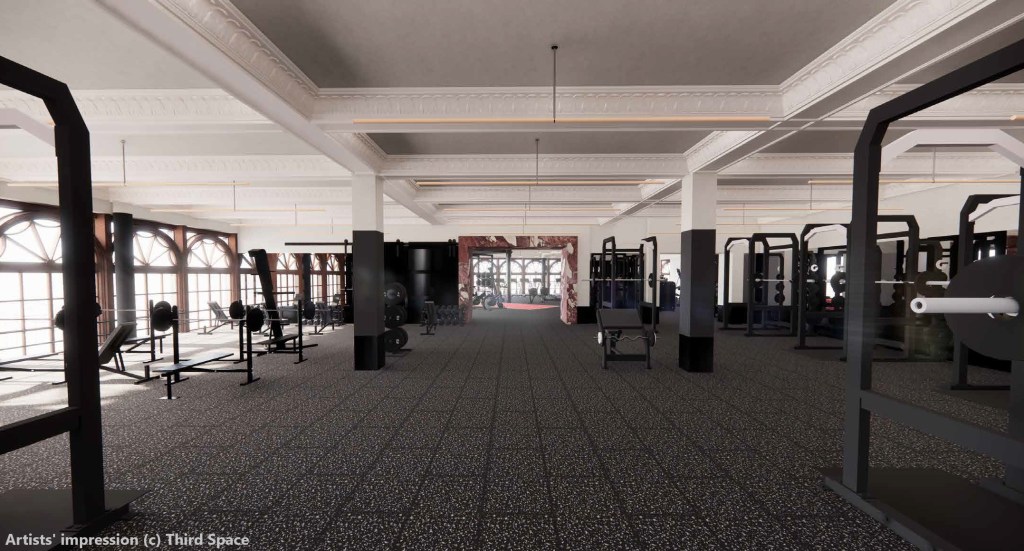
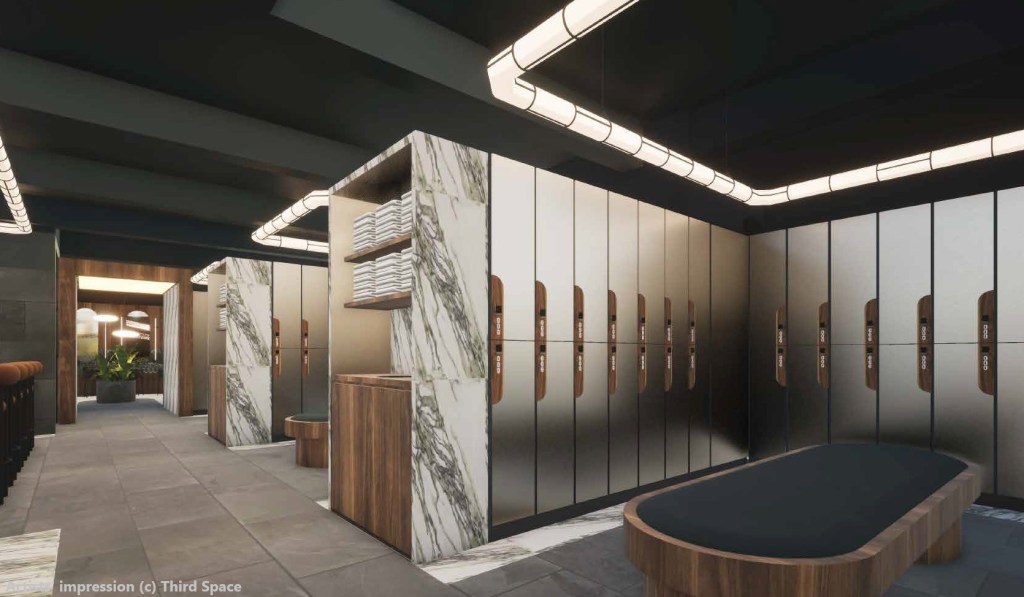
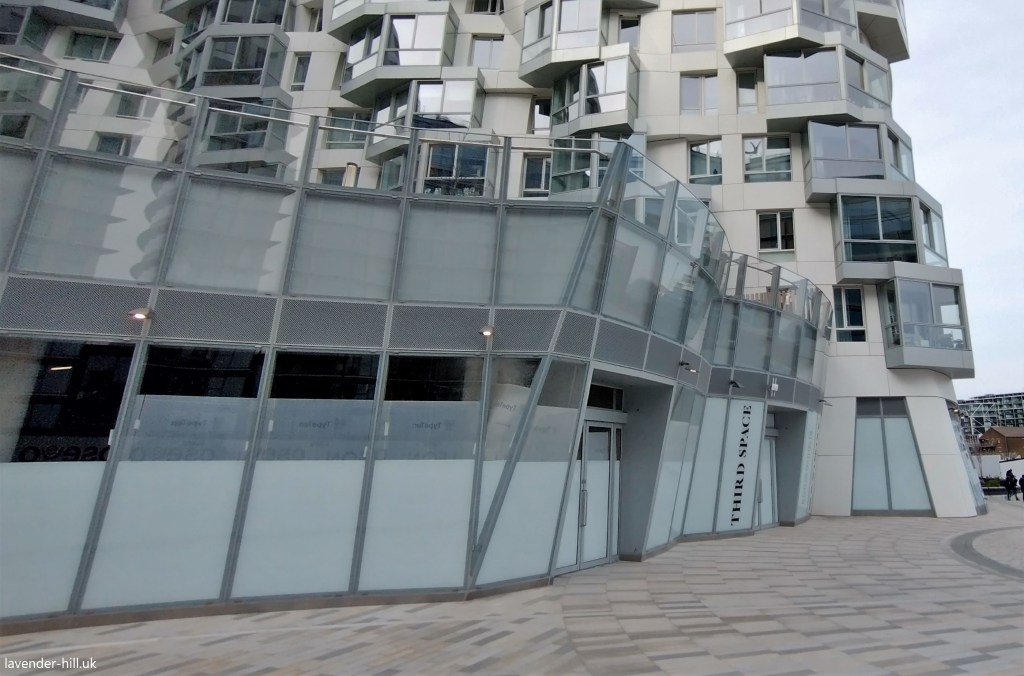
And finally, the flagship openings remain the tenants at the newly refurbished Arding and Hobbs. This has really come together in the last few weeks as the ground floor has been revealed and the gardens at the back and on the roof have been installed, and we can expect the first to get going to be Botanical Hall, as part of the Albion & East chain, to be followed some time later by a Third Space gym and spa over three levels, whose reception will be in the area pictured below. As we understand it one unit is still available, which is the one on St John’s Road that was at one stage lined up for Amazon Fresh until they scaled back their UK expansion plans. The full details here – and we’ll be doing a photo update on the redevelopment soon.

It’s been quite a lot of change over a year, and maybe reflects the difficulty of trading in a world of accelerating inflation, soaring utility bills and above all customers with less to spend. Lavender Hill is in one of the wealthiest parts of the country and trade here has fared better than a lot of other places – but it’s still been a tough year for many – and Lavender Hill still needs your custom. So when you’re looking for something or somewhere to go, do think of the hundred or so independent traders whose hard work, enthusiasm and imagination keeps things going on the street.

If you found this of interest you may want to see our wider articles on retail in Lavender Hill. Our 2022 retail roundup is here, with previous ones are here & here.

Posted in Business, Retail | 4 Comments

A house on Garfield Road may be converted to a 14-person HMO

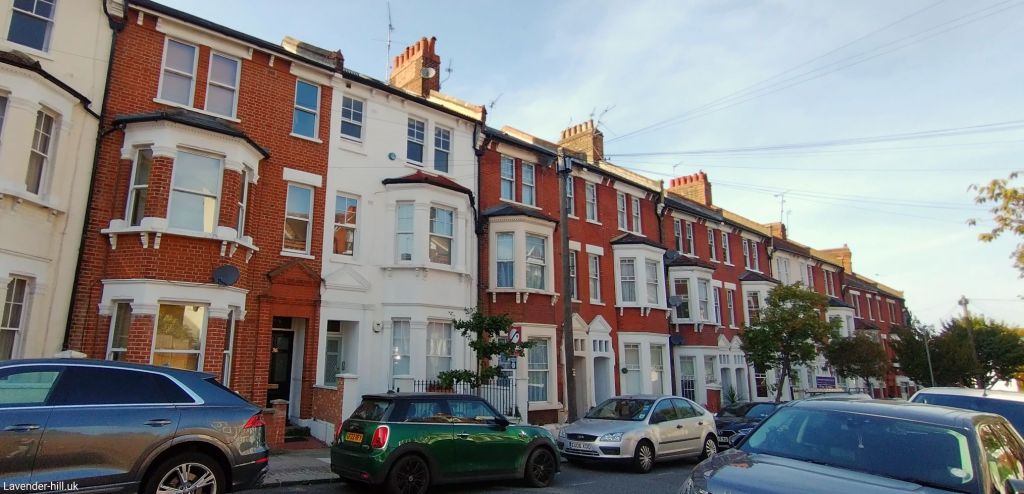
Plans have been submitted to convert 40 Garfield Road – a terrace house about half way along the street, just to the right of the white one pictured above – to an 8-bedroom, 14-person House in Multiple Occupation (HMO) spread over four storeys. The house was sold in a Savills property auction in November last year, for £950,000. It’s currently a three-storey terraced house, spread over three floors with over 1,700 square feet of space, split in to six bedrooms (though a couple of the current rooms are tiny boxrooms at the back), with two bathrooms and a small paved back garden. It’s currently a bit tired and dated, but in reasonable overall condition – we’ve seen much worse!

The new owners – who seem to be running the development via a dedicated company called Clapham Residential Ltd – first applied for planning permission to extend the house in May, getting approval to add an extension to the rear as well as raise the back of the roof to enlarge some of the tiniest rooms (and increase the number of bedrooms to eight). This sort of extension isn’t unusual for the street, and the Council confirmed that this was a ‘permitted development’ (i.e. that it fell within the scope of extensions to buildings that you’re allowed to do without needing to get planning permission).

Then in July the new owners put another application in to reorganise the inside of the property, to turn it in to an HMO – based on the enlarged property, with six two-person rooms and two one-person ones. HMOs are properties rented out by at least three people who are not from one ‘household’ (for example a family) but share facilities like the bathroom and kitchen; they are usually ‘let by the room’ rather than as an overall tenancy for the property. Under the proposals for 40 Garfield Road, five of the rooms would have small en suite bathrooms, with the rest sharing, and there are three shared kitchen / living rooms scattered around the house (which in principle would not be allowed to be used as further bedrooms).

HMOs can work well – they tend to offer small scale accommodation to those who would find it hard to stretch to a larger property, and in London their status of being something between a room in a flatshare and a fully self contained flat can appeal to young professionals, as well as to the wealthier end of the student market – and the past businesses of the people behind the Clapham Residential company profile suggest they have a fair bit of prior experience in similar room letting ventures. The going rates for accommodation round here suggest that it would be in a developer’s interest to aim for the upper end of the market, to make what would be a pretty healthy income from the building. That said, HMOs can also be a bit of a nightmare if they’re not closely managed and the tenants are not picked carefully – and there are a few other HMOs in the wider Lavender Hill area that are run at the bottom end of the range, where the landlords spend as little as possible while cramming as many people in as they can – which are notorious for chaos, and cause real headaches for the neighbours and aren’t much fun for their residents. Whichever route this one takes, it would undoubtedly turn the house in to a notably densely inhabited property – few of these houses currently hold 14 people! – and add a fair bit of new population to the street on one go.

The planning application argued that the development was within permitted development rules (which the property extension is) – but permission is still needed for a change of use. However, while we were writing this post the application was withdrawn – which sometimes is because there has been negative feedback from the planning officers – but which can be for lots of other reasons as well, including developers wanting to update plans. Something will happen to the property, so we suspect revised plans will be back in the relatively near future. If you want to see what was proposed, go to wandsworth.gov.uk/planning and search for application 2023/2385 – which was seeking approval for “Alterations including erection of single storey rear extension and dormer roof extension to main rear roof in connection with change of use from dwelling house (Class C3) to House of multiple occupation (Class C4).

If you’re interested in development plans in the Lavender Hill area you may find our other posts on planning policy of interest, as well as our occasional series on local development projects.

Posted in Planning, Street by street | Leave a comment

A new rough sleepers hostel opposite Battersea Arts Centre?

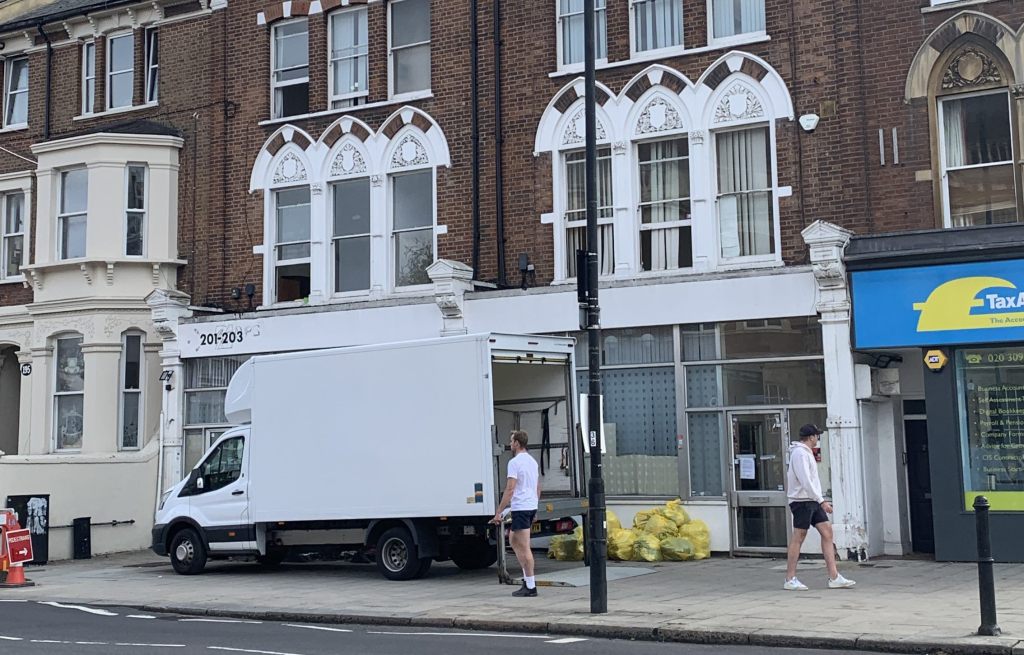
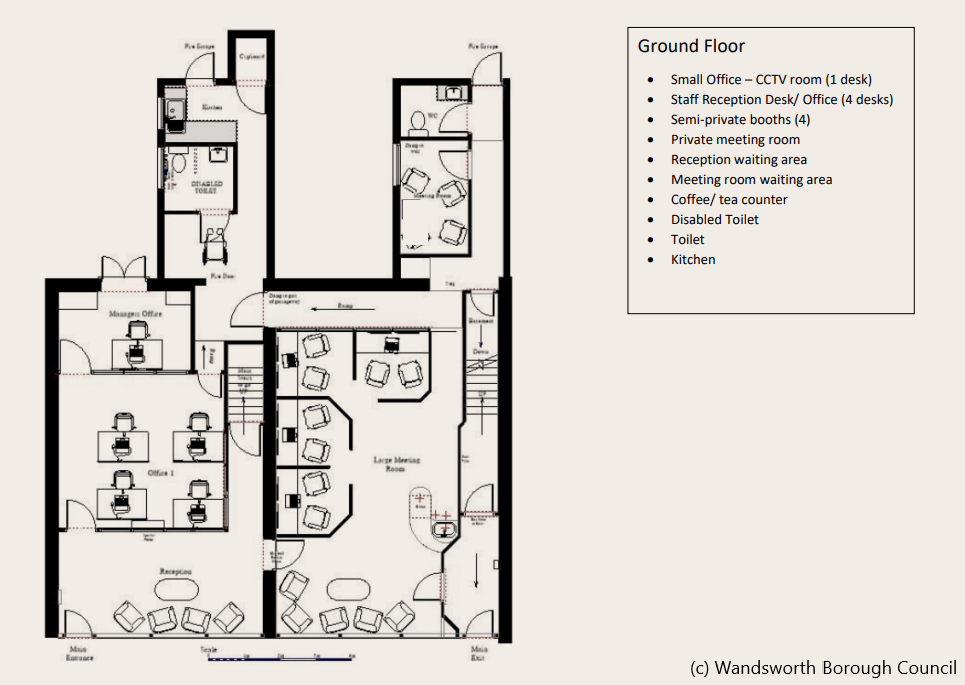
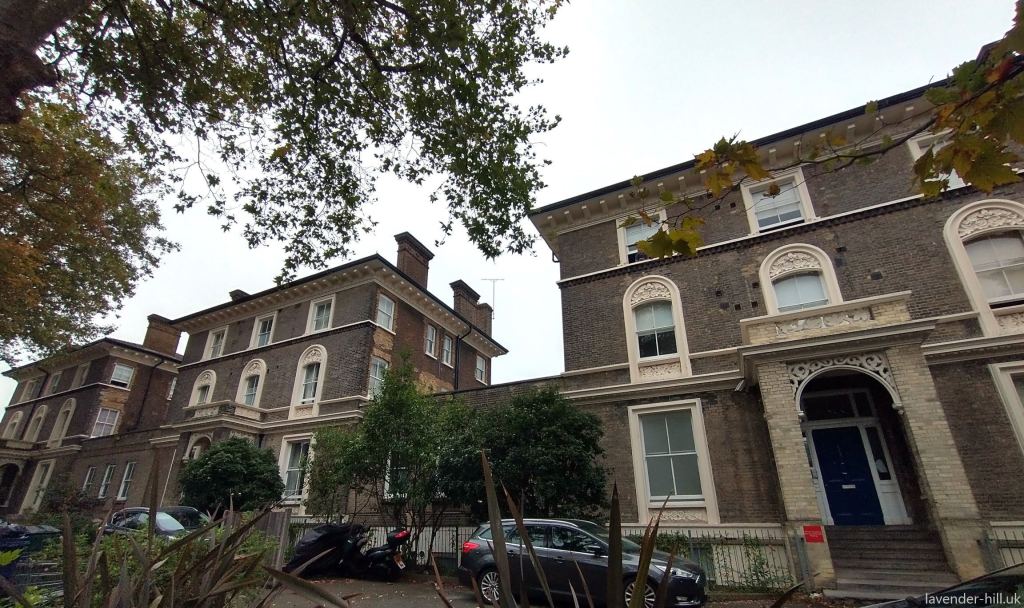
Plans have emerged to convert a small office building on Lavender Hill to a new hub for rough sleepers. 201-203 Lavender Hill, pictured above, would become the Borough’s new ‘rough sleeper assessment hub’. Part of the proposal is a traditional ‘homeless hostel’, which aims to provide a bed for the night for people sleeping on the streets, and gradually move occupants on to sustainable long-term accommodation. But the plans provide quite a lot more than just a hostel, with a relatively large number of on-site staff to provide advice to the residents and a variety of specialist services – supporting them to access specialist services and move away from the dangers of rough sleeping. Some staff will also be on site overnight, to maintain safety on site, given that the residents at hubs can often experience a variety of challenges including substance and alcohol addiction, poor mental health, offending behaviour and histories of abuse.

The planned ground floor, whose layout is shown above, would have a reception desk and a small office space, as well as a small coffee and tea area, a set of semi-private booths where staff and homeless customers can have discussions, and a private meeting room, to accommodate various appointment and drop-in services that will be provided at the site. The upper floors would be a series of hostel bedrooms, as well as an office for night duty staff – with 9 private rooms and a further two beds in an open plan area. The customers of these facilities tend to be predominantly male, but not exclusively so – and in a thoughtful move the planned hostel includes a female-only bedroom and bathroom that’s slightly separated from the rest of the hostel and (by being closer to the night duty office) offered a degree of safety from the rest of the residents. The top floor, which will be ‘staff only’ with secure access, has a larger office space with 17 desks, to accommodate the Rough Sleeper Housing Assessment Officers, Homeless Healthlink workers, Drug and Alcohol Homeless pathway and Outreach teams.

There’s no doubt that rough sleeping is a challenge for London – and a more complicated one that many realise. For starters, we’ve all seen the flood of dubious ‘homeless’ beggars dropped off daily by vans at Clapham Junction and other crowded areas in the Borough – and they’re generally not homeless! They have more serious problems though – as they’re mostly victims of modern slavery, being exploited by some pretty well organised criminal enterprises, who keep much of their takings. The ‘real’ homeless are often a bit more hidden – with a fair share of people used to a life of passing under the radar in a world of undocumented and casual labour, where ‘home’ often means quietly squatting in vacant office space or bouncing around from one overcrowded slum to the next, until something goes off track and they’re on the streets. There’s a group of people in short term difficult situations – with relationship break ups and financial difficulties all able to tip people into homelessness. There are specific groups like former prisoners, who can emerge from years of a relatively institutional lifestyle to a world that may have moved on without them, and who find it notoriously hard to get the things going you need to find work and pay rent. And then some – quite a large portion by most accounts – have severe and complicated issues of drug and alcohol dependency, often coupled with various mental health challenges, and may struggle to manage a tenancy.

Wandsworth currently has no accommodation that rough sleepers can be placed in at short notice, meaning they are placed in temporary accommodation miles away from the borough and without access to locally provided support services, which harms efforts to bring them off the streets – and which is also expensive for the Council. Looking at what seemed to work elsewhere led to a plan to develop a local co-ordinated hub – that would act as a location for services to the homeless like specialist support and health need assessments , as well as providing eleven short-stay accommodation beds that could keep people local while work is underway to see what sort of housing they are ready for. It’s a bold idea, and a fresh attempt to tackle the challenge of homelessness with a more root-and-branch approach than just putting people in hotels, and generally a laudable aim. So much so that central government (the Department for Levelling Up, Housing and Communities) liked the sound of and agreed to partly fund it up to 2025 with a grant from central government, as part of the Rough Sleeping Initiative.

That said – while the benefits in general are clear, hostels of any type can be problematic neighbours, and we don’t expect this proposal to be popular with those who may feel its side effects more locally. There are several already up and running across London – including in Croydon, in Barnet, in Brent, and in Shepherds Bush – as well as around the country. The experience of their neighbours has been pretty mixed, and seems to depend strongly on how well the hostels are managed, whether the staff run a safe environment for the residents themselves, and how they handle any poor behaviour – some operators seem very competent and effective while others have been criticised for tolerating violence and intimidation inside and outside their sites. A councillor whose ward includes a large hostel run by St Mungo’s in Brighton (one of several controversial sites in the city) reported that “so far this year there have been 38 incidents, 11 emergency calls, and ten urgent calls… it is somewhere many residents pass in the evenings with more caution. I’ve been informed that many people circumnavigate the site from a fear of anti-social behaviour and because it does not feel safe.

Some residents will inevitably have patterns of aggressive behaviour, which can be intimidating for everyone in the vicinity. Some hostels provide vouchers for residents to buy food nearby, but this won’t tend to stretch to alcohol or other substances meaning hubs can still lead to increased theft from nearby shops, and sometimes aggressive begging. At some sites, residents banned from drugs and alcohol on site congregate in nearby streets instead, causing nuisance and intimidation for neighbours and drawing in wider criminal activity. A concentration of residents with complex conditions and unpredictable behaviour can in some cases lead to safeguarding problems if hostels are too close to other vulnerable people (an issue that may also apply here, with a day nursery immediately next door).

The planning application documents argue that “A considerable body of research in dealing with the effects of rough sleeping indicate that rough sleeping has a number of negative consequences for society more generally, such as anti-social behaviour and other street-based activity such as begging. Tackling the underlying drivers of rough sleeping as intended with this Hub, should have many associated benefits for the community and the broader Lavender Hill locality.“. This is true, although clearly concentrating the Borough’s entire homeless service provision at a fairly quiet edge-of-town-centre location will be a bit of a gamble and is likely to have negative effects for some residents and traders.

It’s not a huge change, in ‘planning’ terms, to the site – a Council-owned building which has recently been empty and taken over by squatters (the photo above shows some what they left behind being cleared out). The previous office housed a variety of Council-led services, including the Wandsworth Independent Living Scheme, which provided support to young people leaving the care of Wandsworth Children’s Services and to those who have moved into supported housing. No proposals have yet been made to change the appearance of the building, instead the main change in planning terms will be that it’s now becoming a residential facility with potentially complicated residents, rather than an office building.

There are a lot of things that could be done to minimise the downsides – sometimes as part of independent ‘Good Neighbour Plans’ that could be imposed as a planning condition. Other similar hostels have been required to provide 24 hour ‘complaints hotlines’ based in the service, and to advertise it prominently to local residents and businesses if residents cause problems, to ensure problems can be dealt with quickly and avoid the only option for neighbours being to add to the queue of calls to the police. They have also been required to enforce ‘house rules’ including around avoiding noise nuisance, no begging/shop lifting and use / dealing of illicit substances – with rules on swift eviction for breaches. Some also have an area around the hostels that staff patrol to ensure residents are not congregating offsite. An important one is the need for residents to exclusively be brought to the site, and those seeking services to only arrive on appointment, rather than being allowed to turn up unannounced – to avoid the sites becoming a late night magnet for anyone looking for a room, and people then going away disappointed and causing havoc. Several hostels agree to provide all residents with supermarket vouchers to enable them to purchase supplies without more begging or shoplifting, to reduce the harm on nearby traders.

If you want to support, oppose or comment on planning aspects of the proposed change of use for the building, search for application reference 2023/3434 at wandsworth.gov.uk/planning – it’s open for comments until 19th October, and late comments are usually also taken in to account.

As an aside – it’s worth noting that this isn’t the first time there has been a local homeless hostel. St Mungo’s ran a large 120-bed hostel on Cedars Road for some years, which was one of their largest operations in the country – focussed on vulnerable residents with severe drug & alcohol abuse issues. The Cedars hostel took some innovative approaches to improve the experience and care of those who were pretty much at the end of the road as their bodies threw in the towel – but there were also reports that suggested the hostel was not having much success in moving any residents on to longer term accommodation. That hostel was a bit of a nightmare for neighbours, as the erratic and antisocial behaviour of some residents in a quiet residential area (and right next to a large primary school) proved increasingly problematic. To the relief of some neighbours it stopped running as a hostel in 2010, after Lambeth ended its funding as part of a review of its overall rough sleeper provision, with the services being moved to more centrally located buildings near the bus station in Vauxhall. The Cedars Road site is still a St Mungo’s facility but was converted from a hostel format in to a series of self-contained flats in the form of “St Mungo Community Housing Association”, to serve a calmer and more settled group of residents – for example those who were homeless because they had had to escape difficult domestic situations, or who were well on the road to recovery – which calmed things down quite a bit.

Posted in Planning, Politics, Useful to know | 9 Comments

A spruce-up for the Gideon Road Estate’s neglected garden area

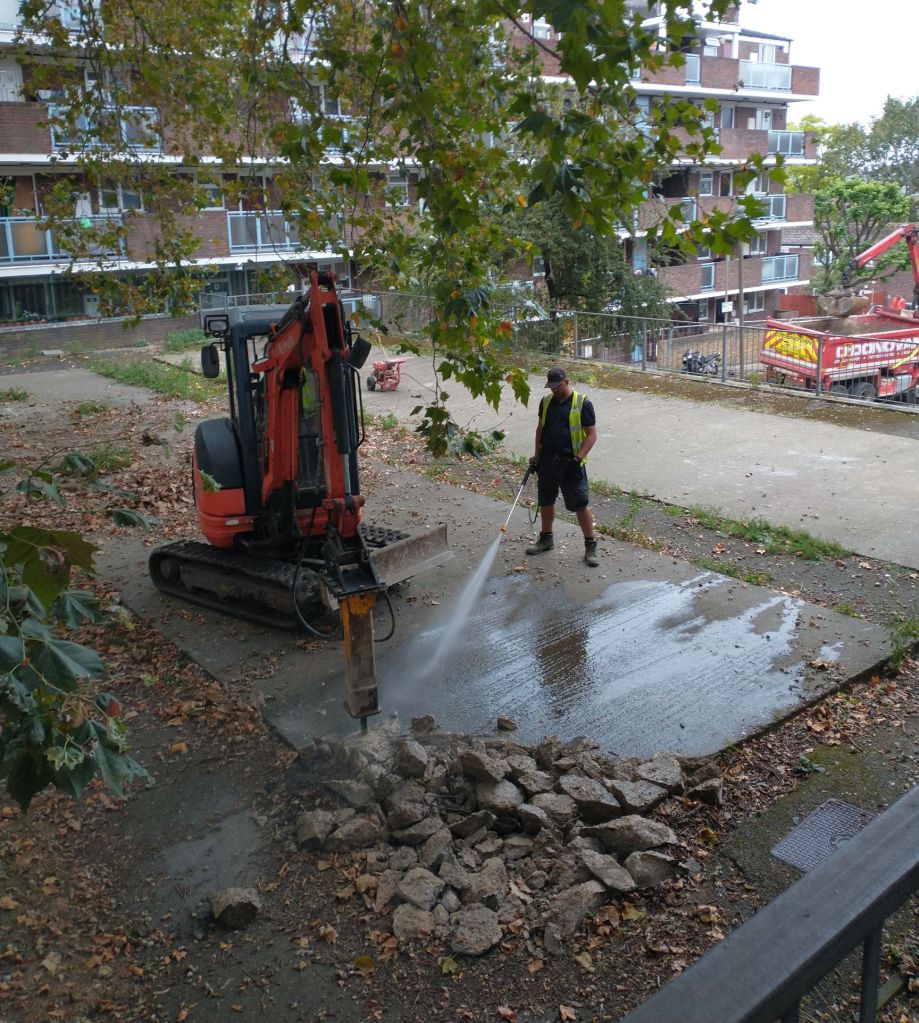
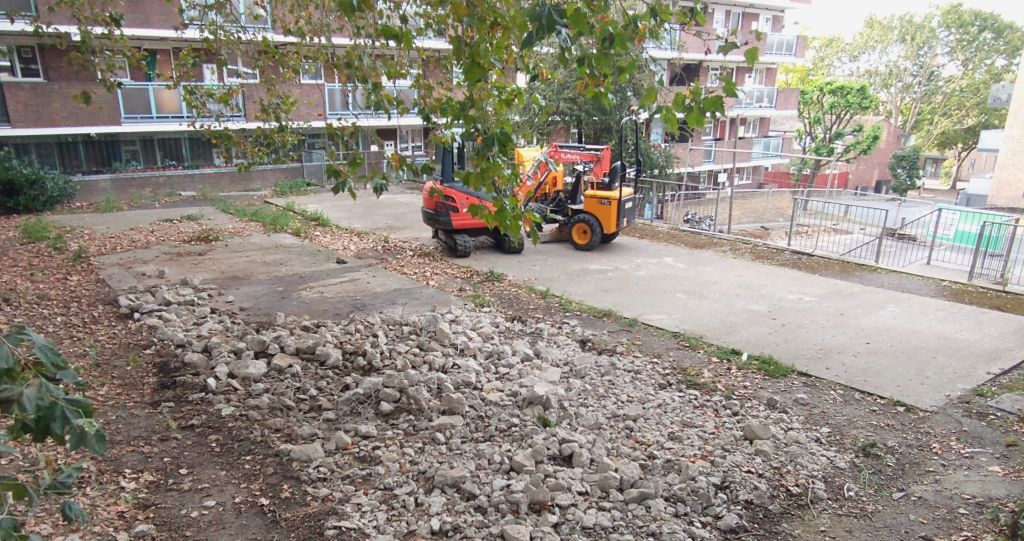
A rather loud day for residents of the Gideon Road estate, as works begin to on a project to improve the estate’s gardens and landscaping. The first stage is the most disruptive, as the large concrete foundations between the blocks are dug up. These used to support a load of rentable storage sheds – which were removed about 15-20 years ago as they were damp and little-used, their roofs were made of asbestos, and the narrow alleyways around them gave cover for all manner of dubious after-dark activities! These areas have been a bit of an eyesore, not to mention a waste of a fairly large area of usable space, ever since.

These new landscaping works are loosely related to the development that has been underway for some time in the estate’s garage area to the north, which we have written about several times (most recently when the first phase completed). There’s a second phase of new building work coming soon, which we’ll write about in the next few days.

Maybe as an indirect effort to make up for the extended disruption that the building works caused to existing residents (including the loss of parking spaces during the works), Wandsworth’s Housing Development team secured funding to improve the shared areas of the Gideon Road estate. They did various investigations to see what could be done to improve the estate landscaping, and developed some initial options that were then discussed with residents – focussed on making the estate a better and more attractive place to live – which included various landscaping and facilities. These conversations led to some tweaks to the plans (for example – people felt that a new playground for young children could be too close to the properties and duplicate the existing one on the other part of the estate). The designs were then updated, and work has now started.

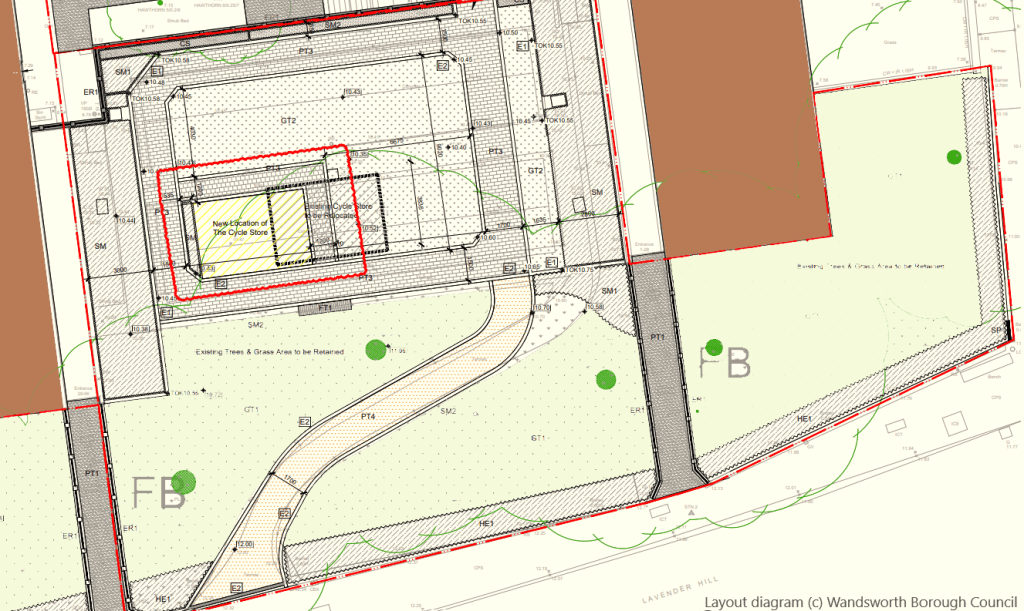
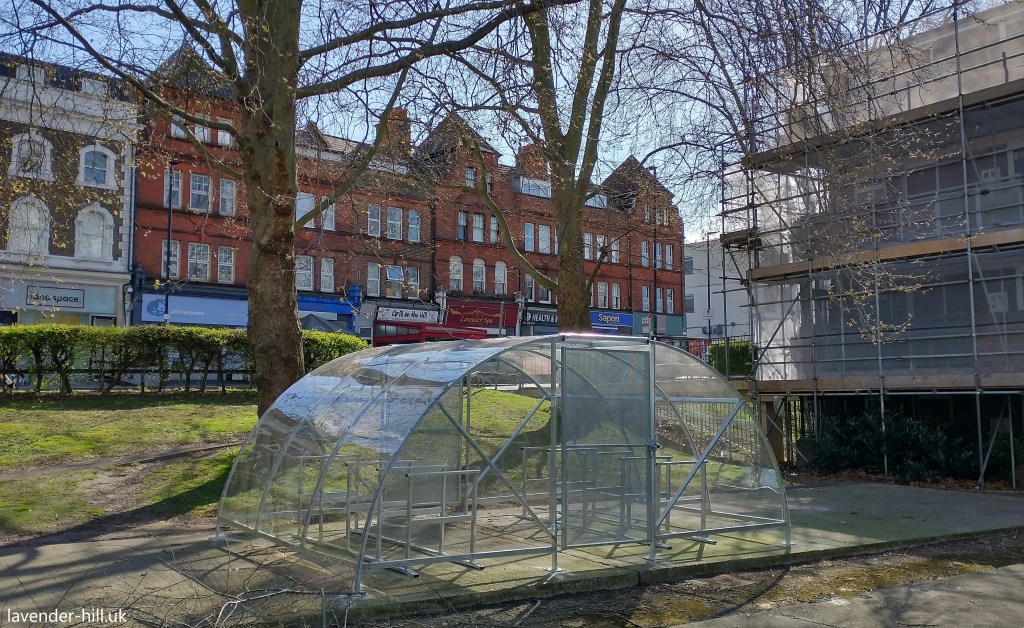
The plan above shows what we can expect for the currently concreted over area between 1-28, and 29-56, which we have shaded in brown. Essentially removing the concrete slabs and converting it to a small grass courtyard surrounded by a new paved pathway and low level planting. We’re lucky to have Wandsworth’s Horticultural Services team involved here, who also look after the Borough’s parks, as they’ve got lots of experience in developing planting schemes that are low maintenance but also likely to provide interest and colour all year round. The footpath that runs from Lavender Hill down to the car park will be realigned to line up with the staircase, moving it a bit further away from the buildings, and will also be repaved with a new surface. The existing London Plane trees will remain in place (and may be a bit happier without huge concrete slabs covering up their roots). One of the foundations was recently adapted as a base for a secure cycle storage shed (pictured above), which has been unbolted during the demolition of the concrete, but which will be reinstalled close to the current location after the works.

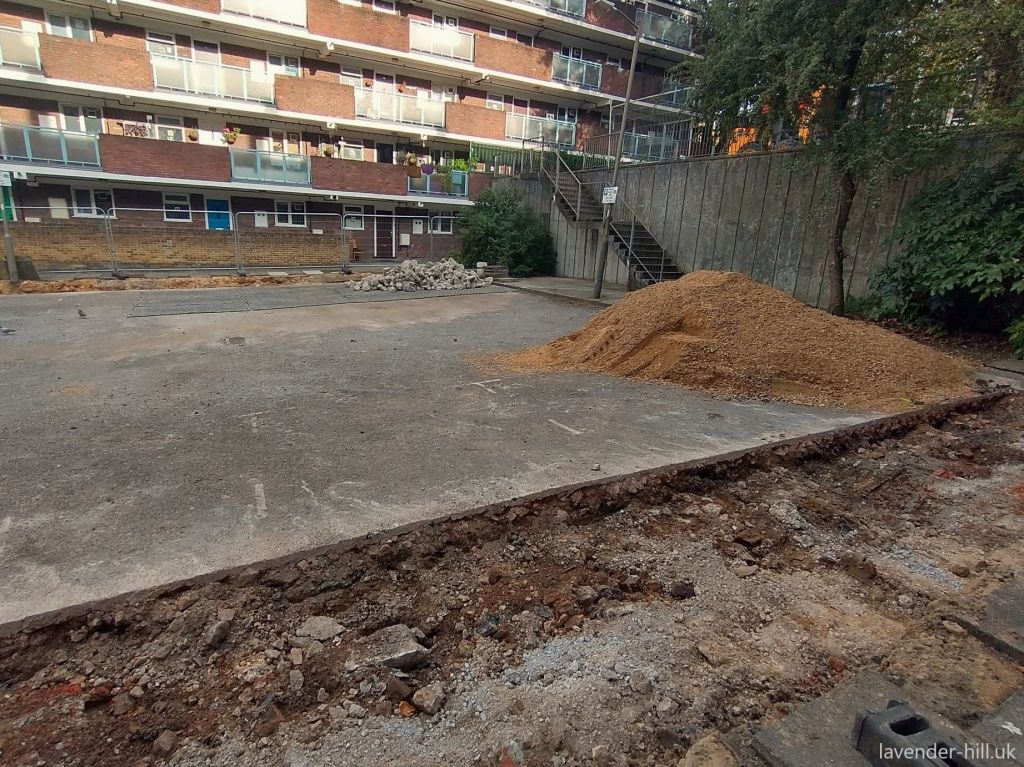
Down the steps to the car park between the same two blocks, work is already underway to dig up the sides of the footpaths, with a small strip of the back of the parking spaces and of the pavement removed and dug out.

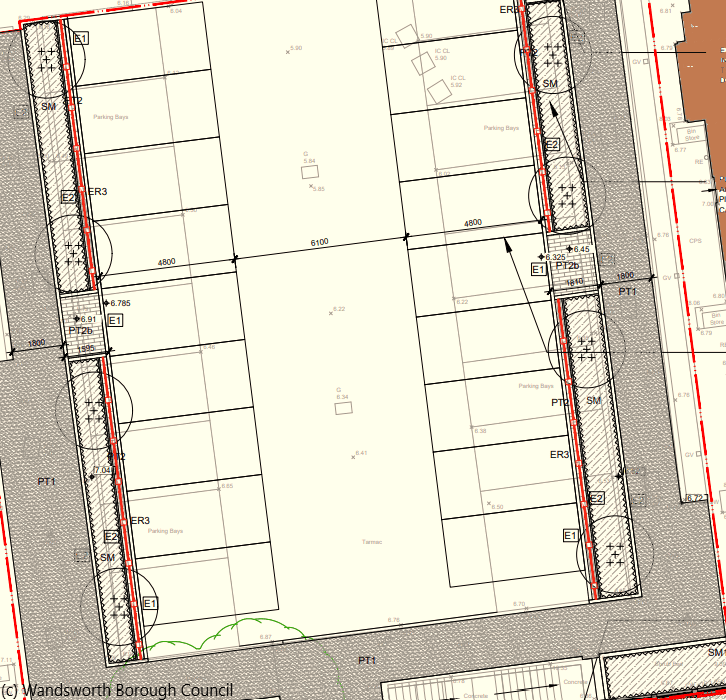
The plan, shown below, is to create a thin strip of green space between the parked cars and the way in to the flats – adding small shrubs and few trees along each side of the car park. Hopefully this should make the car park area look a bit nicer from the flats facing it, and add some colour to what is currently a very grey and bleak part of the estate. Although the building work needs a temporary car park closure, the number of parking spaces won’t be changed as part of these works.

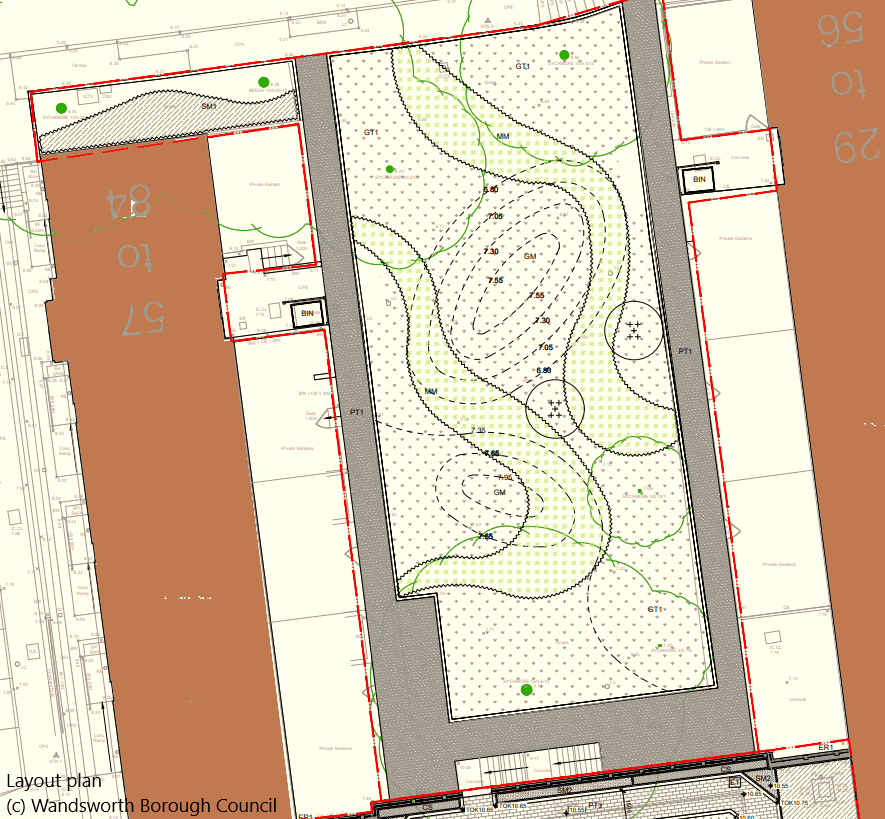
The other courtyard (between 29-57 and 57-84) is also set to see some works – again removing the abandoned concrete slab and creating a small grassed and planted garden courtyard – but also making some small improvements to the existing garden area down the steps. That area is currently a flat lawn area to create a small hillock to add a bit of interest, as well as an area that would be a wildflower meadow (shown in the area with the green dots on the layout plan below, where Gideon Road is at the top of the picture). The five trees will remain in place (and a couple more small ones may be added).

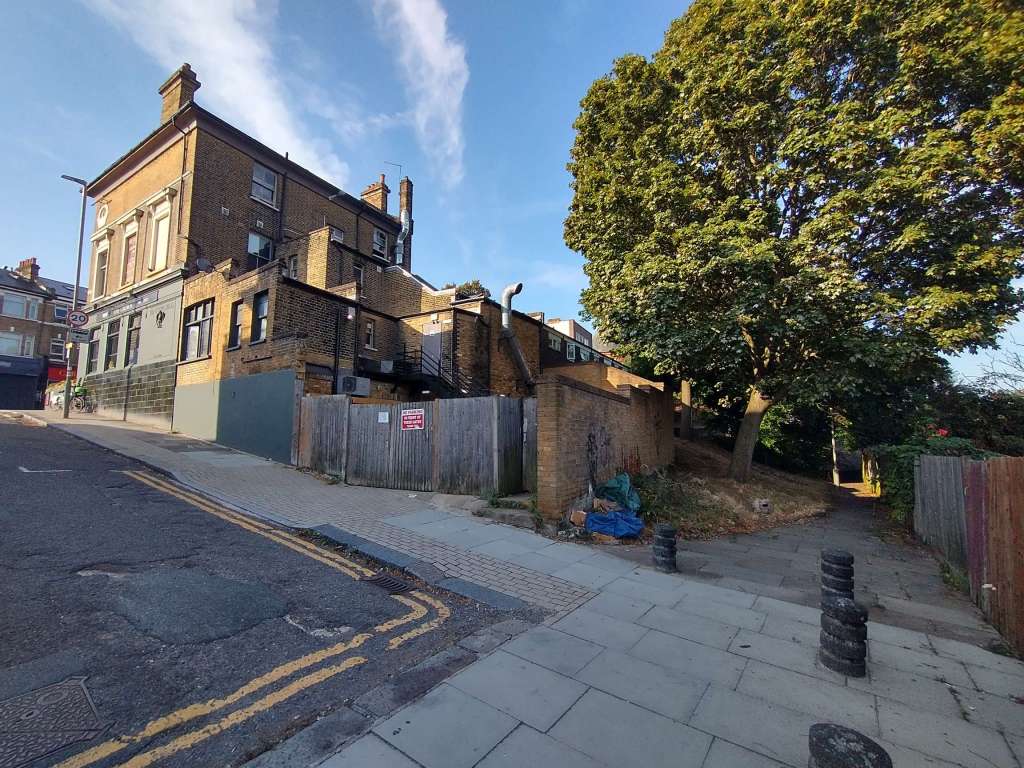
One final change is a small but sensible one: The messy paths connecting Tipthorpe Road and Pountney Road behind The Crown have always seemed a rather odd and badly laid out part of the estate – as it creates two paths that start off well but turn in to complete dead ends, separated by a steep bank of grass – just behind the large three in our photo below. The lower path that goes nowhere other than some rarely used back garden access gates even has street lighting!

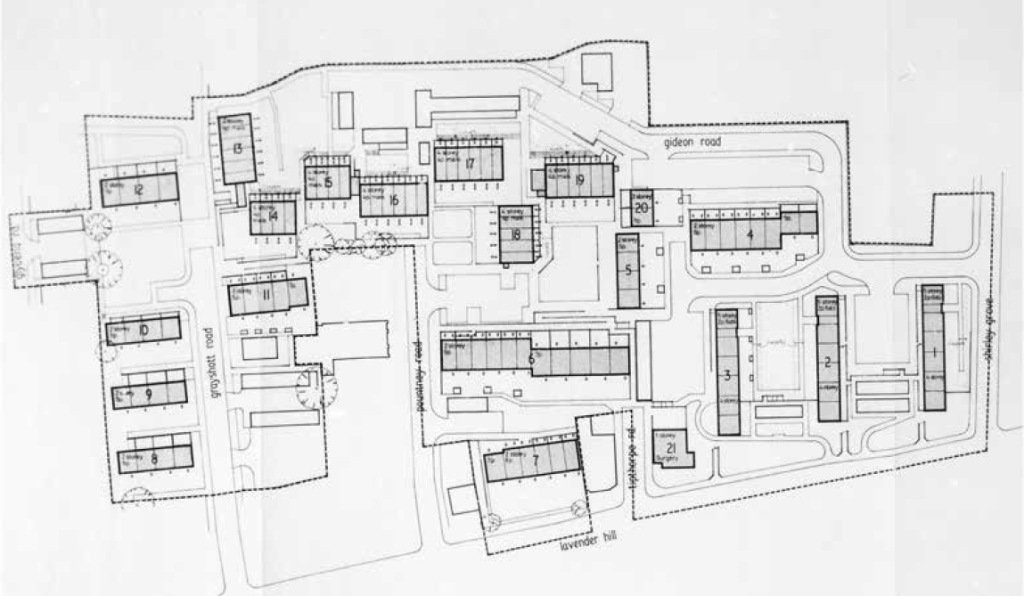
The map below, with the original design of the estate, shows that this strange layout does seem to have been the plan from the outset! Maybe it was a Friday afternoon in the architects’ office at the time. Ever since there has been a muddy unofficial path connecting the two levels, between the row of houses and the rest of the estate, and the schools and facilities lying to the north.

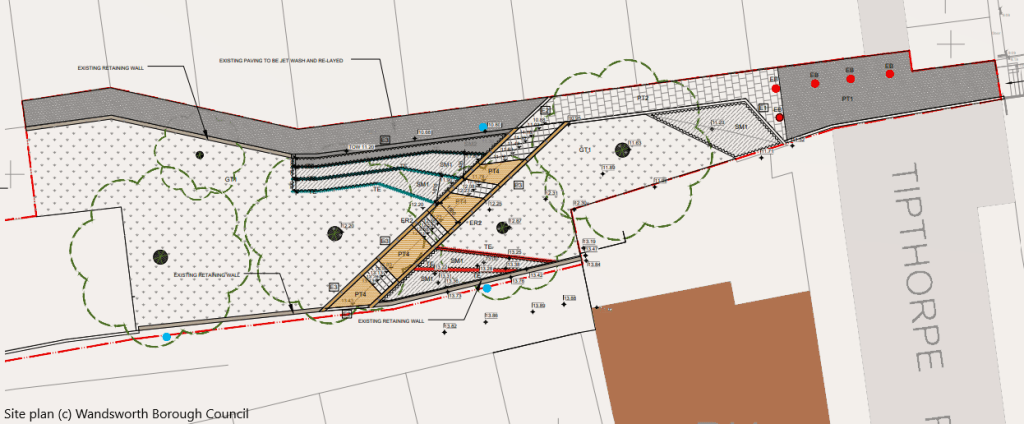
As the plan below shows (where we have shaded the back of The Crown pub in brown, with Tipthorpe Road to the right), a short new path with steps will be built on the current unofficial path, making it tidier and safer; and part of the existing path will be repaved and tidied up.

Overall – it’s good to see some investment in the estate, which is a popular one that’s worked well over the 50 or so years since it was first built. These works seem to have been carefully and sensibly designed to make it a better place to live, while also being durable and low-maintenance. They should improve what ought to be valuable green spaces, but which have definitely been a bit of a lost opportunity for some years.

If you found this of interest you may also want to see our posts on a planned new building in the estate, and on the landscaping in the new houses at the other end of the estate. Our thanks for the team behind the project at Wandsworth Council for sharing details of the planned works.

Posted in Environment, Housing, Street by street | 2 Comments

Some cleverly designed flats on Taybridge Road are in the running for the biggest prize in architecture

Unless you live in it or right next to it, you’ve probably never noticed the group of flats that appeared a few years ago at Crosland Place, near the junction of Lavender Hill and Taybridge Road – hidden away behind the green door pictured above. It was developed by Marston properties – a local firm we have got to know rather well as they’re also the people behind the Plough Brewery on Wandsworth Road, the now-complete project to redevelop the pub next door, and a current major redevelopment of the Artesian Well and Lost Society.

It was a difficult site to work with, and it would take Marston five whole years to complete the small development after they bought the site in 2016, which at the time was an old metal products warehouse. Marston’s team rather liked the initial building, but soon realised that it was not going to be workable as a residential conversion, given the lack of natural light and the difficulty of making it meet any modern building or energy efficiency standards – so they set about designing a completely new building.

The architects were Sergison Bates, who clearly found this small and complicated site to be a properly interesting challenge and spent considerable time designing something a bit special! There was only one access route, through a mews passageway that went under a Victorian house. The site was at a lower level than the gardens around it, and many of those houses were really quite close to the property line – which limited what could be done, and which meant that some serious ingenuity was needed to create flats with a sense of light and space.

The scheme has nine apartments, most of which have two or three bedrooms. They all have a private courtyard of one form or another, designed to bring air and character to the properties. In a particularly clever use of the complicated site the development as a whole faces on to a two-storey inner courtyard that is separate from the access mews. This means everyone has access to both a decent communal space in the courtyard, and their own private space. The development uses robust materials that give a sense of calm and also of quality – including terracotta and oak floors, and pale grey bricks that echo the former industrial building on the site.

We remember visiting one of the earliest neighbour consultations on the proposed scheme, which the developers and architects held in the old building back in 2017; they applied for planing permission later that year. The first application was turned down, on grounds including the impact on the privacy of one of the neighbouring properties. This led to the scheme being very slightly revised, to lower some walls and make minor adjustments in view of neighbours’ concerns, which led to it getting planning permission the next year. Someone still wasn’t happy because some of the neighbours then started proceedings to challenge Wandsworth’s approval decision with a Judicial Review. This didn’t ultimately materialise – but it did delay the project further.

There were then a series of minor challenges in getting a contractor on board – but these were resolved when Uprise Ltd was appointed in summer 2019; demolition of the old building started in October and the site was fully cleared by the end of the year. As part of the build project Marston negotiated to borrow part of their neighbours’ gardens, as well as the Ecole du Parc nursery playground, for most of a year so that they could rebuild the retaining walls. And with rather unfortunate timing this was scheduled for March 2020 to April 2021, at precisely the point when people were stuck at home amid Coronavirus lockdowns and needed their rather limited garden space more than ever! The aerial photo below shows the challenge this caused the neighbours – with two metre slices chopped off and faced with large hoardings.

The flats were completed in April 2021, a few months behind schedule, with the build costing a whisker under £3 million. None of the flats were on sale: instead, Marston is retaining ownership of the whole building, and renting them out. The keys were handed to the letting agent in the middle of May and they went like hot cakes: within five days all nine apartments had been let. The first occupants moved in a week later, and by the end of June the scheme was fully occupied.

It soon became clear that the end result was an unusually high quality bit of design. It was clearly popular with residents, which is the first rule of development! But it also started to make serious waves in architectural circles. This small locally-led project, built to a pretty normal sized budget and barely even known in its own neighbourhood, quickly started to win some big prizes – starting with the Housing Design Award 2022, followed by the Architect of the Year Award for Private Housing 2022, and then the National RIBA Award 2023.

And now it’s on the biggest platform of them all, as what is being described as ‘Lavender Hill courtyard housing’ has now made it on to the shortlist of the final five contenders for the Stirling Prize – which is the most prestigious architecture award in the UK. Patrick Lynch at Architecture Today reported that:

Sergison Bates’ new building at Clapham […] sticks in the memory like an image from a folk tale. Part miniature castle, part microcosmic garden, the evocatively named Lavender Hill housing embodies many of the practice’s interests in type and tectonics that have characterised its output over the past 25 years or so. It’s curiously absolutely embedded in its situation and place, and also somewhat uncanny and other. It’s as if the quality of air and light changes as you enter under the archway and move through the thickness of the castle-like walls, arriving refreshed and surprised into a tiny verdant courtyard at the heart of the scheme.
Chris Foges, in a review of the development at Architects Journal, described the development as ‘compact but magical’, and said that:

It’s often said that great architecture needs constraints. Well, Sergison Bates certainly had them at […] a small housing scheme in south London, and they have provided the stimulus for a building of rare ingenuity and imagination. Replacing an old workshop on a small backland site, hemmed in by the garden walls of terraced houses on three sides, it has almost no outlook. Instead, the architect has structured the nine homes around an array of ‘inner worlds’ that are rich in spatial and material character, yet pervaded by an almost palpable sense of calm.

Our photo below shows the model of the development proudly on display at the home of British architecture, the Royal Institute of British Architects, at Portland Place – together with one of the bricks that was used in the development and an architects’ sketch book.

The Stirling Prize is a big deal, and to even be on the shortlist is a huge achievement for a development like this one that doesn’t have starchitects behind it or big-name high profile customers. Credit is clearly due to Sergison Bates for their skill in designing it – and also to Marston Properties for being an architects’ dream client and going for quality and imaginative approaches, rather than just cramming on whatever could get away with, as well as to the builders who took this forward to a high standards amid Covid chaos in the wider building sector.

Regardless of the big prizes, ultimately what we have here is nine very liveable properties making very clever use of the space, and showing that with a bit of imagination and a god architect, even the most unpromising and complicated site can become a very liveable, high-quality home.

If you found this interesting you may want to see our articles on a nearby Council-led housing development at Gideon Road (and a more recent one on its next phase), a smaller but also rather clever new build round the corner from this one, a detailed piece about the history & development of the Cedars Road estate, or our article just looking at the sheer build quality of Battersea’s reference library.

Posted in Environment, Housing, Planning, Street by street | 3 Comments

Five fairly luxurious new Council flats are coming to the car park behind The Crown on Lavender Hill

Back in 2019, we reported on plans to build a bundle of new Council-owned housing and flats – mostly on bits of car parking in the Gideon Road Estate just north of Lavender hill. These were quite ambitious plans, and a rare example of new-build Council housing – partly designed to accommodate people moved out of the Winstanley Estate as it was redeveloped, and partly designed to provide the sort of accommodation that’s quite rare in the Borough, like wheelchair-accessible flats or flats with the space to accommodate large families needing many bedrooms. The plans were split in to three phases, the first of which was for lots of houses and flats at the western end of Gideon Road, which have now been built – we’ve published lots of photos of the end result here.

The second phase of the original plans was for three flats and a three-bedroom house to be built where there’s currently a row of eleven garages in the sunken car park area behind The Crown pub. The originally planned building is shown above (the lighter-coloured bricks are the house). Unfortunately the first phase took way longer than expected to get going – not helped by the Coronavirus causing mayhem in the construction sector – and the second part of the project never got built; the planning permission for the development that was approved back in 2016 has now ‘timed out’.

The Council has gone back to the drawing board, and now plans to build something a bit different and rather larger in the same spot. The house is gone, as is the block of three flats: instead, we’re likely to see a single building with five flats. Two of them are on the ground floor – a one-bed flat, and a large four-bed flat, both with small private gardens, and provision for two street trees to be added to make the car parking area a bit less of a concrete wasteland. There are then three duplex flats on the first and second floor (a one-bed, a two-bed and a three-bed), each with a private balcony. This is a substantially larger build than what was previously planned for the site, hence why there are now five properties rather than four (and larger properties too, with a total of 11 bedrooms rather than 7) – but it’s fair to say it is also a cleverer approach, solving quite a few issues that had become apparent with the previous design.

The original plans created a small, dark and hidden away garden for one of the ground floor flats, next to the staircase leading down from Tipthorpe Road, which was clearly never going to work for plants, and which was so tucked away that it had the feel of being a burglar’s hideaway in the making. The original plan also broke up the estate car parking provision, with two of the existing open-air spaces visible on the right on the photo below replaced by a bin shed and moved to a spot hidden away in the same corner – creating the sort of place a car break in would be a racing certainty! These have been done away with in the new design.

One of the most ingenious and – on reflection – maybe obvious changes, is that the new building uses the difference in height between Tipthorpe Road and Gideon Road to have two level step-free entrances, with the two lower-level flats accessed from the Gideon Road car park, and the three upper flats accessed via a short corridor from a front entrance at the end of Tipthorpe Road (shown in grey at the top left of the first floor floorplan below). By doing this, it provides a ‘ground floor’ access to every flat without needing a lift or a shared internal staircase.

The three upper flats are all duplex (two-floor) ones, with internal staircases, but generous living spaces at the entrance level. They’re nicely designed properties with lots of living space and light, and in an unusual but welcome move, the flats include small rooms for storage, about the size of a large airing cupboard. These used to come as standard in 1970s Council accommodation but are very rare in an age where every square foot gets costed out and chopped to the bare minimum by property developers. The flats will have heat pumps for heating, as well as solar panels on the roof.

The entrance on to Tipthorpe Road will create a clearer ‘end’ to the road, shown above – with the existing staircase down to the car park set to be rebuilt to a slightly wider width and with a longer middle landing – ensuring the staircase isn’t all hidden away behind the building, but also creating a handy space underneath for the sprinkler tanks and electrical supply for the building. The existing ramp running from Tipthorpe Road towards the rest of the estate and the playground is also set to be retained, albeit in a slightly more tucked away form running between two buildings rather than as the current wide open balcony arrangement (but is likely to be closed for quite some time during the building works – as we saw with the first phase of the new development on the estate where the flats facing the works had to put up with narrow temporary walkways with poor visibility round the corners, that felt rather unsafe at night, for several years).

By and large, this is a decently thought through development that has clearly had some time and effort spent on it, and which is creating five impressively good quality Council-owned flats in a bit of the Gideon Road estate that’s not particularly lovely at the moment. By turning a neglected corner in to new homes – and homes that look set to be fairly smartly presented and well integrated to the layout of the wider estate – these plans seem unlikely to be especially controversial.

Not that it will please everyone: there’s no getting away from the fact that this is quite a large building to be adding on an already dense estate, and its immediate neighbours – especially the flat at the back of 100 Lavender Hill, and the next door terrace at No.1 Pountney Road, are likely to find their views are more enclosed. Parking will likely also be a concern, given that the development is for five flats, including a specially designed wheelchair-accessible flat, with no associated parking at all. This is realistically likely to mean the loss of at least one of the adjacent estate’s existing parking spaces to become a dedicated disabled space (which comes on top of the loss of the 11 garages being removed at this site and the 35 garages that were recently demolished to make way for the linked Gideon Road development), adding to the pressure for car parking in a spot where it’s already difficult.

These plans are still being refined, and haven’t gone in for formal planning permission yet – we’ll aim to provide an update when they do. In the meantime, presumably recognising the disturbance residents have already seen as an extended building project has run in and around the estate for several years, funding has been found and work has just got underway to improve the general landscaping of the wider Gideon Road estate – see our separate post here for details of what is underway.

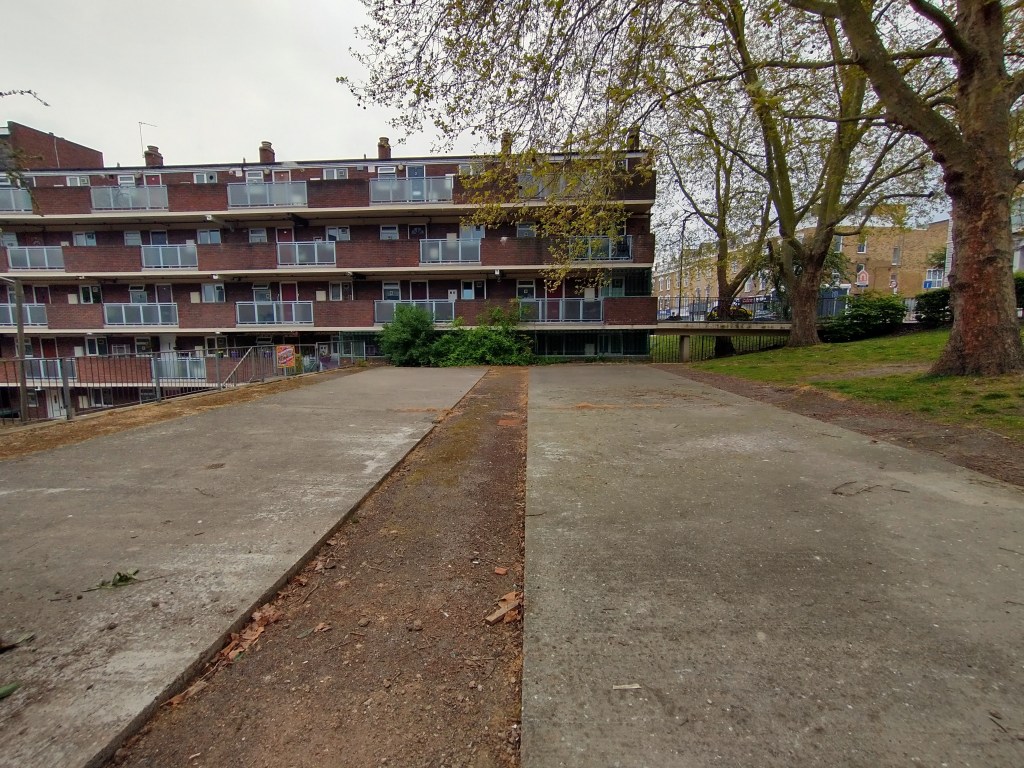
The third (and also un-developed) phase of the originally planned new-build development – which was for two buildings to be added to the corners of Tyneham Close, replacing an underused play pitch shown below, and an abandoned former laundry hanging area – is also being re-engineered, with the new plans looking to be an improvement on the previous somewhat dubious ones, if still far from perfect. We’ll report on the plans for that site in a future post.

If you found this of interest, you may want to see our wider articles on local environment, planning and housing issues. To receive updates sign up here. And if you have any news on these developments do let us know!

Posted in Environment, Housing, Street by street | 1 Comment

Clapham Common’s all-new free waterpark is open!

Just in time for the summer holidays, Clapham Common’s long awaited new waterplay facility has opened. It’s a replacement for the paddling pool that closed in 2020, and building work took a year longer than expected. But we got there in the end – and as a rare example of a free, just-turn-up facility open to kids of all ages, it’s quickly proved popular. It’s expected to run daily from 10am to 7pm, up to the end of September if the weather remains decent.

It’s a large site – 535 square metres! – and features 40 multi-function water jets, including water guns, tipping buckets, showers, soaking jets and fountains galore – as well as accessible and child-friendly toilets. Some of the old paddling pool has been reused – including the perimeter wall which has remained in use as seating for parents. As the following photos show, it was a pretty substantial construction project.

It uses an environmentally considerate and energy-efficient re-circulating water system to power the jets – and aims to be an efficient and creative use of the old paddling pool space, with the added advantage of being more accessible for those with physical, developmental or sensory disabilities. The project involved sizeable excavations to bury this huge underground water tank, which is presumably for treatment and recycling of the water.

There is plenty of space for cycle parking, as well as a service building next to the toilets – the one with the green door below – which we presume houses the pump machinery.

The old paddling pool had been a fixture on the Common since the 1950s, and we know many were sad to see it reach the end of its life. But much as it inspired fond memories for several generations of residents, it’s fair to say it was really struggling towards the end – with increasingly frequent and costly repairs needed as the water filtration machinery and, increasingly, the fabric of the pool itself aged.

It was finally closed for good in 2020, and spent a few years as the preserve of occasional skaters (as well as melancholy alcoholics, pictured below), before the building work got going earlier this summer.

The detailed design for the new facility, by Lambeth Council & the Clapham Common Management Advisory Committee, drew from a public consultation with residents. The consultation saw 614 people respond – with overwhelming support for the project (about 95% in favour of it). Over 800 comments were made – including asks for shaded area, for an accessible toilet, for a changing area, and for somewhere to sit – which led to various changes and improvements to the overall design. The strong public support may not seem surprising, but this was not the case when the original paddling pool was built in 1936! Lambeth’s very comprehensive archives include a newspaper cutting (from the Brixton Free Press) showing it being built – but noting that there had been objections from the residents of the adjacent block of flats, who said it would ‘lower the tone’ of their neighbourhood by attracting children from other areas.

This has been a big investment – ending up at £700,000 or so, with a fair bit of cost inflation along the way given that this was being contracted during the strange years where the Coronavirus was busily causing chaos in global supply chains. As the project’s business case noted, this has created a very accessible facility, which will provide a rest and active play space, with positive health impacts for inner-city children who may not otherwise have an opportunity to enjoy a water experience during the warm summer months. It should also be a boost for local businesses by increasing footfall in this part of Clapham Common – the likes of top ice cream maker Nardulli’s are bound to benefit!

It is the latest of an impressive series of investments in the Common’s exercise and play facilities – following the creation of three outdoor fitness areas and an outdoor gym, a large skate park and an upgrade to the basketball courts (which we have previously reported on), and a major redevelopment of the Windmill childrens’ playground. The commercial premises the on the Common (Megan’s, Pear Tree Cafe…) have seen substantial investment by their tenants to increase capacity and build trade, and whose rental payments ultimately support the ongoing work on the Common. And there have been a series of wildlife-focussed improvements including work to the ponds, creation of wildflower and butterfly meadows, and some work to the woods.

This represents a substantial effort by Lambeth, as well as the Clapham Common Management Advisory Committee & the Friends of Clapham Common – and it’s worth recognising the heroic efforts to get a project like this across the line. It’s been good to see this consistent and careful investment programme for the Common – which seems to be striking a reasonably fair balance between making the commercial income, and preserving the fundamental nature of the Common as an open space for everyone. It’s not always been like this! Back in the 1980s and 1990s it had gone through a period of general decline and very minimal maintenance, as Lambeth (who own and manage the whole of the Common, even though more than half of it is in Wandsworth) went through their own severe financial struggles – becoming rather famous for their factious politics and poor financial control, and having things like repairing bandstands somewhere near the very bottom of the agenda.

But with the finances back on track and enthusiastic leadership – what else might we see happen in the future? On a site as large and complex as Clapham Common there’s always more to do, and the Common still has plenty of difficult & expensive projects ahead. Maybe most obviously – an upgrade is long overdue for the well-used, but ageing and increasingly worn out, western playground near Battersea Rise. The Bowling green on Clapham Common Westside has been the subject of much controversy over now-withdrawn plans to create a commercial mini golf venture – and has a rather uncertain future. Things don’t look much better for the former Bowling Green Cafe / Common Ground next to it (pictured below in happier days), where the building has clearly reached the end of its serviceable life.

As we have previously reported, the tired and part-derelict changing rooms and toilets complex near Battersea woods, pictured below, had been considered for partial redevelopment to create a cafe – and was advertised to potential tenants with the warning that they would potentially need to rebuild the building! – but plans haven’t really advanced. The adjacent changing rooms also suffered a small fire last year that hasn’t helped.

The exercise facilities on the west side are also showing their age: the outdoor gym at the Battersea end was a good facility once, but sadly almost all the equipment has broken or seized up – seemingly due to fairly heavy use coupled with a lack of oil in the mechanisms.

Finally one of the gravel football pitches on the west side of the Common (whose maintenance hut is picyured below) is essentially abandoned. It’s made of a somewhat unusual mix of gravel and red ash called ‘redgra’ – an early example of an innovative all-weather material for pitches, that was developed in the early 1960s, but which has now been replaced with synthetic pitches almost everywhere else in the country.

One key issue affecting these sites is, of course, funding. The common does generate a reasonable income: the largest share, which can be of the order of £500,000 a year, comes from hosting concerts and events (where 21% of the income goes towards investment in parks and the Common). There’s also the rent from cafes and facilities (the Friends of Clapham Common reckoned this was about £125,000 a year in 2016, it will have gone up a fair bit since), and some relatively small fees for sports facilities. Funding has also come from one-off lottery grants (to restore the bandstand) and developer ‘Section 106’ funding (for some of the gym equipment). But we understand the Common doesn’t get to keep a lot of the income it generates – which can also go towards other parks around Lambeth that don’t host events, and wider uses in Lambeth.

Another factor may be politics. Eagle-eyes readers may have noticed that the dilapidated sites are now almost all on the half of the Common that’s in Wandsworth! The neighbouring boroughs have a complicated relationship when it comes to the Common: despite over half of the Common actually being within Wandsworth, all of it is owned and managed by Lambeth Council (who were granted ownership of it all by the old Greater London Council in 1971). Wandsworth have been less than enthusiastic about some of the huge events on the Common whose location and layout seemed designed to mainly keep Wandsworth residents awake at night, while generating funds that were mostly spent on wider uses in Lambeth. Conversely we can imagine Lambeth are not enormously enthusiastic about investing in facilities on the western side of the Common that mostly benefit Wandsworth residents. Will we see an increasingly stark divide between the well-looked-after Lambeth side and a deteriorating Wandsworth side of the Common?

Tie will tell. But for now – huge efforts by a lot of people have given us all an impressive new water play, and it’s set to stay open all summer – so spread the word, and make the most of it!

Clapham Common Water Play, The Pavement, Clapham Common SW4 0QZ. Open daily May to September. (update: open from 10am to 7pm daily, and provided the weather remains decent the plan is for it to stay open to the end of September). Free!

Posted in Clapham Common, Environment, Politics, Useful to know | 10 Comments

Factory developers, social reformers, fearless pilots, celebrated artists, tenacious campaigners and ‘dangerous subversives’: the pioneering women of Battersea’s early days.

London’s blue plaques link people of the past with the still-standing buildings they lived or worked in. It was started back in 1866 when a plaque was put up on the former house of Lord Byron – and it’s led to to 990 plaques in London, and similar schemes in cities around the country and the world. But the plaques managed by English Heritage are notoriously male dominated, with just 15% of them celebrating women. Things are even more skewed in Wandsworth, which has thirty blue plaques, twenty nine of which commemorate men. There’s no doubt that they had 29 very interesting lives – for example we’ve posted before about John Archer, commemorated by a plaque on his old house north of Clapham Junction. But it’s hard not to wonder – what about the women?

Last month, a plaque was finally unveiled for artist Marie Spartali Stillman. This is probably the start of more to come – as there’s far more to the women of Battersea than one plaque! This article, the first of a short series based on research by Jeanne Rathbone, looks at five of the many inspiring women who have lived in and around Lavender Hill.

Jeanie Nassau Senior lived in Lavender Hill in its very early days, when it was a scattering of large country houses along a road with distant views the Thames over fields, before the railways arrived and changed everything. Born in 1828, her brother was Thomas Hughes, who wrote Tom Brown’s Schooldays. She married at 18, and lived with her husband John – a not-very-successful Barrister – at Elm House, a country villa with a small wooded estate that sat on the current site of Battersea Arts Centre, and which is still remembered in the name of one of the rooms there.

Jeanie was the first female civil servant – ever – becoming known as the first woman in Whitehall. She wasn’t just notable for this though – she was also a powerful social reformer, helping Octavia Hill in her work to build decent social housing management in Marylebone, and volunteering in supplying aid during the Franco Prussian war which was the forerunner of the British Red Cross. Following her work with impoverished children in Surrey, Jeanie was appointed Inspector of Workhouses, by the radical President of the Local Government Board James Stansfeld, and in 1875 she published a controversial report criticising the education of “pauper girls” – where the workhouse ‘Barrack’ schools seemed to lead to prostitution. This would have created some family tensions, as her father in law was the very man who had originally instigated the system of workhouses! She also argued for the fostering of all poor orphans, rather than their incarceration. She was ferociously attacked for daring to criticise the poor state of affairs, and her fight to defend her findings against male hostility politicised her, to the extent that she became an icon for the late 19th century women’s movement.

The painting of her above is by George Watts, who painted a series of portraits of the most important men and women of the day, intended to form a “House of Fame”. George said of Jeanie: when you read the biography of “That Woman”, for it is one that will be written, you will find she had very few equals. It took 130 years for it to be written – but it has now been written by Sybil Oldfield. There’s ongoing work to install a blue plaque to Jeanie on Battersea Arts centre (formerly Battersea Town Hall – and going back further, the site of Elm House where Jeanie lived).

Deaconess Isabella Gilmore, born in 1842, had been happily married to a naval officer, and looked set for a pretty normal middle-class life – until her husband died at 40. She then decided to train as a nurse – which caused a lot of misgivings in her wider family. Florence Nightingale had done much to improve people’s idea of hospitals, and nursing was seen as a worthy occupation – but was not really seen as something for an aspiring middle or upper class person to do, as hospitals were still considered too harsh an environment for well-brought up girls! But Isabella was adamant and she entered Guy’s hospital training school.  Two years later took on as her own eight orphaned nieces and nephews when her brother died.

A further two years later, the Bishop of Rochester – clearly impressed by her industriousness – asked her to become a deaconess in his diocese, as part of a wider effort to revive the role of deaconess in the Church. Being a deaconess was quite a curious role – essentially being part of a ministry of women who would work among London’s poor and provide pastoral care, but reporting directly to the Bishop. Isabella didn’t have any theological training, and didn’t know much about the deaconesses either, but with some persuasion, agreed to go ahead. It seems she wasn’t hugely driven by the religious aspects, but saw a considerable opportunity to improve the lot of the poor of south London.

In 1887, she was ordained a deaconess – and with the support of the Bishop, built this in to an Order of Deaconesses within the Church – made up of women who were expected to be “a curiously effective combination of nurse, social worker and amateur policemen”. She set up a training house for deaconesses at 113 Clapham Common Northside. Getting hold of the building was an interesting challenge and shows her mix of pragmatism and ability to impress people with her dedication to the cause: she saw the house being emptied of its furniture as she walked across the common, following the death of its previous occupant, and found it had been bought by Thomas Wallis who lived nearby. She persuaded him to let the building to her, to house the new training centre. When Thomas died, she was able to persuade subsequent owner Herbert Shepherd-Cross – who conveniently happened to be an old friend – to sell her the freehold; Herbert even contributed £100 to her £4000 purchase price.

Isabella served actively in the poorest parishes in South London until her retirement in 1906, addressing the needs of the poor through working with girls and women. It wasn’t an easy life for her, or the deaconesses she trained at the house on Clapham Common: many left as the job proved challenging, not so much ‘dishing out alms to the poor’, but instead a lot of ‘real’ work. Gilmore insisted that the women were trained in basic theological principles, to be ready for parochial duties, as well as basic nursing skills (with some given the opportunity to train for six months at Guy’s hospital where Isabella had trained as a nurse herself). They provided a soup kitchen, donated clothing, looked after the sick, and taught religion and basic sanitation.  Her older brother William Morris – famous in his own right as a social activist and major figure in the Arts & Crafts movement – observed that whilst he preached socialism, his sister actually practised it. The women she trained were paid, she was not.

Deaconesses paved the way for the ordination of women. There is a sculpted plaque to her memory in Southwark Cathedral. The house by Clapham Common, which is still standing at the corner of Elspeth Road (but now split in to flats) was later named Gilmore House in her honour.

Isabella personally paid for the chapel at the site – which features this rather fine stained glass window. The chapel was notable for its ‘Arts and Crafts’ style architecture (something we don’t see much of, which also features in our post on Battersea reference library), and the high quality of its fittings, mostly designed by Webb or Morris & Co (the firm Isabella’s brother William Morris ran). Though the chapel is still standing, it was stripped of most of its furniture in the 1970s for use as a recreation hall for students, and in the early 2000s was converted to a rather luxurious studio apartment – the photo below shows it just before that conversion took place.

Marie Spartali lived directly opposite Gilmore House, at about the same time, in a still-standing house called The Shrubbery (a very grand house on Lavender Gardens that just doesn’t look like it fits in Battersea!). Born in 1844, she was British Pre-Raphaelite painter, arguably the greatest female artist of that movement. During a sixty-year career, she produced 170 works, contributing regularly to exhibitions in the UK and the US. She studied drawing and painting under Ford Madox Brown. She painted images of active, empowered women that challenged the male gaze.

Marie sat for numerous paintings by Ford Madox Brown, Burne-Jones, Whistler, Dante Gabriel Rossetti and for photographs for Julia Cameron, and was a close friend of William Morris (whose sister Isabella worked next door). She married an American widow William Stillman, with three children and had three more. He was foreign correspondent for The Times resulting in them dividing time between London, Florence, Rome and US. She was described as “austere, virtuous and fearless, she was not lacking in a caustic wit and a sharp tongue”.

Marie worked in a period in which the opportunities for women artists were limited, and when social convention viewed them only as amateurs. She was, however, determined to forge her own career and created a significant body of work – over 150 painting in five decades – including The Enchanted Garden of Messer Ansald below. Her work is now regularly included in exhibitions about the Pre-Raphaelite movement.

And Marie is the first woman to have an English Heritage Battersea blue plaque in her honour! As art historian and Blue Plaques Panel member Andrew Graham-Dixon said, there are only a handful of female artists commemorated by the blue plaques scheme, and Marie Spartali Stillman is actually the first female Pre-Raphaelite artist to receive one.

Charlotte Despard was born the same year as Marie in 1844, into a wealthy Anglo Irish family. She married Max Despard and wrote ten novels.

Unfortunately Max died at sea in 1890, after which Charlotte wore black for most of the rest of her life. Charlotte was shocked and radicalised by the levels of poverty in London – and following suggestions by her friends that she could take up charitable activities, she devoted her time and money to helping the poor of Battersea. Nine Elms in particular had become criss-crossed by railways and industry by then, with more than its fair share of poverty and people very much on the breadline; Charlotte lived in Nine Elms during the week (at No. 2 Currie Street – a road which has completely disappeared and is roughly where the US embassy’s security screening section now stands) and created what became known as Despard Clubs. These were a forerunner of future community centres – and included a health clinic, youth and working men’s clubs, and a soup kitchen for the local unemployed.

She was also a powerful campaigner. She became a member of the Independent Labour Party, and later joined the Women’s Social and Political Union, a women-only political movement and leading militant organisation campaigning for women’s suffrage, and maybe better known as the suffragettes. Its members became known for civil disobedience and direct action. and Charlotte served more than one prison sentence! Sylvia Pankhurst, who was imprisoned with Charlotte, later remarked at her death that ‘She was one of our most courageous and devoted social workers. When I was in prison with her in 1907, I was impressed by her truly magnificent courage.’

Divisions started to emerge in the sufragette movement, and Charlotte left the movement (along with 70 others) to set up the Women’s Freedom League, a non-violent organisation – where she edited its magazine The Vote. She was an active member of the Battersea Labour Party and stood as the Labour candidate for Battersea North in the 1918 general election – but her anti-war views proved unpopular at the time.

by Unknown photographer, halftone postcard print, 19 August 1909

After the first World War she left to live in Dublin, to campaign for Irish Independence – and clearly made an impact there too as she was classed as a dangerous subversive under the 1927 Public Safety Act for her opposition to the Anglo-Irish Treaty. She remained actively political well into her 80s and 90s: her house in Dublin was occasionally raided by the authorities, but a few years after she joined the Communist Party in 1930 it was burned down by an anti-communist mob! She died in Belfast in 1939, aged 95; recognising her extraordinarily sustained and varied campaigning her biography was titled “An Unhusbanded Life: Charlotte Despard, Suffragette, Socialist and Sinn Feiner“.

Charlotte donated a building to the Battersea Labour Party, and close to a century later 177 Lavender Hill is still their headquarters, with a plaque in her honour visible in our photo. Charlotte Despard Avenue in the Doddington & Rollo Estate is named after her, as is a both a street and a pub in Archway.

Hilda Hewlett, born in Vauxhall in 1864, was a pioneering aviator, and the first woman to qualify as a pilot in the UK.  She attended the National Art Training School in South Kensington, specialising in skills which served her well in her later aviation engineering career: woodwork, metalwork, and needlework. She was also an early bicycle and car enthusiast – she learned to drive, took part in several car rallies, and was even fined for speeding in May and June 1905!

She attended her first aviation meeting at Blackpool in 1909, and then travelled to France the following year to study aeronautics, where she met aviation engineer Gustave Blondeau – and struck up a long running business partnership. She was clearly keen – and returned to England with a Farman III biplane! Within months, she and Blondeau opened the first flying school in the UK in Weybridge. Thirteen pupils graduated from the school in the year and a half it operated – with an impressive and unusual record of no accidents. the next year, Hilda became the first woman in the UK to earn a pilot’s licence. She taught her son Francis to fly too – he qualified as a pilot the same year; he went on to have a distinguished military aviation career, making him the first military pilot taught to fly by his mother.

Hilda’s role was to grow still more important as the first World War approached. and the need for aircraft became urgent. In 1912 in she, with Gustave, formed Hewlett and Blondeau, the first company to build Caudron aircraft in Britain – which they did under license from the Caudron firm, who were one of the earliest aircraft manufacturers in France. She forged straight in to setting up a factory – which she based in a disused ice skating rink called The Omnia in Battersea, which had seen all manner of unlikely uses in between including a car factory and a snooker hall. They eventually produced ten different types of aircraft.

There wasn’t really space for a fully fledged military aircraft production line in inner-city Battersea, so in 1914 she and Gustave developed a new factory in Bedfordshire specifically to build Farman aircraft. They named the new factory The Omnia Works to keep the Battersea link. They bought the land in May, and when the First World War started three months later the factory was able to meet government orders for aircraft for the wartime expansion of the Royal Flying Corps.

The Hewlett & Blondeau factory employed around up to 700 people at its peak (over 300 of them women), and produced more than 800 aeroplanes; after the war it diversified to make farm machinery but was eventually sold. Recognising the impact of the company she co-founded on the war effort, a road in Luton, Hewlett Road, was named after her. She emigrated to for New Zealand in the thirties, aged 66 – attracted by the outdoor life but still with a keen interest in flying.

English Heritage’s blue plaques may be male-dominated, but Jeanne Rathbone and the Battersea Society are filling the gap by doing a sterling job of filling the gap – with an ever-growing set of plaques to commemorate notable Battersea residents, in particular the women who have been under-represented in local and national commemoration schemes. The street view above shows one of these plaques at 4 Vardens Road, a quiet side street a few blocks west of Clapham Junction – which believe it or not was the site of the old ice skating rink that became Hilda’s first aeroplane factory!

This is the first of what will be a short series of posts on the women of Battersea. We’re deeply indebted to Jeanne Rathbone who developed most of the content of this article – and who has been a driving force behind telling the story of the many inspiring women who have made their lives and careers in Battersea. Jeanne is also a woman of many talents, among them local historian, comedian, one time Council Women’s Officer, former alcohol counsellor, humanist celebrant, and author of Inspiring Women of Battersea (available to buy for under £10 here – it’s well worth a read!). She has published far more detailed accounts than we cover here, and run several Notable Women of Lavender Hill walks. And with impeccable timing, Jeanne is leading a free walk on Sunday the 6th August, starting at Battersea Arts Centre then walking down Lavender Hill to The Falcon looking at sites and survivors of our most iconic buildings and plaques to women – registration details here.

Sticking with the theme of blue plaques, Hilda’s story isn’t the first piece of Battersea’s aviation history we have written about: a previous lavender-hill.uk article tells the story of how a smelly alley behind some bins near Battersea Park started a venture that became a major part of the UK’s aviation industry. Our series of local history posts also include an article about the interesting story of John Archer, the first black Mayor, who saw an English Heritage plaque installed in 2013. We’ve also reported on the unveiling of a plaque to Tom Taylor and Laura Barker on Lavender Sweep.

Posted in Local history | 6 Comments

A difficult problem: Are traffic lights the answer for Culvert Road’s troublesome railway tunnel?

Culvert Road leaves a lot to be desired – a long, narrow tunnel, followed by an isolated and indirect footbridge. We’ve previously written about the unexpectedly interesting history of the place. But it’s a proper traffic headache! It was designed for occasional use by 1870s-sized vehicles rather than regular route by modern vans and trucks, and the opening of a major set of ‘dark kitchens’ in the Parkfield Industrial Estate has seen a huge increase in motorcycles and delivery bikes.

Unfortunately the tunnel is also a major access route to schools on both sides of the railway, with Harris Academy Battersea to the north, and Shaftesbury Park primary & John Burns primary to the south. It’s also a popular route from the Shaftesbury Estate to Battersea Park. Wandsworth counted the pedestrians for a day, and found over 1,000 people walked through the tunnel – with big peaks either side of the school day:

This mixing of fast traffic with sometimes young children has led to substantial safety concerns, and while only six crashes have bene recorded (three either side of the tunnel, all involving a motorcycle and a vehicle, and leading to only minor injuries), there have been a lot of near misses. But anecdotally, and as anyone who uses the tunnel regularly will report, this spot has become a proper headache – whether motorcycles zooming through, vans not waiting and squeezing pedestrians on the woefully narrow pavement, or drivers racing round the corner at the southern end. In our own experience many motorcyclists at this spot are very careful and clearly well aware of the dangers here – but frankly quite a few are not! Residents on both sides of the railway have therefore been calling for something to be done before there is a more serious accident, and Wandsworth – to their credit – have now had a proper look at actually doing something.

Trouble is, Culvert Road is a fiendishly difficult problem to actually fix. The tunnel’s three metres wide at best, so there’s no scope for a proper pavement – what’s currently in place (which the Council call a ‘substandard footway’, but that’s probably overselling it) is a mucky ledge, barely wide enough to walk on and dodge vans’ wing mirrors, and to make matters worse a section half way through has subsided in to a muddy mess. And don’t even think about accessibility to anyone with poor sight or limited mobility – this area has long lacked even basic safety features. The problem mostly comes down to a shoddy and badly-thought-through original design when the railway was built: despite there previously being many actual houses in the space between the railways (pictured above), these were built as fairly cheap houses and no one really bothered to provide decent access other than one rather minimal service tunnel.

There are other, much larger, railway arches to the east – but as the arch plan above shows, these arches only go about a quarter of the way under the railway, with the rest just being a huge earth embankment, so there’s no hope of converting one of them to a better or secondary access tunnel. And somewhat unusually there are no other arches at all that could give access to the large Parkfield industrial estate! Not a single one, it is surrounded on all sides by embankments and live railway lines at ground level – which probably explains why they are serving a whole series of large industrial units and dark kitchens through one woefully narrow tunnel. As an aside – the next two photos show the arch next to the tunnel in use in the film A Fish Called Wanda – for more on the extensive film use of this spot see our previous article.

A proper, straight footbridge running all the way across all the railway lines in one go is another option, and would be a lot safer – but it would need to be two storeys above ground so cost a fortune, it would probably overlook assorted back gardens, and there’s not really space at the south end for ramps or lifts. The tunnel itself can’t be widened without spending stratospheric sums and interrupting access to two mainline London railway stations. The businesses in the Parkfield Industrial Estate have for the most part encouraged their riders to drive carefully, and to give credit where it’s due the established mechanics’ workshops, fireplace stockists and coffee roasters there have always had careful and courteous drivers – but the nature of the food delivery industry means that the dark kitchens that have sene so much recent growth typically have new (and rushed, and inexperienced) drivers turning up every week – so these approaches no longer work. Which leaves us without many options! Someone in Wandsworth has therefore had a good look at what they can do with this tunnel (which they don’t even own – it’s a Network Rail property)

The Council’s Transport committee considered this at a meeting in early July (link here – but beware, it’s an 800+ page PDF!) – and they have gone for the least-worst of what was probably a pretty short list of options – with a plan to install traffic lights at either end of the bridge. This should mean it can operate in three phases: traffic northbound, traffic southbound, and a pedestrians only phase that stops vehicles entering the tunnel in either direction when a button is pressed. There will be sensors to detect vehicles that are inside the tunnel, and probably cameras to detect and issue fines to any vehicles that jump the lights. The proposed layouts are shown below.

The council’s transport committee agreed the proposal last week, which will go for final agreement by the Council executive next week. Network Rail (who own the tunnel) and Transport for London (who own all the traffic lights in London) also need to agree – but this seems reasonably likely as Network Rail are not picking up the £150,000 bill, and TfL will want to avoid a major injury after the ongoing debacle of their somewhat lackadaisical approach to improving the Battersea Bridge pedestrian crossing.

It’s quite an unusual approach and we can’t quite think of anywhere else that this has been tried in a tunnel – but it seems to be the best way of trying to do something about the tunnel; and credit is due to the community members on the safer neighbourhood panel and to tenacious ward councillors for keeping pushing the issue, and for someone in the depths of Wandsworth’s transport department for thinking fairly creatively about what can be done here.

Will it work? Who knows… Delivery mopeds aren’t known for their adherence to the rules of the road. But we suspect enforcement – meaning fines, and lots of them – coupled with prominent signs advertising that this is being CCTV-enforced – will help; and may well offset much of the cost of the scheme. What’s not in doubt is that the current situation is a nasty accident waiting to happen and doing nothing is not really an option. Culvert Road is a knotty and difficult problem with no easy fixes – but this will hopefully make it a bit safer for everyone using it.

If you found this interesting you may want to see a short article about the redevelopment of the Culvert Court industrial estate right next to the tunnel, an article about a small independent coffee roastery within that estate, and above all our detailed article about the lost community that used to be based between the tracks, and the future of this often-overlooked bit of Battersea. There’s also a collection of the other posts we’ve written about transport in the Lavender Hill & Queenstown Road area. It’s now also possible to receive updates on new posts by email.

Posted in Business, Planning, Retail, Transport | 2 Comments

In pictures: Partridges stationers & art suppliers closes after 60 years

Partridges’ art and stationery supplies shop is one of Lavender Hill’s longest standing shops – if not the longest standing. They have been here for sixty years – with the current owner trading for 25 years. Generations of every kind of art paint, pens of all description, craft tools, papers and card of every shade, files and folders – but also polystyrene shapes, wooden figures and shapes, beads and stickers, wool and sewing supplies, glues, plasticines and clays, you name it – this is the one place that is pretty much guaranteed to stock it, no matter how obscure. But that’s all about to come to an end, as they close for good in the middle of July.

It’s been an impressively long run – supplying many a creative school project as well as many a higher end artist. But the last few years have been hard – with rent for the double-sized premises coming in at about £100,000 a year (to landlords Wandsworth Council – who own the freehold of the flats above), and business rates of £26,000 a year, not to mention the cost of staff, insurance, and heating and electricity – where electricity prices for businesses (who aren’t protected by many of the price caps that apply to households) have exploded.

Competition from online sellers who face none of these overheads, and tend not to pay tax either, has been fierce, and we understand that Covid only made things harder as even more of the specialist trade shifted online. Partridges had held its own against Asda almost opposite for decades: while Asda sells some of the stationery basics cheaply, their range was mostly fairly rudimentary and never had the same level of variety.

But rising costs and the pressure of online sales means they have decided to call it a day, with the store’s manager planning to head to a well earned retirement. It’s not the end of the business – their sister store in Tooting will continue to trade, at K&K Stationers & Printers at 94 Mitcham Rd, Tooting SW17 9NG (on the main road south of the station) – pictured below.

But for now, we have a few more days of having a properly stocked local stationery shop before we’re left with the small selection in Rymans, the core range in Asda, or the option of online delivery or heading out to options much further afield like Hobbycraft in Summerstown.

In a way it’s the end of an era, and after all, who doesn’t love a good stationery shop? Of course you can order everything, but there’s still something about having it all in front of you – and with so much stock it always feels full of possibilities.

So as a small tribute to the staff of Partridges, for decades of service to local art projects and everyone who’s wanted specialist stationery, we’ve captured some photos of Partridges in its final days. Sadly we’re unlikely to see a shop like this in Clapham Junction ever again.

This is one of a handful of articles we’ve written about the longest standing retailers of Lavender Hill – you may find our posts on the Hill Launderette, on Donna Margerita restaurant, and on the Corner Stone Bookshop, of interest. At the other end of the longevity scale, we recently posted about the sad case of the China Garden takeaway which lasted just a couple of weeks…

Posted in Business, Local history, Retail | 3 Comments