
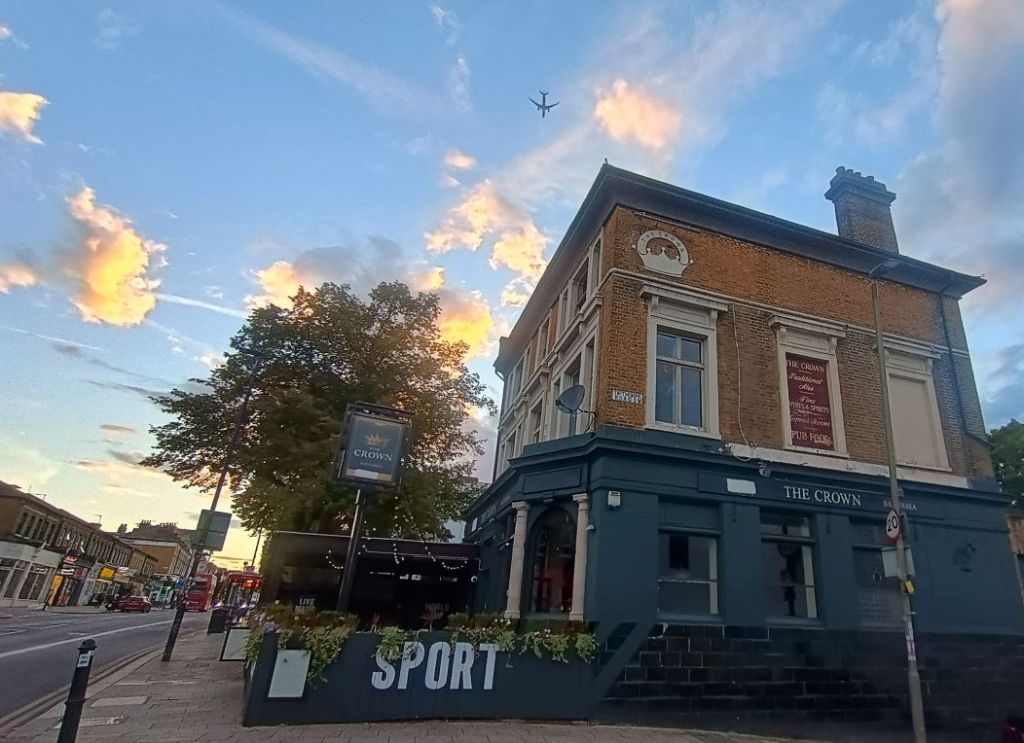
Every neighbourhood needs a decent pub. Lavender Hill used to have lots – but many drifted away over the years, including the Beaufoy Arms (now the Iron BodyFit gym), the Cedars (which we’ve written about – currently up for lease as a restaurant), and the Craven Arms (a former boxing pub, now a medical practice). Four Thieves has a particularly complicated history, originally opening as the Cornet of Horse, sending its early years as a music hall, later becoming the first ever branch of what would become the Jongleurs comedy club empire, and now closer to where it started as a large all-welcome pub and venue. Wetherspoons run what’s probably Lavender Hill’s busiest pub, the London & South Western – but for a lot of its time it wasn’t a pub at all, instead housing Hasting’s furniture store (whose logo is still visible on the mosaic doorstep).
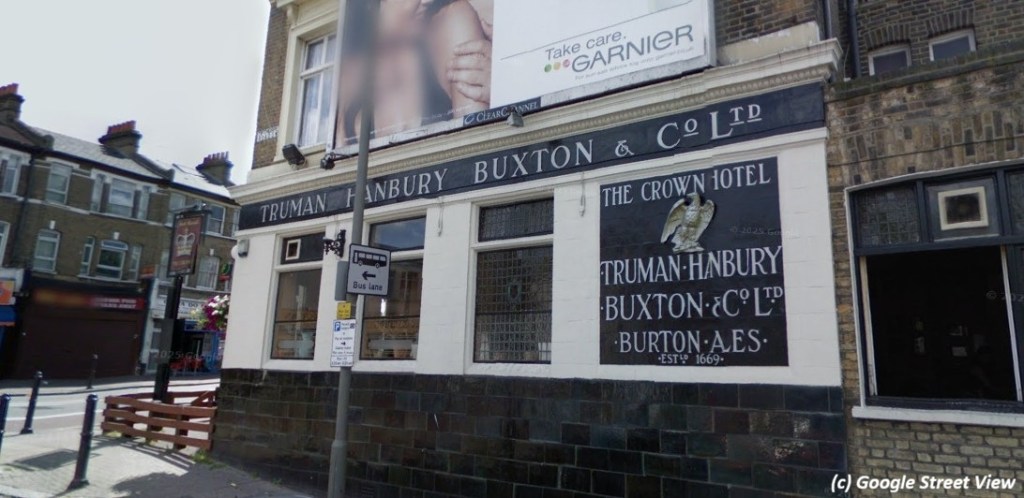
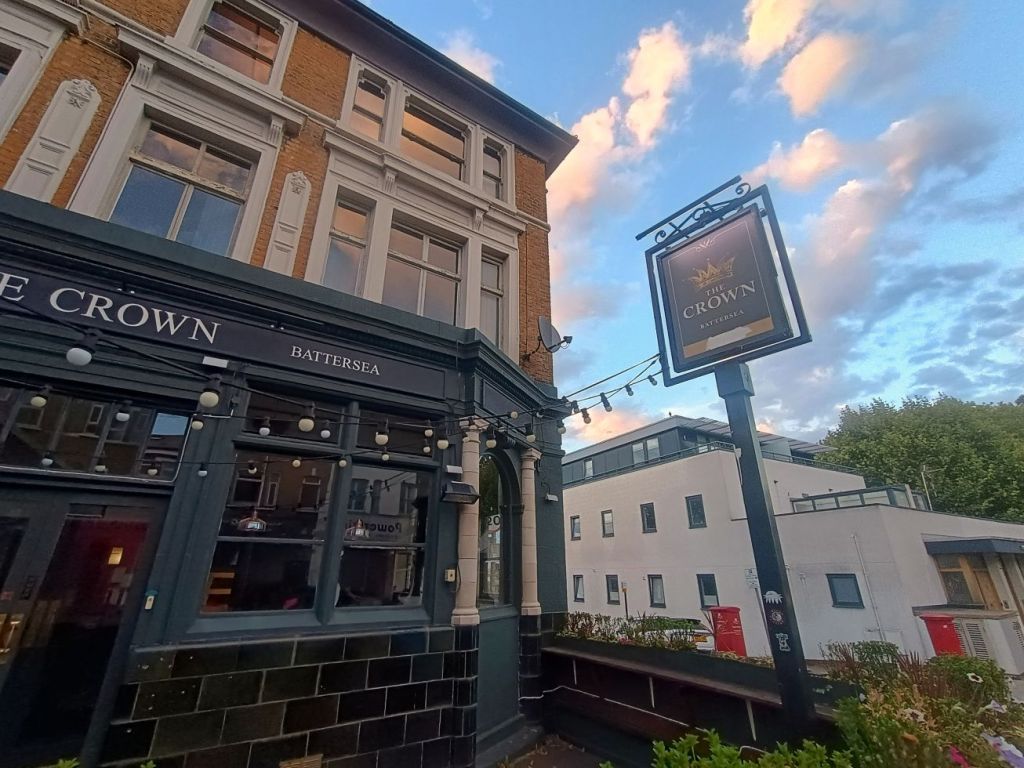
Just one has stuck to being a ‘classic’ pub throughout, and that’s The Crown. Built in the 1870s, at the same time as many of the surrounding houses, it was originally called The Crown Hotel. Later on it became a Truman’s pub, and the tiling on the outside – dark green, with paler cream faience tiles above (currently painted grey – but the colour’s still visible on the corner columns) is a classic part of the Truman brand for pubs that saw makeovers in the 1920s and 1930s. In the early 2000s the Truman branding was still visible on the tiling and signage – as per the Google Street View below.
Inside it’s a big, spacious, open plan pub with plenty of seating, a pool table, and a small raised alcove area at the rear, and there’s a front terrace opening on Lavender Hill. Pub Love, originally called Best Place Inns, have run it for a decade or so as part of a small chain of inner London pubs. They converted the managers’ flat on the upper level to a backpackers’ hostel, which – once a few early planning concerns were ironed out – went on to run happily over the years. The hostel brought a helpful source of affordable accommodation for younger tourists, as well as a useful sideline to the pub’s core business – even if it was fairly high maintenance for the relatively small amount of income it brings.
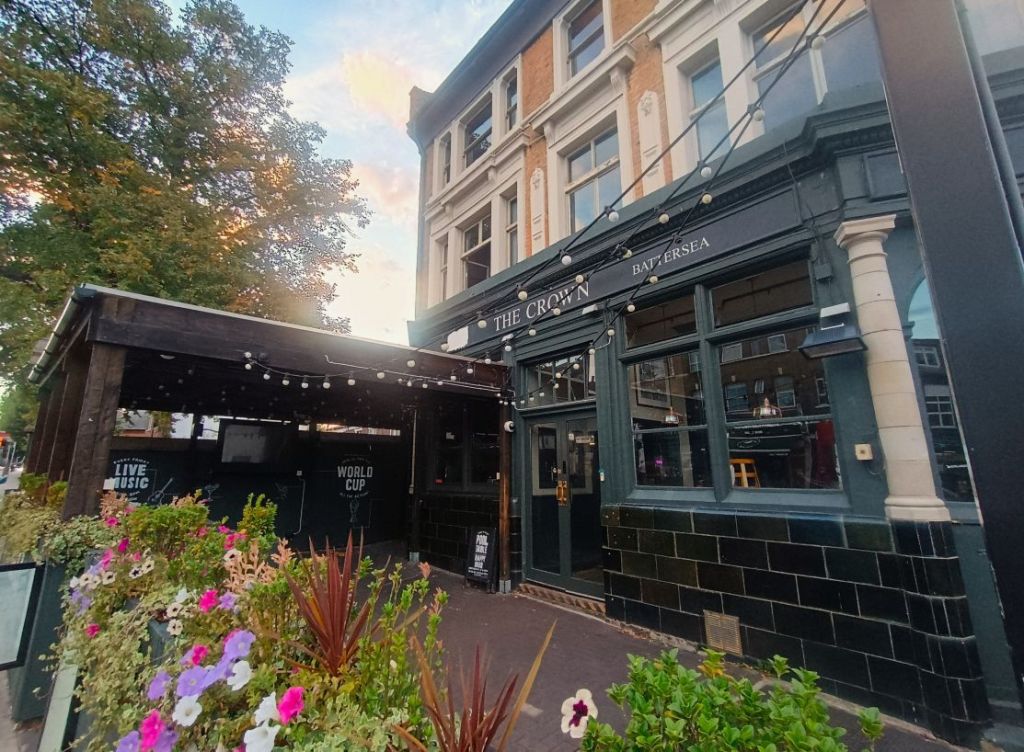
Soon after taking over the venue the PubLove team moved the bar from being right in the middle of the pub to the left hand side, alongside a comprehensive interior refit that brought a quality wooden floor and quite a stylish – but still pub-like – general feel. They also greatly improved the front terrace, that had been a bit bleak beforehand – to make it more welcoming and a little less open to the street, with a partly sheltered area and an outdoor TV. The rather smart stained glass lead-framed windows on the eastern side of the building remain intact, and overall this is a good looking pub, inside and out.
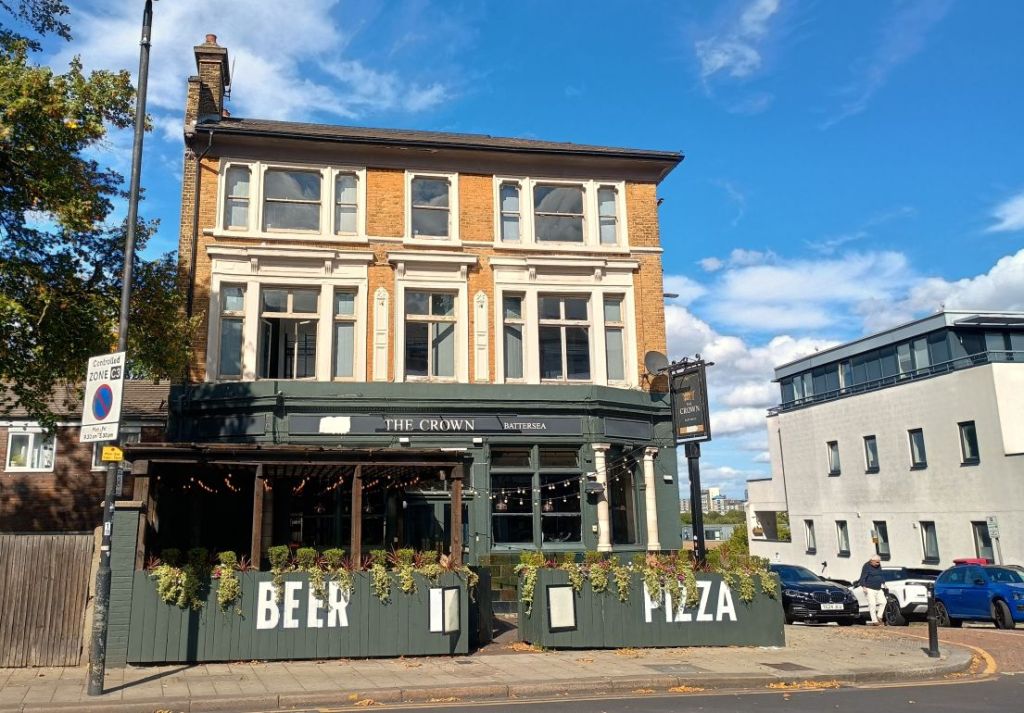
But after ten years at the helm, the team at PubLove’s lease has come to an end – and a couple of weeks ago, the Crown pulled its last pint, at least for the time being, and closed its doors. The PubLove brand was quickly painted over on the signage, but otherwise there was little sign of what the future held for the building.
What happens next? At times like these, it’s worth taking a look at who owns the building, and how it works in business terms. And brace yourselves – because like a lot of London pubs, the Crown has a complicated ownership structure, with a lot of different layers between the people pulling the pints and the ultimate person collecting the rent!
The landlord at The Crown is a firm called Stonegate – a huge company backed by private equity firm TDR Capital, who are registered in the Cayman Islands but with an operational headquarters in Solihull. Stonegate got hold of the Crown in 2020 when they bought the previously listed pub operating firm Enterprise Inns, for around 3 billion ponds – a deal that made them the proud owners of around 4,000 pubs, on top of 772 pubs and bars they already owned and that included the Slug & Lettuce, Yates, and Walkabout chains – and that instantly made them by far the UK’s largest pub landlord.
Around 2,000 of Stonegate’s properties are directly managed within the business. These tend to be the biggest, busiest sites with a strong food offer – they include Be at One on Battersea Rise, and the Two Brewers on Clapham High Street. But many more are leased out to someone else to operate – sometimes with a beer tie, which means the landlord sees a mix of rental income and a share of income by requiring some of the drinks sold in the pub to come from their in-house suppliers. The leased-out pubs in Stonegate’s portfolio are typically more local affairs, but still busy locations – an example is Lost Society on Battersea Park Road, currently on offer to an operator for £40k a year for the first year. If you fancy running one of Stonegate’s pub, there are several currently available! The Crown is very much one of the latter category – a classic neighbourhood pub rather than a big brand city centre bar or club – having been leased to smaller teams to run as they see fit over the years.
Since their huge pub purchase, Stonegate have been busy reorganising their pub empire. They sold off some of the sites, to offset some of the cost of buying the pubs, with some suggestions that they aim to offload up to a thousand in the medium term, worth a billion or so pounds. Some of these may go in big groups: Terra Firma, another venture capital outfit, was reportedly eyeing up 300 or so of the strongest sites – but Stonegate are also selling off smaller bundles of more local pubs – for example a deal thsat has seen a bundle of ten mostly-London pubs sold to Fuller’s for £35 million. They are also part way through moving some of their 2000 or so centrally-managed sites to instead run as leased-out or tenanted sites, with around 300 expected to make the move with time.
So we know who the landlord is, at least for the time being. But the ownership picture gets a little more complicated – because Stonegate only owns the freehold for about a thousand of its pubs (sometimes called its “Platinum” estate). The actual buildings that house other 4,000 or so of their pubs – including the Crown – are leased by Stonegate from all sorts of other property owners. Sometimes this is because the Stonegate property is just one unit in a larger building, and sometimes it’s because someone else owns the freehold and has leased the whole place to Stonegate. The freehold of the Crown building is ultimately owned, as far as we can tell, by someone called Goldcrown Investments Ltd – with a long lease to Stonegate, who the lease it on again to someone else to operate.
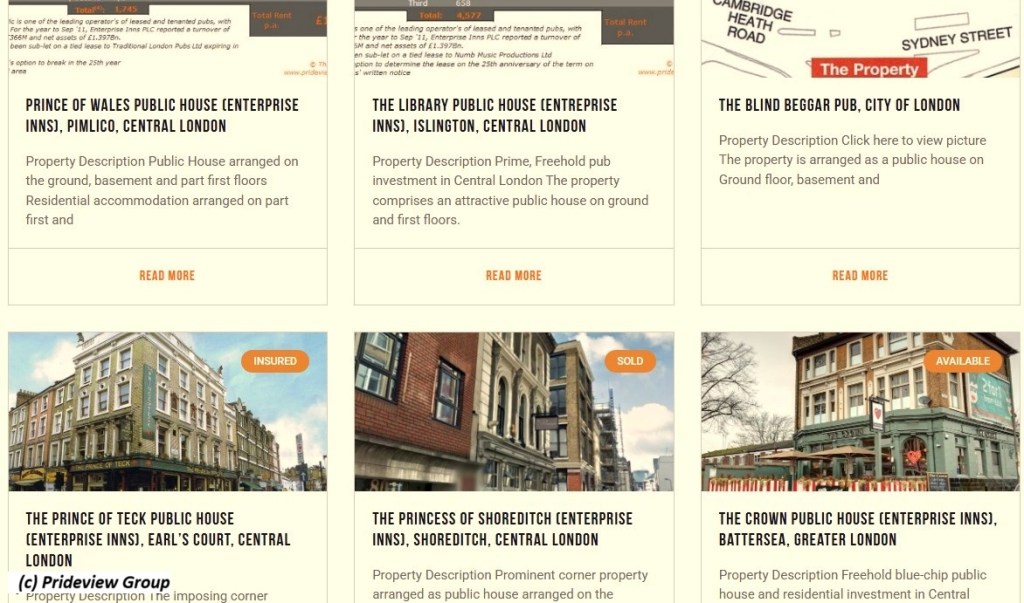
And it’s not just the tenants and Stonegate who are in the middle of a lot of sales and reorganisation: Goldcrown may also have their eye on the door, as the Crown’s freehold is also currently for sale, alongside a whole cluster of ‘Enterprise Inns’ pubs in inner London (including the Kona Kai in Fulham, the Library in Pimlico, and the Prince of Teck in Earls Court). The guide price is £2.2 million, and the property is described as having a blue chip (i.e. reliable, big business) tenant in the form of Stonegate, with a lease for 35 years from June 2020 (so running to 2045), for £92,500 in gross rent. Some highlights from the listing for The Crown:
…a substantial detached three storey (plus basement) Victorian pub building with brick elevations save for the ground floor which has a classic pub frontage and return with feature windows and painted stucco work. The windows on the upper floors have stone surrounds… Stairs to the rear lead down to the basement and up to the upper floors where there are 7 dormitories providing 60 plus beds… there is a substantial basement which is the almost the same size as the ground floor.
Maybe ominously, the listing notes it is a ‘reversionary opportunity‘, which in pub landlord speak means a freehold pub is currently under-rented or undervalued, and that financial value can be unlocked once the current lease expires or “reverts” back to the freehold’s owner. This can mean many things – most commonly it’s because the property is stuck in a long-term lease below market value and can, with time, be brought up to a much higher level (which is probably the case here), but it can also be because the current operator is underperforming (less relevant here given the rent is fixed rather than the freeholder seeing a share of turnover), because the property can see a big renovation or extension to unlock potential (for example extending on to unused land – again unlikely here, though the back of the building is a little underused), or because the building is worth more for other uses than as a pub (for example converted to flats, or demolished altogether and replaced with something bigger). The latter is a risk for any London pub, though in this case the relatively good protection Wandsworth applies to pubs and prevent unscrupulous landlords demolishing them or changing them to flats – which we have covered amid the previous attempts to unpick the protection of the nearby Queens Arms and the decent profitability of well run pubs – maybe reduces the risk here.
The listing also notes that the pub is in a prime location – which it is, being a very visible site right in the middle of a dense and relatively wealthy catchment area, on one of Battersea’s busiest roads. The listing notes that this area of Battersea has a mixed demographic with “relatively affluent housing on the [southern] side of Lavender Hill but social housing (but many now owned privately) to the [North] (to the rear of the Crown).” Competition in its immediate neighbourhood is limited – with the Queens Arms, and the Fox & Hounds on Latchmere Road as the most obvious ‘similar’ pubs, and for more town centre options, the Falcon, Windsor Castle and big Wetherspoons’ at the London and South Western by the station. The sale listing has been online for a while – but as far as we can tell, the building remains on the market at the time of writing.
This may look like it all adds up to quite a turbulent time for the pub, with a landlord busy buying and selling pubs right left and centre, and in some cases changing their operating models, and a freeholder also looking to sell.
But as a generally workable pub in a decent location, that is unlikely to see major redevelopment or a move to being centrally managed, chances are any of these changes won’t really affect the day to day running of the pub – and what matters for most of our readers is whether The Crown is open – and if it’s a decent place.
We had a good run with the team at PubLove, who invested in modernising and improving the building, and generally ran a good pub with a friendly and enthusiastic team who made it work. They also did so in a way that attracted a wide mix of people – from the sports crowd, the lived-here-forever locals, the young family market, the young professionals living here for a few years – and of course some of the visitors staying upstairs in the hostel. The tricky thing with a pub is often that you are trying to be somewhere that serves so many different interests, and you need lots of different customer bases – something the team were very good at. As the old team move on to pastures new it’s worth recognising their effort over the years in running a proper pub on Lavender Hill.
And the good news is that The Crown is not set to stay empty for long – because a new team have already agreed to take over, with plans to reopen this week. They have spent the last 17 years running The Dover Castle, right next to Borough tube station – that lease came to an end a few weeks ago and The Crown is going to be their next venture.
We haven’t been to the Dover Castle – but it seems to be a popular and decent pub – known for a lively atmosphere, and (particularly in its early years) also attracting a significant student crowd. Reviews point to friendly staff, low prices, and a generally unpretentious neighbourhood feel. The pub is appreciated for sensibly priced drinks, regular live music, and generally shows a fairly wide mix of live sport (not just football).
A bit like the Crown, the Dover Castle also catered to backpackers and travellers staying at the associated hostel upstairs. We understand the Dover Castle did not have a full-scale dedicated kitchen, so food options there were limited – but they did offer good-value deals like Sunday pizzas; The Crown has more scope in terms of its on-site food offer but is still not about to convert to being a full gastropub.
Now that they have the keys we look forward to seeing what the new team do with The Crown. It’ll no doubt be a change for the pub and also for the Dover Castle team – the Crown is a bit more suburban, and with a slightly more settled local catchment than the city centre surroundings at Borough, but it’s certainly a well loved pub with lots of potential. In a time when pubs can spend months or longer between tenancies, it’s good to see it has been picked up so quickly. With the pub aiming to reopen today – do visit to welcome the new team to Lavender Hill.
The Crown, at 102 Lavender Hill, London SW11 5RD – details at Dover Castle’s instagram. Lavender-hill.uk is a community site covering retail, planning and development and local business issues, centered loosely on the Lavender Hill area in Battersea, with occasional more detailed articles on local history, occasional coverage of local pubs, and other subjects of wider community interest. You can sign up to receive new posts by email (for free, unsubscribe anytime).


I hope these pubs provide pub quizzes, music events, darts competitions, wheelchair access and family social events.
LikeLike
I can’t find how to make a donation to keep you going.Stephen PicklesOn 14 Oct 2026,
LikeLike