Update: The proposed Sainsbury’s / Asda merger was blocked by the Government’s competition watchdog. It’s likely that the impact in places like Clapham Junction was one of the key reasons behind this! But the changes at the station are very much still on the cards.
Sainsbury’s may well be merging with Asda. It’s not certain this will happen – but if it goes ahead, we reckon that, one way or another, one of the largest sites in Clapham Junction could be up for major redevelopment. This post explores why we think this, and what it could mean for Lavender Hill. We also report on the early plans for redevelopment of Clapham Junction station, some of which have recently become available, as these may become closely intertwined with the future of the Asda site.
The Competition & Markets Authority will need to approve the merger – and will be examining whether the merger still allows enough choice of local supermarkets for customers across the country. Our map below shows all the local supermarkets – large letters mean the big ones with car parking, small ones refer to ‘local’ or ‘express’ shops. The big A in the middle is Asda, S means Sainsbury’s, C means Co-op, T means Tesco, and so on… (we’ve also included the possible new Co-op on Lavender Hill). 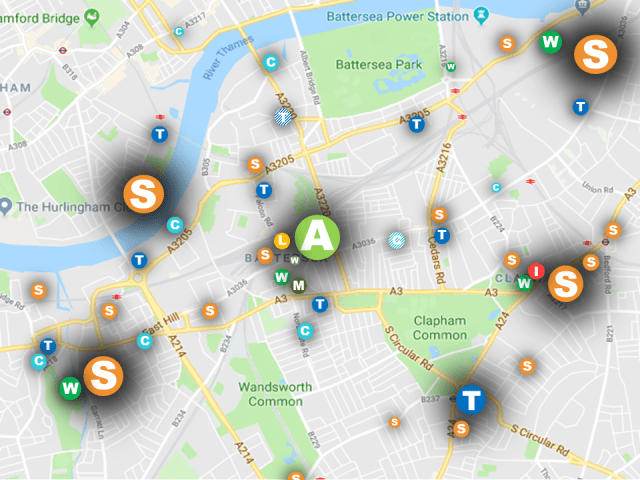 It’s striking that while on the one hand Clapham Junction has eight different supermarkets, they are mostly small convenience versions. When you look at the rival supermarkets around Asda – the large ones, with a full range and car parking – three of the four nearest ones are already owned by Sainsbury’s! A combined Sainsbury’s/Asda would therefore own all the nearby large stores, with huge branches of Sainsbury’s at Fulham, Wandsworth and Nine Elms, all of them recently rebuilt. The CMA tends to only really be interested in the large stores, and Clapham Junction is hence an area they will no doubt look at very closely if the merger gets the green light.
Despite all the problems the big supermarkets are currently facing, the Lavender Hill Asda store won’t be closing any time soon – it’s something of a jewel in the Asda crown and we’ve heard it is highly profitable; it’s certainly very busy most of the time. This means Sainsbury’s/Asda will probably fight hard to hang on to it – but their hand may be forced.
If Sainsbury’s/Asda do have to sell this branch to a rival as a condition of the merger, Tesco seems the likeliest buyer if the price was right. Tesco know the area well – they have plenty of small stores around here and also used to own the Fulham site, but (in a rather complicated deal some years back) sold it to Sainsbury’s; there’s a medium-sized Tesco at Clapham South but nothing much else this side of Vauxhall; and central London remains one of their more successful areas.
Here’s where it gets interesting. Other than adding the odd mezzanine here & there, Asda have shown very little enthusiasm for developing their UK stores to be anything other than supermarkets surrounded by car parks. Maybe this is because they’re owned by Wal-Mart – an American supermarket with only limited experience in such developments (mixing supermarkets and flats is still rare in the US, outside a few major city centres). The fact that Asda are one of the weaker performing parts of the Wal-mart empire (last year reporting 11 consecutive quarters of sales declines) probably didn’t encourage Wal-mart to sign off big (and potentially risky) UK property investments either.
In marked contrast, both Tesco and Sainsbury’s have strong form in redeveloping their city centre stores – you only have to look at Sainsbury’s recent major redevelopments of stores in Nine Elms, Fulham and Whitechapel to see what we could expect under a Sainsbury’s ownership. If the site is sold to Tesco, they have form too – look at their huge redevelopments in Woolwich, Gateshead or Streatham and the model is very similar, with several floors of underground car parking a coupe of levels of retail, and then flats galore on many upper levels.
Some of Tesco’s recent projects have gone wrong – with a redevelopment disaster in Dartford in 2015 probably being the most famous example. However they have reportedly looking again at the value of their sites. As reported in The Drum –
[Tesco] will look to completely overhaul the locations of existing stores. In practice, this would see it block off a significant portion of a store’s carpark and build a new Tesco with residential property above it. Once the new store is operational it would then knock down the old one and transform that into a car park with yet more flats above it.
So, in short, pretty much whoever ends up running this store – whether an Asda/Sainsbury’s partnership, Tesco, or someone else – chances are they’ll be rather more interested in big development projects than Asda ever were.
And as one of very few big supermarket sites so close to central London & excellent transport, with potential for a building that uses the whole of the large site, that goes both deeper below ground and higher above ground than the current structures (the adjacent post office is building about six storeys higher), it may all happen quite quickly.
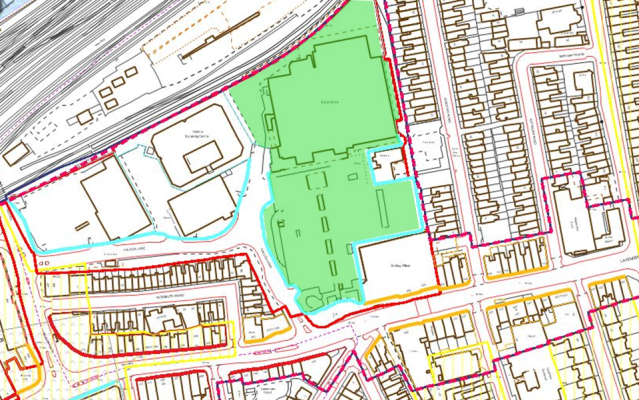
The Asda site, shaded in green (adapted from an extract of Wandsworth’s planning policies map) – which was formerly a railway yard
So what might get built? There is some planning guidance already in place in a little-known tome of Wandsworth’s planning guidance, the Site Specific Allocations document – which includes a brief description of the site and what redevelopment could offer:
Design Principles: The existing development of this site originates from the 1980’s when the former railway lands were developed for a large supermarket, currently ASDA. Since that development took place two other sites have been re-developed for retail use, namely Boots and Lidl. These developments around the northern edge of the town centre lie outside the conservation area, and have resulted in a fragmentation of the urban fabric in contrast to the tight-knit urban grain of the main town centre. The site is occupied by low rise buildings, which contrast markedly with the rest of the town centre. There is a real opportunity as part of the vision for the town centre to secure a development that contributes to its vitality and diversity, whilst ensuring that its contextual grain is respected. Any proposals should seek to enhance the character and appearance of the setting of the conservation area. Any development along the south side of a potential street realignment of Falcon Lane should take account of the impact on properties on Mossbury Road.
The site the document refers to includes Lidl, Boots and the post office building; however as we have reported elsewhere Lidl already has its own redevelopment plans, and the post office still houses a major telephone exchange which is unlikely to be cost-effective to relocate, so we’re probably really only talking about Asda or maybe (at a push) Asda & Boots.
The site specific allocations document includes some fairly high level design steers:
Street blocks: Redevelopment should reflect the urban grain of Clapham Junction. Development of this site should ensure that it integrates with the character of surrounding redevelopment and enhances the setting of the conservation area. Street frontages should respect the prevailing four storey height of the town centre and the enclosure ratio between the width of a new street and buildings should be similar to St John’s Road/Lavender Hill. An improved pedestrian environment to Falcon Road and Lavender Hill with enhanced priorities for pedestrian crossings should be sought with an active frontage to Falcon Road.
There’s a steer to maintain or increase the amount of retail here, which we believe is pretty important – as while the Asda building has dated really quite quickly, this remains an important part of Clapham Junctions’s shopping centre and brings in a fair bit of trade for the other shops in the neighbourhood –
Scope for intensification, including additional retail floorspace, other town centre uses including potential hotel development and residential. Retention of post office and delivery office use. […] There is scope for intensification […] including the provision of significant additional housing in this highly accessible location. New retail floorspace can take pressure off the unique and distinct areas to the south such as Northcote Road, Battersea Rise and Webbs Road and help meet identified retail growth required.
The above was drafted back when there was a bit of a local panic about chains moving in to the Northcote Road and edging out everyone else; this threat seems to have receded somewhat, and the issue now is probably more about ensuring that we don’t lose the main town centre ‘anchor retailers’ we already have.
The current site also provides the only source of car parking for a wide range of local businesses – the site is, technically, town centre parking; one of the conditions on its construction was that Asda can’t force you to make a purchase to use it provided you don’t overstay the free parking timescale. Despite the gradual trend away from large car parks, this one remains very heavily used and we’d be really quite concerned if this was reduced or remved in any redevelopment. To add to the complexity, the site is somewhat interlinked with a railway signalling centre to the north, and a day nursery to the east.
A rebuilding would be quite complex and troublesome to manage (the Vauxhall Sainsbury’s, for example, was replaced for several months with a small temporary supermarket at one end of the site, then disappeared altogether for a good few months during development) – but this is hard to avoid.
Any redevelopment will have a major impact on Lavender Hill – both during the works, and afterwards. It won’t necessarily be negative – there’s little doubt that if Asda was built today, what would have been built would be a very different building that woudl make far better use of the space. The site specific allocations document is a good atrt (not that it necessarily gets followed in practice!); we’d also suggest a few guiding principles –
- The site can add all sorts of new uses (flats, hotels, etc) but a redevelopment needs to retain a large supermarket – as it’s important for the town centre as a whole
- The level of public car parking should be maintained, and it should keep the current ‘free limited-time town centre parking’ arrangements (but it should, of course, be underground – easily done on this sloping site)
- The front of a rebuilt supermarket should actually face on to Lavender Hill, rather than being at the back of a surface car park
- The current small ‘square’, of sorts, between the car park and Lavender Hill should be preserved in some way in the new development, but with active shops / restaurants facing it rather than fences and blank walls (as even though it is currently in a poor condition, it has great potential as a public space)
But this could become a much bigger, even more important project. Network Rail have recently taken over ownership of Clapham Junction station, with a view to sorting out the ongoing issues of congestion for once and for all – something that is very likely to involve some major rebuilding of the station, and which is pretty much unavoidable if Crossrail 2 and / or the long term extension of the Northern line from Battersea Power Station to Clapham Junction go ahead.
Network Rail are well aware that regeneration, if it involves covering over parts of the station and the extensive railway sidings, could give rise to an over–site development opportunity of 57 acres. Have a look at the map below (which is from a Network Rail document – but which we stress is, at this stake, only an early design concept and no doubt subject to huge changes in coming years), showing a potential new street plan if this goes ahead – you’ll see that the entire station area, and some areas around it, could potentially become an extension of the town centre – and that the Asda site, at th ebottom right, is also shown as part of the new street layout:
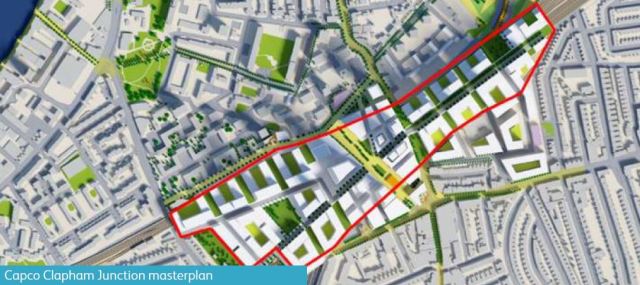
Very early stage masterplan for Clapham Junction station redevelopment, from Network Rail’s property brochure – note that this builds in the Asda site. Note this is, at this stage, a very early design…
Here’s a quote from the ‘longer term developments’ part of a recent Network Rail publication on its planned & potential property developments (remembering that Network Rail have recently taken over Clapham Junction) – as well as, for interest, a couple of very tentative images of what the redeveloped station could maybe look like –
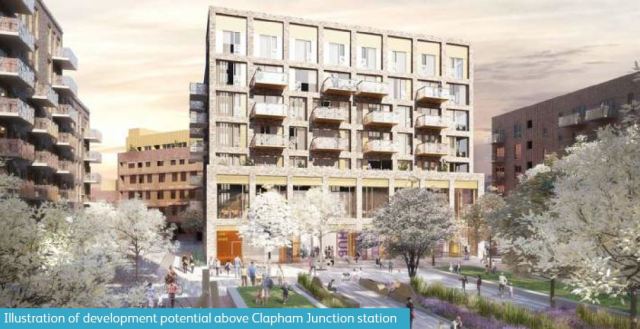
- Illustration of development potential above the station, if it is partly decked over
Clapham Junction – A Masterplan for a Remodelled Station and New Neighbourhood
Clapham Junction is the busiest railway interchange in the UK with over 2,000 trains passing through each day. It needs significant remodelling to cope with a growing customer base and the planned arrival of Crossrail 2. By 2031, Clapham Junction will no longer be able to cope with passenger demand. Through Solum Regeneration – our joint venture vehicle with Capco – we are looking at the potential of redeveloping Clapham Junction to create a modern station, able to cope with future demand and ready to accommodate Crossrail 2. The project could revitalise the town centre, deliver connectivity to its surroundings, and support the wider regeneration within the Clapham Junction to Battersea Riverside Housing Zone.
We are exploring the idea of decking over the station to provide a platform for new enabling development. This would allow us to maximise the space, improving access and circulation, creating opportunities for retail within the station and supporting the delivery of the Housing Zone. The project is still at an early stage but if progressed, we could deliver a new station and create new space for housing in central London.
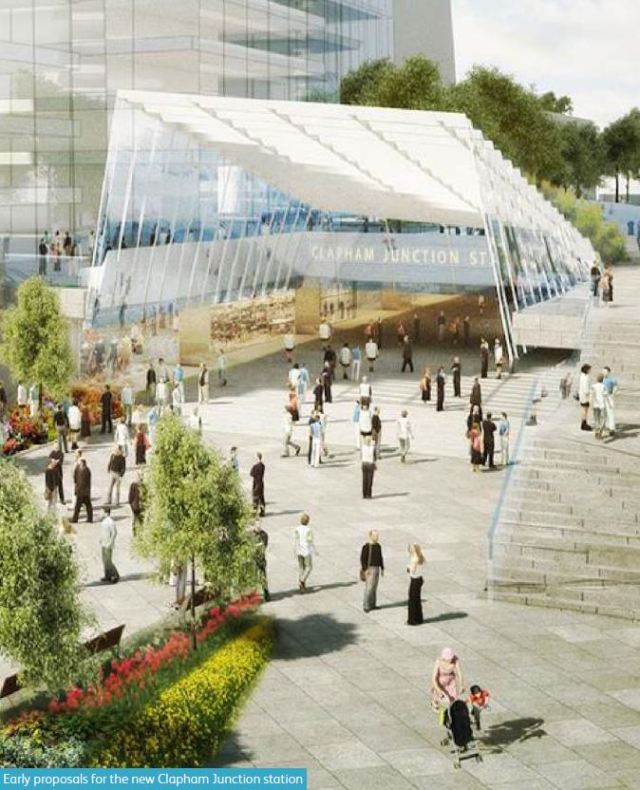
Extract of (very early) proposals for the new Clapham Junction (source: Network Rail). Please note these are concept sketches only at this stage…
This is, of course, all quite speculative, and the proposed Asda/Sainsbury’s merger may never happen.
Either way, Lavender Hill for Me will be watching this all closely (and you can also count on Clapham Junction Action Group keeping a very close eye on the station redevelopment) – and will keep you posted. And we welcome your thoughts…

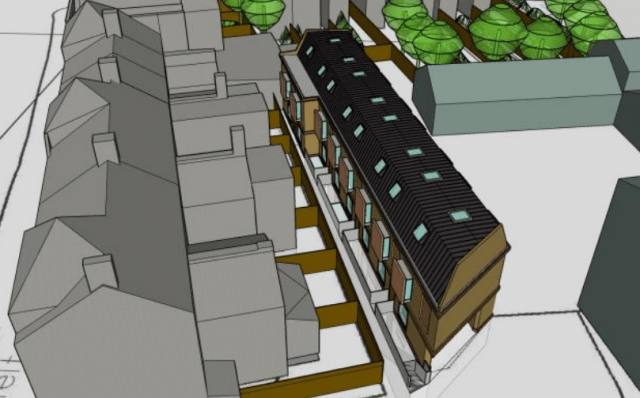
 This will entail some changes to the IdeaSpace, as well as the replacement of a warehouse building that’s currently within Battersea Business Centre. The building in question is old and tired, and isn’t much to look at (image below, from the planning application) – it’s unlikely that anyone will mourn its loss.
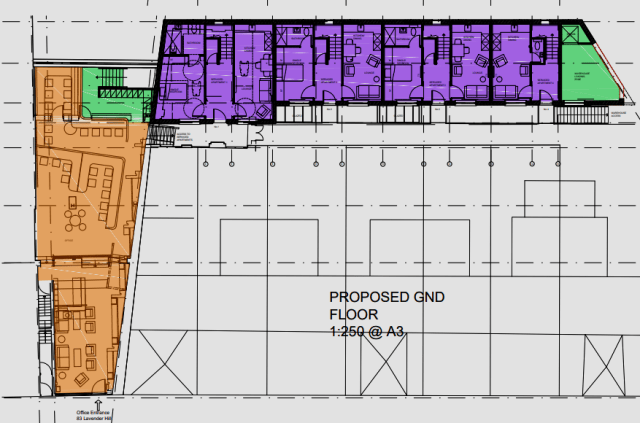
 These units are designed for short-to-medium term stay, and as far as we can tell would be run alongside the shared office space – we doubt these would be viable as long term residential due to the lack of outside space. The diagram below shows the split of office space (orange) and apartment space (purple) on one floor of the proposed development.
 The new building will include a basement, accessed from within the Business Centre, that’s designed to recreate the storage warehouse that is being lost in the development.
 Lavender Gardens is the small child-friendly pocket park and playground on Dorothy Road – maybe better known as a useful cut-through to the Asda car park. A little bit of good news is the announcement by Wandsworth that later this year the path through park will be redesigned and equipped with a ramp, rather than the current steps – making access from the east a lot easier for anyone with a pram or trolley, as well as providing disabled access for the first time.


 A little bit of good news – 303 Lavender Hill (a.k.a. the rather mucky looking shop unit between Whole Foods Market and the Corner Stone bookstore), which has been empty for years and is frankly a bit of an eyesore, is being cleaned up and becoming an extension of the shop next door.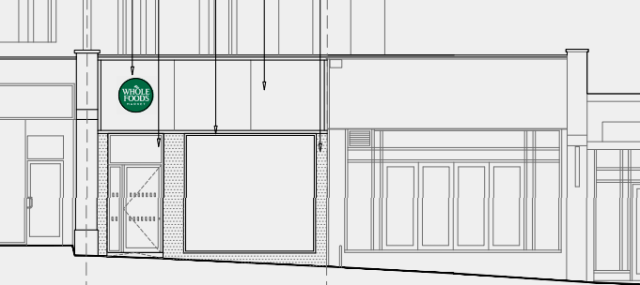


 But the final phase of the project now includes a surprise: BAC are proposing to go much further and convert the whole of Town Hall Road (the street to the right of the building – pictured below) to a small pedestrianised park. With new trees, and a mix of planters, new paving, a mural, and the two telephone kiosks ingeniously converted to a garden tool store and a gardening sink for community gardening visits, it would be quite a change to the current surroundings.
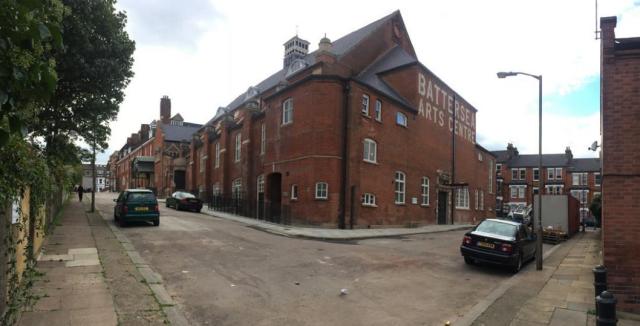 BAC also propose converting the somewhat run-down raised area between BAC and 158 Lavender Hill – which is actually the roof of some old pram sheds for the block of flats – in to a planting area – an approximate ‘before’ (image credit: Google street view) and ‘after’ are shown below.


 This is quite a complicated project – the design has to preserve emergency access (which, maybe not surprisingly in view of recent events at BAC, has been looked at in some detail), the land involved is split in to several ownerships (BAC have leased most of the street itself, but the pavement belongs to Wandsworth, the walls belong to the neighbours, one area belongs to the block of flats next door, and the two telephone kiosks belong to BT), and of course the whole proposal has to be in keeping with the listed nature of BAC itself.


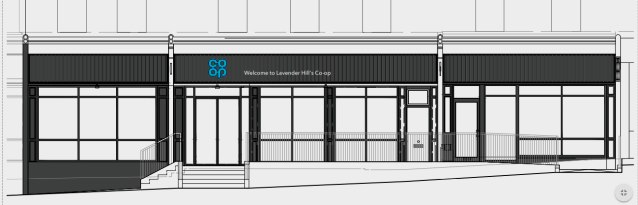
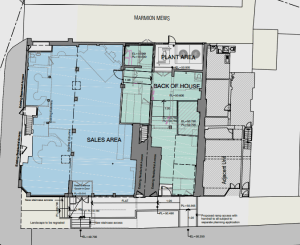
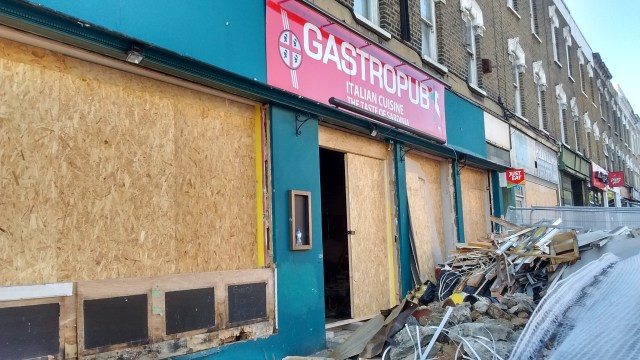 Bringing these units back in to productive use can only really be a good thing for Lavender Hill as a whole, and we doubt this development will be controversial. There may be concerns in Marmion Mews about a proposed new air conditioning unit at the rear, though these tend to get through planning without much difficulty as long as the applicants install a suitably quiet design. The Co-op reckon this new store will create 20-25 jobs (some of which are part time).

 Lavender-Hill.uk : Supporting Lavender Hill