As Lavender Hill’s colony of Lime bikes grows, and with scooters set to join the party too: can Wandsworth bring order to the chaos?

Wandsworth has a complicated relationship with cycle hire schemes! Lots of residents don’t own cars, and we’re close to the centre of London – which means it’s a Borough where a lot of people cycle. Maybe because of this, the Council is pretty supportive of cycling – and has strongly supported TfL’s Santander Cycles. They got enthusiastically involved from the start to get most of the north of the Borough included – which is why there was quite a notable stretch on the initial coverage area to include Wandsworth town centre! They’ve kept going since then: Lavender Hill itself used to be the very edge of the scheme coverage, but in 2014 Wandsworth blagged a small extension with three docking stations to cover Clapham Common Northside and Northcote Road, and last year another one meant the scheme reaching Clapham South. As we reported in 2019 Lambeth did a similar deal to add one at the south end of Cedars Road, giving the Lavender Hill area comprehensive coverage. We’ve also seen a big rollout of cycle lockups, a more continuous cycle lane along Lavender Hill, and improvements to some of the dodgier roads & junctions.

When it comes to ‘dockless’ cycle hire schemes, the relationship has been rather trickier. These schemes have had a messy life so far – starting with an explosion of chaotic and badly designed schemes in 2017 (backed by oodles of Chinese-led investment, almost all of which went up in smoke). They became quite a headache for Councils: in the initial stage where a dozen or so operators were competing with not-very-secure bike schemes cycles where being left all over the place, and costing money to rescue. Wandsworth weren’t happy at the way these schemes just appeared out of the backs of lorries in the dead of night: back in 2017 we reported that they’d seized 130 Obikes, on the grounds that they’d been dumped all over the Borough without any advance warning or consultation and were causing problems at the stations. As the FT noted at the time –

[Obike] has said it is “disappointed” after Wandsworth council seized more than 130 of its cycles and described them as a “yellow bike plague”  […]  Wandsworth council said it had started removing the bikes since they first started appearing last month, saying that “masses” of the bikes were found outside Clapham Junction train station, causing problems for pedestrians and especially for people in wheelchairs and parents with buggies.

Things did calm down a bit, as most of the dockless cycle operators vanished, leaving a handful of more established and organised operators mainly focussed on electric bikes – most notably Lime, who are now turning a decent profit. But the issue of bikes left all over the pace continues to be a headache for Councils trying to keep their pavements accessible to all residents and free of clutter. In 2022, Council leader Simon Hogg told Lime boss Wayne Ting that a fresh round of seizing bikes (and charging for their return) would kick off unless the firm did more to clamp down “unacceptable obstructions” to Wandsworth’s roads and pavements, following what he described as a flood of complaints from residents. The BBC News article featured St John’s Road with bikes all over it! Lime themselves also started to call for designated parking areas to be created, suggesting 10,000 dedicated e-bike parking spaces were needed across London.

Hire bikes are widely used and have become part of London’s transport arrangements, so some sort of middle ground was clearly going to be needed, between ongoing chaos of bikes littered everywhere, and attempts to seize them and get them off the streets. Wandsworth therefore started working with Lime to try and bring some order – while continuing to seize bundles of particularly badly parked bikes, presumably as a way of keeping the pressure up on the cycle scheme operators to make progress. Lime started sending teams out to sort out particularly messy assortments of bikes, as well as restricting parking in parts of the Borough, to prevent journeys being finished in particularly crowded or awkward areas. This didn’t help much at first – mainly because Lime’s bikes were too easy to hack and ride without paying; the familiar ticking of jump-started bikes was one of the sounds of last summer and with no incentive for the typically rather dubious crowd riding them to park them in a sensible way these bikes continued to be dumped all over the place. However it is now starting to work, mainly thanks to hardware tweaks on the bikes that have made it a lot harder to ride the bikes without properly unlocking them!

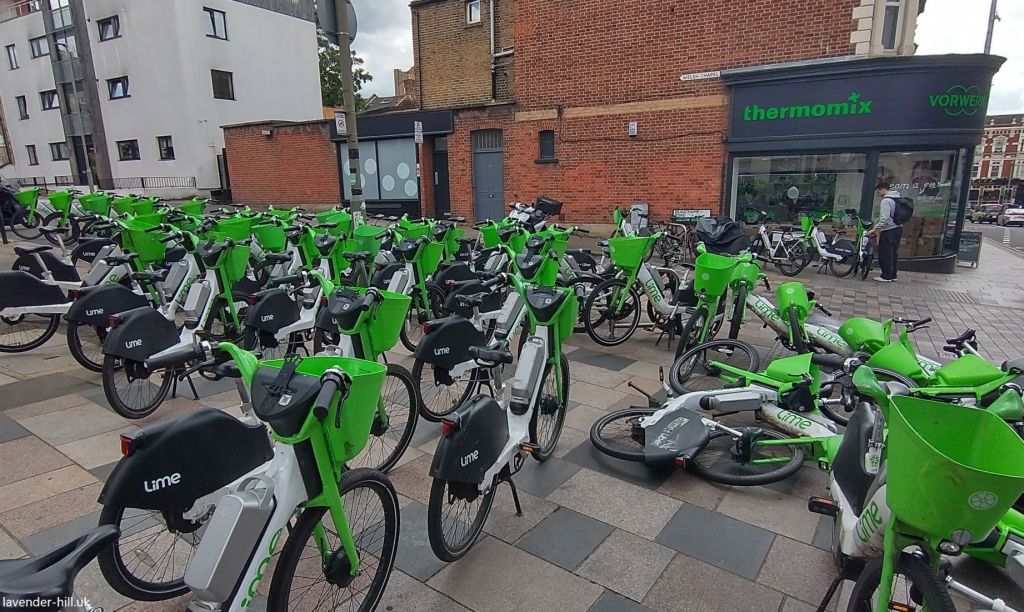
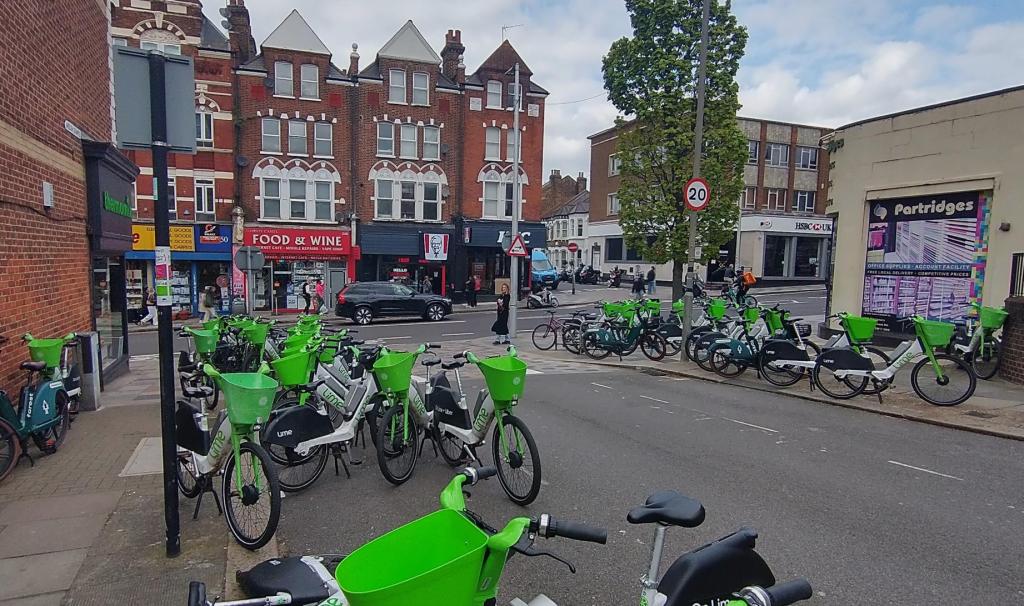
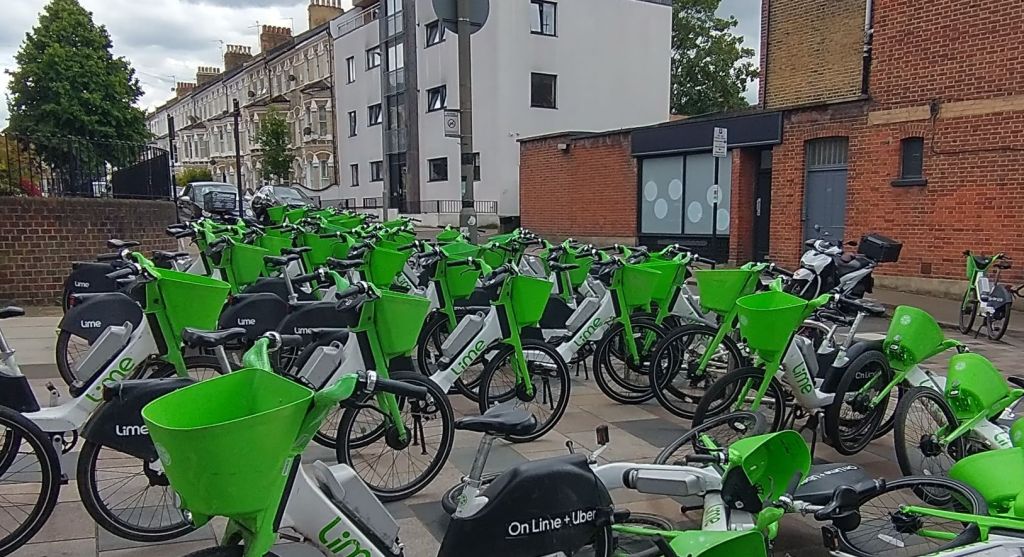
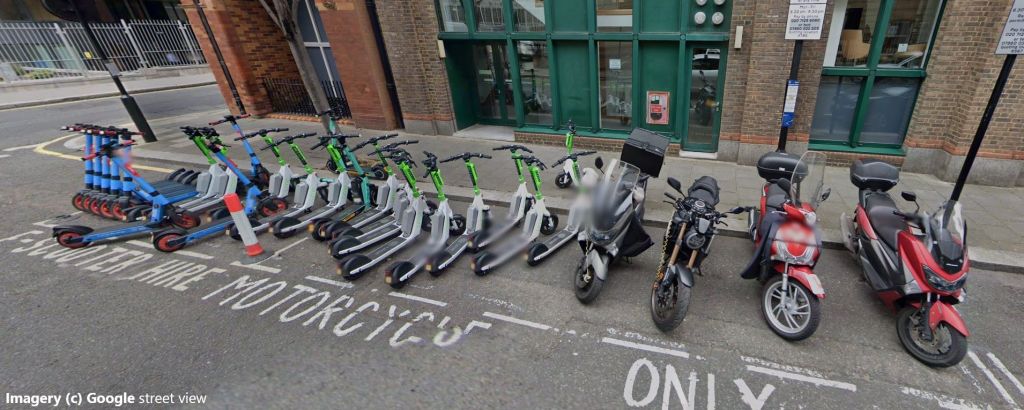
This has had a particularly striking effect on Beauchamp Road, on the corner of Lavender Hill next to the Thermomix shop. It’s become a designated Clapham Junction parking area for Lime bikes – and has been swamped by a huge sea of Lime!

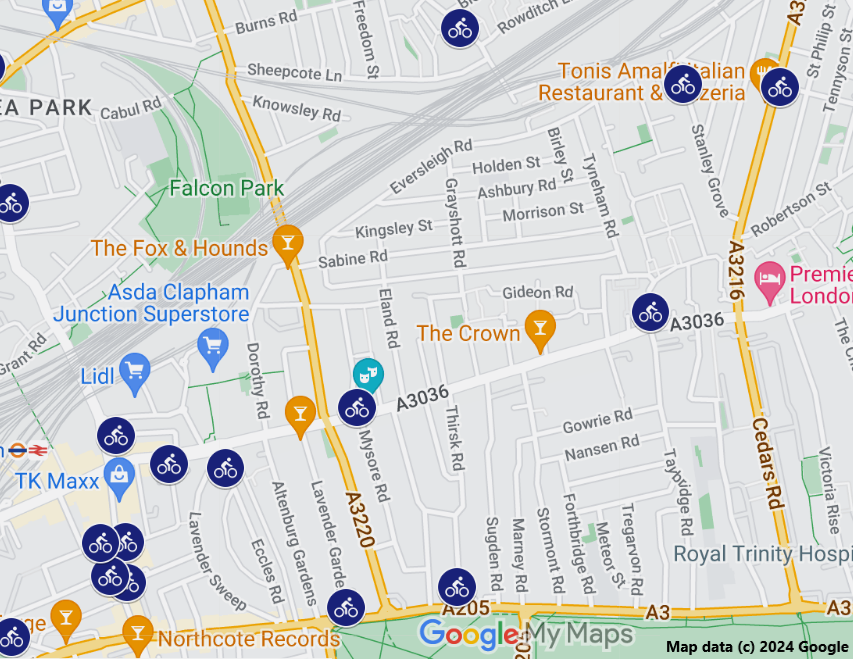
It’s shown that the cycles can be geo-restricted to some extent, and it’s created a more organised parking area than what we saw before, in a spot with a relatively wide pavement that provides space for them without blocking the path. However this doesn’t really feel like the long term solution either – and residents of Beauchamp Road are probably relieved to hear that more improvements are probably on the way. In March, Wandsworth consulted on plans to designate 141 locations around the Borough as cycle hire parking areas, with a view to focussing dropoff and pickup on these sites, and create some space on the road (rather than pavements) specifically for these cycles – which ought to keep the pavements clear at the Beauchamp Road junction. The map below shows the proposed locations – including the spot photographed above, but also a variety of spots just off the main roads round Clapham Junction, and a few locations along Lavender Hill, Queenstown Road & Clapham Common Northside.

The locations will also, on a trial basis, be open for e-scooter hire schemes. These have had a much slower growth in London than cycle hire schemes, which may reflect how much harder it is to run a scooter hire scheme than a cycle scheme. Believe it or not, while anyone can ride a bike or run a cycle ire scheme, privately-owned e-scooters remain illegal to use on London’s roads. Even though they’re out there everywhere! However there’s been a low-profile trial of hire scooters underway for the last five years, subject to quite strict rules on coverage, speed and parking. Voi is one of the firms involved, but recently confirmed it is on the brink of abandoning its current London trial of 1,700 scooters from London (and maybe going in to the cycle hire business instead) – a decision it blames partly on a lack of dedicated parking areas, but mostly on the fact that only nine out of London’s 33 Boroughs have allowed its scooters to be used at all – rather limiting their appeal and the viability of s scooter hire business. It’s not quite as bad as Paris – where a referendum led to hire scooters being completely banned – but the lack of coverage of the trials has made it rather hard to tell if scooters could properly work in London.

Wandsworth was not one of those nine scooter-friendly Boroughs – but alongside the proposal on creating proper parking spaces, it has confirmed that it will now join in with the next part of the London e-scooter rental trial, which should see an expansion in the number of scooters in the Borough from Lime, Dott and Voi, and open up some new commute options to inner London (where most of the other Boroughs already allow rental scooters as part of the same programme).

All in all, the plans to create a proper set of parking spaces, and join in to the small scooter trial, looks like a reasonable proposal. It will lead to some parking bays being converted to drop off / pick up areas for cycle hire schemes, which is never controversy-free. However similar efforts to dedicate spaces to electric vehicle charging, cycle hangars, car-hire schemes, and motorcycles, have been reasonably easily accommodated, and the proposal seems proportionate given the sheer volume of cycle hire use now on our streets. A similar approach is already up & running in several other Boroughs – an example in Westminster is shown above – and it seems to have worked fairly well so far. We’ll keep you posted on any new developments in the area, and if (as seems likely) the Council goes ahead with these plans, we’d be interested in your experience with the new approach.

This is part of an occasional series of posts on transport matters in the Lavender Hill area, in Battersea, London. To receive updates by e-mail, sign up for free here.

Posted in Street by street, Transport | 1 Comment

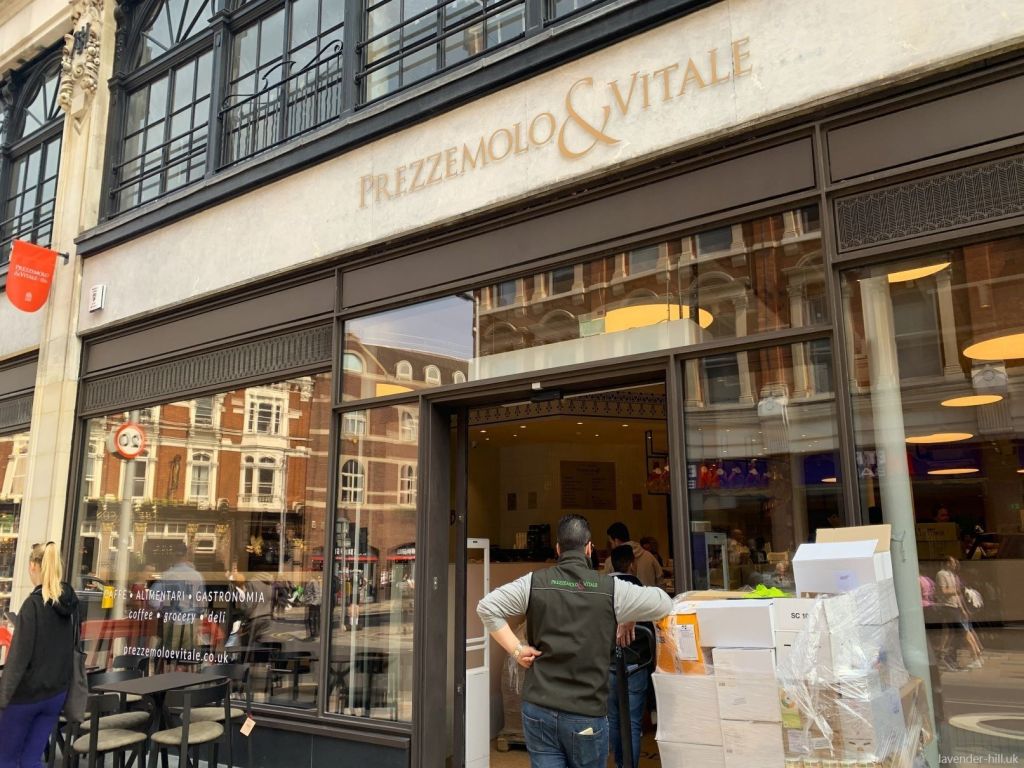
In pictures: Clapham Junction’s impressive new Italian deli and cafe, Prezzemolo & Vitale

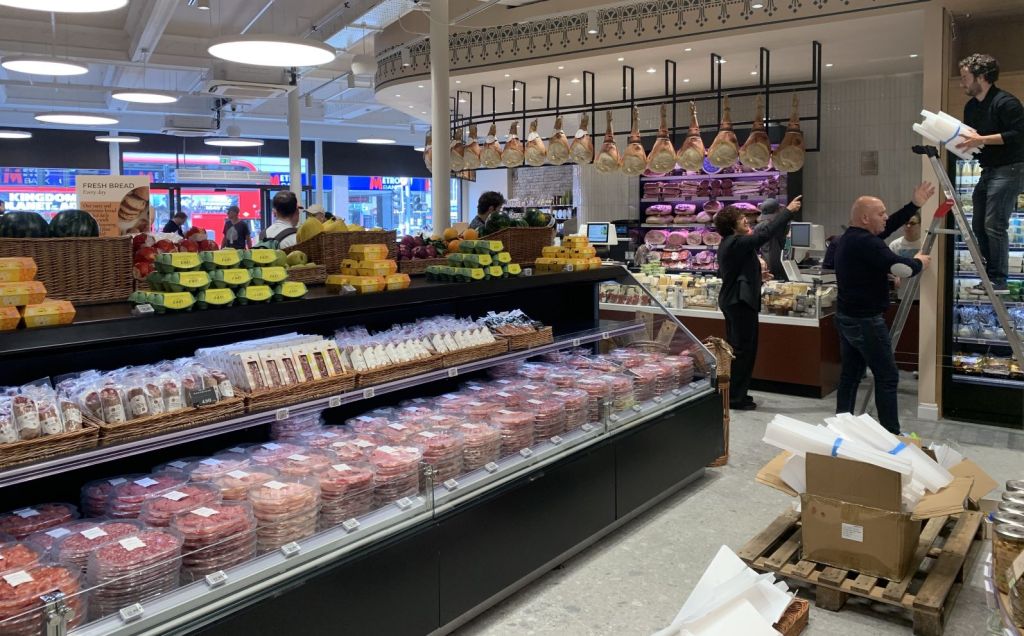
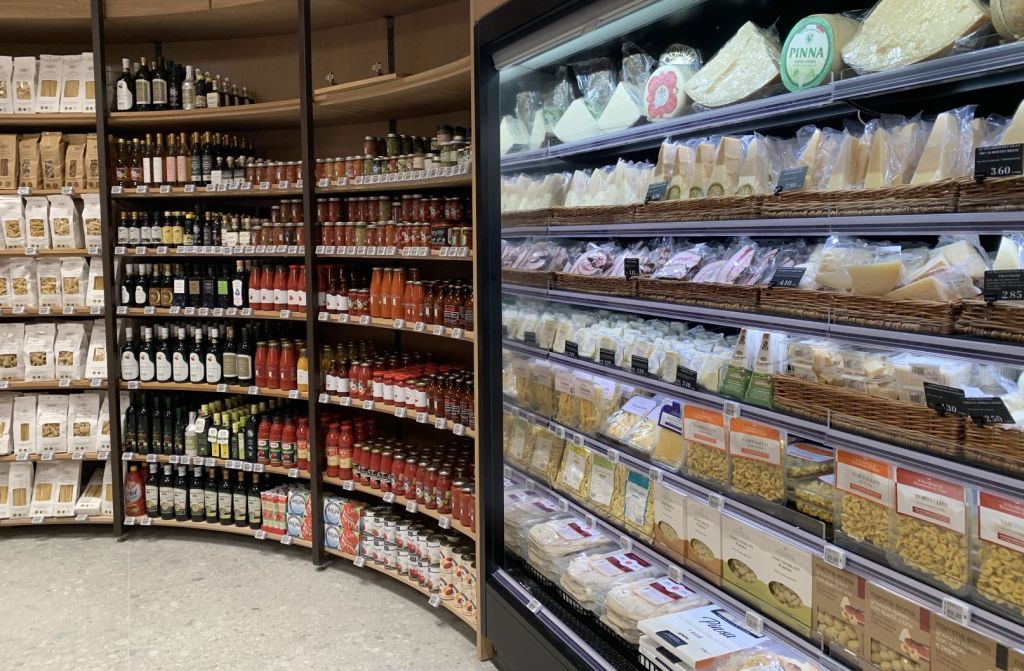
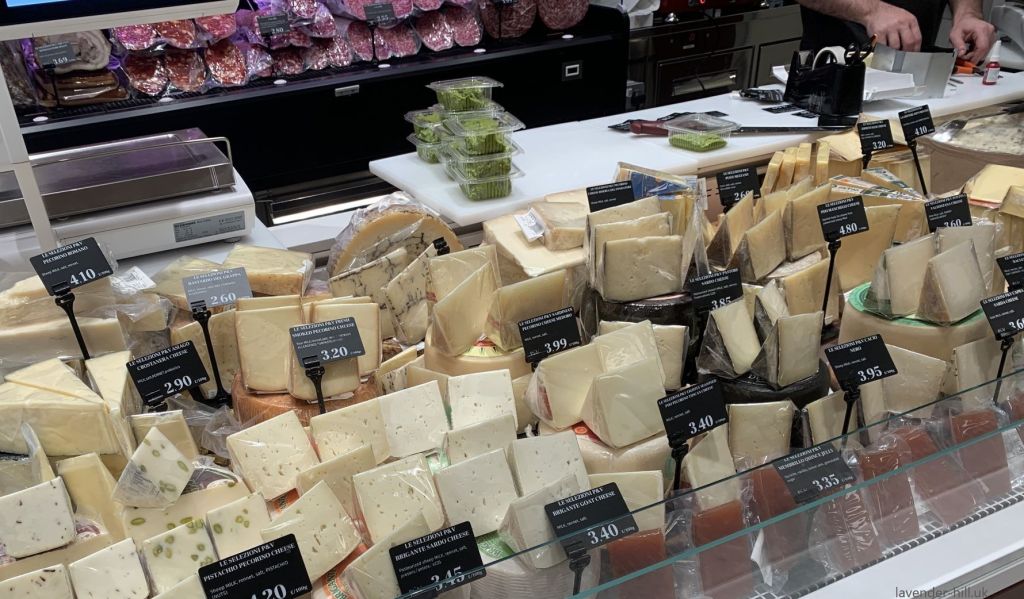
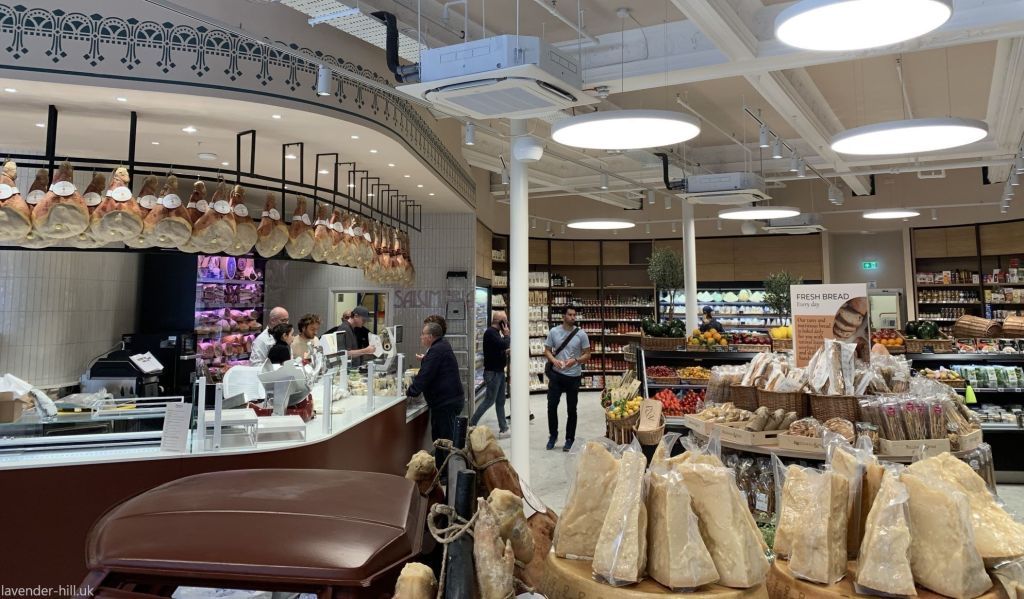
Prezzemolo & Vitale is the latest business to open in what used to be Debenhams’ beauty section at Clapham Junction – and brings a proper emporium of all things Italian – including a wide selection of cheese, meat and charcuterie, drinks, fruit and veg, and bakery produce. There’s also a cafe selling Morettino’s coffee and equipped with a generous supply of Sicilian specialties including Cassata, Cannoli and organic cakes, as well as a food-to-go offer including sandwiches, salads, cold cuts and cheeses, to eat in at the cafe or take away.

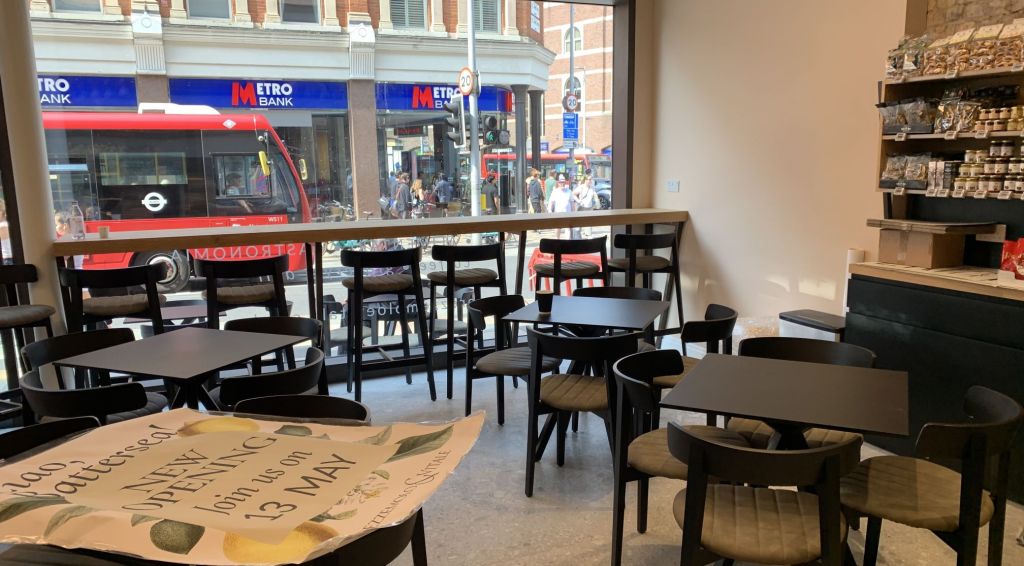
Official opening was Monday, though a soft launch on Saturday allowed us all in for a sneak peek. Stock was still being loaded in and finishing touches were still being made, but even before things were fully complete there was no doubt that they have delivered an impressive product here, bright and smartly fitted out – quite a change from the rather tired look the premises had been taking in the later years as a department store. They have made the most of the new windows – which (as we reported two years ago) involved some substantial engineering work to remove the 1960s canopy over the pavement and recreate the bright Victorian high-ceilinged space.

There’s plenty of room for indoor seating by the big windows, as well as a few outside tables. The original ceilings that go back to the first use of the space as Arding & Hobbs have been restored – including the careful plaster ornaments on the ceiling beams. The curiously-not-quite-flat floors that previously seemed to permeate a lot of the space in the Debenhams years have also finally been levelled out!

This is a fine foods delicatessen, coupled with a cafe – strongly (but not exclusively) focussed on Italian produce, and all displayed to a high standard. It’s clearly backed by a heavyweight supply chain effort behind the scenes, which means that there’s a lot of distinctly Italian produce here that you won’t find anywhere else.

The owners are Giusi Vitale and Giuseppe Prezzemolo, ‘a couple in life and work’, who are unashamedly foodies. Their aim is to combine the variety speed and convenience of a high street supermarket, with a selection of food and wine of much higher quality, and close roots to its production. There’s an assortment of baked goods, some niche high-end products, and also a more mainstream selection of Italian brands that everyone will recognise.

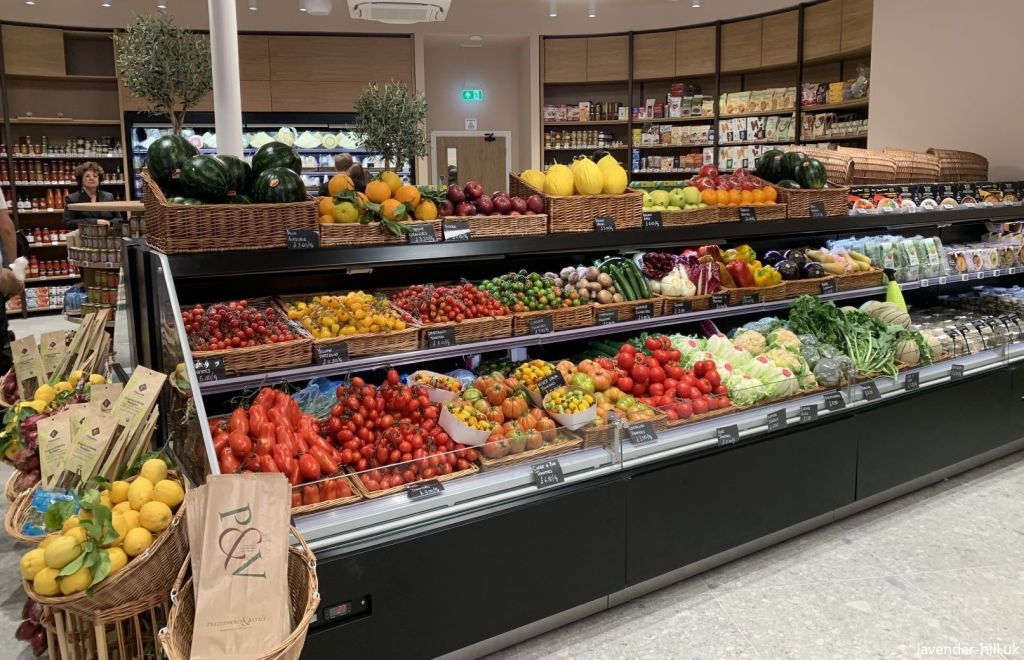
The centre of the store is dominated by a large and colourful assortment of fruit and vegetables – they bring a new consignment in from Italy at least every week. They import some of the most unusual and characteristic products, such as unusual Marsala black tomatoes or very-rare Vanilla-tasting Ribera oranges, straight from Sicily.

Towards the back is, of course, a wide mix of pasta, sauces and and olive oils – with a mix of well regarded Italian brands including Alce Nero, Rummo, Campisi & Barbera.

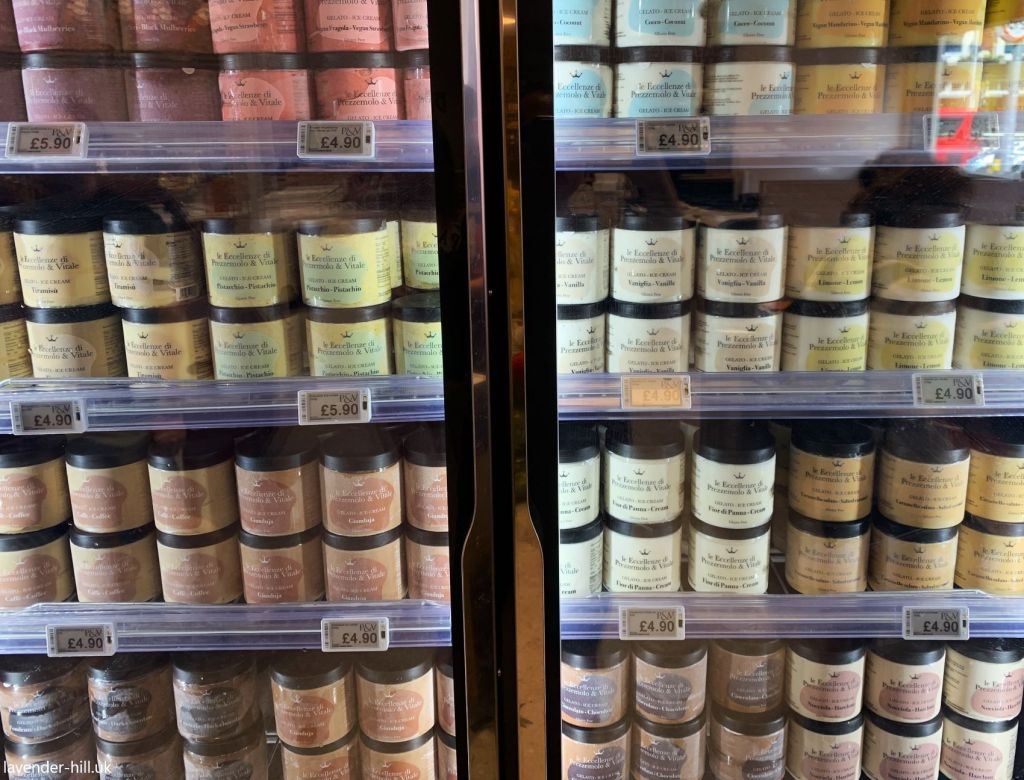
A maybe more unusual find is the fairly extensive selection of Prezzemolo & Vitale’s own brand of Italian ice cream – including Gianduja, Fior di Panna, and Tiramisu.

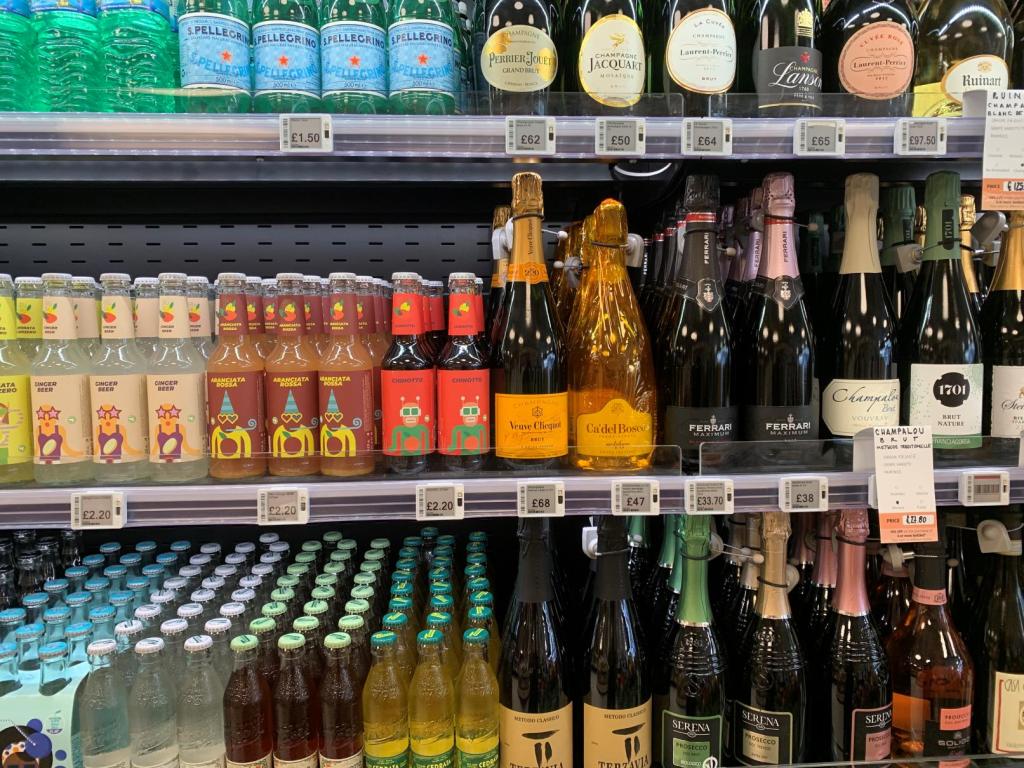
There’s a selection of drinks including a wide range of soft drinks and lemonades (including our personal favourite, Chinotto, whose presence in any business is is a sure sign of Italian influence behind the scenes!) – as well as a mix of both well-known Italian and international wines, and smaller more exclusive ones created by small Italian producers.

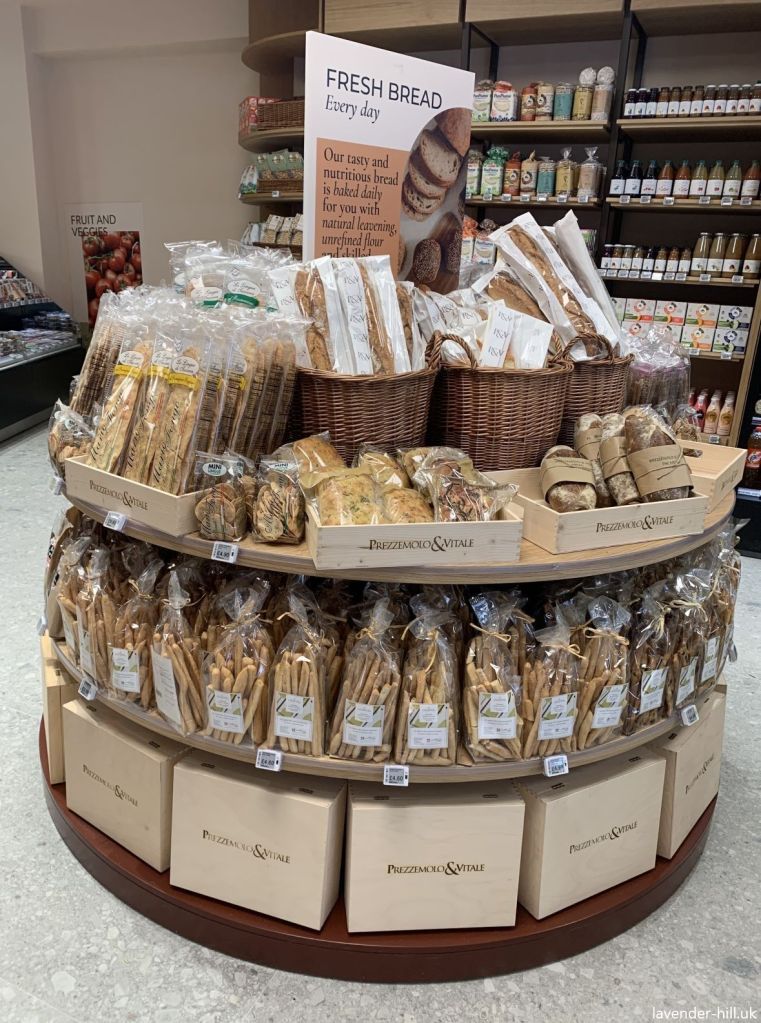
The owners take a lot of pride in their fresh bread, which is locally made in London by a baker who developed his trade in Altamura – a town near Bari whose knotted rural-style bread is widely revered in Italy as the best bread in the business, and which has protected-origin status. They expect to sell a lot of classic sweet Sicilian pastries (many prepared at Prezzemolo’s Wimbledon base) to take away as well as to have in the cafe; though the offer isn’t wholly Italian – there’s also a decent range of French patisseries and more classic English cakes.

One thing you can’t miss is that this is a business very firmly rooted in Sicily! The business was born soon after Giusi and Giuseppe first met in 1982, when they opened a small shop in Palermo, Sicily, called Fratelli Prezzemolo. They had some family experience to build on – Guisi’s father had previously owned a small business affiliated with the large-scale food distribution circuit. That first shop traded well – and allowed the pair to explore their love of, and interest in, Sicilian food, with years of travelling in Italy all the time keeping an eye out for short supply chains and interesting niche products. Over time they expanded, opening a series of larger and more central shops in the city, all focussed on high quality, authentic foods from quality cured meats to fresh fruit and vegetables.
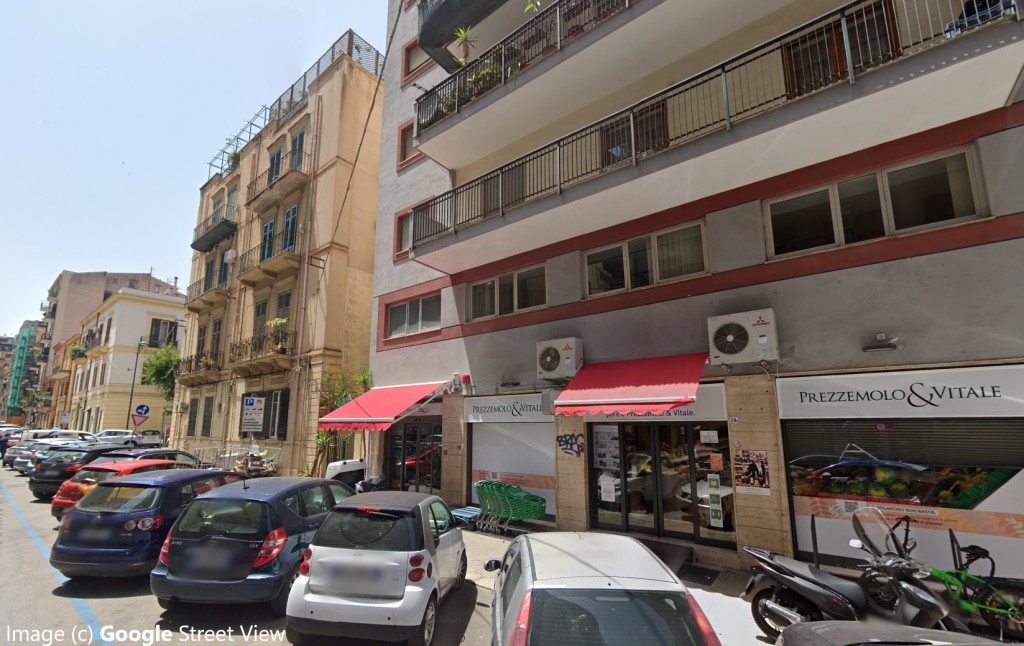
Today they have seven stores in Palermo; the Street View photo below shows one – they’re in the city centre as well as some of the quieter residential suburbs well off the tourist track. More recently the couple have started to grow the business in London – opening shops in Borough Market, Wimbledon Village, the King’s Road, and Westbourne Grove in Notting Hill – and now their fifth venture in Clapham Junction.

So it’s a warm welcome to this interesting and enthusiastic new business, which feels well suited to the area and should do well. Landing Prezzemolo & Vitale as a tenant is also a good move by the building;s developers and landlords W.RE – who have spent several years (and many millions – we’ve written about it all many times) redeveloping the old Arding & Hobbs department store in to modern offices, with shops & leisure uses in the basement, ground and first floor. It follows the opening of Botanica Hall next door (pictured below – and which has been busy from the start), and brings something interesting, and a bit different, to Clapham Junction. In both cases, it’s fair to say that W.RE’s efforts to redevelop the premises properly, and work with the building’s remaining features and architecture to restore its original elegance and scale, have done the building justice and helped land good quality tenants that will support the continued success of the town centre.

You could say that we had a bit of a lucky escape here, as we understand the tenant originally pencilled in for the spot was Amazon, when they were expanding their AmazonFresh chain of cashier-less supermarkets. There’s nothing wrong with Amazon, who already the owners of popular WholeFoods Market just round the corner (and even expanded it a few years back) – and chances are that business woudl also have worked in a spot as busy as this – but there’s no denying that this new opening is far more of a draw to the town centre than another supermarket offering a relatively standard range of convenience produce would have been.
Finally, it’s all coming together again for our landmark Arding & Hobbs building. The next opening will be the luxury Third Space gym just round the corner, whose reception is now open for early membership enquiries and site tours (details here); as we have reported that is also set to be quite an impressive space.

The final piece of the jigsaw will be the letting of the new office space on the upper floors, now equipped with smart reception area, generous roof terrace and some very light and bright spaces in the two-storey extension added to the roof. As yet there’s no news on that front, but we’ll keep you posted.

Prezzemolo & Vitale are at 99 St John’s Rd, London SW11 1QY, moments away from Clapham Junction station. If you found this interesting, you may want to see our previous articles on the long running redevelopment of the Arding & Hobbs / Debenhams building, or on shops and food & drink traders in the Lavender Hill area. To receive new posts on lavender-hill.uk by e-mail (for free, unsubscribe anytime), sign up here.

Posted in Arding & Hobbs, Business, Food & drink, Retail | 5 Comments

Food waste recycling is coming to Lavender Hill – what happens to the food collected, and what is the environmental impact?

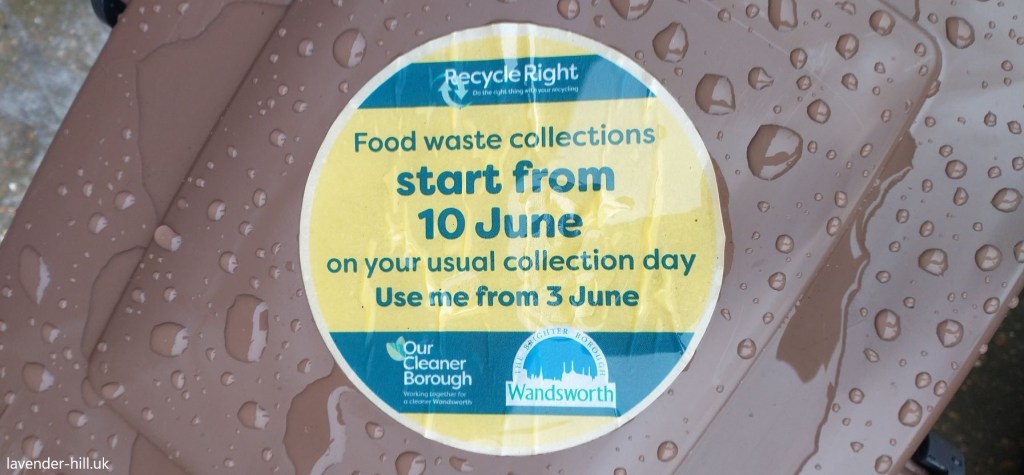
In the next few weeks, small brown bins will appear all over the Lavender Hill area. Everyone in Wandsworth borough who currently has a front-door rubbish collection will get one – so they can use the new weekly collections of food waste from the 10th June. It’ll take a bit longer for this service to extend to flats (where the logistics of finding space in bin sheds can be quite awkward), but the plan is to roll out larger food waste bins to flats by the end of the year. You’ll be able to use these bins for any food materials – including pet foods, and anything biodegradable from food preparation, including inedible bits like bones, eggshells, fruit and vegetable skins, tea bags and coffee grounds.
Wandsworth’s also giving everyone a year’s supply of compostable food waste bin liners to use – using these liners will keep things cleaner and easier but is up to you. After then you’ll need to buy your own; they are sold at most of our local supermarkets; they do ask that everyone checks any more liners include the ‘compostable’ logo shown to the right.
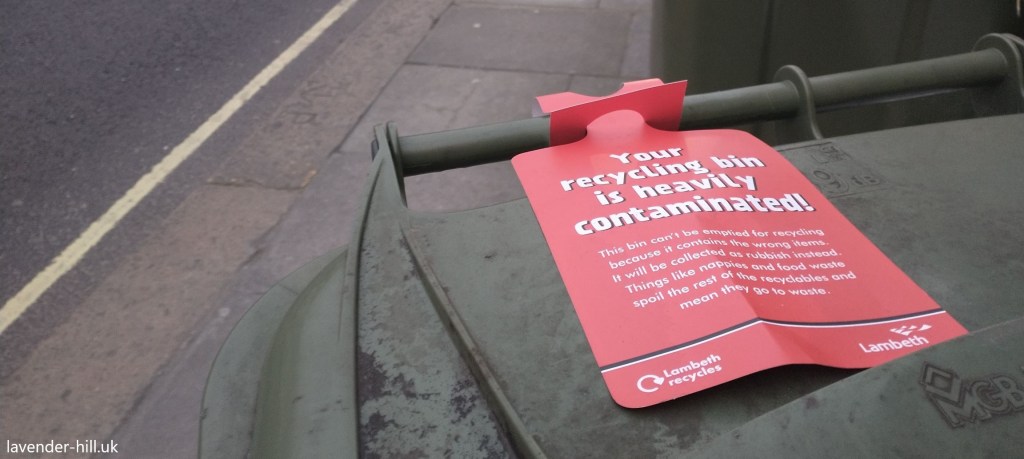
This isn’t really something Wandsworth chose to do. National government has been trying to standardise rubbish collection arrangements for some time, to avoid the confusing situation where local authorities all collect a different set of recyclable products – in the hope that a more standard approach will be better understood, and push overall recycling rates above the current rate of about 44%. Under a new government plan every Council will have to collect a minimum range of recyclable products – which Wandsworth and Lambeth already do (indeed, they both go further than the minimum and collect other more complicated items like aerosols and Tetra Pak containers). Another new rule is a requirement for all Councils to collect food waste. This is old news to our readers in Lambeth, who have had similar brown bins for years (for houses, with plans to extend the service to flats) – but something new for Wandsworth.

An interesting question is – is collecting and recycling food waste a good idea from an environmental or efficiency angle? The evidence is mixed. It partly depends on how the waste is taken to wherever it is processed: if it leads to miles of driving by big diesel lorries round remote rural communities to collect tiny amounts of food waste, or long trips out to far flung waste processing centres, things don’t look great. But if fairly clean modern vehicles can be used (as is the plan for Wandsworth, which is currently replacing the whole fleet) and the distances travelled kept down (where a dense town centre helps – vehicles will fill up fast with not too much driving needed), it starts to look a lot better.

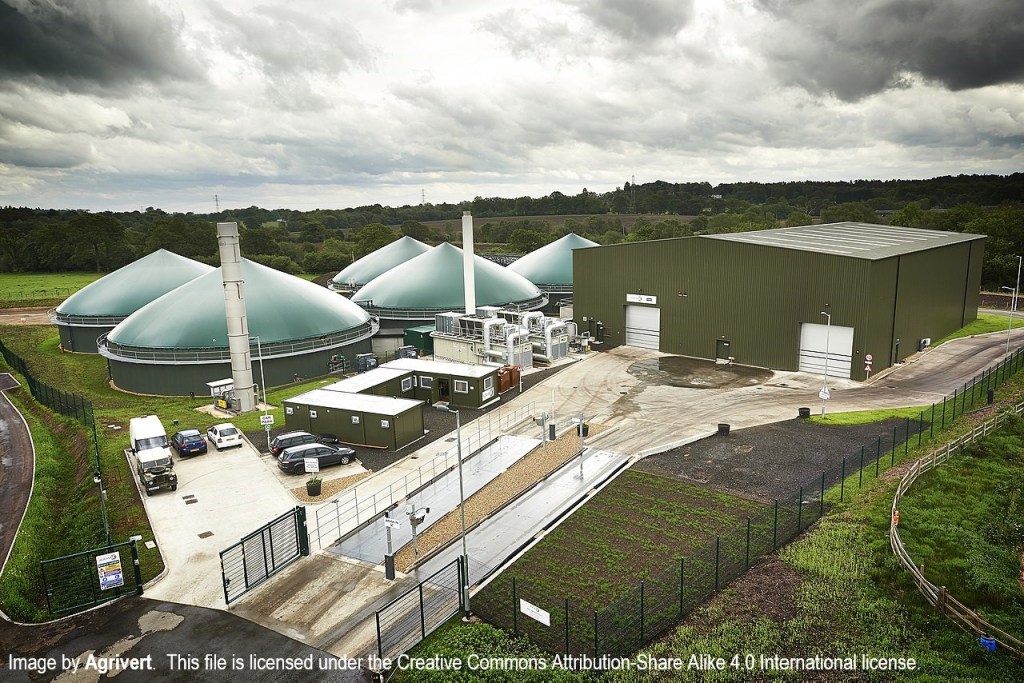
It also depends on what happens to the food waste at the other end. The best option is ‘anaerobic digestion’, which is quite a clever process. First the waste is mixed in with some water and heated up, to make sure that any notable dangers like E.coli from meat waste are eliminated, and filtered (to remove other waste and plastic (as try as we like, it’s very hard to avoid some contamination – and the same goes for recycling collections). It then goes in to a big digester, with a resident population of tiny bacteria. These bacteria are the heroes of the piece – over several weeks they will do the hard work of digesting the assorted bits of food – pretty much the same way as happens in someone’s stomach. As they do this they create heat (which goes back to be used in that killing-off-the-nasties stage at the start of the process), a sort of organic liquid fertiliser (which is sold off to farmers), and methane gas (which is collected off).

The fertiliser is an ingenious way to put a lot of carbon back in the soil rather than it being emitted (and also avoids the need for farmers to use manufactured fertilisers). The methane can, at least in theory, be put in to the gas grid – but building a new connection to the gas pipeline network, and installing all the kit needed to check it’s the right mix of gas and the machinery compress it to the right pressure, is a slow and expensive process (and hard to do even with the benefit of a government subsidy to anaerobic digesters that make gas for the grid). This means that almost all anaerobic digestion plants include mini power stations that burn the gas to make electricity, and sell that to the grid instead (as getting a connection to the grid is relatively cheap and quick).

Actually running one of these anaerobic digesters is as much of an art as a science! You need to get the precise mix of nutrients to keep all the little bacteria well-nourished and efficient, and to keep the temperature comfortable for them. Just like people, a good balanced diet keeps our digestion healthy – and sometimes keeping the digestion plant running means adding ingredients such as manure or other specific trace elements to the feedstock, and if you get the wrong mix of food waste you have to work hard to keep the process going – sometimes adding oatmeal in to give the bacteria a chance to recover with a bit of calm, bland food! You also need to give the bacteria time – as if you rush it the end product is a smelly mess rather than a nice clean fertiliser, and farmers find their lovely farm suddenly gets rather stinky, start getting complaints from the neighbours, and stop buying it. The way the plants are managed has a significant effect on the overall effect they have in reducing emissions – a 2022 research study found that of 30 plants in France that mostly processed agricultural waste, a decent number reduced carbon emissions compared to the more traditional approaches of muck spreading, thanks to careful recovery of all the heat produced, and careful design to avoid any methane leaks – but a fair few didn’t! But when you do get it right, it’s a really clever process that turns lots of waste in to nothing but useful products that can be sold – and ensures that the plant maximises the amount of useable energy recovered from the food waste, whether as heat, fertiliser, gas or power. The plant below is an example run by Agrivert, which recycles food waste from several London boroughs (image source / license).

There are other ways of dealing with this waste, the most common one being to compost it – and letting it decompose to make soil. It’s a simpler process and it will get rid of the waste, but it creates a fair bit of methane in the process, a troublesome greenhouse gas, which can make the overall benefits of collection more dubious. Newer technology has helped to reduce (but not eliminate) the methane involved – mostly by using composting containers that allow more air in to the compost as it forms.

Both of these approaches are arguably better than the current end use of this waste (which gets put on a boat and taken down the river to an incinerator in Belvedere, where it is burnt to create electricity – leaving nothing but ash and a small amount of metal and glass that got put in black bags rather than recycled). At this stage we don’t know what Wandsworth plans to do with the food waste, though the pilot programme a couple of years ago in Southfields used anaerobic digestion.

It does mean a more bins likely to be left on pavements – although food waste bins are small and portable, and Wandsworth has wisely given residents the choice of what (if any – bags also being fine) bin to use for the rest of their rubbish, in contrast to Lambeth next door where rubbish will only be collected from official Lambeth wheelie bins on many streets. Some Lambeth streets spend most of their time flooded with hundreds of somewhat oversized bins clogging up the pavements, sticking about pretty much full-time given there’s not really anywhere else to put them in streets where the houses have minimal front garden spaces. Wandsworth Road, above, maybe typifies this issue – where each house was assigned two large bins without really thinking about their gardens being small, unfenced and sometimes sloping ledges, up steep and angled steps, and the narrow pavement not being wide enough for safe pram / wheelchair access when it is covered in bins.

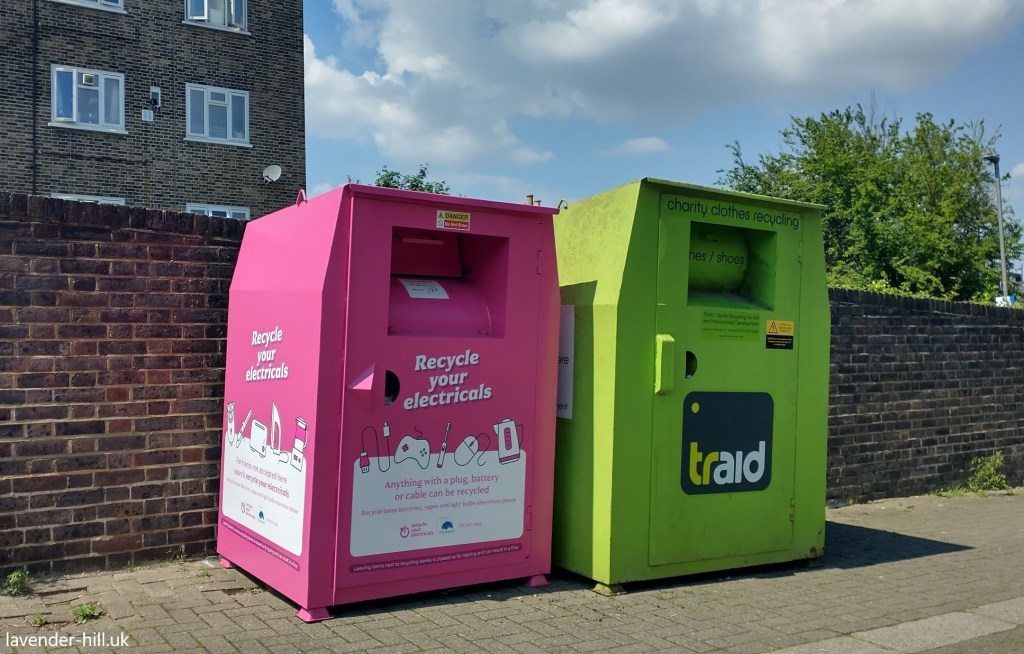
There’s one other new feature coming to Wandsworth’s rubbish collections (again, one already available in Lambeth): collection of small electrical appliances for recycling will start on the 10th June for many households who get a door-to-door waste collection, alongside the regular rubbish collection. By small, the Council means ‘up to 25cm’ – this isn’t a collection service for your old fridge! It seems that some sort of arrangement to recycle electrical goods is also on the way for flats – but this may involve collection points scattered around the Borough rather than specific bins in particular blocks. Some of these bins are already in place, like the one below (which is on Ashley Crescent). At some point in the next few years, recycling collections right across the country are also set to expand to include plastic film (like carrier bags).

All these new collections and the infrastructure to handle the waste that’s collected are not a cheap thing to organise. The government – bound by a well-established principle that if it imposes ‘new burdens’ on local authorities, it needs to fund them – has said it will provide funding to cover ‘all reasonable costs’ to councils that come from that this new recycling requirement – including bins, collection lorries, and possible plants to store and process the waste. However they are not actually telling Councils how much they will be paid, or when, and with a central government which is not exactly known for its love of London at the moment there’s a risk that Wandsworth may end up feeling short changed!

So – will this expansion of Lavender Hill’s recycling work? Food waste recycling seems to be doing reasonably well in Lambeth, though not a lot of data has been published on how much is collected overall and what impact that has on emissions. Wandsworth’s current overall recycling rate is about 25%, which is fairly typical for an inner London Council (where the average is 28%) but notably lower than Lambeth’s at 35% – so there’s plenty of room for improvement.

Experience elsewhere suggests some people will become very efficient food waste recyclers, and some won’t bother – but it should lead to a reasonably steady amount of useable waste being collected. We’ll have to see if Lavender Hill’s resident foxes learn how to open the bin locks to get to a good source of food, which has been a bit of a theme elsewhere (though early tests suggest that Wandsworth’s bins are a bit more robust than the ones that have been in use in Lambeth – and waste put out in these bins may be less tempting to foxes or crows than the same waste in black bags). Overall, this is potentially a decent move for the environment – making better use of our food waste, and reducing what goes in our black bags.

Posted in Environment, Useful to know | Leave a comment

It’s back: a new public consultation is underway on the Clapham Junction rough sleeper hub

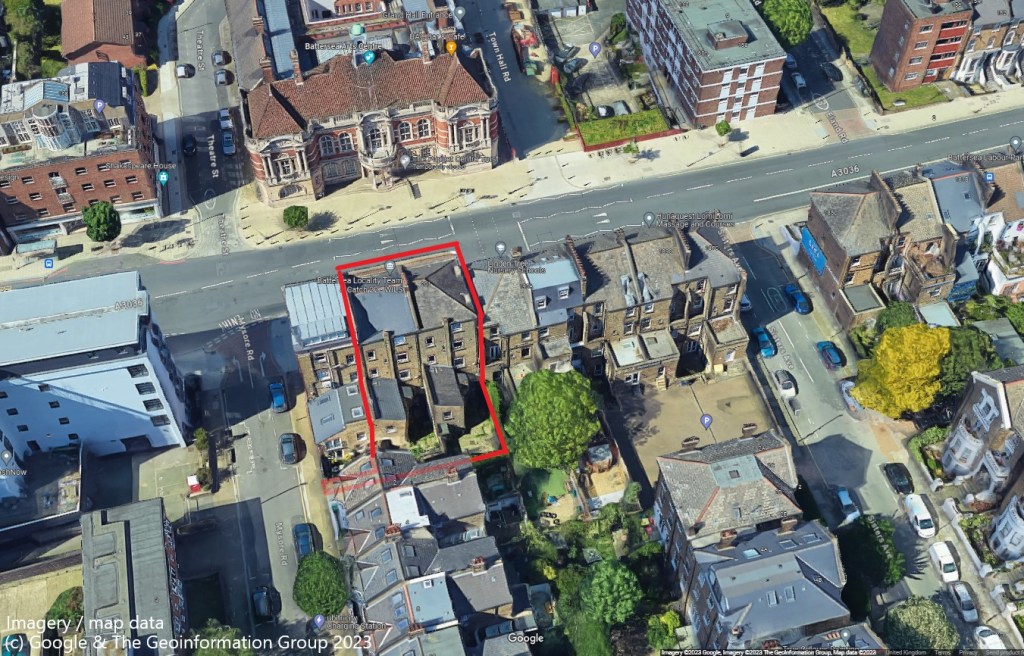
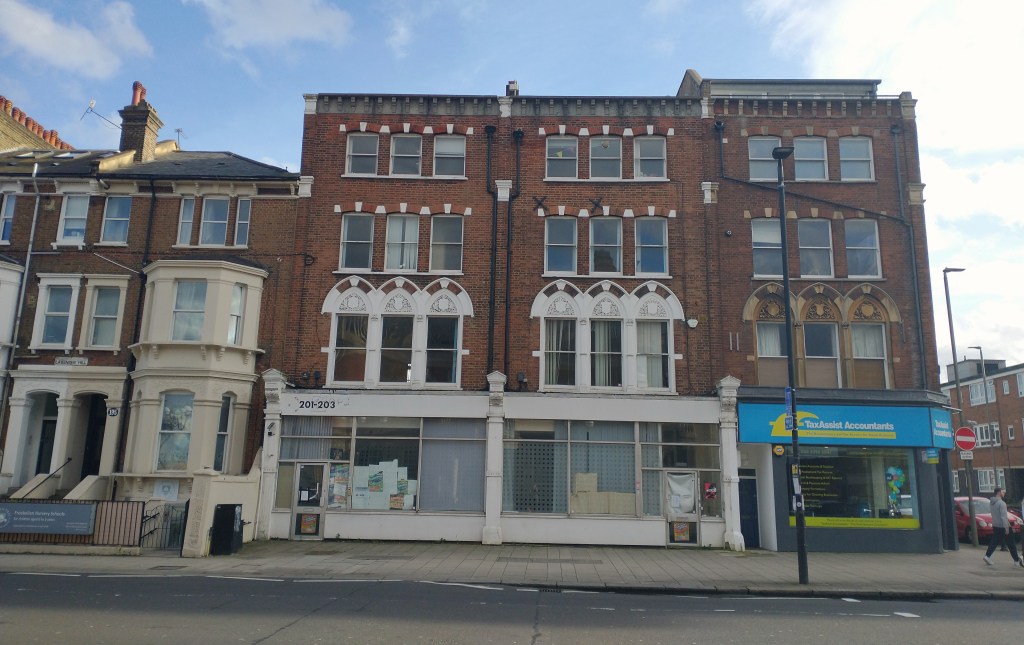
We’ve written a lot about the plans for a new hub for rough sleepers on Lavender Hill. Something which could actually be a decent idea, and which is an innovative way to tackle a difficult issue and help some of the most vulnerable people in the Borough. However the plan so far has been badly executed: the Council developed the plans in secret, and put a virtually content-free planning application through the planning system in a very quiet way (as a minor change of use), which meant that it didn’t go through the usual notification processes and came as a major surprise even to next door neighbours (who only found out about the plans because of our original article! Sometimes you need neighbourhood geeks who keep an eagle eye on the planning database…).

It caused a lot of concern on many fronts, not least because traditional homeless hostels provide an important service but are, in many cases, very challenging neighbours – and the lack of detail in the plans quite understandably led many to fear the worst, by drawing a population with many challenges from the whole of Wandsworth (as well as Richmond, as this would cover both Boroughs) to a fairly quiet residential area right next to a nursery, and near a mix of small independent retailers who really don’t need any more theft and trouble. For some it resurrected memories of the crime and antisocial behaviour that came from the now-closed St Mungo’s hostel on Cedars Road – which had a laudable aim but which really struggled to contain the impact on the surrounding estate.

Many hundreds of comments were made on the original planning application by neighbouring residents and businesses. Lavender Hill is a neighbourhood of sensible and thoughtful people who are clearly pretty aware of how difficult it is to be on the streets, and many of the comments fell in to the camp of being quite understanding what the Council was maybe trying to achieve here – but at the same time being very concerned about the secrecy of the Council process, the striking lack of detail in the plans, the risk that this will prove to be a badly managed hostel bringing all the trouble that a population with addictions can draw in their wake to a non-town-centre location. We wrote another article, summarising the comments made and drawing out a 12 point plan for how a hostel could be made to work.

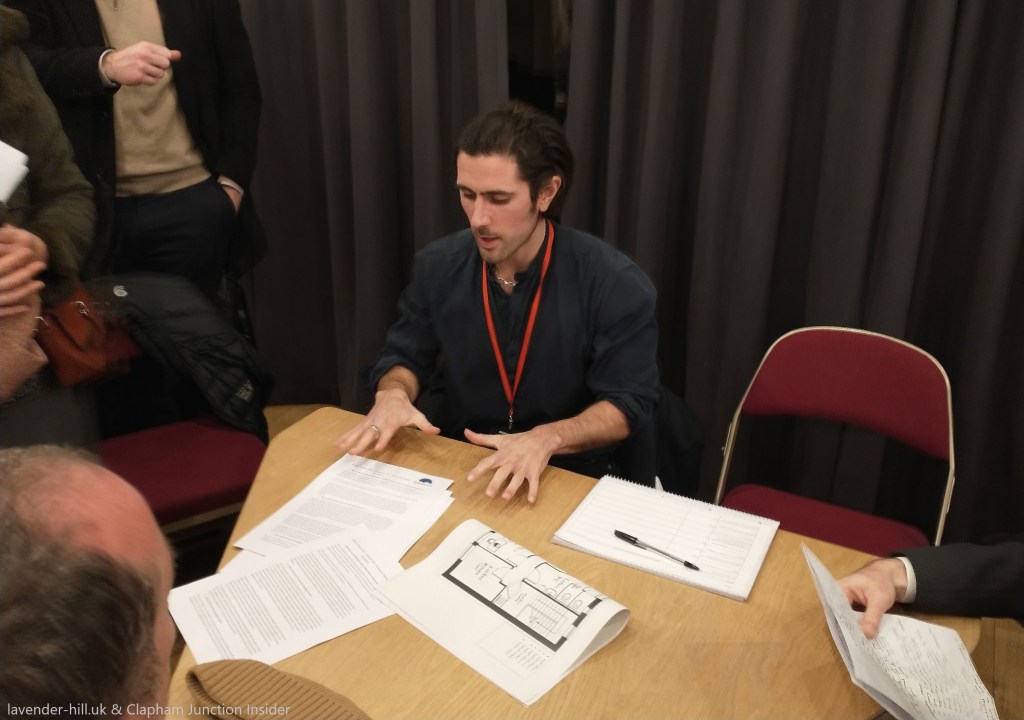
The Council then ran a public meeting at Battersea Arts Centre late last year, which was quite a fiery affair at times – but where the Council officers did give a frank and decent insight to the thinking behind the plans, and also explained several changes they were making to the initial plans to address some few the concerns. It’s worth noting the Council officers were clearly thoughtful people, who were trying to do something positive with this project, rather than foist a nightmare on a far flung corner of the Borough.

We summarised the main points from the meeting in this article: about half of the 12 points we suggested based on the planning consultation responses were addressed in full (such as creating an internal living space, not throwing residents out to roam around the streets in the day, ensuring rooms & services were only available on an appointment basis rather than drawing large numbers of hopefuls to the site in the early evenings, and the like). There was less clarity on others, in particular those to safeguard neighbouring traders (for example by providing food vouchers to the population who probably wouldn’t have much of an income, to avert the shoplifting hotspots that cluster round some hostels), or on how security would avoid activities banned in the hub itself simply being displaced to quite nearby streets. They confirmed that they had (admittedly belatedly) started to work with the nursery next door and the police on how to design and manage the site.

A key point was about what the new facility is trying to actually do, and how it would work. The Council officers were at pains to stress that this was not supposed to be a ‘bed for the night’ place or a straightforward halfway house, both of which are the sort of accommodation that tends to be hard to manage, and which history has shown really does not work well in residential areas. It would instead a relatively innovative facility that would try to get rough sleepers back in to a stable environment and more permanent housing – with a substantial on-site specialist day staff getting people’s lives back on track by helping both hostel residents and others with appointments to find employment and more permanent housing, and nine rooms upstairs where the length of stay would usually measured in weeks rather than days or months. It would also have 24 hour security staff. It would have a room for clinical appointments, but was not a methadone dispensing location; and would also provide some daytime appointments for wider outreach services – again on an appointment basis. The key aim is to keep rough sleepers vaguely near their support networks, and the services they need to escape the streets – rather than the current approach of the Council having to ship people off to expensive and lonely temporary rooms on the outskirts of the city or even further afield, which tends to make their problems worse by making it far harder to them get employment, practical and emotional support. The staff also made the (fair) point that the most troublesome and menacing individuals many neighbours will have seen causing trouble in the Borough and London more widely, are frankly speaking not the type of people that are likely to engage with this new facility – it is more targeted at the quietly struggling and somewhat invisible wider population of rough sleepers. Now obviously it’s fine to say things, and some of what we heard was indeed reassuring – but none of this was spelt out in the planning application. More details, we were assured, would follow.

But they didn’t follow, because the case went silent – for many months – with no more details being provided on the planning case. So much so that we and our partner site Clapham Junction Insider reported on rumours that the planning application might have to start again at square one.

After a few months a leaflet was then distributed round nearby streets that included much of the content of the Q&A document that was distributed at the public meeting. And now there’s news: updated plans have gone in. And rather frustratingly, despite the talk of neighbourhood engagement, they have again gone in very quietly – in the form of a new document quietly slipped in to the back of the case file. As a result, we have yet to find anyone who has actually been properly notified that the clock is ticking again here,or that there is new information on the plans.

The main added material is a planning application report, which summarises engagement to date with the public and the Council’s response (and which is relatively open about the concerns raised), as well as changes to the plans. At the time of writing the Wandsworth planning database seems to have gone offline, so as a public service we’ve temporarily loaded up a copy of the most interesting new file here!

A quick skim suggests the main ‘new’ content is:

  • Considerably more detail on how the building will be managed, with the Council agreeing to have the specialist ‘day’ staff on site half an hour before the nursery opens and after it closes every day, and a minimum of two security staff on site at all times, backed up by on-site CCTV (a helpful change, addressing what had been a widespread concern).
  • The back of the building will now be inaccessible to residents, and windows will be frosted on that side (important – the nursery playground would otherwise be visible from a small number of bedroom windows; it’s not clear if the windows will open at the back, we’d suggest the ones on that side should be required to have restricted opening)
  • The back alley will be gated (which is sensible – otherwise it risks being a gathering spot for things not allowed in the building – but there’s no clarity on how this won’t just go to the hidden away back car park on Sisters Avenue instead)
  • The late night emergency beds have been removed and converted to a lounge for residents (definitely a good change – this needs to be stable and offer proper day- as well as night-time accommodation or residents to work)
  • All residents required to sign a no-drugs-on-site agreement on admission, with a policy of temporary / permanent eviction for breaches.
  • Confirmation no smoking or drinking ‘in communal areas’ (there had been concerns that a complete ban would merely displace that, and other problem behaviour, to the streets behind – this suggests it will be allowed in the private bedrooms which seems a reasonably sensible approach)
  • No news on the previously suggested good neighbour plans, or on the ‘resident expectation document’ including requirements on behaviour in neighbouring shops – but there is a statement that on-duty staff will have ‘specific responsibilities to uphold the safety and wellbeing of local residents and business owners’ (which needs to be followed up on – retail issues are a live challenge we’ll be reporting on in a separate article).
  • Recognition that there is a link between the underlying drivers of rough sleeping and wider behaviours including anticocial behaviour, burglary and shoplifting – and a statement that ‘The Hub aims to provide service users with essentials such as food, clothes and transport, as well as on site access to support services’ – potentially in the longer term reducing these challenges by getting its residents to a more stable living pattern (there’s not a lot of detail on how this will work in practice; we know it is a concern of some traders nearby).
  • A 24/7 ‘hotline’ for residents to report problems, and a Council led ‘Local Residents Forum’ to inform the community of project updates and expected timescales prior to opening, as well as a platform for residents to ask questions and raise concerns during the lifetime of the project (all welcome and worthy aims albeit there’s no detail yet – this new application detail wasn’t advertised…).
  • Various minor tweaks to the planned internal layout – to provide cycle parking, a laundry facility, more clearly separated staff and resident areas (as well as the sole female bedroom, which is deliberately a bit separate – noting that 13% of Richmond’s and 16% of Wandsworth’s rough sleepers are female), and a small residents’ kitchen that can (at a push) seat six.

You have 20 days to comment on this revised application – the comment deadline is 26th April (albeit there is usually a bit of leeway after then) – before it goes to the Planning Committee in May. It has the same case number as the old one, and previous comments are still valid. However the new plans include a lot more detail on some operational aspects, some of it reassuring, as well as some areas where there’s more to do – and we suggest many will want to revisit the case with further comment. The case has a good chance of approval – now that the plans are rather clearer (the previous plans were nowhere near good enough) – however there is plenty of space to make suggestions on how the operations can be made to work as well as possible, and in particular what aspects of the development and management of the site should be included as planning conditions (as without conditions, not much is really binding – even for simple things like frosting of particular windows).

To see the details, search for case 2023/3434 at wandsworth.gov.uk/planning. To see the main new document (the one we have included above) follow the link to ‘View associated application documents’, select ‘report’, ‘list documents’; the key one is called ‘Updated – assessment hub planning statement’. You can comment via the Wandsworth planning site or alternatively send comments to planning@wandsworth.gov.uk – make sure you include the case number in the subject line.

This is a quick post to share the news that there is movement again on this widely reported case – it’ll likely be updated further in the coming days with more detailed thoughts on the updated proposal. We’re also interested in your own thoughts on the case, via the comments or by direct message (contact us here).

Posted in Business, Housing, Planning | 3 Comments

Lavender Hill retail roundup – March 2024

A few times a year we publish a review of who has opened up businesses on Lavender Hill. Back in October last year we reported quite a lot of change – but things have settled down now. Running from east to west – Wild for Dogs‘ headquarters at 4 Lavender Hill is now well established, as a developer and supplier of handmade and organic grooming products for dogs, and M’s Dining Room who were just getting going when we last wrote are now well established, offering both an African & Caribbean takeaway and a well-reviewed dine-in offer. Good to see this doing well, and that this good-sized restaurant (which had a pretty complicated past before it closed) has had the fresh start it needed.

We reported a while back on the challenges that hit No Boring Beer, following a huge rise in electricity costs in particular; the site is now up and running again as Spy Wines and Spirits. Owner Tim Harmsworth has been running Spy Wines as a Battersea-based wholesale supplier of wines to the trade for the last decade, and has now branched out to open their first shop at 22 Lavender Hill. It offers a wide mix of wines, spirits and beers going well beyond what you’ll see in a typical off license – from affordable everyday staples all the way to extra special rare wines – as well as a selection of cigars. The shop also includes a tasting offer, with a selection of eight wines to try in the Enomatic wine dispenser machine. The shop also has a hidden secret in the form of a much larger basement level, which has now been fitted out as a venue for wine tasting and discovery sessions; with a series of masterclasses where their expert team can guide you through some properly interesting wines in a relaxed and unpretentious environment; these have quickly proved popular (details of future events generally via their twitter / instagram, they also plan to let groups book special events).

Yano Sushi at 39 Lavender Hill has been replaced by Go Kyoodai. They specialise in Japanese sushi – but Brazilian style, and are run by brothers Roberto and Cahuê Albuquerque. Their first venture was in São Paulo, which saw the first opening of Go Kyoodai; in 2011 they moved to London – at first running a catering-based operation but then (when they were joined by another partner Geovany Mota) branching out to run a business doing directly to the public. They were initially based in a small business estate in Fulham but have now moved in on Lavender Hill. Don’t rush down in person just yet though, because in a bit of an emerging trend they are currently running the site as a ‘dark kitchen‘ – doing delivery only – so you’ll be wanting to either order from them or via Deliveroo.

Next door, the former Hill Launderette, which closed after decades of service (we wrote a short tribute at the time) has now got the builders in with work well underway to open as Pads, Paws and Claws, a doggy daycare and pet grooming centre, which will also sell a range of pet supplies.

They’re not new to the area, and have been running a grooming business for some years on St John’s Hill, as well as teeth cleaning, pawdicures, flea treatments, and everything you need to keep your pet in top condition; the new larger premises will allow a wider range of daycare services to keep our pets happy – as well as space to have a calmer area for cats, and a variety of different play and relaxation areas for pets. Opening looks to be imminent – we took this photo of the old launderette sign awaiting disposal.

Across the road, 50 Lavender Hill has been through a few ups and downs in recent years – most recently as Sugarcane (which was quickly renamed to Guava, maybe because there was already another business on the street called Sugarcane), until the business closed leaving a rent shortfall and a frankly bit of a mess! The unit was tidied up and refitted by the landlord, and quickly found a new tenant as the home of London Gents Traditional Barbers, offering you would expect. The fit out effort by the new occupiers was a comprehensive one and it now looks very smart – and has quickly found a local customer base. The team behind it already run a somewhat similar venture on Kennington Road.

In slightly sadder news, we reported on the opening of Social Affair, in the old Room 42. This was a combination of an evening catering operation (with both eat-in and delivery), and a daytime cafe with plenty of space for working and general get togethers. The evening offer has prospered, but the front of house cafe had a break in late last week (from a known local burglar, who forced the front doors shortly after midnight and made off with a fair bit of alcohol and some computer tablets – but also made a big mess), and the owners have decided to close the cafe operation. This is a real shame coming after the team had made a real effort to get this going. For now the premises will run from about 4pm and continue to offer five different food offerings – are LovePinsa (described as ‘a cloud-like Pizza’ that has crispy textures on the outside and a super soft and scrumptious inside), Return of the Mac (specialising in Mac & Cheese for grown ups), Organic Butcher (steak & fries), NeoPixa (Neapolitan Pizza), and Wingers (fried chicken & wings). There is maybe going to be something else coming in the daytime later in the summer – maybe with stronger doors! – as it remains a good site with lots of potential.

One of the more mysterious premises is 63 Lavender Hill, which has no signage at all. It is another ‘dark kitchen’ that supplies Snog frozen yoghurts, on a delivery-only basis. There was an equipment malfunction some time back that led to a fire; which then closed the premises as it needed a full refit. This eventually completed, and they reopened – only for a ‘take notice’ landlord sign to briefly appear, to repossess the premises. That was, however, also resolved quite quickly and the premises opened again – now supplying both Snog yoghurt and Biju Bubble Tea, and continues to serve the delivery market.

Next door, is a bit of a success story. Back in 2022 we noted that  Ryan and Dan clinical massage had opened at 36 Lavender Hill. This wasn’t a traditional massage parlour aimed at a ‘quick rub down’ but was instead aimed at accessible and affordable treatments, particularly for those who suffer chronic / acute muscle pains and tensions, and to ease sports injuries. The co-owners were keen to change the narrative of what massage parlours and clinics currently provide, and open it up to a wider customer base in terms of ages and backgrounds who could benefit from treatments to ease their muscles. This was reflected in the more clinical and business-like design of the premises, which is quite different to the more typical styling of a massage business. And it clearly worked, as they have now moved across the road to a much bigger space at 65 Lavender Hill.

Speaking of success stories, HD Cutz have been running since 2001, in very smart premises at 103a Lavender Hill, right next to the gates to the Battersea Business Centre – offering barbering, cornrows, locs, shaving, steam facials as well as wider bespoke hair & beauty treatments. It was a success from the outset, and owner Sheldon Edwards – who learnt his trade in Clarendon in Jamaica – has a big and loyal following. Following the opening and closing of the ill-fated China Garden in the unit next door within just a few weeks (which we reported on as rather a sad and unfortunate episode given the amount of time and money that had been lost), Sheldon has leased the unit to extend the business – and building work is well underway to knock them together. The new space will create space for a new hairstyling academy – building on his existing track record of (and enthusiasm for) developing talent.

As we reported in November last year with a detailed review, Phresh Juice have opened a couple of doors up at 103e Lavender Hill. They are an independent family business, whose flagship product is fresh juices – properly fresh ones, made in house and to order. The menu includes a bewildering array of cold pressed juices, smoothies, ginger & turmeric fruit shots. There’s a big focus on it being properly fresh – which means availability will depend on on what decent fruit is in stock. They have also built up a healthy trade in decent coffee, pastries and cakes, all in a smart well-designed environment.

At about the same time, we reported that another new cafe, Pique, opened at 171 Lavender Hill, with a full brunch / lunchtime food menu as well as a generous assortment of snacks, cakes and coffee.

The works to convert the premises have really opened it up and given it a completely new feel, and the business has met great success, immediately finding a big local audience and being consistently full pretty much from the start; indeed the warmer weather will helpfully allow a bit more space outside as it’s not rare to find all the seating busy.

Moving further towards the station we enter estate agent territory! Back in the day there were about 15 estate agents on this stretch of the road. This is still the place to find an estate agent covering the Clapham Junction area – however recent consolidation in the sector has been quite substantial, and their number has drifted down. Gordon & Co next to the post office were taken over by Foxtons, Dexters closed one of their two branches on Lavender Hill (but did open one on St John’s Road), Lauristons vanished completely to be replaced by a new branch of Costcutter (pictured above), My London Home closed and were replaced with Fitstudioz personal trainers, and Winkworth closed their large branch in the block of flats at the Lavender Hill / Latchmere Road junction. Featherstone Leigh have now also closed, having been taken over by Chestertons, and we expect the elegant corner unit at 253 Lavender Hill (pictured below) to be up for lease soon.

This still leaves us with seven estate agents on Lavender Hill: Winchester White, Bairstow Eves, Barnard Marcus, Rochford Stokes, Dexters, Foxtons and Orlando Reid. But coupled with a similar decline in the other streets around the station, this is probably the smallest number of estate agents we have had in Clapham Junction for 20 years.

Landlords don’t seem to have had too much trouble re-letting these premises. The most prominent ex-estate-agent, the Winkworth unit, briefly reopened as Noble Estates (another estate agent, who also have a branch in Clapham Old Town) but that all seemed to go wrong within a few months, and the unit was quickly repossessed by the landlord, with notes taped to the door giving notice that various bits of furniture and a photocopier left behind would be sold unless they were claimed. It is now set to see a complete change of use, to become a new Nisa supermarket, adding to the provision of smaller convenience stores at this end of the street.

Meanwhile in a small bit of retail news, it’s good to see Asda have continued to work on their small garden area. This was the subject of a bit of a scandal some time back when they tried to tear down all the trees and pave over it (our article on the subject is here); fortunately they realised this wasn’t a wise move for a store that was keen to look attractive and attract a wide range of customers (let alone the environmental implications of replacing a long established green space with a pigeon-infested slab of concrete), and they changed their plans to retain the green space. It’s looking particularly good at the moment with flowering cherry trees.

Finally there’s unfortunately another new entry on the list of the shortest running businesses of all. We haven’t even had time to report that wine bar Aperitivo had opened at 289 Lavender Hill – in a very smartly fitted out premises opposite Pizza Express. Wine was paired with a selection of food built around the Italian ritual of Aperitivo, including lasagne, charcuterie and zucchini rolls. This was a bit different, and an interesting and well-presented concept. But things quickly went off course for reasons unknown, and the business has already closed, with notices from the landlord (who, unusually, in this case, is Wandsworth Council) repossessing the unit. It’s never good to see bold new ventures like this fall over, and there’s always a sad story behind it of dashed hopes and broken dreams.

However overall the last few months have seen far more successes than disasters, with a particularly good number of expansions and upgrades – which is testament to the resilience and imagination of a lot of our local independent traders.

Retail roundups is an occasional series on traders in and near Lavender Hill, in Battersea, London. If this is of interest, do look at our other articles on local business, on retail,or on local food and drink, or our previous retail update from October last year. Details on how to get in touch with a tip on new businesses, or receive updates from us, are here.

Posted in Business, Food & drink, Retail | 3 Comments

Taybridge Road’s long-abandoned corner shop may finally see a new use

For over a century, a newsagents’ and corner shop stood at the corner of the small square at the junction of Taybridge Road and Marmion Road. It was a rare surviving example of a corner shop that was hidden away deep in a really local set of streets: these used to be quite common (similar ex-shops are visible on street corners around the Shaftesbury Estate, and indeed in most big Victorian housing developments) but as the focus for shops gradually moved towards the main roads it was quite unusual to see one still trading.  The odd shape of the roads here is a direct result of the slightly complicated shape of the very end of the back garden of the long-lost country house that used to cover this land – a big house called Northside. We wrote about that house just last week – as one small piece of it is still standing, facing Clapham Common!

The shop and the little cluster of buildings around it was built in 1897 by a Wandsworth solicitor, Henry Nicholas Corsellis, and his family’s chief builder John Stanbury. In just three years this dynamic duo built around 180 houses on an area of just six acres, including the south end of Taybridge Road, Tregarvon Road, Jedburgh Street and a small bit of Clapham Common Northside. They mostly went for relatively straightforward house designs, but built larger and more luxurious houses on the prime spots overlooking the common, with fancier rooflines, balconies and carved brick decoration. The development was a commercial success and the houses saw high demand. The Mitchell Charity, a still-running Charity based in the City, clearly saw this development as a safe bet, as they paid just over £30,000 to buy most of the estate freehold in 1900 as a long term investment.

But nothing is forever: Vairvar Food & Wine closed in the late-2010s, and the property has been empty ever since, gradually falling in to disrepair. A few years ago some quite unusual mushrooms even grew on some of the outside walls!  The building is split into a ground floor shop, with a linked first floor flat. There’s a very small outdoor space (not quite big enough for a bin), and two small basements under the building. There is also a garage that was used to store stock when the shop traded.

After a good few years with no signs of action at all, plans were approved last year to convert the whole building to three flats: a two bed one on the ground floor with a small outdoor courtyard (created by removing part of the existing ground floor garage – at the bottom left hand corner of the floorplan below), another two bed flat on the first floor, and a smaller studio flat on the second floor. The lower section of the roof would be raised a bit to make the space more efficient, so that it would align with the slightly higher building next door, and the internal floor heights would be adjusted to accommodate the flat in the loft with only a slight height increase to the main bit of the roof. Most of the windows will be rearranged, and dormer windows will be added to the roof.

The development was the second set of plans for the site (the first version planned to have larger flats, and included using the basement as the ground floor flat’s kitchen, and a larger courtyard shared by all three flats – but these plans were withdrawn). And it wasn’t especially controversial at the planning stage. The changes to the overall appearance are minor, the quality of the planned flats seems decent, and it’s a fairly obvious place for flats. Loss of shop fronts can be a concern, but at this hidden away spot this was not an issue, with plenty of local shops on Lavender Hill including a branch of the Co-op that opened in 2018 at the other end of Taybridge Road. The existing Victorian shopfront surround will be kept (albeit partly infilled with windows to the internal staircase to the upper floor flats) to keep the overall appearance of this very visible building balanced, given there remains a roughly symmetrical shopfront next door (home to Woofs to Kittys pet supplies and dog groomers). The flats don’t really meet current outside space requirements for new properties, but planners decided this was acceptable given how close the building is to Clapham Common.

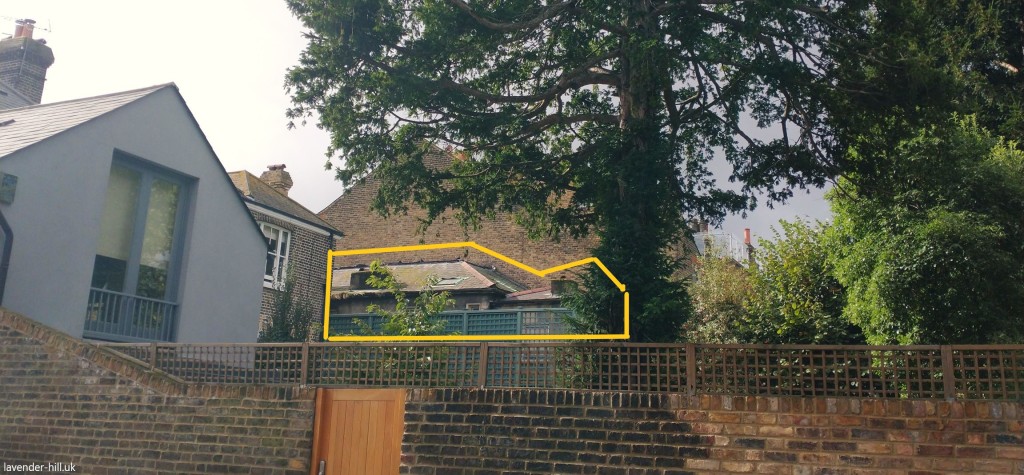
One unusual aspect is that the building next door has lot line windows – which are quite common in American cities (especially New York) but really quite a rare thing in British planning. They’re essentially where someone has built windows that are actually on the edge of a property – and look directly in to a neighbour’s land. The three narrow windows are visible at the top edge of the roof in the street view photo below:

These windows can be a short term thing – you can sometimes build them (subject to some privacy restrictions), but they don’t guarantee you any access to light – if the people next door build a wall right up to them, then you no longer have a window! When the roof extension at the house next door was approved (all the way back in 1990) the decision notice included a specific comment on this, approving the build but saying “You are advised that the proposed high level windows to the eastern elevation at 2nd floor level, could not be protected by the Council in the event of future developments at 80 Taybridge Road.”. So sadly for the neighbours, after 35 years of service these windows look to be doomed.

All in all, this is pretty much what we expected would be the future for the property, although it’s surprising that it has taken this long to see any sign of development work. There’s no sign of any actual building work yet – but after many years, the time 80 Taybridge Road being empty may be coming to a close. If this is of interest, you may want to see our other articles on planning and developments in the Lavender Hill area.

Posted in Clapham Common, Housing, Planning | Leave a comment

A rather unique historic house on Clapham Common is for sale (and maybe demolition)

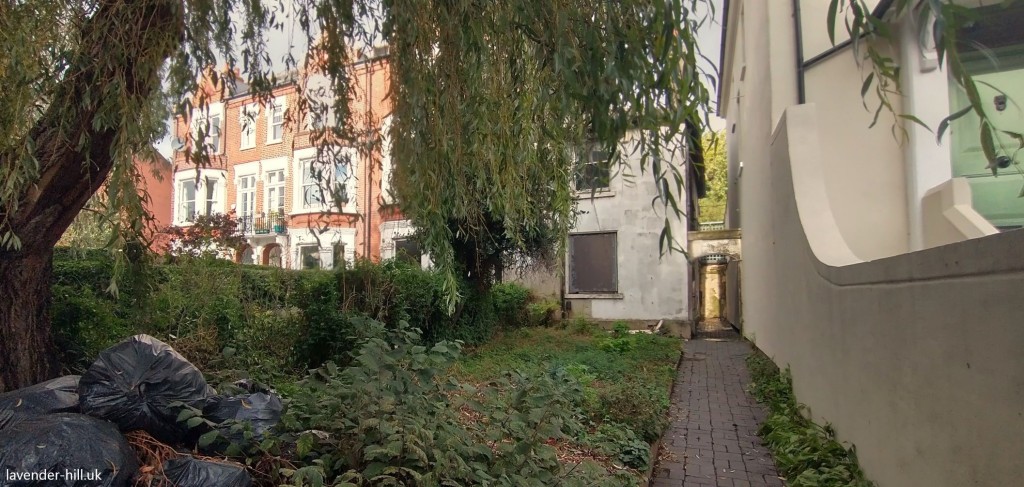
Hidden away between the big Victorian houses along the north side of Clapham Common is something a bit different. 64 Clapham Common Northside is much smaller, much plainer. It’s tucked back between two large neighbours, to the extent you barely notice it from the road. It also has the look of being a bit forgotten, with boarded up windows, a generous but somewhat neglected garden, and a noticeable hole in the roof.

This unassuming house is one of the last surviving parts of a large manor house, called Northside. Northside was built in the first big wave of development in the late 1700s, that saw the whole area converted from a series of country fields on a hill overlooking the Thames valley, to an area of large detached houses with large gardens behind them, mostly inhabited by wealthy businessmen who could afford to take the omnibus services to the city. The map below, from about 1800, shows these houses right around the sides of the Common (ans it’s a bit counterintuitive – it’s rotated so that the Thames is at the bottom left). Northside was on the street labelled ‘Battersea Rise’ on the map but now called Clapham Common Northside (maybe inspired by the name of the manor house).

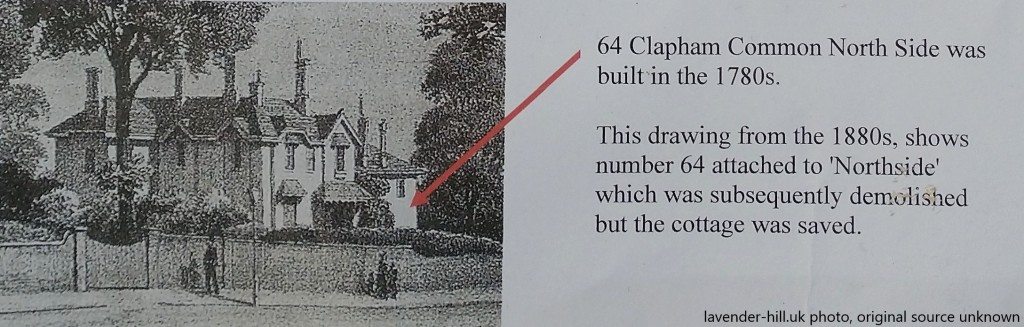
Northside was a large and elegant mansion built at some time around 1811, for John Cunningham. John was the father of well-known evangelical clergyman John William Cunningham who had, a few years earlier in 1807, taken up a new job as the Curate for Clapham, and who would later becoming the Vicar of Harrow. John had already been living in another smaller two-storey cottage on the same plot just to the east for three years, and unfortunately died the year after the bigger house was built – so didn’t get much time to enjoy his new family house! The old two-storey cottage was incorporated into the new house at its eastern end, as a kitchen and servants’ wing – as shown below.

In 1828 Northside was sold to bookseller John Harris the younger, who then lived there for 20 years. It saw a substantial extension (or possibly rebuilding) in around 1830. By all accounts it was quite an interesting property, with a rambling and varied frontage in an Italianate style. The interior included a Gothic hall, and a dining room with a coved ceiling. It was surrounded by generous gardens, where a brick and timber ‘Swiss chalet’ was later built – quite a fashionable thing for the time, which is still reflected in Swiss Cottage in north London. Northside’s gardens had an unusual shape – running right round behind the house next door, with Northside’s stables at the far end (meaning that the neighbours had the house on one side, and the same house’s stables on the other side). The house saw continued investment over the years – including a full redecoration in a Pompeiian style – but the arrival of the railways in the 1870s had seen huge changes in the area, and the days of big country houses were coming to an end – to be replaced by industry, and enormous levels of dense residential development.

Most of those grand houses survived for nearly a century before the railways arrived – when a flood of development saw them all swept away to make way for the dense Victorian streets that have mostly remained in place ever since. As we saw with our detailed history of Rush Hill House a bit to the north, which was one of the last ones to go, the last few big country houses were increasingly at odds with the sounds, smells and general urban feel of their new industrial and residential neighbours, and with people who could afford a big house preferring one further away from the city, the land they sat on was increasingly worth more than the houses themselves. Northside put up a good fight, staying put all the way to the 1890s when it was put up for auction along with its neighbour Springwell, sold, and quickly demolished, with the land laid out as a network of streets for redevelopment.

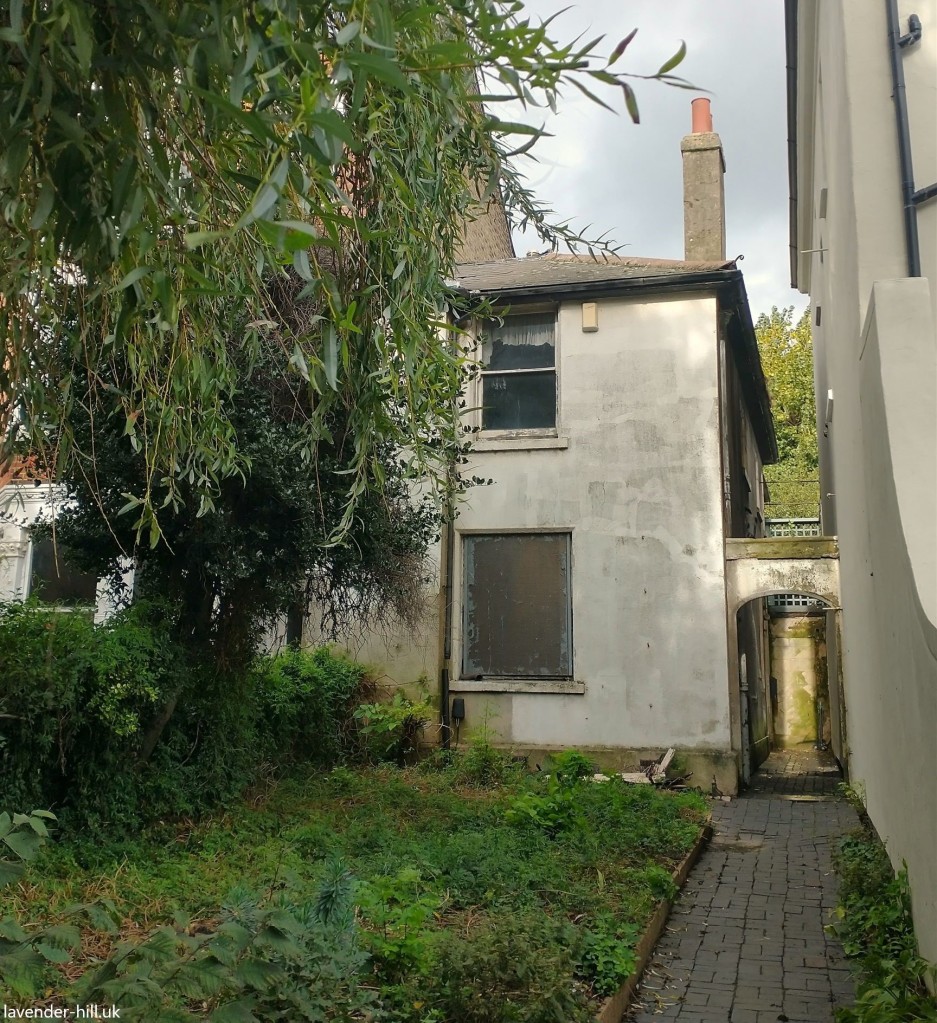
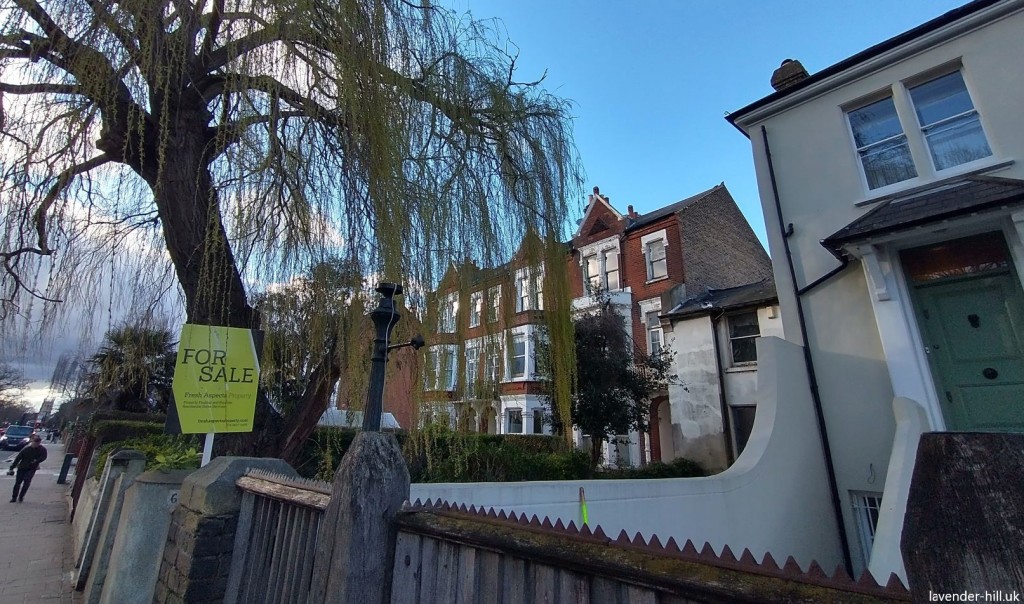
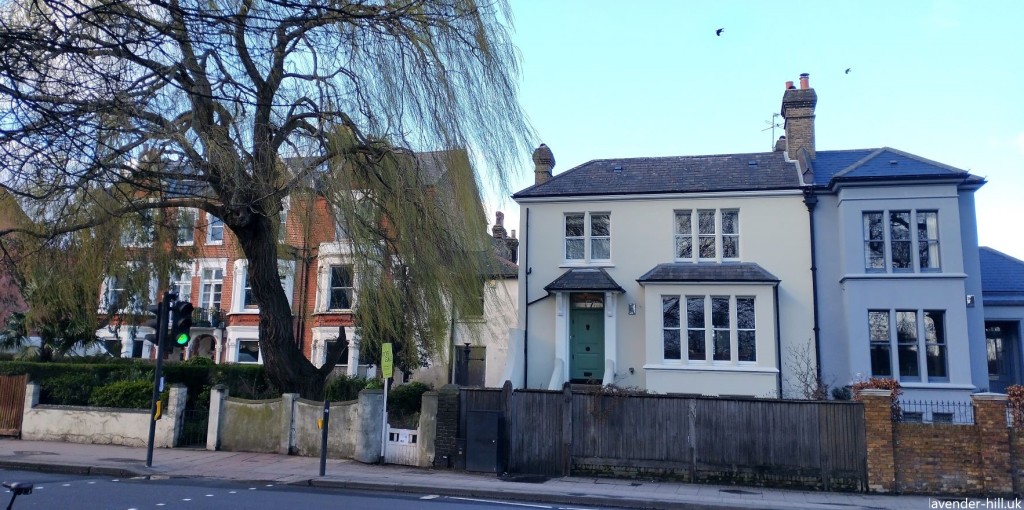
Or mostly demolished. Because for reasons unknown, one small bit of Northside, the old two-storey cottage (which was older then the main house, and had been incorporated in to the building as a kitchen, dairy and servants’ quarters) was saved from demolition. And it’s still standing well over a century later – now known as 64 Clapham Common Northside. It’s the one peeking out behind the big weeping willow tree in our photo above. Numbers 65–79, the red brick terrace to the left, replaced the main house, but are still attached to the two storey cottage. Our photo below shows the back part, where it is clearly attached to the next door terrace (but quite a lot smaller!).

Thanks to our readers, we now know that for many years this was a doctors’ surgery – with a proper old fashioned waiting room on the ground floor, with leather high backed chairs and lots of wood! Many readers have happy memories of Dr Dunwoody, who was clearly a caring and approachable doctor and who also had a huge range of other interests – having also been MP for Falmouth and Camborne, and Minister of Health, in the 1960s, as well as an early crusader against smoking – from 1971 to 1973, he was the first director of the Ash group (‘Action on Smoking and Health’) organising conferences with fellow doctors and others. Dr Dunwoody later moved to the brand-new Stormont Road Health Centre, which was built on the ground floor of what’s now Antrim House, with one reader commenting that “he seemed out of place in that modern environment when for all those years I had seen him in the old surgery”. The Guardian wrote his obituary in 2006. The old cottage had been a surgery for at least twenty years: in the early 50s it was Dr Mackenzie, and then from about 1957 it was run by another doctor, Andrew Boag, before Dr Dunwoody joined in 1970 (and Dr Boag’s wife continued to live upstairs for some years after the ground floor surgery changed hands).

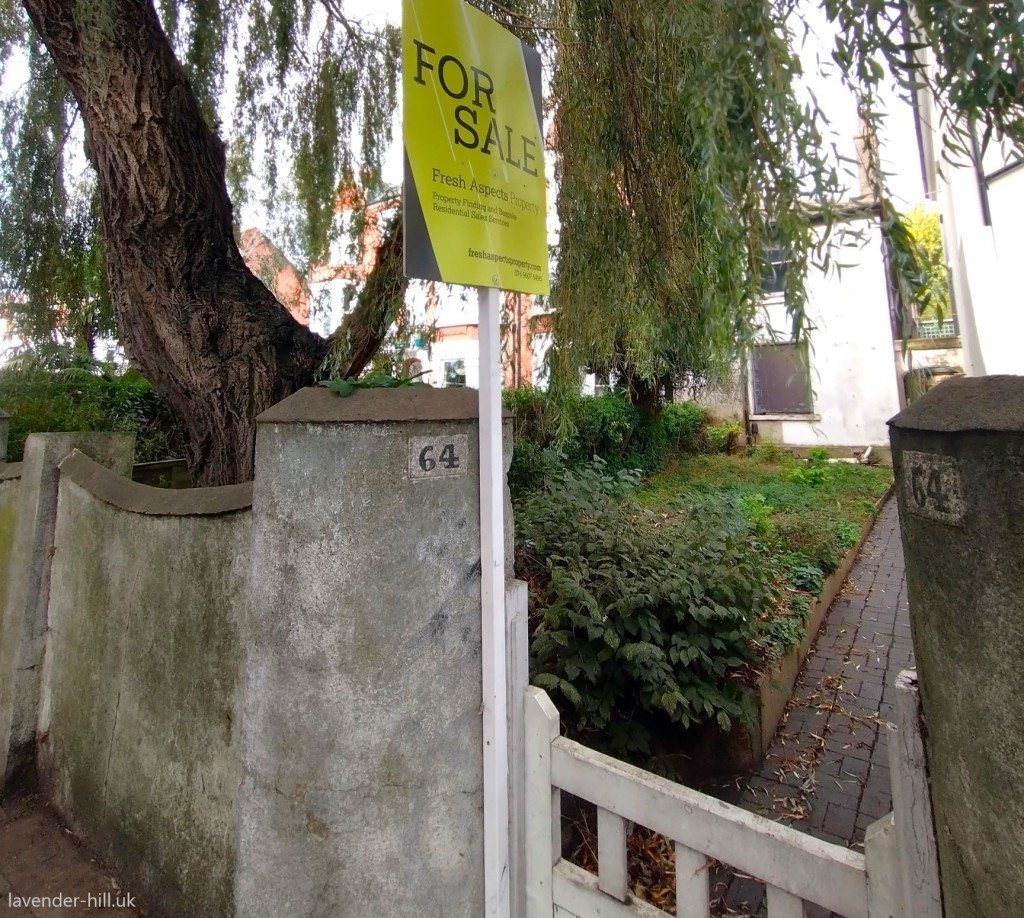
No. 64 has done very well to last this long. But it’s fair to say that the last few years have not been kind to the house, which has been unoccupied for many years – it’s hard to tell precisely how long but it’s well over a decade since its use as a surgery with upstairs flat stopped! It is now in a sorry state, with an overgrown garden, what looks like a hole in the roof, and boarded up windows. But this is Clapham, and no freehold property in a site like this – with direct views over the Common – ever stays lost for long. Sure enough, the house is being marketed by Fresh Aspects Property, for offers in excess of £1,075,000.

This could be a very unique refurbishment project – and a chance to own a proper bit of London’s history, with the bonus of a big garden facing Clapham Common. Sadly, however, the building may now be beyond rescue, and this end up as a total rebuild. It’s described by the sellers as “an incredibly rare opportunity to create a modern, high spec new home overlooking beautiful Clapham Common… Once a gardeners’ quarters to a mansion. Now sadly uninhabitable“. They have worked with an architect to create plans for a complete replacement of the house, and are currently seeking planning permission for a 2,100 square foot property with four double bedrooms. The artists’ impressions below show the proposed new design, which echoes the form of the existing house (covering pretty much the same property footprint) but with more windows, a balcony and an additional storey.

They note that being empty for many years has left 64 Clapham Common Northside in a very dilapidated state – to the point where it’s beyond economic refurbishment – and argue that replacing the building allows something larger and more functional to be built – something ‘suitable for 21st century living’. They note that the interior has lost most or all of its original features. A rebuild would also remove the headaches caused by a split-level ground floor arrangement in the current house where the back kitchen is three steps below the floor level in the rest of the building (which limits its wheelchair accessibility), as well as an awkwardly located staircase.

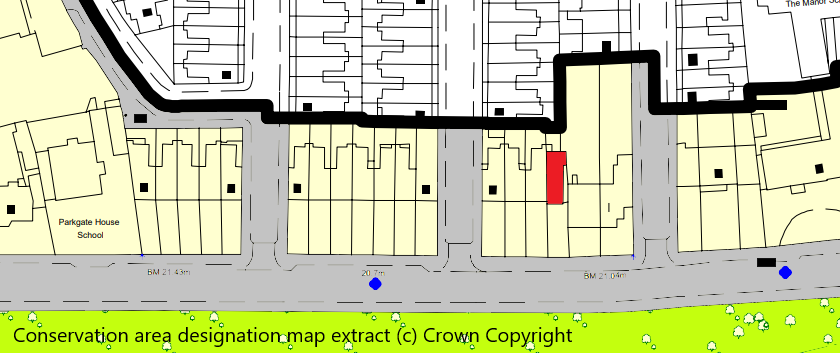
Everyone wants to see the building restored to use – but the proposals to demolish this very original building have also seen a fair bit of controversy, with eight objections registered at the time we wrote this article. The buildings along Northside include the oldest set of the big houses that are still standing, and No 64 and all its immediate neighbours are all now part of the Clapham Common conservation area (whose area is shown below), which means any changes will need to be careful to not change the overall character of the terrace.

The Battersea Society have commented that the building has fallen into a deplorable state of repair since a previous series of applications for redevelopment of the building was submitted and refused in 1987 and 1988, with an appeal against that refusal also refused by the Planning Inspectorate in 1988, and that no work has been undertaken on the house since then. They are also disappointed that proposals back in 1988 that the building should be locally listed saw no action. They criticise the the proposed new build as a pastiche style, with no attempt at any meaningful relationship with its neighbours.

The Clapham Society have also made a detailed objection; noting that the building was probably built in the 1780s (and appears on pretty much every historic map available). They argue that the house is extremely important in the history of estate development in the area, and its frontage together with the fact that it is diminutive in relation to its neighbours is important to the integrity of the conservation area and to views from Clapham Common; they were particularly unimpressed by the (admittedly curious) planning argument that ‘rebuilding will contribute far more to its conservation than any attempt at renovation’, saying this is complete nonsense! They also express surprise that the house has been left to decay since the late-1980s redevelopment efforts, given that lost rent over a quarter of a century or so could be well over a million pounds.

Neighbours have also objected, touching on the value of the building to the wider area as well as on various grounds of overdevelopment, overlooking, and loss of sunlight and daylight; some also argue that the building is perfectly capable of being refurbished, or redeveloped behind the retained front wall. There are also concerns that proposals to build a much higher front garden wall (above head height) would start to wall off the view of these characterful buildings along the north side of the Common, and reduce natural surveillance along a somewhat isolated stretch of the road.

5th March update: Someone has added a sign to the gate titled “Help save 64 Clapham Common North Side from Demolition“, which includes historic information about the house, and encourages neighbours to make comments on the planning application (by searching for number 2023/4402 on the Wandsworth planning consultation site) – noting that the cottage is an important part of Clapham’s history as well as an important part of the integrity of the views from Clapham Common and should be protected and restored, not demolished. It also includes an original drawing of the original Northside house, with the cottage attached – we’re not sure who got that image but it’s a really good find.

This is a complicated case, which clearly has some time to go in the planning process, and as ever, full details of the plans are available on the Wandsworth planning website. The good news is that whether planning permission is granted for a complete demolition & rebuild, or whether this ends up becoming a refurbishment and restoration project instead, the house being on the market means will hopefully now be seeing this property get back in to being used and cared for – after being abandoned for a very long time. Fresh Aspects, who are marketing the building, clearly know how to get things done and are building up a bit of a reputation for getting unusual and interesting properties back in business.

They recently saw the rescue of another local property on Wix’s Lane – part of a terrace of 1920s houses at Manchuria Villas. A bit like the last bit of Northside, it was in a terrible state – having almost disappeared in to a hugely overgrown garden; some of our readers may recognise it as the house that had what we think was an old Mini in the front garden, visible in the Street View image above (a rare winter view, as in summer all that was visible was lots of foliage!). As shown in our photo below, it has since been fully restored to a working family house.

If this sounds like the project house for you – you’ll want to contact Fresh Aspects! If you want to see or comment on the planning application you’ll be wanting Wandsworth’s planning website, search for Application Number 2023/4402 – by the 7th March (though comments are often accepted for several weeks after the deadline). If this was interesting you may also want to see our wider articles on local history, or on planning and development in the Lavender Hill area.

Posted in Clapham Common, Curiosities, Housing, Local history, Planning | 4 Comments

Is the proposed rough sleeper hub on the back burner?

You may be wondering where things have got to with the controversial plans for a Rough Sleeper Hub on Lavender Hill. When we last posted on this in early December, reporting on a well-attended and at times intense public meeting, we expected to be following up with more detailed information on changes to the plans to address the many concerns that were raised. The Council’s aim had been to take it to Planning Application Committee on the 18th January. However nothing else has been revealed since then – nothing at all has been added to the case file since mid-September! – and Clapham Junction Insider’s investigation has now found that the plan is currently on hold, at least for the time being.

As a reminder of the story so far: At the very end of September, an application for the Rough Sleeper Hub on Lavender Hill appeared on the Wandsworth Planning Portal (this wasn’t put out for consultation even with next door neighbours – indeed no-one noticed it at all until we reported on it, article here). The Council’s proposal outlines internal redevelopment and a change of use for a hub designed to accommodate up to 13 residents, featuring a reception area, staff offices, meeting room, tea/coffee counter, and kitchen.

However, the housing department in charge of the application submitted so few details that not only Wandsworth planning department responded that further information was needed, but the case spiralled into growing concerns within the community, resulting in over 500 objections in just a few weeks. We and Clapham Junction Insider reported on the growing controversy – with a lengthy article that explored the thoughtful and detailed concerns of many neighbours (plus, in a few cases, supportive comments). 

We suggested a twelve point plan that could maybe make this project work for the local community – which, importantly, would need significantly more details sharing in the application and being committed to by the Council. Residents and neighbouring businesses expressed worries about managing the challenges of accommodating residents with complex needs in a less-than-ideal location that is already populated with children and facing its own unique set of challenges.

In an attempt to calm the local outcry, Aydin Dikerdem, Cabinet member for housing and consequently accountable for the proposal, organised a public meeting on the 5th of December. Approximately 100 people attended, providing an opportunity for the Council to exchange and explain their intentions to the public.

Many concerns remain unanswered

A wide range of understandable concerns have been raised by neighbours, especially regarding locating the rough sleeper hub near a nursery and in close proximity to other facilities catering to small children. The meeting provided significant details about the housing arrangements and the Housing team handed a leaflet with Q&A to those who attended the meeting. Our third article, posted after the meeting, includes the full Q&A.

However, while some of the explanations given at the meeting look to go some way to addressing the worries, various issues remain outstanding. Even in instances where clarifications have been offered to neighbours, it is apparent that significantly more detailed information needs to be submitted in writing to realistically get through the planning process.

This includes some underlying questions about the Council’s communication regarding the plan, the lack of specifics regarding expected management -especially considering the past experiences of neighbours near the Cedars Road hostel – and apprehensions about effectively addressing the challenges of accommodating residents with complex needs in a less-than-ideal location that is already populated with children.

Furthermore, questions remain unanswered regarding why the provision for the entirety of Richmond and Wandsworth is being concentrated in this location on Lavender Hill, while Westminster and Lambeth have also placed their facilities close to this part of the Borough, resulting in an unusually high concentration of services in a small area. The police confirmed awareness of the hub plan after being contacted by Wandsworth Council, but declined to provide further comment.

The proposal is currently on hold

The planning officer in charge stated to Clapham Junction Insider that the plan is currently on hold, leading to the removal of any date for future submission to the Planning Application Committee. As of now, no additional documents have been submitted by the applicants, and the 515 objections, and 15 support comments, are awaiting attention.

The officer recognised that the document submitted by the Housing department was really thin and not enough to constitute a valid planning application. She heard that the housing department was currently working on consolidating additional information they have collected on the case but was unable to confirm whether it would lead to further submission.

Due to the separation of Wandsworth Council departments, the planning officer explained that receiving limited information is not unusual, especially considering the need to avoid conflicts of interest, particularly with the planning department. If no progress is made by the end of February, the planning officer noted that they would expect to contact the housing department, suggesting the withdrawal of the application, with the possibility of resubmission at a later, more prepared time. This may, of course, just be the calm before the storm – as it’s not unusual for new information to be submitted late in the day (though this can lead to the need for the consultation timescales to also be extended – and we’re far too close to the 18th January now); so further news might appear at some point on the Wandsworth Planning Portal page for application 2023/3434. There was a decent degree of clarification and reassurance at the December meeting, so hopefully any more formal updates to the proposals will see better-thought-out plans and something that can work for the neighbourhood as a whole.

This is an article developed by Clapham Junction Insider, who we are working with on this complicated planning case. Stay tuned here and at cjag.org for any further developments (and thanks for the many messages we have had from our readers).If you’re coming to this new, the story so far’s here: initial article describing the plans, follow-up article summarising the concerns raised & proposals for how the plan could be improved, and third article reporting on what was shared at the public meeting. If planning is your thing, you ma also find our recent post about the interesting situation of whether the Dirty Blonde nightclub further along the road has got planning permission to actually be a nightclub, as well as our other articles on planning in the Lavender Hill area.

Posted in Housing, Planning, Politics | 3 Comments

Lambeth’s Planning officers face the interesting question of whether Dirty Blonde is a bar or a club

642 Wandsworth Road – between the Premier Inn and the Sainsbury’s – has been a nightclub one way or another for years. It was particularly popular in the days when it was Inigo, attracting a young crowd from far and wide; it then became Grind for a short time, saw a couple of years of building work where the upper levels were converted to flats, before reopening as Blake’s, and then its current incarnation Dirty Blonde. But it now turns out that the venue never actually had planning permission to be one. As far as Lambeth Council was concerned, it was a pub – which has quite a different set of rules attached. And this is despite Lambeth itself approving all manner of licenses over the years including both live and recorded music, and ‘Provision of Facilities for Dancing’!

This somewhat irregular situation – of running as a club despite not really having the planning for it – has led the owner to apply for a ‘Certificate of Lawful Development‘, which is essentially a request to the Council to confirm that the way the property is already running is OK in planning terms. This is a legal judgement for the Council rather than a test of whether the development is acceptable, so don’t be surprised if you live near it and weren’t consulted! The question is essentially – has the place run on a continuous basis as a club for ten years, without the Council challenging them for breach of planning? This is because of a rule in planning laws that if the owner can show that they ran (unofficially, without planning permission) as a club for ten continuous years, without the Council taking enforcement action, then the premises can legally become a nightclub on an official basis whether the Council likes it or not.

These are quite unusual cases to have to prove! The owner’s team of planning experts have had to go on an interesting journey, moving away from the technicalities of building space standards, local authority development policies and design and access statements to instead dig through the back archives of Resident Advisor‘s club listings – to find evidence of long-forgotten parties! It’s quite an interesting and unusual planning document, being essentially a collation of club flyers – as the planning experts have had to submit an admirably comprehensive bundle of evidence that the place has run as a club from 2012 to 2023 – like the one pictured, a TyDi-headlined event at Inigo from 2012. They did also supply lots of evidence of licensing of the venue (including that tell-tale ‘provision of facilities for dancing’ bit), as well as evidence of building control checks over the years. 

There’s little doubt that the premises has been running as a nightclub – but the key thing turned out to be whether that use was ‘continuous’. Lambeth’s planners report explains that they did their own investigation – which they note they did by looking at Google street view imagery – where they recognised that this has clearly been a prominent club… but also spotted that the ground floor unit seemed to be unoccupied and not operating between 2014 and 2017, given that there were estate agent boards advertising the premises for lease as restaurant / retail (as shown above). The owner noted that there had been building works to convert the flats above, when the club was closed- but the planners felt that a relatively lengthy period of closure between 2014 – 2017 suggested only sporadic use over the ten-year period rather than continuous use needed to get planning approval by default. The Lambeth planners concluded that there was not sufficiently clear and unambiguous evidence to demonstrate that, on the balance of probability, 642 Wandsworth Road had been used as a nightclub for a consecutive period of at least ten years – and rejected the application.

So that leaves the premises as a pub or a bar – but not a club. It’s a maybe unexpected outcome, given that whenever the venue has been open, it has unarguably been a club (and a notably well known and popular one at some stages too, even if of late it has been rather lower profile) – but the long gap between tenants associated with the building work upstairs and a space without a lease in place has been the owner’s undoing here. It’ll be interesting to see what happens next – as in the meantime in an added twist, current tenant Dirty Blonde might have hit some sort of operational difficulties, with ominous hand-delivered bailiff-type notices spotted attached to the front doors. Maybe the premises will continue as a late night bar rather than a club. Maybe the owner will appeal, on the grounds that it was a club for most of the time and a short gap in use was to be expected with major building works upstairs. Maybe it’ll just plough on as is – and hope Lambeth Council’s planning enforcement remains as laid back as it has been for the last ten years…

If you found this little story about one of the more obscure aspects of planning policy of interest, you may want to see our other articles on planning in the Lavender Hill area. 

Posted in Business, Planning, Retail | Tagged | 2 Comments

Social Affair, a new coffee shop & restaurant, has just opened on Lavender Hill

Hot on the heels of Phresh Juice and Pique, another brand new coffee shop and restaurant has just opened at the eastern end of Lavender Hill. Social Affair has just taken over the old premises of Room 43, which for several years had run as a very popular bar and live music venue, but whose owner decided it was time to move on. The front of house is offering proper quality coffee (which we can vouch for), and a range of pastries and snacks including croissants and rather good dougnuts. 

But that’s not all, as 43 Lavender Hill is an unusually large venue and the back of the premises includes a full scale commercial kitchen (which has had a complete refit in the last few weeks) to become home to five different food offerings. These are LovePinsa (described as ‘a cloud-like Pizza’ that has crispy textures on the outside and a super soft and scrumptious inside), Return of the Mac (specialising in Mac & Cheese for grown ups), Organic Butcher (steak & fries), NeoPixa (Neapolitan Pizza), and Wingers (fried chicken & wings). The back of house is a separate business, trading via Deliveroo – but running in a close partnership with Social Affair coffee shop so that they can offer table service in the front of house, as well as an in-person-takeaway offer. Our photo below shows what you can expect from the food menu – available daily from midday.

It’s the softest of soft launches – what we’re seeing here is the very start of a business! Social Affair are currently running with the decoration of the old Room 43, whose owner helpfully ran an organised closure process and left the place in a good clean and tidy condition – but this will all change in the near future with the place redecorated to have more of a daytime feel. 

Plenty of tables and chairs are already in place to get things going, but in the near future we can expect to see more of a mix of seating including sofas, and there should be WiFi, a bit of music, and all the things you’d expect in a neighbourhood coffee shop. It’s such a soft launch that there’s not actually a sign up on the outside either yet (the rain and cold weather delayed work to repaint the exterior), but that should be up in the next few days. The outside terrace will also be refurbished in time for the spring.

We’ve seen a huge growth in the number of coffee shops on & near Lavender Hill over the last few years: Social Affair‘s launch comes hot on the heels of Phresh Juice and Pique (which opened just a few days ago), and we also have Sendero (who started here and have gone on to open four more branches), Sweet Smile (with a proper bakery and Portuguese pastries), Baguette Deli (with a strong line in French foods), Il Molino (with an Italian angle and a strong line in cakes), Social Pantry (modern brunch and smart coffee), Maiella Worth (Italian coffee and grilled arrosticini in the evenings), BAC’s in house cafe bar (stylish spot in our flagship building), Remedy Kitchen (food and coffee with a healthy angle), Cafe Parisienne (the one who started it all, with a comprehensive all day breakfast offer), 2 Love Tea and Coffee House (small but busy coffee near the station), and Jack’s at the Junction (with a light lunch menu). And we’ve probably missed a few. This reflects a similar trend across London more widely of fewer shops, and more places for food and drink. 

Why so many cafes? Maybe it was the move to working from home that did it, with lots of relatively well paid but bored work-from-home employees who would previously have been in city centre offices, who are now stuck in London flats, looking for somewhere to go for a break or a change of scene during the day. We also have a growinglocal population that may have helped – with ever more developments fitting in to small remaining spaces, and plenty of surprisingly busy workplaces adding to daytime demand. The growth of food delivery services – the Deliveroos and Uber Eats – has also created a new market for those wanting interesting food and drink delivered to their door, adding another stream of trade to a lot of cafes that would not have previously thought of themselves as delivery businesses (even if the fees charged can be pretty sizeable). A lot of Londoners have clearly also got used to a higher standard of coffee, the sort that needs fresh beans and an expensive machine – and businesses have raised their game accordingly. 

Now that Lavender Hill has over a dozen Cafes among the 150-or-so commercial premises along its length, you might think there wasn’t the demand for another… but every time another arrives it seems to find its market – and Social Affair’s large open space, friendly service, high quality coffee (always an important factor!) and unusually wide hot food offer mean it looks set for success. As the premises develops it’s likely to be come one of the most attractive spaces on the street, including lots of room for meeting and working, inside and on the terrace – and we may yet see some return of the live music that the venue used to be well known for. Do visit – the team (who already run existing coffee shops in north and east London) is keen to meet their new neighbours, and it’s a chance to support the business in its earliest days.

Social Affair, 43 Lavender Hill, London SW11 5QW.Open daily. (menu) (IG). 

Posted in Business, Food & drink, Retail | 2 Comments