It’s Christmas tree time!

IMG_20191124_161658706

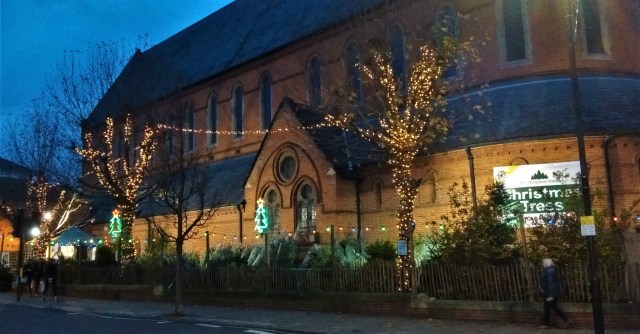
The Christmas Forest is back at the Church of the Ascension, selling a broad range of trees from their Scottish tree plantations (including the bargainous option of a less-than-perfect ‘Value Fir’ if you’re willing to go for a funny-shaped ‘character’ tree).  The annual popup business has grown a fair bit over the years from its start at a site in Richmond, and Lavender Hill is now one of ten sites they run across London. They support Tree Aid with a per-sale donation (whose value is unspecified but some suggest around 80p-£1) which plants a tree in the Sahel (south of the Sahara desert) for each sale. They also provide some income to the Church in order to use their garden. As ever, expect to see a lot of people carrying huge trees around the local streets in coming weeks…

Posted in Uncategorized | Leave a comment

Can you really rely on an electric car without a driveway to charge it in? A review of our local charging points.

Charging point locations

Electric cars are the future.  Big manufacturers are stopping investing in diesel and petrol cars (whose UK sales are set to be banned altogether by 2040), the battery technology’s come on leaps and bounds, and (perhaps most importantly) the electricity that they use is increasingly coming from clean sources rather than CO2-intensive coal! They’re also helping at a local level by removing the soot, dirt and nitrous oxides that cause respiratory illnesses, and are exactly what we want to see more of in London.  But in a dense Victorian street network with no off street parking, the tricky issue has always been where to charge them.

It’s not as bad as you might think. Wandsworth is one of the most proactive Boroughs in rolling out charging points for electric cars, and we now have quite a range of options, with varying speeds, prices and complexity.  We’ve looked at what’s available near Lavender Hill – and if you’ve used any of these local options, or more generally used an electric car in London, we’d be interested in hearing about your experience.

‘Rapid’ chargers (43,000 watts and above) 

Let’s start with the fastest.  We have two ‘rapid chargers’ – one on Clapham Common Northside, and one just off Battersea Rise, both installed by TfL and managed by ESB.  The higher the ‘wattage’ the faster the charge, and these can supply 50,000 watts – which is fast!  These chargers are dishing a lot of power so need a thicker and heavier cable than the one that typically lives in the boot of an electric car – which is why they’re attached to the charger in petrol-pump style. Unfortunately the various models of car and charger have not settled on a single design of socket or charging approach, however these rapid chargers provide three different types that should suit almost all makes and models.

This charging station will be able to top up electric taxis and anyone wanting to charge on the go – you’ll probably stay near(ish) to the car while it charges. It accepts contactless payments, and as you’ll see from our photo at the time of writing electricity was being sold for 25 pence per kWh. Importantly (as we’ll see in a moment), there’s a maximum one-hour stay allowed here – which is as long as you’ll need to fully charge most cars from empty (unless you have a Tesla, which has a large battery and which would take two hours).

‘Fast’ chargers (7,000-22,000 watts)

These SourceLondon chargers have a dedicated electricity supply cable and can therefore be more powerful – these ones can handle around 7,000 watts (reasonably fast).  There are three in the Lavender Hill area – at the southern ends of Stormont Road, Sisters Avenue and Pountney Road. In principle Government rules mean you’re entitled to use any public charging point on a pay-as-you-go basis, without a contract or subscription – but this doesn’t seem to have been applied to these charging points, and you’ll need to have signed up to the service and got hold of a SourceLondon smart card to use them.

img_20190107_145215443.jpg

But be warned: you’re not likely to find these fast chargers particularly useful if you have an electric car of your own. The SourceLondon network of charge points was originally developed by TfL, but later sold on to Bollore, a company that also owns BlueCity (which hires electric cars on a similar approach to Zipcar).  Because people who hire BlueCity cars have to leave them parked at a SourceLondon charging point, almost all the local charging points seem to be permanently used as ordinary parking spaces for BlueCity cars – most of which finished charging hours or even days earlier. Waiving parking charges without imposing any time limit on how long cars can remain in these parking spaces – and then selling them to a company with a large hire car business – was maybe a mistake. While you can in principle reserve a space in advance (for a £2 fee), yu may struggle to find one that’s not occupied.  BlueCity is a good scheme in itself (which we’ll report on in the future), but there’s clearly a slight issue with these charging points being essentially blocked and not delivering the accessible public charging that was originally intended. From a reply by Hackney Council (which has the same issue) we know at least some Councils are trying to find a way forward that works for the electric hire cars while also making these charging points generally available.

As for costs – unless you’re a BlueCity car, charging is billed by the minute, with no pay-as-you-go option (and there’s a minimum time of 10-20 minutes depending on the charge point).

‘Slow’ chargers  (less than 7,000 watts)

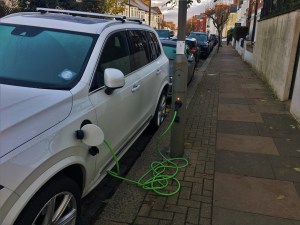
Having changed the old sodium street lights to low-power LEDs, the Council has a network of decent cables under the roads that aren’t being used to their full capacity.  So they’ve started installing SimpleSocket charging plugs in the streets, helped along by a grant they won from the Go Ultra Low Cities Scheme.  While the rapid charger is likely to serve those passing through, these less glamorous lamp post sockets are, ultimately, what will probably help Lavender Hill residents with cars to go electric – as none of us have our own driveways or can be confident of a parking space in front of our house / flat.

And the Council has been pretty enthusiastic about the programme, which is delivered in partnership with Ubitricity. Although the long term plan is to install these almost everywhere, at first the Council asked residents with electric cars to get in touch if they wanted a socket on a street light near their homes, and are trying to match demand – which has led to lots of sockets (well over 200) but inevitably created a slightly uneven distribution (these are the yellow pins on the very comprehensive Zap map of electric charge points, which also shows the faster options – there are mysteriously large numbes of sockets on Forthbridge Road & Ilminster Gardens). In Wandsworth these are mostly 5,500-watt chargers, so almost double the charging speed of the 3,000-watts you could just about manage at home without a special socket connected right to your fuseboard – but there’s a limit to how powerful these can be without overloading the underground supply cables; you’ll need to leave it overnight to charge. You’ll also find plenty of these in Lambeth next door.
IMG_5639 (2)

There’s a trade off between convenience and speed: with these sockets, charging could take 10 hours so you’ll leave the car plugged in to overnight close to home, rather than the quick topup that’s further away. Unlike the fast chargers (which have their own dedicated parking bays) these count as normal parking bays so you can’t use one outside your residents parking zone without paying parking fees! And of course someone else may have already parked near the socket.  You can probably get away with parking a little further from the socket if the space next to it is in use, but the long term plan for these lower-cost charge points is to have lots of them so that you’re always more or less within reach of a socket.

Unlike the faster chargers, these don’t have touch screens or card payment devices.  To use one, you can either plug in your own cable and use the Ubitricity app (and scan the barcode at the lamp post to start charging), or buy a cable from Ubitricity that will automatically identify your car to the socket (so you can just plug it in and go); and depending on whether you go for pay-as-you-go or an account you can (at the time of writing) pay between 16 and 24 pence per Kwh. You’ll note this is less than the rapid charger – there’s a cost to speed and convenience!

Long extension leads (less than 3,000 watts)

You can of course plug in at home, and we’ve seen a few extension cables draped between kitchens and cars!  This is the slowest option of all, and you’ll want to be careful to avoid creating a trip hazard – but it does work on some of the estates that have dedicated parking areas.

Even faster chargers (up to 250,000 watts)

There is one more type of charge point, that’s even faster (and which we don’t have locally) – the Tesla Supercharger, which can supply between 72,000 and 250,000 watts, and which only works with Tesla cars – which integrate charging breaks with their Satnav guidance.  There are a few in London but these tend to be on the motorways, to provide mid-journey charging breaks for powerful electric cars on long journeys.

Posted in Clapham Common, Environment, Transport, Useful to know | 2 Comments

Local councillor constituencies are changing in Battersea: Say hello to the ‘Lavender’ Ward

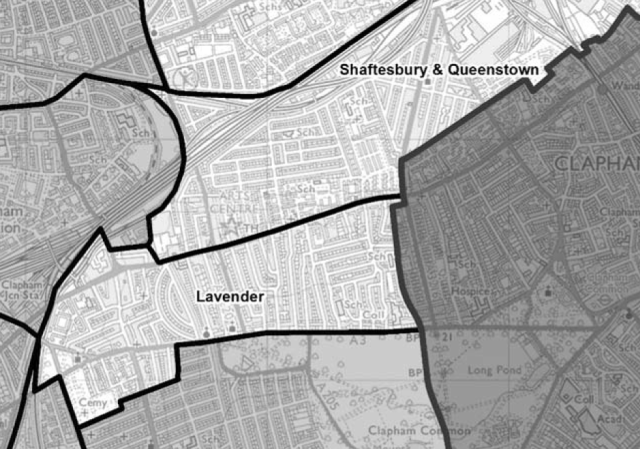
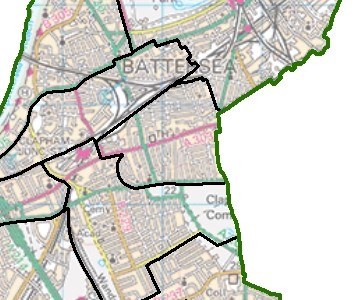
ward boundariesThousands of new residents have moved in to Wandsworth in recent years, especially in Nine Elms – which means that a little-known organisation called the Local Government Boundary Commission has been called in to review the constituencies (also known as wards) covered by our various local councillors to make sure they’re still fair.  They’ve looked at the distribution of people (both now, and in future forecasts) to try and define areas that are proportionally right for two or three councillors (so that the number of ‘voters per councillor’ is roughly the same wherever you live, at around 4,200 each).  Wherever possible they try and make sensible areas with natural  or logical boundaries – both in terms of infrastructure (big railways without many crossings, hard-to-cross roads, etc) and ‘communities’ (a more loosely defined concept of what is a natural ‘ares’ whose residents probably have common issues and concerns. It’s really quite a juggling act, that never really keeps everyone happy.
Wandsworth Wards No Labels

The previous Shaftesbury ward

The proposed new arrangements that they are consulting on eliminate the old Shaftesbury ward (which had three councillors covering both the north and south of Lavender Hill, who as of the last election are all Conservative – Hugh Byrne, Jonathan Cook and Guy Senior).

They will instead create a new  “Queenstown and Shaftesbury” ward, with three-councillors covering a patch running north of Lavender Hill.  This would include all of the Shaftesbury estate and the Queenstown Road diamond – a natural grouping – but it would be a rather unusual beast as it would also encompass the much-further-flung Savona and Patmore estates, that don’t have any direct road connection to the bulk of the ward! This seems odd – but when you think about the odd shape of Wandsworth, there’s not necessarily a better way to do it, bearing in mind that there’s been a deliberate attempt to group the ‘new’ flats in nine Elms together. It’s hard to say where this ward will sit politically – we understand the Savona and Patmore estates are (at least traditionally) a Labour stronghold, while Shaftesbury and the Diamond are mixed with a slim Conservative majority.

The Boundaries Commission are also proposing a two-councillor “Lavender” ward (the smaller area south, including the station itself and St Johns Road).  This is a logical grouping, and is likely to be a mixed but mainly Conservative ward. Mossbury Road was sensibly added to this ward, rather than Queenstown & Shaftesbury, at the specific suggestion of the Clapham Junction Action group.  Curiously the site of Lidl and Boots has been carefully excluded; this won’t have any effect now but in the medium term there are plans to redevelop Boots to build flats, whose residents would share councillors with the Winstanley area.

31965765784_529d0c15a4_b-1014x720

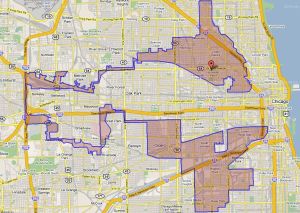
American political districts take the designing of odd-shaped wards to group voters together to an extreme level – this is a real ward in Chicago (c) Bill Moyers.

The way you lay out the wards can have a big effect on who wins more seats – which is why the local political parties always feed in detailed comments on these proposals. As a political party you ideally design them to have about 40% of the people you reckon are most likely to vote for your rivals in every ward, just low enough so that you can comfortably win every time – or if that’s not possible, the next best thing is to try to bundle as close as possible to 100% of the rival voters in to just one ‘unwinnable’ ward, where you don’t bother campaigning – to then make sure you have the best run possible in the other wards nearby.  The map to the right is an example of what this leads to in America (where the process is more politically driven, and where some very strange political districts can appear – this one was designed to have a majority of Hispanic voters).  Luckily in our case the Boundaries Commission has to be politically independent, so constituencies tend to be sensible and ‘fair’. 

If you’re really in to local politics, you can comment on these proposals – details are here.  

Posted in Politics | 1 Comment

New cycle hire location on the way – south end of Cedars Road

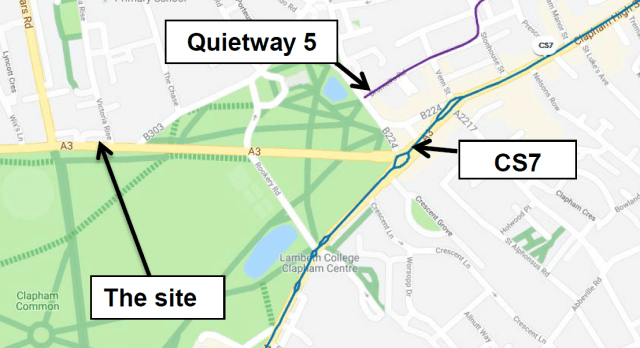
cyc 4In a small extension of the area covered by the cycle hire scheme, TfL are proposing a new docking station for Santander Cycles, close to the southern end of Cedars Road.  This one of three proposed new stations (the others being close to Clapham Common station, and close to Clapham north station). It’s a spot conveniently close to both the CS7 ‘cycle superhighway’ and the more recently built ‘Quietway’ route in to town.

cyc 5

This will complement our existing points quite well – the TfL map to the right illustrates this docking station in orange, and the existing ones are in red (map data © Google).

We don’t expect this to be controversial – they have chosen the one spot where the pavement is about 30 feet wide and has no houses or shops facing it, meaning there’s absolutely loads of space for a cycle hire point without losing any coveted parking spaces, as TfL’s photo and illustration below show rather well.

We generally see broad support for the cycle hire scheme among those we speak to, and reckon this proposal – which patches up a bit of a hole in the area of coverage – is good news.  If you want to formally comment on these proposals (whether to support or express concerns), the planning application is on the Lambeth planning site (as it is just over the Lambeth / Wandsworth border) and you’ll need to search for reference number 19/03730/FUL.

Posted in Clapham Common, Environment, Transport | Leave a comment

Are Debenhams & T.K.Maxx both closing?

IMG_20191026_085015848_HDR

Update: Our sources were right, Debenhams was indeed closing…  though TK Maxx is staying.  See our update article here.

The Clapham Junction Action Group has heard worrying reports that both the ‘anchor tenants’ of Clapham Junction’s shopping centre may close next year.  Not because they want to leave, but because their landlord has given them notice to quit!  Debenhams as a whole has been in difficulty for a while, although as we have previously reported the Clapham Junction branch is profitable and one they definitely want to keep. And we understand our T.K. Maxx is one of their best performing branches.

But several sources, as well as one media article, have suggested that the relatively new owner of the building, W Real Estate, wants them out so they can redevelop some or all of the building as a hotel. This would be the end of one of London’s most famous department stores, and a true icon of Clapham Junction. It would also have major implications for neighbouring traders.

debs

How has this happened?  It all goes back to Debenhams’ recent CVA process – a sort of ‘voluntary bankruptcy’ where Debenhams asked landlords at 105 stores all over the country (including the Arding & Hobbs building) for rent cuts so they could afford to keep trading.  This wasn’t welcomed by landlords, but they were given a consolation prize of being able to end the leases early if they found a better deal (and Debenhams had a 16-year lease at the time). Most landlords just accepted this, as there aren’t that many people out there looking for such large amounts of space – but in Clapham Junction’s case the new landlords (who bought the building at the end of 2018) seem to have called their bluff and taken up the “we can do better with someone else” option.

We know rather less about the situation with T.K. Maxx; they occupy a section carved out of the larger Debenhams space (and they’re surrounded by Debenhams on three sides), and the reports are more vague – some suggest their lease is being ended at around the same time, with others suggesting a closure may only be temporary for a few weeks to allow building work to go ahead (we of course asked T K Maxx’s press office for comment, but have yet to hear back).

What will happen to the building?  The building is Grade II listed, which means that making anything other than minor changes to the exterior will not be allowed – however most of the interior (other than the Cafe ceiling) has been changed so much that almost anything would be feasible.   Rumours are that W Real Estate want to convert the building to a hotel.  There are several possibilities for this: they may want to covert the whole building to hotel use, however to maximise the value of the property (and get through planning) it may make more sense to split maybe the first two floors and the basement in to three or four largeish retail units, with the corner entrance leading up to a hotel on the more peaceful upper floors, a roof storey, and some of the back sections. It would be relatively easy to add another storey on much of the roof, without significantly damaging the appearance of the building. With huge levels of foot traffic along the street there’s still strong local demand for ‘decent size’ shop units – for example we know that Boots has been trying to find a local spot with a size somewhere between their far-too-small St John’s Road unit, and their too-big-and-too-out-of-the-way Falcon Lane site for years; even the basement would be appealing to many a gym operator if it had its own street-level entrance.  Even in the downturn some retailers like Decathlon and Ikea are still interested in large sites (Ikea, for example, has bought a whole shopping centre in Hammersmith for a town centre store!).

img_20170114_113709630_hdr

What does this mean for Clapham Junction? The immediate consequence will be the loss of 140,000 square feet of retail space.  You could be forgiven for thinking this doesn’t matter as shops across the UK are downsizing and closing – however the problem here is that Clapham Junction would lose two of its largest traders, the ones that draw people here from outside the immediate area who then also visit the other smaller shops and businesses, and keep other smaller traders afloat.  T.K. Maxx, despite being smaller (at around 30,000 square feet), has also proved to be a huge draw to the area – much more so than their less busy branches in neighbouring areas. This will not be an easy proposal to get through planning, and while some reconfiguration of the upper levels is likely to be workable, we’d be very concerned if the retail use of the most central building in Clapham Junction’s shopping centre disappeared altogether!

It’s also the loss of an icon. Arding & Hobbs has been around since 1885, when it was the largest department store south of the Thames. A fire destroyed the building in 1909, which was replaced by the current much grander building.  And – via a few years trading as Allders, before being taken over by Debenhams – it’s been with us ever since. There’s a lot of local affection for the store, and it even saw national fame in the riots of 2011, when the boards on the windows were covered with messages of support by members of the public.

What happens now?  We appreciate this will be worrying news for many of us, including those who work in the two businesses, and it’s also important to recognise that this was not Debenhams’ decision – indeed it’s is very much a situation they would have wanted to avoid!  Things can, of course, change quickly in the property market – including these plans – and as yet, the landlord has not submitted any planning applications for changes to the building or its use.  We understand that whatever happens Debenhams will continue to trade through the Christmas season and on to June next year, and maybe for up to a year after then.

What does this mean specifically for Lavender Hill?  Lavender Hill is unlikely to feel the loss of these anchor tenants quite as much as St Johns Road and Northcote Road.  Mainly because it has always had a local focus, and the businesses that do well tend to either be quite specialist so draw people in specifically (like the Fabric store & Drumshack), to not be retail at all (the many restaurants), or to serve a primarily local audience who are here regardless (the cafes, and all the estate agents, the DIY stores and the various small service businesses).

This article was first posted by the Clapham Junction Action Group.  As ever, we and CJAG will keep you posted if we hear updates.

Posted in Arding & Hobbs, Retail | 3 Comments

Three new Cafes for Lavender Hill: Howdy, Maiolica, and 2Love

Who remembers the all day brunches that the Roastery on Wandsworth Road used to offer, complete with giant mushrooms and a corn fritter options? They were the first place in the area to sell Flat Whites (way before they became ubiquitous), and introduced many to to the art of the Anzac cookie. When they closed after more than a decade in business, many missed them – and it also left a local gap in the market for a good quality brunches and lunches.

The Howdy Bistro has opened at 62 Lavender Hill just this week (formerly Noiya, though you won’t recognise the interior), and  James and Yasir aim to fill this gap – as well as supplying good coffee and cakes. James is a professional chef, and it shows – it’s fair to say on our first visit Howdy didn’t disappoint – indeed it felt quite under priced for the quality. Child friendly, with high chairs and a children’s menu set to arrive in the next week or so. We hear more is to follow, including a cosy outdoor seating area that will make the most of their front terrace.

Meanwhile The Roastery’s old premises (up the Wandsworth Road heading up the hill from Tesco) has been redecorated and reopened as Maiolica Cafe, serving Sicilian food (including breakfast) and proper Italian coffee. Headed by enthusiastic new owners, it’s definitely worth heading all the way out here to their end-of-the-street location. We were pleased to see that some of the old wall artwork from its days as the Roastery has been preserved!

Nearer the station, established local coffee shop 2Love have outgrown their St Johns Road premises and opened up their second local branch in what used to be the right hand half of Braggins Carpets. It’s way smaller than their first premises but is doing a healthy trade – and they’ve brought with them the huge range of intriguing teas.

IMG_20190518_091415015

A bit of good news is that the former Valentina (which has been empty for some time after the whole chain went in to administration, and whose garden has been turning in to a bit of a wilderness) has apparently been let and will become a bar with light music (there’s currently a licensing application on the door; neighbours will be pleased to hear that the proposed use of the outdoor garden will be limited to before 9:30pm).

Posted in Uncategorized | Leave a comment

In pictures: Progress on Lavender Hill’s new urban park

Planters around what will be the outdoor cafe area

Back in December we reported  that BAC was developing an ‘urban park’ on Town Hall Road, which at the time was a barriered-off and rather sad-looking road used mainly for deliveries. It was a bold project that faced various hurdles (they didn’t own all the land, they had many other issues on heir hands, and at the time they didn’t have all the cash either) but we’re very happy to see that work is now well underway.

Several new street trees have been planted right along the length of the street. At this point we may have to disappoint any readers who might be hoping that this work will turn the street in to the sort of lush green wilderness you could lose the dog in if you weren’t careful: it’s simply not possible to do that here, because while Town Hall Road is no longer open to traffic it still has to allow for delivery (and fire!) access, as well as being a right of way – however the street level has been raised to be flush with the pavement, and the many planters that will be used create the park effect are currently being prepared.

One of the more unusual features is the creation of a large planted area on the old raised platform, which had been designed as a sort of viewpoint (but which never really worked).  This will house large twisted metal girder that was pulled out of the wreckage of the major fire that destroyed the Great Hall – pictured above.  Work here is also underway, with steel edging now in place and wiring installed for some lighting.

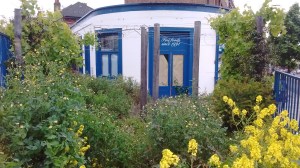
The two old phone boxes have been restored and repainted (the ultimate aim is for them to house a garden store and a sink to support volunteers during gardening projects). The pavement in front of the main entrance to BAC, which was made of proper stone but which had become cracked and uneven over the years, has been completely resurfaced with new stone, and the heritage street lights have all been fully restored and got back in to working order (with energy efficient white LED lighting that suits the building better).

All in all – this is progressing really well, and it already looks better than it did before.  We very much applaud the imagination and enthusiasm of the team at BAC in making this happen.

Posted in Uncategorized | 1 Comment

New Nando’s on Lavender Hill is up & running

Back in February we reported that Nando’s was coming to Lavender Hill – taking over the short-lived Chicken Cottage site between Debenhams and Whole Foods (previously Wimpy).  It’s taken a while, but building work is now complete, and it’s up and running.

The old shop unit has had a proper tidy up, with new windows cut in to the side walls, a rationalisation of the inside layout to make a lot more space, and a smart curved glass corner window.  This is only a small branch with a few tables (and it’s a bit of an experiment for the company), as the aim is to do mainly takeaway and delivery orders, taking a bit of pressure off the ever-crowded Northcote Road branch.

In contrast to many other chains Nando’s rarely put a foot wrong and have seen healthy sales and good profits in recent years (with close to a billion pounds in annual turnover), even while funding costly international expansions. They’ve chosen a good spot here and have put in a good effort on the fit-out; we suspect this will do well.

Posted in Retail | Leave a comment

Battersea’s Post Office is being downgraded

IMG_4596

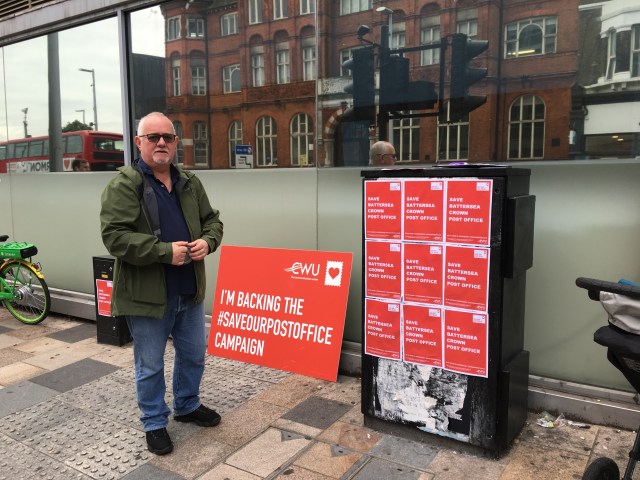
You may have seen posters up in the main Post Office on Lavender Hill, saying that there are ‘changes’ ahead, and that they welcome views.  It’s not entirely clear what the change is about – at first glance, the only proposed changes they consulted on (see this pdf document for details) are about the accessibility of the branch.

If you were there this weekend, you may also have seen Mole Meade from the Commercial Workers Union (which covers, among other areas, those who work in Post Offices), pictured above, with a petition as part of the “#Save our Post Office” campaign.

The real change is nothing to do with the consultation on ‘access to the branch’, but rather that in November this post office is changing from a major office that is centrally managed by Royal Mail itself (known as a ‘Crown’ Post Office – typically the top 2% of all post offices, covering the largest and most important branches), to instead be a franchise run by a separate company, along more commercial lines. The Post Office has the right to make this change without any consultation, so unless there are quick policy changes it’s going to happen whether we (and the post office staff) like it or not.

Franchised Post Offices aren’t unusual – indeed the small post office at the back of Costcutters on Queenstown Road (near the eastern end of Lavender Hill) is an example of one.  At the end of last year the Post Office proposed to franchise 78 branches to WHSmith, who have made a business out of taking over formerly state-run post offices.

But franchising is controversial – partly because the franchisee firms tend to offer lower wages, and less job security, than the previous Crown Post Offices did. Technically speaking, the only proposed change at Lavender Hill is a slight extension in opening hours (it will open on Saturday afternoons). In the longer term the change may make it easier to close down the post office completely if it underperforms, although as a consistently busy urban post office we don’t see that as a particularly high risk.  Recent research by Citizens Advice, using mystery shoppers, found the overall changes were mixed: some aspects of service improved when branches were privatised, but others got worse, maybe reflecting the higher staff turnover and lower wages in a ‘general retail’ environment compared to a centrally run Post Office.  Franchisees have a tendency to co-locate post offices with other businesses (usually shops, but sometimes pubs or restaurants) to cut costs, so we may see it move to somewhere else in the area (and the consultation on ‘access in to the premises’ – where one of the two entrances is up some steps – may be a way of justifying such a relocation).

The official consultation documents don’t say who will take over our post office, though we have heard some reports that rather than the ‘usual suspect’ of WHSmith, it may instead be a firm at least loosely linked to ZCO Limited, a small company that runs several existing Post Offices (as well as stationery shops).  There seems to be a rather worrying amount of  controversy around the company!   This article on the Faversham Eye is particualrly forthright:

Since the privatization mania of the 1980’s, the title of most incompetent company getting a fat government contract has been hotly contested. Though not as well as known or as big as many of the others, ZCO/Potent are well placed to compete for this illustrious title. All the key elements are there – an appalling record of broken promises, poor financial reporting and dismal performance.

There has been debate in Parliament about the company – for example in January, the future of Sydenham’s Post Office was discussed at Westminster, with concern being expressed that “the franchise has been awarded to a stationery company, ZCO Ltd, with no good track record of running post offices”.  For an exhaustive report in to the firm, see this post about ZCO and Acocks Green Post office.

To be fair there has, however, been some evidence of new and imaginative approaches in some cases – for example in Huddersfield the firm seems to have combined a Post Office with a Cafe-Bar and Bistro rather than a stationery outlet.

We’ll keep you posted on how this develops, in particular if we hear more details of which company is taking over and what they are planning for the office and the staff (and do get in touch with any insights!).  Whatever happens, it looks as though change is definitely ahead for our Post Office.

Posted in Business, Politics, Retail | Leave a comment

The betting shops are closing down…

They seem to be everywhere.  Few other businesses can claim to have a presence on almost every high street in the country, from the poshest city centres to the bleakest estate parades.  It’s not unusual to see several of the same chain on a single street – and Lavender Hill is no exception.  There’s a William Hill at 15 Lavender Hill, and another one about four blocks away at 131 Lavender Hill.  Ladbrokes have a branch at each end of Lavender Hill.  And around the station there’s a Paddy Power, yet another William Hill, and a Betfred.

But not for long.

IMG_20190922_162941606_HDRBetting shops are unusual businesses.  There’s nothing perishable, and running costs are low.  But they pay staff, rent, and business rates like any other business.  They’re inherently vulnerable to online competition. The traditional bets on the horses have been bringing in less and less money in recent years – instead, most of the stores have come to rely on the income from the slot machines – ‘Fixed Odds Betting Terminals’, or FOBTs. These typically take a cut of 3-10% of all bets placed, and with each stake between £1 and £100, they were sometimes fabulously profitable!
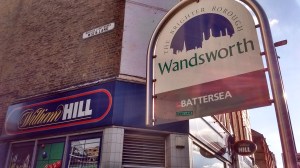
Maybe too profitable for the shops, which is why the government has been keen to regulate them for a while.  The prospect of losing hundreds of pounds within minuted was just too tempting for some.  At first, their numbers were limited to four machines per shop.  This probably encouraged the spread of betting shops, as if you had three small shops close to each other, you could have twelve machines rather than four…

IMG_20190715_184338315_HDR

But it wasn’t to last.  From April this year, the rules were changed – and the maximum bet on FOBTs was reduced from £100 to just £2. This means that a lot of previously profitable shops have suddenly become loss making – and this week, both the branches of William Hill on Lavender Hill announced they were closing down.  Chances are more closures will follow.

Betting shops have always divided opinions.  Some of the people we’ve spoken to about these closures see it as a good thing – reducing the number of high-stakes betting opportunities will, after all, make it harder for those who can’t manage their gambling to lose money (FOBTs have, after all, been described as the ‘crack cocaine’ of gambling). The impact of problem gambling can be devastating, to those affected and everyone around them. Others saw these shops as adding very little value to Lavender Hill, and (as drinking was banned) indirectly leading customers to drink offsite in local side streets.

IMG_20190922_162501247_HDRBut it’s clear that many will be sad to see these go.  Obviously it’s a loss of business rates, and jobs for those who managed the shops.  There’s clearly also a social side to these businesses – at least for the regular customers, some of whom have been customers for many years. Betting shops (and the fees they pay for the live streaming of racing) are an important source of income for the racing sector, which will lose millions of pounds of annual income.  Some argue that all that will happen is that the gambling will be pushed online, where it’s even less regulated and without the presence of store managers trained to recognise ‘problem betters’, gambling addicts could lose even more money.

Wherever you sit on this issue, the once-ubiquitous high street betting shop looks set to become a much rarer sight in the future.

Posted in Retail | 2 Comments