
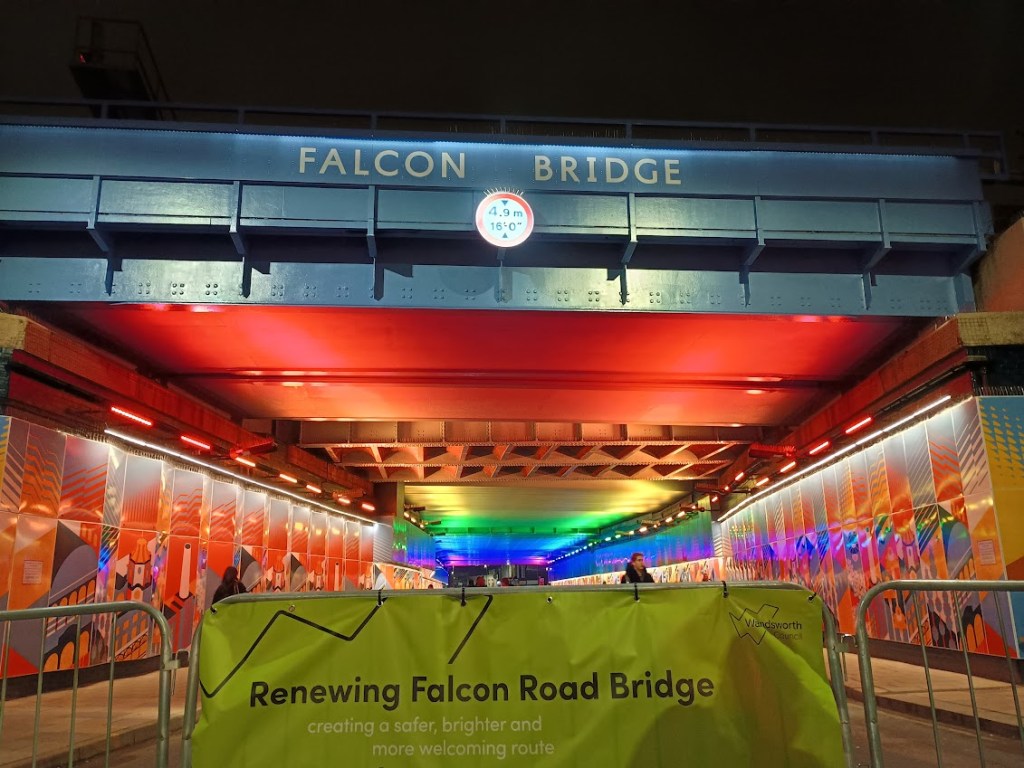
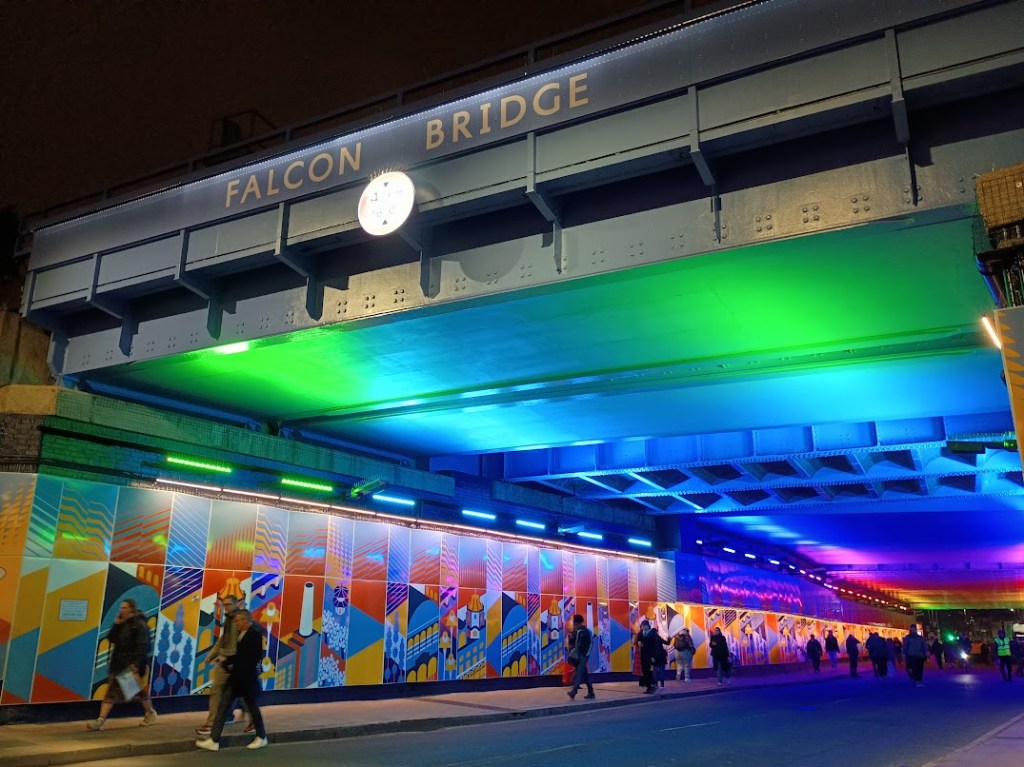
As we wrote way back in 2019, nobody likes the Falcon Road railway bridge. Dark, loud, mucky, and always wet, the need to run the gauntlet of drips and pigeon poo is an unpleasant part of the day for those of us who use it. It’s been splitting Clapham Junction in two from the very beginning, as the railway junction was pretty much the reason a town centre was built here. Over 100 metres long and running under nineteen railway lines in one go, it has reinforced a long running north / south divide in Battersea, condemning those on the north to a rather grim walk to get to the main town centre, and preventing the many businesses on the Falcon Road benefitting from being so close to the crowds of people at Clapham Junction.
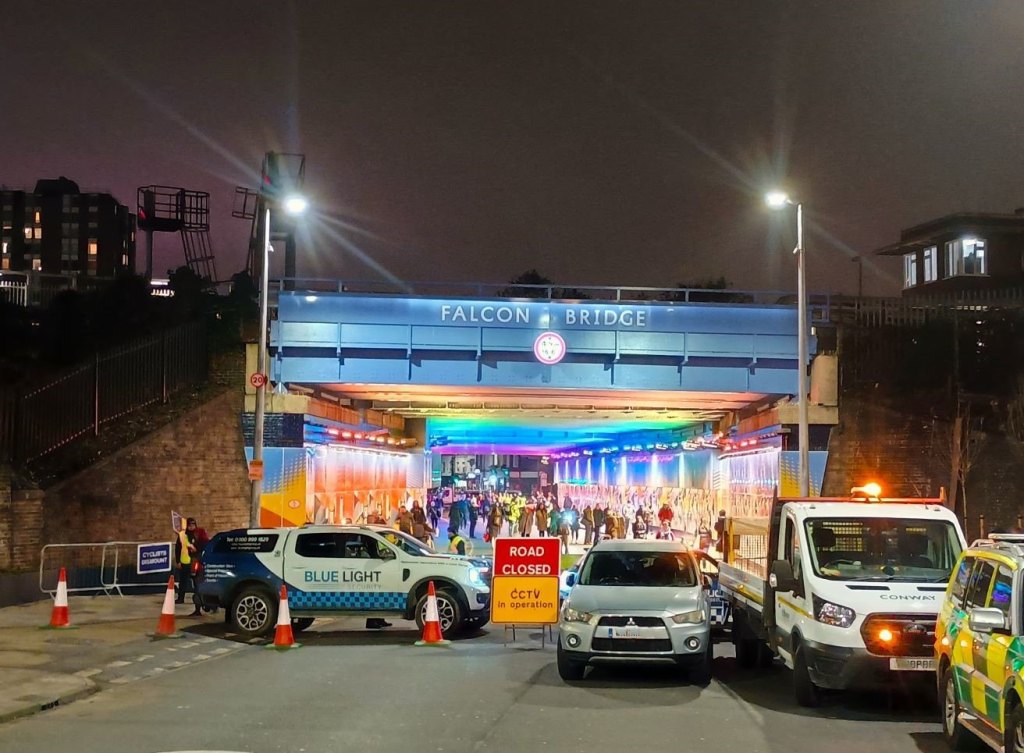
But that has changed. Wandsworth Council has been on a push to renew and clean up our town centres, and one thing that emerged time and time again in discussions with residents was Falcon bridge! They decided to go for it – making the most of the ‘neighbourhood improvement’ funding coming from a lot of the big housing developments along the riverside – and kicked off a major project to completely transform the look and feel of the bridge. There would be no half measures here, this was to be a proper effort that would make an impact. And after months of preparation, and three months of building work, the road briefly closed last night to celebrate the completion of the works.
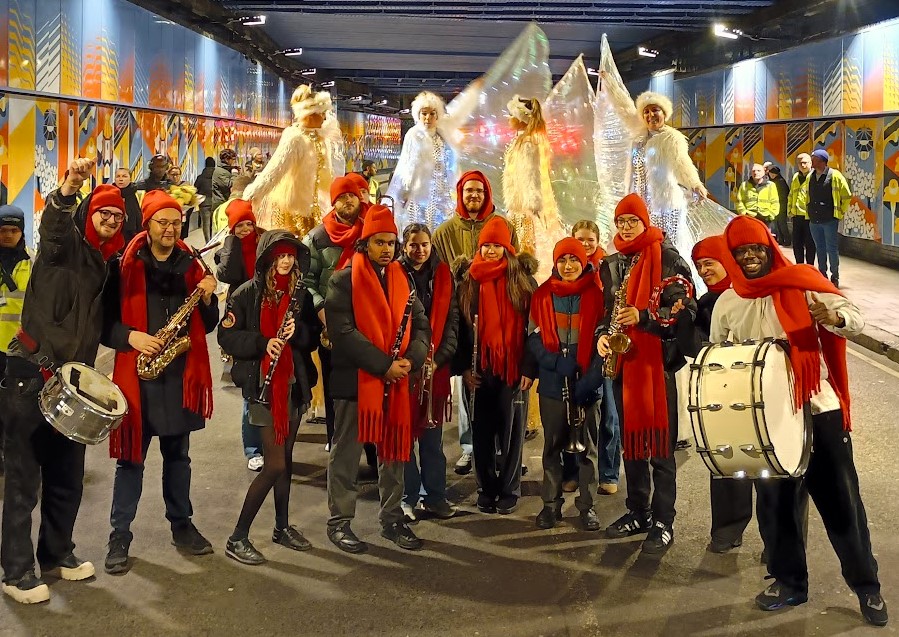
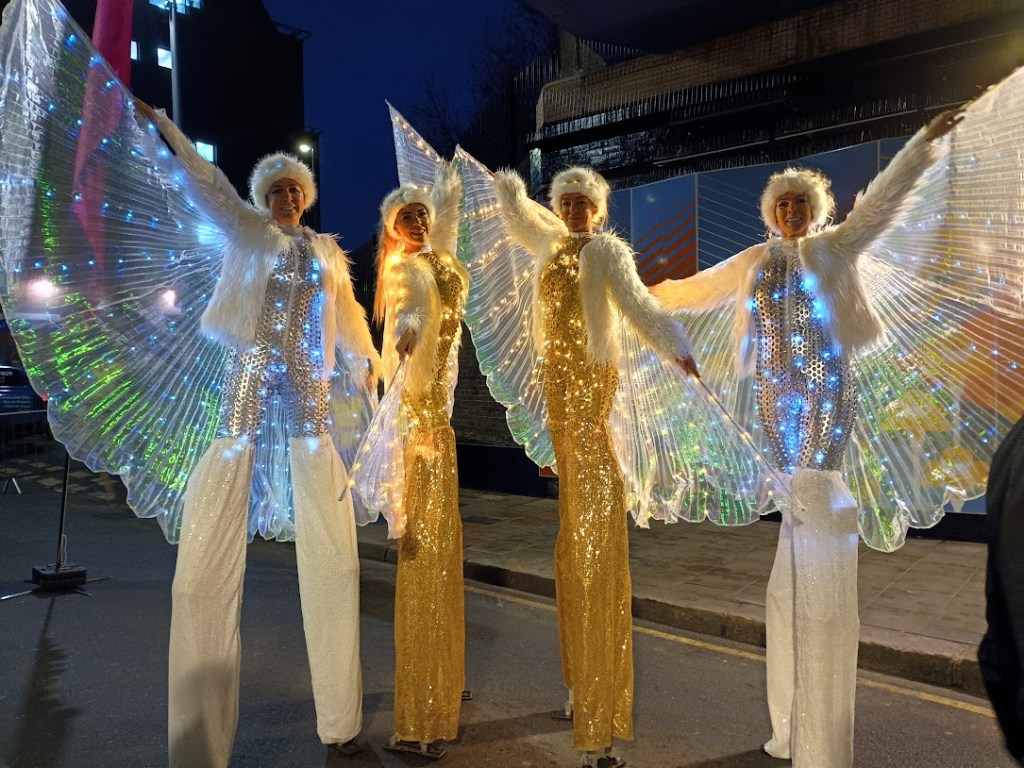
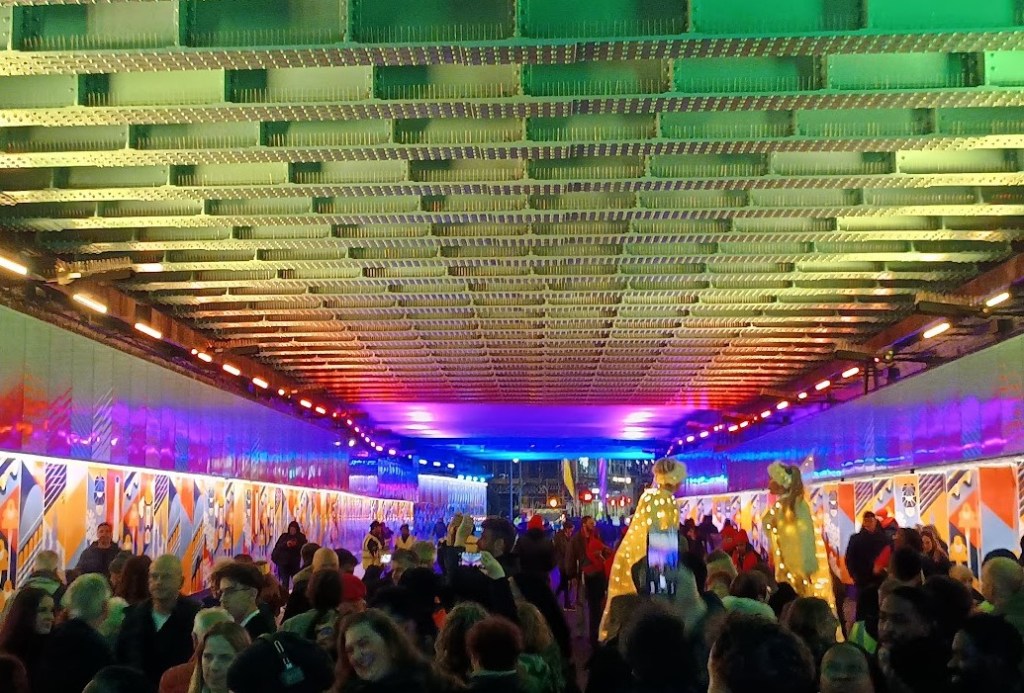
It’s the first time there’s ever been an event actually under the bridge! Even if it had been possible to close the road before, the venue would have been too dirty and unappealing to want to – but this time passers by were surprised to see a full range of entertainment, and the crowd grew quickly. The Falconbrook School Steel Pan Band set the scene, making the most of the acoustics, followed by the Brass Band from World Heart Beat, accompanied by stilt walkers.
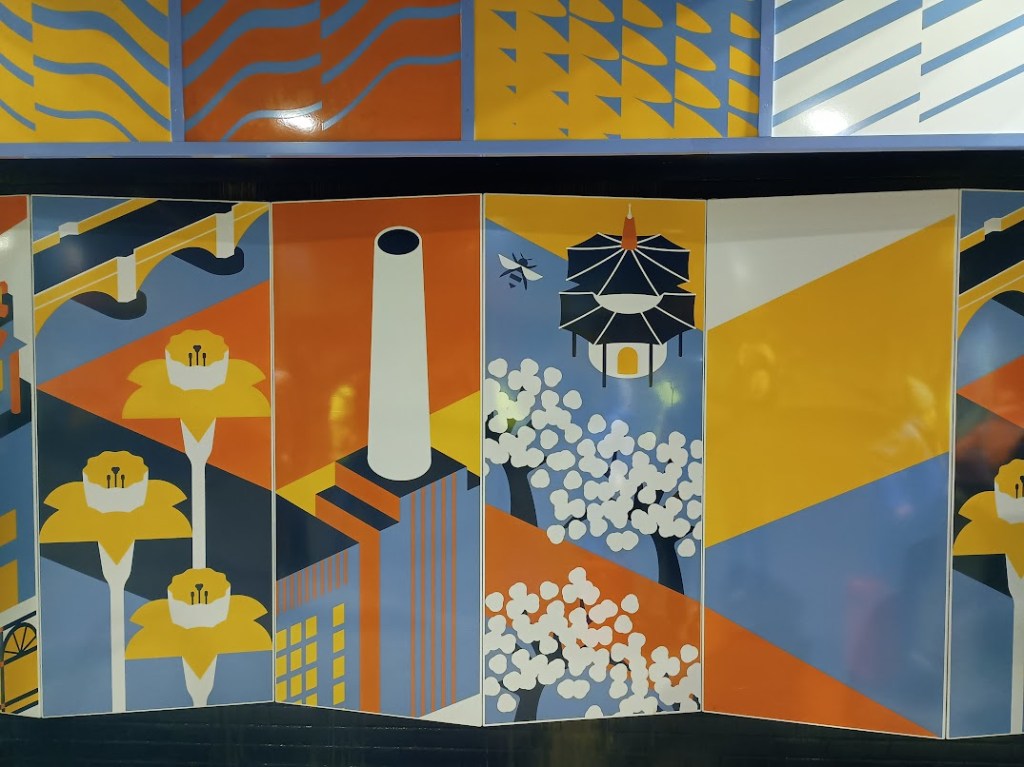
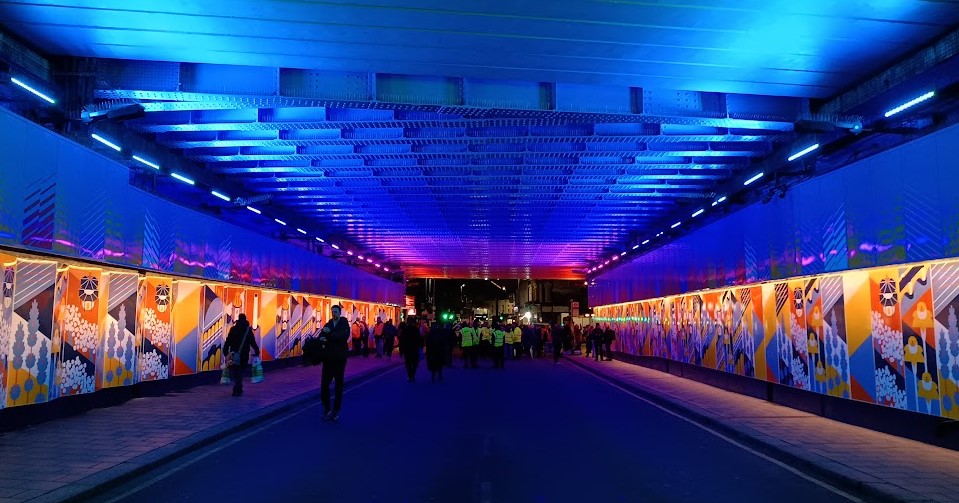
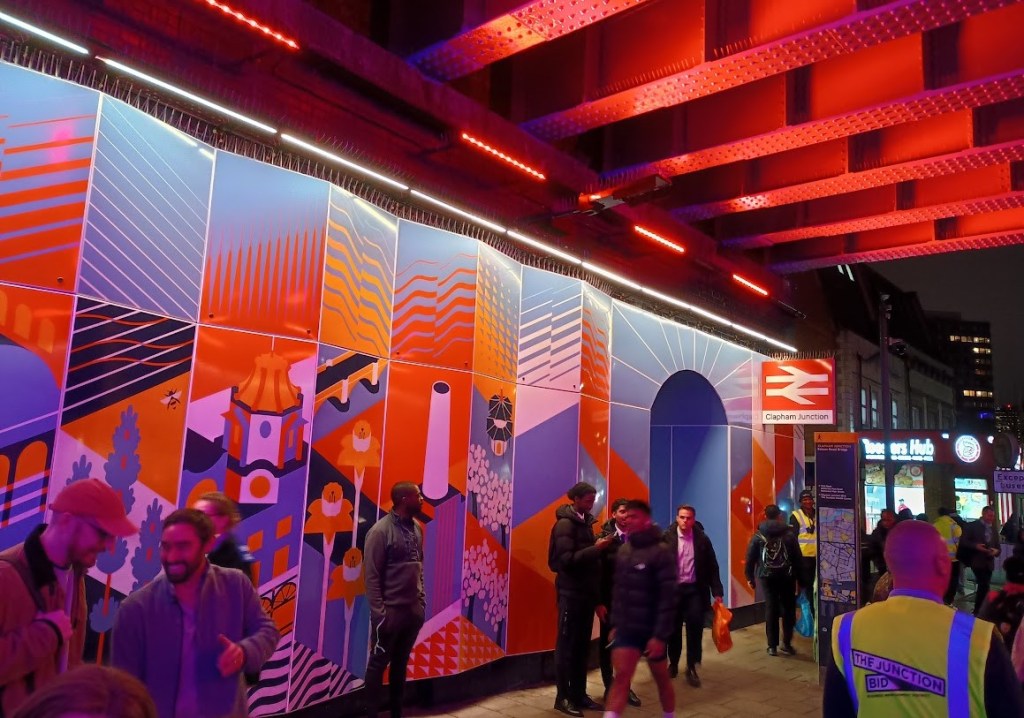
As everyone gathered for the opening, it was already clear that the bridge has a very different look and feel. It’s clean, it’s bright, and maybe most surprisingly of all, it’s dry. The entire wall surface has been covered with five hundred enamel panels, whose designs were developed in a serie sof community workshops. They include stylised images of Battersea Bridge, the Price’s Candles factory that once occupied a huge area north of the York Road (and which, even though the last part of the business moved out to Bedford in 2001, remains the largest British owned candle maker), the Peace Pagoda, Arding and Hobbs, Battersea Power Station, cherry trees in Battersea Park, and of course our favourite the lavender of Lavender Hill.
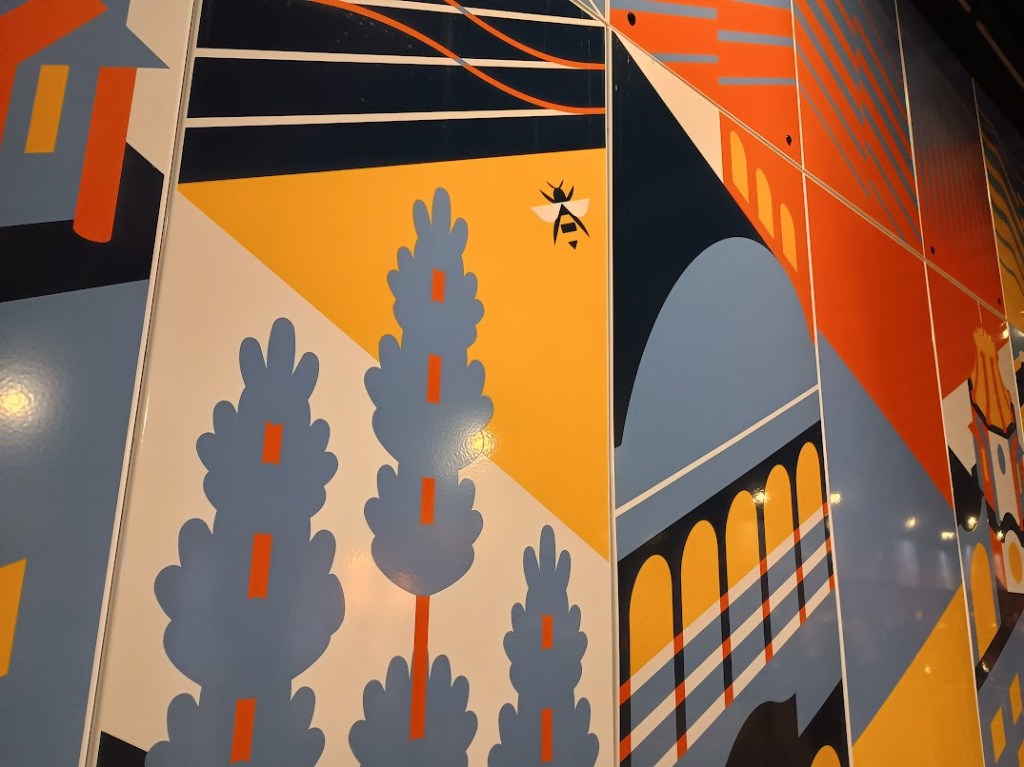
The panels also include daffodils – which (thanks to one of our readers) we know are a nod to the five hundred daffodils planted in Christchurch Gardens by pupils at nearby ChristChurch primary school. The gardens – slightly hidden behind a fruit and veg shop at the other end of Falcon Road – include a relatively little known memorial to those we lost, and flower each spring in memory of the civilian casualties in Battersea during World War II. The planting followed an oral history project interviewing people who were living in Battersea during the war (whose summary includes many eyewitness accounts and can be downloaded here).
The mural also includes lots of Battersea bees. The bee has long been a symbol of Battersea, so much so that many bees feature in the mosaic floors at Battersea Ars Centre, from when it was Battersea Town Hall. It reflects the industrious and community minded people of Battersea – and maybe also the prevalence of bees back when large parts of the low lying area along the riverside were market gardens that were known for their production of quite exotic fruit and vegetables for London’s markets, as well as the Lavender fields up towards Lavender Hill.
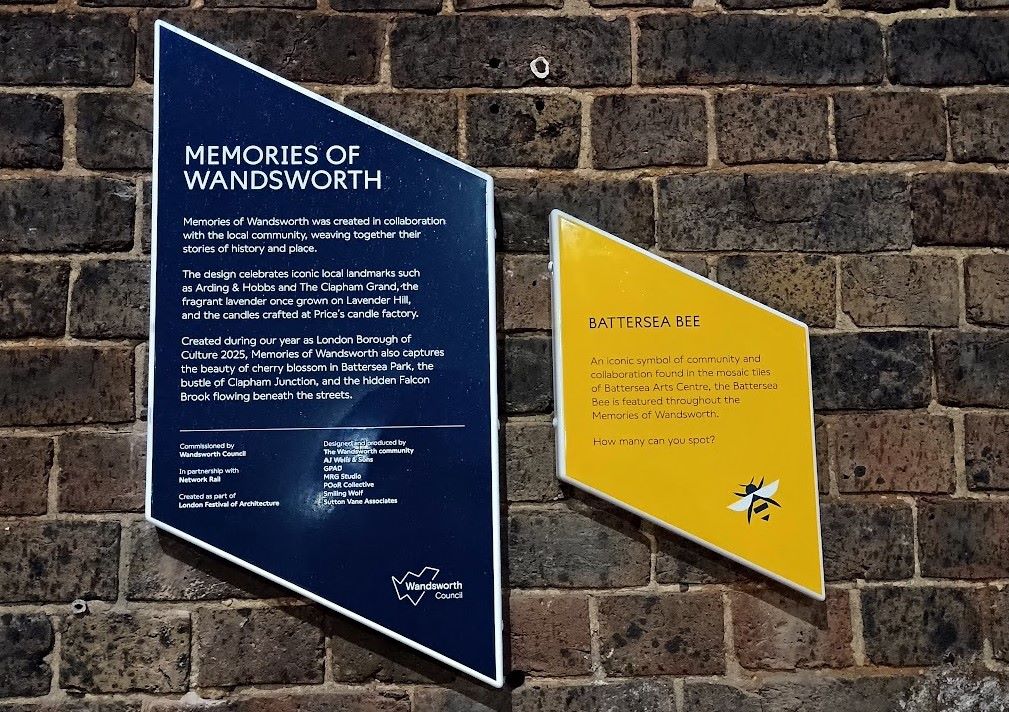
One reference that may be less immediately apparent is flowing water, shown on several of the panels – the ones that also show Arding & Hobbs. This isn’t a reference to the ominous drips that used to rained down on pedestrians – rather it’s a nod to the Falconbrook river, which is responsible for the clear dip between Lavender Hill and St John’s Hill. Once a quiet rural river winding its way through the fields from Balham to the Thames, it was buried soon after the station was opened, and it now flows – quietly and unseen – under our feet as we walk through Falcon Bridge, before heading off under the York Road Estate, and under the remaining buildings of the Price’s Candles factory.
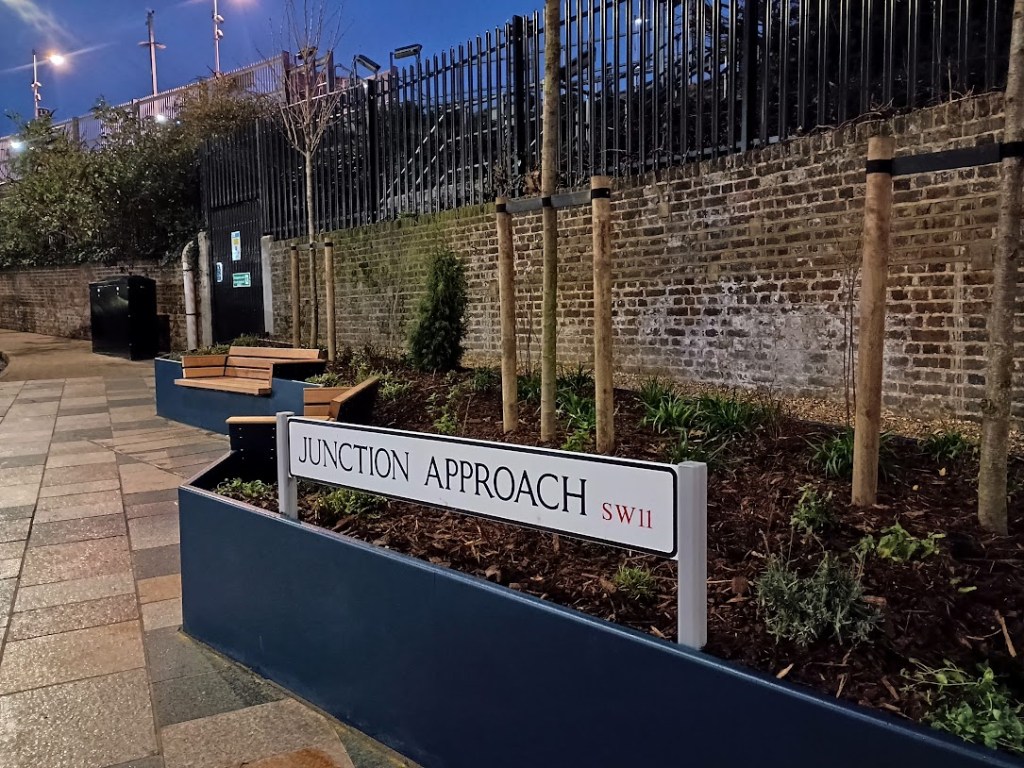
It’s not just about the bridge: there used to be scruffy patches of wasteland and unofficial advertising hoardings at each end of the bridge; those have been replaced with new planting and seating more or less following the design in the original competition.
But now it was time for the main event. Kemi Akinola (deputy leader of Wandsworth Council), Marsha de Cordova MP, and Simon Hogg (leader of the Council) spoke about the project. As a key event in Wandsworth’s year as Borough of Culture, this was a chance to celebrate the community and local landmarks, with a design that reflects the cultural identity of Wandsworth.
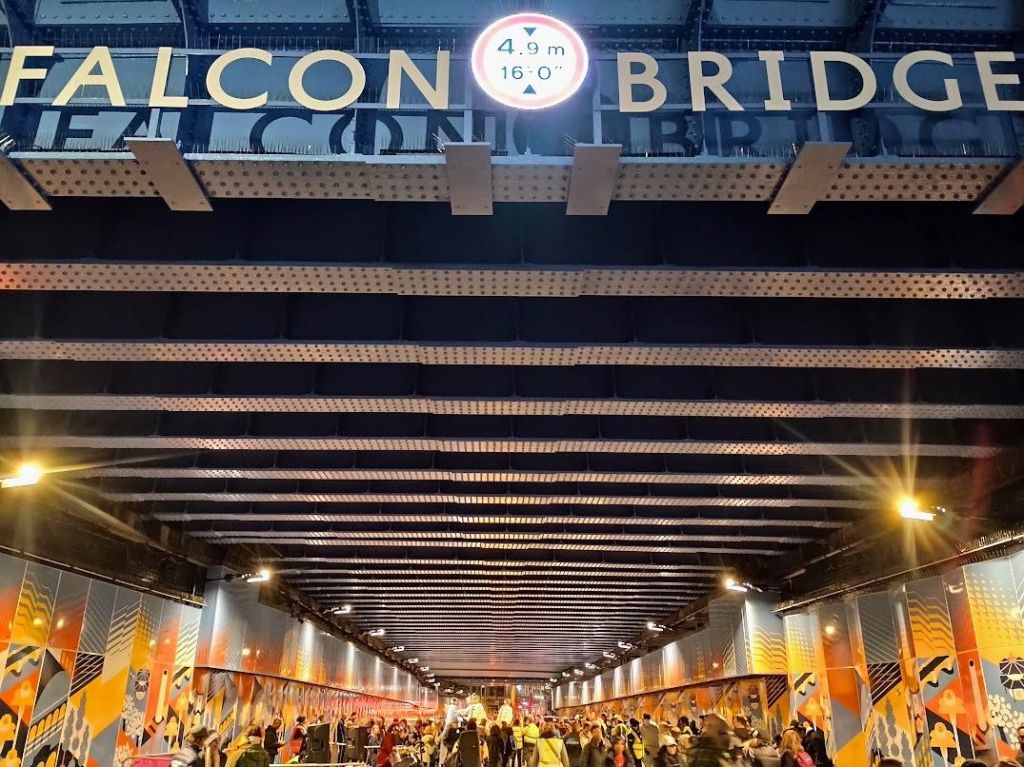
It was also a chance to finally deal with a bridge that had been deeply unpopular with residents, for being unpleasant and unsafe, and that had split Clapham Junction and Battersea for too long.
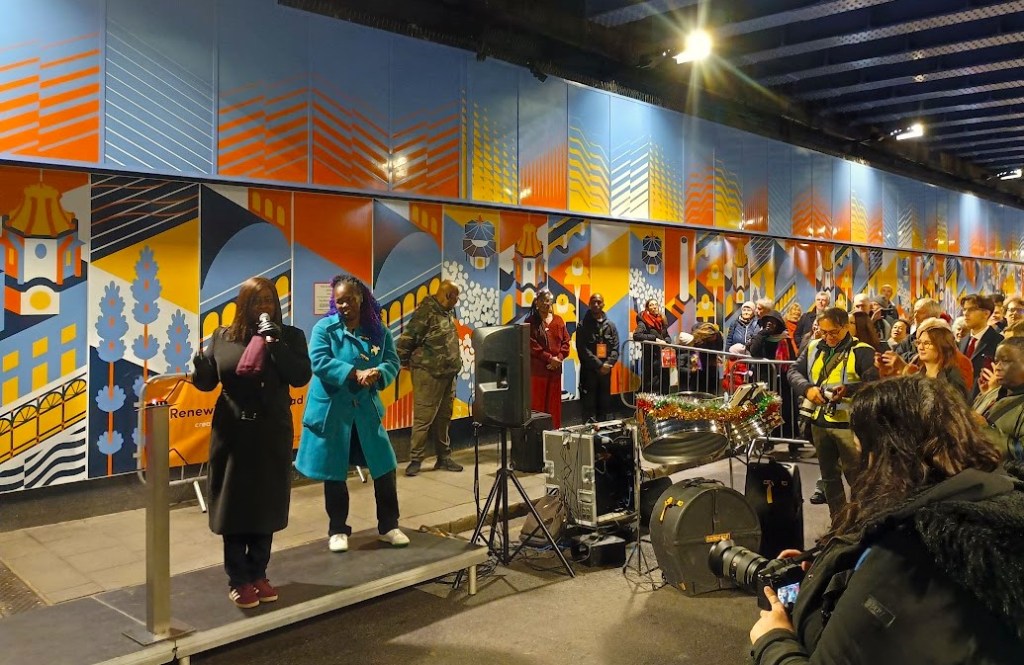
Thanks went to 1,000+ residents who had been involved in the consultation and design stages, the design team who had turned ideas in to a reality, the engineering team at Conway who had managed a complicated build, and to project manager Sam Emmett for leading what had been a complex project bringing together lots of different organisations and managing a fair few challenges. But now it was time to dim the main street lighting, and for the big red button…
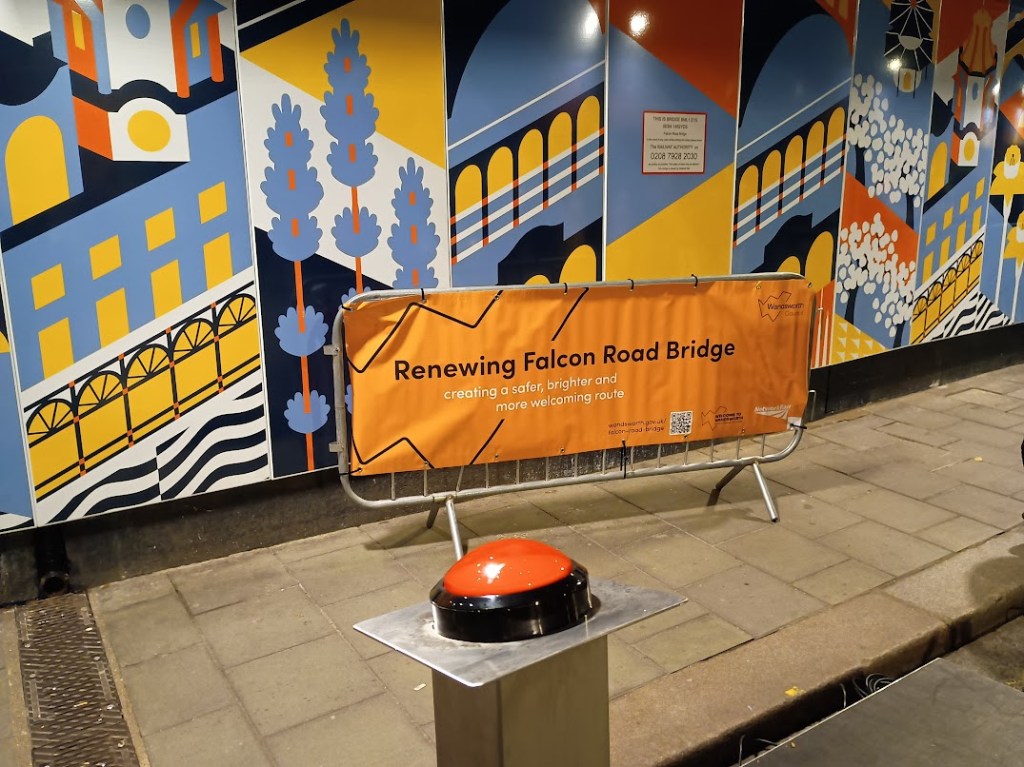
And Falcon bridge’s lighting was switched on…
And the whole bridge lit up. There are upwards and downward facing lights, all of which are individually controlled. The main roadway lights have also been replaced with new ones that are more directional and pigeon proofed (and thanks to legendary London reporter Ian Mansfield, who was also at the launch, we now know that the lights are brighter in the day than at night – to avoid making the contrast between inside & outside the tunnel too sharp). The Victorians who originally built the first spans of Falcon bridge, as a workaday thoroughfare between the new suburban town centre being laid out to the south and the fields and distant village to the north, would never have expected it to look like this.
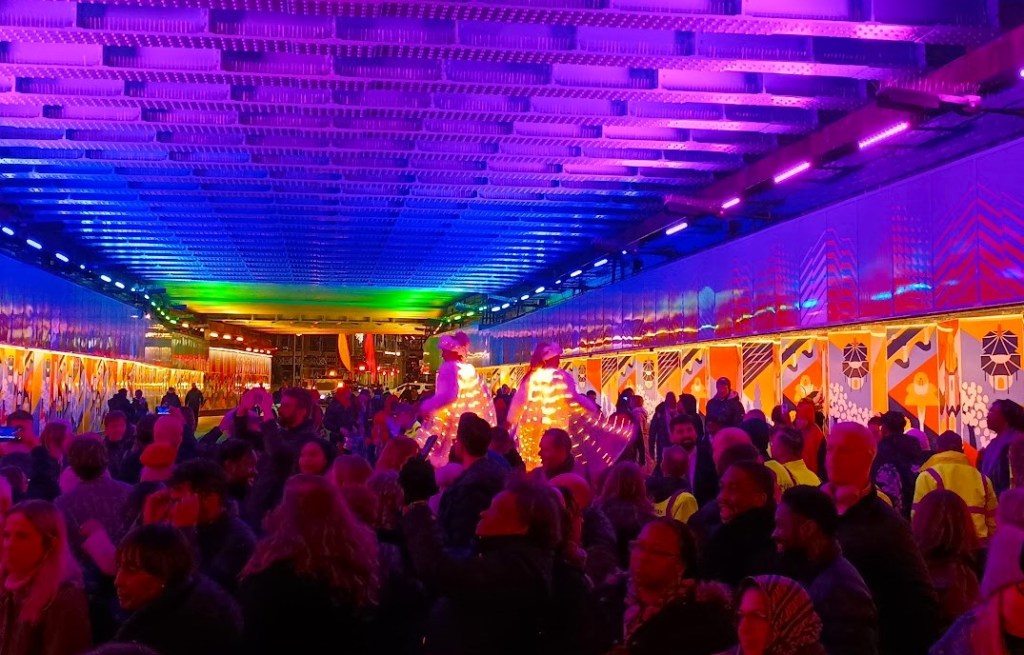
The design team at GPAD and POoR Collective was at the launch, to see the way people were reacting to the bridge – as it’s much more real now that it’s built. The bridge, and the lighting, were clearly making an immediate impression on passers by who hadn’t expected to see anything going on on a slightly rainy Monday evening.
So was the team from FM Conway who had done the construction and installation – and who many of us will have seen on site for several months – were also present. It has been quite a complicated project to deliver – with a live railway and road, pedestrians day and night, and the need to keep closures of the road and lanes to a minimum, while also dealing with an old and rather unpredictable underlying structure. It’s not every day that a project gets such a big launch, and they were pleased to see a job well done, and getting so much public attention!
The five hundred wall panels are made of vitreous enamel – maybe better known for its role in sauce pans that last forever, and which is an exceptionally durable surface finish that withstands all the elements, the team at A.J. Wells who made the panels had made the journey to see this in action. They’re well known as the maker of TfL’s signs on the tube, they were pleased to see the way this had made such a local impact – while the project wasn’t technically unusual for someone used to making robust products for complicated sites, there have only been a few cases of enamel being used at such scale under bridges, and Falcon Bridge was already leading to interest elsewhere.
We also spoke to Sam Emmett, who has managed the overall project – and who was able to answer many of the questions we’ve had from readers over the last few months! It was clear this has been a complex project but also a particularly rewarding one, especially as the changes to the bridge have become much more visible in recent weeks. Sam noted that right from the start the design has had to work closely with Network Rail – who own the bridge, and who also need access to the signal cables and structure on an ongoing basis. While that is never a straightforward thing to do, the team were clearly appreciative of Network Rail’s efforts to help the project progress.
What about the pigeons, who used to be the only ones to love the bridge, and who seemed to lurk on the girders in huge numbers? The cable ducts that run above both pavements had notoriously become home to thousands of nesting pigeons over the years; and the project team worked with a wildlife group to re-house them elsewhere, and keep a check on their health in doing so – so that the original perches could be given a deep clean, and then pigeon proofed with grills and deterrent spikes. There will still be occasional pigeons there for three or four months (as they are used to it as a location) – but thanks to thousands of spikes and surface treatments the bridge is now much less attractive, and they are moving elsewhere.
Graffiti is another concern, and featured heavily in the design thought. The secret weapon here is the enamel material used for all of the wall panels. It’s super tough – way more resilient than any paint cold ever be – and is about as graffiti-resistant as it gets. Sam confirmed that there has already been a tag (a green one about a foot wide) and it just wiped off without needing any chemicals or equipment at all.
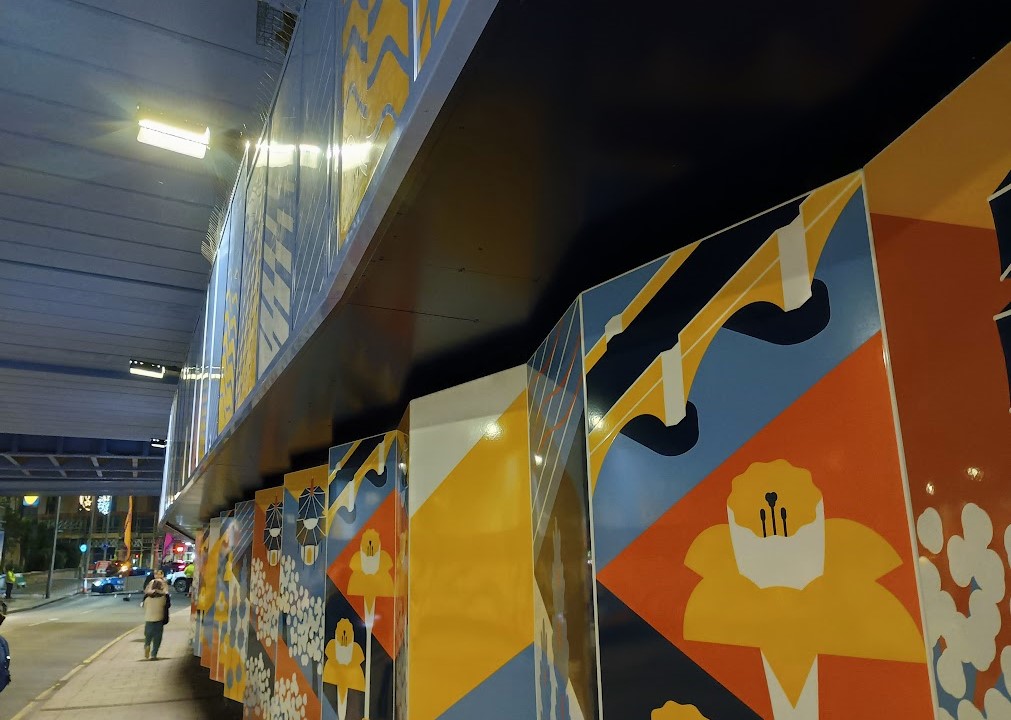
Handling water and drips was always going to be a particular challenge – with leaks from the tracks above, and the walls also being an especially wet part of the bridge. You can’t realistically treat the original bridge walls to waterproof them: the arches and soil behind them is saturated, they have leaked pretty much from the day they were built, and short of rebuilding the bridge it’s pretty much inevitable that water will continue to seep out.
The solution has been to install the panels in a way that is offset from the wall, with a gap behind where the walls can keep leaking water as they always have – which then flows to ground level and in to drains. The cable ducts above the pavement were a little more complex – and the approach there has been to install a drip tray at the base of the ducts – that’s the dark blue bit in our photo above – which channels water over and behind the panels, instead of it dripping on to the pavement (and the effect is quite noticeable – suddenly the walkway is dry!).
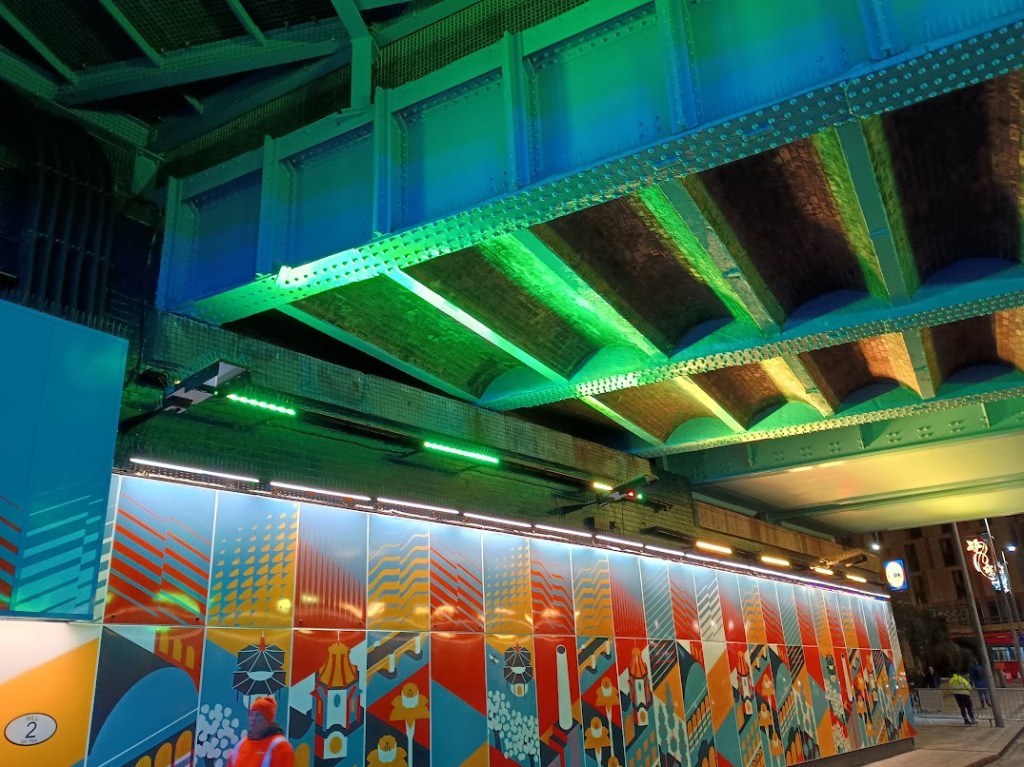
Behind the scenes, there are a fair few different kinds of bridge here – a lot of Victorian girder bridges, some more modern concrete beams of the sort you’ll see on motorways round the country, some grid areas where there are short spaces between bridges, and a section of brick arch shown in our photo above. The latter was especially awkward from a ‘drips on to the pavement’ perspective, so the section of brick arch right above the walkway was treated with a waterproofing system, to keep the most important sections dry.

Asked what he was most proud of about the project, Sam said it was the way everyone involved had pulled together to deliver it. It had been very busy – half a road, eight mobile platforms, three subcontractors, over forty people on the case, electrical work, landscaping, waterproofing, all in a small and constrained area that had to be kept open and accessible pretty much throughout. The teams had made it all come together. And the night before, as they had done a quiet test of the lighting to prepare for the big switch on, it was really good to see people saying “oh wow!” as they walked through.
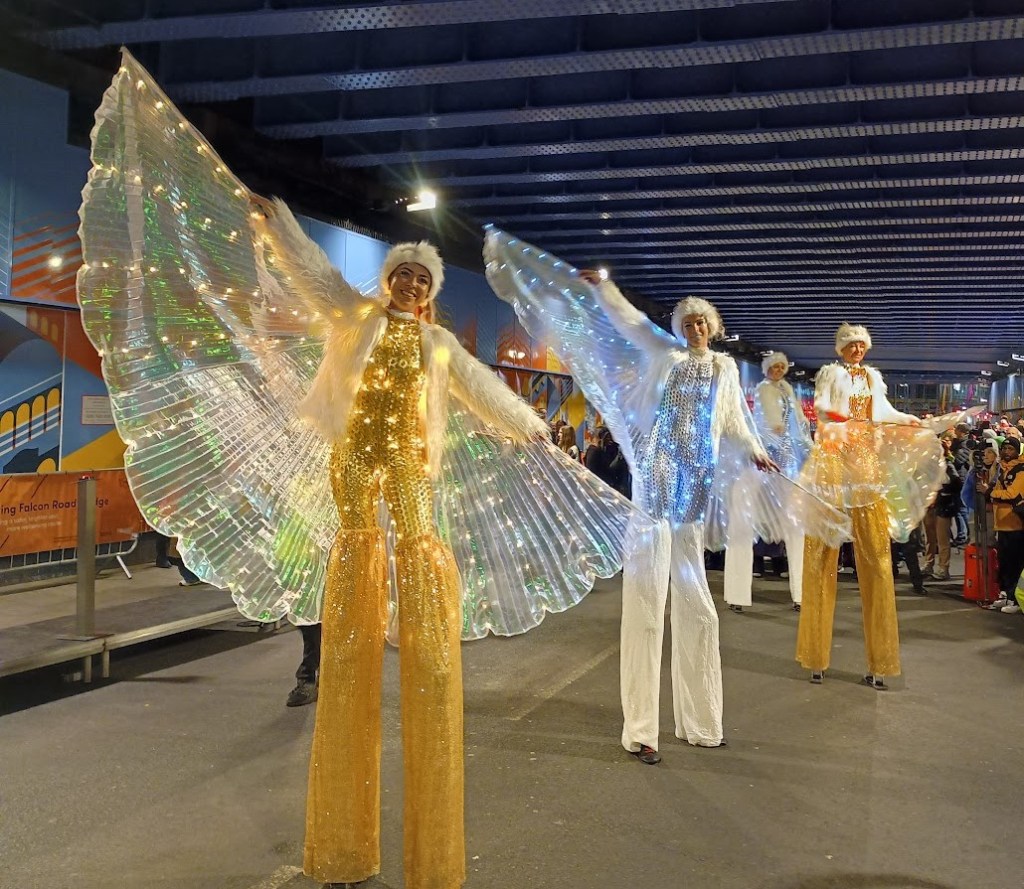
And we’d agree with that reaction. It’s fair to say that historically the area immediately north of the railway has been a bit neglected – and that the deteriorating state of Falcon Bridge had become an only-too-obvious sign of that neglect. The relaunched bridge is the sort of practical improvement that improves everyone’s experience of our town centre, and helps re-join the communities on the two sides. Wandsworth have done something good here, taking one of the worst features of Clapham Junction, and delivering a proper transformation.
Lavender-hill.uk is a community site covering retail, planning and development and local business issues, and sometimes posts like this one on transport and the environment – all centered on the Lavender Hill area in Battersea. We sometimes also post more detailed articles on local history. We first wrote about Falcon bridge on sister site Clapham Junction Insider way back in 2019 – What can we do about Falcon Road’s horrible railway bridge? – and reported on the works in progress back in September. If you found this interesting feel free to sign up to receive new posts by email (for free, unsubscribe anytime).
 Lavender-Hill.uk : Supporting Lavender Hill
Well done, Wandsworth! This is truly transformational!
LikeLike
Pingback: In pictures: Falcon Road bridge’s transformation – Clapham Junction Insider – Local Democracy Reporting