
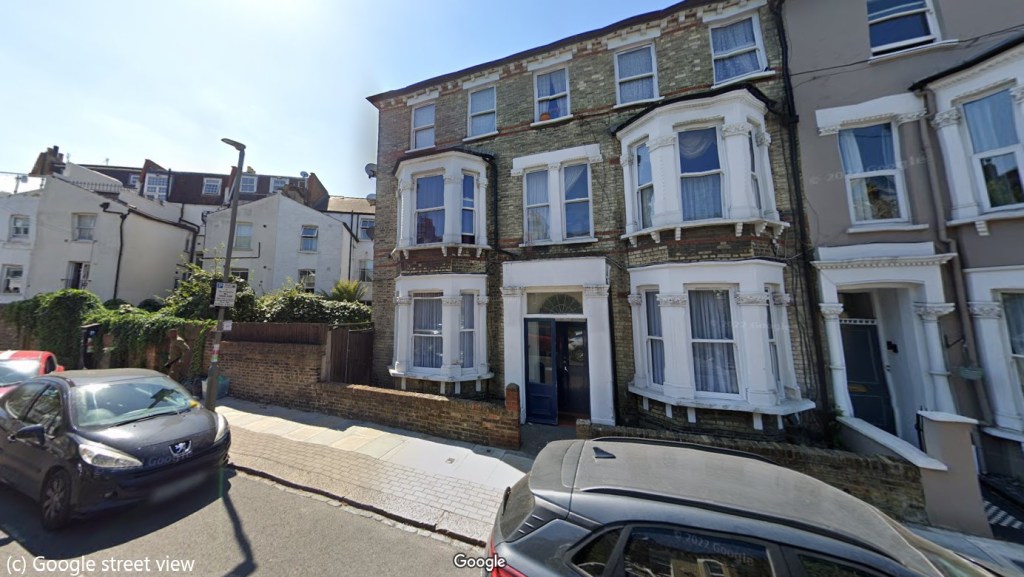
84 Lavender Sweep doesn’t exactly stand out from the crowd. A terrace like the others, just off Battersea Rise, the only thing that’s a little different at first glance is the rather elegant arched window above the inner front door, that looks like a throwback to a much older generation of houses. And that’s exactly what it is – because it was rescued and recycled from the previous house on the site, pictured below (the windows’s admittedly a bit buried by ivy in that photo, but it was also above the front door).
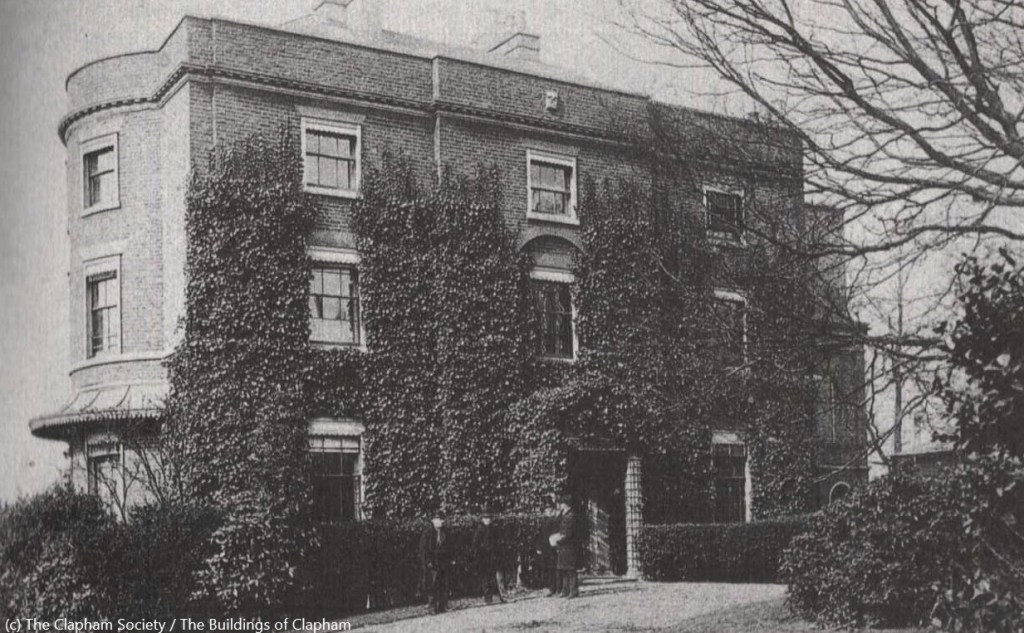
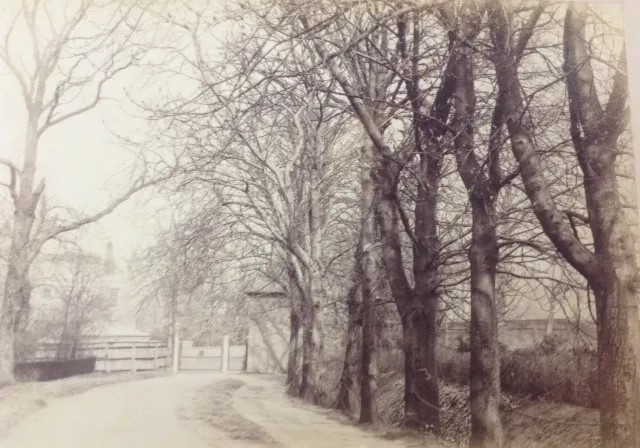
The original Lavender Sweep House was part of the first generation of development in the area, which saw it change from open fields to a landscape dominated by big villas. There may be close to 100 terraced houses there now, but in the mid-1800s there were just four much bigger ones, and this was the grandest of them all. The photo below shows Lavender Sweep as a leafy carriageway, a very different place to what we see now, but whose curve is already visible – and it’s that curve which led to it being called the Sweep (one of very few sweeps in London) . The Sweep was described by a visitor at the time as having ‘horse-chestnut blossoms strewing the drive, and making it look like a tessellated pavement’.
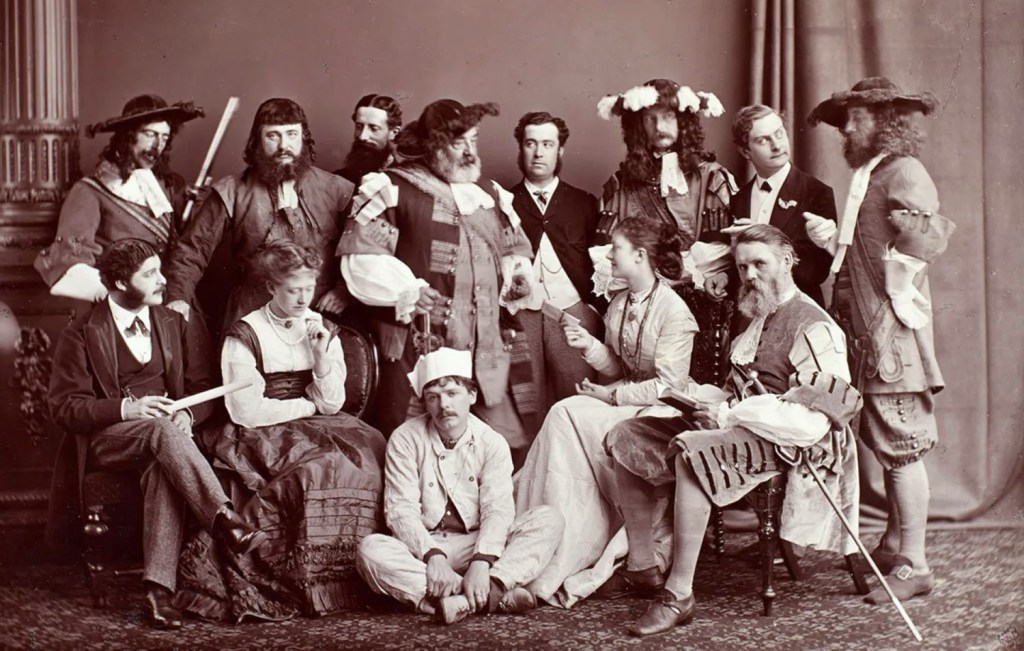
Between 1817 and 1880, the big house was home to Tom Taylor – who was a man of many telents, including playwright, art critic, civil servant, poet, artist, Professor of English literature at University College London. Tom was also the editor of Punch magazine, and wrote Our American Cousin – the play Abraham Lincoln was watching when he was assassinated! He was an amateur actor who co-founded the Old Stagers – the longest running amateur theatre group in the world (who are still up and running today – they’re now based in Canterbury). In this photo of the Stagers, Tom’s the one sat on the right with a wooden sword. As if all that wasn’t enough to keep him busy, he was also a notable supporter of the early campaign to save Wandsworth Common when it looked set to be overrun with new building projects.
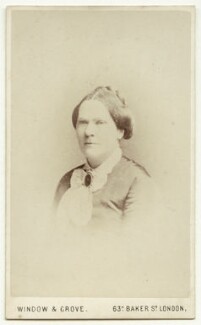
Tom wasn’t the only notable resident, as Lavender Sweep House was also home to his wife Laura Barker. She was already established as a musician and composer by the time she met and married Tom and they came to live in Lavender Sweep. First introduced to violin and piano by her parents, Laura had studied with the composer and pianist Philip Cipriani Potter, and got to know many more musicians as a teenager thanks to her parents’ keen interest – her dad took the whole family to concerts in surprisingly wide mix of places including Leeds, Hull and Norwich, and as a bit of a superfan ahead of his time, got to know many of the musicians at a personal level.
Laura started publishing compositions, which were received enthusiastically by the public and the press; and became a widely respected composer. Many of her works are based on texts by the writer Alfred Tennyson – who in addition to being Poet Laureate, bought 27 houses on the Queenstown Road in Battersea, which coincidentally seem to have included the one that we posted about earlier this week! Laura had inherited a Stradivarius violin (which somehow became known as The Tom Taylor Strad even though she had acquired before she ever met him). She also taught music at the York School for the Blind.
Laura and Tom held regular Sunday music concerts and were clearly noted for their hospitality, and Lavender Sweep House became quite a well known place, described at the time as a ‘house of call for everyone of note’, from politicians, including Mazzini, to artists and actors, all presided over by Taylor himself dressed in ‘black-silk knee-breeches and velvet cutaway coat’. It was visited by a good range of well-known Victorians including Charles Dickens, Lord Tennyson the Poet Laureate, actress Ellen Terry, pianist and composer Clara Schumann, Jeanie Nassau Senior who was the first woman to be appointed as a civil servant (and who was a local living just down the road – who we’ve previously written about) – and author Lewis Carroll who photographed the house. The house was Taylor added a large study ‘to his own design’. A visitor in the 1870s found every wall in the house, even in the bathrooms, covered with pictures; a pet owl perched on a bust of Minerva; and a dining room ‘where Lambeth Faience and Venetian glass abound’
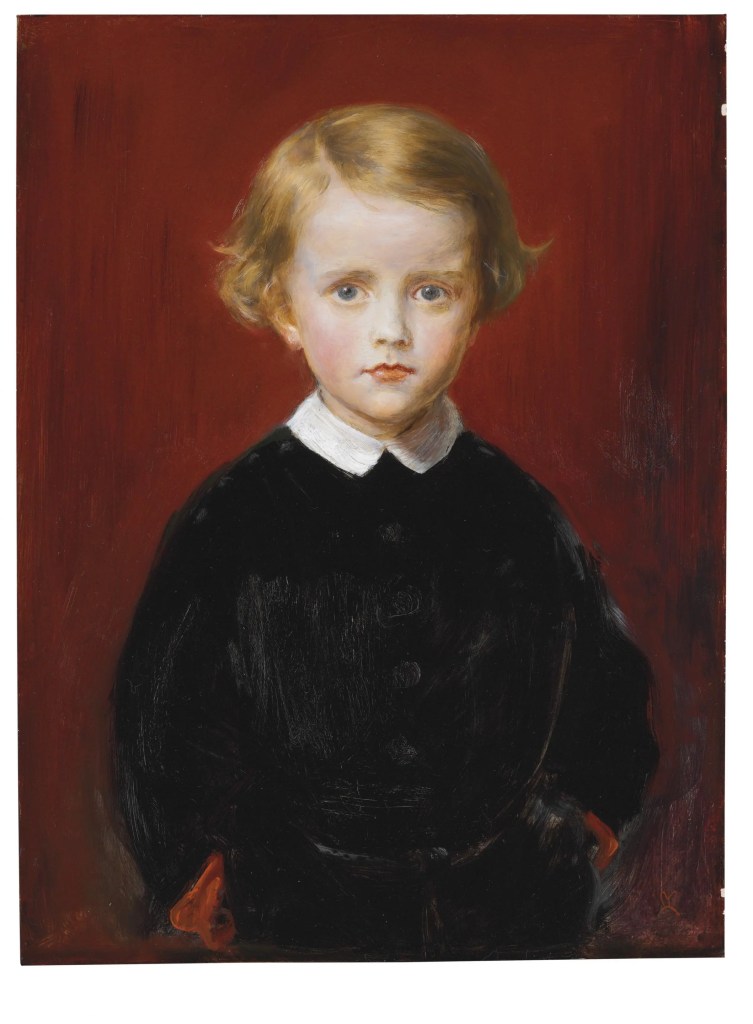
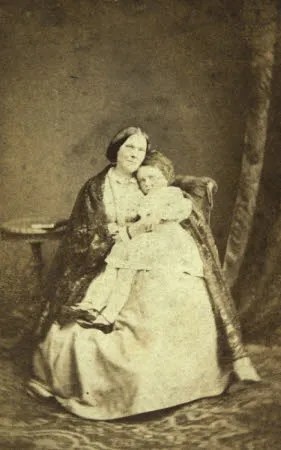
The painting to the right is of Tom and Laura’s son Wycliffe, painted by Millais when he was five. Tom had been was an early champion of Millais’s work, and Wycliffe’s portrait was apparently painted in fulfilment of a promise that Millais made to Taylor before John Wycliffe Taylor was born – that if Tom ever had a son, Millais would paint him in return for Taylor’s ‘many an act of friendly kindness’. The photo of Laura and Wycliffe below was taken by Alice in Wonderland author Lewis Carroll (who we also have to thank for most of the surviving photos of Tom and Laura’s house). Maybe being painted by an artist became a source of inspiration, as Wycliff went on to become an artist himself.
Tom died in 1880, with Laura living to 1905 – publishing several further compositions, including the “Songs of Youth”, which were published in 1884 by Stanley Lucas, Weber & Co. in London. In the “Musical Times,” a reviewer wrote, “This volume of songs is a welcome contribution to the high-class vocal music of the day. With the exception of The Owls, ‘the words of which are by the composer, the poetry is not selected from the works of any living author; but all the subjects are well-chosen and admirably adapted for musical setting. ‘Mariana’s Song,’ from Shakespeare’s’ Measure for Measure, ‘and the Dirge,’ Yes, thou may’st sigh, ‘from Scott’s, Fair Maid of Perth,’ are excellent compositions; but this song with songs is a welcome contribution to today’s world-class vocal music.’. She was also a talented artist, with several paintings surviving.
Of course, it wasn’t to last – as we’ve covered in other articles like our detailed history of Rush Hill Road, the rural landscape of country houses around Lavender Hill saw huge changes in the late 1800s, with the destruction of almost everything as the railways arrived and brought with them an explosion of factories, terraced houses, and dense city streets. Laura and Tom would be Lavender Sweep House’s final owners. In her later years Laura moved to Porch House in Coleshill, Berkshire with her daughter Lucy and two servants, both of whom had worked for the family in London. A few years later, when Tom’s friend the actor John Coleman went to look for the house, he found that ‘not a stone remains … and the demon jerry-builder reigns triumphant’. A very different Lavender Sweep was under construction.
But it’s worth remembering that there was a different world before what we have now, and that it was inhabited by pioneering and interesting people. The Battersea Society have for some years been working to recognise the history of many of our buildings (and former buildings where nothing’s left except memories and a single window), and this Saturday a Battersea Society blue plaque will be unveiled to them both, outside 84 Lavender Sweep. The plaque will be unveiled by Lord Fred Ponsonby and actor Alun Armstrong, alongside Mayor of Wandsworth Sana Jafri, and the CEO of Wandle Housing Association (who now own the property). A descendant of Laura Barker will play her music. Everyone’s welcome – do join the unveiling if you can.
This latest plaque owes a lot to Jeanne Rathbone, who has been a driving force behind telling the story of the many inspiring people – and especially the often somewhat overlooked women – who have made their lives and careers in Battersea. Jeanne is also a woman of many talents, among them local historian, comedian, one time Council Women’s Officer, former alcohol counsellor, humanist celebrant, and author of Inspiring Women of Battersea (available to buy for under £10 here – it’s well worth a read!). She has published far more detailed accounts than we cover here of the lives of both Laura and Tom, and run several Notable Women of Lavender Hill walks.
All welcome at the unveiling of the Battersea Society plaque marking the site of Lavender Sweep House, home to playwright Tom Taylor (1817-1880) and composer Laura Barker (1819-1905). Saturday 28th September 2024, 2pm, Outside 84 Lavender Sweep, SW11 1EA. Full details are on the Battersea Society’s website here. If this was of interest you may want to see our previous article on the inspiring women of Battersea. Our occasional (but sometimes detailed) local history articles are here.
 Lavender-Hill.uk : Supporting Lavender Hill
Pingback: Factory developers, social reformers, fearless pilots, celebrated artists, tenacious campaigners and ‘dangerous subversives’: the pioneering women of Battersea’s early days. | Lavender-Hill.uk : Supporting Lavender Hill
Pingback: Laura Barker 1819-1905 composer | Jeanne Rathbone
Pingback: Local historian spotlights pioneering women of Lavender Hill in Battersea walk – Clapham Junction Insider – Local Democracy Reporting
Pingback: Shapurji Saklavata, Battersea’s controversial one-of-a-kind MP in the 1920s, will be recognised with a plaque this Friday | Lavender-Hill.uk : Supporting Lavender Hill
Pingback: A pair of green plaques are being unveiled this week, in Nine Elms & Lavender Hill | Lavender-Hill.uk : Supporting Lavender Hill