
Lavender Hill was the birthplace of pizza takeaway chain Firezza. It was founded in 2001 by Adnan Medjedovic and Edin Basic, both Bosnian war refugees who had fled the conflict in 1992, and who spent the following years in a variety of catering sector jobs round London. Firezza was inspired by the tradition of pizza sold by the metre in Naples; the idea was that each quarter had different toppings. They hired a couple of pizza chefs, bought a pizza oven, and rented a shop at the cheaper end of Lavender Hill, calling on friends including an architect, builder and graphic designer who helped develop the site and create a brand. A key early feature was Firezza’s extra long pizza boxes, designed to accommodate a double length pizza for people who collected in person. Their idea was an instant success, and Edin went on to open a second branch in Wandsworth, and then bring in venture capital funding and grow Firezza to a 22-strong chain. It was a popular business, with good quality ingredients and a proper Neapolitan theme that made it rather different to many of its rivals. Much was made of the Buffalo mozzarella being flown from Italy every week (the most popular toppings were Bufalina and Capricciosa), while and the dough for the bases was made fresh in the restaurants every day.
Adnan and Edin sold the chain in 2016, to Hony, the owners of Pizza Express, for about £5m (Edin went on to run the Red Lion pub in Ealing for five years). The company planned to use the acquisition to super-charge their entry into the pizza delivery market. The new owners quickly opened six more sites, including (in 2017) a sit-in branch on Dean Street in Soho that included a Marana Forni rotating pizza oven capable of producing more than 250 pizzas an hour. The sit-in venue was well-reviewed by TimeOut (‘Firezza’s remit is pizza all the way, and it rolls with the best of ’em‘), but the small original Battersea venture kept going strong with a loyal following, doing an impressive level of turnover.
Overall though the Pizza Express takeover didn’t really go to plan – and they exited the business in November 2017 after less than two years, nursing a loss of more than £11m. The chain went through further changes that saw it lose an employment tribunal where claims had been made of claims of unlawful deductions from wages and unpaid holiday pay, and seemingly narrowly stave off collapse at one stage with many of the remaining branches closing on 2023. Towards the end the happy days of Adnan and Edin’s tenure were long gone, quality dipped and it became clear that corners were being cut; the rival unit right next door meanwhile was going from strength to strength (and attracting Italians from far and wide) as top local pizzeria Pizza Pellone.
Firezza’s original Battersea branch finally succumbed to the inevitable and closed in January 2024 when the landlord reclaimed the premises following non payment of the rent (though the chain lives on in a much reduced form: three other branches of Firezza survived and are still trading under new ownership in Canary Wharf, Dulwich and Streatham, and are well reviewed).
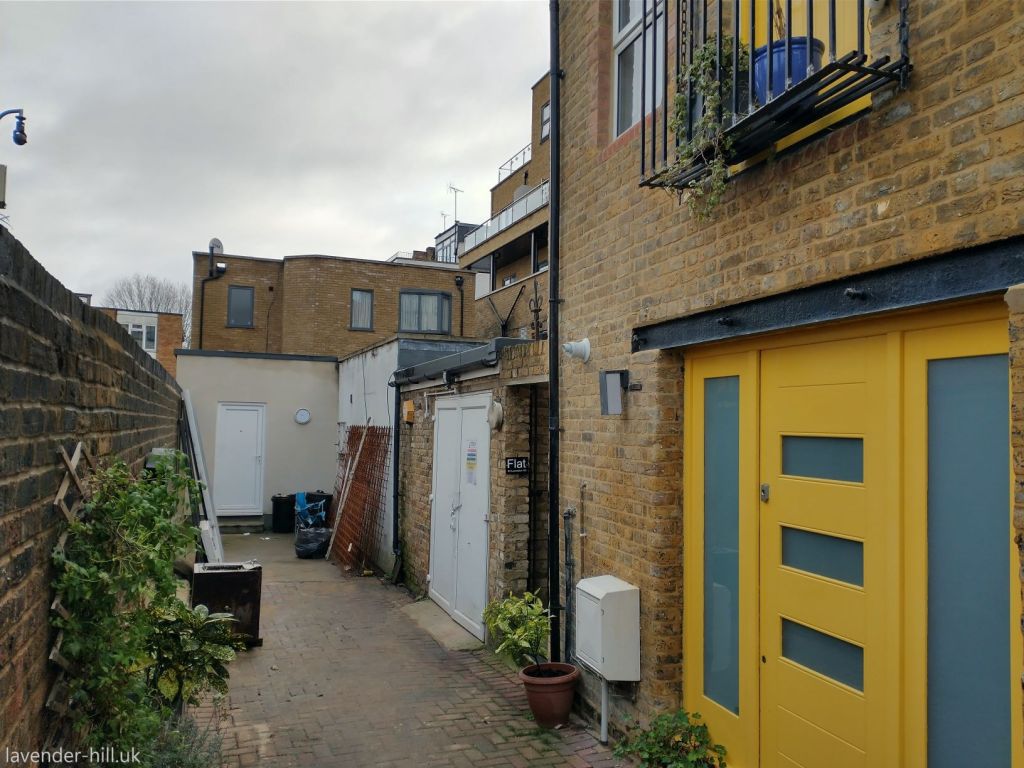
This left 175 Lavender Hill looking for a new tenant. It’s an awkward and somewhat tired-looking building – but it’s also one with a lot of potential. The whole of the Firezza operation was on the ground floor, but there were extensive basement areas that were more or less abandoned, including vaults extending under the front window, and a bit of a maze of storage rooms. The steep slopes along this bit of Lavender Hill (which is the very southern edge of the old Thames estuary) means the ground at the back of the property is a whole floor lower than the street frontage – opening in to the alleyway pictured above, which links to Ashley Crescent. There was also a small building built in the back yard that was mainly used for storage, and two floors of flats upstairs accessed from the back of the building.
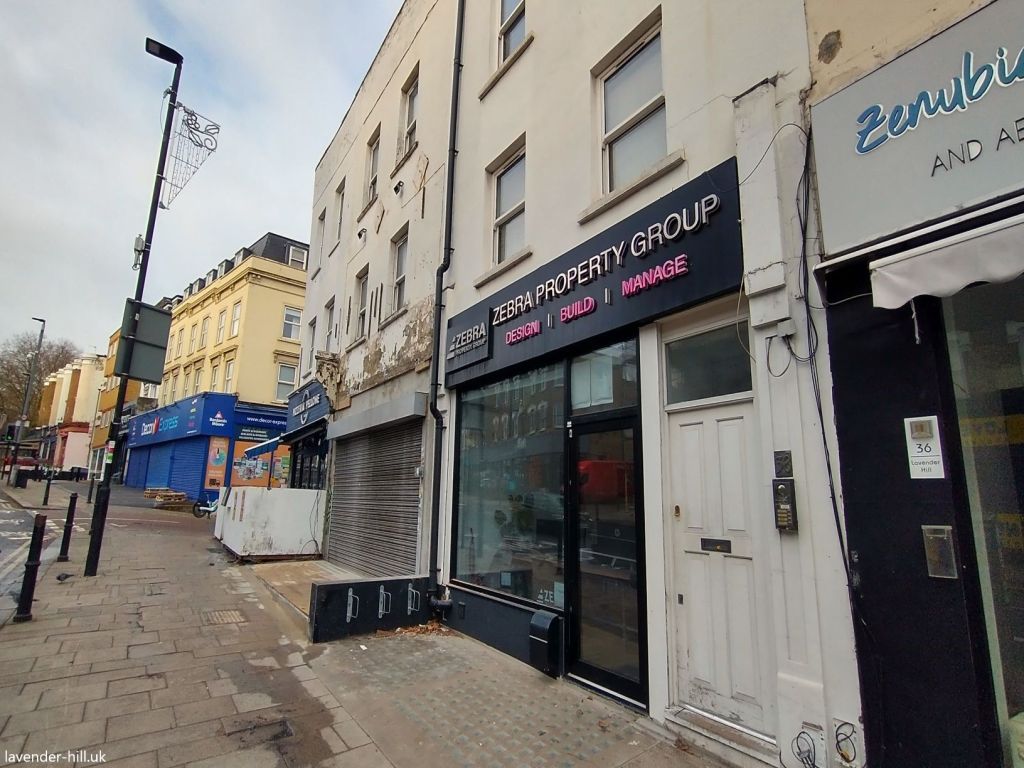
There’s now planning in to make a more logical use of the building. It’s not a controversial proposal, but we’re covering it as an example of the way these buildings along Lavender Hill are evolving, and the often ingenious ways every scrap of space is being used. The first thing that has been done is splitting off the retail premises from the lower level, making a somewhat smaller unit focussed only on the Lavender-Hill-Ground-floor level, but one that should still (just about – storage for chilled foods will be rather tight) be big enough to be capable of running as a pizza takeaway. A small store areas will be created at the back, with the rear entrance out to the passageway kept in use. The premises, pictured below, is currently to let with Graham & Sibbald estate agents for around £29,000pa.

The second part of the plans sees a new two-storey structure built at the back, which will create a two-bedroom flat. The new building will be connected to the back of the main terrace, with one room in the basement level of the main building. The challenge with this layout is in getting enough windows that give light but also a degree of privacy, and in creating an outdoor space for the flat.
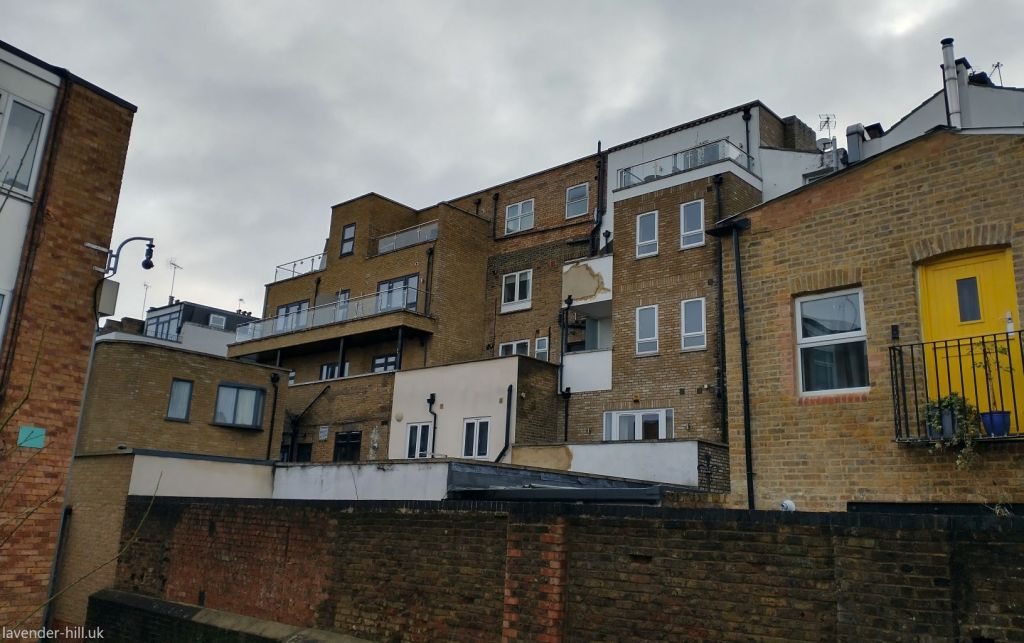
A small courtyard will be created between the back of the existing building and the extension, as shown in a extract of the proposed development plan for the basement level below (where we have shaded the area dedicated to the flat in pale blue), with a corridor running along the side to connect to the room in the basement. This is quite a common approach with small overlooked sites like this one, and it means the downstairs rooms can all get decent sized windows facing out on to a private area. These aren’t straightforward developments to make work – the typically poorly documented mix of access rights to the back passageways, things like rubbish storage and collection, and making extraction systems from the commercial units that are compatible with flats, can be complicated.
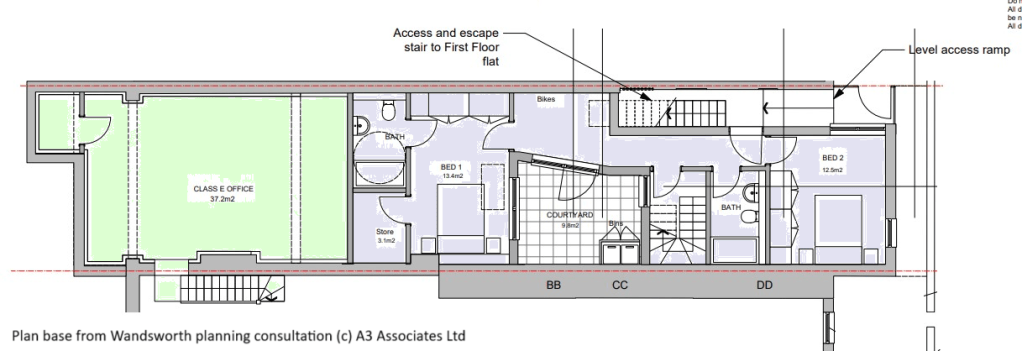
From an architectural perspective working with a whole load of differently designed extensions along the back of these terraces, all trying to get some combination of light and outdoor space, while not overlooking each other too much also takes some doing – but it can be done when there’s enough money to be made from the resulting flats, which is why most of the buildings along Lavender Hill do now have some form of development in these back courtyard areas.
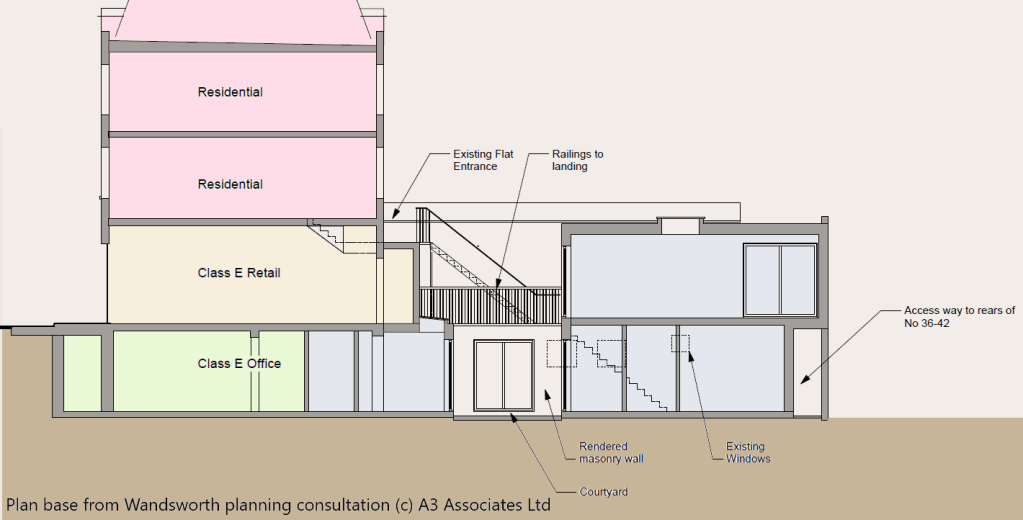
The third part of the 175 Lavender Hill development looks to use the basement of the building on the Lavender Hill side, the bit shaded in green above. This isn’t an easy space to use as it’s underground, with vaults extending under the front forecourt – and it was until recently a rather dark and useless space. Some of the other properties have dug out deep lightwells to make profitable use of these bits of the buildings (an example is 64-66 Lavender Hill, where grills on the street side give access to a lower lightwell), while others have made the room share part of the shop front window (like at E Street Barbers on 26 Lavender Hill, where a small cutout in the shop window leads to the room downstairs, which is connected to a basement flat). Here, another approach has been taken, of installing a series of glass pavement lights in the front forecourt, to allow light to the basement vaults – pictured below.
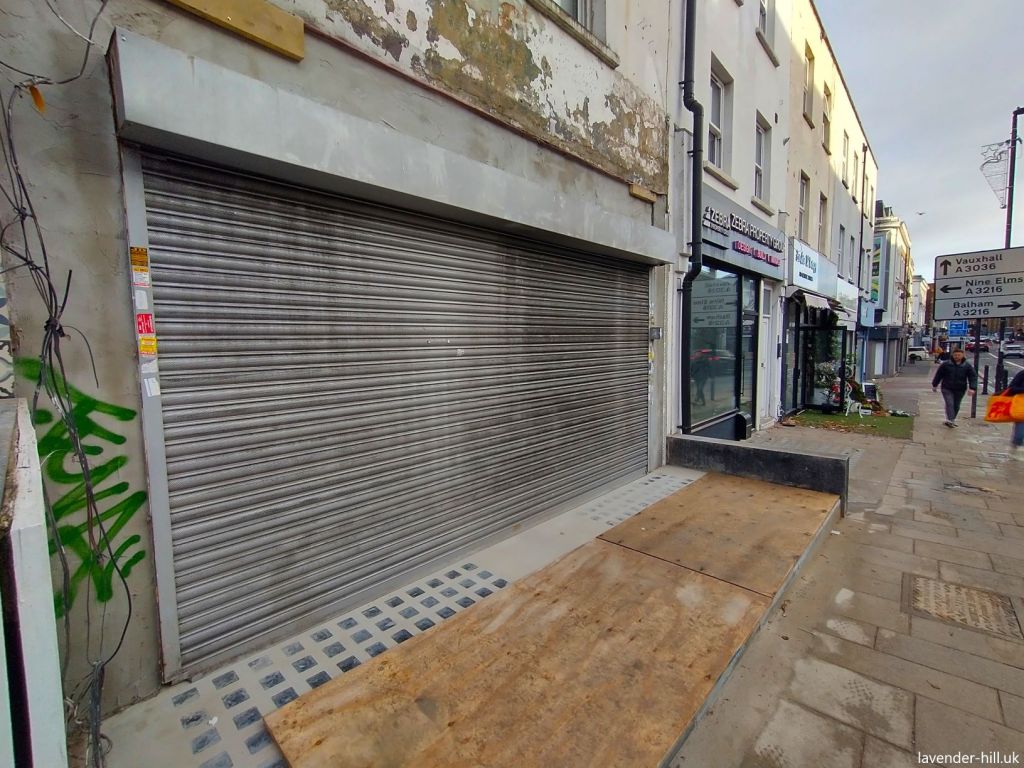
Somewhat unusually, the newly-improved basement with its new pavement light bricks doesn’t have its own entrance, or a staircase to the unit above. Instead it has been leased separately to the shop on the ground floor – and it’s instead being fitted out as an office space and connected, by a new doorway, to the basement level office space at No 38 next door – the one in the right in our photo below. This gives lots more space to neighbouring business the Zebra Property Group, who currently have a small two-storey office that was created when the rest of that property was converted a good few years ago from a large and rather derelict sauna (Star Steam) to flats. Zebra is a developer specialising in high-end extensions and property improvements – so are, of course, someone more than capable of managing a clever extension to their own premises.
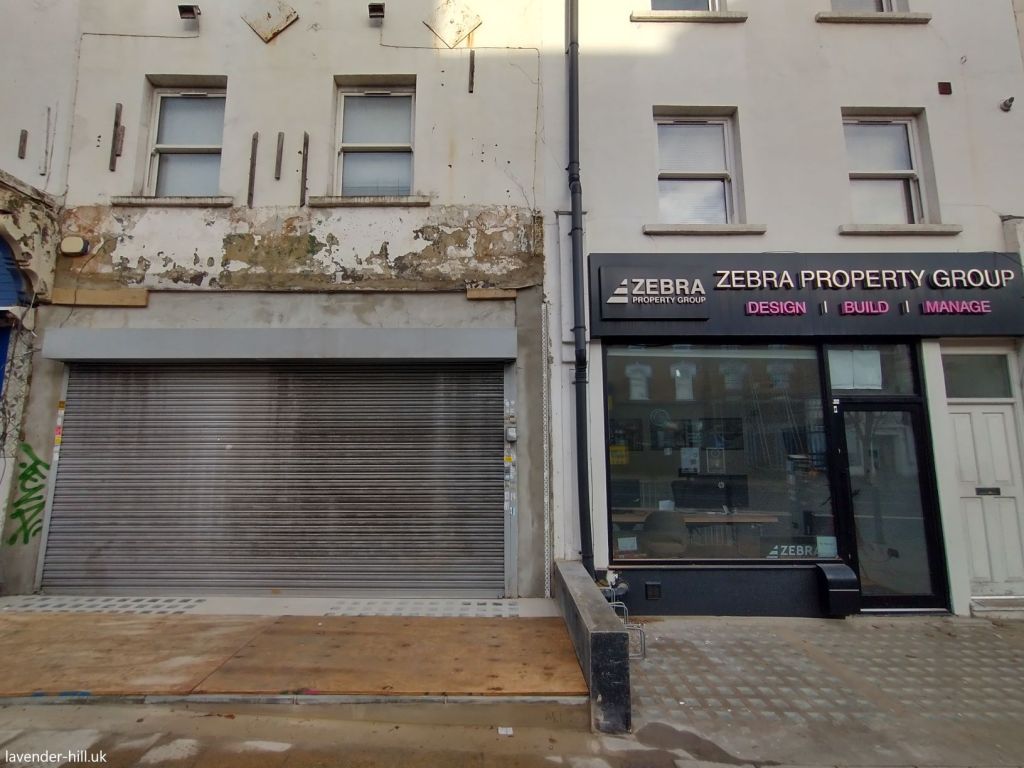
This is an interesting proposal in that it shows the often complicated way many of these Victorian commercial buildings are laid out, and the way they are evolving – in this case to create three different property types at once (retail / catering, residential, and office) with three different access routes. This is also one of the ways London is slowly accommodating its growth – far away from the glamorous big high-rise developments of Battersea and Nine Elms, much of the city’s growth is being accommodated thanks to thousands of small projects like this that pass largely unnoticed, where developers turn under-used spaces in to new flats. As long as these developments make accommodation that’s of decent quality (which seems to be the case here), and keep the street-facing ground floor units in commercial use (to avoid creating awkward gaps between the retail units, with badly designed flats facing right on to the pavement), these seem a sensible approach.
For further details of the plans for the flat, see planning application 2024/3783 on the Wandsworth Planning website, where some of the finer details are out for neighbour comments. If you found this of interest, you may want to see our wider articles on local environment, planning and housing issues. To receive updates on new posts on lavender-hill.uk by email, sign up here.
 Lavender-Hill.uk : Supporting Lavender Hill
Is this proposed at 38 LH rather than 175?
LikeLike