
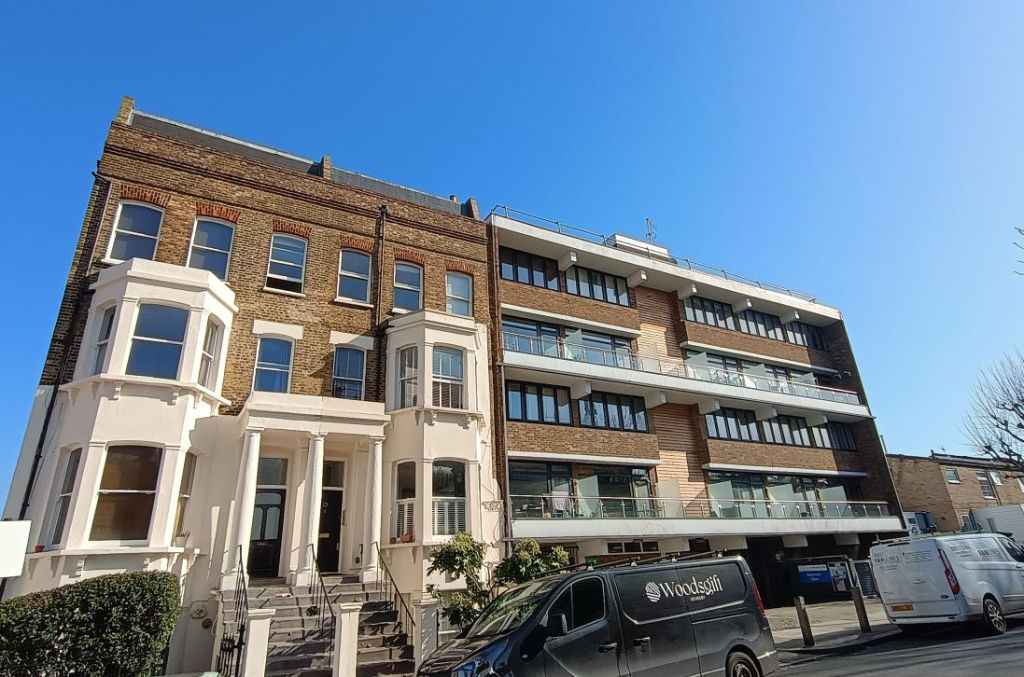
Antrim House is a block of ten flats on Stormont Road, built in 1962. The flats all have two storeys and a balcony, and make good use of space, and they’re popular; apart from a mini makeover a decade or so ago that saw new windows, balconies and cladding, and new paving to the front courtyard area, it’s the sort of building that quietly does what it was designed for and doesn’t get much attention. There’s also a health centre on the ground floor, that was built some years before the flats, in quite an innovative architectural style with internal courtyards and skylights to get natural light and create warm, calm surroundings (Layers of London has published an early photo of the medical centre, with the Battersea Business Centre in the background, it looks much the same now). It works as an outpost of St George’s hospital in Tooting that provides more local services.
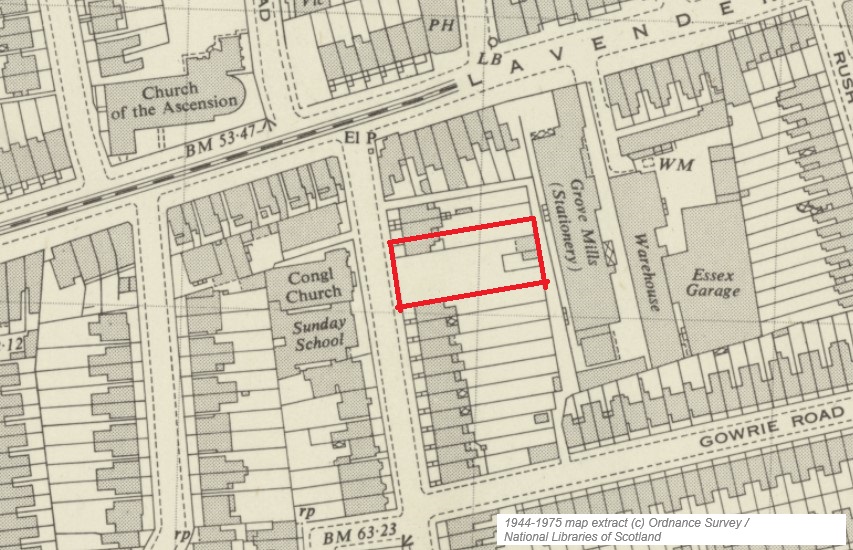
The whole flats-and-health-centre complex was carefully designed by the London County Council (whose architects really liked two-storey flats) to fill a small gap in a row of big terraced houses that ran all the way along to the junction with Gowrie Road. The three-house-wide gap – outlined in the post war Ordnance Survey map above (we presume the surviving house within that outline was also for some reason deemed worthy of demolition) – was the result of a Word War II bomb, that damaged some of the houses beyond repair. While it was of a very different architectural style to its Victorian surroundings, Antrim House initially filled the gap remarkably neatly, by being perfectly aligned and exactly the same height as the terrace on either side.
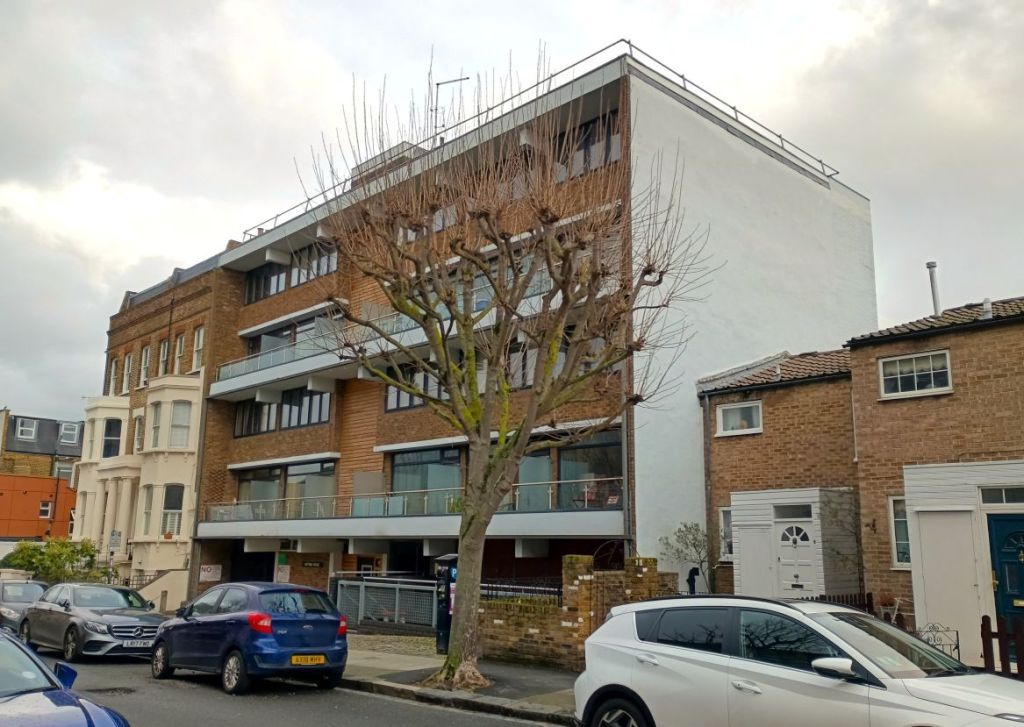
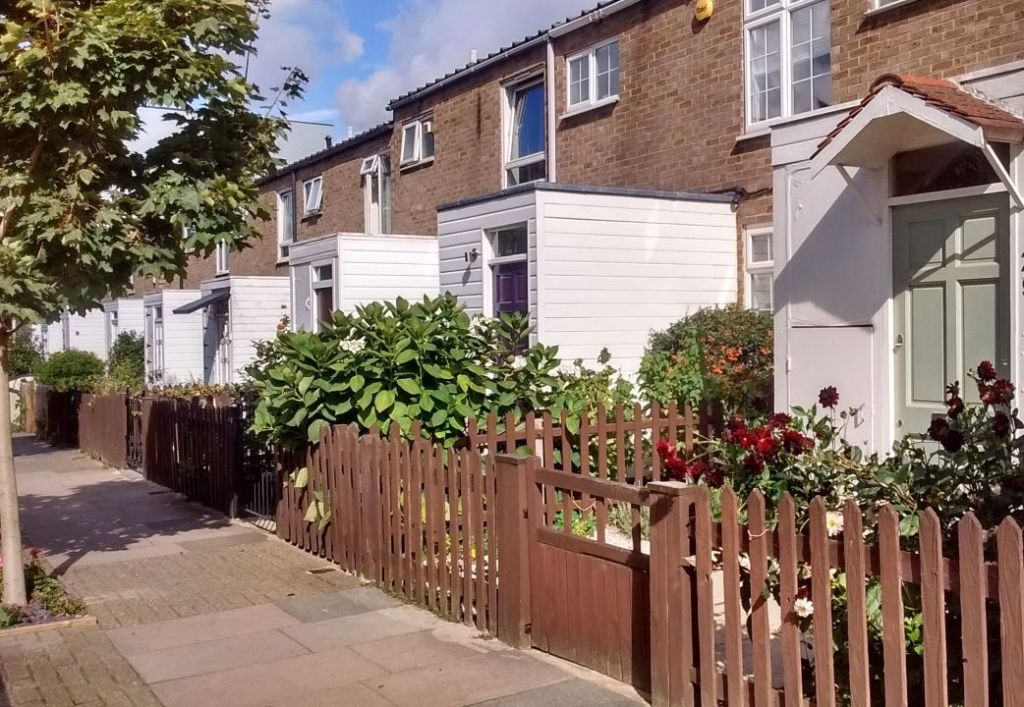
Unfortunately someone in Wandsworth didn’t quite get the memo about what the London County Council was doing here to patch up the original streetscape, as just 8 years after Antrim House was built, Wandsworth Council demolished all the big Victorian terraces on the right hand side, and replaced them with a low-rise estate in a completely different style. The Stormont Road Estate, a dozen terraced houses and a small block of 12 flats, is much lower-rise and the first house is also set back from the street line – rather undermining the architects’ intent of stitching the bomb-damages street pattern back together! If you look closely at the big white wall on the side of Antrim House, there’s a rendered part that was where the Victorian houses were attached to it, and then a small brick bit nearer the back where Antrim House stretched a few feet further back than the terrace houses.
The demolished Victorian buildings – of four storey houses with big entrances – had been some of the biggest and most impressive houses around, if they’d survived another ten or so years they would have been looked after and treasured, rather than something old fashioned to be got rid of as soon as possible. One day we’ll write a more detailed article about it, but for now the houses are just visible in this archive photo!
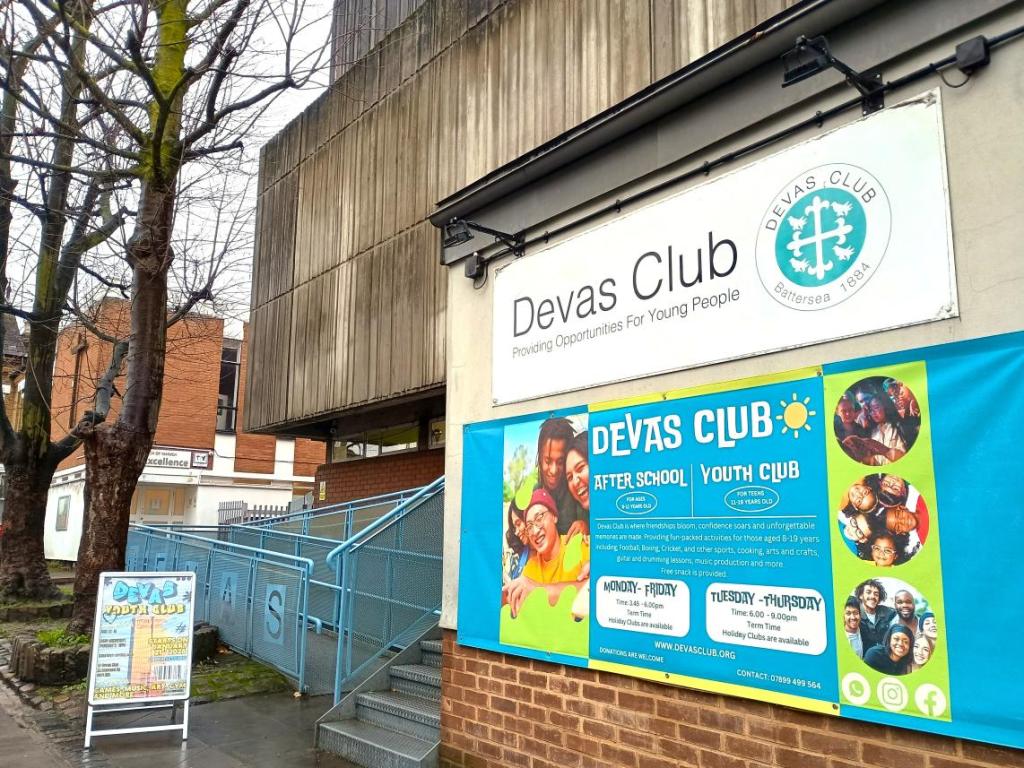
Its neighbour on the opposite side of the road, the Devas Club, is a bit more of a stand out, being a huge block of reinforced concrete! The club is older than it looks, having been founded in 1884 (about the same time as Stormont Road was built) as ‘University College House’ – with the aim of providing poor young men with job skills. Its young founder Jocelyn Devas died a year and a half after founding the club in a climbing accident on the Matterhorn, and his dad offered a sizeable donation to his friends to carry on their work in Battersea.
Until the 1970s the club was based in a Victorian style building on Thessaly Road in Nine Elms – but it found itself in the way of the huge redevelopment of the area to create new Covent Garden Market. A deal was done that saw the club moved to Stormont Road, in a distinctly 1970s building that’s rather similar to the 1970s version of new Covent Garden Market. It has seen a few changes over the years, with a ground floor makeover, and many smaller internal changes as it has adapted and developed to provide modern training and recreation facilities – but it has stayed true to its original mission and will probably be the subject of a future article.
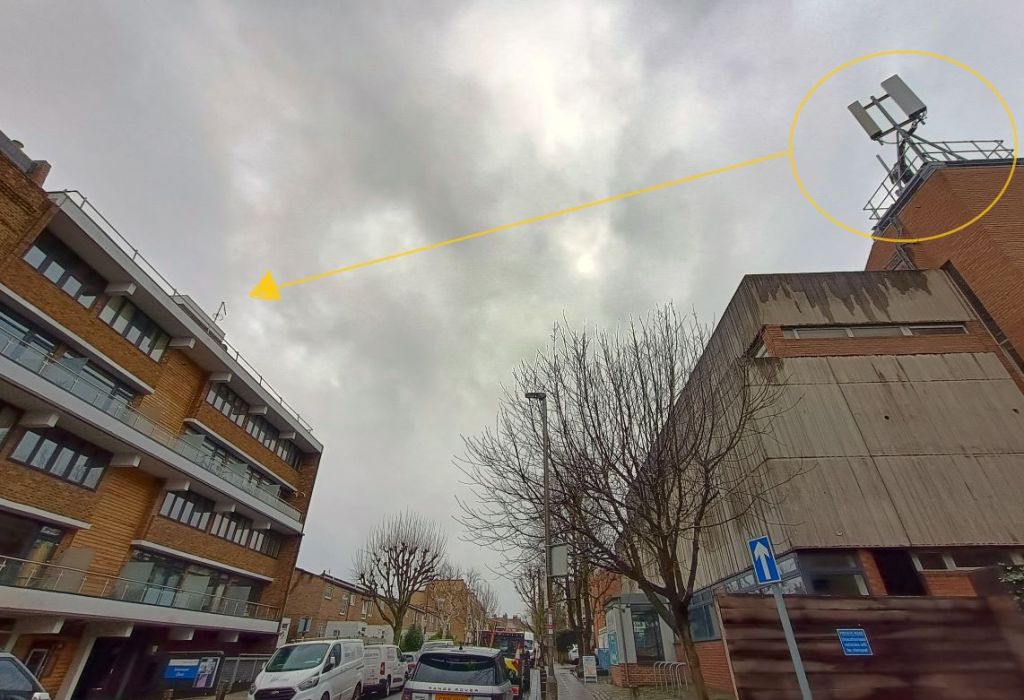
Rather like Antrim Huse, the 1970s version of the Devas Club was developed to replace a worn-out and somewhat bomb damaged Church hall at the north end of Stormont Road, and both its and its neighbour have weathered the past few decades fairly well, even if their styles fell out of fashion not long after they were built. And the two buildings are now also linked by the more prosaic matter of mobile phone masts – because it seems the big clusters of mobile phone masts currently on the roof of the Devas building, are going to be relocated – to be on top of Antrim House.
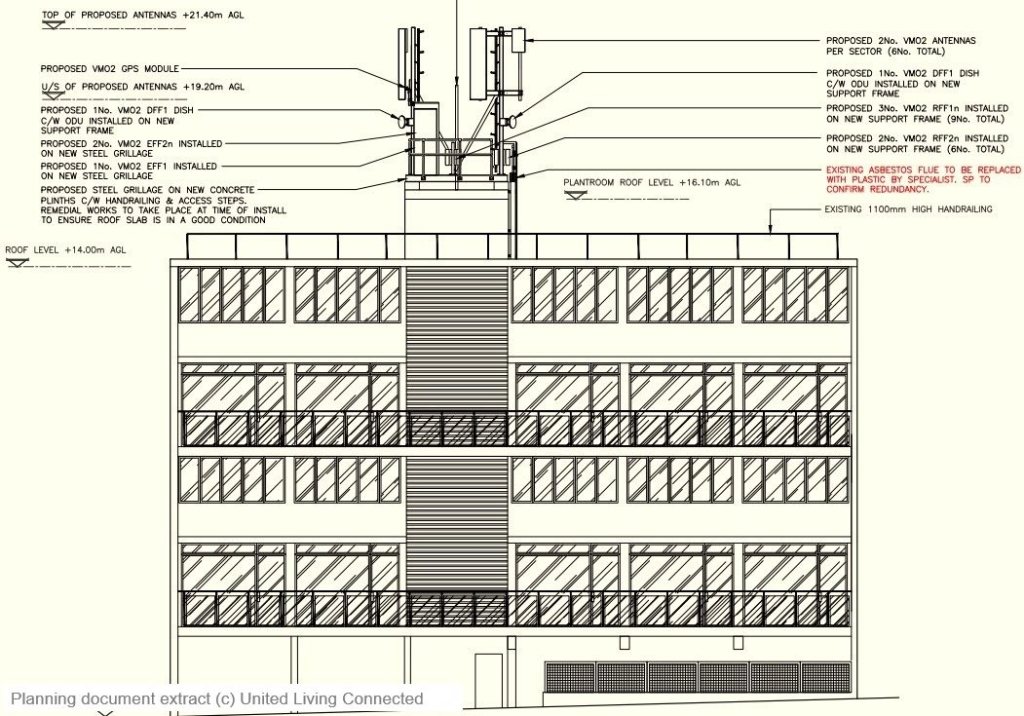
Antrim House’s new masts are being installed by Cornerstone, a large mobile infrastructure services company with over 20,000 sites that cover about half the country’s mobile customers. They’ll include six antennas and two small 30cm dishes, and three rooftop equipment cabinets – essentially exactly what is currently on the roof of the Devas Club. Unlike at the Devas Club where the antennas tend to be on the corners of the building, at Antrim House they will be clustered near the middle of the roof, where there is better access and something sufficiently firm to attach them to; this does have the side effect of making the overall mast a bit higher than it the ones it is replacing at the Devas building (to reach round the building roof) but also probably less visible from the ground.
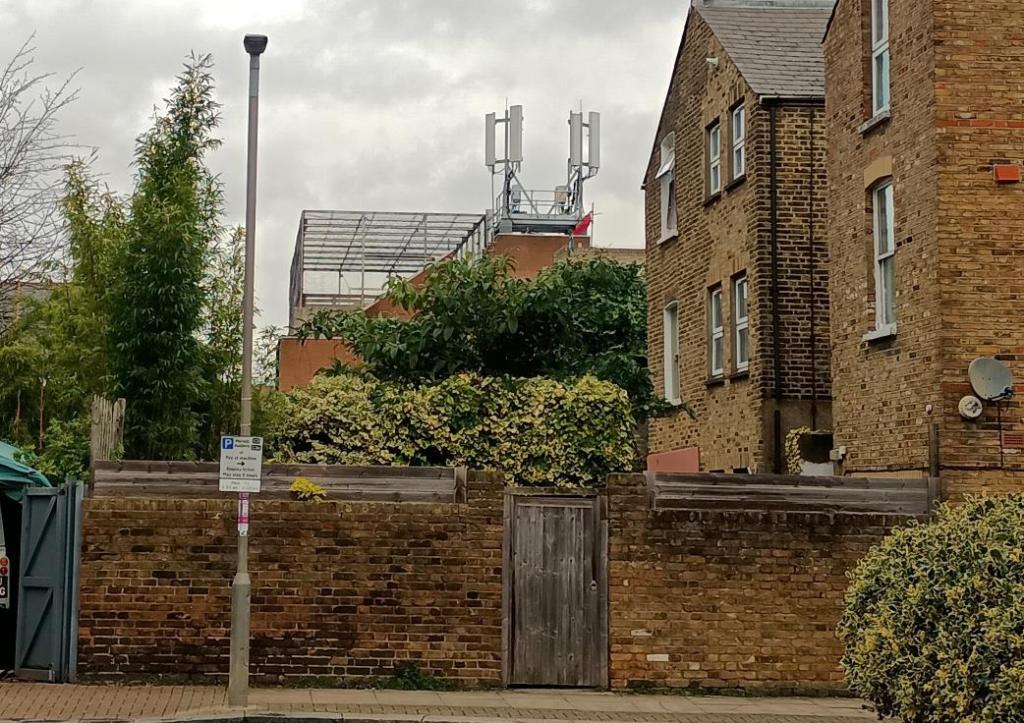
We’re not entirely sure why the aerials are moving; though as a self funded organisation that does good things, it’s a shame to see the income from the phone masts move across the road. We know the Devas Club make £35k-100k a year from a bundle of ‘other revenue’ – which includes rental from the phone masts (as well as investment income and a variety of other sources). They do also make some income from the electricity feed-in tariff, having wisely installed a load of solar panels on their roof a few years ago.
In most cases, developers of phone masts do not need planning permission, they just need to notify the local authority in advance and demonstrate that the proposals meet a few core criteria – and we don’t expect this small move will be particularly controversial in any case. However slightly intriguingly, in the case of Antrim House (a building that they are, of course, also the landlords of – so will have done the deal with Cornerstone), Wandsworth’s planning team have just decided that this proposal will need to go through the planning process.
The planning officers’ reasoning for this was that although the mast plans are compliant with most of the conditions needed to allow mobile telephony equipment to have a ‘free pass’ on planning, the ‘highly prominent’ nature of what was being proposed for Antrim House was likely to detract from the appearance of the building and visual amenity – in other words, be an ugly eyesore for the currently tidy and well-maintained Antrim House – and the proposals did not give much or any evidence that efforts had been made to minimise the visual impact ‘so far as practicable’. The proposed locations of the masts on the roof did not seem to be designed to minimise the ugliness of the setup, or to maximise efficiency (for example by sharing one mast between multiple operators or pieces of equipment), no particular effort seemed to have been made with approaches like coordinating the colour of the masts and equipment with the building, and it was not clear of other options had been explored to make up for the loss of the masts on the Devas buildings like adding equipment to other nearby existing base stations.
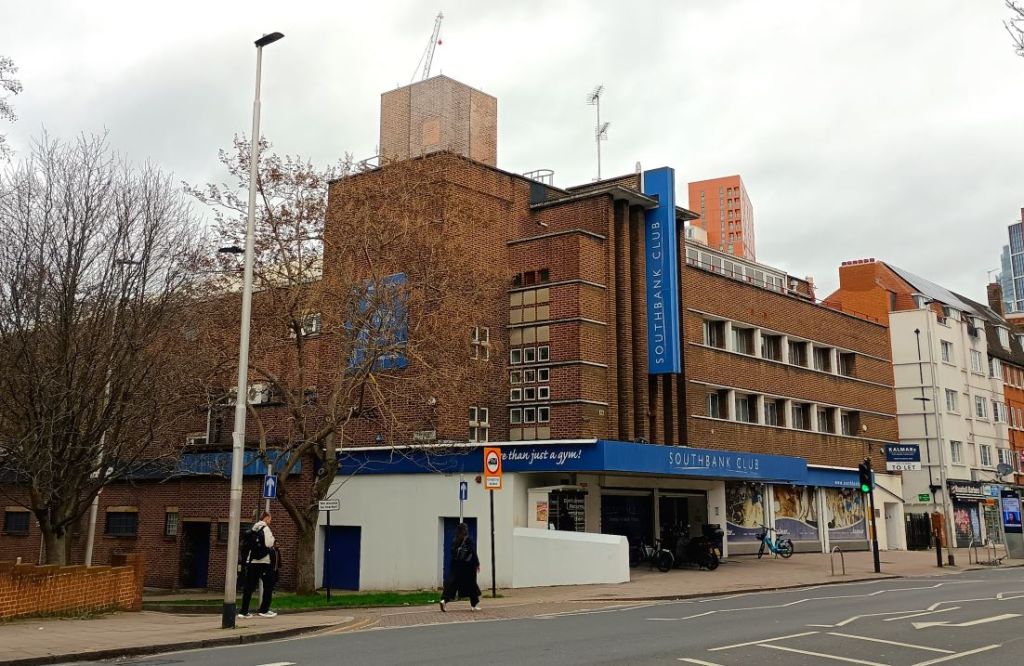
We can see where they’re coming from here too – Antrim does have residents who make an effort to look after the building, and forest of masts on the roof will not help matters! There are better ways of delivering this, like the building above on Wandsworth Road where the bit up at the top (with a crane behind it) is a ‘brick pattern’ screen hiding a similar forest of masts and dishes. That one is well over a decade old and the brick pattern has faded, but when it was new it was very convincing and looked just like a part of the building; the same approach could easily work at Anrim House.
To see the full details of the ‘rejected’ approach visit Wandsworth’s planning site and search for proposal 2026/0070. Depending on how Cornerstone decide to adapt their plans to be less of an eyesore, we’ll probably see a full planning application for the site – hopefully with a bit more effort put in to the appearance of the planned works – in the next few weeks.
Lavender-hill.uk is a community site covering retail, planning and development and local business issues, and sometimes wider areas like transport, all centered on the Lavender Hill area in Battersea. We sometimes also post more detailed articles on local history. If you found this interesting you may want to see our photo story on the history of the Cedars Road estate, an in-depth report on the chaotic redevelopment of the 1970s Westbury Estate flats on Wandsworth Road, an update on planned improvements to Queenstown Road, the imminent project to build lots of new flats on Tyenham Close. You can sign up to receive new posts (for free) by email – and if you have tips and leads to share, get in touch.
 Lavender-Hill.uk : Supporting Lavender Hill