
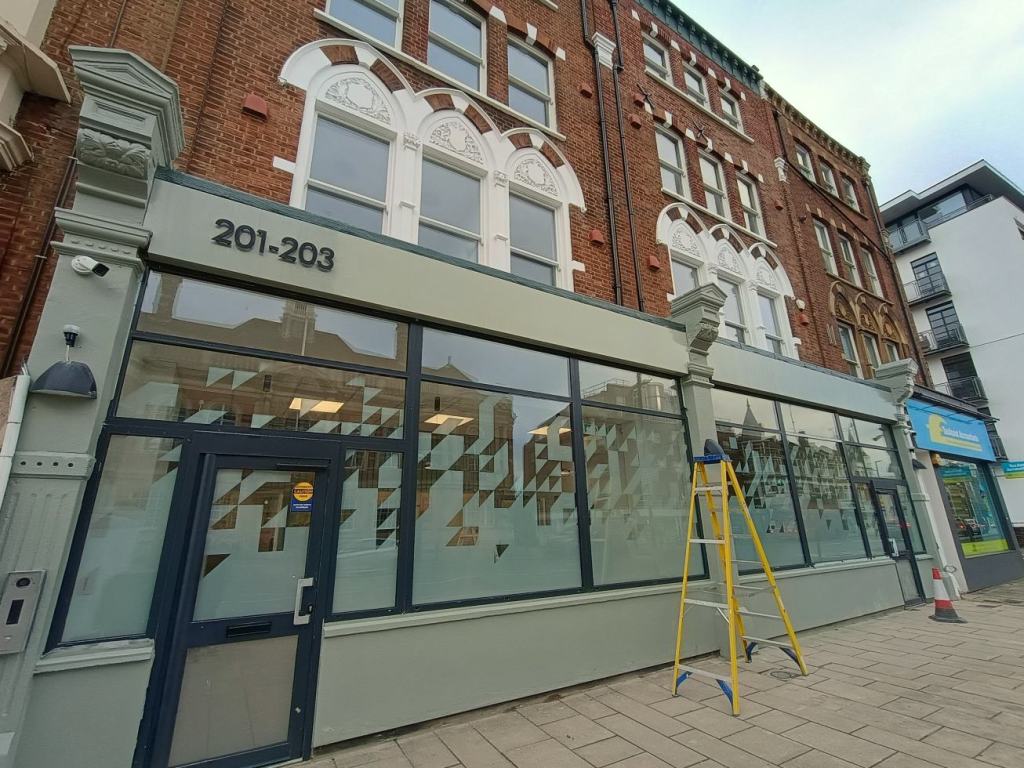
It’s been a long project, and a controversial one too. But after one of the most contentious planning applications in the history of the borough, a long building project that’s seen a dilapidated office building comprehensively renewed, and a bold and quite innovative approach to supporting the homeless move from concept to very real plans, Clapham Junction’s new homeless hub has today – the 9th February – opened for business.
The high-risk moment of truth for Wandsworth Council’s flagship project
This is the moment of truth. Will this prove to be the new thinking that rough sleeping has needed for quite some time now – transforming the messy and piecemeal local authority support landscape, that until recently has done very little to help many of the most vulnerable members of our community just when they need it most? The innovation born in Wandsworth, which can show the rest of the country that a quick, pragmatic and comprehensive approach, rather than passing people from pillar to post, can get people who are struggling back on track – and even save taxpayers money?
Or will it be a crime-ridden magnet for junkies and ne’er-do-well’s, that many of its neighbours feared during the chaotic early days of the project, when it was sprung on them by stealth with an unadvertised planning application – just another shambolic night hostel, no matter how it’s branded, that will add to the headaches of residents and traders already struggling to deal with the antisocial behaviour seeping out of an inner city town centre?
We can’t answer that question – yet. None of us can. But we can report on how the project has fared during the last few months. In this in-depth article we also take a look at the long story of how and why this project came about, what the Hub will do and how it will work, how the plans have developed from the chaotic early stages of the project to address a lot of concerns from local residents, and how this bold experiment still leaves a few concerns in its wake. We take a peek behind the scenes, with lots of photos showing how the lengthy makeover of the building behind the hoardings has transformed a tired and run-down Council office to an up-to-date modern facility – and also report from a meeting with the management team on how the hub is going to operate.
A new approach to rough sleeping, that no one else has tried
It’s worth looking back to how this all came about. A few years ago, an idea germinated at Wandsworth Council: what if all the Council’s services for those vulnerable to homelessness and rough sleeping, which were scattered all around the borough, could be brought under one roof, to coordinate properly between each other and have prevention and support services on one site? Better still – what if rough sleepers themselves could be temporarily housed right next to those services, rather than in expensively-rented rooms all over London and the south east, to go in early and strong with the support, and make sure rough sleepers get access to everything they need at the same time – right away?
Short-stay rooms (for up to a month) would provide safe, comfortable, welcoming surroundings – while being right on the same site as the Council’s homelessness support workers and housing officers, the SPEAR rough sleeping team who they work with as a partner, and all the other services that can get people back on track. A clinical room would mean medical and mental health support could also be provided on site by appointment. It would all work on the basis that ‘every door is the right door’ – where no matter which bit of the Council and its partners’ services someone first approached for help, they would act as a gateway to support from all the other partners, with no need to go to lots of different people and tell them everything again and again. The aim would be to provide intensive, comprehensive, quick support – to get people to the stage where they can then move to settled longer-term accommodation. On the face of it, this doesn’t sound like rocket science, and you’d think there would be some examples elsewhere to point to – but surprisingly, there aren’t. Wandsworth would be the first Borough in London to have all the relevant services in one building. There are loose similarities with St Mungos’ No second night out outreach scheme (though they are also thought to be turning towards a hub model too).
An approach inspired by Wandsworth’s efforts in the 2020 pandemic
The idea was directly inspired by the government’s Everyone In scheme during the early days of the pandemic, which provided all rough sleepers with a place to stay. That scheme was made up within days, and driven by short term need – but it also proved an interesting experiment on whether a more proactive approach to rough sleeping could deliver better results. And sure enough, it does seem that when people were provided with the services and support they needed, many thousands of people who had been out in the streets for many months or years did get back in to stable longer term housing, and just got on with their lives.
Research by Shelter found just under a quarter of the 27,000 people helped by the pandemic scheme across the whole country went on to longer term settled accommodation – but Wandsworth seems to have done rather better than that. They housed 564 rough sleepers as the virus swept around the country, and 244 of them – nearly half – then moved on from those temporary arrangements to settled accommodation. Sometimes they provided ongoing help for those with more complex needs with the skills & support to maintain their tenancies – but in other cases they found that just having a moment of stability and some short-term help to get back on track was all people needed. The Council found that the scheme provided access to a lot of people who wanted to get off the streets, but who hadn’t previously had access to the services to help them do so, and managed to get good results; they regretted that at the end of the trial they lost the space to engage with rough sleepers.
And there are a fair few rough sleepers here, many of whom carefully stay as out-of-sight as possible. A street count in the late autumn found 21 rough sleepers in Wandsworth, and 14 in Richmond; with safety sometimes being found by staying out of the way, chances are the real figures are a bit higher. That may seem a small number – but it’s a very specific subset of the homelessness challenge here; there are far more ‘hidden homeless’ who couch surf and hide away in unoccupied commercial premises, who may also see some support via the Hub’s services, and even more statutory homeless (the Borough has around 4,000 homeless families in temporary accommodation) – but it does reflect those who are arguably the most vulnerable of all.
The triggers for rough sleeping in Wandsworth are often being discharged from a long stay in hospital or prison, the aftermath of a relationship breakdown, and being thrown out of private rented tenancies – the latter often because people have struggled with rent payments – which itself can often be down to unemployment or underemployment, or wider difficulties including substance use, and physical and mental health challenges. There’s also been a recent rise in rough sleeping among non-British nationals who are struggling to find employment as rules and checks have been tightened up. A lot of rough sleepers are local, and have fairly long histories in the area – although there are also people from further afield; Sadiq Khan has recently commented that London in general attracts more people than it can house, being seen as more attractive than the rest of the country – with better access to services and arguably better opportunities for informal employment.
The project hones in on a conveniently available Council-owned building
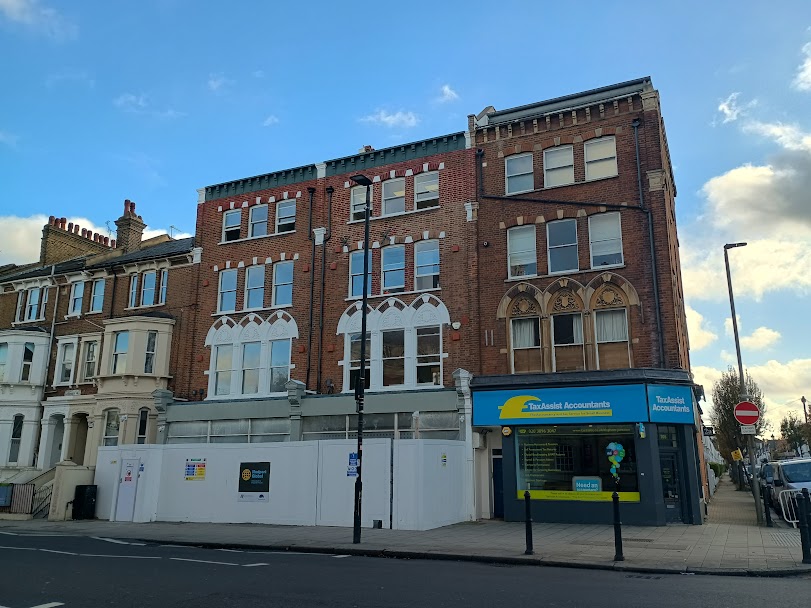
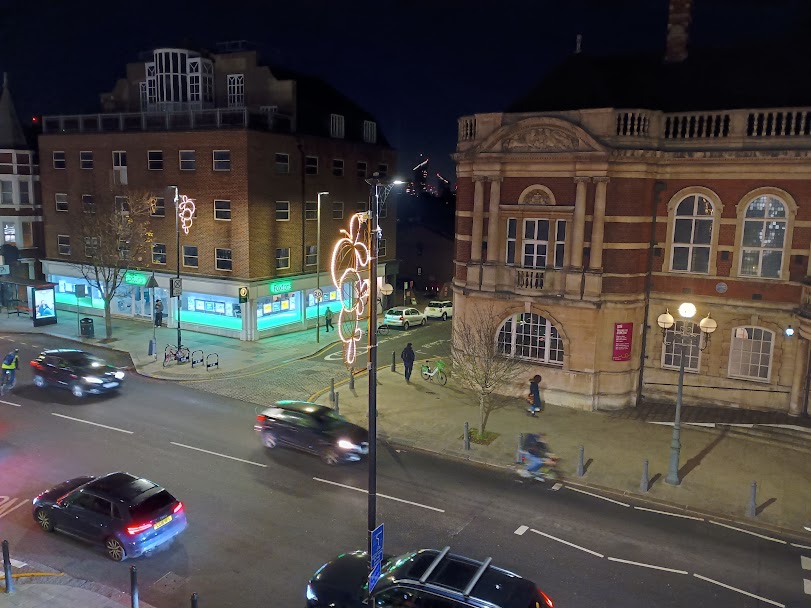
There was, conveniently, an available building to try this out: 201-203 Lavender Hill, right opposite Battersea Arts Centre. Owned by Wandsworth, it had become available following the move of the Council’s care leavers service to be closer to other family services in Falcon Groove. It was a distinctly tired property – a loosely-stuck-together pair of four-storey Victorian terraces, with precisely the tatty facilities and run-down ambience you’d expect of something that had been in local authority hands for decades, far away from the Council headquarters and housing an obscure and little-known bit of the Council’s work. But there was enough space to accommodate both a dozen or so bedrooms, as well as a whole floor of offices for staff, and some rooms for appointments and visits.
The Council applied for funding support from central government, to try out this new approach – and someone must have done a decent job of the application because they landed a grant of just under £5 million. The pieces were starting to come together, to try something quite new.
A botched start to the project annoyed nearly everyone
But things quickly went south – because the start of the process wasn’t handled well at all. A planning application for a change of use of the building, featuring minimal detail and some vague floor plans that seemed to have been sketched out on the back of an envelope, was very quietly submitted by the Council – with hardly any detail on what was being planned. Wandsworth also submitted the plans in a rather sneaky way that framed it all as a trivial ‘change of use’ of the Council building, which meant that even the immediate neighbours whose buildings were connected to the Lavender Hill location, and who were registered to receive planning alerts, weren’t informed.
Whoever did this probably thought they were being very clever and avoiding any of that hasslesome consultation and process that more ordinary residents have to go through if they want to get planning permission. But they hadn’t reckoned with their ever-finicky local community websites. We spotted it buried deep in the database, accidentally while looking for something else, wrote a short and fairly bland article on it… and chaos ensued. This wasn’t surprising – the way it was framed immediately brought up concerns that creating a hostel for two whole London boroughs, to a residential area, would draw in a large population of transient people struggling with all sorts of challenges and addictions – who may or may not then find space overnight, and with knock on impacts on the quiet streets around it, and on local traders who have a tough time at the best of times. For many residents at the eastern end of Lavender Hill, it rekindled difficult memories of the chaotic 120-room St Mungo’s hostel that had, for years, brought mayhem to Cedars Road. That hostel had been questionably managed at the best of times, and while it had a very laudable aim of supporting vulnerable residents with severe drug & alcohol abuse issues, it was hard to escape the feeling that the sheer scale of that hostel tended to make residents’ problems worse, while leaving its neighbours to pick up a lot of the pieces.
The timing of Wandsworth’s stealth planning application was also pretty unfortunate: Clapham Junction and Lavender Hill were struggling with a wave of petty crime (and not-so-petty crime too – to the point where we wrote a fairly detailed special report on the serious violence that was plaguing some streets – and we don’t even cover crime as a topic). When it was revealed that this facility would be the main facility for Richmond as well as Wandsworth – and be focussed on those with complex needs – a view quickly took root among many residents and traders that the last thing the area needed was some new hostel to bring two whole borough’s populations of people struggling with addictions and mental health challenges, to what was a mostly residential site on the very edge of a town centre – and one right next to a busy day nursery.
A quick change of approach, as it became a political problem
The dodgy planning application was hastily withdrawn – and a new one was submitted that had far more detail. But by now the cat was well and truly out of the bag, and it saw 500 often detailed objections (as well as a couple of dozen support comments). People across the Council realised that a well-intentioned project had very much got off on the wrong foot. Worse, both what was being done and how it had been done were becoming sore points well beyond its immediate neighbourhood, and potential election risks. The Lavender ward is mostly made up of Conservative councillors, so from Wandsworth’s perspective trouble there is not their problem (although it is marginal and has been a target) – while Shaftesbury has three Labour councillors and is also something of a swing seat. The impact was spreading too, with disquiet rippling across the north east of the Borough. A change of approach was ordered.
A core residents’ concern, that emerged again and again, was about what the facility would be: somewhere that had the management and support to remain true to its objectives of wraparound support to get people on track, or something that degenerated in to a city-centre casual hostel for vagrants that – by not actually being in a city centre – could cause disproportionate risk to neighbours. Recognising this, the Council organised public meetings to try and reassure residents that no, they didn’t want to create something like the old Cedars Road Hostel (or various other dubiously managed ‘bed for the night’ setups that had been nightmares for their neighbours, and in some cases brought a lot of crime and danger close to other vulnerable populations), that the stealth application had been a mix up, and that they did want this to work with the neighbours.
We reported on this part of the Hub’s development in some detail – and in one of the articles we wrote we suggested a middle ground approach, that could address a lot of the local concerns, and get the project off to a good start.
A better thought through approach to the hub
Wandsworth were quite receptive to the concerns raised, and did take a fair bit of the feedback on board. The building plans got tweaked to reflect the concerns and thoughts, with changes made to both the layout of the building and the way it will operate to both make it work better, address some of the obvious design problems with their initial approach and generally do what they could to minimise the impact on the neighbour.
Councillor Aydin Dikerdem in particular – as the Cabinet member for housing, and who happens to live very close to the site – emerged as a driving force behind the project. To his credit he had not been afraid to discuss and defend it, and also been frank that this is an experiment – not everything will run perfectly from the outset, and there will be hiccups and learning processes.
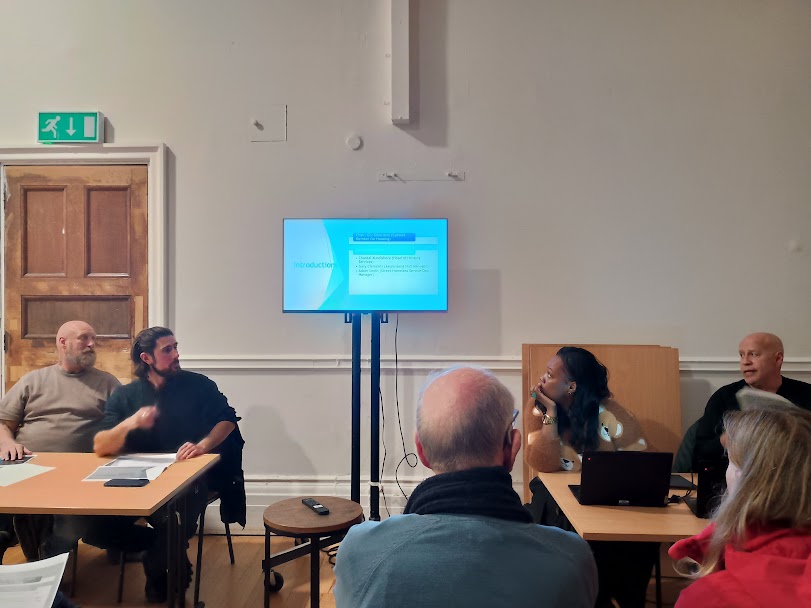
Wandsworth also made a lot of commitments on how the Hub would run. This included a proper sustained engagement programme with the site’s neighbours, including committing to having out of hours contact details if there were disturbances (including a neighbours’ phone line that will be open 24 hours), having the CCTV patched through to the Wandsworth joint control centre on Wandsworth High Street, creating a space within the facility that could let residents have a space to relax during the day rather than driving everyone out to side-street hangouts, closing off the already-problematic back alleys behind the site that risked becoming dealing spots, making the windows at the back that face a small childrens’ play area non-openable, and ensuring residents were provided with access to food to not lead to even more theft from the traders along the street.
The project moves in to the construction phase
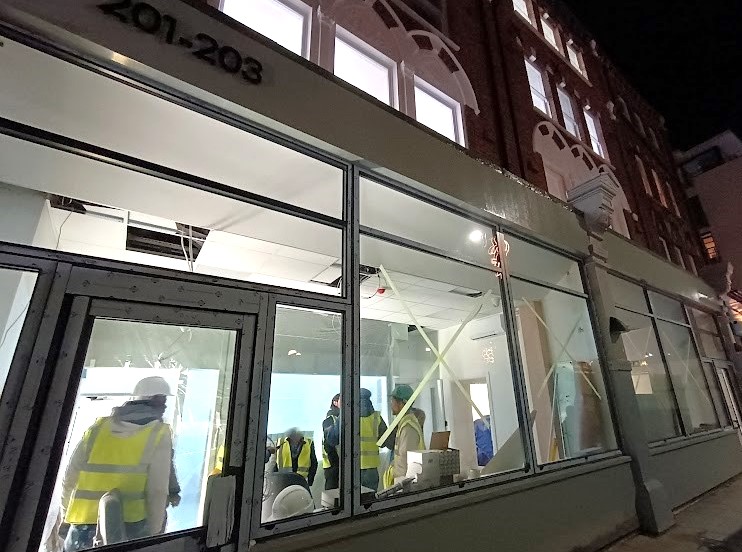
A couple of years later, having got through the planning process (which saw a lot of changes made, and took far longer than originally expected – we also wrote about the updated planning application that was ultimately approved) and moved to the build stage, the building itself has had a comprehensive makeover.
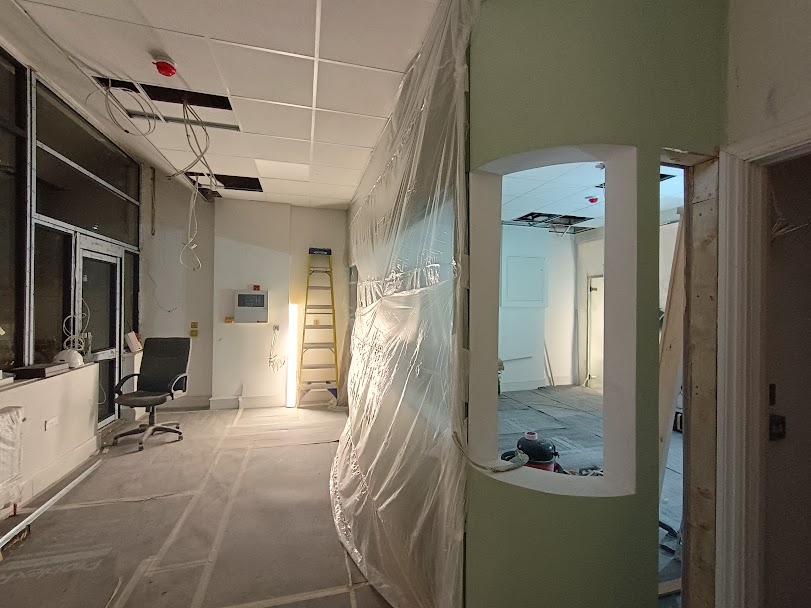
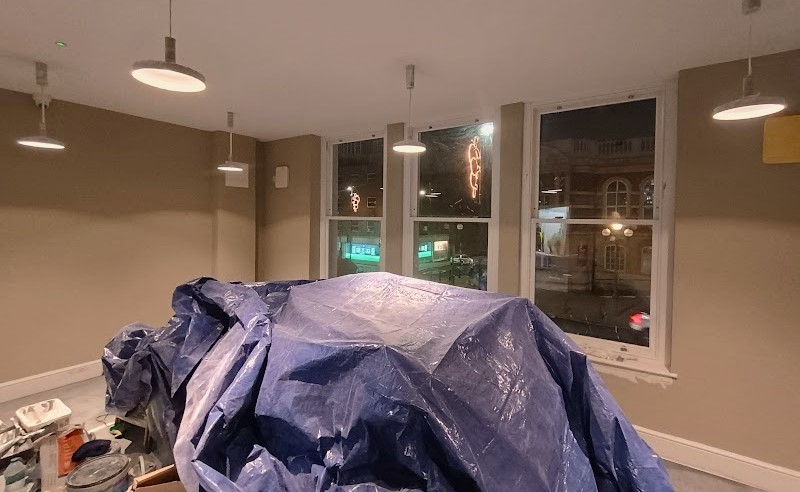
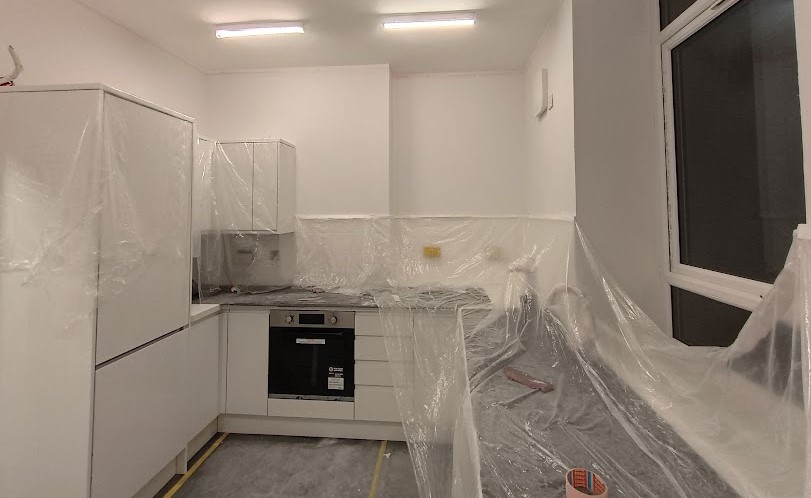
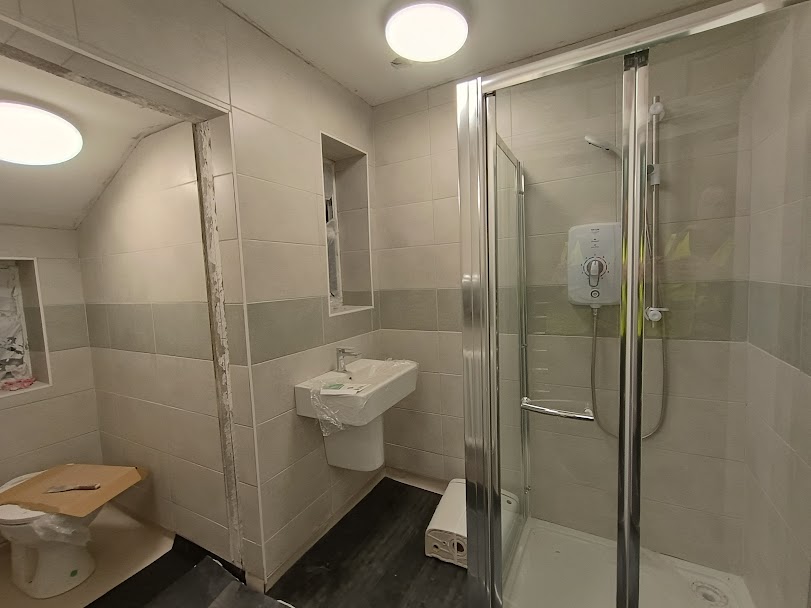
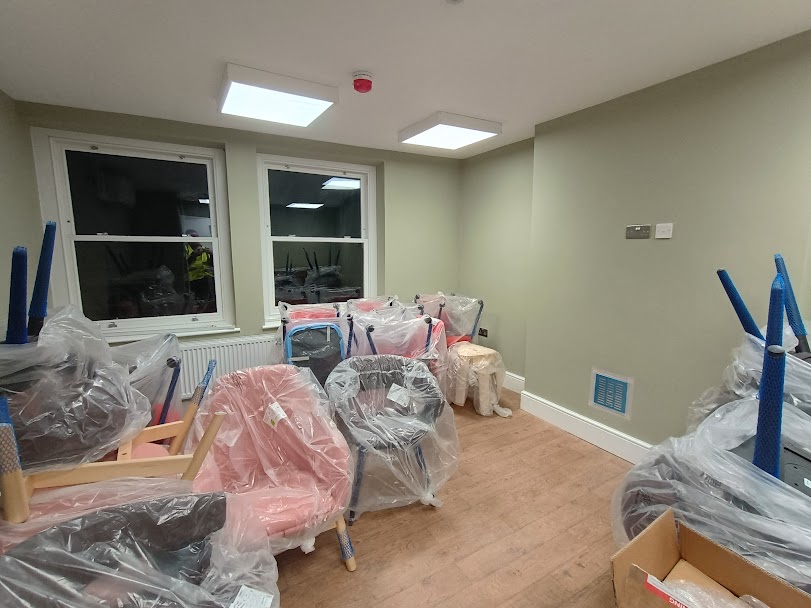
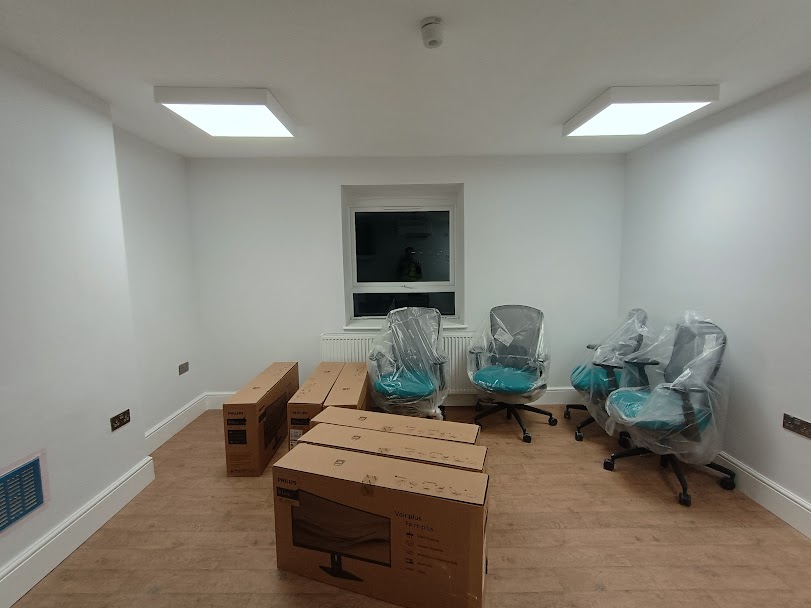
While the initial thinking had been that a bit of a patch up would do, the usual thing happened when you take on a typical local-authority-owned building that’s been far out and out of mind for the main business of the Council, and which has had the bare minimum done to keep it ticking over for any years – and it turned out that lots and lots of things needed work! There’s been a much more in depth effort at really getting it up to date, as our photos throughout this article – which were mostly taken late last year as the building work headed towards completion – show.
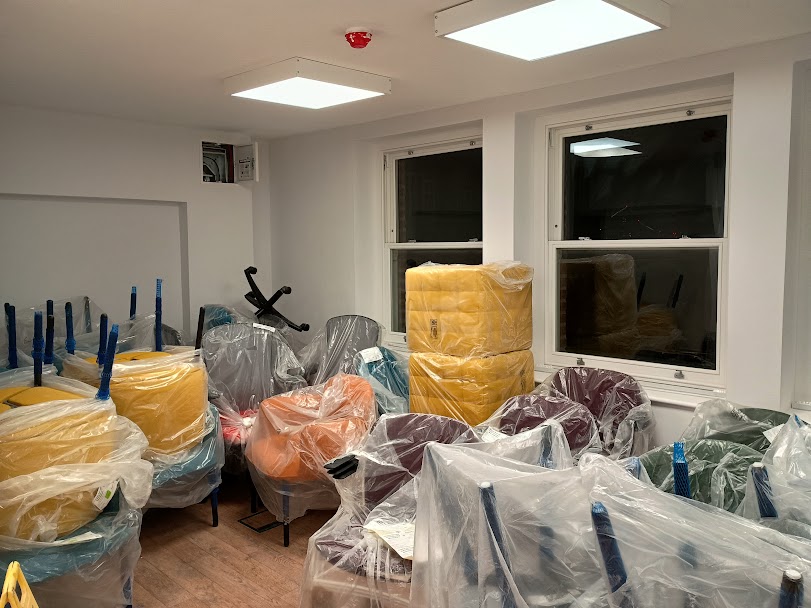
What we have now is pretty much a completely new building, in the shell of an old Victorian one. The exterior has seen the brickwork repaired, the stray cables and pipes removed, the roof and flashing repaired, and the parapet repaired and repainted. All the windows have been replaced, to get the building both warmer and far more sound proof than it was before (we can confirm that you can barely hear the traffic from the inside). It has been fully insulated, and had a complete top-to-bottom rewire, with all the services and utilities replaced, and the whole building brought up to modern fire safety standards. The work was led by Medport Global, whose Director Tunde Adewopo is rightly proud of the way this old building has been given a new lease of life.
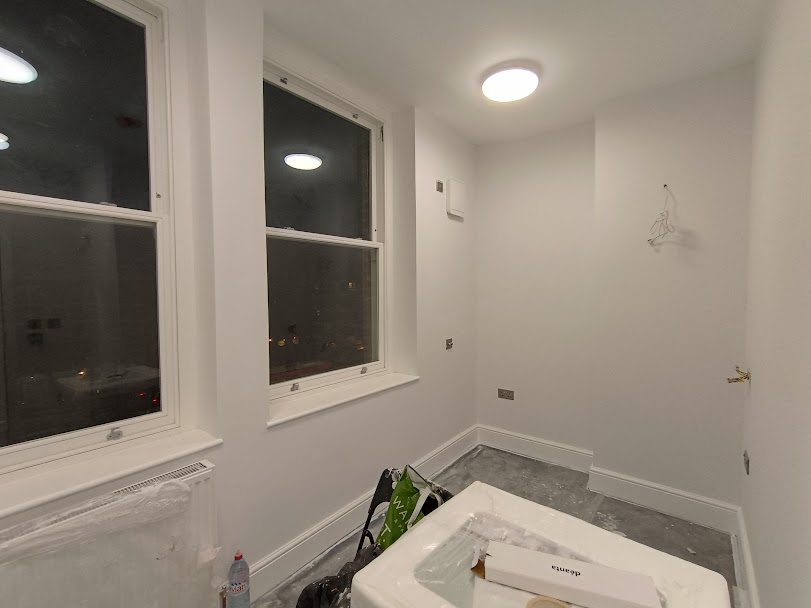
The ground floor houses the reception, and a large area that can accommodate appointments with specialists and meetings. There are two doors: one to the reception, and the other giving direct access to the upper floors. The next two floors are the residential bit of the hub: first floor has a living area, a communal kitchen, and some bedrooms, while up another floor there’ are several more bedrooms (the 11 bedrooms are mainly very small single rooms – but there are a handful that could accommodate doubles if needed). The top floor is staff-only, with a mixture of open plan workspaces, meeting rooms and offices; with a capacity of 15 or so it will house Wandsworth’s homelessness and rough sleeping teams.
So what happens now – how will this work? Who will the Hub house?
The way the hub will work is strictly by referral and appointment – both for meetings with support teams and experts (which will run only Monday to Friday between 9 and 5), and for placements in the residential accommodation. It is absolutely not a ‘bed for the night’ general hostel, the sort seen in city centres that offer shelter or a night – which has reassured some neighbours who were understandably concerned that that type of operation can attract far too many challenging characters for typical residential and edge-of-centre locations to be able to deal with. The Hub is a joint venture between Wandsworth and Richmond, with the capacity (and the bill) split in a 7:4 ratio between the two Boroughs; while the Hub will operate as a unified facility, responsibility for ultimate rehousing of – and ongoing support for – the ‘Richmond’ residents falls to Richmond rather than Wandsworth.
It’s also targeted at a pretty specific set of the homeless and rough-sleeper population: people who, with the right support, are ready to move to settled longer term accommodation – which could be in supported accommodation, the private rented sector, private leased provision, or whatever. It’s not aimed at chronic or ‘high need’ rough sleepers with serious drug or alcohol problems, or who are very unwell physically or mentally – to be taken on you need to be capable of moving on with the support the Hub can offer within a typical four-week placement. Put more bluntly, this means it’s not planning to fill up with the belligerent drunks and aggressive beggars readers will have seen thieving and threatening staff in local shops!
As an aside, it’s also not aimed at the women readers will have seen dropped off with near identical cardboard signs every morning on St John’s Hill (and as a side note – as we understand it they are very likely to have been trafficked and be under some duress, but they are not homeless). Undocumented migrants, no matter how vulnerable, are also out of scope: residents need ‘recourse to public funds‘ to be able to receive Hub support, regardless of Wandsworth’s Borough of Sanctuary status.
There might very occasionally be a wider population housed, as the basement can be activated as a short term urgent shelter when temperatures plunge and the Severe Weather Protocol is activated, which requires Councils across the country to find somewhere indoors for everyone to stay no matter what, no questions asked. But the Hub’s basement is a last resort, and far from the best option available – so unlikely to be used for this much.
What happens when someone arrives at the Hub?
It’s a peer-led service : many of those helping its clients have themselves experienced homelessness and mental health challenges, or their impact on their peers. Each resident will have a housing officer to explore suitable options, and a support worker responsible for their welfare. Staff will aim to find long-term housing for residents to move on to, although they could also explore other alternative short-term options like temporary accommodation. If residents need, for example, to see a drug & alcohol worker as part of the process that appointment will be in the Hub rather than seeing them sent off to St John’s Hill or further field. recognising that a lot of the rough sleeping community are already a bit traumatised, the aim is also that they don’t need to repeat the whole of what has happened so far over and over again at each new appointment with four or five different bits of the Council.
Prospective residents will be booked in for assessment – with a check on immigration status / leave to remain / recourse to public funds, then a review of past housing history (have they managed tenancies before? What locations have they been in?) – sometimes with the ability to cross refer between local authorities. The management are well aware that residents will often be coming from complicated and sometimes traumatic situations and wont exactly share everything all at once; these processes are part of a softer chat – to help people feel sufficiently relaxed and comfortable to share what the Hub needs to help people.
As part of the wraparound support to get people back on track and back in the system, support available on site will include the Central London Homeless Inclusion team, as well as part time staff from the NHS rough sleeping and mental health programme (RAMHP) – including nurses and support workers. There will also be a part time consultant psychiatrist, and GP advice and sessions from St Georges NHS Trust.
The ultimate aim is to work out a personal housing plan with the individual. The Council has a maximum of 56 days to decide if there’s a duty to house someone, and there are a mix of options at its disposal – including the options of referral to low, medium, or high-need supported accommodation (the Council has ten sites around the Borough that house 6-8 residents each), nominations to social housing, or to private sector leases (essentially a two-year ‘training flat’ to help people get used to managing all aspects of a tenancy).
High-risk residents won’t be welcome
Part of the initial assessment process is also the Hub undertaking a risk assessment on prospective new residents, and the management have made clear to neighbours that high-risk prison releases, and sex offenders, will not be suitable for the shared living arrangements it can provide. It will be equipped to accommodate people with drug and alcohol challenges, although neither drink nor drugs are allowed on the premises, and – conscious of the risk of these activities being pushed to nearby quiet corners – part of the Hub’s good neighbour agreement, and the good management procedure, will see a prohibition on residents congregating outside the hub. There is a ban on begging, shoplifting, and causing a nuisance in the vicinity, and Hub staff will patrol nearby streets twice a day specifically to check that this rule is being upheld. Obviously there’s always a bit of a challenge in working out what local problems may be related to the Hub and what isn’t; the aim is for a kind of collective ownership on things that may be Hub or wider neighbourhood problems, and the management will try to work out what is most serious and relevant for quick action at the Hub.
There will also be a minimum of two staff on the premises at all times. There’s no curfew for residents – not least as that can lead to people kicking off outside if they are locked out! – instead, the night staff will manage any late night challenges, on the grounds that this is better for both Hub residents and their neighbours.
A high-stakes move, close to Council elections
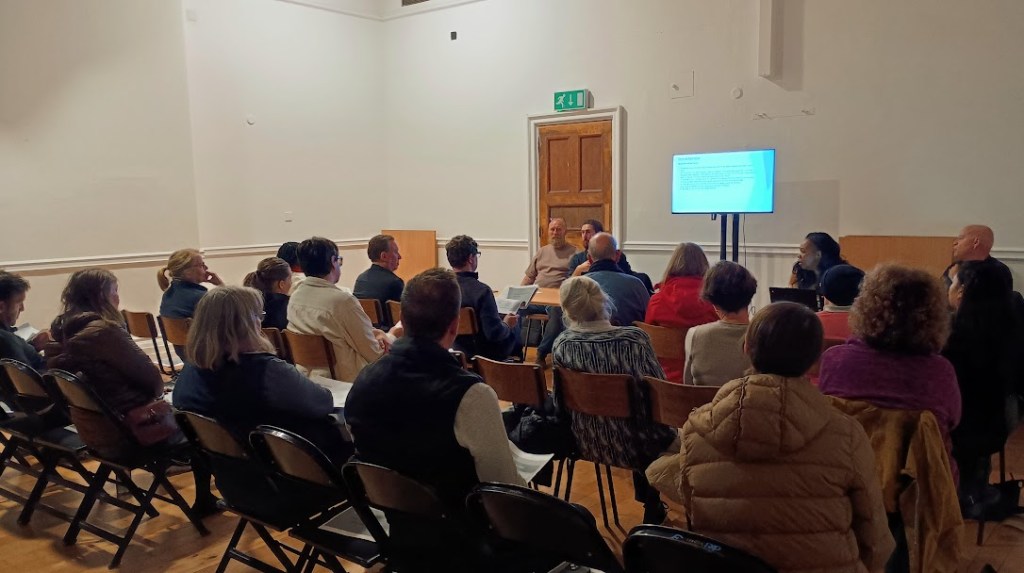
Wandsworth is committed to hosting a monthly meeting for residents, which Aydin is chairing – made up of housing officers, the street homeless service, adult social services, community safety and public health representatives from Wandsworth, as well as the Hub’s partner agencies – the safer neighbourhood team, SPEAR, St Mungo’s and the NHS Trust. If you are a local resident, business owner, faith or community group, or local media, you’re welcome to join and we suggest you do. The comms have been a little bit wobbly: despite some mail shots aimed at the streets nearby, some people have been missed out, or found out about meetings rather late in the day (the aim is to have four weeks’ notice; at the time of writing the next Forum is scheduled for the 12th February). If you’re one of these, contact thehub@richmondandwandsworth.gov.uk to be added to the circulation list for the next meeting. There’s an open offer to neighbours who would be willing to support the Hub with volunteering – including befriending and mentoring Hub residents.
It’s fair to say, a lot of people have been won round by Aydin and the Council since the project’s difficult early days. This was very much in evidence at a recent public forum where views were rather more pragmatic and balanced than previously. Gary Clements, the manager of the Assessment Hub and no stranger to the challenges of homelessness, has also emerged as a reassuringly pragmatic and seasoned hand in charge of the operation, and has clearly inspired a good degree of confidence in the residents forum meetings.
The specific challenge of Mysore Road
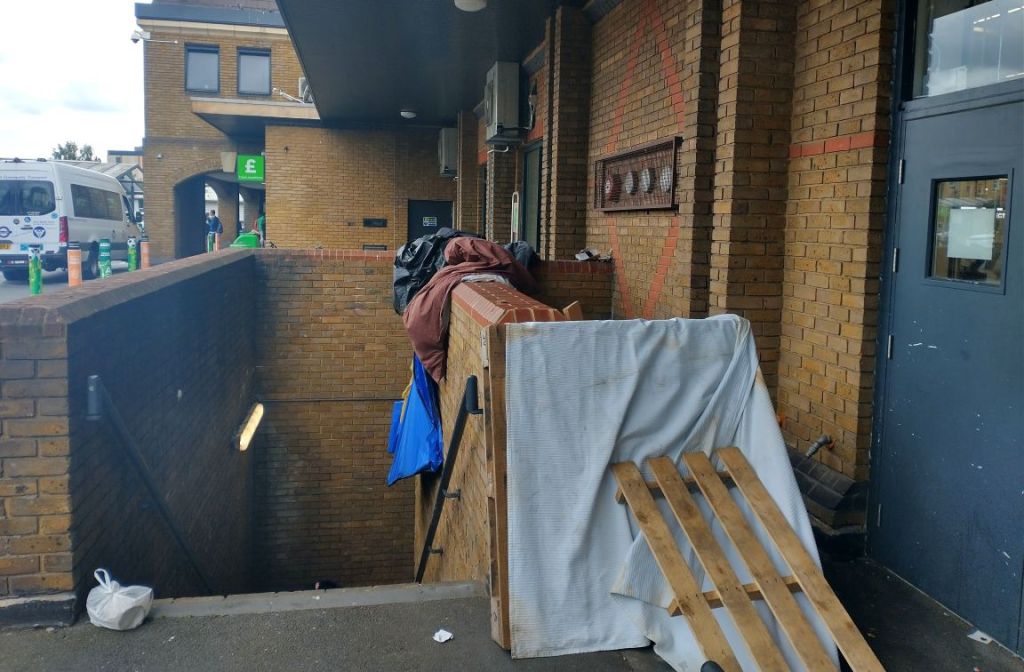
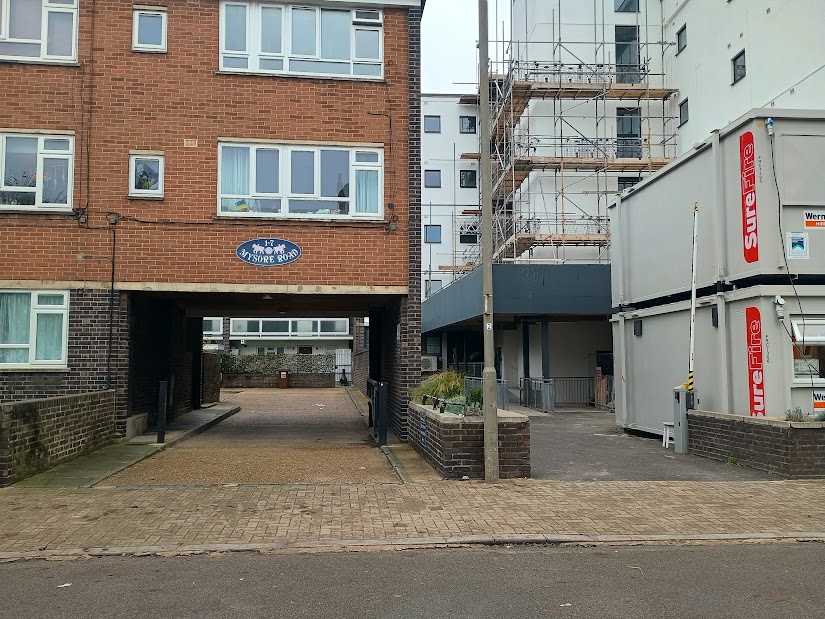
Not everyone is convinced. Residents of the small block of flats on Mysore Road, right next to the Hub, have been especially concerned about an uptick in all sorts of antisocial behaviour in the central courtyard, pictured above and below. It’s one of those awkward 1970s-era layouts that was maybe built in more innocent times: it has no gates and is open to anyone – but it’s also almost completely out of sight to passers-by, with lots of hidden away spaces, as well as ground floor flats. This maybe owes something to a determined effort to crack down on some of these behaviours nearer the station, which may have displaced activity towards to the edges of the town centre.
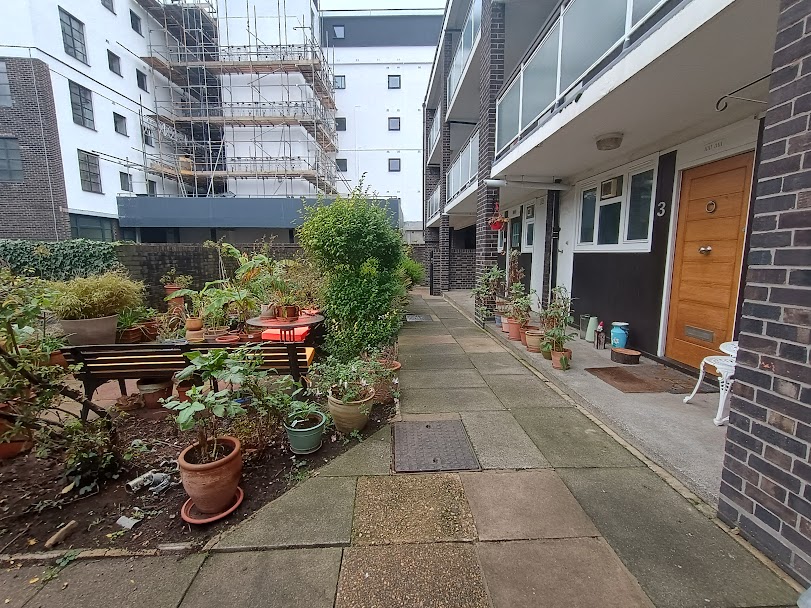
Clearly recent issues here are nothing to do with the only-just-opened-today Hub – but the residents’ fears are very understandable, and they do underline the underlying challenge of being an estate with uncontrolled access to a secluded areas is inherently challenging, with obvious potential to become the quiet out-of-sight area of choice for residents who stick to the ‘no drugs on site’ policy but who still have addictions to deal with. There’s a desire to close the currently unrestricted access to the inner courtyard and parking area, but this is hard to do: it costs money to install and operate, and a clear majority of estate residents need to agree to changes to arrangements. In other words – whether there are problems at Mysore Road or not, may well end up as the real test of how the good neighbour policy works out in practice (and residents – do get in touch to let us know).
The Hub opens today
The Hub officially opened today, the 9th February, for appointments. It’s a soft launch, and the first full time residents won’t be moving in until next Monday – with phased filling up of the 11 bedrooms. In a few weeks it will be fully in use, and we will start to see how it operates – and within 2-3 months we may start to see some of the results in terms of rough sleepers (hopefully) moving on to more settled accommodation.
Ultimately the Hub approach is a bold move, and an attempt to try and address a really knotty and persistent problem that affects communities all over the country, and help some of the most vulnerable people in the community. And on the face of it, with a committed team behind it, it has a good chance of delivering results – maybe this will be the model that other Councils pivot towards.
And in some regards, things have to go well for the Council – as it’s not long until the local elections, and there are some areas near the Hub that are looking to be tightly fought; if the Council is seen to have unleashed a chaotic mess on Lavender Hill this will be a Big Political Problem! Conservative councillors were unhappy at being bounced on the Hub plans along with everyone else, and while they could by and large see the logic in the plans, felt that the initial process was a complete dog’s breakfast. They are currently broadly supporting the approach, but keeping a close eye on if the Council lives up to its promises and makes this work. Councillor Guy Humphries previously welcomed the planned residents forum so the council can ‘be more proactive in their discussions with the obviously understandably concerned residents and businesses nearby‘, and asked for reassurance the authority is ‘willing to be flexible and moderate or change plans if things aren’t working according to exactly how it is in reality’.
And maybe that’s the art of it: this is a big new project and of course there will be the odd slip up, not every resident will end up happily housed, not everyone will prove able to live with others in the Hub environment, not everyone will manage to keep addictions sufficiently under control. If the Council and management team work with residents and neighbours, adapts the approach where it needs tweaking, recognises where things go right and where they go wrong, and reacts accordingly, we ought to get to a decent place.
We will, as ever, be keeping you posted on how this goes.
If you’re coming to this new, the story so far’s here: initial article describing the plans, follow-up article summarising the concerns raised & proposals for how the plan could be improved, and third article reporting on what was shared at the public meeting. Some further posts covered a lull in development, followed by the updated planning application, which more or less led to what has now been built. Don’t hesitate to contact us to let us know your experiences of the Hub; and contact thehub@richmondandwandsworth.gov.uk to be added to the circulation list for future meetings of the Residents’ Forum.
Lavender-hill.uk is a community site covering retail, planning and development and local business issues, and sometimes wider issues like transport, centered on the Lavender Hill area in Battersea. Recent topics include neverending water leaks, plans to smarten up Queenstown Road, the horribly messy redevelopment of the Westbury Estate near Wandsworth Road station, the barely-known Georgian orangery hiding in plain sight near Clapham Common, and a big investigation in to why Battersea Power Station’s cranes mysteriously disappeared. We sometimes also post more detailed articles on local history. If you found this interesting you may want to sign up to receive new posts (for free, unsubscribe anytime) by email.
 Lavender-Hill.uk : Supporting Lavender Hill
Pingback: Clapham Junction’s Rough Sleepers Hub is now open for business – Clapham Junction Insider – Local Democracy Reporting