
This post on crime covers topics some readers may find disturbing. Late last year, some unsavoury characters turned up on Lavender Hill. Four men, rough-looking, roaming round with the oddly bouncy, ‘on a mission’ type walk walk that seems to go with a serious heroin addiction. What followed was a few months of petty crime to a level we’d not really seen before. First up was the parcel thefts – hundreds and hundreds of them, lifted from doorsteps where they’d been left by rushed delivery drivers, opened on the next street along, and more often that not dumped if the contents weren’t resellable. Our shops felt the heat as the ‘gang of four’ grew more confident and started helping themselves to whatever they wanted. They’d get very aggressive when anyone tried to stop them. Anything left in a parked car that looked in interesting was also fair game, as well as the odd bike (though bikes seemed not to be a major draw for them). They weren’t subtle, injecting themselves on garden walls and being so brazen in the shops that the security guards grew to recognise them and bar them from entry, sometimes helped by customers who grew to recognise them too. But they were cleverer than many suspected, and teamed up with some more sophisticated thieves to ransack some flats just before Christmas, using a few tricks we’ll talk about in a moment to walk away with goods worth thousands. These final big steals were the end: maybe sensing the heat was on, as our local police gained an ever growing stack of evidence to take them down, and as residents got wise to the need for some more robust security arrangements, they moved on to rob and harass some other neighbourhood – and we’ve not seen them since.
But there has been a concerning trend more generally of some types of crime increasing, with some real hotpots and a handful of serious incidents. In this article we take a look at the various types of crime that go on in the Lavender Hill area, how we fare compared to other areas, and what you can do to keep yourselves and your property safe (because try as they like, there are some types of crime our police team can’t solve without your help). We also explore the role of our local neighbourhood police team – because we don’t think everyone realises that there’s a team who specifically cover this area of Clapham Junction! – including who they are and what they do, how they work, and how you can meet them and help them keep Lavender Hill as one of the safest bits of inner London.
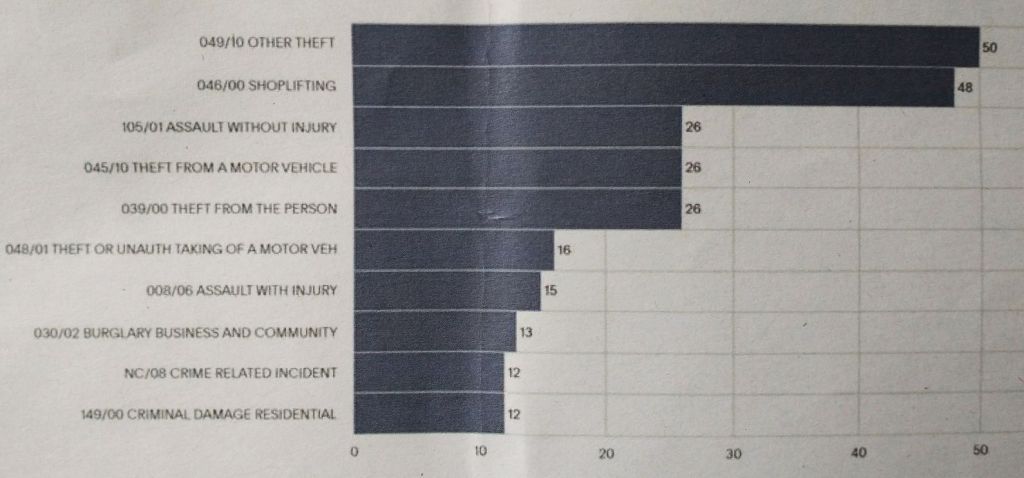
Let’s start with the statistics. The graph below shows what crime was recorded in the three months between March and June, in the most common categories of crime, just in Lavender Ward (which covers St John’s Road and the area south of Lavender Hill). Generalised category of ‘other theft’ kicks off the list – a wide category which includes parcels stolen from doorsteps, phones stolen in ways other than being snatched from people, and even a mysterious woman who keeps digging up plants from front gardens. At 50 crimes in three months you may be thinking this sounds a bit low, as we all know there were hundreds of cases – but the statistics reflect the fact that only the high-value thefts tend to get reported. It’s closely followed by shoplifting, focussed on the St John’s Road area but with a notable small cluster at the Co-op (the graph for Lavender Ward doesn’t include many of the shops north of Lavender Hill like Asda, or the shops at the eastern end of the street, but they see their share of shoplifting action too). There were 26 minor assaults and 15 more serious ones that led to injury, 26 ‘robberies’ from the person’ offences (often snatched phones, but this covers the whole range of mugging offences), 26 thefts from cars and 16 stolen cars, and 13 burglaries of business & community use premises (which we understand is mostly shops and cafes after hours).
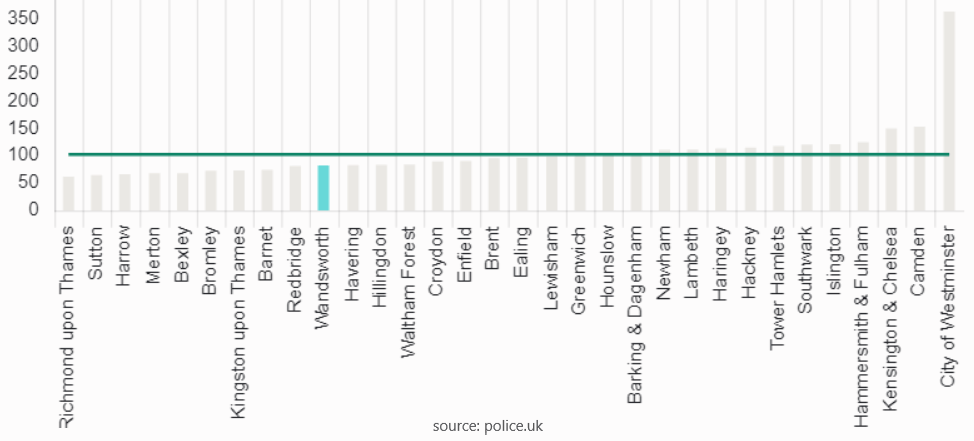
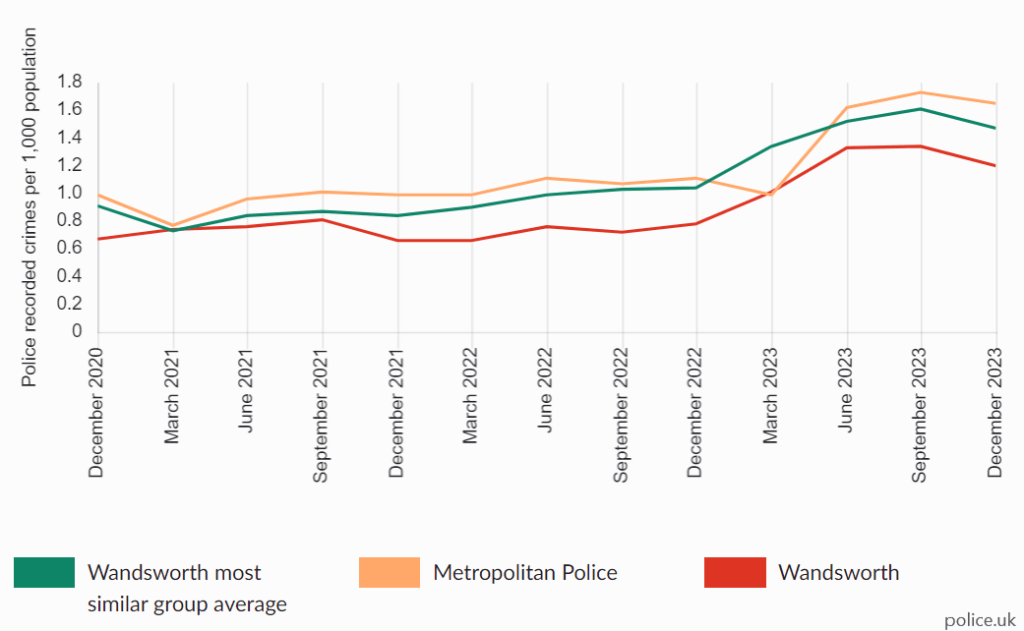
People always think crime has increased! But according to the statistics at least (which are available in glorious detail on the police database for Lavender and Shaftesbury & Queenstown Wards), the overall crime rate here has remained pretty flat over the last few years, and Wandsworth remains a low-crime area by London standards. This graph shows the number of recorded crimes per 1000 people across the Boroughs, with Wandsworth somewhat below the average, and well below some of our neighbouring Boroughs – we’re grouped with a bundle of outer Boroughs. Obviously all statistics need to be handled with caution: Westminster at first glance looks like a terrifying den of rampant lawlessness, but that’s because it has millions of visitors and only a handful of residents, so rather more crimes-per-resident than most. The same to some extent goes for Camden and Kensington & Chelsea. Lambeth next door is more interesting, it has rather higher crime, which reflects a cluster of incidents in the busy area round Vauxhall but also heaps of crime in Brixton – with the Brixton Windrush Ward, which covers the area east of Brixton Road, really standing out.
But statistics only tell part of the story. Crime can cut deep in to people’s sense of wellbeing, and even if we’re a relatively safe area, the villains are in our midst! The impetus for this article is a recent case where two casual thieves were cycling about in the early evening looking to see what they could steal from shops, cars or front gardens. They got subtly moved on a few times by eagle-eyed residents who made it clear enough that they were being observed. Clearly getting frustrated, they spotted a Tesco delivery driver unloading a home shop in one of the quiet residential streets. When he tried to stop them thieving from the van they got the knives out and tried to kill him; luckily residents intervened and while seriously injured his days aren’t in danger – but it added to a sense that some types of crime are getting out of hand, and it’s only a matter of time until someone doing their job doesn’t get to go back to their home and family at the end of the day. This has prompted us to take a look at what we can all do to keep the area safe.

Personal safety: Assault, injury, violence, and robbery
The good news is there were no murders in the two wards that cover Lavender Hill this year, and that’s usually the case (albeit there was one case this year on the Queenstown Road, just outside the boundary of our statistics, where we understand both the assailant and the victim suffered from a variety of wider challenges). But there were 15 ‘assaults with injury’ in three months, and there’s a consistent level of wider personal safety related offenses. The main area for assaults, violence, and sexual offences is exactly where you’d probably expect it, on the busy streets round the station, and typically these occur late in the evening.
There were almost as many cases of robbery, a type of aggravated theft defined as stealing while using force or putting someone in fear of force, which is considered a serious offense by the Met Police. Factors typically considered when sentencing criminals for robbery include if the victim suffered serious physical or psychological harm, and if the robbery had a serious detrimental effect on a business. The map below shows the distribution of cases of robbery in the last three months, again for Lavender ward, with the trend again being for offences to be clustered around the busy area in St John’s Road, often characterised by more aggressive theft from younger people.
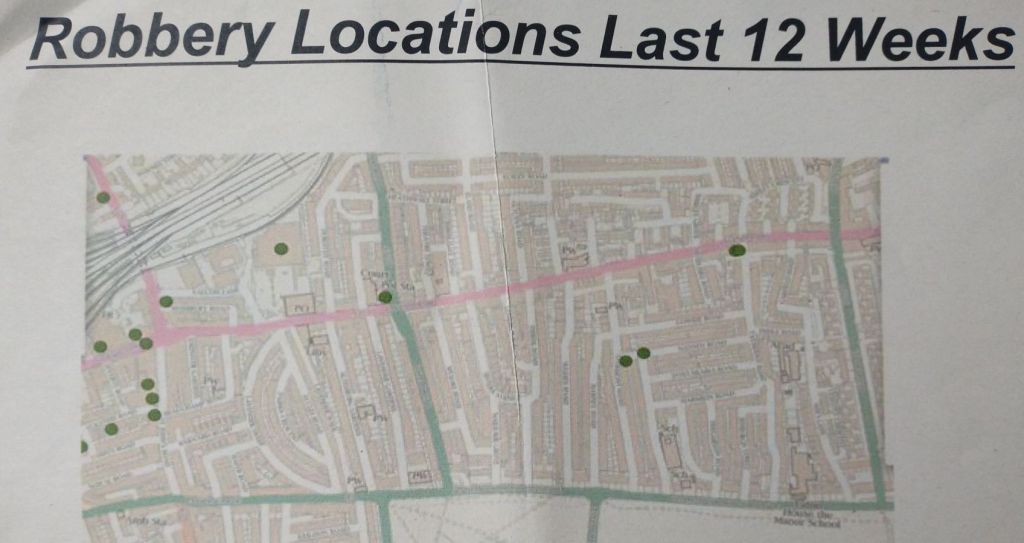
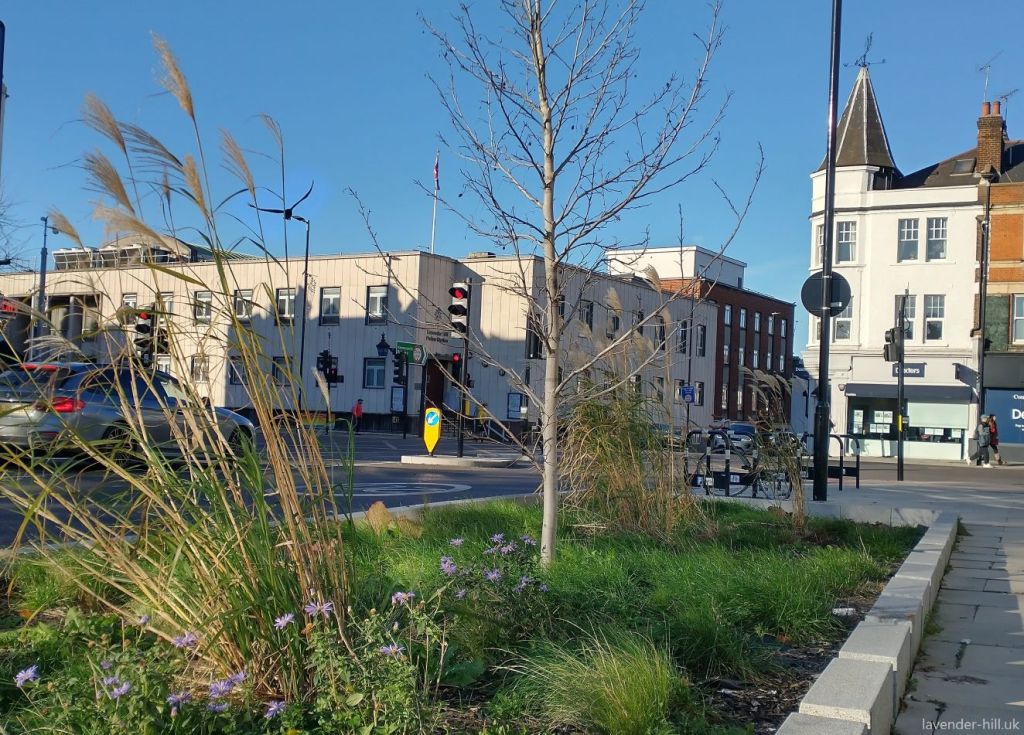
When it comes to the quieter eastern end of the ward we’re fortunate in that Lavender Hill happens to have an urban layout that, to use the industry jargon, is fairly ‘secure by design’ – with a main street which is busy more or less all night, and straightish side streets that mostly have a dense and close knit network of houses overlooking them on both sides, which aren’t too helpful to some types of criminal and which discourage some types of ambush attack. There’s also a pretty robust CCTV network covering all the main areas, and the Borough’s only full time police station – pictured at the top of this article – is of course right in the middle of Lavender Hill, not that our police team sit about there all day.
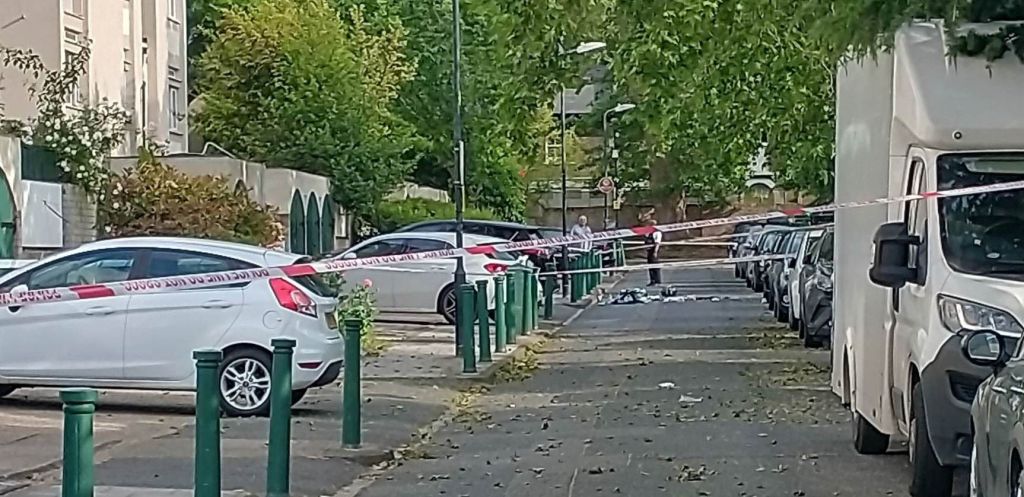
This isn’t a crime typology that’s out of control here, but there does seem to be a trend of lower level criminals, typically stealing on a sustained basis to feed addictions, gaining a local foothold and escalating their activity to the point where their level of violence goes up – we’re aware of some incidents where employees of shops on Lavender Hill have been attacked and suffered minor injuries. The attack on the Tesco delivery driver was unusual – although loosely similar cases have been happening for a while in and around Brixton, with a trend for e-bikes being stolen-with-violence from couriers.
Property crimes: burglary and theft
Daytime house burglary used to be the absolute bread and butter of our local crime statistics, as – being an inner suburb full of people who travel to work – a lot of houses and flats were conveniently empty all day, and full of interesting things to steal. Some houses were more vulnerable than others: those with overgrown passageways running to back garden gates were prime targets as the back access proved an ideal way to quietly gain entrance, force a back window open, snatch a few high value resellable items, and be gone before anyone noticed. The increase in working from home, maybe coupled with a slight increase in the security of many houses, has changed this a bit: old-school burglary is down to the extent that it doesn’t feature in the most-reported crimes, but we’ve seen a small growth in early-evening theft – as the darkness makes it easier to go for the obviously unoccupied properties. With lots of wider activity in the early evening the odd bang or crash is unlikely to make any neighbours’ ears prick as being suspicious. Terraced houses split in to flats are the best target, as they typically have a weak and under-secured front door which can be easily forced (probably fitted with the cheapest, nastiest lock the landlord could get hold of, and even where there’s a second lock that is more of a deadbolt, these tend not to be used as who knows if upstairs is in?). A good mule kick at the door will often open it, and once inside thieves can then take as long as they like to break their way through the internal doors to the flats. The ‘fake’ Deliveroo driver has been a recurring theme in some of the most recent Lavender Hill burglaries, who uses his uniform to loiter around keeping an eye on places to rob without attracting any attention, and more ingeniously, uses his large Deliveroo large backpack (sized to handle a large heap of pizza boxes) to hide the goods he’s robbed from houses.
Making property more secure. There’s plenty we can do on this front, and a lot of it relies on thieves usually looking for easy targets. A decent solid deadbolt lock helps, but you also need a solid door frame – adding a London Bar frame reinforcer costs about £25, and will avoid locks being knocked off. Keep hedges to a moderate height at the front of buildings as it’s a perfect hiding place, and where feasible ensure entrances are well lit. Old sash windows on ground floors need proper locks to stop them being opened too far – you can buy these for under £5 at Screwfix. Home CCTV cameras & smart doorbells can also help: they won’t necessarily deter masked burglars (no matter what the people selling them say), but they can make it easier to track people down. If you have a back access to a house you’ll want to make it awkward to get over, as a typical 6 foot fence can be easily jumped. Add a solid(ish) trellis – tactically chosen to be strong enough to stay put, but fragile enough that it will break and splinter if climbed on; a decent big motion sensor light can also help. But safety against burglary really comes in numbers, and neighbourhood Whatsapp groups – which emerged in the pandemic and have in many cases gone on to become the core of a new wave of Neighbourhood Watch activity, and are proving a key way to keep an eye on dubious characters and keep streets safe. If you see someone acting like a thief, they probably are a thief – and if you call our neighbourhood police team they can and do stop & search these people; many likely crimes have been nipped in the bud this way around Lavender Hill.
Meanwhile over at the more trivial end of the theft scale – parcels are, inevitably, the most commonly stolen item. Mainly because they’re really easy to steal with almost no risk – you just pick them up from the doorstep, where the latest overworked delivery driver has left them! It’s the bane of online retailers. The month or so before Christmas last year was a truly epic time when it came to parcels going missing, as our local crackheads found themselves like kids in a sweet shop, roaming round the neighbourhood picking up everything, and as they learned the delivery routes, following the drivers rounds to get first pick of the latest deliveries. Once it’s ripped open somewhere out of sight, the more sellable items passed on to shady middlemen for resale. Your parcel’s gone, and given your name and address was on it you’ll probably also pick up a Council fine for flytipping when the packaging (and maybe the contents, if it’s something uninteresting) are dumped a few streets away. Parcel theft tends to be the preserve of local, casual thieves but it does also attract a wider set of dodgy characters to the area; the pre Christmas period in particular saw a wave of increasingly organised parcel theft spread out all over London.
Dealing with parcel theft: The poor standard of some delivery companies amid a race to the bottom on pricing makes this difficult to sort out (though not everyone’s bad – and some of our readers will join us in a special mention to Steven, the most reliable Evri courier in the business!). Really all you can do on this front is get parcels delivered to parcel collection points to make this less of a free-stuff emporium for thieves (and we have lots of parcel shops who do this – Tesco, the Coop, Food & Wine at 8 Lavender Hill, to name just a few – who receive a small fee per parcel they take on our behalf). Some streets have arrangements to take in abandoned parcels for their neighbours if they spot them before they’re stolen. This is a minor and very under-reported crime overall, but reporting thefts is again helpful for police to spot trends and to try to encourage more responsible methods of delivery.
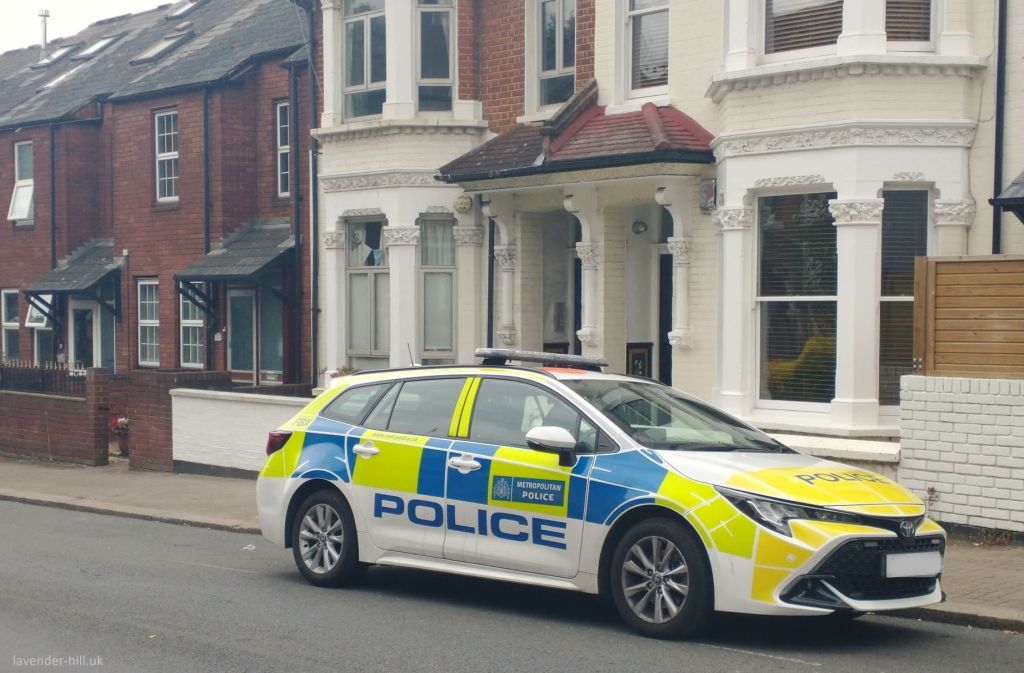
Phone theft is one type of crime that’s relentlessly on the rise, with about 80,000 “snatch thefts” in England and Wales in the year to March, a number that just keeps going up. This is an inner-London crime type, feeding in to quite a complex set of criminal networks. More high-value and desirable phones are sold on for their hardware – with a good number slightly ironically making it back to the somewhat dubious Chinese port of Shenzen, not too far from where they were originally made, where attempts are made to unlock and resell them, or failing that to strip them for parts. There are also attempts at data theft and extortion, based on what is on the phone – with phones stolen while unlocked being especially attractive if they allow quick access to banking or payment apps.
Keeping your phone: This isn’t a crime that the police can arrest their way out of – from the thieves’ perspective it’s easy money for very little effort or skill. A bit like car radios back in the late 1990s before the makers started building them in so they couldn’t be yanked out, the reward-to-effort ratio is really good! To some extent, pressure on the manufacturers to make their phones harder to re-engineer and resell will help, but that will take time to feed through to the market. For the time being situational awareness is everything when it comes to snatch thefts – resisting the temptation to get phones out on street corners outside stations – and all the ‘obvious target’ places you will have seen this crime in practice. That, and keeping an eye out on the surroundings. Put simply, if there are two people in balaclavas on a moped, it’s time to get the phones out of sight! But more generally, having important data and contacts backed up, and knowing how to lock and as far as you can delete content on the phone after a theft via Find my Phone is the best approach here. Our local police can and do recover stashes of stolen phones when they raid the premises of known thieves, and knowing your IMEI number (a unique code identifying every phone handset – to find it type *#06# on the keypad and note the number down somewhere that’s not on your phone) will make you a lot more likely to see your phone again if it is recovered.
Vehicle theft: A crime on the rise
There’s a lot of crime linked to parked vehicles. This splits in to two rather distinct types of crime, and types of criminal! Theft of cars is the one that attracts the maybe more sophisticated thief, where parts of London with high-value cars see groups scout out cars to steal, with a clear idea of what they are looking for. There’s not much point travelling to Lavender Hill to steal a Ford Fiesta when you can pick one up from a hidden away driveway in an empty house out in the suburbs and be off to the motorway or the typically edge-of-town chop shop in no time without going past any cameras or vehicle tracking systems. Instead Lavender Hill mainly gets on to the car thieves’ radar when they’re looking for high end cars, and frankly we have plenty of them parked on the streets. The stolen vehicles will be replated, hidden away in containers, and shipped overseas, or dismantled to service the high-value spare parts market. The cleverest thieves will swap the identity of a stolen-but-intact car for one that was severely damaged in an accident, and hey presto, nearly-new car without a history of being stolen. Keyless entry vehicles are still the preferred targets because they often have poorly designed security features that make them fairly trivial easy to steal, equipped only with some relatively cheap kit you can buy online. Range rovers were the absolute classic – chances are you’ve also seen them being chased around the streets with the police in pursuit! Despite attempts to make them more secure, the thieves’ technology continues to evolve faster than the vehicles’ security.
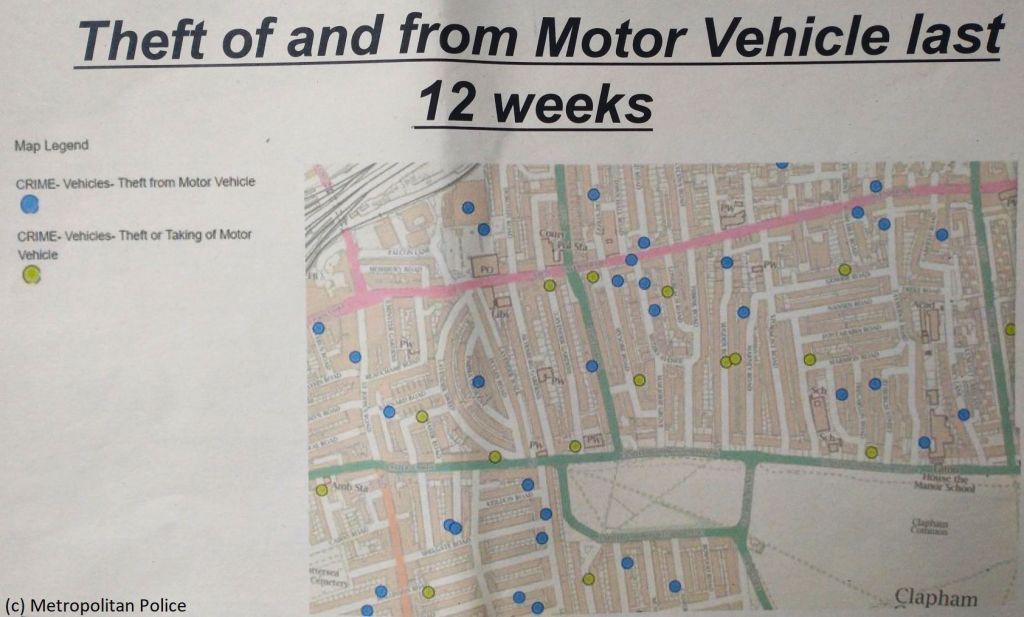
Vehicle theft across the country is up 35% since October 2022 – helped by the value of second hand cars also increasing. The map above shows the cars stolen in the area south of Lavender Hill over three months (16 of them) as green dots; it’s a similar story north of Lavender Hill. Bear in mind that vehicle theft, as a high value crime where insurers will be involved, is more likely to be reported than other crimes. London’s by no means the worst area in the UK for car thefts – that’s the West Midlands! – though it’s above average.
Motor vehicle crime, both theft of and from cars, is one of our local Ward police force’s top three current priorities. They have been using the patterns in reports and thefts to identify locations for patrols and potential offenders, while also doing what they can to spread the word about what we can all do to discourage this type of crime through social media and engagement with local residents.
Reducing theft of cars: Some of the obvious tactics to reduce car theft are to use a sturdy lock for the steering wheel (preferably a disc lock), pedals or gearstick, and have your car’s registration number etched onto the windows. These might be old-school deterrents harking back to the 1990s, but they’re making a comeback in the digital age, especially as a response to the weakening of cars’ own security thanks to ongoing problems with trying-to-be-too-clever keyless entry technologies. Thieves might pass on a car they perceive to be too much hassle. Another option is brake locks, which means if a driver manager to get in and start the vehicle, it is harder to make a getaway. Fitting a GPS / mobile tracking device won’t prevent a vehicle from being stolen, but it will increase the chances of it being recovered before it’s gone for good. Thieves leave a stolen car somewhere else in London for a few days to see if it gets recovered – if not then there’s probably no residual tracking on it. We’ve heard of vehicles being stashed away in all sorts of places, even including private underground parking garages in east London! These devices aren’t just for high-end cars: most vehicles stolen & recovered are worth less than £20,000, with about a quarter in the £5,000 range.
Some vehicle crimes are falling. A few years ago it was all about catalytic converters being stolen – with some makes and models being especially attractive: Toyota Prius & Auris, Honda Jazz & CR-V, and Lexus RX were unlucky enough to have easy-to-access converters; and hybrid cars were also popular for theft as the converters tended to be in better condition. This was mainly but not entirely a suburban crime, with much less of this here than in outer boroughs – and it seemingly peaked in 2020 when the Metropolitan Police investigated 15,000 reports across the city. The rate of theft has dropped steeply since as metal prices have fallen and other crimes have proved more attractive, and is down to 200 or so cases a year across Wandsworth, well under than half what we were seeing a few years ago. There have also been a few fairly isolated cases of components being stolen from cars – from bumpers and lights to steering wheels and airbags – again to supply the parts market.
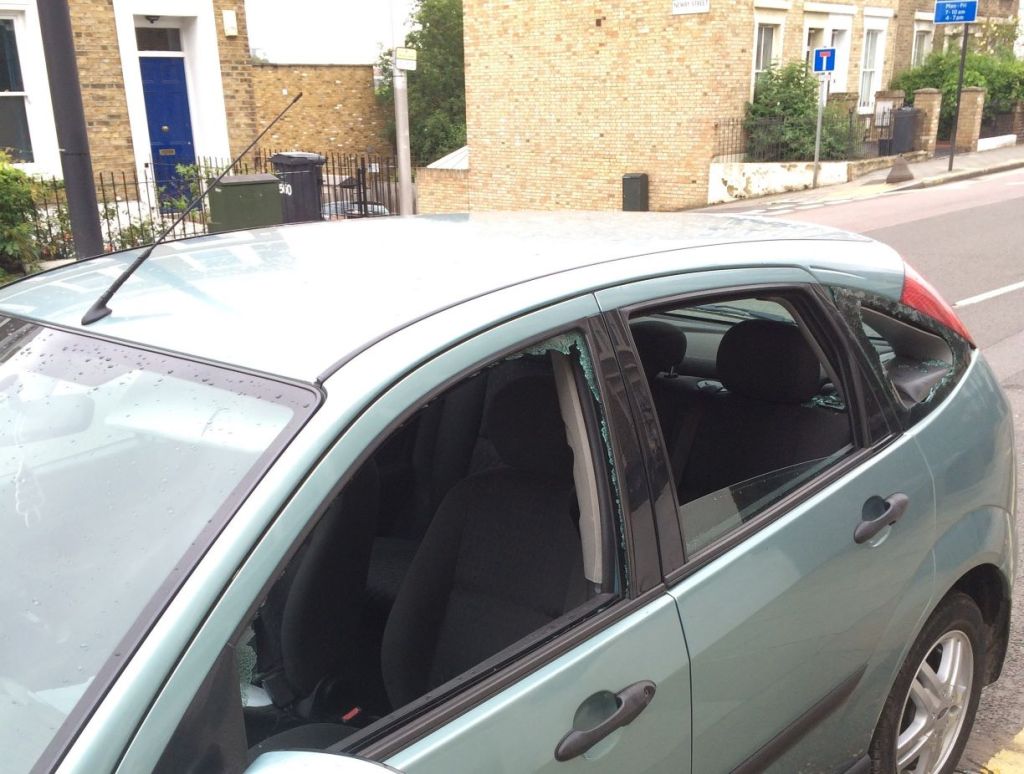
The other type of vehicle crime is theft from cars. This one’s not feeding in to complex networks moving cars and parts around Europe, it’s just the local addicts spotting interesting things left in cars and breaking the windows to get them. They also walk the streets in the early hours seeing if doors have been left unlocked (and they surprisingly often have been!). The damage will usually cost more than the value of what’s stolen.
Reducing theft from vehicles: There’s very little that the police can do on these crimes – but there’s something very easy that we can do – in particular, not leaving things on view in parked cars! It’s staggering how much is left on display. Even junk stored in a car can look potentially interesting to a crackhead in a dimly lit street at 2am. If you really can;t avoid leaving things on view, choose your parking space carefully, because some areas are worse than others – the ends of streets where the front windows of the houses don’t face the parked cars are particular hotspots and occasionally see daytime as well as after-dark theft.
Antisocial behaviour
Antisocial behaviour is a small but persistent type of crime here, centered mainly in the busy streets around the station but with some incidents also scattered around the whole of the ward – mainly tied to aggressive behaviour, open drug dealing and use, and occasional incidents like someone setting fire to one of our corner shops in the middle of the day that could have led to major damage and maybe loss of life if it hadn’t been caught in time. The area round Battersea Arts Centre has sometimes seen problematic late night activity, and there were also problems linked to the ‘stolen bikes’ encampment in the Asda car park, which is unsecured at night and where the owners struggled to keep the site safe after hours, though this has now been moved on.
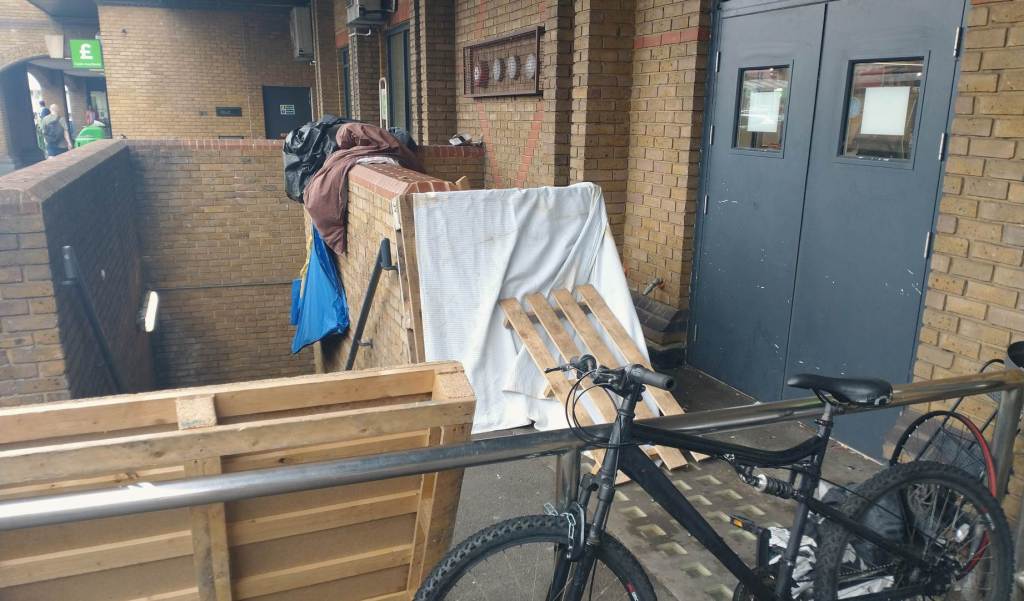
These aren’t especially easy cases to solve, as they often have at their root cause a cocktail of alcoholism and wider addictions, and mental health challenges, which are a difficult societal problem to solve, and go well beyond the capability of our police team or indeed the scope of this article! But making the streets a difficult place to behave badly does work and moves people on to less well managed bits of town, and keeps our town centre a good place to live and do business. Our local police team are currently prioritising work to tackle antisocial behaviour in the ward, especially that linked to a group of known beggars who work outside Clapham Junction Train Station, along St. Johns Road and St. Johns Hill. The main focus is high-visibility patrols to their favoured locations, and using the relatively broad legislation to issue warnings, Community Protection warnings and Community Protection Notices. As a resident or trader, the key thing is to feed in reports and intelligence, as this is what gives them the ability to act and to focus efforts!
The challenge for retailers
The last two years have seen a rapid, and concerning, escalation in the volume of retail crime, right across the country: shoplifting, threats and violence against staff, outright looting of stores. We’re not talking about people pocketing some food while struggling to survive – we know this exists and that it’s grown a bit as the economy has gone south. What we’re seeing here is active, large scale theft, with violence and weapons, being run by well-organised criminal networks – people bringing big holdalls in and stealing the entire stock of meat or coffee, or holding the staff up at knifepoint while they raid the entire stock of cigarettes and spirits, that sort of thing. The rate of theft has reached the highest levels since records began 20 years ago,
It’s an issue that has gained nationwide attention, and become a priority for the government. A previous downgrading of the way shoplifting was treated saw thefts with a value under £200 would treated as a new “low value” crime category. Theresa May, then home secretary, hoped this would speed things up and allow police to deal with these offences by post. It backfired rather spectacularly, because it meant most police forces deprioritised shoplifting – not really bothering to get involved in ‘small’ thefts even if there are several of them an hour by the same people. And if there’s one thing we’ve learnt, it’s that crime will focus on whatever is easiest – and the deprioritising of these offences has been described as a ‘shoplifters’ charter’! Once criminal networks realised this was an easy way to free money, on a high street near them, the staff on the front line were left to deal with a huge rise in organised groups stealing repeatedly and in bulk, and with ever growing violence and threats as they did their best to stop it. There are, finally, some moves underway to reverse the ill-judged changes, including making violence against shop workers a specific new offence and rolling back the £200 threshold, but this will take time.
Wandsworth’s statistics for retail crime echo the nationwide trend with it doubling (although still lower than both the London average, and the average for similar inner suburban Boroughs), although as ever, staff have a business to run which means only the most serious cases are reported.
We have, for years, reported on our local retailers, and we’re well aware that many of them have found themselves as unwilling front line participants on this wave of crime. It’s a cost, a stress, and a risk to our traders. We’ve seen persistent thieves targeting shops several times a day, staff in Sainsbury’s threatened with knives, gangs running into the Coop to grab whatever they can, aggressive thieves fighting with the security at Asda, staff injured with tools and sharp implements when they tried to stop thieves, people running out with boxes & baskets stacked with bottles of wine, coffee, energy drinks, you name it. One boy was robbed at knifepoint inside one of the supermarkets! Security costs money, but without it our traders are rather at the mercy of whoever walks through the door.

There has been action by retailers to try and stem the tide of crime. The area round the station has a coordinated security presence between the shops, with a communication network linking different store security teams and professional guards, which is pretty good at spotting, tracking, and catching persistent thieves – the likes of T.K. Maxx’s security don’t muck about! Inside stores, CCTV has been hugely upgraded to include facial recognition and flag thieves to staff, higher value items are no longer out on the open shelves, easily resellable items like spirits, wines, coffee, powdered milk, steaks and cheese is increasingly locked in boxes or tied up in security nets, doors are sometimes on timed entrance arrangements, aisles are adjusted to make it easier to see what customers are doing, security are more visible and there for more of the day… but this is not an easy problem to fix while stores are on their own.
This is all mainly an issue for shops but even in the cafes we’ve seen some lower-level issues, both on the theft and the antisocial behaviour front – whether the case of the man pictured above who broke in to nine different shops after closing time over a few weeks, mostly by forcing the doors, or the somewhat disturbed man who tries to walk away with the tip jars in our Cafes! As we’ve reported previously, a late night theft was the final straw for local Cafe Social Affair. Even a hairdressers on St John’s Road has seen someone walk out with the entire stock of hair straighteners.
This is not an easy problem to solve – but things could be improved – with tougher sentencing to remove the ‘free for all’ on shoplifting as a good start. As ever, some of it is a sign of deeper and more intractable problems – it’s been estimated that about 70% of shop theft is committed by frequent users of Class A drugs who are stealing to fund a drug addiction, and as a result the crimes they commit – including persistent and high-volume theft – become more volatile, desperate, and potentially violent. Effectively tackling this group of repeat offenders would have a large impact on reducing retail crime, and its pervasive impact on society.
A case study: The Co-op’s headache with retail crime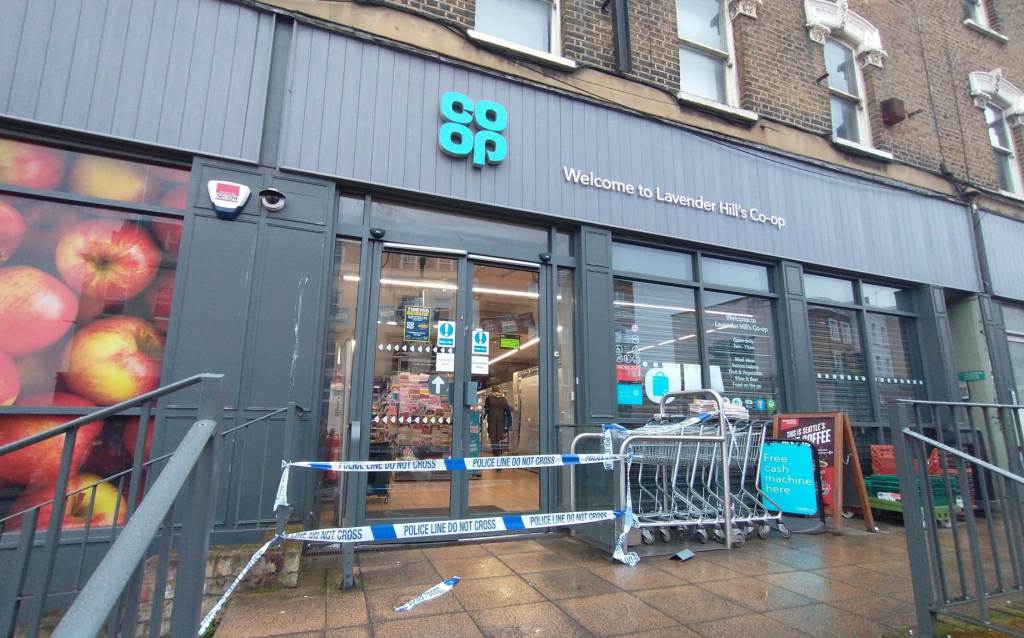 The Co-op’s managing director Matt Hood has been a particularly high profile campaigner on the issue of retail crime, and on what could be done about it. His network of 2,500 stores lost seventy million pounds to shoplifting last year; the Co-op recorded 336,270 incidents of shoplifting and anti-social behaviour in 2022, not far off 1,000 cases a day. He’s been campaigning for shoplifting to be taken more seriously by the government & the police, pointing out that 80% of reported incidents result in an arrest in Scotland (where thefts under £200 aren’t ignored), compared to just 10% south of the border. He’s especially concerned about the impacts on his employees: every day four of his team are attacked and a further 116 colleagues are seriously abused, and a lot of staff we know feel unsafe at work. Lavender Hill’s Coop is fairly calm by the standards of the Co-op nationally – but it’s still had plenty of incidents, and is a good example of how the growth in shoplifting is affecting our businesses. It’s been open a few years, and it’s your standard suburban supermarket – clean and tidy, a decent mix of fresh food, a small bakery offer, coffee machine and cash machine, all the usual staples, helpful but overworked staff. It’s what would expect – not cheap but decent and convenient, open long hours, a neighbourhood supermarket with a bit of an ethical focus, employing staff who mostly also live quite locally. The internal layout of this branch has been a bit of a headache from the outset, as it makes it hard to manage: self service tills on one side far from the door, the service kiosk is out of view of some of the tills, a big structural column means you can’t see the door from the till, meat is over at the opposite corner, coffee’s in the middle, alcohol is in an alcove invisible from almost every angle (for those who know the store: the underlying shape of the premises is square and sensible, so why the designers didn’t put the kiosk to the right of the door, with the tills at the back right, and the higher value stuff opposite in sight of them, is a bit of a mystery). Non-frosted windows behind the till area allow ne’er-do-well to check staff locations from the outside. It tends to be slightly understaffed, with 2-3 people on duty managing the stock deliveries, the counter tills, the Deliveroo pickups, the parcel collection, the self service alerts, and facing up the shelves. The strange configuration, coupled with low staffing levels, means the team do their best but just aren’t able to keep an eye on who is gaining access and what they are doing. There are regular thieves who run out with baskets full of things they can resell, and there have been some cases of groups swarming the store to take as much as they can. A young local woman who’s visibly addicted to meth runs out with stacks of meat, and sells them (in direct sight of the store) on to a man waiting on a Lime bike just down Ashley Crescent, who presumably goes on to resell it to the more dubious takeaways – and the staff may not even notice until they spot the empty shelf. The most consistent headache has been the small groups of aggressive people – the same ones who cause trouble around the station – who steal what they can and get violent when confronted, which has led to staff being hurt, luckily not seriously. Our store even made the national news after one incident last year, of a man brazenly stealing a huge bag full of alcohol and being aggressive to the staff, was caught on camera. Ultimately these neverending incidents really wear down even the most enthusiastic store teams, and it’s to the staff’s credit (here, and in the other supermarkets who also see plenty of this) that they continue to run a decent shop in the face of all this. Head office is well aware of the issues affecting the chain, and has taken some action to help our local store. They’ve invested in much better CCTV, and in a headset communications system so the staff can communicate and tip each other off – as well as their on-call security service – if someone looks like trouble. As others like Tesco have done, they have fitted a secured till area with locked access, so that staff are safe in the evening and to keep the highest value stock – cigarettes, vapes, spirits… – somewhere it can’t be snatched if the staff are elsewhere. This has had some success (though there was one raid where the staff were held hostage and had to hand over the behind-the-tills items). Other stores in more crime-ridden locations have also seen live-streaming body cameras (which were apparently quite effective), and hidden safety call devices for the staff. What they haven’t done on Lavender Hill, despite the store’s staff asking repeatedly, is provide any form of visible door security guard. The Co-op only have a small security provision, and they treat it as a ‘flexible guarding model’ and focus it on the busiest and roughest locations. Security guards only have limited powers to stop thieves but if they are qualified and insured they can be very effective; the Co-op’s own security guard team – some of whom are undercover – detained 3,361 criminals last year. But put simply, other branches have more problems than ours – we just don’t see enough trouble to have security. This is in stark contrast to Tesco, Asda and Sainsbury’s who have security most of the time, and it makes the Co-op peculiarly vulnerable. The Co-op’s somewhat unusual security arrangements are explained in some detail in a note they provided to Parliament recently (16-page pdf): they have a camera and headset call system to a specialist back office organisation, run with security form MITIE, who can start watching any incident in real time, bring in the police, and communicate directly via the store’s loudspeaker system, and assemble a full evidence pack for prosecution – which sounds great, but the fact that there’s a remotely based set of security experts on the cameras doesn’t make you feel much safer when you’re out on the floor alone on a late shift hoping trouble doesn’t come through the door. Remote monitoring just doesn’t give the same deterrent to trouble as a big tough-looking guard on the door with a security pass on his arm who recognises trouble when he sees it and knows who’s not allowed in! The impact of this spills out on to neighbouring streets, as the Co-op’s low-security branches become a sort of magnet for ruffians from far and wide, and support all manner of illicit trades. It’s all frightening and demoralising for staff, and it’s putting the viability of our local shops in danger. Our branch has its problems, and it really needs a sustained security presence. But it’s one of the ‘good’ stores: the Coop’s nightmare elsewhere in the country is severe. Not far away, the Co-op by Battersea Bridge saw an average of at least one police-reported shoplifting incident every day over the three months from January to March. We understand other stores are much, much worse, with some in Stockwell and Camden – but also in some far flung suburbs – struggling to even keep the shelves stocked because theft is so high, and the stock system doesn’t know what to replenish. And while the Co-op has some specific challenges linked to its idiosyncratic security arrangements, chances are similar stories are currently playing out at your nearest Tesco Express, Sainsbury’s Local, Asda Express or corner shop. We can’t go on like this. |
Our local police team
The good news is that we have a proper local police team looking after Lavender Hill! Sometimes they’re bobbies on the beat, sometimes they’re out there more subtly – but they are there. We’re lucky to have a small team for each ward, who have a good local knowledge and tend to know a lot more than you think about what is going on behind the scenes.
The area south of the street, including Clapham Junction, is covered by the Lavender Ward police team, made up of Aneka Jones (Police Sergeant), Emily Hale (Police Constable), Simon Sadasivan (Police Constable) and Syed Rahman (PCSO). They hold regular opportunities to say hello and compare notes. The Lavender team is hosting a Cuppa with a Copper at Pique (the local supplier of quality coffee & food that we’ve reported on previously), at 171, Lavender Hill. It’s running from 1-2pm on Monday 30th September 2024, with another on Tuesday the 1st October. They also have a Whatsapp group for the community, which is a broadcast of useful information rather than a place to report crimes!
Most of the area North of the street is covered by the Shaftesbury and Queenstown team, made up of Steven Hales (Police Sergeant), Charley Shearing (police constable) and Sophie Chin (Police Community Support Officer). They also have a drop in meeting, over at Cafe Santacruzense, 4 Condell Rd, Nine Elms, London SW8 4JA, at 11am on Friday 27th September.
In both cases the key point we’d stress here is – please report crimes and concerns! The teams are keen to help and they value the input we make, and submitting reports is straightforward to do online. Reporting smaller crimes may feel like a waste of time, and you may well get an automated ‘there was no follow up and the case got closed’ after a few days (or even, in some rather unusual cases where third party reports have bene fed in, a note that says that ta report couldn’t be acted on because the victim was unknown) – but that doesn’t mean that the input hasn’t gone to the team and been noted and used, and it does matter. Our police don’t usually just steam in and throw the crooks red handed & toss them in jail – they build up evidence and case information, and if and when they get enough to secure a conviction, they pounce. Unless we feed in the smaller crimes, there’ll be nothing to go on when it comes to the big crimes.
Quarterly Ward Panel meetings are another key moment for our local forces. They’re usually an in-person meeting in the early evening, but sometimes with an additional dial-in option. They’re an opportunity to meet the team, hear what has been going on behind the scenes, share constructive thoughts and concerns from the perspective of the people who live and work in the area. They are also a chance to agree vote on should be the priorities for the next three months. There’s not enormous room for manoeuvre – the results tend to be a mix of police team and resident priorities rather than “finding out who stole my bike” – but they are the place where our police see what matters most to us. They are usually joined by our local Councillors, as well as Council representatives for relevant issues – recently the focus has included antisocial behaviour / theft / criminals in the streets, the problems of theft and violence affecting some of our traders, and wider activities that could maybe help address ongoing challenges such as the Lavender Hill rough sleepers hub and how it will be managed. If you’re interested in learning about what’s going on, feeding in your thoughts, or just showing support for the rather thankless tasks a lot of our police teams do day in day out, we’d encourage you to attend these.
The Lavender team’s next Ward Panel Meeting is imminent – it runs from 6:30PM – 8:00PM on Thursday 19th September 2024, at Battersea Arts Centre. No need to book – just ask for the room at reception. To contact the local team and be added to their mailing list for future events, use the form here or email lavender@met.police.uk .
The Shaftesbury and Queenstown team’s next Ward Panel Meeting is also from 6:00PM – 8:00PM, Thu 19 September 2024, at the Church of St Nectarios (just north of the Dunston estate). To contact the local team and be added to their mailing list for future events, use the form here.
Crime isn’t a topic we normally cover, but we thought this one-off post might be of interest to our readers, and encourage participation in local police engagement and activity. This 7,200-word article is far longer than our usual posts, bur it’s still barely skimming the surface of this complex and multifarious topic; and we’re well aware that we’re talking about the effects, rather than the causes, of crime – where poverty, addiction, mental health, societal challenges and more all play a role. We’d welcome your thoughts on the issues covered here – contact the authors via the form here. And if our wider coverage of very local issues including retail developments, local businesses, housing projects or local history in the Lavender Hill area of Battersea is of interest, do sign up to receive new posts by email.
 Lavender-Hill.uk : Supporting Lavender Hill